Into The Highlands
pp. 19-101 · Read in the full issue

[?]Er The Divide And
In the last quarter-century, exploration has added the Highlands of Papua and New Guinea to the Pacific world —but as a Pacific world apart.
NLY one island in the Pacific has presented problems of exploration on the grand plan— d that island is the mainland of New Guinea, hen PIM first appeared, 25 years ago, a vast iount of exploration had been done but it had, it were, only nibbled Papua and New Guinea )und the edges or cut narrow corridors by lated patrols. The vast interior remained a ; question mark.
Now, in 1955, the question is pretty well swered; aerial surveys have shown what is there, the remotest mountain valleys, even if Euro ms have not had actual physical contact with their inhabitants. So far as the magnificent ling grasslands of the Eastern and Western dilands are concerned—these now arc open to ropeans and European settlement.
Their discovery, exploration and settlement /c been partly chance, partly deliberate. Gold, ape, oil, and the P-NG Administrative policy bringing the whole Territory under “control”, /c all played their part. Before 1930, most )ple believed that this central portion of the at island was a tangled mass of inhospitable untains.
Discoveries in the last quarter-century have •ved that it is far otherwise; have added >bably 500,000 people to the known 1930 ive population; and shown that there are at st 26,000 square miles more of habitable intry.
Early explorers, returning from the area, all 1 one thing to say: it was a wonderland— illy different from anything else in New inea. Colin Simpson in one of his books ms flying from the coast to the Highlands a drink of iced hock after partaking of warm p. Certainly, although there are affinities ween Highlands and the rest of the Territory, re are few with the rest of the South Seas, egion typically one of coral island and atoll I sea-faring natives. In this respect the High ds are a world apart.
Let us then first look at them, as they are in this year of 1955.
Although, in the last few years, there have
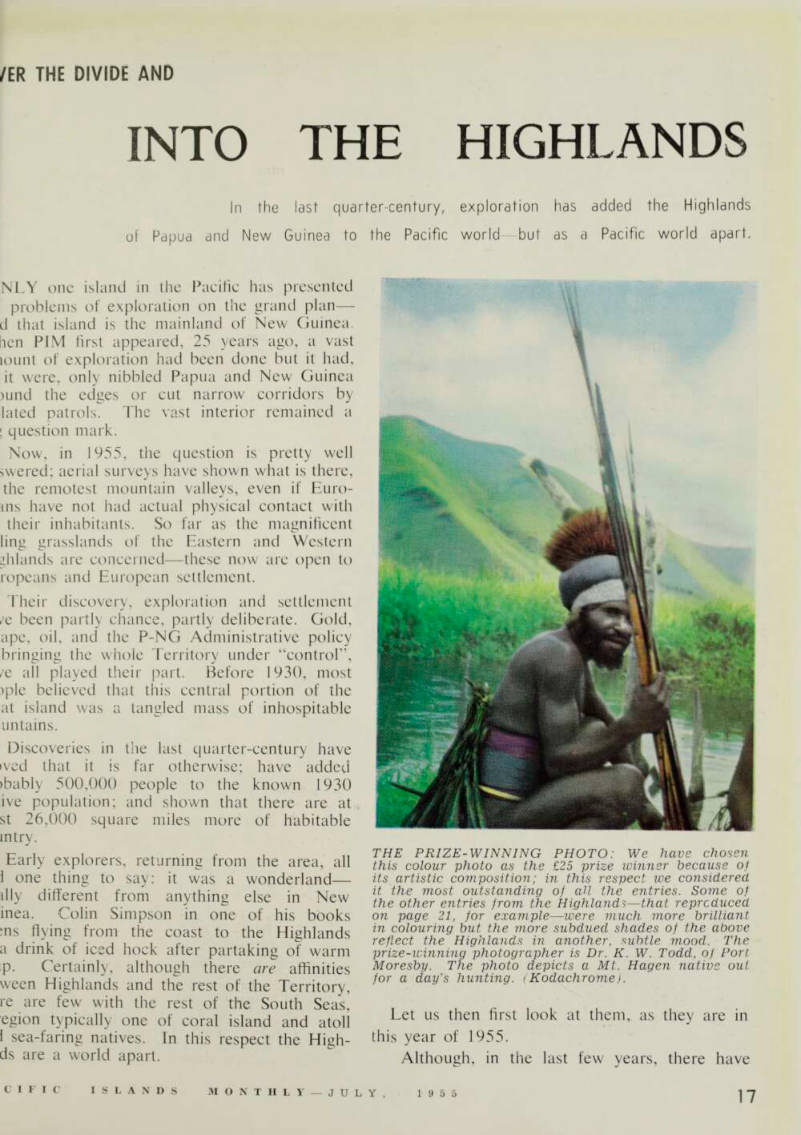
THE PRIZE-WINNING PHOTO: We have chosen this colour photo as the £25 prize winner because of its artistic composition; in this respect we considered it the most outstanding of all the entries. Some of the other entries from the Highlands—that reproduced on page 21, for example—were much more brilliant in colouring but the more subdued shades of the above reflect the Highlands in another, subtle mood. The prize-winning photographer is Dr. K. W. Todd, of Port Moresby. The photo depicts a Mt. Hagen native out for a day’s hunting, (Kodachrome).
Bn 230 miles of roads built in 3 Highlands—from Mt. Hagen in 3 west, to Gusap in the east —the ly connection with the coast is 11 by air to either Lae or Madang. ■loads to link Madang and Lae :h Gusap, and thus with the rest the Western and Eastern High ids, are planned, and at places * underway. But the task of dging the hundreds of rivers and ieks that will be encountered is Ddigious, so it will probably be ne years yet before air transport superseded entirely.
Driginally, the whole Highlands la was called the Central High ids: more recently it has been ided into the Eastern Highlands, t h District Headquarters at roka; and the Western High ids, with Headquarters at Mt. gen. Both these areas are now mtrolled areas.”
Adjoining them to the South, and oily within the Territory of pua, is the Southern Highlands ;h headquarters at Mendi. This an uncontrolled area, civilisation ng restricted to a few miles >und the patrol-posts, where ministration personnel and a few ssionaries live.
Dotted all along the valleys that ke up the Western and Eastern are air-strips—a few of im capable of taking DC3 air .ft; the rest restricted to small craft. There are airstrips also Mendi and Tari in the Southern ?hlands, which depends on air nsport for all supplies—no roads d to this district from East or 3st Highlands, or from the Papuan ast although patrols have been •ough.
Vpart from air transport, the stern and Western Highlands are w linked by the road which was lit entirely by hand labour sup ed by the local natives equipped ;h nothing but shovels, picks and Tying baskets. Bridges—some of im hair-raising in their simplicity vere built by local contractors for fraction of the price quoted by blic Works Department. One day October, 1953, Mick and Jim ahy and Jim Taylor made the >t journey in a jeep, from Goroka Mt. Hagen in a day—a journey it had taken Mick and another >ther, and Taylor months to iomplish in 1933. mid-way along the road — I miles from Gusap, and 130 miles m Mt, Hagen, is Goroka, the only m in the three Highlands dis :ts. European tea and coffee .ntations and farms of various aensions exist both eastward and stward of Goroka—but Goroka is Highlands metropolis, risen from ! green grassy plains in less years in you can count on one hand, t has a European population of iween 400 and 500; European res and a freezer and native de stores: a hotel—which is the :cca of every lowland inhabitant o wants a few weeks cooling off the Highlands: a swimming pool
and paddling pool; an airport (of course) and a £30,000 hangar; a European school; a corn-mill; a processing plant (the passionfruit are grown by local natives, and the pulp 15 alr " freighted to Lae and sent as refrigerated cargo to Australia); and a club and any number of new bungalows.
On the heights above, is a sawmill—for one thing that these wonder-valleys have not got is timber close-by. The valleys are
oPfafuarinas-but “o rell® timber.
This imposes a domestic problem because firewood is all but totally absent. Before Europeans came, these grassy valleys were the traditional “fighting lands.” The
natives themselves lived higher up the mountains.
The tree-denuded valleys and foothills have been the scene of a vigorous tree-planting campaign in the last two or three years. Millions of see dling pines—Klinki and Hoop pine from Bulolo—have been dis tributed to the natives at the be ginning of the wet season, and planted. In years to come it is hoped that the Highlands will be a land of pine as well as of casuarina groves. ° ut alon « the roads are the f ” ms °f t^le European settlers. Here they are growing coffee and corn, Euio pean vegetables and flowers. The coffee is for the Australian market; the vegetables and flowers find a
ready sale when air-freighted out to the coast.
The natives, too, have been en couraged by agricultural extension officers stationed locally, to grow coffee, passionfruit and vegetables.
European potatoes, peas and other vegetables that do not grow on the coast flourish in the Highlands—as do gladiolas, roses, strawberries and other temperate zone oddities.
Men who were famous in the days of Wau and Edie Creek have for saken goldmining to grow cabbages and coffee and corn in the wide, blue-mountain-rimmed valleys that stretch, between Kainantu and Hagen, at between 5,000 and 6,000 feet. Someone has described the climate as “rainy-springtime.” The annual rainfall is around 80 inches —the driest months corresponding to the Southern winter. Days are warm; nights can be chilly and it is always comfortable to sleep under blankets and perhaps an eiderdown-quilt. Log fires can be a cheering sight at night.
European cattle do well, although certain supplements to the indigen ous grasses are usually believed necessary. Pigs flourish and sheep do well enough if maintained in small flocks. In spite of the large scale introduction of Romney Marsh sheep at the Hallstrom Trust Ex perimental Station at Nondugl, in the Wahgi valley, it has yet to be
proved that this is good sheep country.
As the natives come more and more into contact with the Euro pean settlers it is inevitable that they should be influenced in custom and dress. One sees, now, the lap lap and cropped hair on some of the men; occasionally an un beautiful “mother-hubbard” on a woman. But the majority of the Highlanders still live in much the same style as before they were dis covered; the greatest difference in their lives comes from the prohibi tion on tribal fighting. The greatest social experiment was the decision to permit Highlanders to go to the lowlands of the Territory to work.
The first Highland labour to go down to the coast came from around Chimbu, an area of great population density. Thereafter, all Highlanders working on the coast became known as “Chimbus” whether they came from there or not.
They go for a maximum period of 18 months and under rigorous health safeguards. Working on the modern theory that malaria is an entirely preventable disease, people employing Highlands labour are re sponsible for seeing that these people do not contract it. Before they leave the Highlands, they are TB tested and inoculated and on their return they spend some weeks
in quarantine before they are pen mitted to return to their homes f Progress in the Highlands ha£ been speedy in the last five years - For the 20 years before that it wat slow—very, very slow. Two facton were responsible—the murders o: three Europeans in 1934; and thi Pacific war. Now, let us see some thing of the Highlands when the* first stirred from their stone-age slumbers. ♦ ❖ * WHEN Captain Hermann Detzneu of the German administrative service in New Guinea, firss heard of the outbreak of war ir 1914 he immediately took to thu bush. At the time he was at Mtt Joseph, in what is now the Morobfi district, and not far from thu Papuan border.
For four years thereafter, ho strove unsuccessfully to bre a H through to neutral territory—Dutch New Guinea. And in the course; of his wanderings, he traversed the great central plateaus and rich valleys of New Guinea as far west as Mt. Hagen.
After the war he wrote a book: in German, about his wanderings {Vier Yahre unter Kannibalen-y- Four Years Among Cannibals).
It was never translated into Eng* lish, so few knew of his discoveriel and those who did, discounted then!
He has never been given adequate
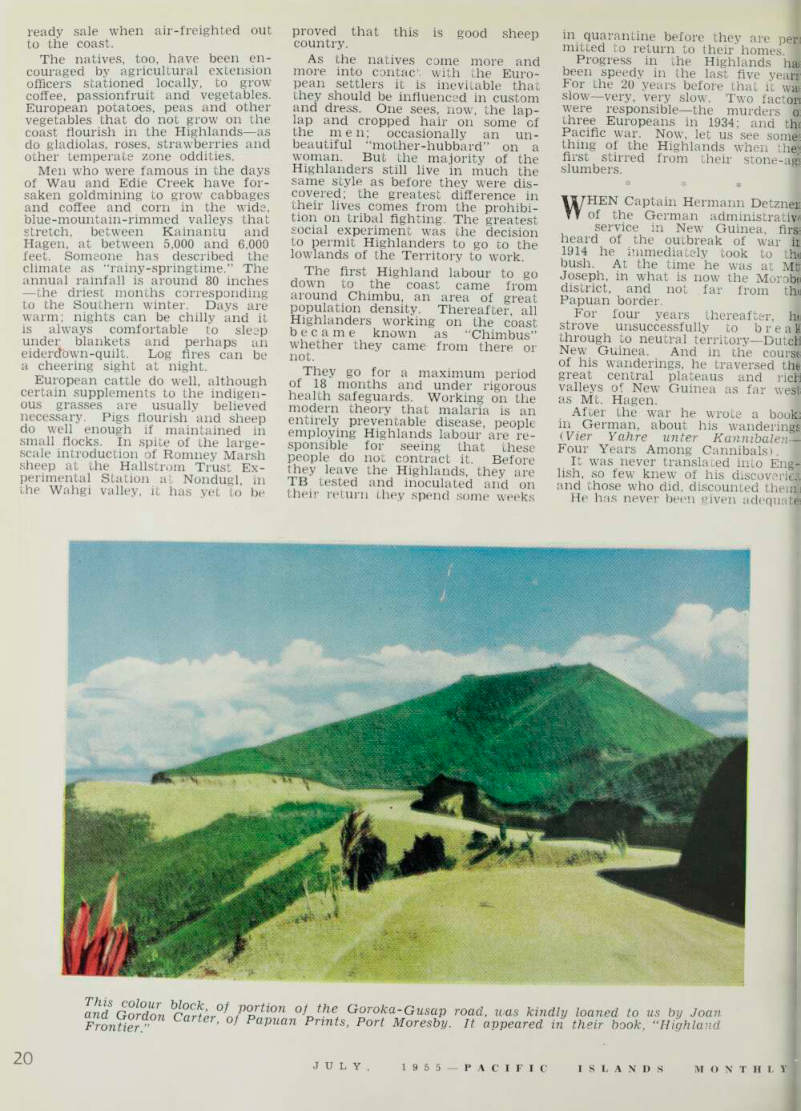
This colour block, of portion of the Goroka-Gusap road, was kindly loaned to us by Joan and Gordom Carter, of Papuan Prints, Port Moresby. It appeared in their book, “Highland Frontier".
[lit for them, but it is obvious m iiis book that he accurately cribed the Purari-Ramu-Mt. jen area and that he penetrated at least 15 years before the hys. [e stated in his book how he ed some day to be able to prove t the headwaters of the Purari e in New Guinea, and not in pa as the British maps showed; that “instead of uninhabitable intain wildernesses, there was a agricultural district of wide, i valleys inhabited by tribes of litic type.” aptain Detzner never did realise hope, but others, years after ds, proved that what he had ten was correct. l 1926-27, from the Papuan side, rles Karms and Ivan Champion le an abortive attempt to cross ua-New Guinea from the Fly :r to the Sepik River. In 1927-28 tried again, and this time suc ed. This was purely a prestige ol —as Sir Hubert Murray, then t.-Governor of Papua, said: it to be done some day and it unthinkable that men other i from the Papuan service would t. the course of this marathon they discovered that the Fly Sepik rose within a few miles ach other and on their way ugh New Guinea they reached fomin, plateau country at an ide slightly under 5,000 feet, h is the logical extension of the •al plateau country west of Mt. in. This country is not, to-day, ded in the Highlands districts idministrative purposes (or the that is published with this le), but is administered from ak in the Sepik District. 1935, the Jack Hides-J. O’Malley >1 penetrated part of what is the Southern Highlands Dis- Again this was a Papua flag ing patrol and Hides described i his book, which he called an Wonderland. this patrol, apart from the areas of population which they 1 in the Tari and elsewhere, discovered the source of the ri River which flowed for reds of miles to discharge into julf of Papua, a preface to this book, Sir rt Murray wrote: “The country rsed is too far from the coast too difficult of access to admit agricultural development by jeans. . . it must remain un oped.” aerally, Sir Hubert is still right, t is anyone’s guess how long dll continue to be so. Head ers for the new Southern High- District were set up at Mendi 50—15 years after Hides first through with his tiny patrol, ib-station was established at some time later. The natives jnmitive and still engage in wars. was here in this district, near that Mr. John Zehnder found
the so-c ailed “Hidden Valley” in May, 1954.
This event, and the aerial survey that was made by the Director oi Civil Aviation, P-NG, and the Director of Dis trict Services shortly after wards caused a world - wide sensation. The valley was dubbed Shangri- La, the Hidden Valley and other fanciful titles; newspaper corre spondents clam cured to be allowed to go in to write the first reports for out si d e consump tion: moving picture com panies wanted to fly in (although there was no aerodrome) and take movies for a sensation hungry world.
Zehnder, 28, a geologist with the Australasian Petroleum Com pany, entered the valley while on a four-months patrol of the Tari and Strick -1 a n d area.
Zehnder started off with another geologist, a field assistant, a large party of native police and carriers, and accompanied by A d m i nistration Assistant Di s trict Officer Clancy.
During the trip, Zehnder, a handful of native police and carriers, went off to have a look at the Muller Range area and later returned to the main party after having stumbled into the hidden valley, which, Zehnder revealed, the natives named Lavina.
This was just before the combined DCA and District Services survey flew into the valley and reported its existence.
The report of the air survey was released before Zehnder returned to civilisation, and while newspapers and movie-makers were screaming to be allowed to go to the valley, Zehnder returned and announced that he had been in and had seen all for himself. He denied that the natives were 6 feet 8 inches tall; or that there were 100,000 of them in the valley. He said the number was likely to be 3,000 and that the
people were like the neighbouring Tari people—they wore hair wigs, decorated wffh purple and yellow flowers and had contact with the areas outside the valley through a mountain pass 7,000 feet above sea level.
Although the discovery of the valley was a sensation to the out side world, as far as the P-NG Ad ministration is concerned, it is just one of many so-far-uncontacted pockets of native population tucked away in the valleys and over the mountain passes of the great in land region. The white man’s con cept of government and justice will be brought to these people sooner or later.
These foregoing patrols and con tacts with the Highlands were, in effect, isolated incidents. It was the Leahy brothers, Mick and Dan, and James Taylor, an Administration
This magnificent fellow is a Waghi Valley Tul-Tul (Administration-appointed headman) dressed in his best. Besides his head-dress of Bird-of-Paradise plumes, he has eight pieces of shell plus a King of Saxony plume in his nose. He has two pieces of shell suspended around his neck; on his forehead can be seen the round medal-like object that is his badge of office. Photo by the Rev. Michael E. Bodnar, SVD , of Goroka, NG, to whom goes an award of £5. (Kodachrome).
leer, who made the Highlands a ictical proposition. 1 1930, Mick Leahy, with his partner, Mick Dwyer, looking for another Edie Creek, set off up Markham from Lae and over divide into the Ramu. They n crossed the mountains to the Lthwards and started down the srs, following elusive colours of d. Finally, they bought canoes
from none-too-friendly natives and followed a large river down, eventu ally to emerge, after weeks, at Port Romilly, on the Gulf of Papua. If you look at a good modern map of Papua and New Guinea you will see what an amazing journey this was —two men, a few scared lowlands natives, left entirely to their own resources amongst the tangled mountains, hostile natives, and swiftly flowing streams of the New
Guinea inland.
Their journey proved what Detzner already knew —that the Purari rose in New Guinea and not in Papua as had been sup posed. At the time the two men were more impressed by the fact that in the
territory they had covered there was no second Edie Creek.
In 1931, the two Micks crossed into the high country from Lae again, but this time they pushed west, not south, and they came to the Bena Bena River, a point close to the Asaro Valley in which Goroka is now established. Because the Bena Bena River seemed pos sible as a dredging proposition, Leahy went back there in 1933 and it is from that point that the ex ploration of Eastern and Western Highlands, as we know them to-day, began.
It is easier to visualise it if we think of the Highlands as a series of wide valleys, separated one from the other by mountain barriers.
You pass over a divide at Bena Bena into the Asaro where Goroka is the centre. Then over the Chimbu divide into the long valley of the Wahgi, at the western end of which, in a sort of side corridor and separated only by low ridges, is Mt. Hagen station, backed by the gigantic 12,500 feet of Mt. Hagen it self; and leading off from there, north-west, is the valley system of the Baiyer River which, in turn, leads into the Jimmi River valley.
In each valley the people differ in customs, dress and manner, although all are agriculturists and some are artistic landscape garden ers. Some live in villages—as those
(Continued on Page 98)
The dark area on the map of Papua- New Guinea main lan d represents the combined area of the Eastern, Western and Southern Highlands Dis tricts.
in the Asaro valley—some in scat tered farmhouses or farming ham lets.
After the discovery of each of these Highlands folk, from the Leahys to the “hidden valleys” of 1954, all have been hailed by the world’s press as “superior, tall, light-skinned” people. That they are more in telligent than the lowlanders has yet to be proved—in fact, many ex asperated employers of Chimbu labour would be pleased to testify to the contrary.
As for the rest —take a High lander to the coast, dress him in a lap-lap, cut his hair and set him to work cutting copra and he cer tainly looks no taller, lighter-skinned —or more superior—than his coastal cousin.
However, in his Highlands he can look a very colourful creature, affecting plumes, shells, paint, wigs, flowers and other ornaments as his custom moves him.
AT the end of March, 1933, Mick Leahy was joined by his young brother, Dan, and by James Taylor, of the Administration, and Ken Spinks, a surveyor. Together, with their carriers and some police boys, they started west.
They stayed out until August of
that year, traversed the whole series of valleys and climbed Mt.
Hagen. In all these operations they were assisted by planes—the first job at any base camp was to con struct a primitive landing ground.
In the end, the Leahys found gold—not an Edie Creek or a dredg ing proposition but enough for themselves —not far from Danny’s present homestead at Kuta, about seven miles from Hagen. In about September of the same year, Taylor opened a patrol-post at Hagen. By October, 1933, the Catholic mission had followed the trail-blazers as far as present Nondugl; by early 1934 they were established at Mt. Hagen with the Lutherans following soon afterwards to establish themselves at Ogelbeng.
When Taylor went on leave in 1934, the patrol-post at Mt. Hagen was abandoned and was not re sumed until 1937. The centre for government was established further along the valley to the east, and around Mt. Hagen, the Leahys and the missionaries maintained their own law and order.
Other prospectors followed the Leahys in and one, McGrath, was killed not far from Bena Bena.
Some months later, in December of 1934, Fr. C. Morschheuser was
murdered by natives in the Chimbu j country and only a few days later,, Brother Eugene, another Catholic; missionary, was speared in the same* country and later died at Salamaua,, on the coast.
As a direct consequence of these i murders, the whole Highlands areas i were sealed off, and with the ex ception of the Leahy brothers who were permitted to go in to work: their claim near Mt. Hagen, some missionaries and the few Adminis tration officers, most of the High lands saw little or nothing of Euro peans until after the War.
BETWEEN March, 1938, and June, 1939, Taylor, together with Patrol Officer J. R. Black, and Medical Assistant C. B. Walsh, undertook a patrol from Mt. Hagen westward —his job primarily con cerned with the headwaters country of the great rivers, Sepik and Fly, and in the course of the patrol Tele-1 fomin was visited.
This exploration, except in its eastern limits, does not concern the areas now included in the three Highlands Districts. But parts of his report are interesting because in it he maps out what he feels will be the future of the Highlands area, and much of this has already; come to pass.
He states: “Much of the area be tween Mt. Hagen and the head-j waters of the Sepik are too mountainous for white settlement,'
jut there are areas, however, which nay be suitable for growing tea and jyrethrum and other products and ;here is a tremendous reserve of vater power which in the future vill enable great industrial develop nent. The interior should, however, »e considered as a whole —that is, he plateau country from the Mark -lam River to Mt. Hagen and the hitch border.
“The eastern half is the more uitable for European development -at least in the first instance —and diat most likely will happen is that rhen we establish industries in the astern area, people will come from be western side to work there and 3 gain experience. . . . Firstly, there ill be native development; secondly, luropean development. The native ill grow in addition to his ordinary Dods, quinine, coffee, soya beans, nd European vegetables. He will also lise pigs. . . and work on Euro ean plantations and some may ork the numerous poor gold-bear ig streams for their own benefit.
“Europeans will grow quinine, Dffee, tea, pyrethrum and Euro jan vegetables to supply the people ving on the coast and lowlands, hey will raise cattle, not after the ustralian and American pattern, it in a smaller way as in the more osely settled European countries, iere will also be dairying,”
Mr. Taylor, now retired from the overnment, is settled on his hold g outside Goroka growing coffee id vegetables and putting into ality the dream of 15 years ago.
In his report, Taylor lists also e previous expeditions that had iversed the country of the head iters of the great rivers—Karius id Champion, the Fox brothers, e Ward Williams mining expedi •n, the German expedition under hrmann in 1914 —all of whom, of arse, approached this area of the stern Highlands boundary, not >m within the Highlands but from thout.
War had small effect on the High ids —Australian military patrols nt in and out, the Mt. Hagen strip was used by the Americans d they had a rest camp nearby, r a few years after the war, Mt. gen was the administrative itre, then came division in the stern and Western District and ; decision to allow European tlement on land surplus to the uirements of the natives. r rom that point the Highlands te leaped ahead—they would leap ot further and much quicker if ny worthy intending settlers 'e not frustrated and hamstrung the slow unravelling of the tape that ties up much of the d. . . but that is another story i has no place here, n the last 25 years, the Euro ns, in relation to the Highlands, r e had to learn patience, while natives have learned peace, ereas in 1933, none but the ssly foolhardy layman or jsionary—w en t unarmed, now
the once treacherous Highlander has laid aside his bow and spears and competes with his European neigh bour in growing passionfruit and corn and cabbages.
Circumstances can usually be re lied upon to produce the man—and this has certainly been so in New Guinea. Perhaps in Africa there are men like these but not in the rest of the South Seas: Australian bushmen—plus something else.
Men with courage, sense of ad venture, an instinct for bush craft; men with ability to plan and think ahead; able to appreciate the odds and counter them. Men with a gift for handling natives.
Circumstances produced these trail-blazers and now are producing
the men to settle into a new concept of tropical living and farming on the roof of New Guinea.
If A son was born to Mr. and Mrs.
Tony Aldridge, of the Cook Islands, on May 17 last. The child has been: christened Roger Peter. t NZ Reparations Estates, Western Samoa, have bought eight Hereford bulls, eight Poll Hereford bulls and two Aberdeen Angus bulls in the Dominion. Because of restricted cargo space in the Island ships, only three bulls can be shipped by each trip, but all were expected to be in Samoa around about the end of June.