some, it meant this . . .
p. 15 · Read in the full issue
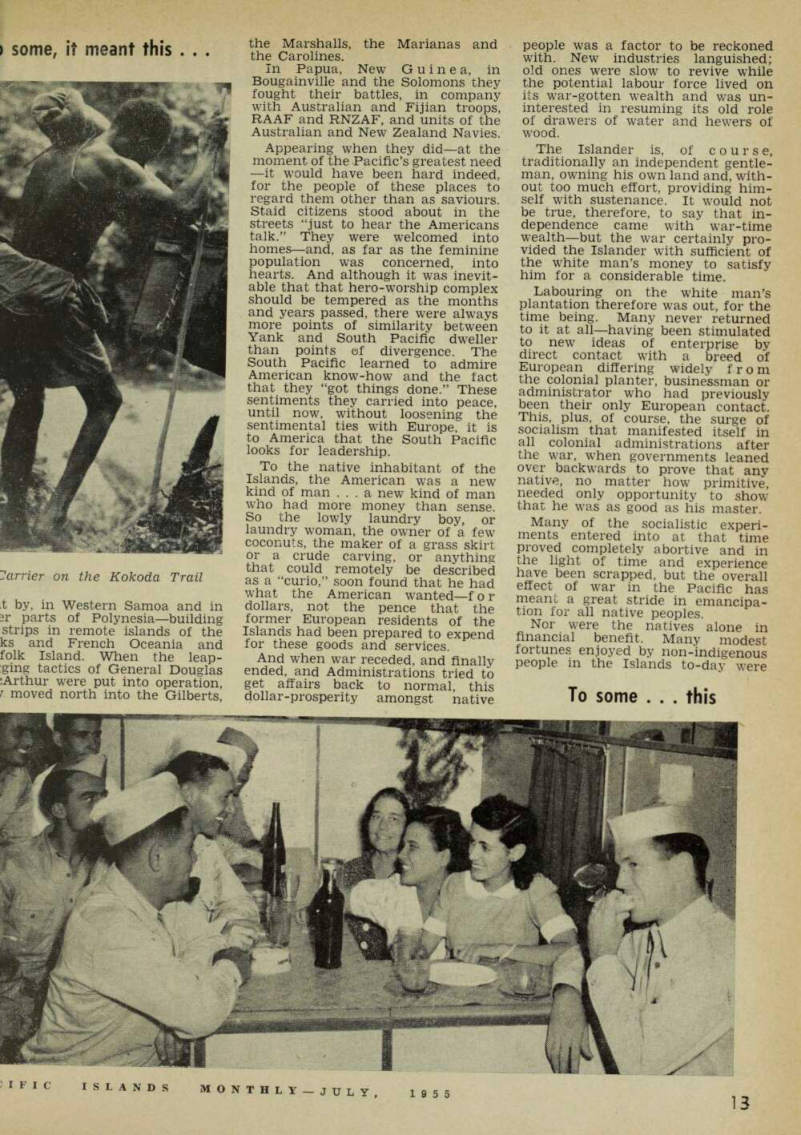
To some . . . this
t by, in Western Samoa and in sr parts of Polynesia—building strips in remote islands of the ks and French Oceania and folk Island. When the leap ing tactics of General Douglas ;Arthur were put into operation, r moved north into the Gilberts,
the Marshalls, the Marianas and the Carolines.
In Papua, New Guinea, in Bougainville and the Solomons they fought their battles, in company with Australian and Fijian troops, RAAF and RNZAF, and units of the Australian and New Zealand Navies.
Appearing when they did —at the moment of the Pacific’s greatest need —it would have been hard indeed, for the people of these places to regard them other than as saviours.
Staid citizens stood about in the streets “just to hear the Americans talk.” They were welcomed into homes—and, as far as the feminine population was concerned, into hearts. And although it was inevit able that that hero-worship complex should be tempered as the months and years passed, there were always more points of similarity between Yank and South Pacific dweller than points of divergence. The South Pacific learned to admire American know-how and the fact that they “got things done.” These sentiments they carried into peace, until now, without loosening the sentimental ties with Europe, it is to America that the South Pacific looks for leadership.
To the native inhabitant of the Islands, the American was a new kind of man ... a new kind of man who had more money than sense.
So the lowly laundry boy, or laundry woman, the owner of a few coconuts, the maker of a grass skirt or a crude carving, or anything that could remotely be described as a “curio,” soon found that he had what the American wanted —f o r dollars, not the pence that the former European residents of the Islands had been prepared to expend for these goods and services.
And when war receded, and finally ended, and Administrations tried to get affairs back to normal, this dollar-prosperity amongst native
people was a factor to be reckoned with. New industries languished; old ones were slow to revive while the potential labour force lived on its war-gotten wealth and was un interested in resuming its old role of drawers of water and hewers of wood.
The Islander is, of course, traditionally an independent gentle man, owning his own land and, with out too much effort, providing him self with sustenance. It would not be true, therefore, to say that in dependence came with war-time wealth—but the war certainly pro vided the Islander with sufficient of the white man’s money to satisfy him for a considerable time.
Labouring on the white man’s plantain therefore was out, for the time being. Many never returned to it at all—having been stimulated to new ideas of enterprise by direct contact with a breed of European differing widely from the colonial planter, businessman or administrator who had previously been their only European contact.
This, plus, of course, the surge of socialism that manifested itself in all colonial administrations after the war, when governments leaned over backwards to prove that any native, no matter how primitive, needed only opportunity to show that he was as good as his master.
Many of the socialistic experi ments entered into at that time proved completely abortive and in the light of time and experience have been scrapped, but the overall effect of war in the Pacific has meant a great stride in emancipa tion for all native peoples.
Nor were the natives alone in financial benefit. Many modest fortunes enjoyed by non-indigenous people in the Islands to-day were
Carrier on the Kokoda Trail