[?]Rman Ace-Reporter
pp. 143-144 · Read in the full issue
Visits South Pacific
I Review By Egon Varro
ERND LOHSE is one of those rare people who seem to need only a couple of weeks of letrating observation and inquiry jrder to sum up a whole country. book, Australia and the South (, alternates between lively de pt ion and erudite analysis, which , be confounding to the local, > hac laboured for decades to ve at similar conclusions, i NG, Lohse talked to planters, linistrators, the church-choir of mabada, visited Bulolo —where a ive discovered for hi m the cks of the Junkers planes—and Blood’s station at Nondugl. )hse was amazed by the mtains of “snowy white bread, ift of the last ounce of good and the ice-cream and made consumed by the natives, !e their gardens are being ected. In Lae, he watched three ve boys departing by taxi with niserable bunch of bananas, ;ht in the market-place, t is difficult to imagine an ad istration which looks after its ges more carefully,” says Lohse, ■ a tribute to Sir Hubert Murray, he sympathises with the “old rs” and their horror at the ding orgies on tinned fish and i, “while the sea next-door brims nutrition.”
HSE calls Fiji Airways the ‘cutest and most charming air ine in the world,” because its rary included zig-zagging for s, and a humorous commentary le pilot. wever, the speed of conversa between a pensioned colonel in b and his wife at the “Grand ic” was assessed by Lohse at four words per hour. He lers whether the “Grand’s ern es read Somerset Maugham in spare time. . . on account o* a nuous twinkle in their eye.” ise asks why the Indians in Fiji seem to be able to smile when do business. They impressed with their interest in technical ess—much less with their “un romising nationalism.” This is mly part of the book where ! is quite blunt. He asks; “Why ji not a paradise”? And he the blame squarely with the ns. ih Samoa, Lohse fell in love— stock and barrel. Wanting to why it seemed more heari ng to leave Samoa than any place on earth, Lohse plunges deep analysis. Neither in lesia nor Micronesia, he says, •ossible to find the same “glow leerfulness and higher level of nity” as in Polynesia, ise claims that the highest level
the other Islanders may reaa that of a peasant; whereas?
Samoans are sailors, founden states —and gentlemen. Samos avoided what Lohse calls “con ated-iron culture,” to be fl everywhere else in the Pacific., pays tribute to the “healthy servatism” of the Samoans in. ferring their own, much more able house, to Nissen-huts.
The world-traveller was somes put out when he addresse Samoan film-extra in Pidgin lish and she replied in fluent lish and told him her name, v; was of German nobility. I observed that race, colour nationality are of no important Samoa—and also that almose building has been going on neai waterfront since the Germans Apia!
Bernd Lohse; “Australian und Sue Obtainable: Angus & Robertson, S? and Continental Bookshop, Melbour: H Mr. Fred Archer, of Jame Pit tion, Buka, New Guinea, retv to the territory this month, making a good recovery from severe abdominal operation! underwent in Brisbane last; cember.
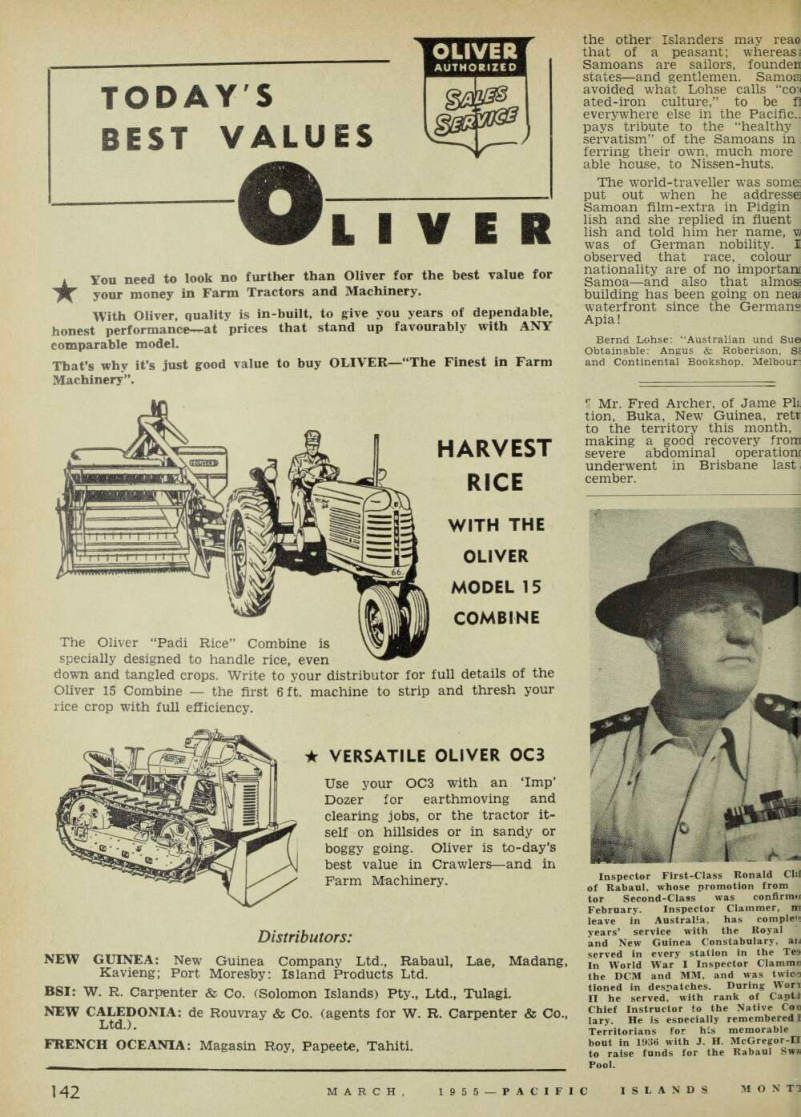
Inspector First-Class Ronald Cl[?] of Rabaul, whose promotion from tor Second-Class was confirms February. Inspector Clammer, m[?] leave in Australia, has comple[? years’ service with the Royal and New Guinea Constabulary, are[?] served in every station in the Tea[?] In World War I Inspector Clamm[?] the DCM and MM. and was twice[?] tioned in despatches. During Woer[?] II he served, with rank of Capt[?] Chief Instructor to the Native Coo[?] lary. He is especially remembered [?] Territorians for his memorable bout in 1036 with J. H. McGregor-II to raise funds for the Rabaul Sw[?] Pool.