Young Tongans Agitate
p. 142 · Read in the full issue
Tonga Is Quiet
And Peaceful, But—
Young Tongans Agitate For Political Reforms
THERE appears to be in Tonga a slow-growing movement directed towards political reform and which has, as its essential purpose, less power for the ruling caste and more power for the commoners.
It appears to be more reformative than subversive in character No personal hostility towards the Royal Family and nobles is expressed; but there is a great eagerness to secure more political power for the people.
One Tongan writer says that if the movement is suppressed “Tonga will drift forward towards Com munism, bloodshed, and the destruc tion of things which the individual holds dear to human dignity and our most precious heritage, Democracy.”
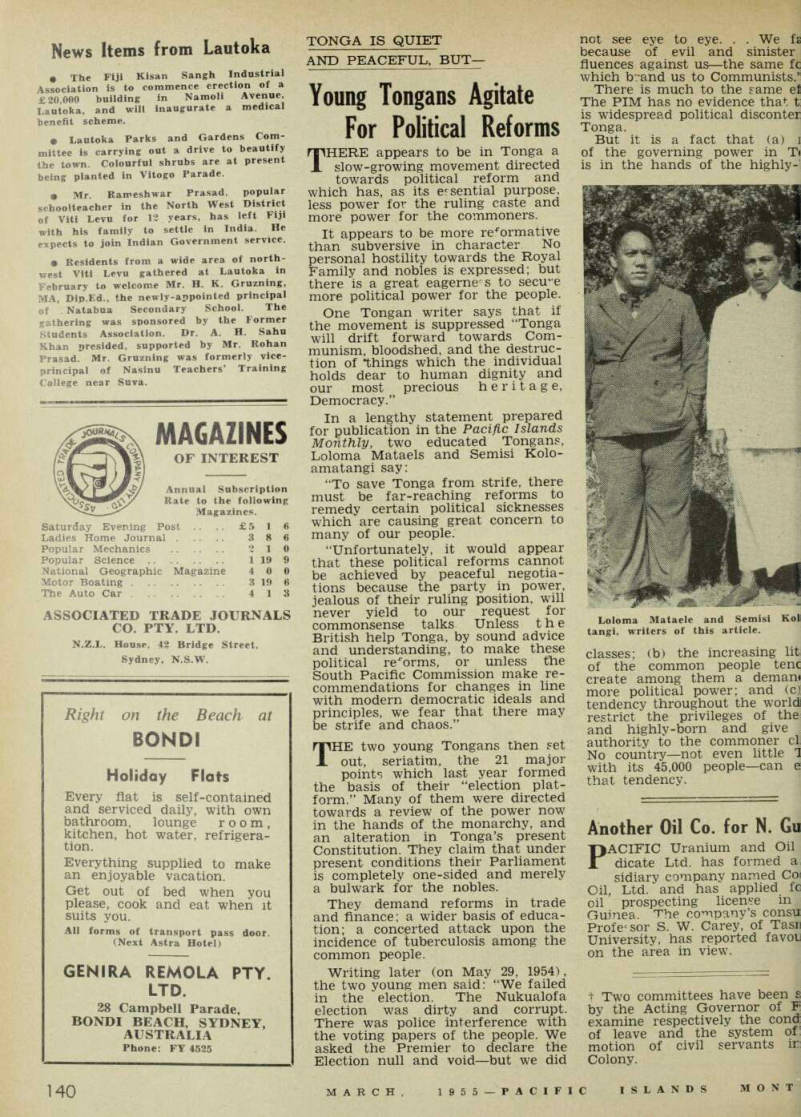
In a lengthy statement prepared for publication in the Pacific Islands Monthly, two educated Tongans, Loloma Mataels and Semisi Kolo amatangi say; “To save Tonga from strife, there must be far-reaching reforms to remedy certain political sicknesses which are causing great concern to many of our people.
“Unfortunately, it would appear that these political reforms cannot be achieved by peaceful negotia tions because the party in power, jealous of their ruling position, will never yield to our request for commonsense talks Unless the British help Tonga, by sound advice and understanding, to make these political reforms, or unless the South Pacific Commission make re commendations for changes in line with modern democratic ideals and principles, we fear that there may be strife and chaos.”
THE two young Tongans then set out, seriatim, the 21 major points which last year formed the basis of their “election plat form.” Many of them were directed towards a review of the power now in the hands of the monarchy, and an alteration in Tonga’s present Constitution. They claim that under present conditions their Parliament is completely one-sided and merely a bulwark for the nobles.
They demand reforms in trade and finance: a wider basis of educa tion; a concerted attack upon the incidence of tuberculosis among the common people.
Writing later (on May 29, 1954), the two young men said: “We failed in the election. The Nukualofa election was dirty and corrupt.
There was police interference with the voting papers of the people. We asked the Premier to declare the Election null and void —but we did
not see eye to eye. . . We fa because of evil and sinister fiuences against us—the same fc which bvand us to Communists.’' There is much to the same eft The PIM has no evidence that t; is widespread political disconter Tonga.
But it is a fact that (a) i of the governing power in Tt is in the hands of the highly-'
classes; (b) the increasing lit; of the common people tenc create among them a demam more political power; and (cl tendency throughout the world! restrict the privileges of the: and highly-born and give authority to the commoner cli No country—not even little 1 with its 45,000 people—can e that tendency.
Loloma Mataele and Semisi Koll tangi, writers of this article.