Charley Goes Home
pp. 82-83 · Read in the full issue
CHARLEY, I was informed, no longer camped at the local: hadn’t been seen there for over a / ortni ght. Someone suggested that he was infesting one of the cabins near the beach. Anyhow, he’d be fishing at this hour.
Sure enough, I found him dangling a rod over the jetty, with a bunch of other enthusiasts, mostly kids.
“Hi-ya, Charley!” I said.
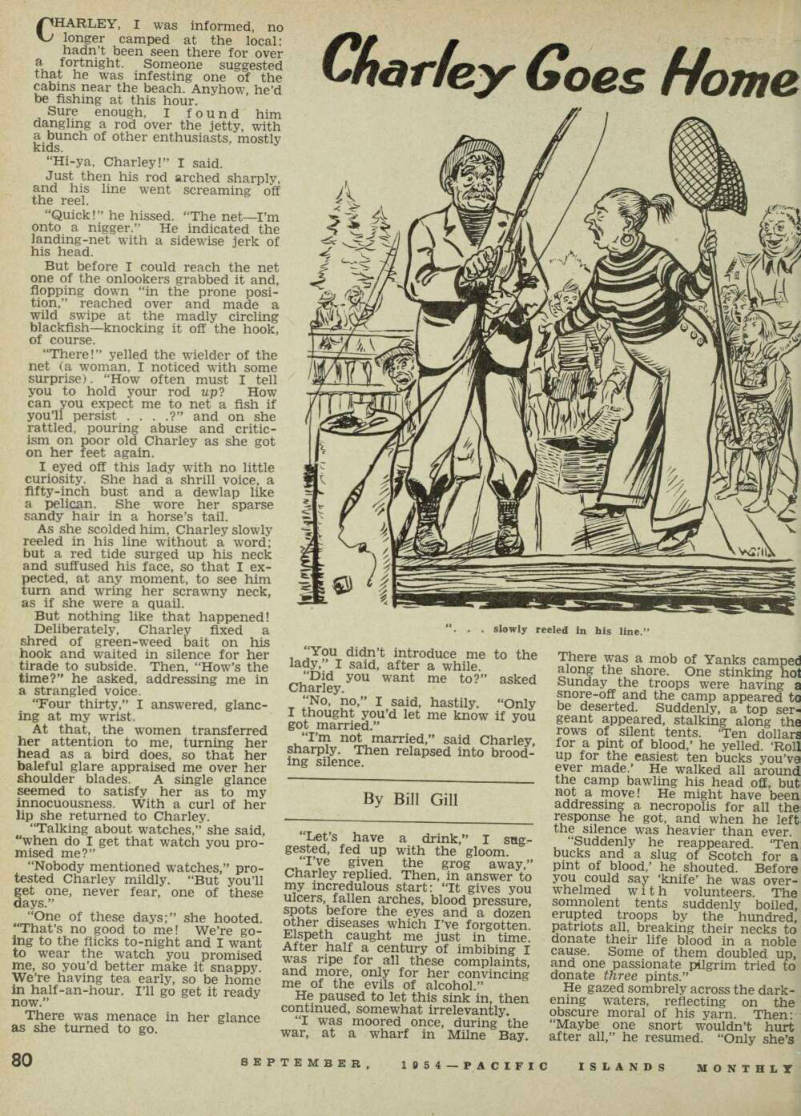
Just then his rod arched sharply, and his line went screaming off the reel.
“Quick!” he hissed. “The net—l’m onto a nigger.” He indicated the landing-net with a sidewise jerk of his head.
But before I could reach the net one of the onlookers grabbed it and, flopping down “in the prone posi tion,” reached over and made a wild swipe at the madly circling blackfish—knocking it off the hook, of course.
“There!” yelled the wielder of the net (a woman, I noticed with some surprise). “How often must I tell you to hold your rod up? How can you expect me to net a fish if you’ll persist . . . .?” and on she rattled, pouring abuse and critic ism on poor old Charley as she got on her feet again.
I eyed off this lady with no little curiosity. She had a shrill voice, a fifty-inch bust and a dewlap like a pelican. She wore her sparse sandy hair in a horse’s tail.
As she scolded him, Charley slowly reeled in his line without a word; but a red tide surged up his neck and suffused his face, so that I ex pected, at any moment, to see him i:urn and wring her scrawny neck, as if she were a quail.
But nothing like that happened!
Deliberately, Charley fixed a shred of green-weed bait on his hook and waited in silence for her tirade to subside. Then, “How’s the time?” he asked, addressing me in a strangled voice.
“Four thirty,” I answered, glanc ing at my wrist.
At that, the women transferred her attention to me, turning her head as a bird does, so that her baleful glare appraised me over her shoulder blades. A single glance seemed to satisfy her as to my innocuousness. With a curl of her lip she returned to Charley.
“Talking about watches,” she said, “when do I get that watch you pro mised me?”
“Nobody mentioned watches,” pro tested Charley mildly. “But you’ll get one, never fear, one of these days.”
“One of these days;” she hooted.
“That’s no good to me! We’re go ing to the flicks to-night and I want to wear the watch you promised me, so you’d better make it snappy.
We’re having tea early, so be home in half-an-hour. I’ll go get it ready now.”
There was menace in her glance as she turned to go.
You didn’t introduce me to the lady,” I said, after a while.
“Did you want me to?” asked Charley. “No. no,” I said, hastily. “Only I thought you’d let me know if you got married.”
“I’m not married,” said Charley, sharply. Then relapsed into brood ing silence.
By Bill Gill
“Let’s have a drink,” I sug gested, fed up with the gloom.
“I’ve given the grog away,”
Charley replied. Then, in answer to my incredulous start: “It gives you ulcers, fallen arches, blood pressure, spots before the eyes and a dozen other diseases which I’ve forgotten.
Elspeth caught me just in time.
After half a century of imbibing I was ripe for all these complaints, and more, only for her convincing me of the evils of alcohol.”
He paused to let this sink in, then continued, somewhat irrelevantly.
“I was moored once, during the war, at a wharf in Milne Bay.
There was a mob of Yanks camped along the shore. One stinking hot Sunday the troops were having a snore-off and the camp appeared to be deserted. Suddenly, a top ser geant appeared, stalking along the rows of silent tents. ‘Ten dollars for a pint of blood/ he yelled. ‘Roll up for the easiest ten bucks you’ve ever made/ He walked all around the camp bawling his head off, but not a move! He might have been addressing a necropolis for all the response he got, and when he left the silence was heavier than ever.
“Suddenly he reappeared. ‘Ten, bucks and a slug of Scotch for a pint of blood/ he shouted. Before you could say ‘knife’ he was over whelmed with volunteers. The somnolent tents suddenly boiled, erupted troops by the hundred, patriots all, breaking their necks to donate their life blood in a noble cause. Some of them doubled up, and one passionate pilgrim tried to donate three pints.”
He gazed sombrely across the dark ening waters, reflecting on the obscure moral of his yarn. Then “ Maybe one snort wouldn’t hurt after all,” he resumed. “Only she's
“. . . slowly reeled in his line.”
got a nose on her like a spaniel dog.”
F “But haven’t you heard of these chlorophyll pills?” I asked. “They’ll •destroy the smell of grog like magic.
You can buy them anywhere.”
F “Then what are we waiting for?” he asked, with animation. “Let’s go.-
AN hour or so later he seemed more like his old self. We had bought a bottle of green tablets, ind he did explain how Espeth had net him one morning when he was suffering from a particularly savage hangover and, with P.ancushinents and fair words” had induced him to abandon the pub for a cabin next to hers. He discovered that ;heir cabins had a hallway in jommon, and soon they were shar ng meals, he supplying the tucker md she doing the cooking.
Gradually her dominance over lim increased and, eventually, she veaned him completely from the jooze.
“She even got me into Sam Langfords,” he said, with a re sentful flush on his battle-scarred )ld dial; and he hitched up his Dants to display his long under vear.
In the course of his narrative, Slspeth had undergone a strange netemorphosis. Starting off as a ‘lady” she became a “lass,” then i “woman,” and finally a “virago.”
We were brought back to earth )y a seedy-looking individual who shoved a mysterious parcel under Charley’s nose.
“Here’s that lady’s watch,” he vhispered hoarsely. “Only sixteen iuid. You’d pay twenty for it in he shops.”
“I’ve changed my mind,” said Charley, his courage restored, and mce more captain of his soul. “Let’s see something cheaper, much heaper—about ten bob, in fact.”
A lot of acrimonious haggling msued, but Charley emerged with ill the honours and a “gold” watch vhich cost seventeen and six. True, t wasn’t much of a watch to look it: the thumbscrew, when you vound it, made a row like a boiler naker’s ratchet, whilst the so-called ‘tick” could be heard above the lubbub of the bar-room.
“This’ll make her happy,” de clared Charley, optimistically, as, arm-in-arm, we meandered towards his cabin. “ ’Twas a gold watch she wanted, and that’s what she’ll get.”
However, his courage appeared to falter as I assisted him up the steps.
“You’ve got those pills all right?” he whispered anxiously.
“Yes, yes,” I reassured him. “A whole bottle —you’ll be jake.”
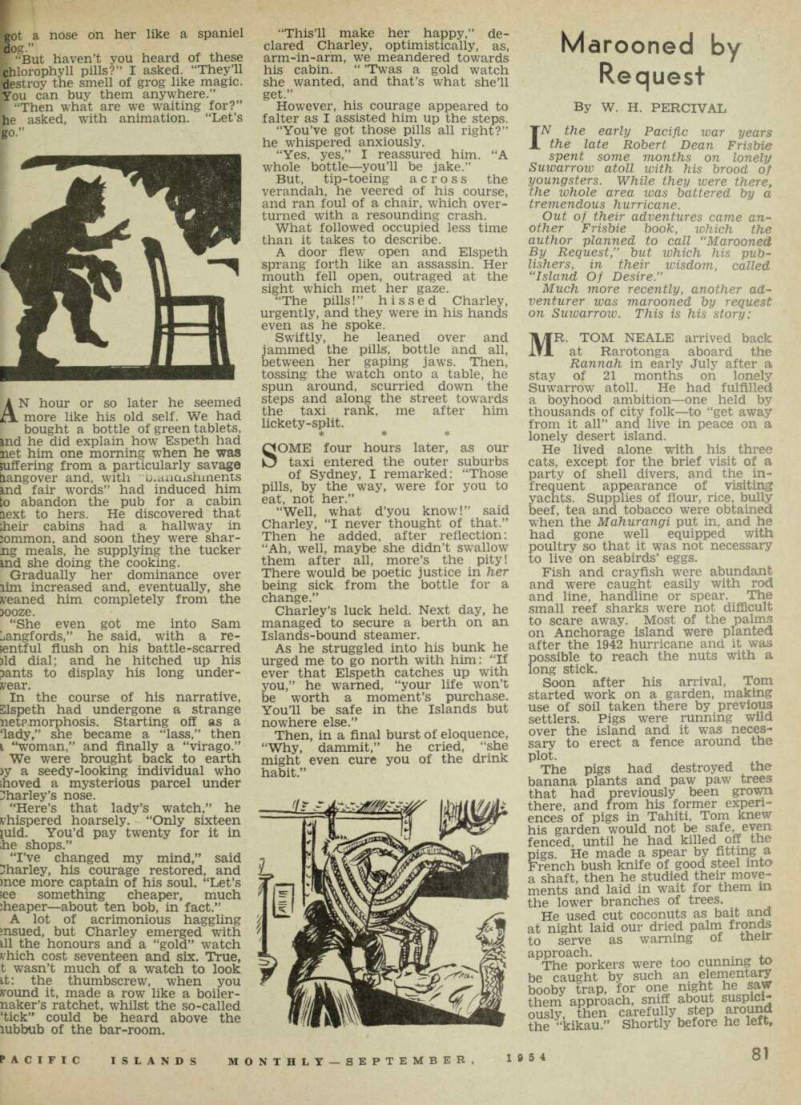
But, tip-toeing across the verandah, he veered of his course, and ran foul of a chair, which over turned with a resounding crash.
What followed occupied less time than it takes to describe.
A door flew open and Elspeth sprang forth like an assassin. Her mouth fell open, outraged at the sight which met her gaze.
“The pills! ” hissed Charley, urgently, and they were in his hands even as he spoke.
Swiftly, he leaned over and jammed the pills, bottle and all, between her gaping jaws. Then, tossing the watch onto a table, he spun around, scurried down the steps and along the street towards the taxi rank, me after him
lickety-split.
♦ * * SOME four hours later, as our taxi entered the outer suburbs of Sydney, I remarked: “Those pills, by the way, were for you to eat, not her.”
“Well, what d’you know!” said Charley, “I never thought of that.”
Then he added, after reflection: “Ah, well, maybe she didn’t swallow them after all, more’s the pity!
There would be poetic justice in her being sick from the bottle for a change.”
Charley’s luck held. Next day, he managed to secure a berth on an Islands-bound steamer.
As he struggled into his bunk he urged me to go north with him: “If ever that Elspeth catches up with you,” he warned, “your life won’t be worth a moment’s purchase.
You’ll be safe in the Islands but nowhere else.”
Then, in a final burst of eloquence, “Why, dammit,” he cried, “she might even cure you of the drink habit.”