Two Ships
pp. 81-92 · Read in the full issue
A Tale Of
By Jeanne Booth Johnson
Salvaging war-junk from the islands, reefs and seas of the South Pacific has meant adventure and profit to a number of
people.
A group of Americans have been working on the wreck of the President Taylor, and doing it in some comfort, although this ship went up on Canton Island, one of the most isolated in the Pacific.
THIS is the tale of two ships, the Motor Yacht Caronia, and the SS President Taylor. For the /vno it ic tup bpo-innine 1 of a new fife for the othllTS the end Firstly, Caronia, a 296-tons steel imii hipspl vacht which was built
originally as&Ta £ Ross
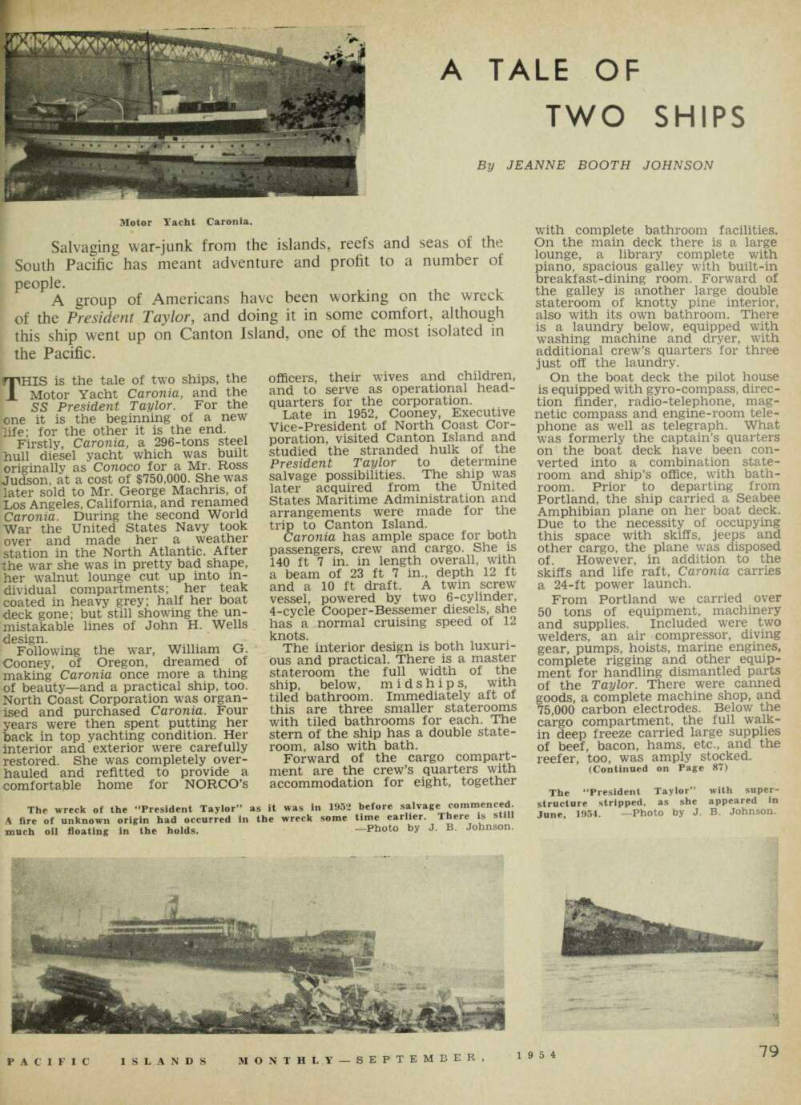
Judson at a cost of $750,000. She was later sold to Mr. George Machris, of Los Angeles, California, and renamed Caronia. During the second World War the United States Navy took over and made her a weather station in the North Atlantic. After the war she was in pretty bad shape, her walnut lounge cut up into individual compartments; her teak coated in heavy grey; half her boat deck gone; but still showing the unmistakable lines of John H. Wells design Following the war, William G.
Cooney, of Oregon, dreamed of making Caronia once more a thing of beauty—and a practical ship, too.
North Coast Corporation was organised and purchased Caronia. Four years were then spent putting her back in top yachting condition. Her interior and exterior were carefully restored. She was completely overhauled and refitted to provide a comfortable home for NORCO’s
officers, their wives and children, and to serve as operational head quarters lor the Late in 1052, Cooney, executive Vice-President of North Coast Cor poration, visited Canton Island and studied, the stranded hulk of the President Taylor to determine salvage possibilities. The ship was later acquired from the United States Maritime Administration and arrangements were made for the trip to Canton Island, Caronia has ample space for both passengers, crew and cargo She is 140 ft 7 in. in length overall, with a beam of 23 ft 7 in., depth 12 it and a 10 ft draft. A twin screw vessel, powered by two 6-cylinder, 4-cycle Cooper-Bessemer diesels, she has a normal cruising speed of 12 knots.
The interior design is both luxuri ous and practical. There is a master stateroom the full width of the ship, below, midships, with tiled bathroom. Immediately aft oi this are three smaller staterooms with tiled bathrooms for The stern of the ship has a double state room, also with bath, Forward of the cargo compart ment are the crew’s quarters with accommodation for eight, together
with complete bathroom facilities.
On the main deck there is a large lounge, a library complete with piano, spacious galley with built-in breakfast-dining room. Forward of the galley is another large double stateroom of knotty pine interior, also with its own bathroom. There is a laundry below, equipped with washing machine and dryer, with additional crew’s quarters for three just off the laundry.
On the boat deck the pilot house is equipped with gyro-compass, direc tion finder, radio-telephone, mag netic compass and engine-room tele phone as well as telegraph. What was formerly the captain’s quarters on the boat deck have been con verted into a combination state room and ship’s office, with bath room. Prior to departing from Portland, the ship carried a Seabee Amphibian plane on her boat deck.
Due to the necessity of occupying this space with skiffs, jeeps and other cargo, the plane was disposed of. However, in addition to the skiffs and life raft, Caronia carries a 24-ft power launch.
From Portland we carried over 50 tons of equipment, machinery and supplies. Included were two welders, an air compressor, diving gear, pumps, hoists, marine engines, complete rigging and other equip ment for handling dismantled parts of the Taylor. There were canned goods, a complete machine shop, and 75,000 carbon electrodes. Below the cargo compartment, the full walk in deep freeze carried large supplies of beef, bacon, hams, etc., and the reefer, too, was amply stocked.
(Continued on Page 87)
Motor Yacht Caronia.
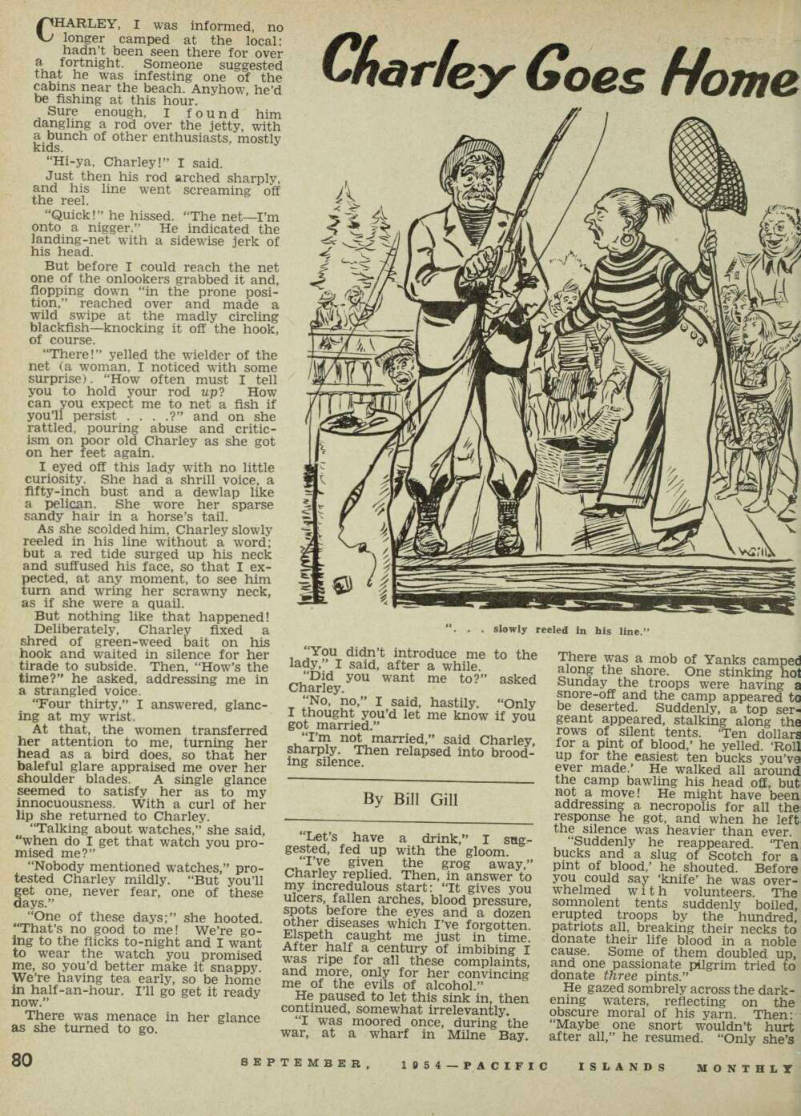
The wreck of the “President Taylor” as it was in 1952 before salvage commenced.
A fire of unknown origin had occurred in the wreck some time earlier. There is sun much oil floating in the holds. —Photo by J. B. Johnson.
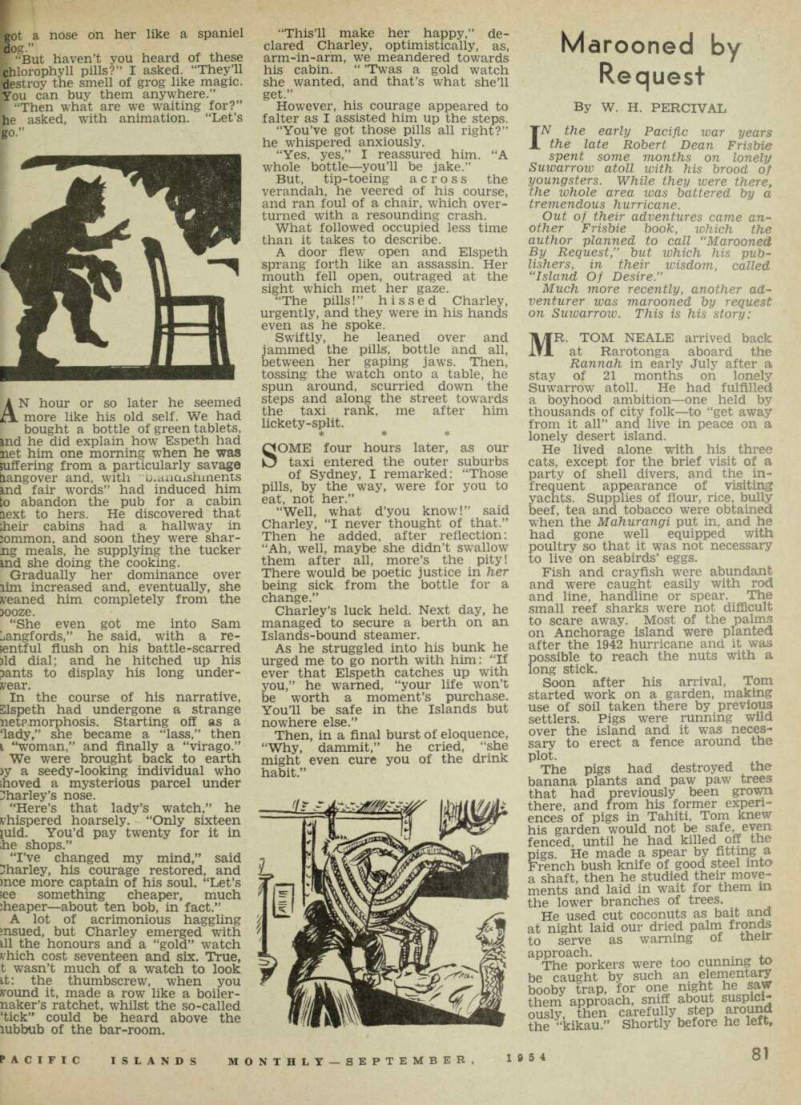
The “President Taylor’’ with super structure stripped, as she appeared in June, 1954. —Photo by J. B. Johnson.
THERE are two organisations en gaged in the salvage of the Pre sident Taylor, North Coast Cor poration, which own the Taylor and Caronia, and Taylor Salvors, organ ised to perform the actual labour under subcontract to North Coast Corporation. Officers of North Coast Corporation are also members of Taylor Salvors. Originally, there were 13 members of Taylor Salvors, Including three directors of Norco.
Recently five members of the group bought out the others, and at pre sent the work is being carried on with the use of Gilbertese labour under the direction of the Group.
On board Caronia are William G. Cooney, Maurice L. Coulter, Herman C. Jacobson —officers of Norco, and members of Taylor Salvors —t oget h e r with Frank Rusinas and Jeanne Booth Johnson, partners with the North Coast Group in Taylor Salvors. Also on board, and representing a very im portant part of the ship’s comple ment, are Mrs. Cooney and the three small Cooney girls, Lee, Kay and Carol; and Mrs. Jacobson with her two boys, Keith and Ronnie.
With them came the family French poodle, Cozette, and I brought my 13-year-old black cocker spaniel, Stormy.
ACCOUNTS vary widely as to the exact cause of the grounding of the SS President Taylor. How ever, the most reliable version, as supplied by American President Lines, former owners, is that on Feb ruary 3, 1942, the Taylor sailed for Canton Island with a task force of approximately 1,200 men, arriving on February 13.
Due to heavy ground swells the troops were unable to disembark that day. The following day, the
destroyer escorting the Taylor re ported submarines in the immediate vicinity and instructed the vessel to stand closer into the shore. While manoeuvring for position, the vessel touched bottom and was forced further ashore by the heavy swell.
The destroyer, which was the only other vessel there, could not offer assistance as it was trying to raise the submarine with depth-charges.
The troops disembarked on Feb ruary 15 and jettisoning operations
were started immediately to lighten the ship. However, they were in sufficient to refloat her. During the following three months, the US Navy made two unsuccessful at tempts to float the Taylor; the vessel was abandoned.
F The Taylor was built by New York Shipbuilding Co., launched in June, 1921, christened the Granite State, and was placed in Trans-Atlantic Service. She was purchased by the Dollar SS Co., renamed the SS Pre sident Polk and placed in the Round the World service in 1923, along with six other vessels of the same class. Subsequently, she was rebuilt by Newport News Shipbuild ing Corporation, in 1929, increasing her passenger-carrying capacity.
She was renamed President Taylor when a new and larger President Polk was acquired by her owners.
The SS Granite State-President Folk-President Taylor, a passenger/ freighter, had a gross tonnage of 10,495. She is of heavy steel con struction throughout, and although the majority of her woodwork was burned by a fire of unknown origin i few years ago, the steel was prac tically undamaged. The Taylor lies )n the leeward side of Canton [sland, and has remained intact luring the long years subsequent to ier grounding.
Originally, North Coast planned » remove her entire upperworks to he main deck, make all the holds watertight, and attempt to refloat he ship, towing her to market for
the purpose of scrapping by buyers.
The upperworks were removed, and the various holds made intact. As a result of a recent Marine Survey, it has been confirmed that the ship can now be refloated at any time. However, she would have to be towed on her tanktops, and in her present position surveyors can not determine the condition of a certain portion of the hull which is grounded midships. In this par ticular section there exists a trans verse crack, and some buckling of the plates.
In view of the additional cost in volved in proceeding with refloat ing operations and resurvey, with out ultimate guarantee of insurance coverage for the tow to market, it has now been decided to completely dismantle the ship here at Canton Island. Cutting operations have commenced on a full-scale basis.
At the end of July, 1954, the Taylor silhouette was rapidly dimin ishing.
There remains no upperworks, although her massive anchor winch is preserved intact on thp for the purpose of assisting in towing the vessel closer inshore after she had been cut to the waterline, so that underwater portions may also be salvaged. This anchor winch, originally powered by steam, has been reconditioned, and powered by a gasoline engine, and is in excel lent working condition.
After cutting the vessel almost to the waterline, it is planned to make
use of the work which was spent in readying the hull for refloating, by actually floating the remaining part of the ship and moving her as far inshore as possible to enable the salvage of the entire ship, par ticularly the massive cast iron machinery in her boiler rooms and engine-room, together with the valuable non-ferrous components thereof. (Over)
During the course of operations several shipments of non-ferrous metals have already been made to the Mainland, and her two huge three-bladed propellers have been removed for shipment and sale in August. Each of these propellers is composed of manganese-bronze, with each blade weighing 4,840 lbs.
One spare blade, found in a cargo hold, has already been shipped and sold.
The huge scrap-pile on the dock is growing daily, with the heavy steel being cut to specification for heavy melting purposes, and reroll ing. Over half of the plate is suit able for rerolling, consequently commanding a premium price.
LIFE at Canton Island has be come somewhat routine for
Caronia and her occupants, an the island itself has offered in teresting diversion for what ther is of spare time.
Fishing and swimming ar popular; so also coral hunting an diving. The children and dogs hav adapted themselves quite well t island life. There is no time for any one to become bored.