Freak Island
pp. 77-78 · Read in the full issue
A Visit To Makatea
By W. A. H.
The first sight of Makatea would dispel the preconceived ideas which many people have about South Sea islands Makatea is 4 by 6 miles in extent, lies about 90 miles north of Tahiti, and would probably be uninhabited and unheard of if it were not rich in the valued phosphate, raw material of commercial fertilisers.
It is entirely lacking in natural beauty, but is nevertheless distincfive in its oddness and plainness.
It is a wall of limestone rising straight out of the sea.
Like the barren and bleak mountains in northern Chile with their nitrate mines, Makatea gives fertility to others but has none itself.
It supports no noteworthy plantl lf e.
For about 45 years an Anglo- French company has exploited the phosphate deposits of Makatea. At first no Polynesian would work on the inhospitable island where the temperature is higher than in other islands, and in the early days the labour problem was solved by employing Japanese. Labour to-
day is recruited mostly from the Cook Islands, some from the outer islands of French Oceania. Their pay is low by Tahitian standards, but high for Cook Islanders, There is no anchorage at Maka tea, the depth of water just on shore being 200 fathoms. Ships are moored to buoys, held in place by huge chains which are renewed every two years—a rather ticklish job as one false move can cause the whole chain to slip to the bot tom to be irretrievably lost. Fven with the ship securely moored it is
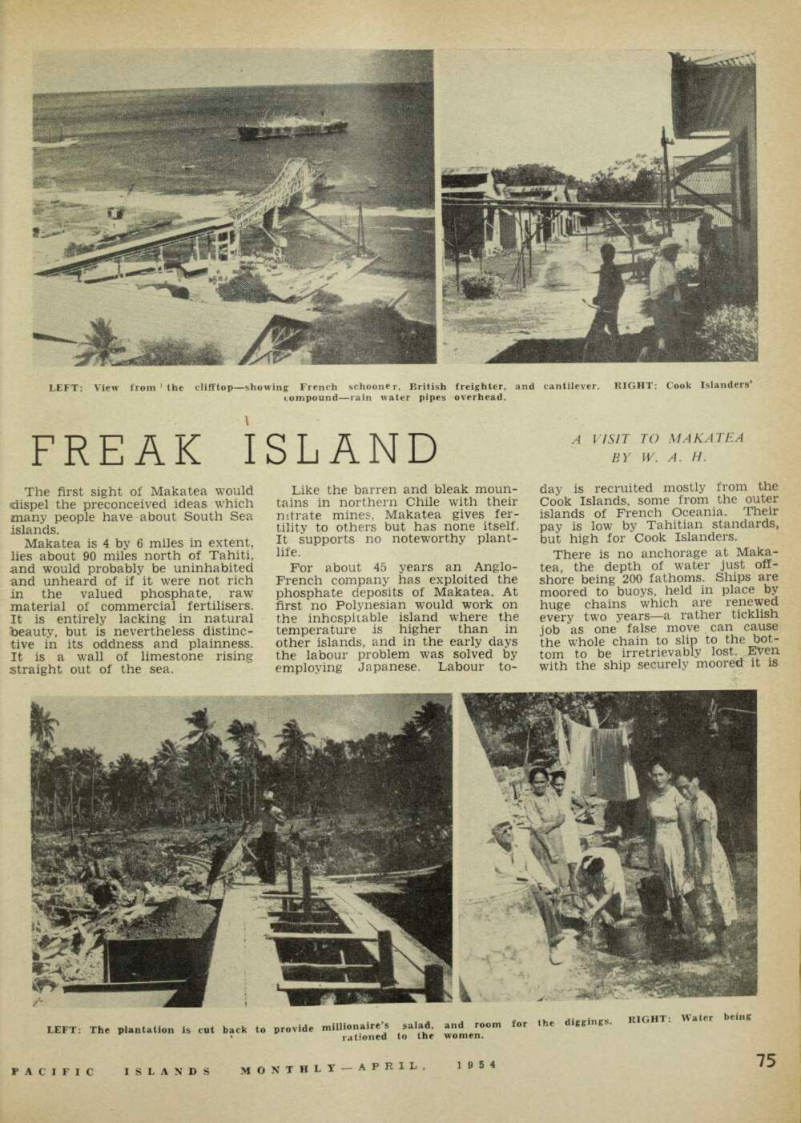
LEFT: View from the clifftop—showing French schooner, British freighter, and cantilever. RIGHT: Cook Islanders’ compound—rain water pipes overhead.
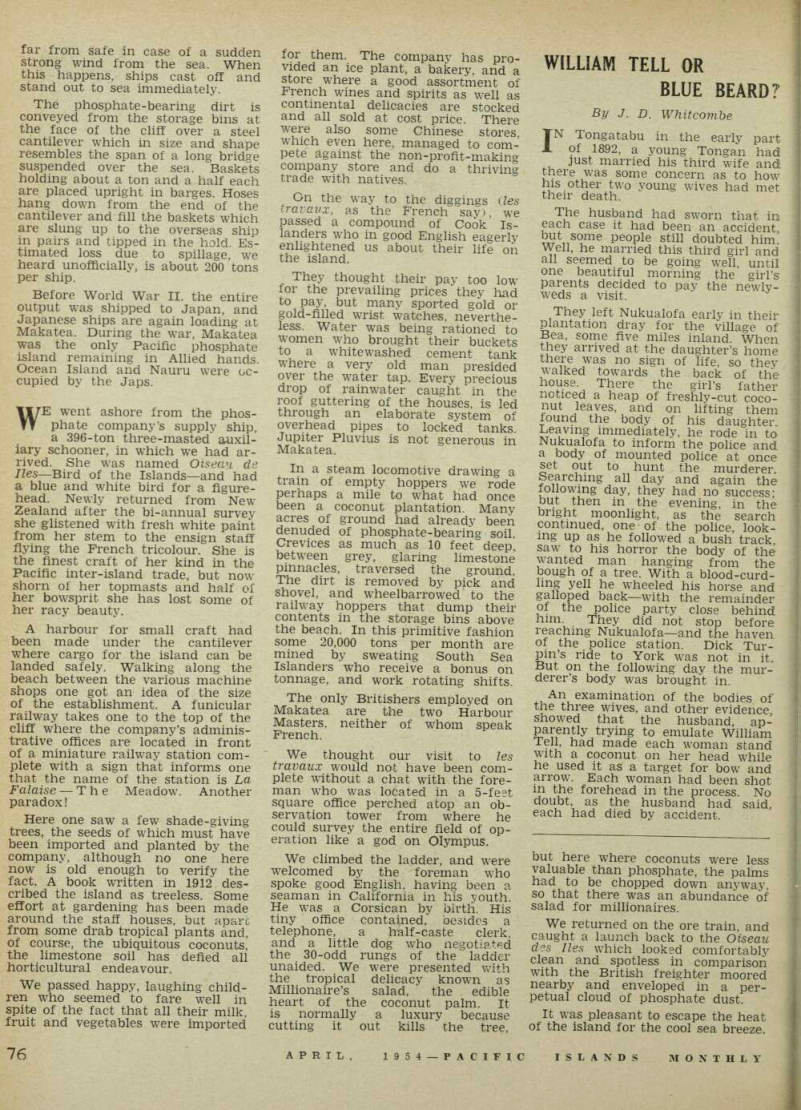
LEFT: The plantation Is cut back to provide millionaire’s salad, and room for the diggings. RIGHT: Water being rationed to the women.
far from safe in case of a sudden strong wind from the sea. When this happens, ships cast off and stand out to sea immediately.
The phosphate-bearing dirt is conveyed from the storage bins at the face of the cliff over a steel cantilever which in size and shape resembles the span of a long bridge suspended over the sea. Baskets holding about a ton and a half each are placed upright in barges. Hoses hang down from the end of the cantilever and fill the baskets which are slung up to the overseas ship in pairs and tipped in the hold. Es timated loss due to spillage, we heard unofficially, is about 200 tons per ship.
Before World War 11. the entire output was shipped to Japan, and Japanese ships are again loading at Makatea. During the war, Makatea was the only Pacific phosphate island remaining in Allied hands.
Ocean Island and Nauru were oc cupied by the Japs.
WE went ashore from the phos phate company’s supply ship, a 396-ton three-masted auxil iary schooner, in which we had ar rived. She was named Oiseau de lies —Bird of the Islands—and had a blue and white bird for a figure head. Newly returned from New Zealand after the bi-annual survey she glistened with fresh white paint from her stem to the ensign staff flying the French tricolour. She is the finest craft of her kind in the Pacific inter-island trade, but now r shorn of her topmasts and half of her bowsprit she has lost some of her racy beauty.
A harbour for small craft had been made under the cantilever where cargo for the island can be landed safely. Walking along the beach between the various machine shops one got an idea of the size of the establishment. A funicular railway takes one to the top of the cliff where the company’s adminis trative offices are located in front of a miniature railway station com plete with a sign that informs one that the name of the station is La Falaise The Meadow. Another paradox!
Here one saw a few shade-giving trees, the seeds of which must have been imported and planted by the company, although no one here now is old enough to verify the fact. A book written in 1912 des cribed the island as treeless. Some effort at gardening has been made around the staff houses, but aparc from some drab tropical plants and, of course, the übiquitous coconuts, the limestone soil has defied all horticultural endeavour.
We passed happy, laughing child ren who seemed to fare well in spite of the fact that all their milk, fruit and vegetables were imported
for them. The company has pro vided an ice plant, a bakery, and a store where a good assortment of French wines and spirits as well as continental delicacies are stocked and all sold at cost price. There were also some Chinese stores, which even here, managed to com pete against the non-profit-making company store and do a thriving trade with natives.
On the way to the diggings (les travavx, as the French say), we passed a compound of Cook Is landers who in good English eagerly enlightened us about their life on the island.
They thought their pay too low for the prevailing prices they had to pay, but many sported gold or gold-filled wrist watches, neverthe less. Water was being rationed to women who brought their buckets to a whitewashed cement tank where a very old man presided over the water tap. Every precious drop of rainwater caught in the roof guttering of the houses, is led through an elaborate system of overhead pipes to locked tanks.
Jupiter Pluvius is not generous in Makatea.
In a steam locomotive drawing a train of empty hoppers we rode perhaps a mile to what had once been a coconut plantation. Many acres of ground had already been denuded of phosphate-bearing soil.
Crevices as much as 10 feet deep between grey, glaring limestone pinnacles, traversed the ground.
The dirt is removed by pick and shovel, and wheelbarrowed to the railway hoppers that dump their contents in the storage bins above the beach. In this primitive fashion some 20,000 tons per month are mined by sweating South Sea Islanders who receive a bonus on tonnage, and work rotating shifts.
The only Britishers employed on Makatea are the two Harbour Masters, neither of whom speak French.
We thought our visit to les travaux would not have been com plete without a chat with the fore man who was located in a 5-feet square office perched atop an ob servation tower from where he could survey the entire field of op eration like a god on Olympus.
We climbed the ladder, and were welcomed by the foreman who spoke good English, having been a seaman in California in his youth.
He was a Corsican by birth. His tiny office contained, besides a telephone, a half-caste clerk, and a little dog who negotiated the 30-odd rungs of the ladder unaided. We were presented with the tropical delicacy known as Millionaire’s salad, the edible heart of the coconut palm. It is normally a luxury because cutting it out kills the tree,
but here where coconuts were less valuable than phosphate, the palms had to be chopped down anyway, so that there was an abundance of salad for millionaires.
We returned on the ore train, and caught a launch back to the Oiseau des lies which looked comfortably clean and spotless in comparison with the British freighter moored nearby and enveloped in a per petual cloud of phosphate dust.
It was pleasant to escape the heat of the island for the cool sea breeze.