The Editors' Mailbag
pp. 21-22 · Read in the full issue
IB in Fiji: More Data
Wanted
THE progress of Fiji’s ten-years’
War Memorial campaign against tuberculosis, launched with an initial fund of over £BO,OOO in 1949, remains a mystery to the gen eral public (says a Fiji man) and comments range from the ex asperated to the outrageous.
He declares that some who sup ported the 1949 appeal have said that they will do nothing about the current issue of anti-TB health stamps until they are officially in formed of where the campaign stands to-day, and whether the TB situation among the indigenous Fijians is better or worse than it was in 1949.
Dairymen’s Howls
There ,is evident a world-wide move to boost the consumption of margarine—it can be seen in pro paganda in Britain as well as in lively advertising in Australia. It is, of course, a revolt against the high and increasing price of butter.
“Queensland dairymen already have started howling at the pol iticians,” says a Cairns correspon dent. “They are demanding that Australia put a tariff on against the copra and coconut oil from which margarine is made, and which they call the products of ‘cheap black labour.’
“The howl, of course, will be re echoed in Parliament, and we can guess what will happen. As some one has said, ‘A politician thinks of the next election; a statesman, of the next generation’.
“It is time that these spoon fed Australian producers investi gated their own dairying methods, and found out why their produc tion costs are so high that butter is now beyond the reach of the poorer classes—and especially the pensioners. There is far more in it than the stupid thinking that argues
that butter should be protected against margarine by making mar garine as dear as butter.”
He Sought Tin and Found
Luv in Tonga
A very indignant reader sends us a copy of English newspaper blurb about a few film. It is called East of Sumatra, and the publicity con cerning it says it is “a torrid love story” and that the principals “plundered the last savage corner of the South Pacific.”
The hero (who is a tin prospector) and the island king fight each other with a blazing torch in one hand and a knife in the other, until the exhausted monarch (of course) ex pires horribly on the point of the hero’s knife. Some of the hero’s companions, less lucky, die in agony “while half-naked savages pump poisoned darts into them from blow-pipes.”
The pictures contain highly stir ring scenes of the kind of love that bites holes in powdered necks and is reduced to various other passion ate extravagances.
And the island where, according to the film, these things occur?
Tonga. TONGA!!
We suggest that six leading citizens of Nukualofa form them themselves into an indignation party, and go to USA, and force a couple of these Hollywood per versionists to chew a few yards of their own foul films, just to demon strate to the picture world that the South Pacific is very, very weary of being the unresisting plaything of producers who know no geography and care less for facts.
Papua and Woolpacks
Papuan Old-Timer Sydney H.
Chance is upset at the suggestion that the much-encouraged Kenaf industry is not going to get a fair deal from Canberra: “Can anything ever go ahead in
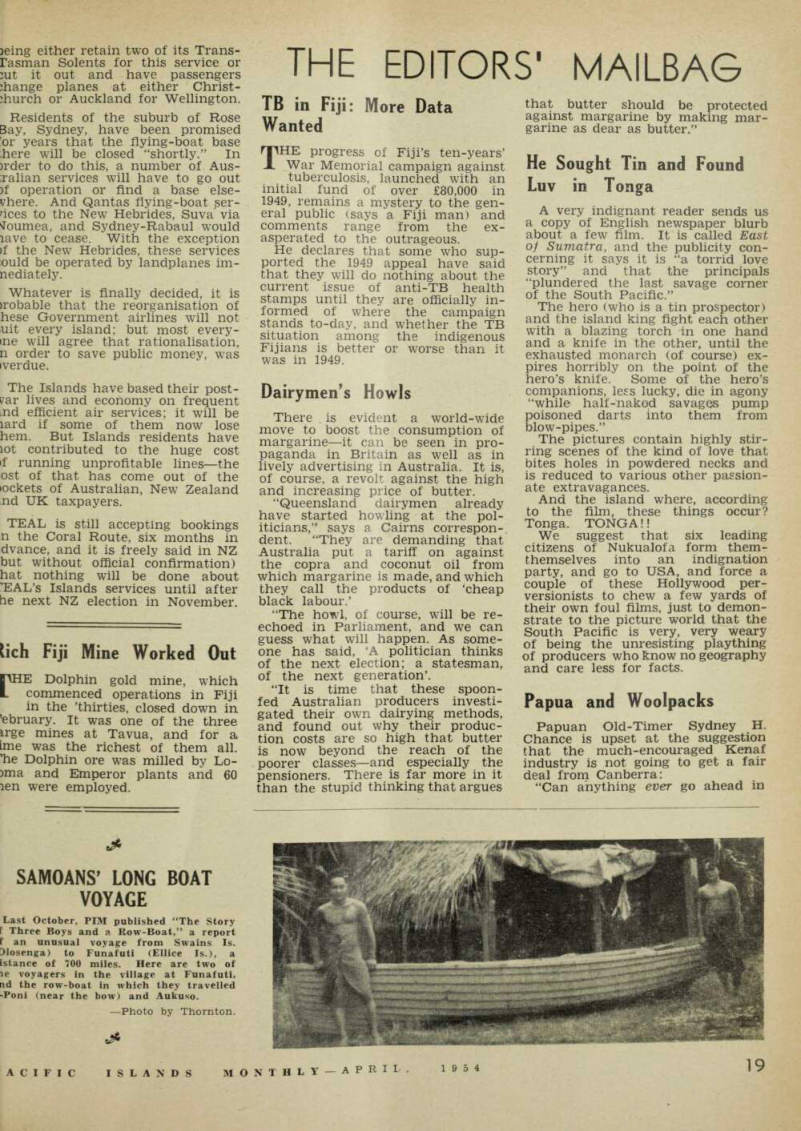
Samoans’ Long Boat
Voyage
Last October, PIM published “The Story [?] Three Boys and a Row-Boat,” a report [?] an unusual voyage from Swains Is. [?]losenga) to Funafuti (Ellice Is.), a [?]istance of 700 miles. Here are two of [?]e voyagers in the village at Funafuti, [?]d the row-boat in which they travelled [?]-Poni (near the bow) and Aukuso.
Photo by Thornton.
these Territories? Years ago, they tried to establish Sisal Hemp in Papua. It was shown that Sisal can be produced ttyere quite well—but Sisal-growing folded up.
“Now look at what they are doing to the Kenaf. We will have to get going an enormous acreage of Kenaf to produce the tonnage of fibre to make the woolpacks the graziers need. I recently met wool men in Western Queensland who were com plaining of the quality of some of the jute packs. How they would wel come Kenaf. From figures I have looked up I gather that there are about 102,559,000 sheep in Aus tralia, and the clip requires about 2,563,975 packs to put it in. Each pack, costing 14 -, means that £1,794,782 goes down the drain be fore the wool leaves the stations.
Surely the Kenaf growers with the knowledge that there is a market for over 2>. million packs, could do better.”
A Dream of Old Woolpacks
■“Talking of Kenaf, and the high prices of jute bags, etc., I am re minded of a brain-wave which a group of us had, a few years ago,” writes an old Islander.
“Woolpacks were at record prices.
Australia, every year, uses millions of these packages, wherein to send her wool overseas. We asked, what becomes of the old woolpacks? Pre sumably, the wOol-purchasers throw them away. We decided that three dsOd packs could be converted into two re-modelled packs, suitable for use' again back on the farm. It vy'puld be far cheaper to buy them from the wool-spinners, and ship them back tb . Australia and NZ, gather thdn -buy jute and make hew packs.
“We followed the idea to Eng land. We really' thought we had something. But we found that old wool-packs- hqtve a very definite use.
They are all bought up in Europe by manufacturers, and used as pack ing for all kinds of machinery in tended for shipment abroad —not a discarded woolpack escapes that demand. By the time the machinery people are finished with them, they are not fit for re-use as woolpacks.
So I went back to the old job!”
Tragedy
On March 8, Mr. B. Sukhlal, of Namoli, Lautoka, Fiji, wrote for us a description of how the teachers and students of Gurukul School, Lautoka, and the parents of the pupils, on March 1, said farewell to Pandit Ami Chandra, the dis tinguished Fiji-Indian scholar and economist, who was about to leave for India and England, on a special mission. IP was a very happy gathering Pandit Chandra re called that it was at this school that he took up his first teaching appoint ment when he arrived in 1927. The children presented him with £5
which they had collected, and wished him bon voyage.
We received Mr. Sukhlal”s letter on the same day that the inter national mail-plane crashed at Singapore, killing 35 travellers— among them Pandit Ami Chandra.
Fiji-Indian Query
It appears that the Commissioner for the Government of India in Fiji, Dr. N. V. Rajkumar, is the author of a book, Indians Outside India, which was banned from Fiji under a Prohibited Publications Order in March, 1953. A disre spectful resident in Fiji wants to know whether the written word is to be banned while all is clear for any possible spoken word; and. if so, what next?
We do not know the answer. So far as we are aware, Dr. Rajkumar has conducted himself, as Indian Commissioner, with perfect pro priety.
This Pidgin
“Amid all this argument about the value of Pidgin, I still maintain that Pidgin is no good to the Adminis
tration, that the natives can be taught to understand English (if English is spoken to them slowly) and that NOW is the time to begin to get rid of Pidgin,” writes SHC, of Brisbane.
“Once, when I was on patrol on the NE coast of Papua, I approached a local in a hurry and demanded: ‘Whaleboat ’e stap?’
“The Mekeo gardener to whom I spoke replied, slowly and with dignity: ‘Sir, there is no news of your whaleboat.’
“Exit, SHC, chastened.”
“Deratisation”
“Terminological absurdity,” says a Suva correspondent, “is the best description to date of an advertise ment for a health inspector in Fiji, published overseas. (His duties will include ‘deratisation’ and ‘disin fectation’ of aircraft and ships”) 4 (See Tropicalities, March.) That may be so; but the term “deratisation” is far from being new. For years, one of the first documents that has been called for from the master of any vessel entering any major port in the world has been a “Certificate of Deratisation.”
If Mr. F. W. R. Godden, associated with Placer Development for 26 years, has retired from that Board, and from the Managing Directorship of Bulolo Gold Dredging Ltd. Mr.
J. W. Austin, another Placer-BGD director, succeeds Mr. Godden as
Managing Director, and Mr. Lara Bergstrand joins the board of BGD.
Walu Bay Road, near Suva, has been renamed Edinburgh Drive. The: coastal road between Suva and Lau thala Bay was renamed Queen Elizabeth Drive last year.