Do You Remember ?
p. 20 · Read in the full issue
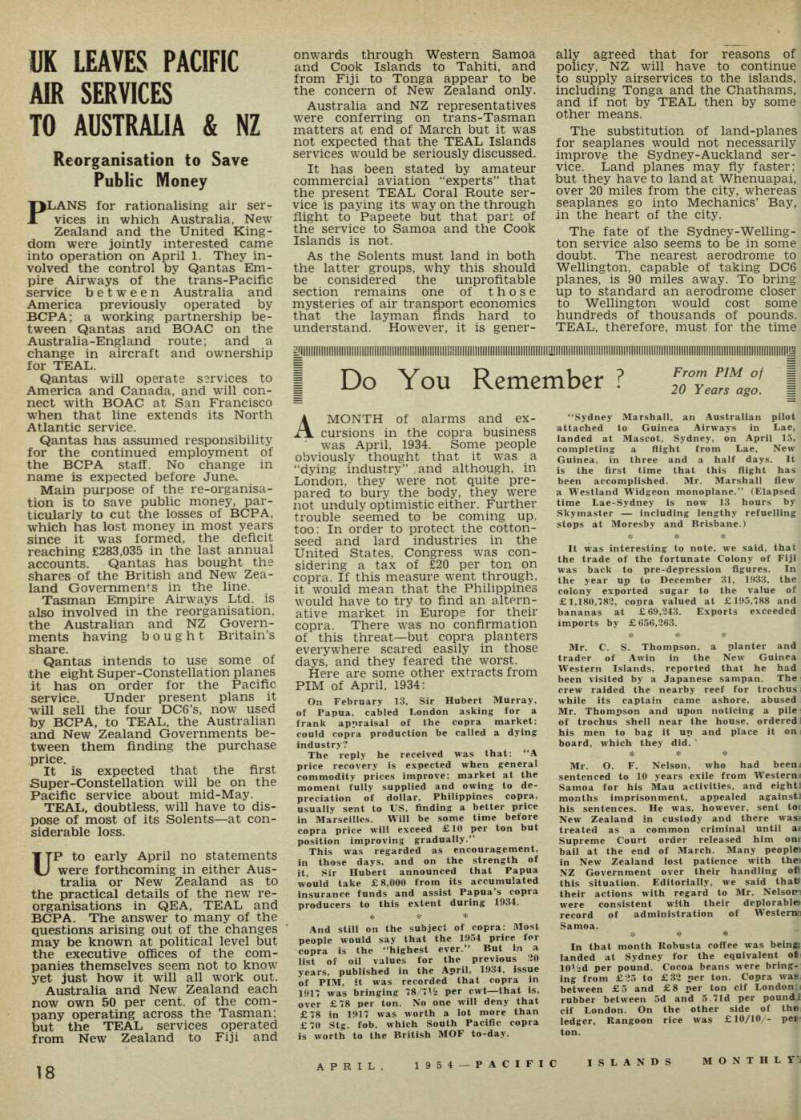
From PIM of 20 Years ago.
A MONTH of alarms and ex cursions in the copra business was April, 1934. Some people obviously thought that it was a “dying industry” .and although, in London, they were not quite pre pared to bury the body, they were not unduly optimistic either. Further trouble seemed to be coming up, too: In order to protect the cotton seed and lard industries in the United States, Congress was con sidering a tax of £2O per ton on copra. If this measure went through, it would mean that the Philippines would have to try to find an altern ative market in Europe for their copra. There was no confirmation of this threat—but copra planters everywhere scared easily in those days, and they feared the worst.
Here are some other extracts from PIM of April, 1934; On February 13, Sir Hubert Murray, of Papua, cabled London asking for a frank appraisal of the copra market; could copra production be called a dying industry?
The reply he received was that: “A price recovery is expected when general commodity prices improve; market at the moment fully supplied and owing to de preciation of dollar, Philippines copra, usually sent to US, finding a better price in Marseilles. Will be some time before copra price will exceed £lO per ton but position improving gradually.”
This was regarded as encouragement, in those days, and on the strength of it, Sir Hubert announced that Papua would take £B,OOO from its accumulated insurance funds and assist Papua’s copra producers to this extent during 1934. * * * And still on the subject of copra: Most people would say that the 1954 price for copra is the “highest ever.” But in a list of oil values for the previous 30 years, published in the April, 1934, issue of PIM, it was recorded that copra in 1917 was bringing 78/7V2 per cwt—that is, over £7B per ton. No one will deny that £7B in 1917 was worth a lot more than £7O Stg. fob, which South Pacific copra is worth to the British MOF to-day.
“Sydney Marshall, an Australian pilot attached to Guinea Airways in Lae, landed at Mascot, Sydney, on April 15, completing a flight from Lae, New Guinea, in three and a half days. It is the first time that this flight has been accomplished. Mr. Marshall flew a Westland Widgeon monoplane.” (Elapsed time Lae-Sydney is now 13 hours by Skymaster including lengthy refuelling stops at Moresby and Brisbane.) * * * It was interesting to note, we said, that the trade of the fortunate Colony of Fiji was back to pre-depression figures. In the year up to December 31, 1933, the colony exported sugar to the value of £ 1,180,782, copra valued at £195,788 and bananas at £69,343. Exports exceeded imports by £656,363. * * * Mr. C. S. Thompson, a planter and trader of Awin in the New Guinea Western Islands, reported that he had been visited by a Japanese sampan. The: crew raided the nearby reef for trochus, while its captain came ashore, abused Mr. Thompson and upon noticing a pile of trochus shell near the house, ordered! his men to bag it up and place it on board, which they did. * * * Mr. O. F. Nelson, who had beeni sentenced to 10 years exile from Westerni Samoa for his Mau activities, and eightl months imprisonment, appealed againsti his sentences. He was, however, sent toi New Zealand in custody and there was? treated as a common criminal until a i Supreme Court order released him om bail at the end of March. Many people? in New Zealand lost patience with the?
NZ Government over their handling oft this situation. Editorially, we said that! their actions with regard to Mr. Nelsons were consistent with their deplorable record of administration of Westernn Samoa. * * * In that month Robusta coffee was beings landed at Sydney for the equivalent oil 10V2d per pound. Cocoa beans were bring ing from £35 to £33 per ton. Copra was between £5 and £8 per ton cif London;s rubber between 5d and 5.71 d per pound,! cif London. On the other side of the ledger, Rangoon rice was £lO/10/- per ton.