120 Years Of Nursing
pp. 75-77 · Read in the full issue
Amongst Them
By Edward W. Johnson
FEBRUARY of this year marked the 40th anniversary of the founding of the Samoan Nurses’
Training School in American Samoa.
The Navy, in its 14th year of ad ministration of the islands of Tutuila and the Manua Group found that its Medical Department was in extreme need of female nurs ing assistants, and sent Navy Nurses Mary H. Humphrey and Corinne Anderson to set up a school of nursing for Samoan Girls.
The LMS Atauloma Girls’ School under the able tutelage of Miss Jean Begg offered the best material. Miss Begg recommended three young ladies, Misses Winnie, Initia and Pepe. The girls lived in the same quarters with the Navy Nurses while undergoing two hard years of work.
Pepe was considered far too small to carry such a big load and was advised to give up the course. She refused and not only graduated with the other two but in time be came first Samoan Chief Nurse of he Hospital. The first class scat tered after graduation in 1916.
Initia to duty in Western Dis trict and Pepe to the Eastern while Winnie remained in the hospital, six months later positions were exchanged. The ensuing classes
were also small but as fast as they graduated they filled positions in the districts and hospital. resigned to marry in 1918 and Winnie in 1921. Both departed
with their Missionary husbands for other islands. Initia went to New Guinea and worked as missionary’s 5 an d nurse until her husband died of malaria. She then returned to Samoa and nursing practice, Winnie performed similar work with her husband in the Gilberts, had four children, returning to American Samoa in 1939, shortly
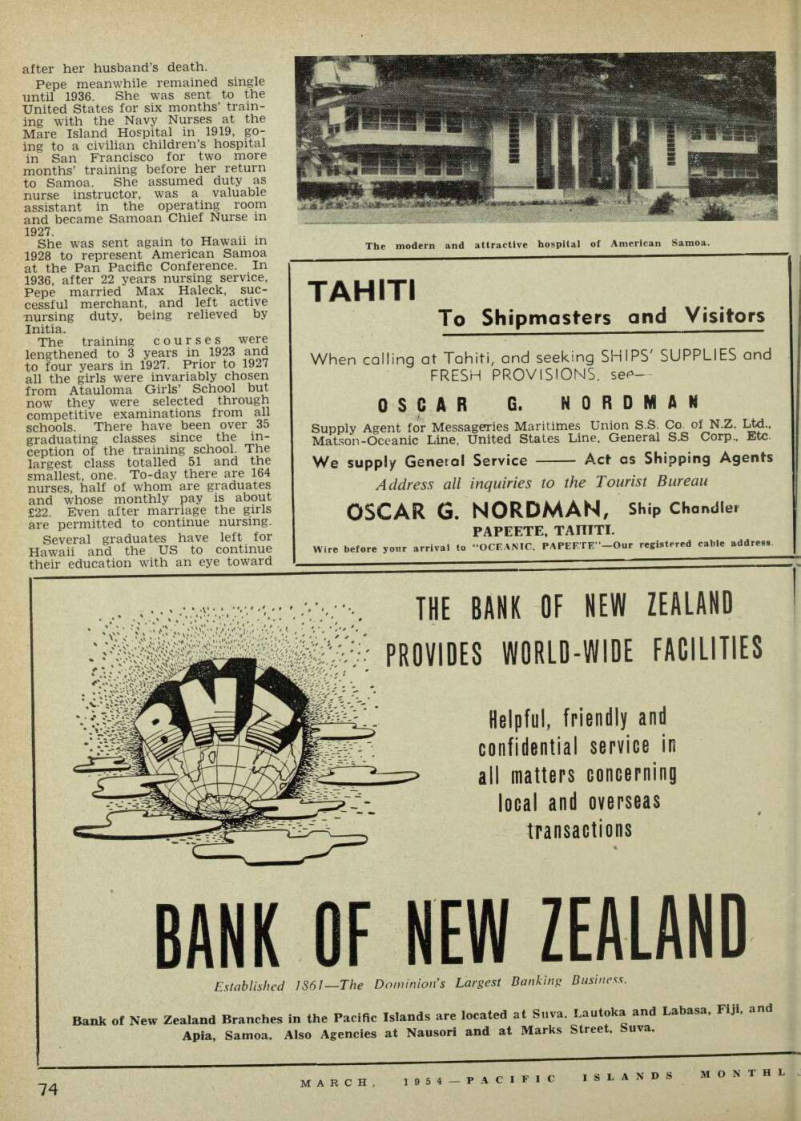
Eastern Samoa’s three original nurses, left to right: Winnie, now Chief Samoan Nurse; Initia, now serving in Papua-New Guinea; and Pepe, now Mrs. Max Haleck of Pago Pago.
after her husband’s death.
Pepe meanwhile remained single until 1936. She was sent to the United States for six months’ train ing with the Navy Nurses at the Mare Island Hospital in 1919, go ing to a civilian children’s hospital in San Francisco for two more months’ training before her return to Samoa. She assumed duty as nurse instructor, was a valuable assistant in the operating room and became Samoan Chief Nurse in 1927.
She was sent again to Hawaii in 1928 to represent American Samoa at the Pan Pacific Conference. In 1936, after 22 years nursing service, Pepe married Max Haleck, suc cessful merchant, and left active nursing duty, being relieved by Initia.
The training courses were lengthened to 3 years in 1923 and to four years in 1927. Prior to 1927 all the girls were invariably chosen from Atauloma Girls’ School but now they were selected through competitive examinations from all schools. There have been over 35 graduating classes since the in ception of the training school. The largest class totalled 51 and the smallest, one. To-day there are 164 nurses, half of whom are graduates and whose monthly pay is about £22. Even after marriage the girls are permitted to continue nursing.
Several graduates have left for Hawaii and the US to continue their education with an eye toward
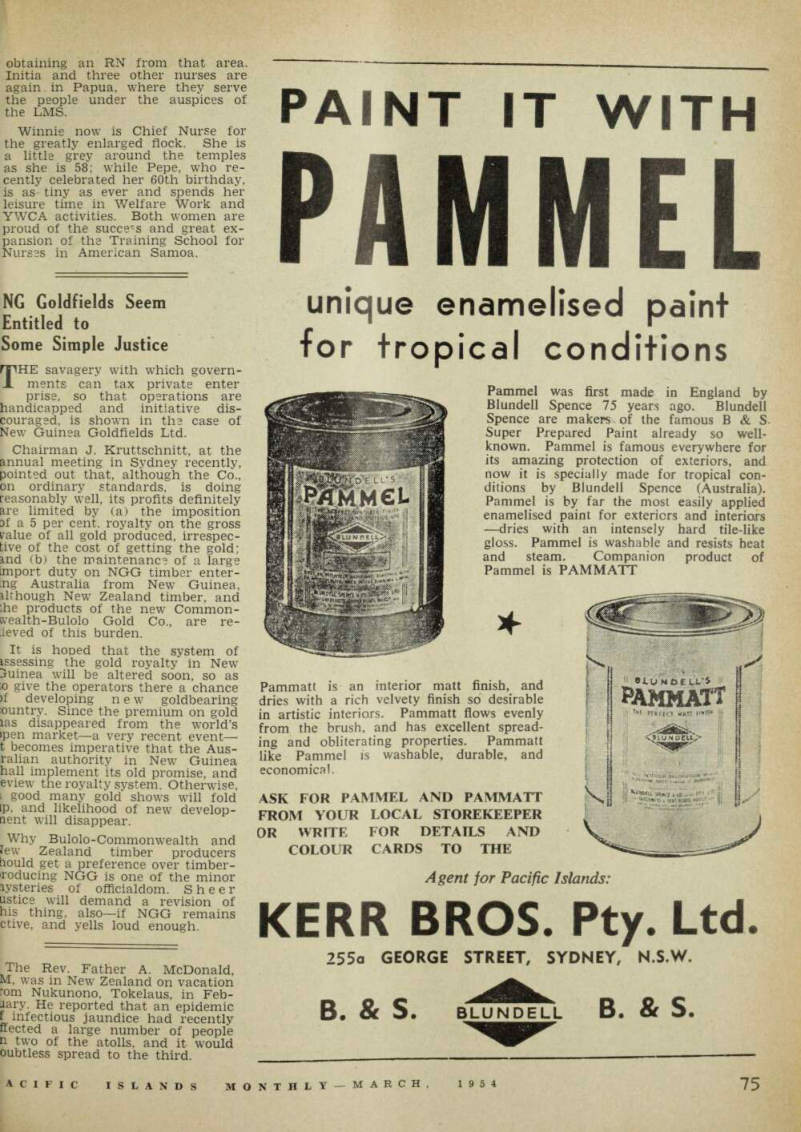
The modern and attractive hospital of American Samoa.
obtaining an RN from that area.
Initia and three other nurses are again. in Papua, where they serve the people under the auspices of the LMS.
Winnie now is Chief Nurse for the greatly enlarged flock. She is a little grey around the temples as she is 58; while Pepe, who re cently celebrated her 60th birthday, is as tiny as ever and spends her leisure time in Welfare Work and YWCA activities. Both women are proud of the success and great ex pansion of the Training School for Nurses in American Samoa.