Take Over
p. 73 · Read in the full issue
The Bureaucrats
Story of Swains Island
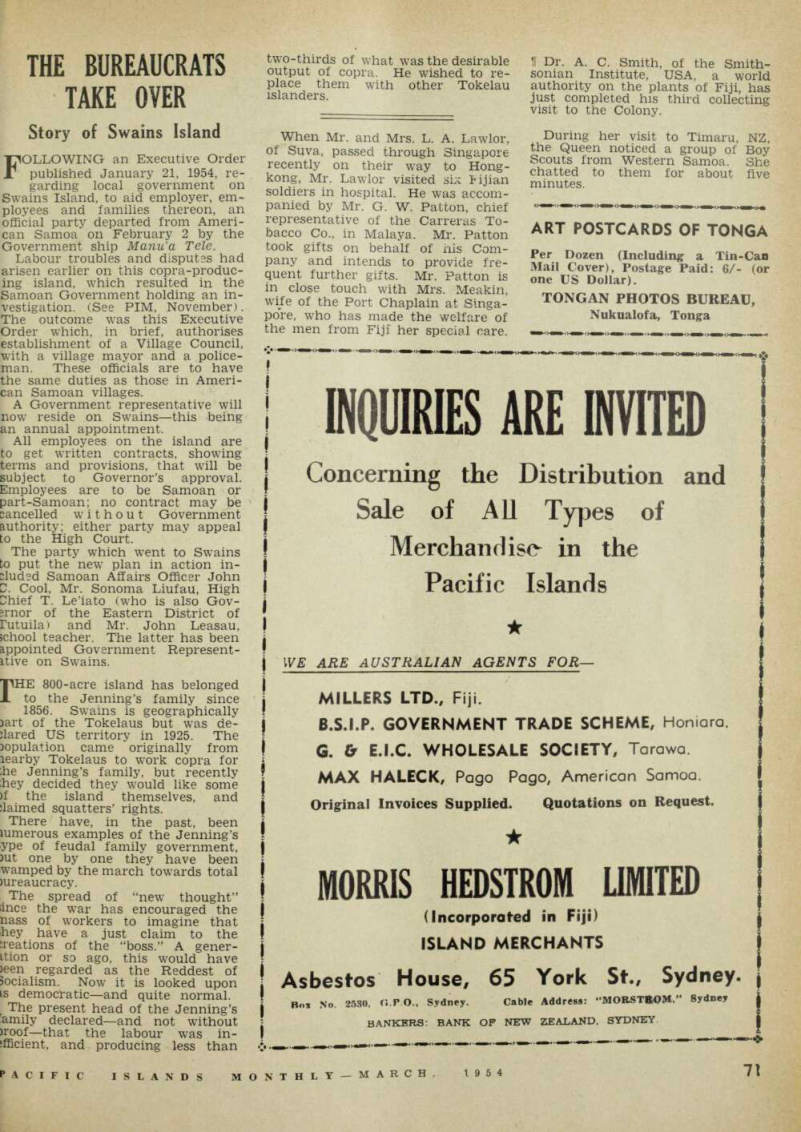
FOLLOWING an Executive Order published January 21, 1954, re garding local government on Swains Island, to aid employer, em ployees and families thereon, an official party departed from Ameri can Samoa on February 2 by the Government ship Manu’a Tele.
Labour troubles and disputes had arisen earlier on this copra-produc ing island, which resulted in the Samoan Government holding an in vestigation. (See PIM, November).
The outcome was this Executive Order which, in brief, authorises establishment of a Village Council, with a village mayor and a police man. These officials are to have the same duties as those in Ameri can Samoan villages.
A Government representative will now reside on Swains —this being an annual appointment.
All employees on the island are to get written contracts, showing terms and provisions, that will be subject to Governor’s approval.
Employees are to be Samoan or part-Samoan; no contract may be cancelled without Government authority; either party may appeal to the High Court.
The party which went to Swains to put the new plan in action in cluded Samoan Affairs Officer John D. Cool, Mr. Sonoma Liufau, High Chief T. Le’iato (who is also Gov ernor of the Eastern District of rutuila) and Mr. John Leasau, school teacher. The latter has been appointed Government Represent ative on Swains. rHE 800-acre island has belonged to the Jenning’s family since 1856. Swains is geographically jart of the Tokelaus but was de ;lared US territory in 1925. The Dopulation came originally from learby Tokelaus to work copra for ;he Jenning’s family, but recently ihey decided they would like some )f the island themselves, and :laimed squatters’ rights.
There have, in the past, been mmerous examples of the Jenning’s ype of feudal family government, )ut one by one they have been wamped by the march towards total mreaucracy.
The spread of “new thought” lince the war has encouraged the nass of workers to imagine that hey have a just claim to the :reations of the “boss.” A gener ition or so ago, this would have )een regarded as the Reddest of Socialism. Now it is looked upon is democratic—and quite normal.
The present head of the Jenning’s amily declared—and not without )roof —that the labour was in :fficient, and producing less than
two-thirds of what was the desirable output of copra. He wished to re place them with other Tokelau islanders.
When Mr. and Mrs. L. A. Lawlor, of Suva, passed through Singapore recently on their way to Hong kong, Mr. Lawlor visited six Pijian soldiers in hospital. He was accom panied by Mr. G. W. Patton, chief representative of the Carreras To bacco Co., in Malaya. Mr, Patton took gifts on behalf of his Com pany and intends to provide fre quent further gifts. Mr. Patton is in close touch with Mrs. Meakin, wife of the Port Chaplain at Singa pore, who has made the welfare of the men from Fiji her special care.
H Dr. A. C. Smith, of the Smith sonian Institute, USA, a world authority on the plants of Fiji, has just completed his third collecting visit to the Colony.
During her visit to Timaru, NZ, the Queen noticed a group of Boy Scouts from Western Samoa. She chatted to them for about five minutes.