Kenaf Trouble
p. 23 · Read in the full issue
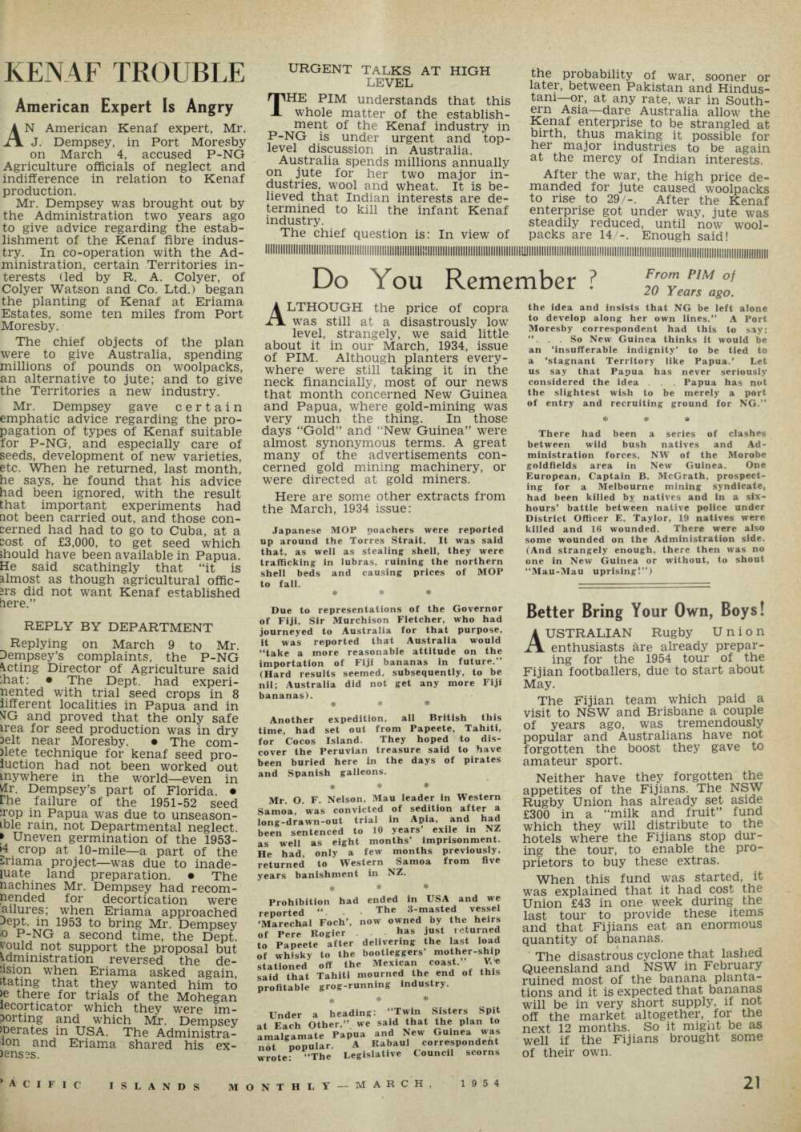
American Expert Is Angry
AN American Kenaf expert, Mr.
J. Dempsey, in Port Moresby on March 4, accused P-NG Agriculture officials of neglect and indifference in relation to Kenaf production.
Mr. Dempsey was brought out by the Administration two years ago to give advice regarding the estab lishment of the Kenaf fibre indus try. In co-operation with the Ad ministration, certain Territories in terests (led by R. A. Colyer, of Colyer Watson and Co. Ltd.) began the planting of Kenaf at Eriama Estates, some ten miles from Port Moresby.
The chief objects of the plan were to give Australia, spending millions of pounds on woolpacks, an alternative to jute; and to give the Territories a new industry.
Mr. Dempsey gave certain emphatic advice regarding the pro pagation of types of Kenaf suitable for P-NG, and especially care of seeds, development of new varieties, etc. When he returned, last month, he says, he found that his advice had been ignored, with the result that important experiments had not been carried out, and those con cerned had had to go to Cuba, at a cost of £3,000, to get seed which should have been available in Papua.
He said scathingly that “it is almost as though agricultural offic ers did not want Kenaf established here.”
Reply By Department
Replying on March 9 to Mr.
Dempsey’s complaints, the P-NG Acting Director of Agriculture said ;hat: • The Dept, had experi mented with trial seed crops in 8 iifferent localities in Papua and in STG and proved that the only safe irea for seed production was in dry aelt near Moresby. • The com pete technique for kenaf seed pro motion had not been worked out inywhere in the world—even in Hr. Dempsey’s part of Florida. • rhe failure of the 1951-52 seed :rop in Papua was due to unseason ible rain, not Departmental neglect. » Uneven germination of the 1953- *4 crop at 10-mile—a part of the Lnama project—was due to inade luate land preparation. • The nachines Mr. Dempsey had recom mended for decortication were ailures; when Eriama approached Dept, in 1953 to bring Mr. Dempsey o P-NG a second time, the Dept, vould not support the proposal but Administration reversed the de ;ision when Eriama asked again, itatmg that they wanted him to )e there for trials of the Mohegan lecorticator which they were im porting and which Mr. Dempsey •Derates in USA. The Administra 10n and Eriama shared his ex tenses.
Urgent Talks At High
Level
THE PIM understands that this whole matter of the establish ment of the Kenaf industry in P-NG is under urgent and top level discussion in Australia.
Australia spends millions annually on jute for her two major in dustries, wool and wheat. It is be lieved that Indian interests are de termined to kill the infant Kenaf industry.
The chief question is: In view of
the probability of war, sooner or later, between Pakistan and Hindus tani—or, at any rate, war in South ern Asia—dare Australia allow the Kenaf enterprise to be strangled at birth, thus making it possible for her major industries to be again at the mercy of Indian interests.
After the war, the high price de manded for jute caused woolpacks to rise to 29/-. After the Kenaf enterprise got under way, jute was steadily reduced, until now wool packs are 14/-. Enough said!