(And, Particularly, The Duke of Edinburgh)
pp. 20-139 · Read in the full issue
Royal Visit In Retrospect:
God Save Our Gracious Queen!
THE Royal Progress rolls on. The other day, in Melbourne, the Duke of Edinburgh received his sixth gift walking stick. He re ceived the first in Fiji. He didn’t say it —but he probably thought: “What do they think I am—a cripple?”
By the time you read this, the Tour will be winding to a close in South Australia and Western Aus tralia. The Queen has already opened five Parliaments —with one more to go. She has a reprieve from this formal duty in Queensland and WA—possibly because these two States have no Upper House, and the Lower House is always tradition ally tabu to the Sovereign.
In each city there have been a Royal Progress, a civic reception or welcome, a returned servicemen’s rally, school children’s rallies, a State dinner, a State ball (Mel bourne had two balls), a Garden Party. Frequently, a luncheon for Her Majesty with women’s organisations; a concert, a film show, an opera, or some other entertainment. In each country town there have been speeches of welcome by the Mayor (or Shire President), children’s rallies, ser vicemen’s rallies, country shows, fleeting visits to rural industries.
There have been variations on this theme —but that is the gen eral pattern. By March, with still a month to go, journalists are run ning short on words in which to describe the same things, differ ently; radio commentators are pro ducing the same running descrip tions with deadly monotony.
AND what of Her Majesty? As some reader from Fiji has already written: the Queen seems to have an inner strength.
He did not mean exactly what we mean—but whatever she has, in order to sustain her on those monotonous occasions, she surely needs it.
And the Duke? Her Majesty, in a sense, has been brought up to withstand these public ordeals, and, from observation, I should say that within the established customs of these formal occasions she is en tirely comfortable.
The Duke, on the other hand, has not been so brought up. Being an entirely human young man, he must find some of the repetitious form alities cruelly boring. During the Canberra festivities, at the pre sentation of new Colours at Dun troon, when duty compelled him to dress up in the tight pants and accoutrements of a Field Marshal and stand in the boiling sun, on an alien parade ground, he looked positively unhappy. * * * APART from the Royal Party it self, the Tour is made up of four sections; • The VlP’s, mostly political, who are seen everywhere; same people, different clothes. • The comparatively small num ber of people who know someone who knows someone and can thus obtain an invitation to some of the functions. ® The crowds—the mobs, if you
like it that way—whose place is be hind the barriers. • And the Press.
You may think that you dislik© both the last two categories. But.? without them, the Tour would hav©' long since fallen flat on its face. .
A few newspapers, have departed from good taste arid) fair play in order to get a storyj or play up an angle; but on the whole, their conduct has been all that could be desired.
Between 60 and 80 press men ano women are with the Tour continu-i ally. They do everything that the: Royal pair do—and, in additionn write their stories, catch their dead-i lines, look after themselves, try toj catch some sleep, keep an eye on. their laundry, their transport, a hairi cut or a hair-set, live in suitcases a but appear well-groomed at any y thing from a kids’ rally to a StaW Ball.
By nature they are a cynicas tribe. Yet their sole purpose seem;n to have been to build up this Royas Tour—when, at times, it would hav«v been fatally easy for them to down. The Press has been thtii vehicle on which the Tour has rolleoe on, on oiled wheels.
NOW, the crowds. It is my opinioitc that it is from these that th'ri Queen draws that thing whicKo our reader called “inner strength..!
The “Queen” feeling”, engendered in a large waiting crowd—maS3i hysteria, if you want to put it thacj way—is quite a different thing td the feeling engendered in a selecD? few VlP’s at an exclusive occasionc And the Queen, driving, smilinin and waving through cheering peoplic —when they keep at a safe distfg ance —appears a different being tit
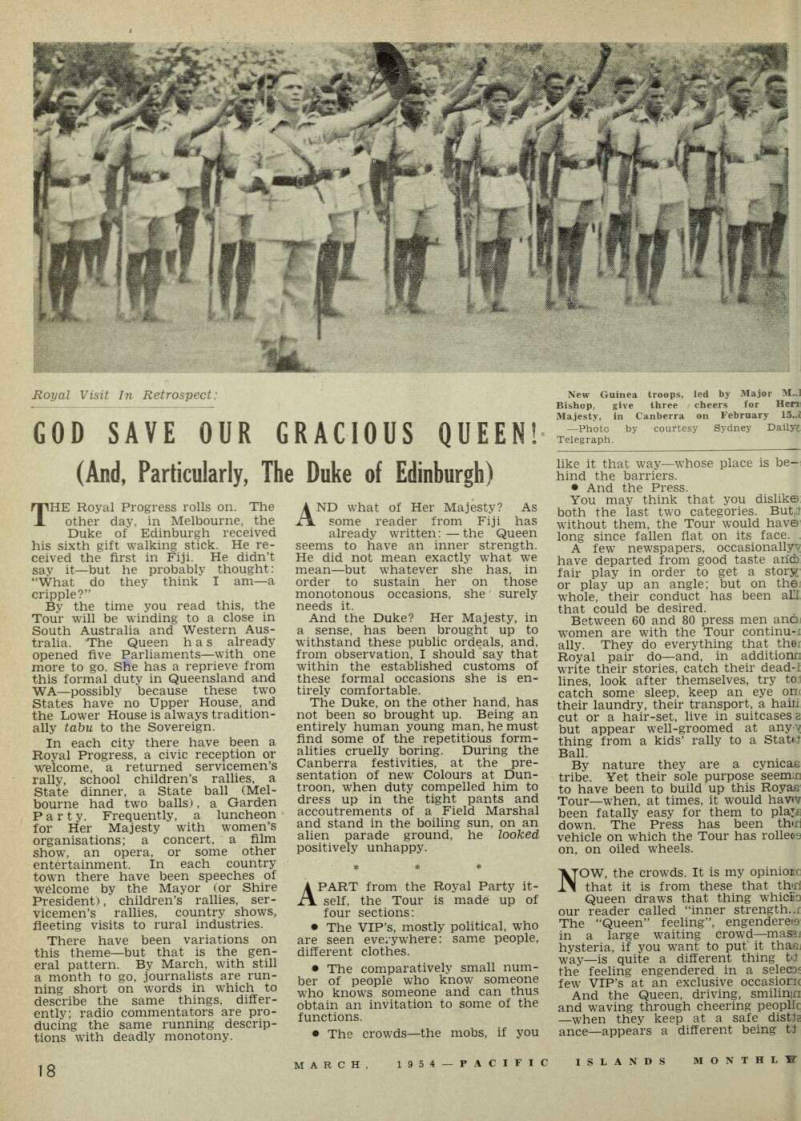
New Guinea troops, led by Major M.
Bishop, give three cheers for Her Majesty, in Canberra on February 15.
Photo by courtesy Sydney Daily Telegraph.
the rather remote young creature who makes her formal appearance Delore the select VlP’s.
Occasionally the crowds have beoome mobs, have been badly behaved; but generally—and in the 'Circumstances—they have behaved well. They have waited for hours -in teeming rain or blistering sun,
packed a dozen deep, knowing full well that only a fraction of them will see anything more than a white, gloved hand raised in salute, or the brim of a tiny hat, in one fleeting glimpse.
It is all very like a stage produc tion: The Queen and the Duke as
the principals; the VlP’s as the bit players—often only the props on which lavish gowns and gentle men’s best suitings are displayed; the crowds as the audience—pushed and harried and crushed, thrust as far off as possible behind the barriers, phenomenally patient from them come the cheers, the
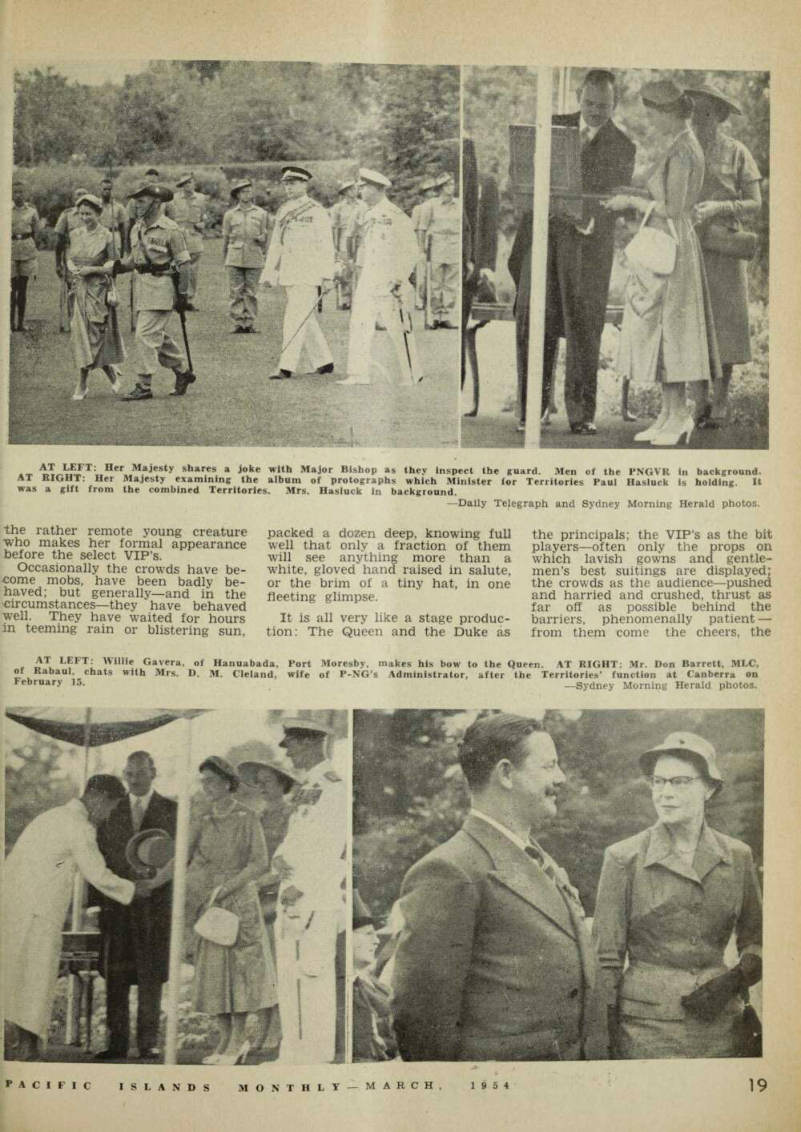
Her Majesty sbares a Jo ke with Major Bishop as they inspect the guard. Men of the PNGVR in background.
AT RIGHT; Her Majesty examining the album of protographs which Minister for Territories Paul Hasluck is holding. It was a gift from the combined Territories. Mrs. Hasluck in background.
Daily Telegraph and Sydney Morning Herald photos.
AT LEFT: Gavera, of Hanuabada, Port Moresby, makes his bow to the Queen. AT RIGHT: Mr. Don Barrett, MLC, of Rabaul, chats with Mrs. D. M. Cleland, wife of P-NG’s Administrator, after the Territories’ function at Canberra on February 15. —Sydney Morning Herald photos.
applause, the approval. Without them there would be no show. ♦ ❖ * The crowds have had a raw deal, on the whole. Yet, it is hard to see how it could ever be any different.
There have been the usual cries that the VlP’s and the politicians were monopolising the Royal couple; that they should be allowed to meet ordinary people; or young people or some other kind of people. But generally, it is difficult to see how this could be done. The crowd could not be let loose about them, that is certain —they would be crushed to death in the process.
But even if ordinary folks could be divided into manageable con gregations I. personally, feel that the Queen would probably find it a considerable ordeal. Although she obviously has a deep feeling for the crowd —“my people”—a n d reacts tremendously to their enthusiasm and applause, she appears much more at ease in carrying out, in pre scribed form, the tasks she is used to, than when she meets up un expectedly with the unexpected.
Then there is a momentary hesita tion and a feeling of restraint.
The Duke, of course, is another proposition. There is probably noth ing he would like better than to meet a lot of strange people doing strange things.
One Canberra citizen —who waited eight hours in the rain to catch a glimpse of Her Majesty’s white glove as she flashed past, wearing her magnificent Coronation gown, on her way to open Federal Parlia ment on February 15 —has a solu tion to this business of the mass look. He suggested that the Queen
sit on a saluting platform while the citizenry drive past her. Much more comfortable for the citizens, and probably no worse for Her Majesty than a march-past of massed troops.
H 5 H 5 % THE Territories’ gathering on the lawns of Government House, Canberra, on the forenoon of February 15, I think, could have served as an experiment in letting the Royal pair meet the people.
Territorians themselves seemed very content with the proceedings, but to me it appeared a very formal little ceremony which could have had some of the stiffening removed without harming anyone. The Queen, on this occasion, seemed more re mote and solemn than usual, and press photographers had to work hard for a smiling photograph.
The Royal dais was flanked on one side by a great body of top hatted, frock-coated Federal poli ticians and their ladies; and on the other, by an equal-sized body of diplomats and their wives, all in exotic array.
The party would have been just as happy without them; and then, perhaps, Her Majesty and His Royal Highness would have felt inclined to chat informally with the as sembled Territories people, after the more formal presentations were over.
Each of those delegates has led an interesting life, in places re mote from the ken of either of our Royal visitors. All have a story to tell, and all Territorians like to talk. Here was a small group, of say 30, who could, if spared 30 minutes of precious Royal time,
have given the visitors at least a glimpse of life in strange countries which they will probably never see.
The conversations attending the formal presentations, although they looked impressive enough as re ported in the newspapers, in reality were of only a few seconds’ dura tion.
THE conversation which Simogun, the native New Guinea Legis lative Councillor, had with the Duke has been variously built up in the newspapers into many para graphs.
Actually, Simogun bowed to the Duke, shook hands and the Duke asked him a question. Simogun re plied in Pidgin—probably to the effect that he spoke only Pidgin. The Duke craned his neck forward in that characteristic attitude of his and looked as though he were say ing, in some surprise, “U-m-m?”; and Simogun, evidently feeling that this was a conversation that led no where, moved on.
It was over in four seconds, flat.
After the presentations, the speeches and the acceptance by Her Majesty of the Territories’ gift photo album, the Royal party went straight back indoors. * * * IWAS standing a few yards from a the dais —close enough to hear * Minister Hasluck when he pre- sented the Territories’ gift—but not d close enough to hear what the Ad- ministrator of the Northern Terri- tory said in his Address of Loyalty on behalf of all the Territories rep- resented. The microphones were? out of action and came on only y after Her Majesty began her reply..
To the uninstructed onlooker,, what happened was this: A worried-looking man appeared on the dais,,; read a few sentences from a paper,, in an inaudible voice, presented it d to the Queen, and hurriedly with drew.
I was therefore surprised to findb that, according to the official hand out, the Northern Territory’s Ad ministrator said this: “To Her Most Excellent Majesty Eliza beth 11.
“May it please Your Most Graciousei Majesty— “We, the Administrators of the Austra lian Territories respectfully desire to con—i vey to you and to His Royal Highness, thC9i Duke of Edinburgh, the affectionate greet—j ings of the peoples of those Territoriese-i and, on their behalf, to tender to you ann expression of devotion and loyalty to thes.
Throne and to Your Majesty.
“The delegations here to-day have corner thousands of miles to bring this messages to you. They have come from the fam north and the centre of the continent, from the Island of Norfolk, sen-? gem-like in the South Pacific, from thon tropical richness and mountain splendours! of Papua and New Guinea, and fromm Nauru, the loneliest outpost of all, lyingr just below the equator in mid-Pacific.
These Territories are still engaged imx the work of pioneering and development/! and the guardianship and advancement/! of dependent peoples. Both the nativov
(Continued on Pagre 13”)
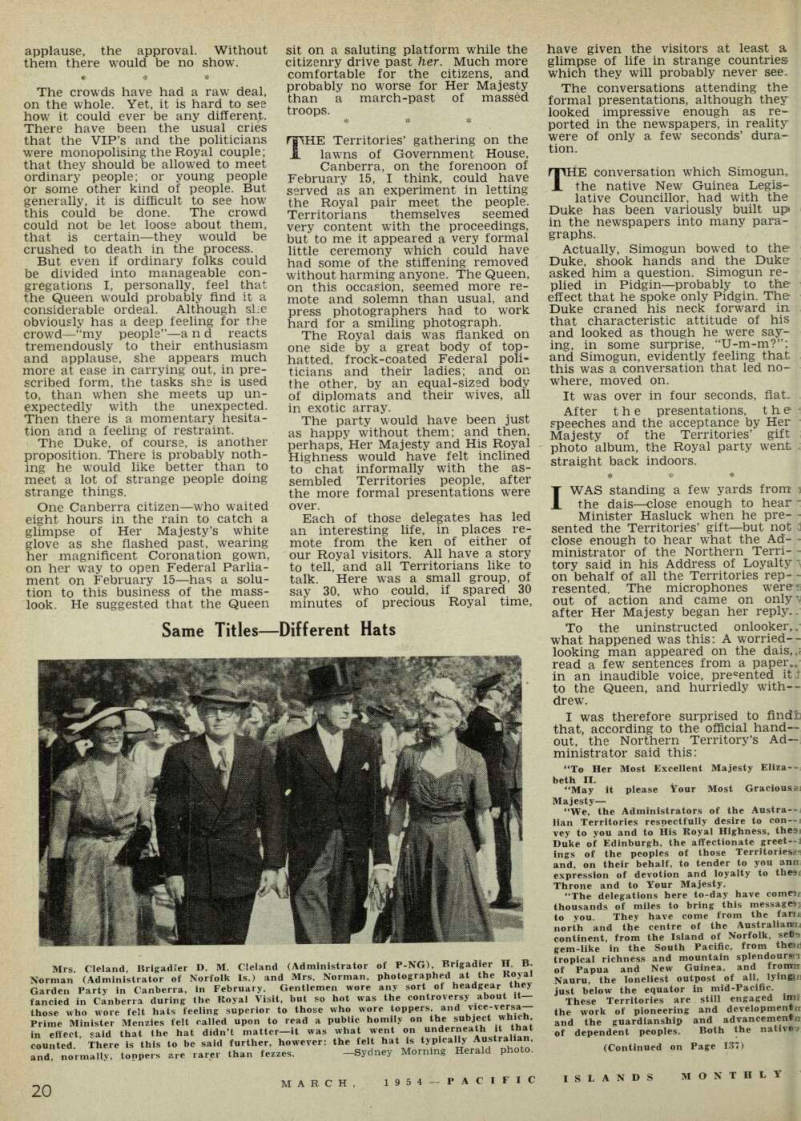
Same Titles—Different Hats
Mrs. Cleland, Brigadier D. M. Cleland (Administrator of P-NG), Brigadier H. B.
Norman (Administrator of Norfolk Is.) and Mrs. Norman, photographed at the Royal Garden Party in Canberra, in February. Gentlemen wore any sort of headgear they fancied in Canberra during the Royal Visit, but so hot was the controversy about it— those who wore felt hats feeling superior to those who wore toppers, and vice-versa Prime Minister Menzies felt called upon to read a public homily on the subject which, in effect, said that the hat didn’t matter-it was what went on underneath it that counted. There is this to be said further, however: the felt hat is typically Austral, and. normally, toppers are rarer than fezzes. —Sydney Morning Herald photo.
eoples and the Australians are seeking to ork together for mutual benefit and for re progress of the lands that are their ►mmon home.
“Wihether in palm-thatched village or on ic vast expanse of an inland cattle ation, whether on the sea-fringed plan ition or the garden among the island nes, they live under laws, shielded by istice, served by an administration and lited in a loyalty and a hope that all srive from the British Throne.
“It is the regret of all their inhabitants tat they have not the opportunity of elcoming you in person to their own lores. They pray, that, on some future casion, Your Majesty may yet be able honour them with a visit. Meanwhile, ey hope and trust that your visit to eir mother country, Australia, will be iiitful and enjoyable and they unite in shing you safe return, at the conclusion your tour, to the companionship of ur beloved children.
“Signed at Canberra, on behalf of the oples of the Australian Territories and th a renewed avowal of our own per aal loyalty and affection, this Fifteenth y of February, 1954.”
Signatories were F. J. S. Wise, H. Boyd rman, D. M. Cleland, J. K. Lawrence, that order.
I should like to take an even bet at he read no more than the first Tagraph. And I cannot blame m for boggling at the lush rest it—far removed from how Terri rians would describe their own rritories.
We understand that the speeches ide to the Queen, on this tour, d her speeches in reply, were all spared months ago and approved Buckingham Palace before she t London. There are, therefore, surprises in any of them for yone; they are completely made of generalisations to fit a gen ii, not a particular, situation. :t is a great pity, however, that nething could not have been itten into the Queen’s speech in tise of the native servicemen ose bearing and drill, as her ique guard, were really excellent.
These native people were sent to nberra in order that they might ye some close contact with the een whom they are taught to lour and obey. But only Simo i, as a Legislative Councillor, was mitted to see Her Majesty in magnificence of her Coronation m and glittering jewels. To the t, she probably appeared much - any other very personable and sed young European woman. * * * ATIVE members of the Terri tories’ delegations attended many of the important Canberra ctions and took them all in their de with a quiet and natural aity —often foreign to Europeans ) are given to fluttering and bling on high social occasions, here were 3,800 people at the r al Garden Party at Government ise, Canberra, on February 17— )ng them about 30 Territorians. )ent an hour and a half look-
mg for these 30, but, although scouts reported them here and there during the afternoon, I succeeded in running to earth only half a dozen, including Simogun.
SimQgun, like me, had given away the idea of seeing the Queen and the Duke in the crush of well dressed people, and was sensibly established outside the tea marquee, deep in conversation with Namat jira, the Arunta tribesman of Central Australia who has become a famous painter of landscapes and a social lion (and doesn’t let it bother him) and with Micky (Ginger one) Maureen, who runs an Administration launch around Darwin. They were fortifying them selves with orangeade, ice-cream and iced-cakes, and discussing painting, maybe, or launches—or Europeans.
I got myself a cup of tea, and Simogun courteously assisted my search.
“Masta James? He no stop. Be fore me look’im—now he go finish,” he said.
Simogun comes from near Wewak, TNG. Once, I used to call this part of the world home, too. I never thought then that, some day, I should find myself in his company at a Royal garden party in Can berra—and by that I don’t mean that it was incongruous to do so,
although I might have thought so once.
One can meet, at a Government House garden party, a lot of less Interesting folk than the native representatives of our Territories and Pacific Islands.
MEANTIME, the Queen the Duke were doing what, accord ing to the official book, is de scribed as “mingling informally with the guests.” This consisted of the guests forming a tight little circle, ten deep, around each of them— the inner circle being kept off the Royal personages by members of their staff.
From a distance, these circles of people looked like a plot of a couple of erratic cyclones—the Queen and the Duke representing the “eye” of each. Wherever the Royal visitors moved, so did the tight rings of people.
However, the Canberra party guests were comparatively well be haved. I saw no top-hatted gentle men up in the trees or chiffon draped dowagers standing on chairs straining for a view—as has been reported about similar parties in Sydney and Melbourne.
After an hour and a half of do ing my duty, mostly vainly, and long before Her Majesty could do likewise, I escaped. In my case, to the privacy of the Press bus where, in company with a tired police man, a soldier and a bus-driver, 1 put my feet up. —JUDY TUDOR.