£7O Stg. Fob Is New Basic Copra Price
p. 17 · Read in the full issue
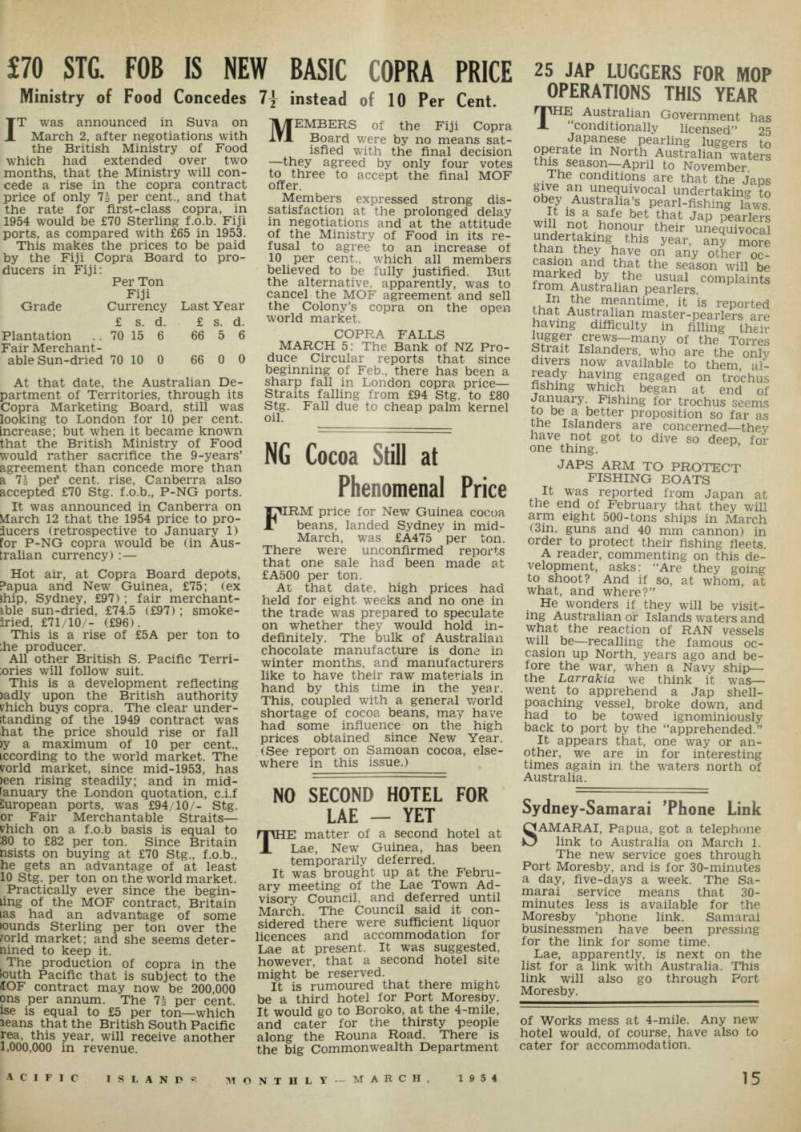
Ministry of Food Concedes 7½ instead of 10 Per Cent.
IT was announced in Suva on March 2, after negotiations with the British Ministry of Food which had extended over two months, that the Ministry will con cede a rise in the copra contract price of only 11 per cent., and that the rate for first-class copra, in 1954 would be £70 Sterling f.o.b. Fiji ports, as compared with £65 in 1953.
This makes the prices to be paid by the Fiji Copra Board to pro ducers in Fiji:
At that date, the Australian De partment of Territories, through its Copra Marketing Board, still was looking to London for 10 per cent, increase; but when it became known that the British Ministry of Food would rather sacrifice the 9-years’ agreement than concede more than a 71 pef cent, rise, Canberra also accepted £70 Stg. f.o.b., P-NG ports.
It was announced in Canberra on March 12 that the 1954 price to pro iucers (retrospective to January 1) for P-NG copra would be (in Aus tralian currency):— Hot air, at Copra Board depots, Papua and New Guinea, £75; (ex ship, Sydney, £97); fair merchant ible sun-dried, £74.5 (£97); smoke iried, £71/10/- (£96).
This is a rise of £5A per ton to ;he producer.
All other British S. Pacific Terri fies will follow suit.
This is a development reflecting )adly upon the British authority yhich buys copra. The clear under itanding of the 1949 contract was hat the price should rise or fall )y a maximum of 10 per cent., iccording to the world market. The yorld market, since mid-1953, has >een rising steadily; and in mid fanuary the London quotation, c.i.f European ports, was £94/10/- Stg. or Fair Merchantable Straits — vhich on a f.o.b basis is equal to 80 to £82 per ton. Since Britain nsists on buying at £70 Stg., f.o.b., he gets an advantage of at least 10 Stg. per ton on the world market.
Practically ever since the begin ling of the MOF contract, Britain las had an advantage of some lounds Sterling per ton over the forld market; and she seems deter nined to keep it.
The production of copra in the South Pacific that is subject to the lOF contract may now be 200,000 ons per annum. The 11 per cent, ise is equal to £5 per ton—which leans that the British South Pacific rea, this year, will receive another 1,000,000 in revenue.
MEMBERS of the Fiji Copra Board were by no means sat isfied with the final decision —they agreed by only four votes to three to accept the final MOF offer.
Members expressed strong dis satisfaction at the prolonged delay in negotiations and at the attitude of the Ministry of Food in its re fusal to agree to an increase of 10 per cent., which all members believed to be fully justified. But the alternative, apparently, was to cancel the MOF agreement and sell the Colony’s copra on the open world market.
Copra Falls
MARCH 5: The Bank of NZ Pro duce Circular reports that since beginning of Feb., there has been a sharp fall in London copra price— Straits falling from £94 Stg. to £BO Stg. Fall due to cheap palm kernel oil.
Grade Per Ton Fiji Currency Last Year £ s. d. £ s. d.
Plantation 70 15 6 66 5 6 Fair Merchantable Sun-dried 70 10 0 66 0 0