Germany’s Revival is Outstanding
pp. 15-16 · Read in the full issue
Factor in Changing World
rHERE is a tendency to listen to the queer people who say that the Cold War is less acute — ;hat the danger of a hot World War 111 is receding.
That is blind and wishful think ng. The danger of World War 111 vill reipain and grow so lohg as the vorld is split into two camps, rrevocably divided on the funda nental issue of whether the in iividual shall be free, or merely i chattel of the State.
There is not a sign of reconcilia ion. All that has happened is the .ppearance of a new depth of unning in Red diplomacy. The Muscovites are playing for time, n the belief that the Western /orld is moving towards socio conomic collapse, and so that the Communist bloc can overtake and •ass the West’s superiority in atomic weapons. To understand he game that Russia is playing it s necessary to pass some recent vents in review.
The United States, which saved le West (including the Muscovites) rom Axis Totalitarianism in 1941- 5, again saved the West from eing overwhelmed in 1950-53 —this ime by Communist Totalitarianism, t is certain that if America had ot had superiority in atom weapons i that period, and had not shown i the Berlin air-lift and in Korea er readiness to fight, Russia would iave attacked the nations of vestern Europe, which were then
war-weary, economically sick and politically staggering—and some of which are not much better now.
But while France and Italy, under steady Red penetration, have been growing weaker as units of Western European defence. Britain definitely has grown stronger, while Germany has emerged as the most startling and significant development of the post-war period.
Under our wise old Churchill, Britain is doing a magnificent job, despite handicaps which must at times be the despair of the British Government. Economically, Britain still is partially crippled by the conditions fastened upon her in seven full years of war (in which she spent the whole of her enorm ous savings) and five years of Attlee Socialism (in which the in dustrial masses were taught to be lieve that they can achieve a social Utopia without hard work).
Until 1939, Britain’s economy was based on an income from oversea investments so large that her people could enjoy a good standard of liv ing, while competing successfully in overseas markets against the products of low-standard countries.
With the loss of those investments, Britain had either to produce much more per person, or accept a lower standard of living, or completely alter the national economy from secondary industries to primary production, so that the nation could feed itself, instead of exporting
manufactured goods in return for imported foodstuffs. Probably, Attlee knew this as well as did Churchill; but Labour Governments, in Eng land as elsewhere, never have the courage to implement logical reason ing if such implementation means a call upon the masses for a greater effort. Instead, Labour adopted its invariable remedy for the post-war problem—namely, nationalisation of key industries and spoliation of the rich.
BRITAIN, if she had had no in ternational complications, would have worked the nonsense out of her system eventually, and got back to political sanity. Unfor tunately for her, while she was truckling to the Trades Hall politicians, Russia was “making every post a winner.” Not only were Communists boring into every trade union—quite rightly calculating that this can be the short cut to political control—but Red emissaries were arousing most Asiatic and African communities against the Western Europeans.
By the time that Britain, in 1950, had got around to throwing the Socialists out of office —‘and then by only a narrow majority—the Western European set-up was horribly close to surrender to the Communist thrust. Not one West European Power was healthily aggressive; while their Asiatic and African pos sessions were in a state of growing revolt. It was only America’s pos session of formidable weapons, and her manifest readiness to use them, that kept the Reds behind the Iron Curtain.
Since then, Prime Minister
Churchill has accomplished some thing like a miracle. Britain, de spite her fearful economic and politico-social embarrassments for she has not yet solved the problem of how she is going to live, and she now is compelled to maintain large forces against revolutionary and Red-based movements in Malaya, Suez zone and Kenya—has regained her fighting spirit and has re-established her armaments (in cluding some very special atomic weapons); and, furthermore, she has co-operated most effectively with United States in the rehabilita tion of Western Germany.
OF all the set-backs which Soviet diplomacy and Red plotting have suffered in the last two years, by far the most startling is the reappearance of Germany as a military Power, staunchly aligned with the West. The Reds imagined that their imprisonment of East Germany behind the Iron Curtain would cripple West Germany: for (said the Reds) how could she function again when deprived of a quarter of her former area and population, and while divorced from helpful neighbours, like Austria, Czecho-Slovakia, and the Baltic nations?
But quite friendly relations have developed between the Western Germans and their Anglo-American conquerors; and the Germans, for at least four years, have been work ing like tigers to rehabilitate their country and turn it against the power they hate most beyond words —namely, Muscovite Communism.
When Churchill returned to office in 1950, his first vital decision was that France, for at least a genera tion or two, was completely un dependable. So he turned, with America, to the rehabilitation of Germany. France still is France — the home of a very gallant people, the centre of Western culture—but France never has recoverd from 1940, and will remain sick until the nation’s cleaner and more vital elements get rid of all the para sitical growths which cluster around
professional politics.
Compared with 1950, there is a vast change in Western Europe.
Britain, now closely aligned with America, is prepared and ready to fight; Western Germany, actively assisted by the Anglo-Americans, is rapidly building herself into war time strength and readiness; and the sounder of the smaller nations —Netherlands, Belgium, and Scand inavian countries, Greece and Turkey—are loyal and dependable members of the Western alliance.
AS a vital part of the Cold War, there has been a terrific struggle between the Westerners and the Reds in the zone which ex tends from Northwest Africa, through Morocco, Tunisia, Egypt, all the Middle East countries, Iraq, Persia, Malaya, to Indo-China, and
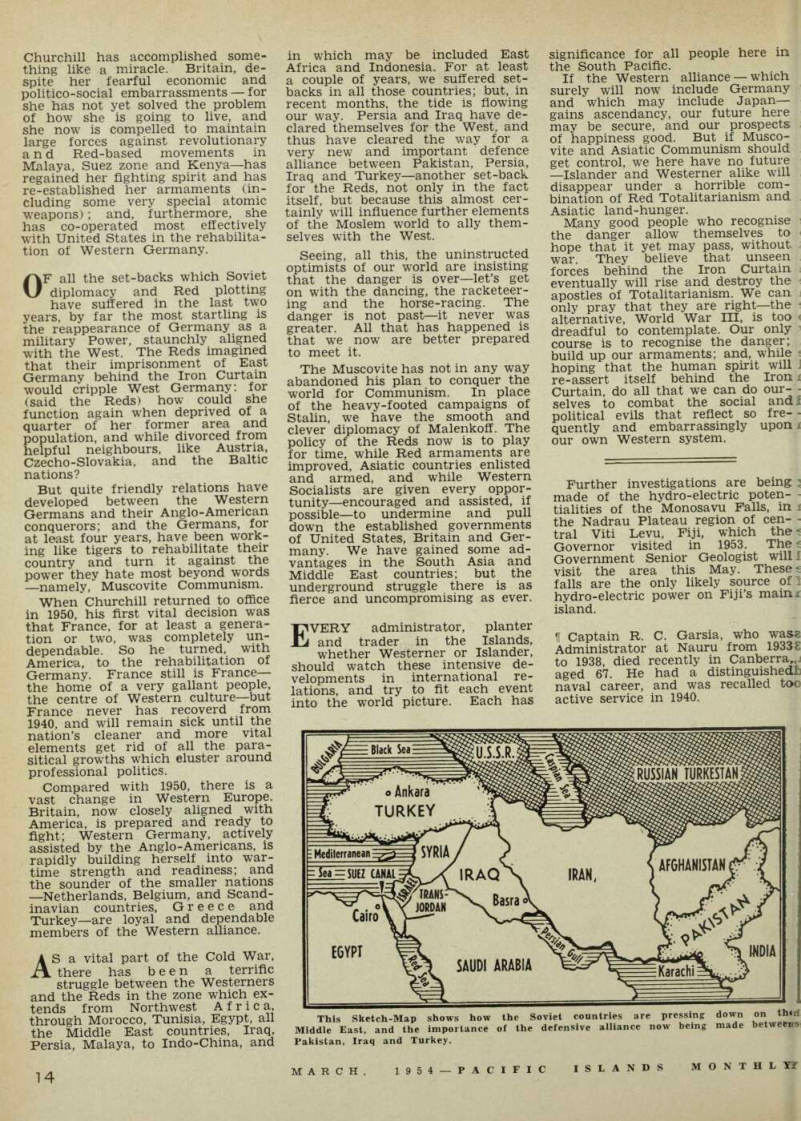
in which may be included East Africa and Indonesia. For at least a couple of years, we suffered set backs in all those countries; but, in recent months, the tide is flowing our way. Persia and Iraq have de clared themselves for the West, and thus have cleared the way for a very new and important defence alliance between Pakistan, Persia, Iraq and Turkey—another set-back for the Reds, not only in the fact itself, but because this almost cer tainly will influence further elements of the Moslem world to ally them selves with the West.
Seeing, all this, the uninstructed optimists of our world are insisting that the danger is over —let’s get on with the dancing, the racketeer ing and the horse-racing. The danger is not past—it never was greater. All that has happened is that we now are better prepared to meet it.
The Muscovite has not in any way abandoned his plan to conquer the world for Communism. In place of the heavy-footed campaigns of Stalin, we have the smooth and clever diplomacy of Malenkoff. The policy of the Reds now is to play for time, while Red armaments are improved, Asiatic countries enlisted and armed, and while Western Socialists are given every oppor
tunity—encouraged and assisted, if
possible—to undermine and pull down the established governments of United States, Britain and Ger many. We have gained some ad vantages in the South Asia and Middle East countries; but the underground struggle there is as fierce and uncompromising as ever.
EVERY administrator, planter and trader in the Islands, whether Westerner or Islander, should watch these intensive de velopments in international re lations, and try to fit each event Into the world picture. Each has
significance for all people here in the South Pacific.
If the Western alliance which surely will now include Germany and which may include Japan— gains ascendancy, our future here may be secure, and our prospects of happiness good. But if Musco vite and Asiatic Communism should get control, we here have no future —lslander and Westerner alike will disappear under a horrible com bination of Red Totalitarianism and Asiatic land-hunger.
Many good people who recognise • the danger allow themselves to < hope that it yet may pass, without. war. They believe that unseen forces behind the Iron Curtain eventually will rise and destroy the ; apostles of Totalitarianism. We can only pray that they are right—the alternative, World War 111, is too < dreadful to contemplate. Our only course is to recognise the danger; build up our armaments; and, while i hoping that the human spirit will i re-assert itself behind the Iron i Curtain, do all that we can do our- selves to combat the social and i political evils that reflect so fre-quently and embarrassingly upon i our own Western system.
Further investigations are being ’ made of the hydro-electric poten tialities of the Monosavu Falls, in j the Nadrau Plateau region of cen- tral Viti Levu, Fiji, which the - Governor visited in 1953. The € Government Senior Geologist willl visit the area this May. These t falls are the only likely source ofl hydro-electric power on Fiji’s maim island. fl Captain R. C. Garsia, who wasa Administrator at Nauru from 1933 £ to 1938, died recently in Canberra,,; aged 67. He had a distinguishedb naval career, and was recalled too active service in 1940.
This Sketch-Map shows how the Soviet countries are pressing down on the Middle East, and the importance of the defensive alliance now being made betweens Pakistan, Iraq and Turkey.