Do You Remember ?
p. 20 · Read in the full issue
From PIM oj 20 Years ago.
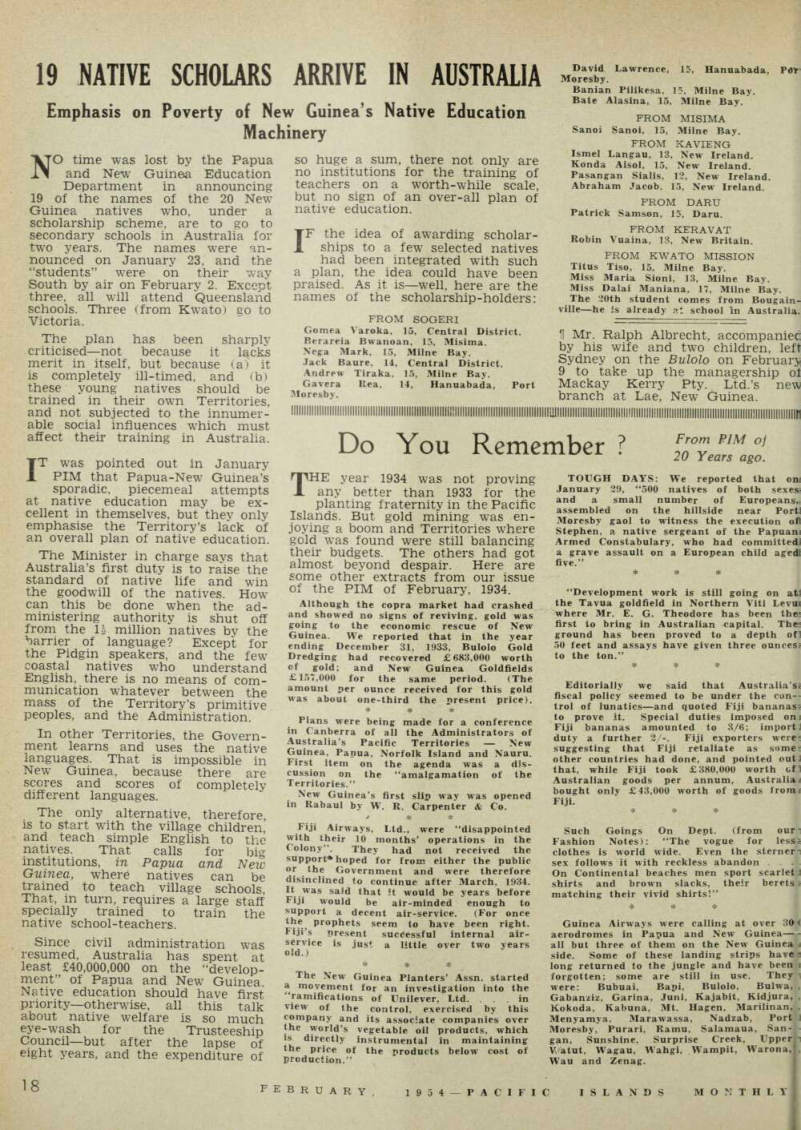
THE year 1934 was not proving any better than 1933 for the planting fraternity in the Pacific Islands. But gold mining was en joying a boom and Territories where gold was found were still balancing their budgets. The others had got almost beyond despair. Here are some other extracts from our issue of the PIM of February, 1934.
Although the copra market had crashed and showed no signs of reviving, gold was going to the economic rescue of New Guinea. We reported that in the year ending December 31, 1933, Bulolo Gold Dredging had recovered £683,000 worth of gold; and New Guinea Goldfields £157,000 for the same period. (The amount per ounce received for this gold was about one-third the present price). * * * Plans were being made for a conference in Canberra of all the Administrators of Australia’s Pacific Territories New Guinea, Papua, Norfolk Island and Nauru.
First item on the agenda was a dis cussion on the “amalgamation of the Territories.”
New Guinea’s first slip way was opened in Rabaul by W T . R. Carpenter & Co. -f * * Fiji Airways, Ltd., were “disappointed with their 10 months’ operations in the Colony”. They had not received the support* hoped for from either the public or the Government and were therefore disinclined to continue after March, 1934.
It was said that it would be years before Fiji would be air-minded enough to support a decent air-service. (For once prophets seem to have been right.
Fiji’s present successful internal air service is just a little over two years old.) * * * The New Guinea Planters’ Assn, started a movement for an investigation into the “ramifications of Unilever, Ltd. ... in view of the control, exercised by this company and its associate companies over the world’s vegetable oil products, which is directly instrumental in maintaining the price of the products below cost of production.”
TOUGH DAYS: We reported that om January 29, “500 natives of both sexes? and a small number of Europeans,, assembled on the hillside near Port!
Moresby gaol to witness the execution ofl Stephen, a native sergeant of the Papuani Armed Constabulary, who had committed! a grave assault on a European child agedl five.” * * * “Development work is still going on at) the Tavua goldfield in Northern Viti Levui where Mr. E. G. Theodore has been thea first to bring in Australian capital. Thea ground has been proved to a depth ofl 50 feet and assays have given three ounces? to the ton.” * * * Editorially we said that Australia’s? fiscal policy seemed to be under the con-trol of lunatics—and quoted Fiji bananas? to prove it. Special duties imposed om Fiji bananas amounted to 3/6; import i duty a further 2/-. Fiji exporters werea suggesting that Fiji retaliate as some; other countries had done, and pointed out) that, while Fiji took £380,000 worth ofl Australian goods per annum, Australia* bought only £43,000 worth of goods from* Fiji, * * * Such Goings On Dept. (from our - Fashion Notes): “The vogue for less? clothes is world wide. Even the sternen sex follows it with reckless abandon . . . .
On Continental beaches men sport scarlet 1 shirts and brown slacks, their berets ? matching their vivid shirts!” * * * Guinea Airways were calling at over 30 <1 aerodromes in Papua and New Guinea all but three of them on the New Guinea * side. Some of these landing strips have a long returned to the jungle and have been i forgotten; some are still in use. They were: Bubuai, Bapi, Bulolo, Bulwa, , Gabanziz, Garina, Juni, Kajabit, Kidjura, , Kokoda, Kabuna, Mt. Hagen, Marilinan, , Menyamya, Marawassa, Nadzab, Port 1 Moresby, Purari, Ramu, Salamaua, San- gan, Sunshine, Surprise Creek, Upper V/atut, Wagau, Wahgi, Wampit, Warona, .
Wau and Zenag.