19 Native Scholars Arrive In Australia
p. 20 · Read in the full issue
Emphasis on Poverty of New Guinea’s Native Education Machinery
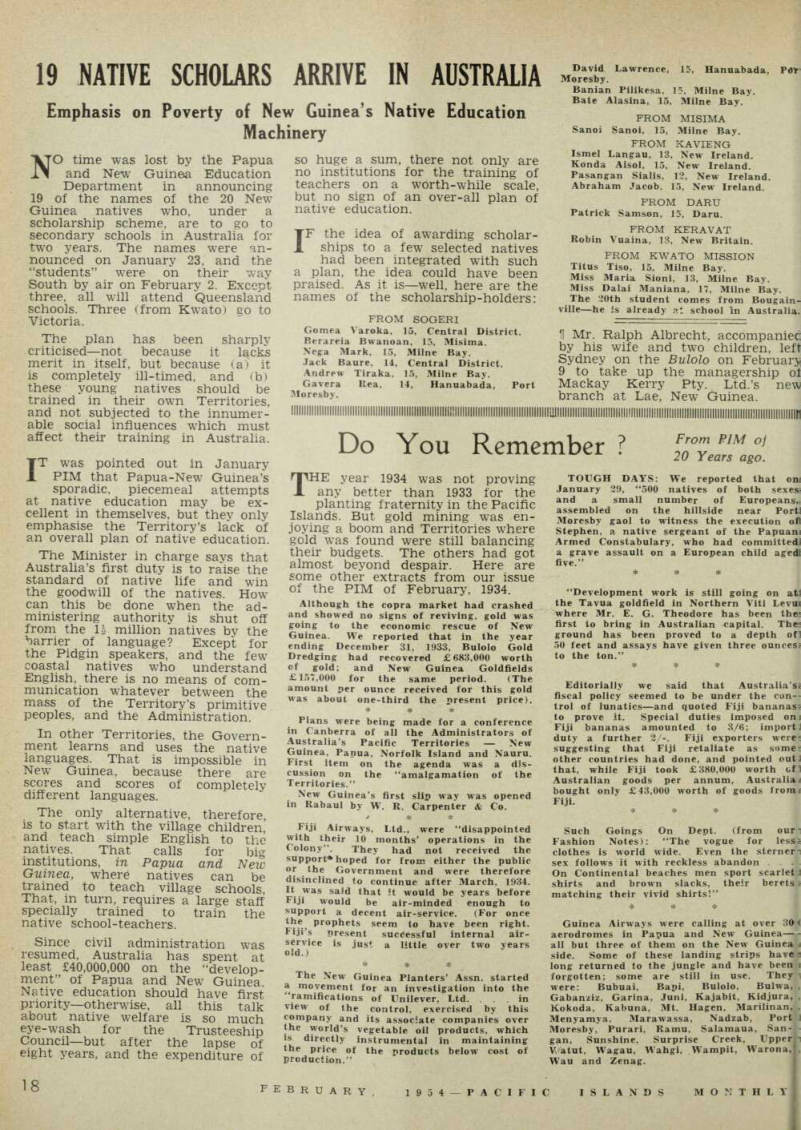
NO time was lost by the Papua and New Guinea Education Department in announcing 19 of the names of the 20 New Guinea natives who, under a scholarship scheme, are to go to secondary schools in Australia for two years. The names were an nounced on January 23, and the “students” were on their way South by air on February 2. Except three, all will attend Queensland schools. Three (from Kwato) go to Victoria.
The plan has been sharply criticised—not because it lacks merit in itself, but because (a) it is completely ill-timed, and (b) these young natives should be trained in their own Territories, and not subjected to the innumer able social influences which must affect their training in Australia.
IT was pointed out in January PIM that Papua-New Guinea’s sporadic, piecemeal attempts at native education may be ex cellent in themselves, but they only emphasise the Territory’s lack of an overall plan of native education.
The Minister in charge says that Australia’s first duty is to raise the standard of native life and win the goodwill of the natives. How can this be done when the ad ministering authority is shut off from the 1| million natives by the harrier of language? Except for the Pidgin speakers, and the few coastal natives who understand English, there is no means of com munication whatever between the mass of the Territory’s primitive peoples, and the Administration.
In other Territories, the Govern ment learns and uses the native languages. That is impossible in New Guinea, because there are scores and scores of completely different languages.
The only alternative, therefore, is to start with the village children, and teach simple English to the natives. That calls for big institutions, in Papua and New Guinea, where natives can be trained to teach village schools, That, in turn, requires a large staff specially trained to train the native school-teachers.
Since civil administration was resumed, Australia has spent at least £40,000,000 on the “develop ment” of Papua and New Guinea Native education should have first priority—otherwise, all this talk about native welfare is so much eye-wash for the Trusteeship Council—but after the lapse of eight years, and the expenditure of
so huge a sum, there not only are no institutions for the training of teachers on a worth-while scale, but no sign of an over-all plan of native education.
IF the idea of awarding scholar ships to a few selected natives had been integrated with such a plan, the idea could have been praised. As it is—well, here are the names of the scholarship-holders:
From Sogeri
Gomea Varoka, 15, Central District.
Berareia Bwanoan, 15, Misima.
Nega Mark, 15, Milne Bay.
Jack Baure. 14, Central District.
Andrew Tiraka, 15, Milne Bay.
Gavera Rea, 14, Hanuabada, Port Moresby.
David Lawrence, 15, Hanuabada, Pdf Moresby.
Banian Pilikesa, 15, Milne Bay.
Bate Alasina, 15, Milne Bay.
From Misima
Sanoi Sanoi, 15, Milne Bay.
From Xavieng
Israel Langau, 13, New Ireland.
Konda Aisol, 15, New Ireland.
Pasangan Sialis, 12, New Ireland.
Abraham Jacob, 15, New Ireland.
From Daru
Patrick Samson, 15, Daru.
From Keravat
Robin Vuaina, 13, New Britain.
From Kwato Mission
Titus Tiso, 15, Milne Bay.
Miss Maria Sioni, 13, Milne Bay.
Miss Dalai Maniana, 17, Milne Bay.
The 20th student comes from Bougain ville—he :s already at school in Australia.
If Mr. Ralph Albrecht, accompanied:
by his wife and two children, left Sydney on the Bulolo on February 9 to take up the managership of
Mackay Kerry Pty. Ltd.’s new
branch at Lae, New Guinea.