Tongan Jack-in-the-Box
p. 78 · Read in the full issue
By J. D. Whitcombe
FALCON ISLAND, reported some months ago as “currently miss ing,” flickers in and out of the sea, and PIM pages.
This is an account of its early life.
Falcon is a marine volcano. When it is in eruption, and shortly after wards, it consists of volcanic ash and cinders. The sea then sets to work to wash it away, and succeeds, until the next eruption.
THE curious Tongan jack-in-the box island, known as Falcon Island, which lies to the west ward of Haapai, between the two ports of Nukualofa and Lifuka, was most likely first se~n by the Spanish discoverer, Maurelle, who reported a bank in this area in 1781. There is also little doubt that it was also seen by the Frenchman La Perouse.
Its first authenticated appearance was in 1865, when it was seen as a reef by HMS Falcon; some time later the warship Sappho reporting that smoke was seen issuing from it. In 1885, it appeared as an island, and was surveyed by the British surveying ship Egsria, in 1889. It was then found to be 1.3 miles long, north to south, and one mile wide, shaped like a wedge, the highest point being 153 ft above sea level at the southern end. It was formed of loose volcanic ashes and cinders which were constantly slip ping down into the sea so that the size of the island was as constantly being reduced.
By April, 1894, Falcon Island had to all intents and purposes dis appeared but renewed volcanic activity in December of the sam 1 year caused it to re-appear. It was then 50 ft high, 3 miles long and V, miles wide. Four years later the island had disappeared again and its place was occupied by a shoal
about 100 yards in extent. By April, 1900, the “shoal” was about 9 ft above water, but it had disappeared again by 1913.
When HMS Veronica examined the site of Falcon Island in 1921, a continuous break in the sea was observed at the south-west corner of the area, caused by a rock about 15 yards in diameter. By 1927, the island had re-appeared, HMS Laburnum reporting that it ex tended 1,730 yards in a north-south direction and 1,430 yards in an east west direction. Steam was seen issuing from the island.
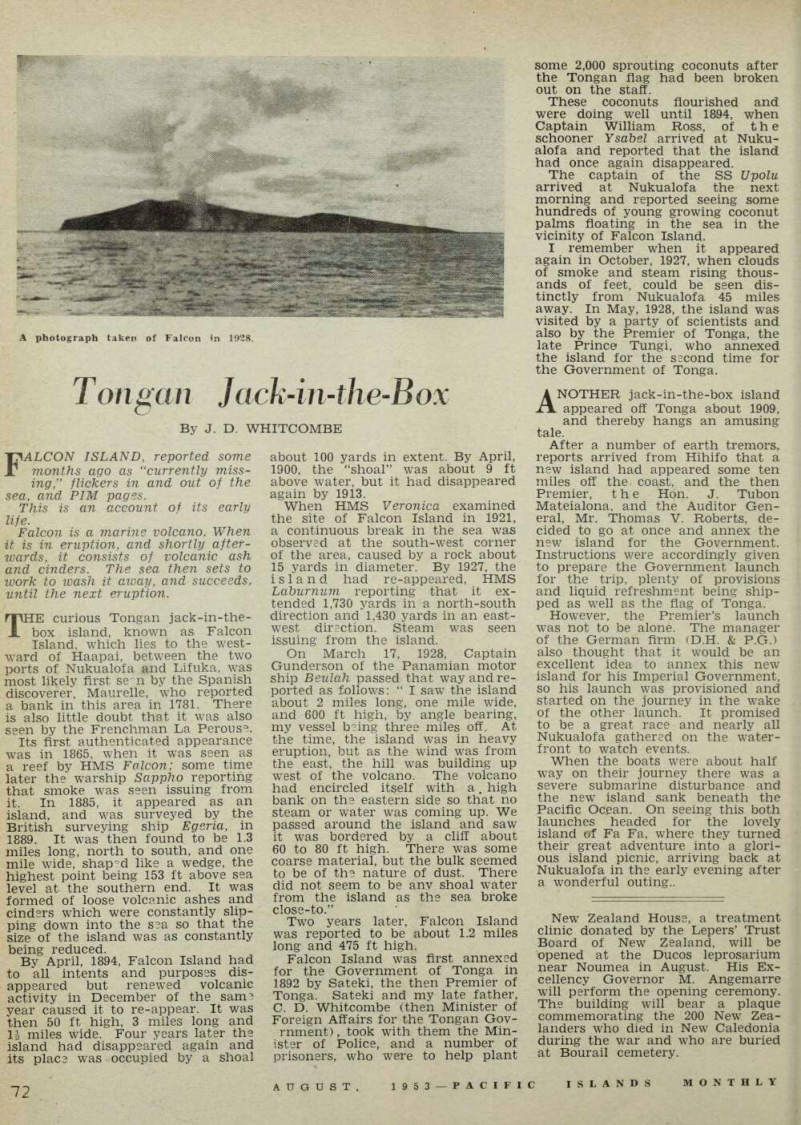
On March 17, 1928, Captain Gunderson of the Panamian motor ship Beulah passed that way and re ported as follows: “ I saw the island about 2 miles long, one mile wide, and 600 ft high, by angle bearing, my vessel being three miles off. At the time, the island was in heavy eruption, but as the wind was from the east, the hill was building up west of the volcano. The volcano had encircled itself with a. high bank on the eastern side so that no steam or water was coming up. We passed around the island and saw it was bordered by a cliff about 60 to 80 ft high. There was some coarse material, but the bulk seemed to be of the nature of dust. There did not seem to be any shoal water from the island as the sea broke close-to.”
Two years later, Falcon Island was reported to be about 1.2 miles long and 475 ft high.
Falcon Island was first annexed for the Government of Tonga in 1892 by Sateki, the then Premier of Tonga. Sateki and my late father, C. D. Whitcombe (then Minister of Foreign Affairs for the Tongan Gov rnment), took with them the Min ister of Police, and a number of prisoners, who were to help plant
some 2,000 sprouting coconuts after the Tongan flag had been broken out on the staff.
These coconuts flourished and were doing well until 1894, when Captain William Ross, of the schooner Ysdbsl arrived at Nuku alofa and reported that the island had once again disappeared.
The captain of the SS Upolu arrived at Nukualofa the next morning and reported seeing some hundreds of young growing coconut palms floating in the sea in the vicinity of Falcon Island.
I remember when it appeared again in October, 1927, when clouds of smoke and steam rising thous ands of feet, could be seen dis tinctly from Nukualofa 45 miles away. In May, 1928, the island was visited by a party of scientists and also by the Premier of Tonga, the late Prince Tungi, who annexed the island for the second time for the Government of Tonga.
ANOTHER jack-in-the-box island appeared off Tonga about 1909, and thereby hangs an amusing tale.
After a number of earth tremors, reports arrived from Hihifo that a new island had appeared some ten miles off the. coast, and the then Premier, the Hon. J. Tubon Mateialona, and the Auditor Gen eral, Mr. Thomas V. Roberts, de cided to go at once and annex the new island for the Government.
Instructions were accordingly given to prepare the Government launch for the trip, plenty of provisions and liquid refreshment being ship ped as well as the flag of Tonga.
However, the Premier’s launch was not to be alone. The manager of the German firm (D.H. & P.G.) also thought that it would be an excellent idea to annex this new island for his Imperial Government, so his launch was provisioned and started on the journey in the wake of the other launch. It promised to be a great race and nearly all Nukualofa gathered on the water front to watch events.
When the boats were about half way on their journey there was a severe submarine disturbance and the new island sank beneath the Pacific Ocean. On seeing this both launches headed for the lovely island of Fa Fa, where they turned their great adventure into a glori ous island picnic, arriving back at Nukualofa in the early evening after a wonderful outing..
New Zealand House, a treatment clinic donated by the Lepers’ Trust Board of New Zealand, will be opened at the Ducos leprosarium near Noumea in August. His Ex cellency Governor M. Angemarre will perform the opening ceremony.
The building will bear a plaque commemorating the 200 New Zea landers who died in New Caledonia during the war and who are buried at Bourail cemetery.
A photograph taken of Falcon in 1928.