Samarai By
p. 77 · Read in the full issue
The Sea
SAMARAI, a tiny story-book island off the extreme eastern point of Papua, has recovered from most of its war wounds (it was effectively scorch-earthed) although virtually all of its old landmarks are gone—the pubs, for example.
Newer and bigger buildings have been constructed or are in the course of being so; the gardens are flowering again and the sea, some times blue, often misty grey, is there within a hop and a step of anyone’s back door.
The same road, with leaning coconuts, encircles the island —and you can still walk right round in
20 minutes. .But now you are apt to meet a truck coming round one of the bends —there are three (trucks) on the island.
In comparison with many of the other P-NG natives, those around Samarai seem happy, polite, willing
and, as house-boys, the best in the S-W Pacific. Of happy memory are my hosts’ house-boys, particu larly the one in the spotless white lava-lava with his name lavishly embroidered in lazy-daisy stitch: JIM ROSSEL BOY. He said his
girl-friend executed this piece of finery. Spotless white lava-lavas, with or without lazy-daisies, are mighty rare in P-NG these days—possibly as a direct reflection on the price of cloth (about 5/- per yard as against the pre-war 4d or ( 6d).
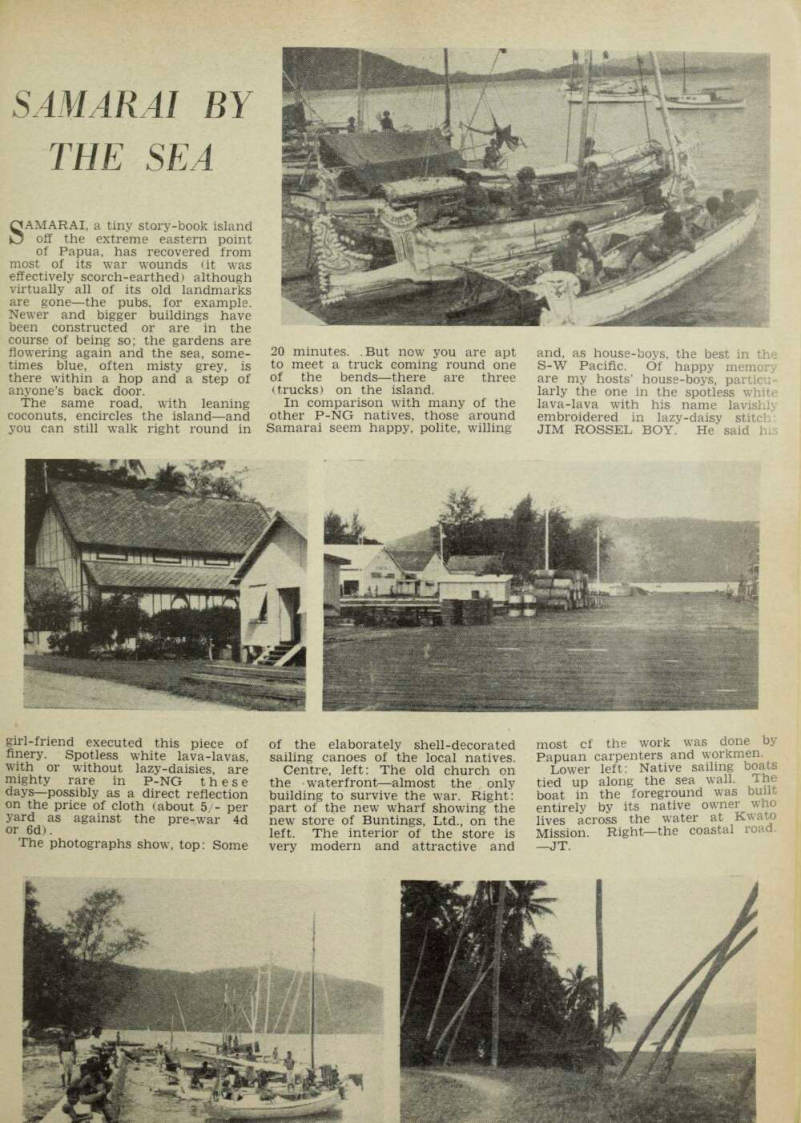
The photographs show, top: Some
of the elaborately shell-decorated sailing canoes of the local natives.
Centre, left: The old church on the waterfront—almost the only building to survive the war. Right: part of the new wharf showing the new store of Buntings, Ltd., on the left. The interior of the store is very modern and attractive and
most of the work was done by Papuan carpenters and workmen, Lower left: Native sailing boats tied up along the sea wall. The boat in the foreground was bum entirely by its native owner who lives across the water at Kwato Mission. Right—the coastal road. —JT.