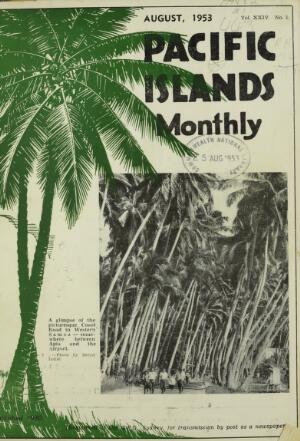
Monthly
Pacific
Islands
August, 1953
Vol. XXIV. No. 1.
advt
/or transmission by post as a newspapeii
A glimpse of the picturesque Coast Road in Western Samoa-some where between Apia and the Airport. —Photo: by Bernd Lohse.
Advertisements & other items, pp. 2-4 (1 item)
Antas
LEADER
£ —
IN TROPICAL TRAVEL
32 years’ experience is at your command when you fly QANTAS. Veteran crews with thousands of flying hours on 60,000 miles of QANTAS routes ensure that your trip is a truly enjoyable experience. Save precious time, travel in comfort and arrive refreshed. It’s the ONLY way to travel
in the Islands —arid to Australia.
ANTAS
ISLANDS AIR SERVICES
link New Guinea, Papua, and Pacific Is. with Australia
Over 50 points in
the area shown are
linked by Qantas
Air Services,
operating on
regular schedules.
talasea
WABAG
JACQUINOT
BAY
NONOUGL
HARBOUR
ARONA
KIETA
KAIAPIT
FOROKINA
FINSCHHAFEN
lake
YURA
E**
BUIN
VELLA LAVELLA
kerema m %
ISLAND
YANOINA
PORT
MORESBY
ESA ALA
HONIARA
SAMARAI
[ PORT
MORESBY
ESPIRITU SANTO
Q SUVA
ICAIRNS
V \
NORFOLK
BRISBANE
ISLAND
QANTAS EMPIRE AIRWAYS LTD.
in association with 8.0.A.C. and TEAL
AUSTRALIA'S
OVERSEAS AIRLINE
PI4«
m m :• ■ ■:■■ ' /* ms~ 3 m V 11^ Available for petrol or kerosene in capacities of 200, 300 and 500 C.P.
Coleman Lanterns burn steadily and safely regardless of the weather. Their globes are proof against the shocks of cold rain and they floodlight a 100 foot area with light so bright a newspaper can be read 50 feet away.
Coleman Lanterns are safe, because it is impossible to fill them while burning and they cannot spill if overturned.
Representatives for the Pacific Islands:
54a PITT STREET
SYDNEY
ROBERT GILLESPIE PUL™
PEARCE & CO. LTD.
SUVA
FOR FIJI ISLANDS
CASH
for
SCRAP METALS
HIGHEST PRICES FOR Copper Brass Aluminium Lead Muntz Metal
BRANCHES THROUGHOUT N.S.W., VICTORIA, QUEENSLAND
(through subsidiary Abrahams and Williams Pty. Ltd.) and
SOUTH AUSTRALIA
Leader of the Secondary Metal Industry for 30 Years Telegraphic Address: "SIMSMETAL," Sydney. ★ ★ Newtown, Sydney, N.S.W.
LA 5111 LA 5111
Shipping Time-Tables
There now arc comparatively few ship ping lines running on regular time-tables In the Pacific Islands. The following tlme taoies are only approximately correct— they are subject to much alteration at short notice:—
Sydney-Papua-N. Guinea
MV Bulolo, modern liner, sails about every six weeks: Sydney-Brisbane-Moresby- Samarai - Lae - Madang - Manus - Rabaul - Samaral-Moresby-Brisbane-Sydney.
Next sailing August 11.
MV Malekula leaves Sydney on Sept. 2 for Samarai, Rabaul, Manus, Wewak, Madang, Lae, Samarai and return to Sydney.
Details from Burns Phllp & Co. Ltd., 7 Bridge Street, Sydney.
MV Soochow and MV Sinkiang. modern 3,000 tons vessels, now leave every six weeks approximately (making a three weekly service): Sydney-Brisbane-Port Moresby - Madang - Rabaul - Pt. Moresby, Sydney. Sinkiang will sail from Sydney about August 11; Soochow, September 4.
Details from New Guinea Australia Line (O. S. Yuill & Co., Ltd., agents), 6 Bridge St.. Sydney.
N. Zealand-Fiji-Samoa-Tonga
Motor vessels Tofua and Matua, from New Zealand, serve Suva (Fiji), Nukua lofa and Vavau (Tonga), Niue Is., Pago Pago (American Samoa), Apia (.Western Samoa). Tofua leaves Auckland for any or all of above ports at approx, five weeks Intervals. Matua calls at Wellington and Lyttelton (NZ), Lautoka (Fiji) and sup plements Tofua’s schedule in Islands, calling at ports as directed by owners.
Tofua leaves Auckland on next voyages
about September 1 and 29 and then with draws for survey.
Matua will leave Auckland on her next voyage on August 22. She then withdraws for survey.
N. Zealand-Cook Is.
The NZ Government’s old motor vessel Maui Pomare is scheduled to leave Auck land every month for Rarotonga and other Islands in the lower Cooks, subject to
requirements of trade. This vessel carries 30 passengers and will provide, for the next several months, a connection between Rarotonga and Aitutaki for the benefit of passengers travelling on TEAL Coral Route.
Full -details on application to NZ Government' Department of Island Terri tories in Wellington, or to any office of the Union S 3 Co. of NZ, Ltd., Which Company acts as Agent for this vessel at some ports.
Sydney-New Hebrides-BSI-
Rabaul, Etc.
MV Malalta makes a round trip at about 8-weeks intervals from Sydney to Lord Howe-Norfoik Is.-New Hebrides Ports - BSI ports - Bougainville - Kaoaoi - Samarai-Sydney.
Next sailing from Sydney August 14.
Details from Burns Phllp & Co., 7 Bridge Street. Sydney.
Sydney-N. Caledonia-Tahiti
Vessels of Messageries Maritlmes Line, coming from Marseilles, via West Indies and Panama, call about every six weeks at Papeete, Vila (New Hebrides), Noumea and Sydney, and return by same
route. Details from Messageries Mari felmea. Luxurious new liners Caledonlen end Tahltlen recently added to this service.
Small motor-ships Polynesian (Messa gems Maritlmes) and Neo Hebrldais (H.
C. Sleigh. Ltd.) maintain fairly regular service between Noumea and Sydney.
N. America-Fiji-Hebrides, etc.
Norwegian motor vessel Thorsisle, carry ing cargo and passengers maintains a regu lar service between North American ports ana Frencn Oceania, .Samoa, Fiji, isew Caledonia and New Hebrides.
Next sailing from San Francisco Sept 3, Papeete, Sept. 16, Apia, Sept. 21, Suva, Sept. 24, Noumea, Sept. 30. (Dates approx, only).
Details from General Steamships Cor poration Ltd., H 2 California St., San Francisco.
Advertisements & other items, pp. 5-6 (1 item)
Pacific Islands Transport Line
Owners: Thor Dahls Hvalfangerselskap A/S Sandefjord, Norway
- M.V. "THORSISLE" -
Regular Freight and Passenger Service between Pacific Coast Ports of U.S.A. and Canada and
TAHITI SAMOA FIJI NEW CALEDONIA
NEW HEBRIDES
GENERAL STEAMSHIP CORPORATION, LTD.
General Agents 432 California Street, San Francisco 4, Calif., U.S.A.
PAPEETE—Etablissements Donald Tahiti APlA—Morris Hedstrom Ltd.
SUVA—Morris Hedstrom Ltd. NOUMEA—Etablissements Ballande PORT VlLA—Comptoirs Francais des Nouveiles Hebrides
9 H.P. DB2
W Heavy Duty Petrol - Kero- Engine.
RELIABILITY
t sene
PLUS
v RTR4 Marine Diesel 30 H.P. This modem general purpose and lifeboat engine has proved to be extremely satisfactory and efficient in the Pacific Islands.
Enquiries:
THORNYCROFT (Aust.) Pty. Ltd
Cables: “Thornmotor”, Sydney. 6/10 Wattle Street,
Pyrmont, N.S.W.
LONDON - SUVA
SB#.
<c\v vi*
V PANAMA V
For Sailings and Further Particulars Apply To:— BETHELL, GWYN & CO., BURNS PHILP (SOUTH SEA)
138 LEADENHALL ST., CO. LTD.,
LONDON, E.C.3. SUVA, FIJI.
New Guinea Australia Line
Regular Three Weekly Service to
PORT MORESBY, SAMARAI, LAE, MADANG, KAVIENG,
AND RABAUL, VIA BRISBANE
WITH THE MODERN MOTORSHIPS
“SOOCHOW” “SINKIANG”
Agents for PAPUA: Agents for NEW GUINEA: STEAMSHIPS TRADING CO. LTD. COLYER WATSON (NEW GUINEA) LTD.
General Agents: G. S. YUILL & CO. PTY. LTD.
6 BRIDGE ST., SYDNEY
Telephones: BW 2731 Cable Address: “YUILL”
BU 6313 (Freight only)
Airways Time-Tables
Trans Pacific Services
1. Australia (or NZ)-Fiji-
Hawaii-N. America
By Pan-American Airways
With Strato Clippers, using Sleeperettes and Berths Thur. and Mon.—Sydney-Nadl (PIJD- Canton Is.-Honolulu-S. Franclsco-Seattle- Portland.
Sun. and Thur.—Return via same route. * Thur. and Mon.—Auckland-Nadi (Fiji).
Every Friday—Return by same route. * Wed. and Sun.—Nadi (Fiji)-Auckland. * Connecting with Strato Clipper at Nadi.
By British Commonwealth Pacific
Airlines (Bcpa)
Wed. and Sat.—Sydney-Nadl (Fiji)-Canton Is.-Honolulu-S. Francisco-Vancouver.
Mon. and first Thur.—Dep. southwards, same route. On second or alternate Thursday, flight commences at S Francisco. rues.—Dep. Auckland-Nadi-Canton-Hono lulu-S. Francisco-Vancouver.
Frl.—Dep. Vancouver and S. Francisco alternatively; thence same route to Auckland.
By Canadian Pacific Airlines
(Cpal)
(With Super DC-6B Aircraft) Every Tuesday—Sydney - Auckland - Nadi (Fiji) - Honolulu - Vancouver.
Every Friday return by same route.
Sectional Services In
Pacific
2. Sydney-New Guinea
Service by Qantas Empire Airways
Northwards
Tuesdays and Saturdays (Skymasters) Depart; Arrive: Sydney, 7.30 pm Brisbane, 10.15 pm Brisbane, 11.40 pm Moresby, 6.30 am (Wed., Sun.) Moresby, 7.30 am Lae, 8.45 am Connecting services north of Lae by Drover to Bulolo and Wau.
Wednesday and Sundays (Sandringhams) Depart: Arrive: Sydney, 7.30 pm Brisbane, 10.50 pm Brisbane, 12.20 am Cairns, 6.35 am (Thur., Mon.) Cairns, 8.5 am Moresby, 11.55 am (Night stop) Moresby,* 8.30 am Samarai, 10.30 am (Tue.) Samarai, 11.30 am Esa’ala, 12.10 pm (Alt. weeks) Esa’ala. 12.25 pm Rabaul, 3.25 pm The Wednesday Sandringham from Sydney terminates at Port Moresby, a connection north to Lae on the following uav at 9.00 am being by D.C.3. * The Sunday Sandringham from Sydney arrives Moresby Monday and after a night stop there goes on to Rabaul via Samarai, etc., on Tuesday.
Southwards
Sundays and Wednesdays (Skymaster) Depart: Arrive: Lae, 10.25 am Moresby, 11.40 am Moresby, 12.40 pm Brisbane, 7.15 pm Brisbane, 8.45 pm Sydney, 11.30 pm Thursdays (Sandringham) Depart: Arrive: Rabaul, 6 am Samarai, 9.15 am Samarai, 9.45 am Moresby, 11.45 am Moresby, 1.15 pm Cairns, 5.5 pm (Night stop) Cairns, 9.30 am Brisbane, 3.45 pm (Prl.) Brisbane, 4.45 pm Sydney, 8.5 pm Saturdays (Sandringham) Depart: Arrive: Moresby, 6 am Cairns, 9.50 am Cairns, 11.20 am Brisbane, 5.35 pm Brisbane, 6.35 pm Sydney, 9.55 pm A connection from Lae, with a DC3, to pick up Saturday Sandringham, arrives in Moresby on Friday at 8.20 am.
3. N. Guinea Internal
Services
Operated by Qantas
Lae-Manus (Dcs)
Every Wednesday.
Dep. Lae, 10.15 am; Finschhafen, Rabaul, Kavieng, Manus (5.45 pm) Returns Saturdays (dep. 8 am), via Kavieng and Rabaul; optional call at Finschhafen; arr. Lae, 2.45 pm.
MOBESBY-DARU (Sandringham) Via Yule Is., Kerema, Wana (optional), Kikorl, L. Kutubu.—Every alternate Friday, returning same day. (August 21, Sept. 4. 18, etc.).
Rabaul-Moewe Harbour
(Sandringham) Mt. Wed—Rabaul-Jacquinot Bay-Moewe Harbour-Talasea-Rabaul—August 12. 26 Sept. 9, 23, etc.
N.B.—The direction of operation changes with each service, i.e., each alternate service operates Rabaul-Talasea-Moewe
Harbour-Jacquinot Bay-Rabaul.
New Bbitain-Bougainville
(Sandringham) Alt. Wed.—Rabaul-Queen Carola Hbr.-
Buka-Kieta-Buin —August 19, Sept. 2, 16, 30, etc.
Alt. Wed. (same day) Buin-Kieta-Buka- Rabaul.
Lae-Mad Ang-We Wak-Mancs
Kavieng-Rabaul General
Service
(High-Density DCS) Mon,, Thur. Dep. Lae 6.30 am, Madang arr. 7.35 am Wewak, Manus Is., Kavieng, Rabaul arr. 3.35 pm.
Tue. only Dep. Rabaul 8.00 am, direct Madang arr. 11.00 am, Lae arr. 12.35 am. (This is now the only Qantas service to Madang.)
Central Highlands
(Drover) Fridays.—Lae (7.00 am) to Wabag, calling at any of: Nadzab, Kialpit, Arona, Alyura, Kainantu, Bena Bena, Qoroka, Kerowagi, Kup, Nondugl, Banz, MlnJ, Mt. Hagen, Ogelbeng, Balyer R., Wabamunda, Wabag. Return to Lae arriving 6 pm.
Lae-Bulolo-Wau (Drover)
Dep. Lae. —Tues. 3 pm.—Mon. & Sat. 7.30 am.
Dep. Wau. —Tues. 4.30 pm—Mon. 9.00 am —Wed. 12.35 pm. Direct to Lae in 35 minutes.
Services By Mandated Airlines
With headquarters at Lae, this company runs regular services for passengers freight and mails to all New Guinea settlements.
4. Aust.-Dutch N. Guinea
By KLM Royal Dutch Airlines.
A weekly service with Constellations between Sydney and Amsterdam with a call at Biak, DNG, and Manila, Philippines.
DCS aircraft link Biak with Hollandia, Sorong, Merauke and Tannah Merah.
5. N. Guinea-Solomons
By Qantas with DCS 3 Flights Every Four Weeks, Mon. (Aug. 17, 24, 31. Sept. 14, 21, 28,
etc.), Lae (dep. 6 am) —Pinschhafen — Rabaul Torokina (Bougain.) —Vella lavella—Yandina—Honiara, BSI (arriv ing 4.25 pm).
Tue. (Aug. 18. 25. Sept. 1, 15, 22, 29, etc.), Honiara (dep. 7 am) —Yandina—Vellalavella Torokina Rabaul Pinsch hafen Lae (arriving 3.15 pm).
6. Indo-China-Brisbane-
N. Caledonia
By Air France, Monthly.
Constellation aircraft dep. Saigon, August 10, and every 28 days thereafter for Darwin-Brisbane-Noumea, and return.
Australian agents: Messageries Marltlmes.
7. Sydney-Lord Howe Is.
By Ansett Flying-boat Service, with Sandringhams and Hythes.
Six services per month, return same day.
8. Sydney-Norfolk Is.
By Qantas, with Skymasters.
Alternate Thursdays (Aug. 13, 27, Sept. 10, 24, etc.), returning same day.
9. Sydney-New Hebrides
By Qantas, with Sandringham Flying Boats: Aug. 17, 31, Sept. 14, 28, etc.
Depart: Arrive: Sydney, Alt. Mon. 7.30 pm Brisbane. 10.50 pm Brisbane, 12.20 am (Tue.) Noumea. 7.20 am Noumea, 9.20 am Vila, 11.55 am Vila, 1.25 pm Santo, 2.40 pm (Night stop) Santo, 6.30 am (Wed.) Vila. 7.45 am Vila, 8.45 am Noumea, 11.25 am Noumea, 1.00 pm Sydney, 8.40 pm (Additional flights operate subject to approval of Governments concerned.)
10. Sydney-Noumea-Suva
By Qantas with Sandringham Flying Boats—Weekly.
Depart: Arrive: Sydney, Thur. 7.30 pm Brisbane, 10.50 pm Brisbane, 12.20 am (Fri.) Noumea, 7.20 am Noumea, 9.20 am Suva, 3.50 pm Suva, Sat. 6.30 am Noumea, 11.00 am Noumea, 1.00 pm Sydney, 8.40 pm
11. Auckland-Norfolk Is.
By NZ National Airways, with DCS’s Sundays—From Auckland double service returning same day.
12. Sydney-Auckland
Tasman E. Airways, with Solents Wed., Sun.—Dept. Sydney 12 midnight arr. 8.45 am following day.
Sat. —Dept. Sydney 7.30 am, arr. 4.15 pm.
Dep. Auckland 8.30 am, arr. 1.45 pm Mon Wed., Fri.
13. Sydney-Wellington
Tasman E. Airways, with Solents Dep. Sydney 10.30 pm Tue., Thur., Fri., Arr 7.30 am following day.
Dep Wellington 10.30 am Wed., Fri., Sat. arriving 3.45 pm.
14. Melbourne-Christchurcix
Tasman E. Airways, with DC4 Skymaster Thurs.—Dep. Melb., 10.25 pm; arr. Ch’ch.. 8.15 am next day.
Fri.—Dep. Ch’ch., 11 am; arr. Melb., 5.30 pm.
15. New Zealand-Fiji
See Also Table 18.
Tasman Empire Airways, Ltd., with Solents.
Dep. Auckland—August 25, 29, September 8. 22, 26, October 3, 17.
Return to Auckland on August 26, 31, .1 September 9, 23, 28, October 4. 18, etc..?
Depart Arrive Auckland, 9.30 am Suva, 4.45 pm cc Suva. 9.00 am Auckland, 4.15 pmn
16. Fiji-Western Samoa
See Also Table 18.
Tasman Empire Airways, Ltd., with Solents.
Dep. Auckland, Aug. 15, Sept. 12, Oct. 10. .0 Depart Arrive Auck., 9.30 am Sat. Suva, 4.45 pm Sat. 1 Suva, 6.00 am Sun. Apia, 11.05 am Sat 1 Apia, 1.30 pm Sat. Suva 4.35 pm Sun..: Suva, 9.00 am Mon. Auck., 4.15 pm Mon..::
17. New Zealand-Chatham Is.
In the 1953-54 season, Solents will make nights to the Chatham Is. as follows -•- November 5, December 3, 14, January 27, S March 11, April 8. Departure from m Auckland 3.30 am, dep. Wellington 5.30 0< am, arr. Chathams 10.30 am. Dep. 230 0< pm, same day for Auckland.
18. New Zealand-Tahiti
Tasman Empire Airways, Ltd., with Solents ..^ A , L Service, Auckland-Suva-Apia- - Aitutaki-Papeete, is operated with Solent h Flying-Boats once every two weeks. Dep Auckland, Tuesday, 9.30 am. Arr. Suva « 4.00 pm. Dep. Suva (Wednesday) 900 0< am, cross International Date Line: Arr. ,i Apia 1.55 pm Tuesday. Dep. Apia 200 CM am Wednesday. Arr. Aitutaki 7.30 am.
Dep. Aitutaki 9.30 am. Arr. Papeete 1,30 0* pm. Return by same route every alt. 3 Friday, leaving Papeete 7.30 am.
The next flights leave Auckland b August 18, September 1, 15, 29, October i 13, 27, etc.
19. Fiji-Tonga
Tasman E. Airways with Solents.
Dep. Suva Aug. 12, 26, Oct. 7, 21, return n from Nukualofa same day.
Depart Arrive Suva, 7.00 am Nukualofa, 10.20 am tr (Wednesday! (Wednesday) Nukualofa, 2.00 pm Suva. 4.10 pm cr (Wednesday) (Wednesday) Suva. 9.00 am Auckland, 4.15 pm r (Thursday) (Thursday)
20. Micronesia
Civilian services, based on Guam, using gj 2-engined amphibious Catalinas, run re- -s gularly to Koror (Palau), Yap (West is Carolines), Truk (Central Carolines), .( Ponape (E. Carolines), Majuro (Marshalls) \i and Saipan (Marianas), Details from xr Trans-Ocean Airlines, Guam, via Honolulu, .l
21. Fiji Internal Airways
By Fiji Airways, with twin-engine de Haviland Rapides Suva-Nadi & Lautoka* and return: Mornings—Daily except Tuesday. After- -7 noons— Daily except Friday.
Suva-Labasa: Daily except Sundays.
Labasa-Suva: Daily except Sunday.
Nadi & Lautoka to Labasa: Every Thursday.
Labasa to Nadi & Lautoka; Every Tuesday.
Suva - Savusavu - Labasa - Savusavu - - Suva: Monday, Wednesday, Saturday. * No call on Sundays.
Advertisements & other items, pp. 7-10 (1 item)
and trip-planning help.
8.0.A.C. TAKES GOOD CARE OF YOU
—TO ALL SIX CONTINENTS
y You can book to almost anywhere in the
world by 8.0.A.C. Speedbird Services —
on one ticket all the way. Your 8.0.A.C.
Agent makes no charge for expert advice
and trip-planning help.
i c.
AUSTRALIA . INDONESIA
BURMA * THAILAND • MALAYA
HONG KONG . JAPAN . CEYLON
INDIA • PAKISTAN • MIDDLE EAST
AFRICA 'GREAT BRITAIN
U.S.A.. CANADA • CENTRAL AND
SOUTH AMERICA. BERMUDA
n mm
CONSULT YOUR TRAVEL AGENT
For Post Haste without waste—use Overseas Airmail BRITISH OVERSEAS AIRWAYS CORPORATION WITH QANTAS, TEAL AND S.A.A.
A4O/PIM
There's so much to do
NEW ZEALAND
Imagine a holiday in this land of breathtaking beauty!
At any time of the year there’s so much to do . . . V watching geysers play in wondrous thermal regions . . . fishing in placid lake or swift-running stream or spectacular big-game waters . . . climbing in the towering Southern Alps . . . deer shooting in virgin forest . . . slaloming on perfect ski runs . . . swimming and boat-
ing in fascinating fiordlands!
flying gives you so
much more time
Air travel will save you days in which to play, let you see so much more of this scenic wonderland.
And it’s so much more comfortable.
NAC
\ e i ( 9*4 4V Linking all principal New Zealand cities and extending to Norfolk Island. Offices and Agents throughout New Zealand, Australia and the South-West Pacific. * * w
ZEALAND
NATIONAL
AIRWAYS
CORPORATION
The Best!
AUSTRALIAN
cc U 4 man
SYDNEY
AUSTRALIA
"Blue Superb"
Fine & Dry
MUNGO SCOTT PTY. LTD.,
FLOURMILLERS,
Summer Hill, Sydney, Aust.
THE GARRICK HOTEL
SUVA, FIJI
ii 's!«g H% j <yk a* v.< mm Mm, Wk .. k. M This well-known Hotel is centrally situated in Suva’s main business quarter :: Modern accommodation provides comfort m all climatic conditions : : Only the best of Beers, Spirits and Wines is served.
Telephone: 80. VINCE COSTELLO, Proprietor.
N.
SHIP
THE
GOODS
We recommend these Soap
FOR YOU: . LUX, CUTICURA, REXONA,
PEARS and SOLVOL.
FOR THE
LAUNDRY: LUX, SUNLIGHT, VELVET,
and "WARATAH."
FOR THE
KITCHEN: RINSO, PERSIL, VIM and
PEARSON.
It’s Clean Business with
NIRCX Pty. Ltd.
545 GEORGE STREET, SYDNEY,
Cables: “Nirex, Sydney.”
Represented in the Pocific by: MORGAN-VERNEX CIE, Papeete, Tahiti; WM. BRECKWOLDT & CO., Rabaul, Papua-N.G.;
WM. BRECKWOLDT & CO., Suva, Fiji;
P. PLOWMAN & CO., Apia, W. Samoa.
Oil To Be
J. K. Murray Expects
Found In Papua
“T HAVE a layman’s belief that 1 oil will be found in commercial quantities in Papua, but it is a reasonably informed belief,” said Colonel J. K. Murray, in an article in the Brisbane Telegraph of July 23. He was Administrator of Papua- New Guinea from 1945 to 1952, and worked in close co-operation with the oil-seeking companies.
After remarking that the Papuan sil-seekers had spent £1 million per annum for several years, he added; : ‘A Dutch Minister to Australia once told me that £80,000,000 had been spent before oil was obtained in commercial quantities at Sorong (in Dutch New Guinea).
“There will be a big programme )f development ahead when oil lows in commercial quantities at i Papuan centre.”
With the eighth reinforce nents to the Fiji Infantry Battalion n Malaya went Mr. Rob Wright, r iji Public Relations Office photo rapher, to spend several weeks with he troops taking photographs.
The Rev. and Mrs. T. C. Crane ift Australia end of July for fission work among the Indians >f Fiji.
Rabaul’S Police Chief For
The Capital
P. Moresby, Aug. 7.
POLICE Superintendent Normoyle, of Rabaul, has been transferred to Port Moresby; and Superin tendent Rackamann will take Mr.
Normoyle’s place in Rabaul. While glad to know of his promotion, Rabaul people will be sorry to lose Mr. Normoyle. He has been there for many years, and is held in high regard.
The Queen’S Visit To Fiji
SUVA, August 4.
DURING her two days’ visit to Fiji, on December 17 and 18, Her Majesty Queen Elizabeth II and the Duke of Edinburgh will reside aboard the liner Gothic. On the 17th, they will visit Tamavua and Nausori, lunch and dine at Government House, and attend a State Ball at the Grand Pacific Hotel. On the 18th, they will visit Lautoka by Solent flying-boat.
If The engagement has been an nounced of Miss Dorothy Stewart to Mr. Alex Hubbard, of Qantas, Lae, New Guinea. This is the culmination of a somewhat whirl wind courtship and many male NG residents are asking themselves what Mr. Hubbard has that they have not. Miss Stewart is popular in Rabaul and Lae, where she is
well known. Recently she has been keeping an experienced eye on the Hotel Cecil while its owner, Mrs Flo Stewart, was making a Corona tion visit. Mrs. Stewart is her aunt. Miss Stewart will fly to Australia on August 23, but ex pects to return to Lae to be married before the end of the year. Mr Hubbard is a native of the Isle of Skye.
Advertisements & other items, pp. 11-12 (2 items)
5
CIF I C ISLANDS MONTHLY AUGUST, 1953
Manning & Osborne
Spend Your Holidays away from the Tropics at
CRONULLA
SYDNEY'S SUPER
SEASIDE SUBURB.
Bounded by 3 rivers and 6 mile beach, Cronulla is the only seaside resort in N.S.W. served by frequent electric train service. Never under 45° seldom over 90°.
For home, investment, or
holiday, contact:
MONRO & BUIST
PTY. LTD. (Est. 1906)
Real Estate Agents
3 SURF ROAD, CRONULLA,
N.S.W.
We Can Supply These Materials
At Australian Prices
STRUCTURAL STEEL TO YOUR SPECIFICATIONS or BUILDING MATERIALS.
SMALL BRIDGES.
SHEDS—OFFICES.
DRIERS (TO YOUR PLAN).
SHEET STEEL, NAILS, BOLTS, SCREWS.
P.C. ITEMS—BASINS, SINKS, BATHS, etc.
WEATHER BOARD, FLOORING, BEADING
HARDWOOD BATTENS & STUDS.
FLY GAUZE.
ROOFING MATERIALS ANY KIND.
CORRUGATED & FLAT GAL. IRON.
GAL. WIRE NETTING FENCING WIRE.
BARBED WIRE.
GATES, GUTTERING & DOWN PIPING.
Have You Difficulties with Odd Sizes in Tyres? If so please consult-
MANNING & OSBORNE
8a Castlereagh Sf. Sydney.
Telegrams and Cables: “MANSTOCKS, SYDNEY.”
Ss m a
ROTARY HOES
tljlnqlaiui
designed by the Australian
inventor of rotary tillage—
The Powerful "GEM
Because of its many new and improved features, the “Gem” has a work capacity and ease of control never seen before in any rotary hoe.
Features include: Robust 6 h.p. J.A.P. engine with three forward speeds . . . differential for easy turning with only one hand . . . automatic safety reverse gear . . . totally enclosed, single unit gearbox . . . handlebars adjustable sideways and
vertically.
Mark IV Models with 9.6 h.p. and 24” or 30” cuts are also available.
Amazing "BANTAM"
Nothing like it has ever been seen before in the Islands! A highly efficient hoe, the “Bantam” can also cut, mow and trim by means of various attachments. It has a sturdy, specially built British engine, handlebars adjustable horizontally as well as vertically, two moulded rubber treads 10” apart for extra stability, and many other features.
AMPLE SPARE PARTS
\ FOR ALL MODELS
Distributors in N.S.W.
DANGAR, GEDVE S MALLOCH UNITED
10-14 Young St., Sydney
Cables: “DANGARS,” Sydney
Index To Advertisers
A.M.L. & F. . 64
A. & N.Z. Bank 144 Achun, G. . .62 Akta-Vite ... 42 Aluminium Ltd. 60 Amplion Pty. . 85 A. & R. Ltd. . 23 Ardath Co. Ltd. 66 Armstrong & Springhall . . 7 Amott, Wm. . 50 A. Ltd. . . 135 Aspaxadrene . . 25 Aspro 94 Aywun Farm . 42 Baker, W. Jno. 55 Bank of NSW . 91 Bank of NZ . 114 Bethell, Gwyn . iv B. Co. . . 105 Blaxland Rae . 123 Blundell Spence 36 8.0.A.C. ... 1 Braybon Bros. 106 Breckwoldt, W. 87 Breden, W. S. . 121 Bristol-Myers . 51 Broomfields . . 126 Brunton & Co. 109 Bunge Pty. 35, 129 Bunting, A. H. 97 B.P. 77, 85, 132, 140 Caine’s Studios 99 Cairns Ship Co. 128 Carpenter 48, c. iv Carr Pountney 125 Clae Engines 28 Classified . 145-146 Colgate 84, 136, 139 Colonial Meat . 134 Colyer Watson (NG) 27, 39, 79 Cooke Bros. . .113 Crammond Co. 112 Cystex ... 49 Dangar, G. &M. 6 Darling, J. Ltd. 54 Dettol . . . . 139* Donald Ltd. 45, 94 Douglass, W. C. 47 Dunlop Rubber 37 Dynon, J., Co. 40 Ellwood, Jack . 143 Erskine Stamps 61 Et. Donald . . 38 Eveready Pty. . 31 Perrier & Dickin son 122 Ford Sherington 53 Foyle’s Books . 29 Frigate Rum . 127 Garrett, D. M., 148 Garrick Hotel . 3 George & Son . 106 Gubey, W. & A. 81 Gillespie Bros. . 98 Gillespie, R. i, 65, 107. 128, 131, 137 Gillette, Ltd. . 108
G.M.P. Co. . . 38
Goodall & Co. . 24 Gordon’s Gin . 102 Gordon Vale . . 59 Grahame Books 24 G. (Suva) . 8 Grove Ltd. . 34, 90 H. & R. . . .23 Hastings Diesels 44 Halvorsen, B. . 117 Halvorsens 67, 118 Hardman - Hall 46, HO, 141, 145, 146
Hawleys Ltd. . 116
Heinz & Co. . . 89 HeUaby, R. & W. 11l Hercules Co. . 63 Hill & son . . 57
Holbrooks Ltd. . 82
Hygeia Co. . . 86
Jc.S 133
Imperial Stores 115
Invincible Motors
126
Is. Industries . 43 Is. Transport . 118 Jacketts Pty. . 123 Karp, Tulk Co. 102 Kasper Refrig. 103 Kennedy, Capt. 122 Kerr Bros. Ltd. 130 Kerry, M. Pty. . 33 Kiwi Polish . . 90 Kolynos Inc. . 104 Kopsen & Co. . 127 La Paula . . . 145 Lillis & Co. . . 100 Maclntyre, T. . 137 Manning & Os borne ... 5 Mcllrath’s Ltd. 129 Mendaco ... 93 Millers Ltd. . . 54 Monro & Buist . 5 Morgan Vernex 66 Morris Hedstrom Ltd. ... 22, 55 Mungo Scott . 3 N. & R. 93, 121, 147 Needham & Co. 101 NG Aust. Line . iv Nile Products . 92 Nirex Pty. ... 4 Nixoderm ... 61 Nordman, O. . . 65
Nznac ... 2
Pabco Co. ... 26 Pan Pacific Co. 105 Parke Davis . . 31 Parker Pens . . 30 Pearson, Russell 142 Penfold, W. C. 133 P. I. Line . . . iii Presbyterian Schools ... 34 Proud’s ... 68 Qantas . . cov. ii Qld. Milling . . 57 Qld. Insurance . 33 Quirk’s Co. 130, 138 Raleigh Pres’g. 96 Ransomes Co. . 114 Reckitt’s Blue . 97 Reed, W. E. 117, 135 Refrig. Inst. Co. 82 Riverstone Co. . 52 Rohu, Sil . . .41 Rodgers, G. . . 119 Seward Ltd. . . 37 Shell Co. . . . 78 Sims, A. G. . . ii Smith-Rees . . 86
S.M.P. Co. . . 124
Spruso Co. . . 28 S.T.C. Ltd. . . 46 Stewarts-Lloyds 30 Sthn. Pac. Ins. 45 Sullivan, C., Ltd. 53 Suva Motors 95 S. Pac. Tr. . 25 Tait, W. S. . . 41 Taylor & Co. . 101 T. . cov. iii Thornycroft Co. iii Tilley Lamps . 83 Tillock & Co. . 120 Tongan Photos 47 Tooheys Ltd. . 32 Tooth & Co. . . 49 Turners Supply 98 Tyneside Eng. . 99 United Radio . 113 Vacuum Oil Co. 56 Valiant Rum . 110 Ventura Co. 109, 148 Vi-Stim ... 131 Warnock Bros. 78 Westfield Meats 80 Williams, Dr. 27, 81 Wills, Ltd. ... 88 Winn, B. H. . 50 Wise Bros. . . 143 Wright & Co. . 125 Wrigley’s ... 58 Wunderlich Co. 87 Yorkshire Ins. . 89
Advertisements & other items, p. 13 (1 item)
Imperial Typewriters are in use throughout
use throughout the world. The Imperial is absolutely dependable under all kinds of working conditions, in every sort of climate. Sold and serviced throughout the South Pacific by
m mm
i
LIMITED
ADDING MACHINES • ACCOUNTING MACHINES
ADDRESSOGRAPH MACHINES . CALCULATING
MACHINES & SUPPLIES . FILING SYSTEMS . POSTAL
FRANKING MACHINES • STEEL OFFICE FURNITURE
TIME RECORDERS . TYPEWRITERS & SUPPLIES
Victoria Parade SUVA and twelve Branches in New Zealand
In This Issue:
Editorials: Important Events in Dutch and Australian inbw Guinea :; Solutions for Fiji- Indian Problem 9, 10 There are Four Types of Rhino Beetle—The Asian Kind Is the Menace 11 Typhoid Scare Kills Papuan Desiccated Coconut Industry 11 Governor to Examine Fiji’s Central Plateau 11 Editors’ Mailbag 12 Lae-Labu Ferry Near Collapse— Threat to Wau-Bulolo In dustries 13 Do You Remember? Extracts from PIM of 20 Years Ago .. 13 Important Transport Plans for
Wphc 14
Many Happy Septembers to New Caledonia—loo Years a French Colony 15 Poor Impression Made by Trusteeship Mission 16 From Notes Made In NG by R. W. Robson 17 Japanese Get Huge Hauls of Fish 19 Absurd Status of P-NG Governor 19 Queen Salote in Sydney .. .. 19 Woman Pilot Down in NG Jungle 20 Solve the Solomons-Fiji problems by Indian Migration to Solomons 20 Amphibious Landing of Honiara Power Plant 24 Fiji Council—E lection on August 29 25 Screeching Newspaper Finds
Revolt in Solomons 25 Fiji’s Hotel Programme Going Ahead 28 London Copra Quote Under MOF Price 29 £1,663,000 in P-NG Stabilisation Fund 33 Malaita Natives Grow Cocoa and Rice 35 School of Tropical Administra tion should be in N. Guinea 36 Tonga Makes It Tough For Away-From-It-Allers 37 The Fight Against Rhino Beetle In Fiji and Tonga 38 France’s Grip On New Hebrides —Forgotten Story of John Higginson 41 Samoa’s Coronation Awards 50 Interesting Moves in the Jute Market 53 SPC Research Council Plans For 1954 57 Developments In Fiji’s Com munications 59 Prospects Of Cocoa Growing In Some Pacific Islands 61 In Defence Of Bods and Smells 65 Beqa Firewalkers For Auckland 67
Magazine Section:
Tropicalities 69 Samarai In Pictures 71 Tongan Jack-in-the-Box ... 72 How To Keep Fit in the Tropics 76 Missionaries Go Over the
Mountains—Roadmaking In
Papua 81 Samoan Banana Shipments Increase 86
Fiji Visitors’ Reaction to Coronation 95 High Cost Of France’s War Against Communism 97 Suva “Welcomes” Tahiti’s Mayor 99 New Hospital and School for Wau 105 Criticism of PNG Co-ops 106 P 1 ante r s’ Representatives’
Answer to Mr. Hasluck’s Reproach 107 Absurdities of PNG Permit System 109 For Pacific Radio Amateurs .. 113 Japs Show Us How to Fish For Pearl Shell 115 News of the Smallships 117 Another Coronation Climb — Baines at Top of Mt. Victoria In Papua 128 Official Appeal to Raluana Natives 129 Runaway Labourers Are a Seri ous P-NG Industrial and Social Problem 131 Pedgin—lllegitimate, but here to Stay 135 OBITUARY: Mrs. Isobel Field; Francis Griffen; The Rev. Bro.
Cuthbert; Miss E. B. Inch board; Mrs. Janie Macnair; Babulal; Henry Lovett Cameron; J. B. McKenna; F. M. Campbell; Father Bock; Ted Nielsen; R. L. Corney 137-140 Moresby “Body Snatches”
Rabaul Driver Boys 143 Cook Is. Judge Retires .. .. 144 Farmers’ and Settlers’ Assn.
Formed in NG Highlands .. 147 Commercial, Markets, Etc 148
Advertisements & other items, p. 14 (1 item)
stay
at
gS»*S2.*-*
l\vff
SftotUfy si , c- ‘ he Gr *0d , r Pec '*lly „ ' c *“ ; r °p/c s . t de sig neH
■3ft cut. «,
Ce afre 5? 40/ es erv, a od ? y attariff <*CS* cy; r °^/} Per ?”y oml y be or ? Co m ; a °/ » 6"* iot, < " ao °f fe n ° P3c *.“ t-C able a PPjica,£ ’ r ess : Suva. Add,
Pacific Islands Monthly
The Newspaper-Magazine ol the South Seas Distributed in AUSTRALIA, NEW ZEALAND and the following PACIFIC ISLANDS:
Australian Territories: Papua. Norfolk Is.
Cocos Is.
Aust. Trustee Territories.
New Guinea. Nauru.
British Protectorates: Solomon Is. Tonga.
British Crown Colonics: FIJI. Gilbert & Ellice.
New Zealand Territories: Cook Islands. Niue.
N.Z. Trustee Territory: Western Samoa.
French Territories: New Caledonia. French Oceania.
Anglo-French Condominium: New Hebrides.
United States Territories: Eastern Samoa. Hawaii.
U.S. Trustee Territory: Micronesia (Caroline, Marshall and Mariana).
Dutch Territory: Western New Guinea.
A Product of Pacific Publications Pty. Ltd., Union House, 247 George Street, Sydney.
r ol. XXIV. No. 1.
August, 1953
PRICE: 2/- Per Copy.
Important Events In Dutch
Australian New Guinea
PiESE things have happened within very recent weeks: • The Government of Australia ias agreed with the Government f the Netherlands that the deelopmental and administrative (Olicies of both of them, in relation o Papua-New Guinea and Western lew Guinea respectively, shall be ligned as far as is possible. • Qantas (the Government-owned lompany which provides the Southjest Pacific with its major air serices) is to commence forthwith a egular, scheduled air-service, conacting Australian and Dutch New Juinea. It will run from Lae to liak, via Madang, Wewak and [ollandia, and return by same route. • After two months of political lanoeuvring, Indonesia finally has stablished a “government” which 5 strongly under Communist influnee, and is kept in power by the tommunist group. . , YEN m these days of political degeneracy, there has been a remarkable amount of hushush about Australia’s relations dth the Dutch and the Indolesians; but a reasonably clear icture now is emerging.
The elimination of the Dutch rom the East Indies archipelagoes -the result of the bumble-footed lundering of the Socialist Governlents of Britain, Australia and the retherlands, in the 1945-50 period— flowed a Jap-organised gang of alf-educated political agitators to et control of the government of ndonesia. Most of the post-war rop of sociologists acclaimed this s “the liberation of Indonesia”; but -as this journal has consistently ointed out, over the years—all it as done is to open wide the doors o (a) the collapse of the economic ystem so efficiently established by he Dutch and (b) the advance outh-eastwards of the Communists * . , This is of the utmost concern to
Australia, New Zealand and all the Territories of the South Pacific.
The Asiatics already have their outposts throughout the Pacific. If the Reds get control of Indonesia— and there seems to be little now to stop them—their advance across the South Pacific will follow, sooner or later.
This danger must have been re cognised by the anti-socialist Government which took control in Australia two years ago; but, apparently because it is afraid of offending the delicate sensibilities of the gang of adventurers in charge at Djakarta (late Batavia), if has made no declaration of policy—not even when the Soe karna “government” was pressing the Dutch for the surrender of Dutch New Guinea. However, it now is clear that the influence of the Australian Government, plus a definite change in the character of the Netherlands Government, (hitherto predominantly Socialist) has been instrumental in a decision by the Dutch, not only to hold Western New Guinea, but to collaborate with Australia in build ing up a strong Western European economy in the great island of New Guinea, as a whole, FTTHERE is not the slightest in- X dication that the truce in Korea means the end of the Cold War, or of the southwestwards thrust of the Reds. While China remains under Moscow control, and aggressively Red, the whole of the Pacific is in deadly danger. We are fighting the Reds now in Indo- China and Malaya, but the Com munist underground penetration of those countries, and of Siam, Burma, India and Indonesia, con tinues unabated. Truce or no truce, there can be no cessation of our preparations for defence while that Red thrust goes on.
With the loss of the Dutch East Indies, the position of New Guinea,
as our barrier against Asia, there fore becomes of first-rate impor tance. If we Western Europeans do not occupy that huge island, as the first lines of our defence system, then inevitably it will be occupied by the people coming out of Asia, as a colony and as the ad vanced bases for their attack. The Japanese, in 1942, showed us how it is done. Australia, long since, should have made a clear-cut state ment of policy in relation to New Guinea and the Indonesian area. The world should have been made aware that it is the purpose of Australia, as the largest in dependent country in the South Pacific, to preserve the South Pacific countries for Western Europeans. As the Government, with the timidity typical of pro fessional politicians, has made no such statement, we can only line up and read the facts as we see them.
The facts show that Australia, in co-operation with the Dutch and actively supported by the United States, is creating a defence sys tem in the Southwest Pacific, based on the whole of New Guinea and the Bismarck archipelago. Part of the plan is the establishment in that area of an economy which, while definitely expendable in the event of war, would give immense support to Australia’s first line of defence.
The Anzus Pact means that this is being done in collaboration with America. Should World War 111 come, Australia and New Zealand could not indefinitely keep the Asiatic Communist nations out of the South Pacific. But they could do a good job, as they did before, in holding the line until the Ameri cans come to their aid.
SINCE the end of World War 11, Australia has spent at least £50,000,000 probably much more—on the “development” of New Guinea. A good deal of it has been frittered away on “schemes” of a Socialist or idealistic charac ter; but, nonetheless, a large pro portion has been ploughed deep
into the country, on some sort of pattern.
If all this has not a defensive purpose, why is it being done?
Australia neither needs nor seeks an external area for settlement and colonisation. There are only 9,000, 000 people in Australia and —with water conservation and irrigation— there is room for countless more millions. Why then, should Aus tralia spend £50,000,000 in de veloping a colony in these tropical islands when she can grow all her tropical needs in North Queensland and Northern Territory, and more effectively spend the £50,000,000 on vital irrigation projects?
Australia holds Papua - New Guinea for defence and not econ omic reasons. She is working to a definite plan, which is concerned w T ith her future security.
Then why, in the name of com monsense, does she allow her im portant and costly work in New Guinea to be hamstrung by the Trusteeship Council set-up? Why does she submit at the Trusteeship Council to the silly and pointless interrogation and criticism of her NG administration which we heard in early July? Why does a country, already famous for its ad vanced sociology and its care of the down-trodden, patiently allow’ its experienced administrators in Papua-New Guinea to be badgered and nagged at by delegations such as that led there recently by the Dominican Dr. Marchena, who seemed to think they had some God-given mission to save the wTetched natives from European exploiters?
Why does Australia not take a bold, courageous line, and honestly state the purpose of her work in New Guinea, and either withdraw from the Trusteeship Council farce, or let the Council understand that, while she has nothing to conceal in her treatment of natives, she will insist that only experienced and helpful people be included in these wandering, Trusteeship dele gations? Echo answers, Why.
HOWEVER, as we have said, the Australian-Dutch New Guinea- Indonesian pattern becomes clearer. There is to be, an increas ingly closer relationship between Dutch and Australians in New Guinea, and this may have im portant results, economically and
politically. xl ,
If it were not for the danger that the whole of the Indies may fall into Communist hands, Indonesia’s political stewpot might be left to its inevitable fate. But the Red danger is too great. The Dutch and the Australians, for their own protection, must soon step in and try to form some sort of stable ad ministration. It could be done, perhaps, by strenthening the more responsible section of the army, and by supporting the Moslem (Masjumi) and moderate Labour parties against the milling crowd of political hyenas which now sur
rounds the governmental fleshpots.
There is not the least chance of operating a responsible form of democratic government among this mass of 73 million people. Their only hope of getting efficient gov ernment and security is to accept either some form of dictatorship, backed by military force, or the re-
See Late News Page 5
turn of the Dutch. But, at the mere suggestion of either, every socio political crank, from the Sydney Trades Hall to UNO headquarters, will begin howling, and the politicians probably will run for cover.
The oil angle should not be forgotten. The Dutch have found oil in the western end of their ter ritory, and increasing quantities are coming out through Sorong, for refining at the new works in Vic toria. Despite expenditure of over £10,000,000, Anglo-American-Aus tralian interests have not yet re ported oil in the eastern end of New r Guinea; but they have
abandoned none of their effort and, if oil is not immediately in sight (the portents are good) they seem determined to go on. Active co operation between Dutch and Anglo-American oil interests is likely; and this may be another factor of significance.
We have reached, in relation to the whole island of New Guinea, a situation that would have been reached six years ago, had we had less fanaticism and more plain commonsense in government. The immediate outlook although somewhat out of focus because of the Australian Government’s fear of the next election —is good; and, if it is not dislocated by another incursion of Socialism, and UNO interfesrenee of the Evatt brand, it may produce results of a remark able feind. After all, we cannot continue to spend six or seven million pounds per annum in a Territory, no matter how un skilfully or wastefully, without creating something noticeable — even if it is only the enrichment of a deserving tribe of enterprising traders!
Solutions for the Fiji-Indian Problem
LATELY, there have been two notable contributions to dis cussions of the Fiji-Indian problem. We are encouraged to hope that a way out of what ap peared to be an ugly situation can be found.
The Indians and the Fijians, under enlightened guidance, may themselves provide a solution. The younger Indians —especially those born in Fiji—are disposed to accept the fact that if they are to have a worthwhile future in the Pacific, it must be shaped in genuine co operation with the owners of Fiji —namely, the indigenous Fijians— and that the Fijian people must be assisted in every way to themselves handle their national obligations.
If that can become the basis of future policy in Fiji—genuine Fijian-Indian co-operation, under European direction for a while — the whole aspect of Fiji affairs will change for the better. Such a solu tion becomes possible because of the steady progress that is being made by the Fijians in the social, economic and political fields.
Another solution is presented in an article, in this issue, wherein is made the suggestion that the Fiji-born Indians should be encour aged to settle in the British Solo mon Islands, and develop the re sources of that huge archipelago.
The most acute angle of the Fiji- Indian problem is the rapidity of the natural increase of the Indians in Fiji, which is contemporaneous with an equally notable growth in the Fijian population. Within a few years, Indians and Fijians will be
jostling each other for possession of land, and that must create most undesirable conditions.
But if there are made available in the Solomons a sufficiency of land and opportunities for the sur plus Fiji-Indians, there need be no population crisis in Fiji; while the British Colonial Office, in its turn, will be supplied with an answer to its now hopeless question: “What shall we do with the British Solomons?”
Of course Australia, at first glance, will shudder in horror at the idea of establishing another Asiatic community within a few hundred miles of the Queensland coast. But it is not suggested, for a moment, that the Solomons should be open to immigration from India. The Fiji-Indians, born in Fiji, speaking English, regarding themselves as British citizens of the South Pacific, are not in the same category as the overcrowded masses in Mother India. They, established and prospering in both Fiji and the Solomons, could become just as good citizens of the British Com monwealth in the South Pacific as are the large Japanese communi ties of Hawaii good and valuable citizens of the United States.
These things are presented as worthy of consideration. We can no more ignore the emptiness of the undeveloped Solomons than we can close our eyes to the implications of the present conditions in Fiji.
Mr and Mrs. W. M. Fell, of the Gilbert and Ellice Island Colony,, are on leave in the UK.
Four Types Of Rhino
Beetles
Asian Kind is the Menace
P. Moresby, July 25.
rERE was an interesting dis cussion among Legislative Councillors here this week about the incidence of the Rhino ceros beetle, now threatening the coconut plantations of Samoa, Tonga, Fiji and New Guinea.
District Commissioner Niall said that the distribution of the beetle was considered in Noumea, when he attended a conference there recently. The beetle was not re garded seriously in New Guinea, because it appeared to have been there for a very long time.
Others took the view that there is more than one kind of Rhino ceros beetle in the Islands. There is one kind, apparently indigenous, which is not a serious pest; and another kind, newly arrived, which is a menace.
Finally, Mr. Don Barrett, of Rabaul, brought to the argument a new book, in French, Les Insectes des Palmiers, by P. Lepesme, pub lished in 1947. This compilation, well illustrated and documented, made it clear that, in the Pacific Islands, there are four distinct types of Rhinoceros beetle; and that a comparative newcomer, called the Asiatic beetle, is the real pest. The author shows that the Asiatic type is now distributed fairly generally over East Africa, Southeast Asia and Indonesia, and is spreading eastwards.
From this data, it was apparent that the beetle established long ago in New Guinea is a harmless type; That the Asiatic type has spread from Samoa to Fiji; and that the Asiatic type has become established in comparatively recent times (probably during the Japanese in vasion) in certain areas of New Guinea.
Tongan Anti-Beetle Measures
THE Tongan Government an nounced in July that, as a precaution against the rhino ceros beetle, which at present infests only Vavau, the importation of plants of any kind, cooked or un cooked, from other Pacific terri tories is totally prohibited.
Coronation Bridge Opened
The biggest bridge in Western Samoa was formally opened on Coronation Day by the wife of the High Commissioner, and named “Coronation Bridge.” At the opening were, left to right: Hon. G. F.
Betham. Judge Marsack. Hon. Malietoa, The High Commissioner (Mr. G. R.
Powles), Mrs. Powles, Judge Marrow and Hon. Tualaulelei. (Photo by Rankin).
Desiccated Industry
Typhoid Scare Kills Papuan Desiccated Industry
IN a remarkable fashion, outbreaks of typhoid have flared up in half a dozen widely separated localities in Queensland, New South Wales, Canberra and Victoria. In a way equally remarkable, ap parently bewildered medical officers have announced that desiccated coconut from Papua is more than suspect, and have ordered store stocks to be “frozen” and house holders to burn any they may have.
Australia eats a lot of desiccated coconut, most of which comes from Ceylon. One by one, the desiccated coconut mills in Papua and New Guinea have folded up, under Ceylon competition, and to-day the only suppliers are at Milne Bay (Bruce Hamilton), Kemp Welch River (Rosser Brothers) and Aroa (Harrison Ramsay), Medical officers in Melbourne found several typhoid patients who had eaten Papuan coconut; in the coconut, they found some sort of bacteria —not necessarily typhoid— which they had found in the patients; similar data was found in Canberra and later, by research workers at St. Vincent’s Hospital, Sydney.
“Tropic Snow” brand of Papuan desiccated was at first the only suspect—in Victoria. However, on August 8, NSW joined Victoria and Canberra by issuing a warning to the public not to eat any brand of desiccated if its origin was not known.
Now that the general ukase has gone forth it very probably is the end of the Papua-New Guinea desiccated coconut industry. There will be some Australian prejudice against it, even if cleared of blame at the Papuan end.
Aug. 12: Victorian authorities an nounced they opened to-day one 65-lb pack of desiccated “alive with typhoid.” They believe only one typhoid carrier in Papua is respon sible, and that only “Tropic Snow” brand is affected.
Plateau
Fiji’S Central
Governor Will Examine Area at 3,000 Ft.
Preparatory to a personal survey of the area by the Governor (Sir Ronald Garvey) in September, a Fiji Forestry De partment party of 14 persons re cently completed an examination of the Nadrau Plateau, in central Viti Levu, at the headwaters of the Sigatoka river.
The plateau area, located about 3,000 feet above sea-level, was ex posed to the full force of the 1952 hurricane, and the survey team found large numbers of fallen trees blocking the paths.
The whole area is overgrown with timber trees, jungle and vines, with large numbers of wild pigs roaming the area—and providing a welcome addition to the diet.
Two small species of prawn were found in the rivers.
To assess the quantities of timber available in the area, the party cut tracks through the jungle, in straight lines of U to 2 miles long, at various points across the plateau, and then took tally of the trees for half a chain on either side of the tracks. From the figures thus obtained, the total timber resources will be computed.
The party also cleared a track to the Monasavu Falls, which has been suggested as the site of a hydro-electric power station.
The Nadrau Plateau area, far from being flat or open country, as is often popularly believed, is actually much broken, and some of it is very steep country; but it is here that people familiar with Viti Levu’s hinterland believe that the greatest hope for development of the island lies. It is for this reason that His Excellency intends to make his personal examination with a team of experts during September.
Mrs. S. B. Philp, of the Deuba Hotel, Fiji, returned from holiday in Australia in July.
The Editors' Mailbag
Malacology Surprised
In the March issue of the PIM we published a photograph, received from Mr. Gordon Thomas, of snails clustering thickly upon a tree-trunk, in the New Britain district. It will be remembered that these giant snails were introduced to the area by the Japanese in the war years, and have been causing havoc in jungle growth and plantations.
Soon afterwards, we received an inquiry, couched in very urgent language, from Mr. Yoshio Kondo, an entomologist of the staff of the Bishop Museum, in Honolulu. Mr.
Kondo wanted to know if, in print ing the photograph, we had in some way reversed the negative.
Wonderingly, we referred the in quiry to Mr. Thomas. He in turn inquired of the photographer. He and we were then assured that the photographic print had not been reversed. We sent on the reply to Mr. Kondo, and expressed our natural curiosity.
Mr. Kondo’s courteous explana tion follows. Please bear in mind that “sinistral” means “pertaining to left”; while “a dextral shell” is “a spiral the whorls of which turn from left to right.”
“If you will kindly examine the photograph again (writes Mr.
Kondo) it will be noticed that each snail on the tree trunk is a sinistral individual, something which only a conchologist is expected to notice, and it is no wonder that my un explained note puzzled you.
“Now, the giant African snail, or Achatina fulica, is normally a dextral snail; in recent years only five specimens of the sinistral mutant have been found in the Pacific, namely, on Pagan, Tinian, Agiguan and a rumored fourth specimen from the same group of Islands, that is to say, the Marianas.
The fifth sinistral specimen was discovered in Honolulu this year.
“The probability of an entire colony of this particular species be ing sinistral is so remote that I was strongly impelled to submit the question to you. Should the photo graph be a true copy of the negative, the world of malacology will be in position for a surprise, though not entirely unexpected.”
Qld. Thinks Ahead for
P-Ng
The National Parks Association of Queensland is interesting itself in the question of National Parks in Papua-New Guinea, and has submitted to the Administrator eight areas which it feels should be preserved.
The matter has been discussed before—but mostly by mainland
Australians; Papua-New Guinea residents seem to have little real interest in the project, although it might be something in which the proposed Historical Society in Port Moresby could concern itself. Dec laration of a National Park is better done early in a country’s history, rather than late.
The eight areas which the Queensland Association has pro posed are:— Cape Nelson, Papua, with its fiords and mountains; 15,400-ft.
Mt. Wilhelm, which is sometimes snowclad; portion of the Kokoda Track in the Owen Stanleys; Lake Kutubu which is at an elevation of 2,500 ft. and inland from the Gulf of Papua, and the Naora River; Beaver Falls and Gorge on the Mobi River, between Lake Kutubu and the coast; the large waterfall on the October River, a tributary of the Sepik; portion of Goodenough Island; a section of the Bulolo Valley and its unique trees, between Wau and Bulolo.
Any P-NG resident with any suggestions to make in the matter of National Parks should write to Mr. Douglas Jolly of the National Parks Assoc, of Queensland, Box 1883 W, GPO, Brisbane.
Houses and Hospitality
in Kavieng
Mr. G. F. Clark, proprietor of the Kavieng Hotel, says that the house whose portrait we published in the July PIM is not the only post-war building in Kavieng—and sends along a photograph of his hotel to prove it.
He is, of course, right when he says a number of buildings have gone up in Kavieng since 1946—the Club, the hotel, one or two stores, the new hospital, a new Education Department cottage some miles out of the town—and doubtless a few more elsewhere. How e v er, we specifically said “house” and the one that was shown in July stands out in its magnificence against the native-material houses of the rest of the Administration officials.
As far as livability is concerned, there is nothing wrong with a native-material house. Although those in Kavieng are “temporary,” and although the use of native materials does entail more mainten ance, considerable ingenuity has been employed in their construction and their chatelaines have certainly spared no effort and trouble to make them attractive—even to the extent of drawing issues of govern ment paint and putting it on with their own hands.
Hospitality counts more than sawn-timber houses round those
parts, anyway; and in that depart ment Kavieng comes out with top
marks.-
JT.
New Era in NI
Norfolk Island residents seem pleased with their new Administra tor, Brigadier C. H. B. Norman and his wife. In their praise, one of them writes (under the title “Happy Days are Here Again"): Since the arrival of Brigadier and Mrs. Norman, life in general has taken a turn for the better.
Both Islanders and Mainlanders appreciate their friendly manner and kindly hospitality. Mrs. Nor man is often seen riding round on horseback, occasionally dropping in for a chat and a cup of tea with one of the more isolated Island families. She has excellent taste and has already improved the in terior of Government, House with carefully selected curtains and carpets, and her keen interest in gardening should give the exterior also a gayer aspect. Many happy parties have already been held at Government House.
Both the Brigadier and Mrs.
Norman are good mixers and obviously enjoy the dances which they often attend at Rawson Hall.
Recently a new Council was in stalled in office and we feel sure that our Administrator will work with them towards a new era for Norfolk Island. (Brigadier Norman’s appointment to the Norfolk Is. vacancy at the end of last year was re garded by many people as just another political hand-out. But he seems to be making NI residents happy.)
Brisbane-Suva Phone
“I used the new radiophone from Brisbane to Suva to congratulate Jocelyn on her 21st birthday. The thing was clearer than a trunkline call within the State. The thrill of being able to sit at home in Aus tralia and hear the voices of one’s family in Fiji!” —A young matron’s reaction to the new Australia-Fiji radiophone service, which has just opened, and is very popular.
A Bit of Pidgin
Whenever I read in PIM the word “Kavieng” (a place where I lived and worked about 40 years ago) it reminds me of the following episode: After a hot day I took, before sunset, a stroll along the water front towards the village of Bagail.
Passing the then German police station, I noticed four black boys standing at the roadside. Approach ing them I asked: “What name you
boys linlimboo long this place?”
Whereon one boy answered, point ing his hand towards the house of the then German Amtmann, Herr Boluminski, from which piano playing and singing were heard.
“Missis ’e got big feller bockis.
Now he fight ’im bockis. Bockis he cry. Misses ’e cry, too.” —Hermann Kirmis, Methler, Ger many.
The modern Pidgin description of a piano is: “Big fella Bokis (box) you fight ’im ’e sing out.”
Industries
Threat To Bulolo
Labu-Lae Ferry Near Collapse
A THREATENED breakdown of the Labu-Lae ferry service is causing anxiety to those in terests which now make extensive use of the Lae-Eulolo Valley road.
The ferry service, which has been carried on by vehicular punts for at least eight years, Is just about worn out. It provides a vital link in the road system.
The road from Bulolo Valley and Wau comes down the south side of the Markham, and ends at Labu, on the southern side of the Markham’s mouth. The journey must be com pleted on the ferry, which runs from Labu, across the mouth of the Markham, to Milfordhaven, the port of Lae, on the north side.
Without the ferry, the road is use less.
Because of the decision to build a bridge over the Markham (a few miles up the river, at Markham Point) officialdom has taken no special steps to maintain the punt service. The punts now are in such bad condition that the service may cease at any time. No suitable punts, for replacement, are in sight anywhere. It is unlikely that the new bridge will be in use be fore 1955.
Cessation of the service means paralysis of the new Bulolo tim ber industry, which depends on the road for sending out timber. As a breakdown of the timber industry —built up at great cost by both Government and private interests —will reflect badly upon the Ad ministration, urgent attention now is being given to the problem of ferry replacements.
The Mortlock, Carteret and Tas man Islands, off Bougainville, have been closed to recruiting with the single exception that the Carteret natives can be employed as boat crews. A recruiting ban has also been placed on villages in the Kenaka area of the Buka Passage Sub-District.
Fiji’S Taxes
Analysis of Source is Interesting
FIJI, once a place very happily free from taxation collectors, now actually boasts that its receipts from income taxation are very close to £1,000,000 per annum!
An interesting analysis of the figures shows that the taxes have been collected from the various communities in this way:
Of the total sum taken in taxation, £646,575 is from com panies; and, of this, European com panies provide £635,067; Indian companies, £2,950; and Chinese companies, £8,501.
It is a curious and interesting commentary on the economic set up in Fiji.
Community Number Tax paid „ £ Europeans . 10,000 859,679 Indians .. 150,000 90,918 Chinese .. 4,000 28,041 Fijians . .. 135,000 2,109
Do You Remember ?
20 Years ago.
WITH the August issue, 1933, PIM
had completed three years of life and was, we felt, no longer a puling infant but some thing of an established institution.
In the Pacific, in that month, economic affairs were certainly no worse than they had been for the past several years, but they were no better either. There was, how ever, no mention of any other new ways of making money. Residents seemed (that month, anyway) to be just digging in and bearing it.
Here are some extracts from our issue of August, 1933: We had the first first-hand account of Mr. Fred Deckert’s Bitza—the first motor lorry to essay the 4,000 ft., 14 mile climb along the bush track between Wau and Edie Creek, NG. The Bitza had been made to Deckert’s own specifications and had a three-ft. wheel base, but even then it just fitted the narrow track that formerly had been negotiated only by men and donkeys. The surface of the road was red mud, there was a sheer rock wall on one side and a sheer drop down hundreds of feet on the other. .Some of the bends were so sharp that the lorry had to be backed and filled several times before they could be negotiated. Chains for the wheels were regular equipment, but in those days before jeeps and vehicles with 4-wheel drives, Deckert’s Bitza filled the bill. ♦ <5 C We reported that the proposed con ference between the Western Samoan Administration (the Administrator was then General Hart) and leaders of the Mau was likely to result in a stalemate.
The Administration would not agree to the inclusion in the delegation of Mr.
O. F. Nelson (lately returned from five years’ exile in New Zealand) and the Mau leaders as stubbornly refused to exclude him. * * • In a Tropicality we suggested that all the Pacific Island names beginning with “New” (New Ireland, New Britain, New Hebrides, New Caledonia, etc.) should be thrown overboard for native names that did not suggest cold, bleak Northern Europe. They had not the music of such names as Samoa, Rarotonga, Tahiti, Hawaii, etc., we said. Tonga, Hawaii and Samoa had just escaped the clutches of the unimaginative cartographers—until quite recent times they were known as Friendly, Sandwich and Navigator Islands respectively. * * *
Sulphur deposits on Vanua Lata in the New Hebrides were being investigated, and it was said that several syndicates including Australian, British and French were interested in exploiting them. The deposits were 97 per cent, pure and 15,000 tons were reported to be lying on the surface. (These deposits have been worked at various times but without much financial reward for the people involved). • * • In a seven-day wonder case at Rabaul, a solicitor, F. L. Flannery, was convicted of stealing £BC(C(, the property of Guinea Airways, Ltd., and sentenced to four years’ hard labour.
Before his trial at Rabaul Central Court he was out on bail provided by a war time comrade, Mr. Charles Booth. How ever, on the day he was to stand trial, Flannery bush, somewhere in the Toma District and was discovered in a native house by the police after they had searched for him for a week, • * * In a list of appointments as Cadets to the New Guinea District Services Depart ment were these names: K. W. Bilson, H. E. Hamilton, K. J. Hickey, J. R.
Black, T. G. Aitchison, M. S. Edwards, D.
McCarthy, H. G. Verey, G. Greathead, L. G. Vial. * * * From Fiji came an article called “The Indian Problem”—the first time we had called it that— that concerned the then new Indian demand for a “common roll,” that iSr equal status with Europeans in government of the Colony. Indian mem bers of the Fij Legislative Council had at that time walked out in a huff over the issue and our correspondent saw only one solution —for Fiji to revert to the old Crown Colony type of government which gave equality to all but taxation without
representation.
♦ * * Cook Islands orange growers were de manding a better deal from New Zealand —where fruit was alleged to be landed in rotten condition, where the market was glutted and where they suspected mer chants rigged the market. Better market facilities, cool stores, and better shipping were demanded. The editor of PIM pointed out that, when he first visited the Cooks 19 years before, growers had much the same complaints and that he had written articles about the disabilities of fruit growing in the Pacific for the NZ market. It was high time something was done, he said.
Another 30 years have passed—and In 1953 Cook Island orange growers are still asking for cool stores, better shipping, etc. There are now no orange gluts in NZ but what has the Dominion done to improve matters for the long-suffering Cl fruit growers?
Bigger And Better
Transportation
Important Plans for WPHC Territories
SINCE he arrived In the South Pacific from London a few weeks ago, the new Marine Superintendent for the High Com mission of the Western Pacific, Commander J. H. Deane, has been very busy. His first task has been the compilation of a report on the whole transportation system of the Solomons, New Hebrides and Gilbert and Ellice Territories; and, to obtain the data, he has had to travel extensively in the Southwest and Central Pacific. It is expected that his report will be in the hands of the High Commissioner, and in London, this month.
The new High Commissioner, when he arrived last October, saw that it was useless to plan any economic future for his under developed archipelagoes unless the latter have adequate and depend able transportation; and they have had that at no time, and certainly not since 1941. Sea and air ser vices both are needed, and they must be co-ordinated.
The policy of the British Socialist Government, which had charge of the WPHC areas after the war, was the elimination of private enter prise and the introduction of Sta te owned transportation. The creation of the WPHC fleet of little trading ships was an exceedingly costly affair: and there has been criticism of the set-up on the score of efficiency. If the private traders, with their ships and their big stores and their drive, had been encouraged to return after 1945, the story might have been different.
The present British Government, anti-Socialist, is eager that enter prise shall come back, and especi ally that private capital shall in troduce and develop new industries.
But PE, with its eye on the next British general election (when Socialism may return) is shy; and when it looks at the transportation and labour systems, it is definitely uninterested.
The new High Commissioner, therefore, has done a wise thing in making this important transporta tion survey. It is likely that, follow ing Commander Deane’s report, action will be taken to induce pri vate enterprise to re-enter this field, as part of a plan to encourage economic development.
New transportation may include the inauguration of a regular air service between Henderson Field (Honiara), Nauru and Tarawa (Gilberts). It is many months since the High Commissioner and Qantas first discussed this service; but it has, among other things, raised the question of how to finance so ex pensive a service, and how to get
on b Slnde?S) d n rfeid. strip int ° USe The WPHC probably will seek, also, the introduction of a better air service with Australia. At prefrom WydneT^ia^oumea 3 at Santo (New and high officials from New Hebrides, desiring conference with their HQ at Honiara, have to travel Vila- Sydney-Moresby-Lae-Rabaul to get to Honiara on the Lae-Solomons service, although in a direct line the Solomons are only a few hunmlles . , . , . . .
The established industries of New Guinea are still not enough to justify the big and expensive air organisation which services that Territory. That factor is even more marked in the case of the New Hebrides and Solomons. However, it apparently is the view of Governments nowadays that economic development will follow the establishment of good transportation services, rather than the reverse.
Rabaul Memorial to Gallant
Father and Son
A targe rrnss rarvpri nut nf A wood and P laced ln the Rabaul Methodist Church by Mrs. U. da !C, S ’ was dedlca J ed ’ on Jal y 26, to the memory of the late Mr.
Harold Page and his son, the late Captain Robert Page, Mr. Page was Government Secretary in New Guinea, and was one those lost on the Montevideo Maru after they had been seized j n R a b au i by the invading Japanese.
J Captain Robert Page met his death while in Japanese hands in Singapore; and he, like his father, displayed courage and a capacity f o r self-sacrifice, „ TT , , . Mrs. Harold Page, who had been on a long visit to the Bainings area, was present to witness this tribute to her husband and son.
Oil Company’s New Vuda Pt. Terminal
Vacuum Oil’s new bulk oil terminal at Vuda Point, Fiji, was officially opened by the Governor of Fiji, Sir Ronald Garvey, on July 23 in the presence of over 400 guests of the company.
Many of the guests arrived by car from Suva, assembled at the installations eight miles across the bay from Nadi Airport at 2.30 p.m., and were conducted around the installations.
The guests then were taken by car to a reception at the airport.
There the Governor declared the Vuda Point terminal officially open, and con gratulated the company on the establish ment of these important aviation fuelling facilities.
First tanker bringing aviation fuel to the new installation is expected at Vuda Point early August. Most of the fuel will
be carried to Nadi airport by a self-propelled tank-barge, but some products will con tinue to be carried by road tanker.
During the war the Americans estab lished a pipe-line from Vuda Point to the airfield. Enroute, where it traversed mangrove swamps, it was much preyed upon by busy black-marketeers and tax [?] drivers equipped with metal drills, who more often than not, after filling their containers did not remain long enough to plug the hole.
Eventually, a constant night patro [?] had to be maintained on this line. Its useful life ended, it was removed some time ago.
Photographs show (top) Sir Ronald Garvey and official party at the reception and (lower) some of the storage tanks at Vuda Point.
Caledonia!
Many ‘Happy Septembers’ To New
And Less Tragedy in the Next Hundred Years
Specially Written For "Pacific Islands Monthly.”
SEPTEMBER is an important month in the New Caledonian calendar. British people will always remember that on Sep tember 19, 1940, the Colony rallied to Free France, and turned out its Vichy-minded governor.
Going back to the very beginning; it was on September 4, 1774, that Colnett, look-out man on the Resolution, caught sight of the dim outline of the island’s northern mountain range, whose liking to the Scottish Highlands led Captain James Cook to give the country the name which the French have con verted into La Nouvelle Caledonie.
The French took possession 79 years after Cook’s arrival, on Sep tember 24, 1853 and it is this event that the people of New Caledonia will celebrate next month with a fervour which should exceed that with which their grandfathers cele brated the 50th anniversary, in 1903.
John Rider Haggard, brother of the English novelist, who was British Consul in Noumea at the time, has left a cheerful account of that occasion.
In New Caledonia, there is no monument to the great navigator who discovered the island, to Cook; but he left names on the map. Be sides a reef named after him, there is Cape Colnett, the Isle of Pines, and Botany Bay. To the south, he mistook He Ouen for a part of the main island and called it Prince of Wales Foreland. It was not until the 1850’s that an English sandal wooder rounded He Ouen and gave his name to the delightful little Woodin Passage. And nearby is swift Havannah Pass, named after Admiral Erskine’s English warships, there in 1847.
Before the French came, these seas were the haunt of sandalwood and beche-de-mer traders, Paddon, Towns, Rodd, Underwood and others, who brought much wealth to Old Sydney. They also carried to Aus tralia the first kanaka labour, Loyalty boys who worked for the NSW pastoralists, for the Port Eden whaling establishment, and even on Sydney wharves, where their em ployment caused a strike of ticket of-leave men who were the lumpers of those days.
At La Conception mission, near Noumea, there is an interesting museum of early history, contain ing one of the handsome medallions left behind by Cook; and another of these turned up in a native’s hut only last year.
IT was at Balade, not far from Cook’s landing place, that Rear-Admiral Auguste Febvrier- Despointes, commander of the
Division Navale du Pacifique, raised the French flag 100 years ago, in the name of Nanoleon 111. (Cook anchored the Adventure and Re solution in the Bay of Bouayaoup, a little to the north). The French then were seeking a big penitentiary establishment, as far away from France as possible. This plan dark ened the island’s story for much of the following century.
For the first few years, the island was under the French Governor in Tahiti. At first, the tiny settle ment of Noumea was known as Port-de-France. That name was abandoned owing to postal con fusion with Fort-de-France, in
Martinique.
Unlike Cook, the French formed an unfavourable opinion of the natives, who suffered under French rule. There is a long history of massacre; and punitive expedition: down to the final revolt of Chief Noel, of Kone, in 1917-18. Noel, in the end, was decapitated by a formerly friendly Arab, who claimed the big reward offered for his head.
This head was put on a pol?, on the main highway, by the gendarmes, as a warning to rebels.
The only witness of the original flag-hoisting in 1853 were the crew of the steam corvette Phoque, a few Marist brothers, and a tiny military garrison left behind at Balade to protect them. The French chastised the natives who had earlier driven
the first missionaries away, to take refnge with Paddon, at Anatom, in the New Hebrides and at the Isle ot Pines; one or two also found their way to Sydney. The French naval ship Seine, which had gone to their assistance, had run aground nearby and been pillaged by the natives, so that the crew of 250 had been taken to Sydney by an English ship. A dozen sailors of the warship Alcmene had also been massacred in 1850.
MANY French writers since 1853 have repeated a statement by Pere Montrouzier, one of the early priests, that the British were about to proclaim sovereignty over New' Caledonia, and were only beaten by a short head. There cer tainly was a British ship of the Sydney station in the vicinity of the Isle of Pines, but she was doing a routine hydrographic survey. Also the Anglican Bishop Selwyn, of New Zealand had paid the Loyalties a visit and touched at Hienghene. on the East coast. But British policy then and for many years later was to discourage commitments in the South Seas, as the Australian Colonies were to find out.
For instance, the first British Consuls in Noumea received explicit instructions from the Foreign Office not to give encouragement to British missions in the area (in cluding the New Hebrides), even though in the Loyalties the natives were coerced by the French who backed their own co-religionists by force of arms in an attempt to make the natives desert their English pastors. This led to an unfortunate religious war on Mare, Lifou, and Ouvea, in which scores of natives lost their lives.
(Continued on Page 141)
Vila (New Hebrides) tennis players were victorious recently in matches against players of Noumea, New Caledonia. They won by eight matches to seven. This is
the Vila team (left to right): M. de- Gaillande, P. Lutgen, Mrs. Jamieson, Miss Reid, O. Richards and L. Bairstow. —Photo by Fung Kuei.
On the main island, the worst re volt—or rather the worst of a state of revolt which was to cover 65 years—came in 1878-80, when 200 whites were massacred in a matter of weeks. This was followed by a war of extermination in which no quarter was given on either side.
The outcome was a decline in the Melanesian population, which lost all faith in the future. The remnants of the decimated tribes have since become reconciled to living on reservations, but the de cline has been finally arrested (at something like 16,000 on the main island in recent years). It is hardly to be wondered at that up to now the native inhabitants have played little active part in the making of the present New Caledonia. /TIHE early days are of interest be- JL cause of the story of Paddon, the famous trader whom the French found in possession of He Nou. Paddon was a man beloved by all he met, French and English, black and white. He is the recog nised Father of the Colony, this seaman from Portsmouth who was so well known in Sydney’s colonial days.
The French were suspicious of most Britons they found on the Island on their arrival. They claimed that the Sydney captains touched the chord of self-interest by telling the natives that once France took over the supply of trade goods would dry up. The French shot out-of-hand two Britishers and an American—their names, Fred Williams, William Smith and Samuel Baily —on Hienghene beach, though nothing definite was proved against them.
The matter was hushed up for fear of international complications, but It may have been because of this affair that Paddon temporarily left the colony.
Directly he had gone, the French prayed him to return. Shipowner in a big way, he was their only link with Australia, and that meant with the outside world. On him the infant settlement relied for supplies as well as for immigrants; and the immigrants he brought were among the best free citizens and pioneers the island was ever to get.
It was after 1880, with the discovery of great mineral wealth, that the free settler, whether from Australia or France, was discouraged, and the country handed over to interests which used unpaid or little-paid convict and coolie labour. Paddon’s influence with the chiefs saved the first whites from extermination.
The long story of opposition and bitterness between the local-born free white population and the gov ernment and penitentiary officials who backed the nickel interests began in 1880. Their points of view were irreconcilable.
From this period, too, one can trace causes of friction with Aus tralia which were to last through the remainder of the century— until the end of transportation in 1898, followed by the New Hebridean Condominium settle ment and the Entente Cordiale, brought a welcome change of temper in South Pacific relationships. Two world wars have cemented the French Colonial friendship with Australia and New Zealand, follow ing a long period of estrangement.
In or about 1880, France passed many laws navigation, mining, trade, and so on whose apparent purpose was to discourage the Colonists and assist the new metal industries.
UP to 1897, 25,000 convicts were brought into the island. The result was to repeat in a small country all the features and horrors of a system that Australia had been only too thankful to rid herself of.
We find on He Nou, at Bouloupari, and elsewhere, the convict station system which formerly disgraced Tasmania, New South Wales and Norfolk Island. We get the same tales of inhumane warders; of convicts drawing lots as to who should “do in” the other; the same chain-gang miseries; the same tales of bushrangers and escapees, and of white derelicts (known as ticket-of-leave men) roaming un wanted through the island, and consorting with the blacks, who sometimes put them in the pot, and sometimes brought in the escapees trussed like pigs for the customary 25-francs reward. Now
and again we also find the occa sional convict making good and be ing allowed to join the body of free and generally worthy citizens.
One Australian worry was the number of escapees who turned up in Queensland and had to be re patriated. Another was the French threat to stock the New Hebrides with convicts on an employment basis. There were hazardous escapes in open boats as far afield as New Guinea.
There was a bad development when the Paris Government signed over to the mining companies, and to big commercial concerns, large numbers of unpaid convicts, who thus became lifetime slaves in very fact—many of these contracts cov ered periods of up to twenty years.
This so-called “market in human flesh” caused strong protests in the French Parliament which, however, voted that the system should con tinue. The free settlers of the colony became very irate indeed, but the nickel bosses paid no heed.
The colony was not directly repre sented in Paris, and self-govern ment was practically unknown.
As a result of this policy, hun dreds of Australian, New Zealand, Cornish and Dalmatian miners, as well as French settlers, packed up and left the island never to return.
Hundreds of kanaka labourers from the New Hebrides, brought along by Higginson’s blackbirders, were sent to virtual slavery in the mines alongside the convicts.
Few of the convicts founded families or stable homes, so the island was unable to build up a permanent labour force. With the de cline of the convict element, instead of turning to free and fairly paid labour, the mining interests brought jn . some 15,000 Japanese, Indo- Chinese, Javanese and other Asiatic
coolies to replace the convicts. The Asiatics, poorly paid and accustomed to low living standards, have not done the colony much good. Un like the convicts, they were allowed to raise families on the spot, usually big ones, so that the population has steadily increased—but has be come less white and less Melanesian.
Now, with the end of World War 11, cheap Asiatic labour is at an end, and the mining concerns are in something of a dilemma. The heterogeneous mass which, based on the original pioneer and freed con vict stock, make up the majority of New Caledonia’s citizenry are now demanding that the opening of the Colony’s second century be marked by a new policy. There always has been a desire in the Colony that the mining industry should employ adequately paid labour, so that whether recruited locally or brought in from outside, workers should have a real stake in the country. Such a development could be more satisfactory to Aus tralian and New Zealand sentiment than coolie labour importations.
The New Caledonians who are now claiming a degree of self-gov ernment, are a patriotic and a friendly people. They fought readily and well for and in France in World War I, and were the very first to rally to Free France in 1940, sending contingents to help the Eighth Army in the desert. They have the will to be good neighbours and always give a friendly welcome bo Australians. There is much com mercial and social intercourse be tween New Caledonia and Aus tralia.
A suggestion was made in the Sunday edition of a Sydney news paper that Sydney and Noumea should adopt or “marry" each other, as certain English and French towns have recently arranged to do. In any case Australians will do well, m September 24 next, to wish New Caledonia not only many happy re turns, but a century of greater pro gress and less tragedy than the one that has passed. i Queen Salote, of Tonga, was re ceived in official audience by the Pope at the Vatican during her nsit to Rome. The Queen, who was accompanied by her daughter-in aw, was presented with a com nemorative gold medal by the Pope. r Mr. A C. (Bill) O’Reilly returned « Suva recently as secretary to W.
Carpenter & Co. (Fiji), Ltd., md associated companies. He was ransferred to New Guinea as lecretary to Coconut Products, Ltd., wo years ago, but before that he vas formerly secretary to Islands -ndustries, Ltd., Suva. While in xabaul he took a prominent part n the commercial and social life >f the town.
Poor Impression Made by the Trusteeship
Mission
OF all the useless delegations from the Trusteeship Council which have visited the “mandated”
Territories of the South Pacific, that which was in Nauru, New Guinea and Western Samoa in April and May made the most un favourable impression. It was led by Dr. Enrique de Marchena, of the Dominican Republic.
The enthusiasm with which some members of the party entered upon the saltatory exercises at a Rabaul function arranged in their honour has been the subject of comment.
Later in the New Guinea tour, officials at Lae arranged to take the party up the mountain road to Bulolo in Landrovers, to let them see the country and the natives.
Dr. de Marchena made history by flatly refused to ride through the country in a Landrover —it was too uncomfortable. He remained in the hotel. Other members of the party showed little interest in what they were shown at Wau and Bulolo.
But the real highlight came in Western Samoa. The Samoans, notable for their hospitality, courtesy and strict etiquette, made the traditional presentations of food, fine mats and tapa and then they put on the Ta’alolo ceremony, reserved for only the most im portant visitors. The Trusteeship Mission, of course, was enthroned on a dais.
Believe it or not: while the cere mony was in progress, the members of the Mission, led by Dr. de Marchena, came down off the dais, and circled around, trying to get effective pictures for their cameras.
And then (according to a well known New Zealand weekly news paper of May 13) “Dr. de Marchena adopted every possible attitude to ensure good results, finally lying flat on his stomach a few feet away from a dancing girl in order to get the right angles.” (The worthy Dr. de Marchena evidently was trained in photo graphy in America, where some contend that the best way to photo graph shapeliness is to put the camera low down and point up wards—usually with startling results in the picturing of ankles and thighs!) The NZ newspaper’s head ing to the article was “Contortions With Cameras Over Dancing Girls”!
It is not surprising to learn that the attitude of the Samoans to the Trusteeship Council gentlemen was “courteous but cold.”
This may appear to be merely an amusing incident. But it does give strength to the repeated plea
of this and other journals that the Governments concerned (especially Britain, United States, Australia and New Zealand) should put an end to this useless Trusteeship farce, and leave the Territories of New Guinea, Nauru and Western Samoa in the complete control of the countries which have efficiently governed them and protected and helped their natives since 1914.
Dr. de Marchena, photographed as he presented his dancing partner to members of the Mission, at an entertainment in Rabaul.
Tariffs in W. Samoa
FTTHE NZ representative to the UN, X Mr. L. K. Munro, has informed the Trusteeship Council that his Government has no objection to the abolition of the British preferential tariff and the sub stitution of a general tariff in Western Samoa.
Mr. Munro said that the Govern ment of Western Samoa had been informed of this and now could take appropriate action. He added that his Government did not feel it had any legal obligation to abolish or vary the preferential tariff in Western Samoa, but it felt it should defer to the wishes of the Samoan people as expressed through their Legislative Assembly.
Miss M. Keeting, P-NG Educa tion Dept., will spend her leave in Australia and USA.
Fiji Governor’S Narrow
Escape
117HILE Sir Ronald and Lady TT Garvey were returning to Suva, via Queens Road, from a function on the other side of the island, late in July, they were in volved in a car accident.
Some 34 miles from Sigatoka the Governor’s car, driven by an aide, approached a one-car bridge as another car, travelling fast, came from the other direction, A head on collision appeared certain; but the aide, by swinging the official car to the extreme edge of the road —and at the same time striking a concrete post—managed to clear the other car by an inch or so.
Had the Governor’s car been struck it would almost certainly have gone over a steep bank into the river.
The other car did not stop, but was later traced by the Sigatoka police.
Their Excellencies went on in the official car, which was not badly damaged.
Nondugl Sheep-Raising
Continued Faith In
A Suggestion In May Pim
that Sir Edward Hallstrom, of Sydney, had lost interest in his big sheep-raising project at Nondugl, in the Central Highlands of New Guinea, is contradicted by friends of Sir Edward. They say that he is more than ever deter mined to show that sheep may be successfully established in the Highlands—not in a big way, but in small flocks, so that they may have the personal care necessary to guard them against tropical diseases The August Bulolo is carrying to Lae, to be flown in to Nondugl, £l,OOO worth of fencing material — iron posts and six miles of netting —which is a personal gift from Sir Edward to the experimental station.
Highlands
Medical Training in NG Highlands
A HOSPITAL and medical train ing centre have been opened by the SDA Mission at Omaura, in the Eastern Highlands of New Guinea. The Mission says the purpose is a practical medical training in nursing and first-aid for the young people of that area.
Already 21 young men and two young women have commenced classwork. The opening ceremony was carried out by Pastor A. J.
Campbell, and Mr. and Mrs. L.
Hawkes, graduate nurses of the Sydney Sanitarium, are in charge.
From Notes Made in New Guinea
By R. W. Robson
“Coons,” “Kongkongs,” Etc.
I FOUND that, following the Raluana case, Rabaul is a little vociferous on the subject of “coon.” A lot of people still use the term to mean a native worker, and it is not used offensively. It is so much easier to say than “native labourer.”
Rabaul tells me that the Chinese object strongly to the native name for a Chinese—“kongkong.” Some natives have retorted that if the Chinese will refrain from calling natives “bloody kanakas,” they will try to discourage “kongkong.”
Actually, “kongkong” has no offensive meaning. In the German time, a lot of the Chinese labourers who were brought in game from Hong Kong, and it became the practice to refer to them as “Hong Konffs.” The aspirate is not easy for the natives, and so the term naturally became “kong kong,” and has persisted since. It is not de rogatory.
While the Japanese were here, they forbade “kongkong,” and made the natives call the Chinese “China.” “China” is in use to some extent, but the easily-spoken “kong kong” is far commoner.
The native name for the Euro pean, or white man is “wittiman.”
It is in the same category as “coon,”
“kongkong” and “kanaka,” but the Europeans show no signs of suffer ing under it.
Need For A Bank Of
New Guinea
ALL leaders of the Territories’ commerce and industry especially the men in Rabaul —are emphatic and unanimous on the need for establishing some kind of bank which will provide finance for the new and expanded indus tries which the government is so anxious to encourage.
They do not criticise the existing banks—NS Wales and Common wealth are here, and ANZ is coming in—because those are merely branches of the Australian banks, whose primary function is to facili tate trading. What they want is a financial institution whose special purpose is to appraise the value of new projects, and the character of the men who will handle them, and then advance funds in accordance with a policy for encouraging de velopment.
Some favour an extension of the Rural Bank of Australia. Others advocate a new, special bank for the Territories, owned and directed jointly by Government and private enterprise. The history of all colonial development emphasises
the need for such an institution here.
There cannot be much progress, however, until there is a clearer policy announced regarding the re sumption of lands now nominally owned by natives; until lands are more readily available; and until it is easier to get titles.
I saw two good men hard at work out in the field—Mr. McCubbery, Commissioner who is restoring the land titles lost in the war, and Mr.
Mclnnes, brought from Australia recently to take charge of the Lands Department, and whose work already is earning general praise.
All this talk about the develop ment of P-NG resources, however, represents much useless beating of the political air, so long as Can berra allows itself to be influenced by the stupidities of the Trustee ship Council, and is afraid to deal boldly and efficiently with land.
Land is the basis of everything. Un less the Government overcomes its timidities in this direction, it might as well send a thousand or so officials back to Australia, and leave Papua-New Guinea as a sort of protected zoo, a happy hunting ground for anthropologists and post-war sociologists.
The District Governors
I WAS sorry to see District Com missioner D. C. Bates, from Madang, on Lae airstrip, head ed South, seeking urgent medical attention. Post-war, he has rendered most useful service in Rabaul and Madang, and is the type of officer whom the Territories can ill spare.
District Commissioner “Horrie”
Niall has just resumed his task at Lae, and DC Aitchison, who acted here during Mr. Niall’s 5-months’ leave, has departed to take charge in Kavieng. Both have a fine ad ministrative record, and are person ally popular.
It is remarkable how high all these District Commissioners gener ally stand in the regard of the unofficial public, although their de cisions often, as a matter of necessity, offend some section of opinion.
District Commissioner Keith McCarthy, in Rabaul, maintains his hold on popular regard, despite a little behind-the-scenes mud slinging during the Raluana affair.
The upshot of it all probably will be a clearer directive from HQ to District Commissioners in relation to native policy—which was con siderably confused by the thinking of the Ward-Murray regime, and the change of government.
McCarthy is booked for long leave in October, but I hear that per sonnel shortage in District Ser
vices er-cates a problem of finding: relief. McCarthy’s staff already is depicted, and it is likely that the efficient young McLean will be moved across from Sohano to Rabaul.
Incredible—But It Could
Happen
BOTH Suva and Papeete will have to look to their laurels as the prettiest towns in the South Pacific. Port Moresby is on their tail.
If anyone, 15 years ago, had sug gested that Moresby could develop beauty he would have been laughed at. Moresby then was a dilapidated, untidy and dusty little place—situ ation good, but condition dreadful But the post-war Administrations, plus private enterprise, have done wonders. Each side of the main street is now adorned with modern buildings. All side streets have been re-shaped, given concrete gutters and footpaths, planted with trees and flowers. Ela Beach, with its Casuarina Avenue and its bungalow buildings, is a charming place.
Moresby is in the “dry belt,” and no one ever thought it could acquire a tropical and luscious green. But well-selected trees are growing strongly, in and near the streets, and have assisted much to change the appearance of the town.
It needs only a continuance of this cooperation between govern ment and townsfolk for Moresby to become celebrated in song and story (and technicolor) for its beauty.
The Markham And Its
Bridge
HORNIBROOKS Limited are just beginning the construction of the 500-yards bridge across the Markham at Markham Point, eight miles out of and above Lae. The piers will have to go very deep into this shifting, ugly river-bed, if it is to withstand the river’s occasional terrific floods.
Only a few days ago, heavy rain inland,sent down a sudden mighty wall of water, which swept away one of the dongas just built for workmen on the bank.
These are good bridge-builders, and should know their job. The real problem lies in the two miles of road just built through sago swamps from the main Markham Valley-Nadzab road, across to the bridge. During recent heavy rains and floods, this road became heavily inundated and impassable—obvi ously, not a suitable highway for this area’s rainy season. I expect that High Authority will now have the road built up a bit —an ex pensive business.
The bridge-builders don’t care— their job is simply to construct a bridge in a designated position— but a certain gentleman up at Mumeng, who fought so consistently against that Markham Point site, may be getting a kick out of it.
Hotel Cecil’S Boss Returns
riTHE return of Mrs. Flo Stewart A to her new T Cecil Hotel, at Lae, after a visit to the Corona tion, and Europe, and America, was something worth seeing. Sister-in law Dorothy Stewart, and attractive young daughter Flora Stewart — who gave the hotel some notable finishing touches during the owner’s absence —had a welcome home expressed in flowers and de corations; the locals came in little parties to hear “Flo’s” accounts of bull-fighting in Spain and beauty in Honolulu; the dogs were in ecstacies; and even the house-boys —who hold the boss’s disciplinary measures in wholesome respect— could not contain their grins.
Right alongside her bonny bis hotel this enterprising woman now is erecting a huge new hall, com plete with stage, capable of accom modating any kind of public func tion, from the weekly dance to a theatrical production. The hotel can take 100 first-class travellers; and another double-story building, set back between the hotel and the hall, will accommodate a couple of score of second-class people.
Some effort should be made to develop a tourist traffic to the New Guinea Highlands—unique in the Pacific, and probably in the world— and this new hotel in Lae would be the sightseers’ natural stepping-off
place lor the Highlands,
Harnessing Highlands
Water
THE Administration now is taking many active steps to develop hydro-electric power for the benefit of the Central Highlands.
Old-timer Jim Ellis (he and Gordon Thomas were prisoners of the Japs in Rabaul, 1942-45) has gone to Goroka with a contract to erect lines to distribute power over a wide area thereabouts; and other minor schemes are under way.
Many streams run continuously down onto those Highlands plat eaus from the surrounding moun tains; and hydro-electric power may create something very important there before long.
Curiously, I was told by a man who knows the Eastern Highlands that there is a substantial seam of coal to be seen somewhere east wards of Goroka. Coal there' might render the development of hydro electric power unnecessary. The report is hard to believe. I know of no workable coal seam anywhere in the South Pacific Islands.
If The Roman Catholic Vicar Apos tolic of the Gilbert and Ellies Islands. Bishop Terrienne, visited Papua-New Guinea during July, first going to the Vunapope Catholic Mission near Kokopo, and then to the Yule Island Mission. He has recently visited Italy and France.
Planes to Link Dutch
and Aus. N. G’nea
ANEW air service linking Hollandia, Biak, Lae, Madang, Port Moresby and Australian mainland ports will be starting shortly said the Australian Minister for Civil Aviation, Mr. H. L.
Anthony, on July 22.
It will be operated by Qantas Empire Airways and for a start
will function once a month —Lae- Madang - Wewak - Hollandia - Biak, and return.
The Netherlands and Australian Governments have agreed on the service and will provide reciprocal information.
H Miss Annie Nicholas, daughter of a well-known Rarotonga family, was married to Mr. Vaai Moate, son of Island Councillor Piri Moate and Mrs. Moate, at the LMS Church, Ngatangiia, Rarotonga, on July 17.
Vila Celebrates Coronation
The brightest and most successful Ball ever held in Vila, New Hebrides, was given by the Vila Cricket Club on June 1, 1953, to celebrate the Coronation of Her Majesty, Queen Elizabeth II. The Vila Cricket Club Committee, Messrs. S. G.
Jones (President), G. Husband (Social Secretary), H. Horsburgh (Secretary), J.
Murray (Treasurer) and R. A. Warren (Team Captain) were responsible for the success of the function. They were assisted by Messrs. G. Ward, N. Gilliland, W. Shipley, L. Bairstow and B. Lodwick, Misses A. Eaton, M. Croker, H. Briat and Mesdames Frouin, Holder, Warren, Max well and Lodwick.
Guests were received by members of the Committee and presented with a rosette of red, white and blue ribbons and a Coronation Badge. Several large photo graphs of the Queen were prominently dis played in the hall and the main feature of the decorations was a huge Crown
suspended from the centre of the ceiling, which supported coloured bunting, and red, white and blue streamers (see top photo).
During the evening various Novelty Dances were enjoyed and handsome prizes were won by lucky winners. The British Resident Commissioner, Mr. H. J. M. Flax man, proposed the Toast to Her Majesty, which was followed by the singing of “God Save the Queen.” Those entertained at the official table by the Vila Cricket Club President and his wife, Mr. and Mrs. S.
G. Jones, were Mr. H. J. M. Flaxman, M. P. Anthonioz, Resident Commissioner for the French Republic, M. and Mme.
Jouve, M. and Mrs. M. Challons, Monsieur, Madame and Mademoiselle Ohlen, Mrs.
Carter, Dr. and Madame Merle and Mr.
E. L. Lancon.
The bottom photo shows some of those who attended the Ball. —Photos by Fung Kuei.
Japs Get Huge Hauls Of Fish
Profitable Operations in the Solomons Area
SUVA, July 30.
FURTHER reports of “mysterious vessels” being sighted in the Solomons area may soon be ex pected. Japan’s largest and most modern tuna fishing fleet —consisting of 30 fishing craft and an 11,000-ton mother ship—sailed from Japan on May 28 to operate in the vicinity of the Solomons, according to a report in an American fisheries journal.
As an indication of the enormous wealth that Australia is failing to exploit in the Solomons-New Guinea area, it is stated in this report that the Japanese expedition expects to take home about 12 million pounds’ weight of tuna from this voyage.
Also from Japan comes word that the Government has just approved a subsidy of £A500,000 to private owners to build ten motor-ships of from 240 to 270 gross tons, for tuna fishing in Trust Territory and equatorial waters of the Pacific.
The building of this fleet is to be expedited, following favourable fishing reports by an American Fish & Wild Life Department’s survey of the area by an expedition from Honolulu in recent months.
Jap Haul in 1952
WE learn from a report received through the Fisheries Division of the Australian CSIRO that in three months, in 1952, the Taiyo Fishery Company of Tokio, operat ing in the waters of the Solomon Islands, caught 4,580 tons of fish.
The breakdown of this remarkable catch was as follows:
The Japanese expedition used, as a mother-ship, the ss Tanyo Maru, 11,224 tons, and 28 fishing-boats, of from 70 to 180 tons, each with a diesel engine. The “long-line” fishing method was employed; and the bait was frozen sardines. The fishing extended over 85 days, from June 12 to September 4, 1952.
The official report says: “Out of the fish caught in this operation, all of the first-class yellowfin tuna were quick-frozen in round, and exported to the United States. The other fish were frozen in fillet, and met with domestic demand in Japan.”
It may be remembered that, when a Japanese expedition was arrested for fishing in territorial waters off New Britain last April, the Japanese were using approxi mately similar methods, and
appeared to be getting very large quantities of fish. The PIM sug gested then that, instead of fining the Jananese, the Administration could more advantageously pay them to show us how to catch fish pro fitably in those waters. The above merely adds another chapter to the incident.
The despatch from our Suva correspondent indicates that the Jap fleet, which did so well in 1952, is returning to the Solomons waters for similar work in 1953.
(See also article on page 115)
Percentage Yellow Tuna .. . .. .. 64 Big-eyed Tuna .. .. .. 6 Swordfish ... 15 Sharks ... 12 Albacore .. .. 2 Others .. .. 1 100
Absurd Status of P-NG
Governor
IT has been noted lately that if the Administrator of Papua-New Guinea should have much to do with his neighbours and colleagues —the Governor of Dutch-New Guinea and the Resident Commis sioner of the British Solomon Islands—the official set-up could be embarrassing for him and bad for Australian prestige. Don’t be mis led: in personal quality, Brigadier Cleland is a match for all-comers.
But, as a mere lowly Administrator, he is junior in rank to both of his neighbours.
Although, in fact, governor of what is by far the biggest Territory in the Pacific, Brigadier Cleland, because he is classed by Canberra as an “Administrator” ranks below Gov ernors , High Commissioners and Commonwealth Ministers and —believe it or not—even below State Ministers. That is an absurd posi tion.
In the smallest United Kingdom Colony, the Governor takes preced ence over everybody, except a Gov ernor-General or High Commis sioner acting within his jurisdiction.
He takes precedence over the Prime Minister, the Colonial Secretary, and even the Heir to the Throne.
What is good enough for Sir Winston Churchill and Mr. Oliver Lyttleton should not derogate un duly from the position of Messrs.
Menzies and Hasluck.
But, United Kingdom protocol apart, there are two sound, prac tical reasons for adding to the dignity, if not to the power, of the Queen’s Australian representative in Papua-New Guinea: the natives are likely to misunderstand things if every Tom, Dick and Harry who comes up from Canberra for a week or two takes precedence over their governor. Either he is “Namba wan” or they are confused by the fact (mentioned above) of his per man e n t inferiority on official occasions to neighbouring Governors.
If St. Helena (population approxi mately 800) can boast a “Governor
and Commander-in-Chief,” why not Papua-New Guinea?
Sir Herbert Murray was Lieut.- Governor of Papua. Since then, Canberra has kept the Territories’ heads on a lower official status than the Territories Minister—B
Queen Salote
Brief Stay in Sydney
QUEEN SALOTE, of Tonga, is due in Sydney on August 22 on the Orient liner Orontes.
While in Australia, she will be the guest of the Australian Govern ment. She will be in Sydney only three or four days, however, before leaving by air on her return home, to Nukualofa.
The Tongan monarch has been received abroad with demonstra tions of friendship and admiration, not only in the United Kingdom, but also in Europe, where she made a limited tour. She joined the Orontes in Naples; and the liner is according her the usual acknowledgments to her rank, and flying her Tongan flag on all formal occasions.
An effort is being made to organise a semi-public luncheon for Queen Salote, in Sydney, but it is feared that her short stay in the NSW capital will not permit of this.
Enough
Pacific Trochus Not Good Enough
From Our Own Correspondent SUVA, July 30 MR. Kenneth E. White of Sydney called briefly at Suva and Papeete in July in the course of a world business trip. He had already called on button manufac turers in England, Europe and New York, and on shell producers elsewhere.
European manufacturers, said Mr. White, were very critical of Papua-NG green-snail and trochus, and of some BSI shippers of trochus, who included large per centages of burnt, dead or un cleaned shell.
Compared with Mergui green snail shipped from Singapore, the manufacturers said that the Pacific Islands product was inferior in the matter of cleaning, carrying much waste material that should be chipped off before shipment.
Buyers are reluctant to pay good money for this waste material.
The European manufacturers, said Mr. White, consider that trochus —and other shell —prices are bound to fall next year as the Japanesse production comes onto the world market. (See article p. 115, this issue.)
in N. Guinea Jungle
Woman Pilot Down in N. Guinea Jungle
From Our Madang Correspondent MRS. PAT TOOLE, New Guinea’s only commercial woman pilot, crash-landed her Auster air craft one afternoon in June, on the only clear stretch of river bed in amongst hundred of miles of rugged, mountainous country.
Mrs. Toole crashed about 20 miles from Drekikir and 50 miles west of Wewak. This area is only just being brought under Adminis tration control.
She apparently lost her way in very bad weather. She flew over the remote patrol post of Drekikir for half an hour trying to find a place to set the aircraft down, then through a break in the clouds she sighted a dry, shingle area in the Om river, and managed to land the plane causing, what appeared from the air, only minor damage.
The discovery of Mrs. Toole was remarkable and can only be de scribed as a fluke. The District Commissioner of Wewak was flying in a Mandated Airlines Dragon air craft and happened to see Mrs.
Toole at the end of the dry stretch of river. Later, when well-known war-time and commercial pilot, Bobby Gibbes, and DCA officials flew over the area, they were un able to sight her.
When Mrs. Toole saw that she had been found, she spelled out a one-word message in stones using a piece of white laplap as a back ground. The message was FOOD.
After Mrs. Toole had been lo cated, three patrols set out to pro vide help. One patrol, in charge of Patrol Officer Macgregor, reached Mrs. Toole after 14 hours hard walking through thick jungle country. The patrol had to cut its own track over the last two miles in pitch darkness whilst torren tial rain was falling.
Mr. Bobby Gibbes later walked in to the plane in the hope that he will be able to fly it out. The plane is owned by Gibbes Sepik Airways and is based at Wewak for local flying.
Mrs. Pat Toole is an attractive young woman who accepts her un usual job very matter-of-factly.
She is the daughter of Mr. and Mrs. W. R. Graham of Kavieng.
She and Mr. Toole, who is Gibbes Sepik Airways representative at Wewak, were married at the be ginning of this year.
Women commercial pilots are un usual enough anywhere, but Mrs.
Toole is the only one to tackle the tough flying conditions of NG, and beat them, even to the extent of coping with the emergency she has just experienced.
Solve The Solomons-Fiji Problems By
Encouraging Indian Migration To Bsi
Review of South West Pacific t>y JUDY TUDOR
IF the group of Islands in the SW Pacific known as the British Solomon Islands Protectorate were to sink suddenly and perman ently, the event would cause few ripples on the economic ocean.
The 17,000 tons of copra which it produces annually, as its chief reason for being, could easily and quickly be compensated for by in creased production in more acces sible and more bountifully endowed Territories.
If one could ignore the fact that it is now a home for 95,000 Melanesians, that possibly would be the best solution of the problem of the BSlP—in one blow it would re move what is obviously little more than a financial embarrassment to the UK Government, and also the risk that, at some future time, over crowded Asia might regard it as a legitimate field for migration.
The greater part of what we now know as the BSIP was proclaimed a Protectorate by Britain in 1893, and the rest was acquired and added to it between then and 1900.
The reasons for the Proclamation followed the usual pattern. There were about 50 Europeans living in the Group and, in the previous half century, a prodigious number of missionaries and others had man aged to have themselves murdered by the natives. But this was at the fag-end of Britain’s Victorian era of colonising zeal; and the factors that make for growth, vigor and prosperity in a Colony have always been lacking from, or denied to, the Solomons.
In 1905, Lever Bros, began estab lishing their coconut plantations in the Protectorate, planting up, eventually, 20 000 acres, and this was and still is the hard, economic core of the BSIP. There always were few private European plant ers in the Solomons, and since World War 11, there have been even fewer.
Since annexation, of course, colonial theory has changed greatly.
In those days, it was assumed that a Colony should contribute some thing to the common wealth; pro fits were not then sneered at. Later, the theory that we, the European governing body, merely held a colony, at our own expense if neces sary, until such time as the native inhabitants were fit to run it themselves, was embraced enthusi astically.
Very, very recently the latter phase has been tempered by the thought in high places that if suf ficient of the Late Victorian profit making could be wedded to our altruism as to take some of the
burden off the unfortunate tax payers, it would be a good thing.
And, with this last phase of all, has come the corollary that each country must have a Future, and people therefore speak portentously about The Future of the Solomons.
Well, what is the future of the BSIP? Has it one?
European Enterprise
fIIHE Solomons, to-day, are produc- JL ing about three-quarters of the copra that they produced before the war. One reason for this is the obvious one that great areas of coconuts were destroyed during the war and virtually no new areas have been planted since.
Officially, however, the view is that the development of the copra industry is the only means by which the BSIP can hope for an early improvement in its economic posi tion. This may be so, so long as the present demand for copra holds. But a one-crop economy is always dangerous and if the BSIP is to have this nebulous thing called a Future —if, indeed, it is not to remain static —new industries are essential. These could be based either on private, individual enter prise, with capital introduced from outside the Protectorate; or based on native enterprise, heavily bolst ered by Government money and Government guidance.
Since gold was discovered in Fiji and New Guinea in the 30’s and 20’s, there has been a correspond ing interest in gold in the Solomons; but, to date, nothing has been found in payable, workable quantities, and, to-day, any gold find would have to be at least three times richer than a similar find in the early 30’s to make it payable.
But gold still is a possibility, although more as the lucky marble in a lottery than as a factor in a sober summary of future prospects.
BSl’s future seems to lie in its agriculture, possibly in its forests. (In this latter department, although there is a small export of logs from near Honiara, there is no mill to serve the timber-hungry township).
After the war, planters were actively discouraged from returning to their plantations. The British Government paid no war-damage compensation, and no assistance was given in transport or in re establishment such as was afforded, albeit reluctantly, the planters of Papua-New Guinea. BSI planters returned in small privately-owned ships, taking their goods and chat tels with them, and beginning from scratch again on their bombed-out
(Continued on Page 85)
plantations. As soon as they began again to produce they were attacked ferociously by the Internal Revenue Department with a newly devised income tax.
It is small wonder, then, that there has been no clamouring at the gates by strangers to invest money or grow new crops in the BSIP. Such enterprise as there has been in the Solomons since the war has been connected with the wasting asset of war-scrap or of the taking-in-each-other’s-wash ing variety in Honiara.
It is interesting to note that although Papua-New Guinea was equally beset by Socialists after the war, it has at least acquired some promising new enterprises: also that although it has at least two British firms —one making cutch from the mangroves of Western Papua and the other surveying hydro-electric potential in the same region with a view of refining bauxite —no British firm has fav oured the Solomons with anything of a similar sort.
The first essential of a new large-scale industry in BSIP, as elsewhere in the Pacific, is a re liable and adequate labour supply.
Ihe official opinion is that the labour potential is by no means fully utilised —while private opinion
is that the labour force at present presenting itself is totally in adequate for any large scale step up of production, and that more over, it is, on the whole, inefficient labour.
Cost of importing food to the Solomons, plus local wage rates, does not make it cheap labour, either. Semi-skilled jobs of car pentering, etc., which in Papua are performed by Papuans, are done in Honiara by Fijians and Indians brought across from Fiji.
TRAVELLING in a ship for the A 16 to 24 hours it takes from Santa Anna and Santa Catalina, up along the coast of San Christoval Island into the long inland passage between the larger islands of the Solomons Group, and so to Honiara half-way along Guadalcanal, the traveller is struck by the forbidding look of these islands and the feel ing that they are lands without people. Few villages can be seen along the shores by day and at night there are gaps of many miles between village fires.
The total land area of the Solo mons is 12,000 square miles. The population is about 95,000 natives, of whom over 40,000 live on the 1,500 square-miles island of Malaita.
Compare that with Fiji, which has
a total land area of about 7,000 square miles and a population of 313,000.
BSI has a similar land policy to that of Papua-New Guinea —that is, native land can be leased through the Government from the native owners.
But at this stage it is probably opportune to ask ourselves what
BSIP has to attract new enterprise, new capital and new blood that can not also be supplied by other Terri tories better endowed with trans port services, proximity to markets and without the income-tax factor that must be considered in the Solomons.
Native Enterprise
AS an alternative to European enterprise, let us consider the case for an economy based on native enterprise. This obviously was the plan of the immediate post war years, when Socialism was in full flower and private individuals were actively discouraged from re turning to the Solomons.
If the Solomons are to be de veloped to a first-class Pacific territory by this means it is going to take a great quantity of Govern ment money, a great deal of time and an even greater amount of patience.
During the war, the American forces had a farm at Ilu, about 12 miles out of Honiara, and this pro duced large quantities of vegetables for the local forces. This appears to have been one of the factors in the decision to put the capital at harbourless Honiara. The Yanks had produced bountiful supplies of vegetable crops—ergo, with this and the fertile plains on the east coast of Guadalcanal, native peasant farming could be established forth with.
Rice was then scarce and ex pensive, and natives like to eat rice —so planners immediately decided to experiment with rice at Ilu. The seed was imported from Fiji— although most of the rice grown in that colony is of the submerged variety and the rice to be grown at Ilu was dry rice.
T*?e ? r ,°K grown at Ilu shot up like Jack’s beanstalk to about six feet high—probably due to the wrong variety of seed being used and possibly because of a high residue of fertilisers left after US army “truck” farming, it set a heavy crop of grain; but, when it was mature, it was too heavy for
the long stalks, which toppled over and could not be successfully har vested.
The second attempt was a com plete failure, due to drought. The rice experiment was then abandoned.
A tremendous rice-harvester is standing idly in a shed at Ilu, with out any work to do.
But the plan to grow rice locally has not been entirely abandoned.
Rice is grown at St. Joseph’s Catholic Mission school, near Ilu — and, as it is a success in New Guinea, there seems no good reason why the right varieties should not be grown satisfactorily on Guadalcanal.
Hu at present is the home of about 30 or 40 cattle, imported from New Zealand and Fiji for experi mental purposes, and a few large white pigs. No crops are grown. r!E failure of experimental agri culture in the Solomons can not be attributed to the local De partment of Agriculture. For the whole of the Solomons, the agricul tural personnel of all grades, from the chief executive officer to the tractor mechanic, could be counted on the fingers of one hand. To in troduce agriculture to natives on a large scale —and this must have been the plan at one stage—it needs a big team of vigorous, enthusi astic agricultural officers, and a great deal of cash. Papua-New Guinea is 50 years ahead of the Solomons in this department; yet here, too, progress is impeded by lack of qualified officers, particularly on the veterinary and scientific side.
Although Guadalcanal is the largest of the Solomon Islands— -2,500 square miles— the population is only about 15,000. The villages around Honiara are few, indeed, and on the road between the town and Ilu not one is seen. North of Honiara, there are one or two very small villages.
The plains in this part of Guadal canal may be the most fertile land in the Solomons; but the natives show complete indifference about it.
They have not even sufficient energy to provide an adequate fresh vegetable supply for Honiara.
The comparatively small island of Malaita contains almost half the population of the Solomons. The island is poor in natural resources, and the old law of survival makes the natives the most vigorous and energetic in the group. It was Malaitamen who traditionally were the workers in the Solomons—until post-World War 11, when they de veloped a new nationalism which usually goes under the name of
“Marching Rule.”
If there is scope for native in dustry, and an economy based on that, it probably exists with the Malaita natives; but this also probably means their partial trans plantation to the less populated areas of the Solomons. There seem to be no official plans for anything
of this sort—if, indeed the Malaita natives themselves would counten ance such a move.
Why Not The Fiji-Indians?
r[ERE is another possibility for the future of the Solomons— but one which may cause horror in certain places, and the imple mentation of which would call for a considerable amount of courage.
Fiji and the Solomons still have many affinities. But while in Fiji there is a large, landless section of the community—the Fiji-Indians,
who make up half the population— in the Solomons are large areas of land lying idle for want of people or inclination or plans to develop them.
Why not cancel out the two problems by giving the Fiji-Indians a stake in the Solomons, and afford ing them the opportunity of provid ing the Solomons with this Future of which so many speak so glibly?
The Fiji-Indians, of course, may not be interested. They could, how ever, be given the opportunity of offering. At present, except for a
few artisans who are brought in temporarily they are apparently not allowed into the BSIP.
If Papua-New Guinea can grow rice, peanuts, coffee, cocoa, kenaf and fibres, why cannot these things be grown in the Solomons? Why not let the Fiji-Indians have the opportunity of proving that it can be done?
It is not suggested that the Indian community should be shifted entirely from Fiji. Whether that is desirable or not, it is not practic able. Fiji is accommodating her present population (150,000 Indians and 130,000 Fijians) comfortably enough.
But in Fiji, as in BSI, it is the future that is ugly. Both Fijian and Indian communities are growing rapidly: and trouble will commence before another 25 per cent, increase is recorded. But the shape of the picture might change very much if the future surplus population of Fiji-Indians were given land-owner ship and opportunities in Pacific Islands similar in character to the islands of Fiji.
The migration scheme could be carefully controlled and sponsored by the governments of Fiji and Solomons. Land and technical assistance could be made available to the migrants; and, in their train, in course of time, would come the artisans and the skilled tradesmen, new enterprises and organised transport.
“And what would happen to the poor Solomon Islanders?” asks someone. “In half a century the place would be over-run by Indians,” yells someone else.
And why not? If not Indians it will probably be someone else. Only for the might of the American armed forces, Japanese would now be colonising the British Solomon Islands, just as they colonised Micronesia between 1920 and 1940.
It is too bad for the Islanders that the time has now passed when the mere fact of being was sufficient excuse for inhabiting the earth.
Are the 17,000 tons of copra which the Solomons now produce sufficient reason for their continued existence under the present set-up?
If the handful of Europeans and the 95,000 Solomon Islanders can not do more with their country than that, is it not better to plan realistically for some one who can, rather than wait, hands folded, until in the fullness of time popu lation pressure from Asia forces the issue?
This problem, of course, is not one peculiar to the Solomons. But the Solomons are the least developed of the fertile islands of the Pacific.
There, more easily than in most territories, it would be possible to take time by the forelock and an ticipate the inevitable, and while there still is time to shape it to our own ideals.
Such a step would need bold
planning; the obstacles are obvious and many; there would be no lack of critics to denounce the plan. The Indians may not be interested—or they may prove a dismal failure at the job of pioneering.
But the alternative? To carry on as at present, with UK disinterested: a few unfortunate officials, caught midway between better things in the West Indies or Fiji or Africa,
Squabbles
Lautoka’S Absurd
SUVA, July 28.
AT mid-July, the faction war within the Lautoka Town Coun cil, between present Mayor Hollander and former Mayor C. A.
Adams, was still in progress.
The fight seems to have had its genesis in personal feeling, and intolerance. It directly manifested itself in June, when Mayor Hollander —for some reason un known—refused the use of Churchill Park to the Lautoka Basketball Association (11 clubs) because it was not affiliated with the Suva Basketball Association; whereupon a majority of Town Councillors in sisted the Mayor reverse his decision, and allow the Lautoka basketballers to use the Park.
The Mayor says he permitted the use of the ground as soon as he knew more of the circumstances.
Mr. Adams says he “surrendered with a bad grace.”
All sorts of petty matters then were ventilated. Late in June the Adams section got a special meet ing of the Council which, by 6-4, passed a resolution of no-confidence in Mayor Hollander. (Ayes, Adams, Beddoes, Naidu, Nityanand, Patel, Prasad: Noes, Hollander, Stokes, Corbett, Saukuru.) Mayor Hollander refused to re sign over such a “petty” thing; he declared the attack upon him was organised by one man, out of per sonal grudge. He challenged the malcontents to petition the Govern ment for the dissolution of the Council.
It seems an extraordinary storm in a teacup, and is deplored by re sponsible people in the Northwest districts. Both Mr. Adams (who has given much excellent public service to this area) and Mr. Hollander (a newcomer, and now the man ager of the Northern Hotels Com pany) are held in high respect in the district; but both now are blamed for an absurd situation.
French Celebrations at Suva
DURING the visit of the French patrol vessel Tiare to Suva in July, the 164th anniversary of Bastille Day was celebrated.
Capitaine de Corvette Houdayer, commander of the vessel, and a de tachment of French seamen at tended the Colonial War Memorial Hospital to lay a wreath there on July 14. The French Consul, Mr.
M. Helsen, also attended. The party was met by Dr. J. M. Cruikshank, Director of Medical Services and by the Medical Superintendent of the hospital, Dr. T. A. Doran.
On July 15, Captain Houdayer entertained the Fiji Governor and Lady Garvey • and a large party of Suva people aboard Tiare at a cock tail party.
Territories Talk-Talk
By Tolala
A N apology to readers of “Talk- Talk” for my silence in the July issue. It was unavoidable. Every bit of machinery requires overhaul ing at times and, believe me, even I am not immune from the need for repairs. During my period of “servicing” I received many cheer ing messages for which I am ex ceedingly grateful. Especially did I appreciate the thoughtful tributes —good wishes, flowers and reading matter —which I received from the President and Members of the New Guinea Women's Club, as well as the cheerful visits from many of its members. I say a very big “thank you”.
I came across an appropriate reference to Pidgin the other day as I was browsing through “Some Experiences of a New Guinea Resi dent Magistrate”—C. A. W. Monck ton’s book, first published in 1920.
In the Preface he writes: “I have abstained from putting into the mouths of natives the ridiculous jargon or ‘pidgin English’ in which they are popularly sup posed to converse. The old style of New Guinea officer spoke Motuan to his men, and I have, where re quired, merely given free translation from that language into English.
In recent books about New Guinea, written by men of whom I never heard whilst there, I have noticed sentences in Pidgin English, sup posed to have been spoken by natives, which I would defy any European or native in New Guinea, in my time, either to make sense of or interpret.”
Although written over 30 years ago it could easily refer to the present-day method of mutilating the pure Pidgin.
And when I refer to “pure Pidgin” I mean that lingua franca which consists of a mere 350 words and wa,s learned by the new-arrivals in New Guinea before World War I as a separate language, not to be confused with pure English by the non-English speaking people.
The mutilation of Pidgin started with the advent of the Australian soldiery in War I, when they occupied the old German colony, and its mutilation has been steadily progressing ever since, for the reason so many of the English speaking residents do not bother to learn the real Pidgin and carry on a conversation in a fantastic chop suey jargon of words, ending in “ee” with a liberal smattering of “fella” and “savee”, somewhat along the lines of the Adelaide Pidgin as mentioned in PIM July (p. 32).
Had a letter the other day from a chap, who had been up in the Territories for over 30 years, and he mentioned employing four Papuan carpenter boys, on a New Britain plantation. Three of them from the same village. My friend carefully spoke to them in pure English, which they understood quite well, but he discovered when they worked on their own they spoke nothing but Pidgin!
A short while ago, in the columns of the PIM, there was some ex change of ideas concerning the activities of the Works & Housing folk in NG. Thus an extract of an article, on the Manus base, written by a Special Correspondent of the Sunday Herald (2/8/53): “Unlike the servicemen, they (Works & Housing employees) lived tax-free, were paid an average of £22 a week (£6 for Saturday) and were charged only 16/6 a week for messing. But they worked at such a snail’s pace that the sea-air corrosion, termites and voracious jungle growth that are the curse of Manus threaten to overtake the little they did achieve.”
Now, however (the article points out) progress is being made with Naval and Air Force personnel who “in a few months have accom plished more than W & H was able to do in four years.”
I don’t know. I’m merely quoting what a man on the spot writes and I don’t think he has any particular axe to grind for any section.
A step in the direction of real progress is the establishment of a branch of the ANZ Bank in Moresby, where a bank official is reported as saying that ordinary business in Papua “was providing an attractive and growing market.”
It’s good to read about the pro posed Historical Society in PM (PIM July, p. 131) and Minister Hasluck (himself an historian of no mean tonnage) will doubtless give it his full blessing.
One of the best sources of re search, in TNG anyway, should be the Catholic Missions, especially Vunapope, unless their old records have been sent to the Vatican.
Much valuable data was lost when the Japs came in. • • • Islands MLC Don Barrett, who is working for the abolition of the Trusteeship over NG, has an uphill fight, despite the fact that 90 per cent, of the thinking Territory population agree with his policy.
Top level politicians say the old Mandated area must remain a
Trusteeship, willy nilly. I have yet to learn what advantage the Mandate system was to the Terri tory under the aegis of the Permanent Mandates Commission, and the same applies to the present control from UNO.
Australia is far too conscious of outside criticism concerning the ad ministration of NG. A pity she does not take a leaf out of Nippon’s book when that country held the mandate for Micronesia following the First War. Japan politely ignored the League of Nations and got away with it. It’s impossible to serve two masters and no one must realise that more than Minister Hasluck.
If there is any trouble brewing anywhere it’s a pretty safe bet that Bertie Hall will be somewhere about. At the latter part of June, the 25-tonner Lochaven left Sydney harbour for a trial run, with Skipper Bertie Hall and Gus Kuster (another well-known Islands identity) and two others. The engines failed and the hooker was adrift for seven days. Conditions were grim when Lochaven was picked up and towed into New castle. So happily ended another dire experience for Bertie Hall, who has been cruising around New Guinea waters since the First War.
Falling down the hold of a ship in Rabaul and breaking his back some years ago put him in Namanula Hospital for a long spell, and internment by the Japs in China didn’t add to his enjoyment of life.
But despite his ups and downs Bertie—for all his 73 years—gets a lot of pleasure out of this world.
“Stamp duty comes to P-NG,” says a heading in the June PIM
(p. 15) —but not for the first time so far as NG is concerned. I have vivid recollections of cheque books bearing penny postage stamps back in the ’3o’s, and I think receipts for over £2 required stamping also.
Hanuabadan natives have been told by a District Commissioner to “stop bickering.” Says he: “I suggest if you talked less and did a little more, your lot would be a much happier one.”
It would appear that the adoption by the Hanuabadans (and many others also) of the Australian way of life has been most successful.
Civilisation carries the good as well as the bad attributes to primitive folk.
Advertisements & other items, pp. 27-29 (3 items)
21
PACIFIC ISLANDS MONIHLY AUGUST, 1953
22
AUGUST, 1953 PACIFIC ISLANDS MONTHL
Morris Hedstrom Limited
General Merchants, Importers and Exporters,
Shipowners, Plantation Owners,
Commission and Insurance Agents
HEAD OFFICE
SUVA, FIJI
Established 1868 Registered Cable Addresses: Deuba Suva Morrished . . Levuka Morstrom . . Sydney Suvamark . . London Morrisco . . Nukualofa Deuba Apia Telephones: Suva . . 32 (8 lines) Sydney . 8X2677 and BX 2678
SERVICE IN THE SOUTH PACIFIC
TERRITORIES
rpHROUGH our Large Establishments in Suva and our Numerous Branches, we distribute a wide and comprehensive range of General Merchandise and provide almost every kind of service. Our departments and associated businesses include:
DRAPERY
MOTOR SALES
AND SERVICE
TOBACCO
TIMBER AND
BUILDING
GROCERY
CONFECTIONERY
HARDWARE
ELECTRICAL
LIQUORS
DRUGS
Branches Throughout Fiji, Samoa and Tonga
There is a Branch or Agent of Morris Hedstrom Limited in every Town in the Three Territories. We are Sole Agents in these Territories for British Drug Houses Ltd.
"Chula" Copra Dryers.
Electrolux Ltd.
Ford Motor Co.
General Electric Co. Ltd.
Goodyear Tyre & Rubber Co.
B. A. Hjorth & Co. (Primus Products).
Imperial Chemical Industries Ltd.
International Harvester Export Co.
Matson Navigation Company.
Max Factor and Co. Inc.
Pacific Islands Transport Line.
Ransomes, Sims & Jefferies Ltd.
Vacuum Oil Co. Pty. Ltd.
Yorkshire Copper Works Ltd.
Morris Hedstrom Limited are LLOYD’S AGENTS in Fiji and Samoa.
IN AUSTRALIA:
Morris Hedstrom Limited,
(Incorporated in Fiji.) Asbestos House, 65 York Street, SYDNEY
IN GREAT BRITAIN:
Morris Hedstrom Limited,
Barclay's Bank Buildings, 73 Cheapside, LONDON, E.C.2
EUCHANTS, Accoun-
tants, Secretaries, Bankers and Business Managers ... all hold responsible positions with commensurate salaries.
You, too, can enhance your prospects in tfte ever-expanding commercial field, which yields abundant returns to those with adequate qualifications. Since 1897, the Hemingway Robertson Institute has been preparing ambitious men and women for all business positions, from junior to senior executive.
Our tuition is practical authoritative up-to-date time-saving . . . and certain in Its successful results.
Fill in and post coupon below further information and literature will be sent free.
H.R.I. Career
Training Covers:
Accountancy and Commerce- Accountancy, Secretaryship Cost Accountancy Bankers’ Institute Exams.
Insurance Examinations Local Government Exams.
Bookkeeping (all grades) Effective Correspondence Psychology Industrial Psychology Economics, Money & Exchange All Business Subjects Distribution- Selling and Sales Management Marketing and Advertising Retail Practice and Selling Wholesale Softgoods Selling Ticket and Showcard Writing Hardware Distributors’ Course Business Admlnstratlon— Business Administration Merchandising Management Foremanshlpand Industrial Man’g' Under H.R.I.
You Make No Experiment Name Age Address Interested in PJ.M.
Hemingway Robertson
Institute
Owned by H«mhngwov & Iwt I Accountants . . . Professional Tutors
126 BANK HOUSE,
BANK PLACE, MELBOURNE
Offices in ail Capital Cities, Newcastle and Launceston.
I Hi
PAPERS
KIVERSLAKE
by T. A. G. Hunger ford A vivid and disturbing novel of Australia today.
The problems of migrants, their workmates, and authorities are poignantly interwoven, and presented with powerful realism. 16/- (post 7d.)
THE ROMMEL PAPERS
edited by B. H. Liddell Hart “No commander in history has written an account of his campaigns to match the vividness and value of Rommel’s .. .” This clear and exact accounts includes 24 maps, 25 photos. 31/- (post 1/1) ft For these ’ or any other books you would like, write to
ANGUS & ROBERTSON LTD.
89-93 CASTLEREAGH ST. SYIINEY, AUSTRALIA.
68-68 ELIZABETH ST. MELBOURNE, C.l, AUSTRALIA.
Beatrice Grimshaw
Commenting on the death (at 82) of South Pacific novelist, Miss Beatrice Grimshaw, Mr. Sydney H.
Chance writes: In my early Papuan days, “Beattie” lived with her brother Osborne and his wife in Moresby.
It was a practice of hers to enter tain Patrol Officers on their occasional visits to Moresby from the wilds, and thus she gathered much material for her books and stories. She came to Papua for some English newspaper about 1910, when the ss Bentinck arrived with the initial staff of the British New Guinea Development Co.
H Mr. George Clark, Burns Philp manager in Rabaul, has been elected President of the Rabaul Chamber of Commerce. The former president, Mr. Norman Lee. has gone South on sick leave. Mr. H.
Hodson (of Coconut Products Ltd.) becomes vice-president.
Amphibious Landing
Of Honiara Power Plant
From Our Own Correspondent
Honiara, Bsi, July 30.
THE July Malaita brought the third of the new engines for the Honiara power-house. Al though all three engines have now been delivered, the second and third alternators have not arrived, and the electricity supply of Honiara is still dependent upon the first engine which was installed last year.
The two cases containing the engine bed and cylinder block of the engine that arrived by the Malaita weigh five tons each, and as the only means of unloading them was to use the Bomb Disposal Unit’s landing craft, considerable difficulty was experienced. There was no crane available capable of lifting the weight, and a bulldozer had to be used to skid the heavy cases off the landing craft.
Unfortaunately the load on the LCM caused the front landing ramp to lean and the vessel being vee bottomed could not be hauled up on the beach and therefore filled with water. It was pumped out suf ficiently to allow it to be anchored
against the jetty at Point Cruz, but here intervened one of those things that happen in the Solomons; The crowd of native fishermen on the jetty decided that the barge would be an ideal place from which to fish and the weight of the fisher men, all on one side, plus the water already in the barge, made the barge sink for the second time.
The crates were retrieved by the use of the bulldozer and sustained little damage. An overhaul of the barge engine was necessary.
H Frank McNulty, who helped to sail Wanderer II from England to Tahiti, arrived in Sydney in June on the MM liner Tahitien.
Advertisements & other items, p. 30 (1 item)
“Premo” Canadian Sawmill
BOOKS TOO GOOD TO MISS!
“THE SILENT WORLD” by Cousteau. 22/6.
A story of undersea discovery and adventure by the first men to swim at record depths without lines to the surface. (Including 64 pages in full colour.) “AUTUMN THUNDER” by Robert Wilder. 15/6.
This is the latest novel of the author of those popular best-sellers —“Written on the Wind” and “Wait for To-morrow”.
SRAHAME BOOK COMPANY
39-49 Martin Place, Sydney, Australia.
“PREMO” CANADIAN SAWMILL
42" CARRIAGE OPENING WITH TOP SAW UNIT n
"LOGS TO BOARDS”
Full details and specifications on application.
Consult us for your requirements in woodworking ond machine tools, engineers supplies, steam packings, jointings, etc.
GOODALL & CO. PTY. LTD., 301-305 Kent Street, Sydney
Fiji Council
Election on August 29
ONLY member to be re-elected unopposed to the new Fiji Legislative Council is Mr. H.
Maurice Scott, European Member, of the North-western Division.
Other nominations announced, at closing late July, are:— Southern Division. —European: J.
N. Falvey, C. S. Phillips, J. B.
Turner. Indian: Hari Charan Akheel, Hari Charan, Vishnu Deo.
North - western Division.—Euro pean: H. Maurice Scott (elected unopposed). Indian: A. D. Patel, Babubhai Patel, Ajodhya Prasad, Hari Shankar, Tulsi Ram Sharma.
Eastern Division. —European: F.
G. Archibald, H. B. Gibson, W. E.
Willoughby-Tottenham. Indian: J.
Madhavan, Odin Ramrakha.
From these will be elected, on August 29, one European and one Indian member for each Division.
Two other European and two Indian members will be nominated by the Governor, who also nominates all five Fijian members.
There is a hope in many quarters that the Governor will nominate Fijian-born Indians to the Indian vacancies.
Taveuni Airstrip
WORK is proceeding apace on the new airstrip at Taveuni, Fiji.
All palms have now been cleared from the area and heavy machinery is fully engaged in mov ing the 100,000 cubic yards of spoil involved in levelling the area.
Screeching Newspaper
Finds Revolt
In The Solomons
J JNDER huge black headings (“Japs Arm Natives —Alarm Spreading in Solomons”) a Sydney newspaper on July 26 announced that Asian Communists are secretly arming cannibalistic savages in the Solomon Islands with modern rifles and automatic small-arms; that missionaries report the “Marching Rule” is spreading unrest among 70,000,000 islanders north of Aus tralia; that Naval Intelligence officers are “concerned”; that planters fear uprisings and violence; that “Marching Rule” continues to gain ground, with a threat of armed violence. And so forth.
There is not a word of truth in the absurd story; but it is typical of the rubbish with which Aus tralia’s more sensational newspapers seek to tickle the ears of their credulous readers.
Guiding in New Guinea
Mrs. A. V. Price, P-NG Com missioner for Guides, and Miss Daphne Carpenter spent a busy few days in Rabaul in mid-July on affairs connected with Guiding.
Miss Carpenter was State Secre tary for Guiding in Queensland before she resigned last year to become private secretary to the< wife of the Administrator, Mrs.
Cleland. Miss Carpenter has not escaped Guiding, however, and has been re-organising the business side of the Association in P-NG.
Advertisements & other items, pp. 31-32 (1 item)
Doses
DOSEY-DO
50,000,000
(3 Puffs to a Dose) of Aspaxadrene are inhaled yearly, all over the world (near enough)! from Scotland right around to the Solomons: letters of appreciation (full name and address published in monthly leaflet) have actually (literally actually) been received (unasked for) from over 47 countries;—
ENGLAND, IRELAND, SCOTLAND,
WALES, SWEDEN, HOLLAND,
BELGIUM, FRANCE, ITALY.
YUGOSLAVIA, CYPRUS, ISRAEL,
PERSIA, GOLD COAST, PORT
SAID, EGYPT, UGANDA, KENYA,
RHODESIA. CAPETOWN, PAKI-
STAN, INDIA, CEYLON. ASSAM,
MALAYA, BORNEO, VIETNAM,
KOREA, CHINA, HONGKONG,
JAPAN, PHILIPPINES, INDONESIA,
NEW GUINEA, PAPUA, NAURU,
OCEAN ISLAND, TONGA, SOLP-
MONS, FIJI, U.S.A. (Ca., Arizona, N.Y., Mass., Conn., Mich., la.),
SOUTH AMERICA, PERU.
Not one penny spent on advertising except Australasia. Proving indisputably, undoubtedly, incontestably, to the efficacy of timetested, seconds-acting, harmlessproven, atomised Inhalant
ASPAXADRENE
for the relief from the bronchial spasms of asthma and the congestion and discomfort of bronchitis, nasal catarrh, hay fever, ’flu, &c.
incidentally
Aspaxadrene earns thousands ol dollars yearly for Australia.
Australia, New Zealand and Islands testimonials now over 30,000.
Used by everyone from Vice- Royalty to descamisados and sansculottes.
Same spray and liquid babies and adults guaranteed free froin ephedrine, pituitary scopalamine, cocaine, morphia, papaverine or any other opium drug.
S’no Use if you are an abominable NO man—don’t try this treatment.
Above figure could probably have been much improved upon, but we’ve been so awfully modest; however, we’ve awakened up to ourselves and at last have had a good old “bash” (we’re telling you).
The price ? ? ? paltry 12/6 (5,000 doses).
All chemists of perspicuity and perspicacity or most Islands stores.
A H. CRUNDALL, BOX 58,
PRAHRAN, VIC., AUSTRALIA.
Sensational New Discovery Stops Refrigerators Defrosting, Smoking and Sooting!
When your Kerosene Refrigerator smokes and soots up your walls and ceilings, it’s not burning fuel correctly.
That means it’s costing you extra money to run as well as making a mess of your kitchen. A simple, but effective adaptor called the “Jovburner”, placed over the wick stops sooting, saves at least 33-1/3% on Kerosene, makes your refrigerator freeze faster, even on the hottest days! Easily fitted, nothing to screw in, no moving parts. Once on, it stays on—lasts a order by mail today! * lifetime!
SOUTH WEST PACIFIC TRADING CO.
27-29 King St., Sydney. BX 6970. BX 6480 jL (Trade enquiries invited). ** Recommended by Australia’s
leading Oil
Company.
Sold on money-back guarantee.
Price
20/- Post Free! (Specify make of Refrigerator) Add exchange to Islands cheques.
RAIN DAMAGE?
J v^ r °
Ut K F « Xl-B;
A
for . ROOFS
• GUTTERS
. WINDOW FRAMES
• CHIMNEYS
• WALLS
• DOWN PIPES
• FLASHINGS
© Obtainable from all leading island stores.
If your store does not stock Pabco Hydroseal, write to us direct.
Pabco Hydroseal, a specially formulated bituminous mastic, repairs leaks effectively and permanently.
Easy to apply, Hydroseal provides low-cost sealing of roofing and constructional faults. » Manufacfured by
PABCO PRODUCTS
PTY. LIMITED
150 WIGRAM ROAD, GLEBE, N. S. W.
Makers ol Genuine MoHhoid Roofing and floor Covering
PAI2-52
Last Link With Rls
Death of Mrs. Isobel Field
rE death occurred, in Los Angeles, in July, of Mrs. Isobel Salisbury Field, who was the step-daughter of Robert Louis Stevenson, and who was with him in Western Samoa until his death there on December 3, 1894. She had lived to the great age of 95.
Although 60 years had passed since she accompanied her mother and Stevenson in their South Seas wanderings, including five years in Samoa, Mrs. Field never lost her interest in the Pacific Islands. For years (ever Since the publication of her charming book, This Life I’ve Loved) and in spite of the fact that she was bedridden, Mrs. Field had maintained a correspondence on Islands affairs with the editor of the PIM. She was a distinguished woman of letters in her own right, apart from her association with the great Scottish writer. Her son, Austin Strong, a notable architect and playwright, died last year, aged 71.
“Her death was a shock to those who, over the years, had seen her fight her way up from these heart attacks,” writes Mrs. Elsie Noble Caldwell, also well known as a Pacific Islands traveller and author.
“Her strength was not equal to the last one, and she quietly fell asleep.”
Her friends brought from San Francisco, and laid across her coffin, the same ’ie fog a (fine mat) that had covered the body of RLS when he died at Vailima, Samoa, 59 years ago.
So passes the last living link be tween Stevenson and the Samoa he loved so much.
Fishing a Profitable
Nadi Sideline
FISHING is becoming big business for some of the Nadi (Fiji) Airport emptoyees, who in their spare time, combining business with pleasure, head forth in a variety of craft that were mostly never de signed for the job, and sometimes bring back good hauls.
The Mocambo caterers pay 1/3 per pound for fish delivered to their freezer. More than one employee, striking the fish when they’re in the mood to bite, has made better than his salary in a month of spare time operations. Fish caught are surface feeders, taking lures of various kinds—just what kinds are top secret to the individual fisher men, and frequently known only to the fish, which are fickle indeed in their feeding habits. But when the correct lure for the existing light, weather, and state of sea is struck, the sport—and profits—can be rich indeed. —JPS.
Heavy Damages
Echo Of Papua Case
Former PO Asked to Pay Heavy Damages
A FORMER Patrol Officer in Papua, Lawrence Anderson Wall, was proceeded against in the Supreme Court in Maitland, NSW, at the end of June, by a man, E. W.
Murdoch, whom he had charged with theft; and a jury awarded Murdoch £2,500 against Wall, dam ages for malicious prosecution. It was estimated that the costs of the action represented another £2,000.
Wall now is licensee of the Rich mond Hotel, at Lismore. Before that, he was part owner of Manning Motors, ih Taree, and Murdoch was employed there by him. Bad rela tions developed between them; Wall charged Murdoch with theft; and Murdoch was arrested, charged and found not guilty.
In the course of evidence, Wall, under cross examination, denied that at Kokoda, in 1939, he was committed for trial for manslaughter by Mr. Chance, the Resident Magis trate; he denied that subsequently, before Mr. Justice Gore, he was convicted of manslaughter in re spect of the death of a native.
Wall was not to know that, sit ting outside the court, awaiting his call as a witness, was Mr. S. H.
Chance, formerly RM at Kokoda, who committed Wall for trial in 1939. Mr. Chance is now retired,
and living in Brisbane. Mr. Murray Mackay Hooke, solicitor, once well known in Papua, who prepared the case for Murdoch against Wall, somehow found out about Wall’s career in Papua, and it was he who brought Mr. Chance down from Brisbane to Maitland. He was pre pared to show that Wall was con victed in Port Moresby of man slaughter and sentenced to six months, and was subsequently let off on a bond, and departed immedi ately from Papua. This evidence was not produced, however, because a curious legal position developed when Wall denied on oath that he had been convicted.
J The High Commissioner for the Western Pacific, Mr. R. c. S. Stan ley, with Mrs. Stanley and Miss Stanley, visited the Eastern Solo mons from June 14-19 in the MV Bina. His Excellency inspected Kira Kira Station, and called at the Melanesian Mission School at Pawa on the island of Ugi.
An earth tremor shook Lae, Wau, Bulolo and Kerema (Papua) about 8 a.m. on July 7. This was reported as being a severe shake, but the only casualties were a few bottles and some crockery which tumbled from shelves.
Advertisements & other items, p. 33 (1 item)
Now-She Can
Laugh at age
Springtime in her heart again! New found gaiety, peppy energy. A new, alive woman—sparkling eyes, better colour, fresh, calm youthfulness—-has replaced the worn, tired look. No wonder life has taken on new interests. Yes, thousands of once faded women, weary from blood-iron poverty, have bloomed anew with the help of Dr. Williams* Pink Pills. Try Dr. Williams’ Pink Pills yourself for 30 days! Enjoy new health, pep and energy.
Start to-day! Get back “in the pink” with
DR. WILLIAMS’ PINK PILLS
Ordinary and New Large Family Sizes now available.
* V ■»!
"Essential for economy
0 • 0
THE ALL-PURPOSE FAMILY SOAP
Pental Is to-day’s biggest soap-saver! Pure Pental Soap is a beauty treatment for your finest washables as well as the most sensitive skins You’ll find busy working hands stay soft and smooth, linens come up gleaming white, coloureds stay fresh and dazzling bright, delicate fabrics are always safe in the gentle rich-foaming lather of kindly Pental Soap.
Pacific Islands Distributors’. — x. ( //*j fiTi** lOiJ* iin ppoi AT
UHOV
a hd rod 1 1 fO*
(YOU CAN GET PENTAL
SOAP POWDER TOO!)
COLTER WATSON PTY. LTD. 22 S
Going Ahead
Fiji’s Hotel Programme Going Ahead
From Our Own Correspondent SUVA, July 28.
GOOD progress is being made on the new South Seas Hotel in Suva, Fiji.
It was anticipated at the end of July that the bar would come into use, though not completed, by late August or September. The hotel itself is unlikely to be completed before the end of 1954, but will come into use in stages before that date.
Round the coast at Koro Levu Beach Hotel extensions and im provements are being made by Sir Hugh Ragg. The new central hall, dining room and lounge should be completed by November, Thereafter the present central building on the inland side of the road will become staff quarters.
Levelling of land on the seaward side continues and further attrac tive bures for the use of guests are being erected. By the end of the year there will be bure accom modation for 100 guests and a set ting as attractive as any in Fiji.
In April, Mr. S. B. Philp, who with his brother, Mr. D. R. Philp, operates the attractive Deuba Hotel on the south coast of Viti Levu, 35 miles from Suva, took over a ten
years’ lease of the Mocambo Hotel at Nadi Airport.
Since then Mr. Philp has pressed ahead with improvements to the accommodation there.
Originally it was a barracks-style building divided into cubicles for the very temporary use of air passengers in transit and stopping only for a matter of hours. These
cubicles are now being made into comfortable rooms. Partitions have still to be extended to ceiling height but already hot and cold water has been laid to each room and other furnishings provided.
There will soon be accommodation here for 65 guests.
Under existing airline schedules, few air travellers use the hotel for
any length of time and there is therefore much accommodation available for tourists on a longer term basis, though some is still be ing used by airport staff pending shifts into their own housing which is also being extended on a large scale.
Mr. Philp has for the past 18 months managed the victualling of 350 airport staff in the special din ing room adjoining the Mocambo.
Advertisements & other items, p. 34 (2 items)
28
AUGUST, 1953 PACIFIC ISLANDS MONTHLI
&pnuce
t /Z-'' 3fo aw UP
SPRUSO LIQUID, SPRUSO LIQUIDSHEEN, and SPRUSO
CRYSTALLISED SHEEN.
SPRUSO is the best selling Hairdressing in Australia TRADERS : write for samples.
SPRUSO COMPANY, Redfern, New South Wales, Australia
More Modern , More Economical 9 More
Efficient Electric Power for YOU!
C.LA.E. “Brite-Lite”
1000 Watt, 32 Volf Power Unit
WATER-COOLED ENGINE
PRESS-BUTTON STARTING
The “Brite-Lite” power unit incorporates the famous C.L.A.E. “Bantam” water-cooled engine driving a 32/45 volt generator of proven efficiency. This set is fully mounted, fully portable and comprises engine, generator, switchboard, water cooling tank and petrol tank, mounted on strong fabricated steel base. Ample power for 20 lights or appliances. Let us send you details.
List Price (exclusive of batteries), £195 plus packing F. 0.8. Sydney.
C.L.A.E. Engine Pty, Ltd.
31-35 Hoskins Avenue, Banksfrown,
N.S.W.
Cables and Telegrams: “Claemarine,”
Sydney.
Builders of the renowned and rugged C.L.A.E. Marine Engines. ■ H £ <1 s 1
London Copra Quote
Has Been
Under Mof Rate
London, July 24.
AFTER having fallen from £B5 Stg. per ton, cif European port, down to £7O, the copra price has improved in the last fortnight, and to-day it is £74/10/per ton. This is a little under the price which the British Ministry of Food now is paying for South Pacific copra under its nine-years contract—namely, £65 Stg. per ton, fob South Pacific port. Freight and costs added to that would make the price approximately £77 per ton, European port.
Ceylon and Straits coconut oil is between £ll2 and £ll4 Stg. per ton, cif.
Both copra and oil markets have been affected by irregular offerings from Indonesia,
Increasing Mekeo Rice
Production
From Our Own Correspondent
Moresby, July 20.
A STEP-UP of rice production in the Mekeo area of Papua is hoped for following recent staff reorganisation there.
Production of rice is to be directed jointly by the District Commissioner of the Central District, Mr. S. Elliott-Smith, and the Director of Agriculture, Mr.
R. E. P. Dwyer.
The DC will be in charge of pro duction, processing and marketing of all rice, which will include out put from both mechanised produc tion and individual village plots.
The Agricultural Department will supervise the technical side of pro duction, and will have , two Agri cultural Extension Officers working in the Mekeo.
Rural Progress Societies of the Mekeo are to be replaced gradually by co-operative organisations which will handle the buying, processing and marketing of rice.
There are to be five European officers working in the district in connection with the rice production scheme, and at present preparations are under way for the planting season.
It has been proved that the
Mekeo can produce rice, and the new system will be watched with interest to see if this area can be come the “rice bowl” of Papua.
Output of Bulolo Gold Dredging, Ltd., increased by 49 per cent, for the year ended May 31, 1953; 118,495 oz gold was won from 16,901,200 cubic yards of gravel. Value was 4,147,325 US dollars.
American Cessna aircraft are popular with New Guinea Missions The Lutheran Mission at Madang has one in use and is bringing another from the United States shortly, also a Piper Pacer. Two other Cessnas have been ordered from America, one for the Catholic Mission at Alexishafen, and the fourth for Bishop Arkfeld of the Wewak Catholic Mission.
Advertisements & other items, p. 35 (1 item)
Only 6/8 a Month
Privilege Offer to “P.I.M ” Readers
Members buy books published at
12/6, 15/-, 17/6 and 25/-
for ONLY 6/8 post free.
Here is splendid news for all book buyers!
The famous Foyles’ Book Clubs (listed below i are offering members bigger value than ever Each month Foyles’ Book Club members receive the Club’s full length, full size, unabridged edition of an outstanding recently published book. And, although in the ordinary way these books would cost 12/6, 15/-, 17/6 or 25/-, MEMBERS OF THE BOOK CLUB ARE PRIVILEGED TO BUY THEM FOR ONLY 6/8 EACH! (Postage and packing free).
To join all you have to do is—agree to membership for a minimum of SIX MONTHS and merely SEND 6/8 for your first book and pay for subsequent selections on receipt. In the event of you wishing to discontinue membership four weeks’ notice must be given.
HERE ARE THE CLUBS!
THE BOOK CLUB. Popular fiction by bestselling authors.
THRILLER BOOK CLUB. Exciting mystery and detective stories.
WESTERN BOOK CLUB. Swift-moving stories of the romantic West.
ROMANCE BOOK CLUB. Fascinating human stories by the top-ranking light fiction writers of to-day.
TRAVEL BOOK CLUB. Thrilling, colourful travel books to enrich your living.
SCIENTIFIC BOOK CLUB. Outstanding scientific books formed to bring to the reader outstanding scientific achievements of the day.
SEND ONLY 6/8 and Receive
Your FIRST BOOK by Return
Membership Application—Post
i Now
TO JOIN FOYLES’
BOOK CLUB
The Secretary, FOYLES’ BOOK CLUB, Dept. P4B,
DEAN HOUSE, DEAN PLACE,
SYDNEY, AUSTRALIA.
I wish to become a member of the club indicated in box in coupon. I enclose 6/8 for my first book and agree to pay for each subsequent book on delivery.
It is agreed I must take a minimum of SIX books.
OR To save time and postage, I enclose £2/-/- for 6 months’ sub. or £4/-/for 12 months’ sub.
“1 L r □
(NAME OF CLUB I
NAME .. .
ADDRESS
PIM 1/8/53
Norfolk Island Notes
From Our Own Correspondent Mr. C. R. Lambert, Secretary to the Department of Territories, has been on an official visit to Norfolk. He appears to be of the opinion that if we can afford an expenditure of £22,000 per annum on liquor, we should be more self supporting. It must be remembered, how ever, that tourists are responsible for a goodly proportion of that sum.
There is no doubt that the island’s income could be greatly increased if more land were cultivated as recent results have shown from the sale of Norfolk Island green beans (up to 4/7 per lb in Auckland), kumaras, avocados, guavas and cut flowers.
Dr. Stephens, of the Wade Institute, Adelaide, is conducting a soil survey at the invitation of the new Administrator, to ascertain if there is a shortage of mineral elements as alleged by private investigators.
Much to the regret of everyone, Norfolk Island is losing its Medical Officer, Dr.
K. Wise, who is moving to Darwin. He will be succeeded by Dr, Neumann.
A strong resurgence of “Nationalism” was noticeable during the Advisory Council elections, and with the exception of one “Mainlander” councillor, whose term of office has another year to run, the Council is now composed entirely of “Islanders.” This new interest in Council affairs may have been prompted by the Administrator, who, since his arrival, has
shown much social interest in the com munity.
Mr. L. A. Harris, an expert on land titles, has been visiting the island.
Following the re-survey of the island there will be a change over to the system of Torrens titles, old permanent boundaries being recognised as valid.
Mr. G. Buscombe, air port manager, is being transferred to Mascot, his position here being filled by Mr. Holmes.
In Greenslopes Military Hospital in July 1 found three Papuan “Bills.”
Bill Simpson (famous as PXI in W/War II) is still there under treatment. Bill O’Brien, Treasury Officer, was in there for a general check-up. Bill Brazier, Pay Officer, came south with a heavy, deep seated cold, and was undergoing a couple of wee k s’ treatment.—
Sanasi.
Advertisements & other items, p. 36 (1 item)
new Parker “51”
dMD
Stewarts and Lloyds (Australia) pt y . Ltd.
Manufacturers of “S&U" PIPES and FITTINGS for GAS, WATER, STEAM and other purposes.
AND Distributors of:
GALVANISED IRON; BOLTS and NUTS; ELECTRODES
and WELDING EQUIPMENT.
Stewarts and Lloyds (Australia) pt y . Ltd.
Fiji Agents:
BURNS PHILP (S.S.) Co. Ltd., SUVA
Agents for New Guinea Territory:
BURNS PHILP (N.G.) Ltd.
CHOSEN GIFT OF
FAMOUS PEOPLE EVERYWHERE
new Parker “51”
The most beautiful and practical of gifts, far advanced in design and technical achievement! Give the new Parker “51” Pen. At all good dealers.
Distributors to the Trade and Repair Service Station: 7'y y V.V Quin* For best results in this and all other pens, use Parker Quink with SOLV-X.
BROWN AND DUREAU LIMITED 422 Collins St., Melbourne, C.l, Victoria. And at Sydney, Brisbane, Adelaide and Perth.
Fiji Aviation—25 Years Ago
The Solomon Islands Arts Club, which includes sketching, music and dramatic groups, is going ahead in Honiara. A recent musical evening, held at the home of the District Commissioner, Central Solomons (Mr. G. A. Skipper) was much appreciated. The dramatic group held a play-reading evening at Gov ernment House on July 2, when “The Taming of the Shrew” was read.
The opening of the new Vuda Pt. oil terminal in Fiji—the purpose of which Is primarily to serve Nadi airport—is a good time to look back 25 years to 1928, when Sir Charles Kingsford Smith first con quered the vastness of the Pacific Ocean by air. To-day trans-Pacific commercial services take a matter of hours to do the job, whereas “Smithy’s” epic flight of 7,054 miles from Oakland, California, to Brisbane was achieved in a flying time of 83 hours 11 minutes.
The middle and longest hop of “Smithy’s” flight (Honolulu to Suva, 3,138 miles) was probably the greatest aspect of his memorable flight. The “Southern Cross” landed at Albert Park, Suva, on June 5, 1928, and, although un realised then, foreshadowed the part Fiji was to play in the years ahead during the great development of international aviation.
These events are recalled in a booklet
issued recently by the Vacuum Oil Co. on the occasion of the opening: of their oil terminal at Vuda Point.
Our photograph shows the “Southern Cross” at Albert Park after it landed there on June 5, 1928.
Advertisements & other items, pp. 37-38 (1 item)
Camoql) In
BRIGHTER LIGHT
every time you want it In the tropics you must have dependability in your flashlight and flashlight batteries.
So be sure to have a 2-cell
“Eveready” brand Flashlight
for your own personal use and wherever you’re likely to need bright light that can be depended on. Use only “Eveready” brand Batteries in your
flashlights for
brighter light and longer life. r :
fVEREADV
ThatA
8 * GHTIR
fIWGEfI lift A "Eveready" 3773 standard Flashlight is smartly chrome-finished and reliable.
EVEREADY
TRADE-MARK
FLASHLIGHTS, BATTERIES, BULBS
The trademark "Eveready" distinguishes products of Eveready (Australia) Pty.
Ltd., Rosebery, N.S.W.
CAMOQL) IN
A New Antimalarial Highly Effective Treatment for all Types of Malaria.
Available from all Suppliers of Parke-Davis Products.
Full Technical Information on Request from
PARKE, DAVIS & CO., LTD.,
Box 4198, G.P.0., Sydney.
J - / m f H O to®
£1,663,055 in P-NG Copra
Stabilisation Fund
WE have received from the Secretary of the Department of Territories the following statement on the two copra funds that have operated in the Terri tory of Papua and New Guinea since the end of the war: ' Until 31st December, 1949, moneys were accumulated for the purpose of maintaining the Territory’s copra industry on a sound basis, by set ting aside part of the sales receipts of copra purchased by the Produc tion Control Board.
Rates at which funds were
Accumulations at these rates, to gether with profits, amounting to nearly £40,000 accumulated from copra trading by the Production Control Board from July, 1943, to June, 1946, and interest on invest ments, totalled £771,958.
From January 1, 1950, part of the export duty from copra has, under the provisions of the Customs (Ex port) Tariff Ordinance, 1951, been paid to the Papua and New Guinea Copra Fund established by that Ordinance. The payments have been made at the rate of £5 per ton from January 1, 1950, to July 1, 1951, and £2 per ton from August 1, 1951, to date. The total of amounts accumulated under the provisions of this Ordinance to March 31, 1953, was £891,097.
What It Means
IN the above statement, what is usually unofficially called the PNG Copra Stabilisation Fund is regarded as two funds. The first operated during the Wardist regime from December 1, 1946, to December 31, 1949, and together with £40,000 accumulated from PCB trading dur ing the war years, totalled £771,958.
However, it was never clear what legal right the Commonwealth Gov ernment of the day had to levy “stabilisation” deductions of this sort, and in Australia other primary producers who had been forced to make “stabilisation” payments had fought the Government in the High Court and won their case.
From January 1, 1950, the com pulsory deductions towards the “stabilisation” of the copra industry were embodied in the Customs (Ex port) Tariff Ordinance, and the payments at the rate of £5 per ton (and later £2 per ton) were paid into the Papua and New Guinea Copra Fund established under that ordinance.
The total accumulation in the Funds from 1946 to the present day are therefore £1,663,055.
Planters have always been re sentful of the stabilisation fund collections—particularly so after a nine-years’ buying agreement was made with the British Ministry of Food. They felt that the MOF con tract was all the “stabilisation” that the copra industry required.
At the end of last year, the Min ister for Territories stated that the Government would not accede to requests of planters for distribution of the fund to individual planters.
The New Guinea Planters’ Assn, then announced that having re ceived the advice of leading con stitutional lawyers in Australia, the Association would take legal action against the Commonwealth and force it to return the accumulation in the fund to the people from whom it was taken compulsorily.
Nothing has been heard of this legal action since.
accumulated were: p er on From December 1, 1946 .. £1 0 0 From May 1, 1947 .. .. 2 12 0 From August 1, 1947 .. .. 6 17 6 From April 1, 1948 .. ..8 5 0 From January 1, 1949 ..5 0 0
Preparing For Action
Rabaul, July 25.
The Planters’ Association is not moving hastily against the Govern ment on the Stabilisation Fund.
There has been much correspond ence in recent months, and Australia’s leading constitutional lawyers have been consulted. It is likely that action will be taken fairly soon. The planters seem confident they can recover the money taken from them up to mid-1946. The subsequent deductions may call for more expert legal treatment.
Advertisements & other items, p. 39 (1 item)
Nackav Kerry Ptv. Ltd,
QUEENSLAND
INSURANCE
CO. LTD.
(Incorporated 1886 In Australia).
Assets Exceed £7,000,000
Head Office:
QUEENSLAND INSURANCE
BUILDING. 80-82 PITT STREET.
SYDNEY.
Specialists in South Sea Fire, Marine & Accident Insurances Apply to:— FlJl.—Branch Office: J. F. Drury, Manager.
Burns Phllp (South Sea) Co.. Ltd.
VlLA.—Burns Phllp (N.H.), Ltd.
Comptoirs Francals Des Nouvelles Hebrides.
NOUMEA— L. & W. Johnston.
NEW GUlNEA.—Manager for the Territory of Papua and New Guinea, W. A. Anderson.
Resident officer at Lae, B. Bembrlck.
PORT MORESBY—SAMARAI—LAE
—MADANG- RABAUL.
Burns Philp (New Guinea). Ltd.
PAGO PAGO.
Burns Philp (South Sea) Co.. Ltd.
G. H. C. Reid & Co.
OTHER SOUTH SEA ISLANDS.
Burns Philp (South Sea) Co.. Ltd.
Also to any of the Company’s Offices in Australia or N.Z.
<wi\ A &
•MJ * -■a
Don't Throw
Money Down
the Drain!
Entrust Your Orders to the Reliable Firm of
NACKAV KERRY PTV. LTD,
Islands Agents and Merchants
215 CLARENCE STREET, SYDNEY
Cable address: “MARNIKAY,” Sydney Forward your general buying requests to us for prompt attention and that “little extra” service. Original invoices furnished. We are so e Pacific distributors for many of Australia's premier industries.
Local Representatives in the Islands: OCEANIA AGENCIES CO., BOX 284, SUVA, FIJI.
A. MacDONALD, BOX 14, APIA, WESTERN SAMOA.
Moresby
New Bank Opened in Moresby
The new Port Moresby branch of the Australia and i New Zealand Bank, Ltd., is expected to open on September 3, in premises now be ing completed next to Steamships Trad ing Co., in Port Road. This will give Moresby its third bank (the other two being Commonwealth j and New South Wales). Mr. F. A. S.
Robertson has been appointed manager of the ANZ branch at Moresby and. with Mrs. Robertson,
arrived there at the end of July in Soochow. Mr. Robertson, until recently, was manager of the ANZ Bank at Crow’s Nest, NSW.
Mr. Robertson.
Mr. Robertson.
Ball at Mangaia
Accident Follows Coronation Ball at Mangaia
SEVERAL people were injured in June when a truck got out of control following the Corona tion Ball at Mangaia, Cook Islands.
The ball was held in the Kaumata Hall and proved to be a most colourful function, lasting until midnight. A large truck returning
dancers to Ivirua village encountered trouble while ascending a steep rise and ran backwards out of control until brought to an abrupt halt by rocks. Many of its passengers were thrown out, several of them sustaining leg and head injuries.
White residents, in view of past accidents, are of the opinion that local drivers are apt to drive too recklessly and feel that stricter measures should be adopted to en force more responsible driving of
motor vehicles.-
E.G.
Advertisements & other items, p. 40 (1 item)
Thornburgh College
SCHOOLS FOR ISLAND CHILDREN
FOR BOYS
’Phone: Charters Towers, 164.
Blackheath College
FOR GIRLS
’Phone: Charters Towers, 110.
Kindergarten to University Courses available: Academic, Commercial, Industrial, and Domestic Science, Music and Art of Speech.
Excellent Sporting Facilities, including Swimming Pool.
Prospectus and full information from the Principal.
REV. C. D. ALCORN, 8.A., 8.D., or Secretary,
PRESBYTERIAN AND METHODIST SCHOOLS
ASSOCIATION
City Mutual Building, 309 Queen Street, Brisbane, Queensland.
■ 11
"mIL 'mi**
&«oT
W. H. GROVE
& SONS LTD.
Established 1896
P.O. BOX 490, AUCKLAND,
NEW ZEALAND.
ISLAND
MERCHANTS
REPRESENTING
ENGLISH
MANUFACTURERS
THROUGHOUT THE
PACIFIC ISLANDS
In Fiji as:
W. H. GROVE & SONS
(FIJI) LTD.
Office and Sample Room: Bank of New South Wales Chambers. Suva, Fiji.
Pacific Travellers
Some travellers snapped in Suva in July: Mr. K. M. Patel, President of the Suva Indian Chamber of Commerce, meet ing Mr. C. W. Mansell (of Mackay Kerry Pty., Ltd.), on the latter’s arrival from Sydney.
At the BP inter-island vessel Yanawai, left to right: Miss Mabel McKenzie, Mr.
K. S. Lyons of Debo, Buca Bay, Vanua Levu, Miss Mona McKenzie, Mr. W. M.
Pearman of Suva, Mr. A. P. Ward return ing to Buca Bay after one of his rare visits to “town”.
Captain W. R. Percy of Yanawai, off on another round of the Group, was farewelled by his wife.
Malaita Natives
Grow Cocoa and Rice
From Our Own Correspondent
Honiara, June 30.
THE Acting Senior Agricultural Officer, BSIP (Mr. C. B. Mead) recently visited Malaita and has stated that Auki, the Agricultural Department’s two acres of cocoa, which is now two years old, is generally healthy and thriving.
These trees should start bearing in another year.
With seed supplied by the Roman Catholic Mission at Rokera, Malaita, several other small areas of cocoa have been planted near Auki by Malaita natives, arrangements hav ing been made by the District Commissioner, Malaita (Mr. V. J.
Andersen).
There are quite a number of small areas of cocoa throughout the Pro tectorate and these could provide seed for a considerable area of new planting each year.
At Hauhui, the Government’s Community Development settlement on Malaita, over two acres of rice were being harvested, producing a good crop. Hulling is being done by hand-operated wooden denkis intro duced by the Agricultural Depart ment. Considerable interest is be ing taken in these machines and a number of variants have been con structed by the natives in an endeavour to find the best method of hulling. Interest in rice seems to be spreading in the area and seed is being sold to natives in sur rounding villages. f Warrant Officer August Watson, of the Fiji Military Forces has been awarded the Efficiency Medal.
Advertisements & other items, pp. 41-42 (1 item)
Bunge
FLOUR, SHARPS, WHEATMEAL,
TEXTILES, COPRASACKS,
CANNED FISH
and many other lines are becoming more and more
POPULAR
in the
PACIFIC ISLANDS
PAINT IT WITH
PAMMEL
unique enamelised paint
for tropical conditions
P/IMM€L
Pammel was first made in England by Blundell Spence 75 years ago. Blundell Spence are makers of the famous B & S Super Prepared Paint already so wellknown. Pammel is famous everywhere for its amazing protection of exteriors, and now it is specially made for tropical conditions by Blundell Spence (Australia).
Pammel is by far the most easily applied enamelised paint for exteriors and interiors —dries with an intensely hard tile-like gloss. Pammel is washable and resists heat and steam. Companion product of Pammel is PAMMATT Pammatt is an interior matt finish, and dries with a rich velvety finish so desirable in artistic interiors. Pammatt flows evenly from the brush, and has excellent spreading and obliterating properties. Pammatt like Pammel is washable, durable, and economical.
«iUMDELfS H
PAMMATT
1» <?^u> ft
ASK FOR PAMMEL AND PAMMATT
FROM YOUR LOCAL STOREKEEPER
OR WRITE FOR DETAILS AND
COLOUR CARDS TO THE
' *•; >mss > w g 8
Agent for Pacific Islands:
KERR BROS. Pty. Ltd.
255 a GEORGE STREET, SYDNEY, N.S.W.
B. & S.
BLUNDELL
B. & S.
Admin’N
Why Not Keep The
School In N. Guinea?
SOME experienced observers of Territories conditions are in clined to argue that the Terri tories Department’s School of Pacific Administration should be in a central place in Papua-New Guinea, instead of in Mosman, Syd ney. I am told that academic gentlemen connected with the School ridicule the idea that it should be anywhere else. lam no expert in these matters, but I have some sympathy with the critics.
The young men selected for this training put in a brief time in the Territory, and then are sent South to the School for two years. The weakness of this system, according to the critics, is that the young officials, during this period of train ing, are completely out of touch with the natives. Yet they, above all, are the men responsible in the future for satisfactory European- Native relationship.
The critics also say that too many of these cadets come under the in fluence of academic sociologists, whose idea of what should be the white-brown relationship is gener ally idealistic, rather than practical.
Events of recent years give some colour to that argument. No one can rule this country satisfactorily unless he has learned about natives through direct personal contact with them.
The critics contend that most of the specialised knowledge provided by the School could be given just as well in the Territories (where the chief lecturers would have to reside); Chat the School’s curriculum should be revised, to keep the students in more constant touch with natives and native activities; and that the students could, in some degree, be available for limited help in the Administration during their two years’ specialised training.
I found that in the District Offices in both Lae and Rabaul there is a serious shortage of per sonnel, and administration is suf fering accordingly. Yet there are scores of able young officers im mured in Sydney, undergoing special training.—R.W.R.
Sigatoka Valley Road
EXCELLENT progress is being made on the Sigatoka Valley Road, Viti Levu, which will open up much country in the centre of the main Fiji island. The road has now reached a point 26 miles up the valley, and an access track has been cut through the final seven miles to Keiasi Village. Five bull dozers are engaged on the job.
Tough for
Tonga Makes it Tough for Away-From-it-Allers
MANY of Tonga’s early European settlers arrived by the simple method of jumping their ships and never going away. Others merely come on visits and stayed a lifetime. These days, would-be seekers of a South Sea island paradise do not find it so easy to get into Tonga which, like other Pacific island countries, has tightened up considerably on regula tions concerning entry.
Just in case any penniless artist, frustrated city dweller, or victim of wanderlust thinks Tonga the ideal spot in which to settle down and “go native,” here is a copy of ques tions he will have to answer to the satisfaction of the Tongan Govern ment before he will be admitted: Surname, Christian names, sex, occupation, marital status, place of birth, date of birth, nationality at birth, present nationality, race, reason for going to Tonga, connec tion with and name of business, if visit for business purposes, dates of any previous visits to Tonga, pro posed address in Tonga, last per manent address outside Tonga,
names of any references in Tonga, passport number, date of expiry, conditions of physical and mental health, the amount of money possessed on arrival in Tonga. He or she will also have to make a declaration as to good character and reputation, and that “if called upon to do so will defray the cost of maintenance, deportation and any other expenses incurred on behalf of any person herein named who will accompany me and myself, and that if called upon to do so I will give such security by bond.”
Visitors to Papua-New Guinea who have complained about “Per mits to Enter” that Territory may be interested in above. —Tonga Cor respondent.
Margarine
Rising Consumption Of
IN his opening speech at the In ternational Congress of Edible Oil Manufacturers at The Hague, in July, the Netherlands Minister for Agriculture stated, inter alia, that the consumption of margarine in the Western world has in creased considerably in recent years.
Domestic consumption of margarine per head has increased in:
From To Britain .. .. 9.9 lbs 18.2 lbs W. Germany 13.2 „ 22.0 „
Usa
3.0 „ 6.6 „ Netherlands . 14.3 „ 40.0 „
Advertisements & other items, p. 43 (1 item)
Dunlop
BOOKS TO READ
B , L °P? BROTHERS (H ‘ Tegnaius).-An Ethno-Sociological study of the institutions of blood-brotherhood, with special reference to Africa, illust. £3/7/6. Post 3/6.
FOLK TALES FROM KOREA (Collected and Translated by Zong In-Sob). —A book which gives some understanding of the tragedy of Korea by revealing the calm and ancient culture of its background. £l/15/6. Post 1/6.
THE MALAYS—A CULTURAL HISTORY (Sir Richard Winstedt). —An authoritative account of beliefs, religions, social systems, arts, crafts, etc. £l/5/6. Post 1/6.
ARTS OF THE SOUTH SEAS (R. Linton & P. S. Wingert) illust. £2/11/6. Post 1/6.
Free lists of Australiana and Pacific items, new and secondhand. Thousands of books in stock. Also Microscopes from £2 to £l5O. Surveying instruments, binoculars, magnifiers, etc. Lists on application. WRITE FOR OUR LIST OF PENGUIN TITLES comprising: Crime, Biography, Fiction, Miscellaneous, Plays, Travel, World Affairs, Miniature Music Scores, etc. Also the famous KING PENGUIN series.
N. H. SEWARD PTY. LTD., 457 Bourke St., Melbourne, Aust. ML 6129.
mak * n l* till 1 h*** is i >/ r 8 °' f h '^or y; I
CmCK THESE MAJOR
IMPROVEMENTS TO THE
WORLD’S BEST BALL
NEWLY DEVELOPED PAINT that keeps your *6s’ glossy-white longer than any other ball.
NEW COVER, factory and ‘course’ tested to give you longer service yet retain that exclusive resilience that makes ‘6s’ the world’s longest distance ball.
NEW TREAD, responds like a shot to every stroke, giving you greater speed off the clubhead, even greater distance and accuracy right to the flag.
ve yourself a champion’s chanc
mjHWk 65
DUNLOP
m*9 DUNLOP RUBBER AUSTRALIA LIMITED (Inc. in Vic.) ■DO-1731
Rhino Beetle
Fiji's Fight Against
LATEST move in the Fiji cam paign against the rhinoceros beetle was the proclamation by the Governor in mid-July of the whole of Viti Levu island and islets within 5 miles of its coast as an infected area, and the total pro hibition of removal of root vege tables from this area to other parts of the group.
Vegetables may, however, be taken on inter-island vessels as ship stores after they have first been washed down under supervision.
The danger with vegetables lies in the possible transfer of beetle eggs on the root soil.
During July, evidence of the presence of the beetle was discovered on palms in the Viti Levu Bay area of eastern Viti Levu south of Port Ellington. So far there has been no evidence of beetles discovered on the north-west coast between Sigatoka and Raki Raki.
In view of the widespread, if light, infestation of the beetle on Viti Levu, the Eradication Board has announced a new plan of campaign which may be summarised under the following headings: extension of the system of inspection of shipping; maintenance of a small mobile labour force to work in areas where breeding has been discovered; maintenance
of several small mobile units of skilled workers to detect further areas of infestation; further re search to discover what probable factors are at present holding the beetle in check —as it is believed that some predator, such as per haps the toad, must be responsible for preventing a more rapid spread of the pest; and finally, continued
support of the SPC scheme for the investigation of control measures on a regional basis.
The South Pacific Commission will soon appoint an entomologist for the work. Research is com mencing on palm-leaf material to discover what it is that attracts the beetle to palms.
The Fiji Eradication Board has
engaged Mr. H. W. Simmonds, former Government Entomologist and lately retired, to carry out field work in collaboration with the Government Entomologist in the search for natural predators of the beetle.
Meanwhile, wherever beetle dam age has been discovered compost “traps” have been established. In these the beetles tend to breed and the grubs are then killed as they hatch. Experiments are continu ing with chemically treated com post, it having already been dis covered that certain poisonous chemicals actually attract the grubs and cause their death.
Though the compost traps offer the best counter measure at the moment, there is a very great danger that such traps, if not closely attended could become pro lific breeding places and have the very opposite effect to that intended.
The Board is fully alive to this danger.
Advertisements & other items, p. 44 (1 item)
Etablissements Donald Tahiti
HEAD OFFICE—QUAI DU COMMERCE—PAPEETE.
Telegraphic Address: “DONALD, PAPEETE.’’
General Merchants (Wholesale Cr Retail) Cx Shipowners
Importers & Exporters
Branches Throughout the Marquesas Islands.
ASSOCIATE HOUSES: A. B. Donald, Ltd., Auckland, N.Z.; A. B. Donald, Ltd., Rarotonga, Cook Is.; Dominion Fruit Co., Suva, Fiji.
Lloyd’s Agents. Booking and Handling Agents for Tasman Empire Airways, Ltd.
Agents and Distributors for:
FRANCE: Hennessy Cognacs; Marie Brizard & Roger Liqueurs: Charles Heidsieck Champagnes; Gruber Beer.
NEW ZEALAND: Vacuum Oil Co. (N.Z.), Ltd., Petroleum Products.
SWEDEN: Hjorth <%; Co.. Primus Stoves; Elektrolux Refrigerators & Motors.
GERMANY: Breckwoldt & Co., Hamburg; Beck’s Beer, Bremen.
U.S.A.: General Steamship Corp.; Radio Corp. of America; Brown & Williamson. Ltd.: Cigarettes: Lucky Strike, Wings; Champion Spark Plug Co.; Steelcote Paints & Lacquers; Remington Rand Inc.
ENGLAND: Reckitt & Colman (Overseas), Ltd.; Hercules Bicycles; The Bank Line, Ltd.
Sydney Agents: BURNS, PHILP & CO., LTD. San Francisco Agents: BURNS- PHILP CO. OP SAN FRANCISCO. INC. London Agents: BURNS, PHILP & CO., LTD. Agents in France: HARTH & CIE, PARIS; A. BICKART, MARSEILLES.
Here’s a real power plant for island use .. .
GULDNER DIESEL ALTERNATOR SETS
GREATER RELIABILITY . .
. . MORE POWER
CHEAPER TO RUN
Fut in a diesel—factory-new Guldner diesel—and get plenty of power for pumps, motor drives, lighting, heating—everything!
Guldner diesels need less attention, run cheaper, have the power for all your electrical needs.
Three powerful models—ls KVA (19 H.P. engine); 22 KVA (28 H.P. engine); 28 KVA (36 H.P. engine)—all delivering 415 volts, 3-phase 50 cycle A.C. supply, and 240 volts, single phase 50 cycle A.C, supply.
Give your property a real power supply. Clip coupon now for facts and descriptive literature on famous Guldner Diesel Alternator Sets completely equipped with switchboard, spares, tools, everything!
FACTORY NEW! —No reconditioned engines. No rewound alternators. Spares included.
Specially Reduced Prices Available Ex- Stock and Shipped F. 0.8. Sydney.
ROBERT GILLESPIE PTY. LTD.
54a Pitt Street, Sydney, N.S.W.
Please send me complete details and price of Guldner Diesel Sets.
NAME ...
ADDRESS
P.I.M. 8/53
In Tongan Group
No Let Up on Rhino Beetle In Tongan Group
From Our Vava’u Correspondent THE rhinoceros beetle has not yet gone from Vava’u, Tonga, but it is now well under control and it is expected that the group will be free of this copra-destroy ing pest in the not remote future.
If earlier criticisms concerning the laxity of authorities and the levity and unconcern of the teams of beetle hunters were, in some in stances, justified, they are so no longer. Once the average Tongan came to realise that the beetle could destroy his economic security and all chance of obtaining the European amenities and goods which have become so important to him, he was only too glad to co-operate with control regulations and to take his turn with the hunting teams.
At present, all able bodied males between the ages of 16 and 60 give one day a week to hunting the beetles. Beetle traps have been laid in various places and a rigid inspection is maintained of people and goods moving from one island to another in the Vava’u group as well as of those travelling to the other Tongan groups.
The fact that the beetle has not spread to other parts of Tonga nor to the outer islands of Vava’u speaks well for the present system.
The latest control advance is a fumigation station which will be established at the port of Neiafu and will be in charge of Sione Vaipulu, who has recently returned from NZ where he was sent for special training in fumigation tech nique.
The entire programme is under the direct supervision of Mr. Mickey
Miller, whose skill at winning battles against the rhinoceros beetle was proved some years ago when he completely eradicated it from Niuataputapu, another Tongan island which was far more badly in fested than Vava’u has ever been.
fl Assistant Police Superintendent A. D. Pysten, of Fiji, who is on his way to Britain on leave, was so impressed by one-man police stations he saw in Australian country areas that he hopes to in troduce similar stations in the out lying islands of Fiji on his return there.
Cars Smashed at Rarotonga
THREE almost new cars were badly damaged in separate accidents at Rarotonga re cently. Captain Andy Thomson’s new Austin, driven by one of his sons, left the road at Arorangi; the driver was unhurt but the body of the car is wrecked. Next, a car be longing to Mrs. Lucy, of the Raro tonga Hotel, crashed into a tree near Black Rock. Mr. Gordon Cald well then overturning his car. Mrs.
Caldwell was admitted to hospital shaken and slightly injured. The three cars will be shipped to New Zealand for repairs.
Advertisements & other items, pp. 45-46 (1 item)
Utility
n i \r ]
Make Every Load a PROFIT Load
Every load is a profit load where you use a Fargo Coupe Utility, for Fargo will handle your job faster, better and with operating costs that add up to big savings. Your Fargo dealer will be glad to prove it for you—so why not see him to-day.
Fargo is EASIER to handle, EASIER to service, EASIER to ride. Fargo has NEW T Cabs, NEW Extra wide seats, NEW Shorter turning diameter, NEW, Better weight distribution.
UTILITY
Distributors: Dealers for Papua: ..nnr'.HT
SANDERS TRANSPORT CO., FOR
COLYER WATSON (guinea) LTD
RABAUL • MADANC • KAVIENC
iveRYTHm
FOR HOTELS, CAFES, CLUBS,
INSTITUTIONS AND RESTAURANTS
PROMPT ATTENTION AND DESPATCH
OF PACIFIC ISLANDS’ ORDERS
CROCKERY
GLASSWARE
SHEETS AND
PILLOWCASES
TOWELS AND
TOWELLING
TABLE CLOTHS
AND NAPKINS
BLANKETS AND
BEDSPREADS
SOAPS AND
TOILET PAPER
E.P.N.S. CUTLERY
Sole Australian agents for J.
E. Heath Potteries’ Vitrified crockery. Extensively used throughout New South Wales by Hospitals, Colleges and Institutions. Plain or Badged to suit your requirements.
Complete range of glassware always in stock. Toughened “CRYSTOLAC” tumblers Special glass and water iugs for Hospitals and Colleges.
Glassware badged upon request.
We stock famous “ERIN ART” pillowcases, housewife style or taped, sheets ranging in size from 55ins. x 99ins. to 90ins. x 99ins. Unbleached sheeting always available Towels: Multi-colored DRIGLO
AND SUPERTEX. Roller
towelling: hand towels and guest towels. Guaranteed pure Irish linen glass towels, cotton tea towels, Terry Towelling Swabs.
Tablecloths in Damask, Seersucker, Linen and Plastic; plain or designed. All types of Napkins, including paper serviettes. We can also make tablecloths to any specifications “EDGELEY” blankets all sizes and types. Other brands on request. “JELDI” or “PACIFIC” chenille bedspreads. “MAR- CELLA” Bedquilts available in all sizes. Other brands on request.
PALMOLIVE £oz to 3oz cakes.
Liquid and disinfectant soap.
Detergents. MEDESA, MEDAL- LION and MERINO toilet papers, all brands can be used in septic tanks. SAFIX toilet paper dispensers.
Bone and Solid handled table knives. Teapots, coffee pots, hot water jugs in all sizes.
Toast racks, iced water jugs, individual veg. and meat plates, forks, spoons, salt and oepper shakers.
UL v\<m' i LX K
A Ay
John Dunon&sons pty.ito.
ESTABLISHED 18S4 ■
Showrooms & Warehouse: 395 KENT STREET • SYDNEY Phones: BX 3438 (5 Lines) Telegrams: ‘JONDYNON Sydney
Hebrides
France’S Grip On New
Picturesque But Forgotten Story of John Higginson
By H. E. L. Friday
rtE French hold on the New Hebrides was the work of one man, English-born John Hig ginson, whom the London Morning Post dubbed the “Cecil Rhodes of the South Pacific.” He had previ ously made a fortune in Caledonian nickel, and with Rothschild capital had founded the great French Nickel Company, which has since virtually run the older colony. For this work he was given special naturalisation papers by the Presi dent of the French Republic, who loaded him with honours.
Higginson was very much in volved in the Hebridean labour traffic, and employed some of the most notorious of the blackbirders.
It was neither the whalers, the mis sionaries, nor the secretive sandal wood traders, but the recruiters who revealed to the outside world the riches awaiting exploitation in this seductive yet treacherous and fever-stricken group.
Yet when Higginson began to take notice he found the British planter and trader in possession from the tiny Banks islands in the
north to Anatom in the south, with not one single Frenchman settled in the entire archipelago. While British settlement was going on, French national ambitions had been weakened by defeat in Europe, while New Caledonia was exclusive ly occupied with the first nickel rush and the great native revolt which followed in 1878-79.
HIGGINSON’S colonisation of the New Hebrides, which he aimed to make a dependency of New Caledonia, has been termed his epic achievement; the way he turned the tables on the casual British was dramatic in the ex treme.
He was the first to boost the eco nomic possibilities of the group, the first to hold out promises of ade quate protection for the white settler, and at one time he came near to securing right-out annexa tion to France. His idea was to secure a French preponderance of interest so that the British would be prepared to exchange their in terests for concessions elsewhere; and it took him only a few months to make this result seem possible.
Higginson claimed that New Hebridean soil was so fertile that it could become a garden colony, con tributing its quota to the wealth of France and to the rapidly develop ing mining colony of New Cale donia, to which he considered its resources were complementary. His was a real 19th century imperialist’s dream. The French Cabinet told him to go ahead, though it was felt that proclamation of French sovereignty should await the es tablishment of active branches of French trading concerns. (Over)
Higginson returned from Paris at a time when Sir Arthur Gordon, the first British High Commissioner for the Western Pacific, was mak ing it known that titles of land ac quired from natives in the New Hebrides could be registered with the British authorities in Fiji. This guarantee of possession was en couraging British planters and traders to stake a claim in this primitive, forbidding no-man’s land where death was never far away.
A copy of the British proclama tion quickly fell into Higginson’s hands; and he read it as a move designed to draw the group into the British orbit; but it gave him the idea how to beat the British at their own game. And behind the scene, of course, the diplomats were busy, France protesting that the move was not in accordance with the tentative understanding that neither country would do anything to prejudice the independence of the group without first consulting the other.
Higginson was not dismayed by the fact that the British already had a score or two of adventurous traders and planters scattered thinly among the innumerable isles.
If the Fijian Registration Act was legal, then a New Caledonian
Registration Act would be equally legal.
His plans were far more prompt, decisive, wholesale and ruthless than anything the British had thought of. He saw to it that the widest publicity was given to the announcement that settlers, no
matter from where, could secure titles to New Hebridean territory by registering their claims in Noumea. rpHOUGH it may seem strange to JL us to-day, practically all the British settlers discouraged because warships of the Australian
station did not adequately protect their lives, while they were apt to apply too strictly the liquor and re cruiting laws—rallied to Higginson’s banner. His only opponents, and they were implacable, were the Presbyterian missionaries; but to them the British planters were antagonistic because of their ten dency to hamper recruitment of kanaka labour.
Sir William Morgan, ex-Premier of South Australia (who had de serted politics in 1881, when his ministry was defeated) was, with his two sons, already closely in volved with Higginson’s mining and other ventures in New Caledonia.
He owned the blackbirding schooner Energy, and had founded in Noumea what was described as “a speculative company for de veloping the New Hebrides.” He now threw in his lot with Higgin son’s famous Compagnie Cale donienne des Nouvelles Hebrides, whose initial capital of £20,000 was quickly raised to £BO,OOO, or two million francs. Its avowed object was to assist French settlement of the group and “to inaugurate a reliable and unobjectionable sys tem of procuring native labourers for New Caledonia.”
The French Government gave the company its blessing, and at differ ent times down to our own day has been ready at crucial times to weigh in with political and economic aid.
IT was in the latter half of 1882 that the Australian Colonies and the British in Fiji woke up to find that Higginson had stolen a march on them. His move had been to charter the small steamer Caledonien, which he loaded up with 100,000 francs worth of mer chandise and lots of ready cash.
Leaving Noumea, the ship called at just about every settlement or port of call where white storekeepers, planters or native chiefs had land, labour or other assets for sale.
The temptation proved irresistible-; within a few weeks practically all the then settled areas of the New Hebrides, apart from the missions, had changed allegiance.
The Caledonien, master Captain Vidal, had on board three of Higginson’s most influential agents; Alphonse Bernier, a rich Efate settler named Peterson Stuart, and Higginson’s lifelong friend, the capable Captain B. Gaspard. Their job was “to supervise and ensure the legality of all transfers, purchase and agreement entered into on be half of the company”. The scramble for the cash and trade goods—gin and carbines, beads and calico, tobacco and axes, jews harps and so forth—was such that the company quickly had on its books most of the fertile coastal areas.
Although for trifling payment many of the natives blandly signed
away whole areas which on sub sequent inquiry turned out to be tribal or family rather than in dividual property, the Caledonian administration hastened to re cognise their marks, duly witnessed by Higginson’s envoys, and issued titles to the lands thus acquired.
The full extent of Higginson’s coup was only realised in Australia following a loud outburst from the Protestant missionaries, who pro claimed with bitter vehemence in the Sydney and Melbourne papers that much of the land had been “sold” by natives quite incapable of understanding the nature of a legal contract; that the price paid in goods was in most cases, derisory: that a good many thousand
hectares (a hectare is nearly 2.5 acres) had been already “sold” by the same natives two or three times over; and that they were quite ready to “sell” them all over again to the next European who came along with a bottle of gin or a bale of cotton.
The French ignored these pro tests, and many of the Europeans, feeling as has been said, that the French would give them better security of life and property and a greater latitude in trade and re cruiting matters, were induced to stay on as salaried managers and agents of the company.
On Efate alone Gaspard, on this and subsequent trips, bought 92,000 hectares from the natives, besides acquiring the pick of the planta tions formerly in British hands.
The key to his success was that the most influential settler in the group, Captain Donald Mac Leod — by all accounts an extraordinary man as well as being the richest of the original planters, and the founder of Port Vila—threw in his lot with Higginson. He brought in most of the other planters, who de clared they were tired of asking the Fijian and Australian authori ties to take some practical interest in their welfare.
SO, by the end of the year, from Efate to Espiritu Santo, the French company was able to
boast that it had acquired three million acres of the choicest land, for situation and fertility, in the archipelago. MacLeod was likewise of great use in inducing the chiefs, who looked upon him almost as a god, to sell their coastal lands and move their villages elsewhere. He also engaged native labour for the company’s plantations and for Higginson’s New Caledonian mining and agricultural ventures.
The “salt water” chiefs, informed of the ship’s impending arrival by MacLeod, went on board at bay after bay to make their marks on title deeds already prepared.
Wherever possible the company bought up big lots of from 8,000 to 10,000 hectares at a time; and wherever parties landed the French flag was ceremoniously hoisted.
At the same time the Caledonien was commissioned to recruit labour.
On Efate, where the missions had been the longest established, the labour situation was the most un satisfactory, for the men generally refused to work for the white man, though they did not object to going to other islands to work. The depopulation of this thickly in habited group was already under way. Most of the natives sent to Higginson’s nickel mines died within a year or two. (The Noumea papers used to print periodical lists of them, running to several columns, but suddenly gave up the practice.)
To fill the labour gap caused by the decline of blackbirding, the French later introduced thousands of Japanese, Indo-Chinese and Javanese coolies to do plantation
and mining work in the French Pacific, but this source of labour has been denied to those planters in the New Hebrides who have re tained British nationality.
HIGGINSON was so well satisfied with Gaspard’s report that he decided to make a tour of the New Hebrides on his own account.
He did so on a ship named after him, the John Higginson, an iron vessel of 400 tons and finest of the Caledonian coastal craft, belonging in the first place to Higginson, Morgan and Co. (A year or two later she was wrecked on the Kouakoue Reef.) Higginson’s tour was a triumph.
With him were directors of the Compagnie, including John and William Morgan, sons of Sir William, importers in a very big way who had built the Noumea flour mill, then the tallest building in the port, and who ran it with huge orders from the French peni tentiary. Also on board were the Mayor of Noumea, Mr. J. B. B.
Dezarnaulds (grandfather of the present Sydney solicitor of that name), businessmen named Violette and le Granval, a penitentiary boss named Verignon (who was investi gating the possibility of introduc ing convict labour to the New Hebrides), and Paris journalists named Mourot and Julien Bernier.
Higginson clinched deals with Bush and Co., a British concern owning several rich plantations, and
with MacLeod, Peterson Stuart, Young and other planters, as well as with the chiefs, adding a further 240,000 acres to the company’s hold ings. There was so much flag wagging that the missionaries accused Higginson of taking posses sion of the group, not only in the name of the company, but of France. This charge seemed justi
fled two or three years later, when France sent soldiers to occupy strategic points in the Hebrides; they were only withdrawn after strongly-worded British protests.
With much to report, Higginson again visited Paris. He returned with a French Government promise to survey the company’s territory free of charge, and with a contract
from the penitentiary to furnish him with 2,500,000 days of free con vict labour for his Caledonian nickel mines. In return he handed over 20,000 hectares of Hebridean soil to the French Government and agreed to establish a coaling station for French warships and to carry mail between Noumea and the Hebridean group.
HIGGINSON paid several other dramatic visits to the Hebrides, two of them in 1884. He took staff with him for a new store at Port Sandwich, on Mallicolo, to be on the same scale as those already operating at Havannah and Port Vila. The coastal chiefs came on Board the Chevert, where the great man stood surrounded by French officers and representatives of the company, and were presented with military uniforms in which, with sabre at side and kepi on head, they strutted about with con siderable pride. Higginson explained to Nearn Bangere, Sam (his son), and Timbou, chief of the Bangaou: “You white chiefs now. When white ship come you put on uniforms and say you French chiefs.” The as sembly toasted La Patrie in bumpers of champagne.
On returning to Port Vila, Higgin son was presented with an illum inated address praising his work as empire builder, but hoping it was not France’s intention to turn the place into a convict colony. In Paris, his offices at No. 8 Rue de la Paix, were deluged with inquiries from would-be colonists, but out of 2,500 applicants not more than 50 seem to have reached the group and most of these perished miser ably. In addition to managers, agents, and planters, a few score convicts of good behaviour were allowed to work at the company’s depots in the Hebrides and on plan tations owned personally by Higgin son, who built up a personal estate in the group worth £150,000, quite apart from his interests in the company.
Ballande and Sons, of Bordeaux (“the Burns Philp of the French Pacific,” as M. Milliard, a former managing director in Noumea, once described them to me) also started a shipping service and bought up plantations wholesale, particularly in the south-east of Mallicolo and around the south of Santo. France granted Ballandes 200 convict em employees for a ten-years period, and L. Henriques, a member of Higginson’s board, got a further BUT the Presbyterian missions found a strong supporter in James Service, the Victorian Premier; but for his prompt and determined action it is more than likely that France would have annexed the New Hebrides without real opposition from the British Foreign Office.
The French story is that Britain was disposed to cede her interests in the New Hebrides for the island “f.RfPa (south of the Society group), on condition that France should agree to suppress transportation to New Caledonia, but the French Government refused. In any case Service roused Australians against the dangers of French recidivist policy, his argument being that were France allowed to annex the Hebrides yet another colony at this continent’s eastern threshold would be swamped with “the worst type of colonist.”
Australia therefore enthusiastically supported Britain in 1889 when she successfully demanded the withdrawal of French armed forces
from the New Hebrides Soon after when the Societe FrancaSe di
Nouvelles Hebrides too” ttaS
Compagme Caledonienne’s “and and assets, the New South Wales Government replied to French shipping subsidies by subsidising Burns Philp to operate a servicl calling at the New Hebrides everv second month The New Hebrides officially
ceased to be a no-man’s-land only on December 2, 1907, when the Con dominium was proclaimed at Port Vila.
The ensuing years have shown the tenacity of French settlement as established by Higginson, for although the white population has regularly increased, the British colonists are still relatively fewer than the French, who solved their labour problem by bringing in Asiatics. Nevertheless, two World Wars have shown all New Hebri dean whites how dependent they are on Australian goodwill; the nationals of both countries are to day excellent friends, now that the Age of John Higginson has passed— or is rapidly passing.
Advertisements & other items, pp. 47-54 (1 item)
W. S. Tait & Co. Pty. Ltd.
“OUR
HANDS
MAKE
GOOD
ARM S.
For your Fishing and Shooting Wants Consult Us, Llthgow .22 Cal. Repeating Rifle .. .. £l5 19 3 l Post Lithgow .22 Cal. Single Shot £8 19 6 Extra.
C I I f* U (Prices Subject to Change Without Notice.) 5I L KOHU, 143 ELIZABETH STREET, SYDNEY.
ESTABLISHED IN 1890.
The Ancient House with the Youthful Vigor!
W. S. Tait & Co. Pty. Ltd.
8 SPRING STREET, SYDNEY, N.S.W.
General Importers and Exporters
INDENT AGENTS—BUYING AND SELLING AGENTS— with over 60 years experience of the requirements of the South Sea Islands and in the disposal of their produce at best prices.
Cotton and Rayon Textiles —we specialise in Island designs.
Associate Company: W. S. TAIT (HONGKONG) CO.
All enquiries through Sydney Office.
We Live to Serve and Serve to Live
■ DAY OLD CHICKS*
Quality Chicks from Acclimatised Stock
NEW HAMPSHIRE REDS, W. LEGHORNS, AUSTRALORPS
and CROSSBREDS.
PRICES: £9/-/- per 100 or £4/17/6 for 50. (Hampshires SO/- per 100 extra)
AIR FREIGHT AND PACKING EXTRA.
MIXED SEXES ONLY
SAFE ARRIVAL GUARANTEED GOVT. TESTED STOCK.
AVAILABLE UNTIL OCTOBER
Aywun Poultry Farm
(KNOPKE & BRADFORD, Proprietors)
ANDERSON STREET, CAIRNS, NORTH QUEENSLAND.
Aywun Stock is Always A 1 Quality.
THE SURE WAY OF GETTING THE VITAMINS
SO ESSENTIAL TO MAINTAINING ENERGY/
Buoyant health, reserves of energy and correct nutrition are not possible in any region if sufficient vitamins are not CONSTANTLY available to the body. A large proportion of the vitamins in our everyday food is lost through storage, cooking, etc.
'AKTA-VITE' contains FOUR vitamins in definite and stated amounts: sufficient of each for supplementing any modern diet in tropical or temperate areas. It is not just a common food drink with vague amounts of one or two vitamins.
Be SURE of your vitamins —moke 'AKTA-VITE a family routine.
AKTA-VITE
'AKTA-VITE' is mode in oven-crisp chocolate malt flavoured granules which are delicious when served in hot or cold milk, sprinkled over ice cream, cereals or stewed fruit or other foods. Children love 'AKTA-VITE' direct from the jar.
'AKTA-VITE' is available in 5 and 10-oz. trial size jars or economical family-size tins through chemists and island trading houses.
Ethical Division NICHOLAS PTY. LTD. Melbourne, Sydney, Z r x \ s.
V "5?
A.E.P.6
An overage serve of two teospoonfuls contains: Vitamin A 2000 International Units Vitamin B 1 300 International Units Vitamin C 300 International Units Vitamin D 1000 International Units Brisbane, Adelaide and Perth.
PACIFIC ISLANDS
YEAR BOOK
(Sixth Edition—l9so).
This standard reference book of the South Seas, with 500 pages and numerous maps, is available at leading stores throughout the Islands, or direct from the Publishers. Price: 25/- per copy.
Add postage, etc. (Within the British Empire, 1/3; Foreign, 2/6) when ordering direct. (In U.S. Currencv: $3.50, Including postage.)
PACIFIC PUBLICATIONS
PTY. LTD.,
247 George St., Sydney, Australia,
COPRA PRODUCERS OF FUI
YOU HELP YOURSELVES when you consign your Copra to any of the Fiji Copra Board’s Agents in Suva.
In 1952 approximately £F 1/3/3 per ton was saved by the Copra Producers of Fiji on every ton of Copra crushed in Suva.
You can help to do the same again THIS year
HELP YOURSELVES, HELP THE COLONY,
HELP LOCAL EMPLOYMENT
ISLAND INDUSTRIES LTD.
P.O. BOX 299, SUVA, FIJI.
Agents in Suva for Fiji Copra Board: W. R. Carpenter Cr Co. (Fiji) Ltd.
TieffiffffT POWER
FOR NEW GUINEAS DEVELOPMENT
the idea!
CATERPILLAR
GENUINE
CATERPILLAR PARTS
Available from stock. A comprehensive range of all parts is carried at the Hastings Diesels Sales and Service Branch at Milford Haven Road. Lae.
New Guinea is
Caterpillar proving
ground. Its different and
difficult pioneer-engineer-
ing operations have demonstrated the suitability of Caterpillar Diesel engines for hard work in bad conditions. Caterpillar Diesel Power has been successfully harnessed to mining, pumping, dredging and all other work requiring reliable power for electrically driven machinery.
Caterpillar Diesels are easy and economical to operate anywhere.
Hastings dieselS
IMPORTANT! CATERPILLAR owners, please forward to Hastings Diesels /New Guineal Limited. Lae, the following Information; — Your CATERPILLAR Model Immediate and future parts needed Details of work being performed— Other equipment in use
YOUR NAME
YOUR ADDRESS
Serial No._ NG-2
HASTINGS DIESELS (NEW GUINEA) LIMITED
MILFORD HAVEN ROAD. LAE. Service and Parts.
Specialising in Pacific Island Insurances.
FIRE—MOTOR VEHICLE—MARINE
—HULLS AND CARGO-
EMPLOYER’S LIABILITY.
BONDS—In accordance with Administration Ordinances—COPßA insured from drier to buyer—and all other classes arranged at lowest current rates.
Established Agencies throughout the Territory of Papua and New Guinea.
RABAUL, T.N.G.
Managing Agents; New Guinea Co., Ltd.
Island Representative: O. D. A. Kent, Rabaul Branch
SUVA, FIJI
Colony of Fiji Branch Office: W. R. Carpenter & Co. Fiji), Ltd., Bldg., Suva.
Branch Manager: R. W. Connolly.
Southern Pacific Insurance co., LTD.
Head Office: 60 Hunter St., Sydney.
A. B. DONALD LTD.
RAROTONGA COOK ISLANDS
Telegraphic Address: “DONALD, RAROTONGA."
General Merchants (Wholesale fir Retail) and Shipowners—lmporters fir Exporters
—Branches Throughout Cook Islands
Fire, Marine fir Motor Vehicles Insurance Agents for Yorkshire Insurance Co.
Lloyd's Agents
Agents and Distributors for: ENGLAND,—Austin Cars & Trucks, Pye Radios, Dunlop Rubber Co., Ltd., Vauxhall Cars & Trucks, R. A. Lister & Co., Ltd., Phillips Cycles, Marples Tools.
D.S.A.—Remington Rand Corp.. Radio Corp. of America, Champion Spark Plug Co., Firestone Tyres, General Steamship Corp.
NEW ZEALAND.—Vacuum Oil Co. Pty., Ltd., Petroleum Products.
AUSTRALlA.—Wunderlich, Ltd., Cement Asbestos Products.
NORWAY.—O. Mustad & Sons. Pish Hooks.
SWEDEN.—B. A. HJorth & Co., Primus Products.
Head Office:— A. B. DONALD LTD., Auckland.
Associate Houses:—
ETA BLISS EME NTS DONALD TAHITI,
Papeete, Society Islands.
DOMINION FRUIT CO., Suva, FIJI Island*.
CODES: Bentley's Complete Phrase, Acme
Sydney Agents:
BURNS, PHILP A CO., LTD.
London Agents:
BURNS. PHILP A CO., LTD.
San Francisco Agents:
BURNS-PHILP CO. OF SAN FRANCISCO INC.
SIMPLEX
300 WATT, 12 VOLT
GENERATING SET
This set comprises a 300-watt ballbearing generator belt coupled to a U H.P. J.A.P. Engine and is available in two models either 12 Volt or 32 Volt.
It is a sturdy battery charging set and is ideal for lighting, say, 7-40 watt globes, or 10-25 watt globes, using either 12 or 32-volt batteries. Set is started by pressing button on panel. ★ This is a standard line made by the manufacturers of Simplex Marine Engines.
Trade enquiries are invited.
HARDMAN and HALL
161 Missenden Road, Newtown, Sydney, Australia.
Weight: 76 lb.
Price: £75.
STEAMSHIPS TRADING COMPANY LTD,
PORT MORESBY AND SAMARAI PAPUA
Wholesale b Retail Merchants, Shipowners, Planters, Sawmillers, Engineers, Slip Proprietors Shipping, Customs and Insurance Agents.
MANAGING AGENTS for:
SAWMILLERS & TRADERS LTD.
CORAL SEA INSURANCE CO. LTD.
ACME BAKERY COMPANY.
MARIBOI RUBBER LTD.
RUBBERLANDS LTD.
KEREMA RUBBER PLANTATIONS LTD.
COCOALANDS LTD.
AGENCIES:
HARVEY TRINDER (N.S.W.) PTY., LTD. (In-
surances effected at Lloyd’s.) NEW GUINEA AUSTRALIA LINE OF THE CHINA
NAVIGATION CO. LTD.
ROYAL INTEROCEAN LINE.
KOKE BAGU PTY., LTD.
LOLORUA RUBBER ESTATES LTD.
DISTRIBUTORS IN PAPUA for:
ARMSTRONG-HOLLAND PTY., LTD. INTERNATIONAL HARVESTER CO. OP AUST. LTD Earth Moving and Logging Equipment. International Trucks, WILLYS-OVERLAND EXPORT CORPORATION. McCormick-Deering Farming Machinery, Defender Refrigerators.
Jeep cars, etc.
HILLMAN MOTOR CARS.
SYDNEY AGENTS: NELSON Cr ROBERTSON PTY. LTD., 12 SPRING STREET.
ART POSTCARDS OF TONGA
Per Dozen (Including a Tin-Can Mail Cover), Postage Paid: 6/- (or one US Dollar).
TONGAN PHOTOS BUREAU,
Nukualofa, Tonga
For
LIGHTER,
FLUFFIER
OTHER
FAMOUS
FOUNTAIN
PRODUCTS
U
mmm
#***£ ThtuliSUiU. tomato sauce
BSeHliv
T2'hl
*Er r
C °SiCS'
SELFRAISING
FLOUR
FOUNTAIN food products are famous throughout the. South Pacific for their consistent quality and suitability of packing for tropical conditions.
You are assured satisfaction when you specify FOUNTAIN brand.
Trade inquiries are welcome and all orders are promptly despatched.
FOUNTAIN
W.C DOUGLASS L ,M -iI- ED
FOVEAUX ST. SYDNEY AUSTRALIA
gRIAKi^Sf
FOUNTAIN
FOUNTAIN
nii'ium’M. l l m'.Vliim.iil.
PUJM PUDDI^
1 FA,Alcrr when pacAT O
TTieQSJI
ELECTROLUX
BUILT FOR
EFFICIENCY
Just What You’ve
Wanted . . .
Built-in wall-to-wall
Ice-making & Frozen
Storage Compart-
ment clear across
the top.
CAPACITY: 7.1 cu. ft.
SHELF AREA: 13 sq. ft. • Redesigned interior gives easier access. • Removable rust - proof grid-type shelves. • One-piece porcelain interior lining glistening white and food-acid resistant. • Easy-release ice trays. • Exterior in gleaming oven - baked cream enamel. • Lower running cost with a new freezing unit designed for even greater efficiency. • Kerosene or electrically operated, it can be easily converted from one medium to another. • Precision-built freezing unit with no moving parts, trouble - free and guaranteed for five (5) years.
EARLY DELIVERY.
Ask your local Electrolux
agent for further particu-
lars now.
PAPUA:
J. R. CLAY & Co. Ltd.,
Port Moresby.
T.NG.:
NEW GUINEA Co. Ltd.
V V.
MHI
I 1 111 ■
ssi
m Model LT 701
ELECTROLUX IS ALWAYS SILENT
—Or write to the Distributors:
W. R. CARPENTER & CO. LTD.
16 O'CONNELL STREET, SYDNEY.
Passage
Coronation Day at Buka Passage
Sohano was the centre of the Coronation celebrations held by the Buka Passage (NG) community. European residents from surrounding plantations and natives from Buka and other islands all congre gated in Sohano for the great day. The wharf and Administration buildings were gaily decorated and the craft were festive with flags and pennants.
Mr. Cornwell, of Skotolan Methodist Mission, conducted the Church Service after which a parade of natives, headed by a detachment of the Royal Papuan
and New Guinea Constabulary marched into position round the flag pole. The District Commissioner, Mr. CoUn Maclean, gave an address, followed by the Oath of Loyalty, two minutes' silence, cheers for the Queen and concluding with the singing of the National Anthem. At the march past, the salute was taken by the District Commissioner supported by Mr.
Alf Long, president of the local sub-branch of the RSL. A tree-planting ceremony, displays by the police squad and the schoolchildren, and native pageants com pleted the day’s programme. Special mention should be made however, of the Marist Mission’s pupils, who formed a living Union Jack in colour, and of the children’s whistle band with its en thusiastic drummer and diminutive drum major.
In the evening the District Commissioner held a reception and dance at his residence, where guests were able to listen to the broadcast of the Westminster Abbey service. The Royal Toast was honoured after the Queen had been crowned.
Fireworks and bonfires added to the enthusiasm of the natives feasting and dancing on the football ground.
A Fiji army rugby team which was flown from Malaya to Indo China in June, defeated a com bined French army-navy team at Saigon 42-3—and a French air force team by 76-0. The Fijian team was headed by Battalion Commander Lieut.-Col. Edward Cakobau.
Replacing the Matua, which is re lieving on the New Zealand inter island service, the USS Co’s freighter Katui made a trip to Suva early July, loading nearly 15,000 cases of bananas for Lyttelton, NZ. She was to make another trip late? July.
Matua was expected to leave Auck land in resumption of her normal service August 22.
Advertisements & other items, p. 55 (1 item)
layer**
If Back Aches
Tjnr A Kidney
HOUSKlEAMKl
Are you embarrassed and bothered by too frequent elimination during the day and night? These symptoms, as well as Bladder Irritation, Backache, Swollen Ankles, Leg Pains, Nervousness, Dizziness, Lumbago.
Interrupted Sleep, Circles Under the Eyes and a generally rundown feeling, are usually due to germ-caused kidney and bladder troubles. The very first dose of Cystex, the scientifically compounded medicine, goes right to work overcoming these troubles in 3 ways. 1. Quickly kills germs causing troubles. 2. Gets rid of poisonous acids. 3. Strengthens and reinvigorates the kidneys and bladder. Get Cystex from your chemist to-day under the guarantee of complete satisfaction or money back.
-a . M ta»'«r A
layer**
/ 0 m i icot thirst than ’s „„ /tner tray •» reihi „g K.B. fl" jg^ a S l«ss of sparkling, There with a glass and women with men favourite fir *r?i e E •
lageb
n » \io
tooth
co
Western Samoa’s Coronation
Awards
From Our Own Correspondent APIA, June 30.
AT the official Coronation Cere mony at Government Central Office, Apia, on June 2, the fol lowing awards of Coronation Medals to residents of Western Samoa were announced by the High Commis sioner: Guy Richardson Powles, High Commissioner; Tupua Tamasese, Faut u a; Malietoa Tanumafili, Fautua; Joseph Darnand, RC Bishop of Samoa; Charles Croft Marsack, Chief Judge; F. J, H. Grattan, Secretary to the Samoan Govern ment; Tualaulelei Mauri, Member of the Executive Council; G. F. D.
Betham, Member of the Executive Council; Emily Richmond Smyth in recognition of outstanding contribu tions to social welfare; Alesana, Head Teacher at LMS Malua Col lege; D. R. Eden, General Manager New Zealand Reparation Estates; C. L. Williams, head of the Meth odist Mission; P. Kightley, London Missionary Society; Gatoloai Peseta Sio, chairman Fono of Faipule; L. M. Cook, President Returned Servicemen’s Assn.; H. Gow, presi dent Chamber of Commerce.
Tokelau Awards
A. E. B. Macdonald, resident Catholic Priest in the group, Manuele Preira magistrate and faipule Tokelau Islands.
H Mr. and Mrs. E. F. Paul of Apia travelled to Tahiti in July for the National fete celebrations.
II Private Semisi Vulivosa, Ist Battalion, Fiji Infantry Regiment, was wounded on July 1 when a truck in which he was travelling was ambushed in the Yong Peng area of Malaya. He was evacuated to the British Military Hospital, Kluang.
Mr. C. L. Cheng of Suva made a trip to Sydney in June to visit his sons David and Cecil who received their Bachelor of Engineering De grees while he was there. David is on the staff of Malley’s Ltd., electri cal engineers, and Cecil has joined the staff of Chloride Corporation, Newcastle, The boys were educated in China before attending Sydney University.
Advertisements & other items, p. 56 (1 item)
Qrnotts fiuncuA Biscuits
fiiuauviHj
The Perfect Way
Relax!
to Here is the luxury hammock of your dreams! It’s easy to carry, easy to assemble and, best of all, it’s at home indoors, in the garden, on the terrace or even at a picnic.
PRICE: £9/7/-
plus Sales Tax
DELIVERED EX
STORE SYDNEY.
Obtainable direct from the manufacturer
B. H. WINN PTY. LTD.
103 Australia St., Camperdown, N.S.W.
LA 3527 LA 3437
Qrnotts fiuncuA Biscuits
There is no Substitute for Quality, We wish to announce that Arnott's famous Cabin Biscuits are again available for the Island Trade.
These biscuits are of the same quality as the Cabin Biscuits supplied to the Royal Australian Navy.
Packed in hermetically sealed tins in cartons containing approximately 30 lbs. nett weight of biscuits,
WILLIAM ARNOTT PTY. LIMITED,
HOMEBUSH, N.S.W.
Western Samoa
News Items From
From Our Own Correspondent APIA, July 10. ▲ N acute beer shortage, which \ caused criticism of the Samoan Government’s administration of tie liquor scheme, was partly re eved when the Government re ently imported 200 cartons of .merican canned beer from neigh ouring American Samoa.
A pint can of beer is being sold t 1/8 by the Customs.
The liquor regulations governing tie importation and issue of beer nd spirits will shortly be revised— robably on the basis of the report ibmitted by the recent commission f inquiry into the Liquor Scheme.
The Secretary to the Samoan Gov rnment, Mr. F. J. H. Grattan, left .pia by plane on June 27 to at md a meeting of the UN Trustee tiip Council in New York as special spresentative of the New Zealand rovernment. The meeting held in arly July discussed the report on Western Samoa, and the NZ Gov rnment’s Development Plan.
Dr. J. S. Armstrong, of the amoan Health Department has left Western Samoa after completing his econd term of service in the Ter- Itory.
The repeal of the Trade Debts ►rdinance, 1925, under which amoans could not be legally sued ir trade debts, came into force on uly 1. All debts for goods supplied r money advanced to Samoans by raders will now be recoverable at iw. The measure repealing the rdinance was passed by the Legis itive Assembly at its April session.
Petty thieving and pilfering has mr a long time been prevalent in nd around Apia. Recently, poultry wners in Vaimea district lost nearly 11 their best fowls when some night rowler broke into their properties.
The Police Department later dis- Dvered over 100 head of poultry, in luding imported stock, on the pre mises of a Chinese restaurant eeper. He bought the stolen fowls rom a Samoan for 2/- a head normally fowls fetch some 6/ach). Subsequently, the Samoan ffender was arrested and is await mg trial.
Owners of the stolen fowls were tappy to recover their property still alive) from the Police Station.
A Boy Scouts’ Association has een formed at Apia recently to sup port and assist the Scouting Move ment in Western Samoa. The meet ng at which the new body was ormed was sponsored by the High Commissioner, Mr. R. G. R. Powles.
There are at present four scout troops in Samoa—the Anglican, Pesega, Avele and Marist troops. A strong Committee was elected and Mr. S. Fish, Assistant Director of Education was appointed District Scout Commissioner. Represent atives of the various troops will go to the next Scout jamboree in New Zealand.
Residents of Savu Savu, Vanua Levu, met early in July at the re sidence of the District Officer, Mr.
C. A. A. Hughes, to discuss the formation of a social and sports club there. Proposals put forward by the District Officer met with general support and a committee was formed to consider ways of imple menting them.
Advertisements & other items, pp. 57-58 (2 items)
51
ACIFIC ISLANDS MONTHLY AUGUST, 1953
/
y Clean your teeth with IPANA directly after eating . . . that’s the surest way to prevent tooth decay and gum troubles! Cool, refreshing IPANA has extra cleansing power . . . keeps your teeth spark ling white...your whole mouth fresh and wholesome. Use IPANA always!
A PRODUCT OF
BRISTOL-MYERS
BM2-53
Take your choice...
from this list of quality canned foods . . . tasty hot meals and cold meats ready for any occasion. Stock up with
Imperial, the Friendly Foods.
HOT PACKS
16-oz. Braised Beef Steak Stew. 16-oz. Steak and Kidney Pudding. 16-oz. Sausages and Vegetables. 16-oz. Steak and Tomato. 16-oz. Irish Stew. ★
COLD MEATS
12-oz. Trim (Pork and Beef). 12-oz. Meatreat. 12-oz. Hampe. 12-oz. Camp Pie. 12-oz. Corned Beef W/C. 12-oz. Taper Corned Beef. 6-lb. Taper Corned Beef W/C. 6-lb. Taper Corned Beef. ★
CONDENSED MILK
14-oz. Sweetened Condensed Milk. 12-oz. Unsweetened Condensed Milk. ★
CANNED FISH
8-oz. Flair Fish Cutlets. 12-oz. Flair Fish Cutlets. ★ Norwegian Sardines.
FRUIT JUICES
16-oz. "Mildura" Brand Orange. 16-oz. "Mildura” Brand Grapefruit.
TOMATO PRODUCTS
8-oz. Tomato Soup. 16-oz. Tomato Soup. 10-oz. Tomato Sauce. 13-oz. Tomato Sauce. 28-oz. Peeled Tomatoes. ★
SAUSAGES
16-oz. Beef Sausages. 16-oz. Oxford Sausages. 16-oz. Cambridge Sausages. 16-oz. Pork Sausages. 10-oz. Vienna Sausages. ★
TONGUES
12-oz. Sheep Tongues. 12-oz. Lamb Tongues. 12-oz. Calves' Tongues. 2-lb. Ox Tongues. ★
MARGARINE
56-lb. boxes Cake Margarine. 56-lb. boxes Pastry Margarine. ★
"RIVERMEDE" BUTTER
56-lb. boxes Bulk Butter. 16-oz. pats Butter, i-lb. pats Butter. 12-oz. tins Butter. 16-oz. tins Butter.
AGENCIES
CANNED FRUITS
16-oz. Grapes. 30-oz. Peaches. 30-oz. Pears. 30-oz. Apricots. 16-oz. & 30-oz. Raspberries. 16-oz. & 30-oz. Loganberries. 16-oz. & 30-oz. Gooseberries. 30-oz. Cherries. 16-oz. & 30-oz. Strawberries. 16-oz. & 28-oz. Solid Pack Apple. 16-oz. & 30-oz. Sliced Apple in Syrup. ★
CANNED JAMS
12-oz. & 24-oz. Gooseberry. 12-oz. & 24-oz. Blackcurrant. 12-oz. & 24-oz. Loganberry. 12-oz. & 24-oz. Plum. 12-oz. & 24-oz. Raspberry. 12-oz. & 24-oz. Apple Jelly. 12-oz. & 24-oz. Quince. 24-oz. Quince Jelly. 12-oz. & 24-oz. Marmalade. 12-oz. & 24-oz. Sweet Orange. 12-oz. & 24-oz. Strawberry. 24-oz. Redcurrant Jelly. 12-oz. & 24-oz. Peach. 12-oz. & 24-oz. Apricot.
Maize Products Ltd.. N.S.W.
"Kream" Cornflour.
"Acme" Starch.
"Cameo" Custard Powder.
Bernard Jones (Aust.) Pty. Ltd., N.S.W.
"Zippy" Liquid Starch.
Fish Canneries of Tasmania Pty. Ltd., Tasmania.
"Flair" Canned Fish.
Gartside Products Pty. Ltd., Victoria.
"Gartside" Canned Vegetables.
Tongala Milk Company, Victoria.
"Jersey Cow" and "Mont Blanc"
Condensed Milk.
Mildura Co-op. Fruit Co. Ltd., N.S.W.
"Mildura" Canned Orange and Grapefruit Juices.
Port Huon Fruitgrowers’ Co-op. Association Ltd., Tasmania.
"Huoncry" Canned Fruits and Jams.
RIVERSTONE MEAT CO. PTY. LTD.
5-7 O'CONNELL STREET, SYDNEY
How to Grow Cauliflowers
in New Guinea
ALTHOUGH the New Guinea Highlands produce good peas, potatoes, beans, cabbage and other European vegetables, cauli flower culture has not been entirely successful. Yet in Fiji, in the dry season, excellent cauliflowers are grown—and down at sea-level.
A former agricultural officer of Fiji says that this is how it is done: • First, you import the seeds from Suttons, of Calcutta. • Secondly, you plant them in seed boxes or beds and as soon as possible you transplant them into rows, fairly close together. When the plants are about four inches high, you transplant them again, with wider spaces between; and when they are six or seven inches high you transplant them finally into their rows, about eighteen inches apart.
These shock tactics are called “vernalisation” (or something like that) and it agrees with cauli flowers. If transplanted once you produce cauliflowers about the size of a tea-cup—but those transplanted several times produce something that is large and white and family-sized.
Anyway, cauliflower-growers in the NG Highlands might like to try
out the idea.
JT.
Mr. and Mrs. O. Denny, of Lae, NG, were in Sydney in July.
Jute Market
Interesting Moves In
PEOPLE in Papua-New Guinea who say that kenaf fibre has already achieved its purpose in that the price of jute has fallen to about half its peak price, may be interested in the Australian version of this fall.
There the impact of kenaf, or the threat of kenaf in the future, is believed to have little to do with the present price of jute. It is be lieved, instead, that Australia’s de velopment of bulk handling of wheat and sugar supplies the answer to the spectacular fall.
Bulk handling was itself a direct development of the high cost of jute,
but this method of dealing with wheat and sugar is now likely to stay, no matter how low jute prices fall.
In addition, Australia has large stocks of jute on hand and this year will take only about 40,000 tons of jute—half normal purchases.
It is believed that the Indian Government is worried about the new trend in their lucrative Australian market and may make a move to put a ceiling on the export price of jute.
At a meeting at the Lautoka Mosque, Fiji, on July 5, a Fiji Muslim Women’s Association was formed. The patron of the new association is Mrs. M. T. Khan, and the President Mrs. M. S. Khan
Advertisements & other items, p. 59 (1 item)
C. Sullivan (Export) Pty. Ltd.
FIBRE TRAVEL and ATTACHE
CASES OF ALL QUALITIES!
In sizes to serve all needs and at prices to suit all types of trade. Write for full particulars to—
FORD SHERINGTON LTD.
Makers of Olobite, Airway and Pordlte Travel Cases.
Kippax St., Sydney, Australia.
C. Sullivan (Export) Pty. Ltd.
HEAD OFFICE
379 KENT STREET, SYDNEY, N.S.W.
Telegrams and Cables: "CHASULL,” Sydney. Telephone: 8X6381 (6 lines).
And at Melbourne, Victoria—Brisbane, Queensland.
Associated Companies : C. SULLIVAN (PACIFIC ISLANDS) LTD., Suva, Fiji.
C. SULLIVAN INC., 230 California Street, San Francisco, U.S.A.
Over 30 Years' Pacific Island Experience
Expert Buying Service
Original Invoices Furnished
Overseas Indents Arranged BEST PRICES FOR COPRA, COCOA, SHELLS AND GENERAL ISLAND PRODUCE
Noted Anthropologist
Revisiting NG
From Our Own Correspondent.
Port Moresby, July 10.
rE well-known American anthro pologist and author, Dr.
Margaret Mead, is back in New Guinea. This makes her fourth anthropological visit to New Guinea, and this time she is going back to Manus, where she made her original study of New Guinea natives. That was around 20 years ago, and she then made a special study of the native children who to-day will be the adult population of the com munity.
Dr. Mead is being assisted in her present study by two other Ameri can anthropologists, Mr. and Mrs.
T. Schwartz, and the expedition is being financed by the American Museum of Natural History and a grant from Rockefeller Foundation.
The expense of such an expedition is now six times as great as on her first visit. However, the party is equipped with all the very latest type of recording equipment and other special gear for the work.
They plan to be at Manus for about six months, and will live in the village where she made her original study of the children, and gathered material for her first book, “Growing Up In New Guinea.” Since then she has written three other
books about New Guinea natives.
A new popular edition of her first book has just been published in the United States.
Dr. Mead is at present Associate Curator of Ethnology at the American Museum of Natural His tory, New York. She visited Aus tralia in 1951 as the guest of tiie Commonwealth Government on the occasion of the 50th anniversary of Federation.
Encouraged by the success of the Coronation race meeting, big social event of the Coronation season at Nadi, Fiji, the Namaka Racing Club is holding a further meeting on August 1, Bank Holiday week-end.
Principal event will be the Johnny Walker Cup, presented by Sir Hugh Ragg, with £5O, £2O and £lO prizes for winning horses. The races are run over a straight course —an old road which connected a former fighter strip with the main Nadi air strips.
Advertisements & other items, p. 60 (1 item)
MILLERS LTD. iiiiiiiiiiiiifliiiiiiiiiiiiiiiiiiiiiiwiuilii
SUVA and LAUTOKA, FIJI.
Every Branch of Engineering and Building
Construction
Sawmillers and Timber Merchants; Shipwrights and Sailmakers; Joinery and Furniture Manufacturers; Upholsterers; Plumbers; Electricians; Hardware Merchants; Motor Dealers.
Agencies : Chevrolet, Bedford, Vauxhall, Nash Motors, Land Rovers and Rover Cars.
Firestone Tyres. Frigidaire Refrigerators. G.E.C. Radio Sets. Priestman Excavators. British Australian Lead Manufacturers Pty. Ltd. Atlas Assurance Co. Ltd.
There is no need to send to Australia or New Zealand for Repairs or Replacements. We can give you a sound Quotation and guarantee First-Class Workmanship.
& Oa r ling 9 s
“ECLIPSE
FLOUR”
Guaranteed for quality and strength
John Darling
and SON Millers of fine flour 31 Macquarie Place, SYDNEY 44 King Street, MELBOURNE , , ’ v H fl • T 4B Milled in Australia and known throughout the world, “Eclipse” flour has the quality and strength that have made Darling’s flours first choice for good baking. Also available are Darling’s Sharps and Darling’s Wheatmeal.
COMBINED FLOUR OUTPUT: 888,000 lbs. per 24 hrs.
COMBINED SILO CAPACITY: 1,000,000 bushels
058
Where Should The
Ng Natives
Be Paid Off?
ON this question of where time expired labourers in Papua and New Guinea can be most con veniently paid off, it is interesting to examine the practices of former years (writes Mr. S. H. Chance, a former RM in Papua).
On the Manus plantations in 1920 most of the natives from othfer districts were sent with their con tracts of service to Rabaul, and there paid off and sent home. This system was bad. The locals were paid off at Lorengau, and were able to buy their needs locally, at Makaring, and get home with them.
This was a good system.
In the Western Islands (the H. R.
Wahlen-GMBH concerns) the pay ing off of labourers in “trade” was still permitted (early 1920). The common labourers were very prim itive and it would take 6 months to tame them enough so they would not go bush when a white overseer appeared. A trade-box of goods was made up at the local store, and the T/E labourers would be handed it, with no questions asked or desired.
All the goods were invoiced out, and all seemed fair; but such a system could not possibly work these days!
In Papua, for many years after 1922, paying-off was mainly in Samarai or Moresby. The natives would be herded into the stores, and expected to spend most of their earnings! What was not thieved from them (or lost in gambling) before they got home was, appar ently, no concern of the employers.
This system was wholly had. Trade stores along the coast were kept mostly by poor-white types, and the goods available were so much trash. Once, on my way to the Delta Division with about 60 “Pay offs,” several boxes were lifted from the native owners while their at tention was distracted, and the re sult (bad for recruiting) was that the “pay-offs” got home with next to nothing.
When the late Commissioner for Native Affairs, Mr. J. T. O’Malley, brought in, with certain exceptions a law enforcing “pay-off at home stations” he was attacked by every body except the outside traders (good types like Percy Hinds—who had to stock up with lots of good lines) and the shipmasters who got the freight on the bulk goods. That system worked admirably.
Except in very special cases, a native should always be paid off at the Government Station nearest his home. It is better for the native himself, and for his past and his
future employer; it makes for a healthier coastal shipping service, and decentralises the white popula tions, and the centres of industry, stores, etc. A good thing for any Territory.
An Auckland Provincial women’s hockey team is to visit Fiji for a short tour in July, arriving July 18 and returning at the end of the month. Managed by Miss P, Hick son, the fifteen players are paying their own expenses.
Twenty-year-old Diane Cilento, daughter of Sir Raphael and Lady Cilento, made a big hit in London recently in a Shaw play. She was born in NG when her father was CMO there.
Mr. H. Standen, of the Bamu River Mission, Papua, was in northern NSW on leave recently.
Advertisements & other items, pp. 61-62 (1 item)
Inquiries Are Invited
VETERINARY
INSTRUMENTS
For Sheep and Cattle can be Supplied Immediately
EARMARKERS.
SPEYING INSTRUMENTS.
BULLRINGS. FIREBRANDS.
EMASCULATORS.
W. JNO. BAKER
PTY. LTD.
3 Hunter St., Sydney, N.S.W.
INQUIRIES ARE INVITED
Concerning the Distribution and
Sale of AH Types of
Merchandise in the
Pacific Islands
WE ARE AUSTRALIAN AGENTS FOR—
MILLERS LTD., Fiji.
8.5.1. P. GOVERNMENT TRADE SCHEME, Honiara.
G. Cr E.I.C. WHOLESALE SOCIETY, Tarawa.
MAX HALECK, Pago Pago, American Samoa.
Original Invoices Supplied. Quotations on Request. ★
MORRIS HEDSTROM LIMITED
(Incorporated in Fiji)
ISLAND MERCHANTS
Asbestos House, 65 York St., Sydney.
Box No. 2530, G.P.0., Sydney. Cable Address: “MOBSTHOM,” Sydney.
BANKERS: BANK OP NEW ZEALAND, SYDNEY.
FIGHTS NOT ONE
BUT EVERY CAUSE
OF ENGINE WEAR
New
Rob o
fig/rts fr/ef/oa...fifo/s Mras/o/r... fights The greatest oil ever made
/t’s got
VACUUM OIL COMPANY PTY. LTD. (Inc. in Aust;)
Spc Research Council Plans For 1954
fITHE fifth annual meeting of the X South Pacific Commission’s expert advisory body, the Re search Council, was held at Noumea headquarters, New Caledonia, June 8-11. Chairman was Mr. D. R. A.
Eden, General Manager of the New Zealand Reparation Estates in Western Samoa.
Twenty-two members attended: 18 economists, doctors, agr i culturalists and educationists working in Pacific territories, and four specialist officers in charge of the Commission’s work programme of economic development, health and social development.
Work carried out by the Com mission since the Research Council last met in June, 1952, was re viewed, and plans were made for its continuance during 1954. These plans will form the basis of dis cussions by the Commission at its twelfth session, to be held at Noumea in October.
Pacific Copra Survey
The copra industry in French Oceania is now being investigated by the Com mission’s coconut officer, Mr. W. Y. D.
Pieris, who left Noumea for Tahiti on June 19.
French Oceania is the eighth Pacific territory visited by Mr. Pieris in his investigations of the copra industry for the SPC. Mr. Pieris believes that copra storage is a major problem of the area.
Each year producers suffer heavy losses, due to shrinkage and deterioration of copra through mould and insect infestation.
There is urgent need for the development of a well-ventilated, insect-proof copra store of cheap construction which can be easily sealed for fumigation purposes.
Cattle Breeders’ Interest In
Santa Gertrudis
Cattle breeders in New Caledonia have shown keen interest in the articles that appeared in the Commission’s “Quarterly Bulletin,” April, 1!)53, relating to Santa Gertrudis cattle, a new breed specially developed for tropical conditions at the King Ranch, Texas, by the crossing of European and Indian species. Several station owners are considering importing sires to improve their herds.
In Fiji also, the early importation of Santa Gertrudis stock for a local grading up scheme is contemplated.
The improvement of stock and pastures in South Pacific territories forms an important project in the Commission's work programme for economic develop ment in the area.
Improving Pacific Food
Resources
The Commission is studying ways of improving the production and utilisation of subsistence foods in the South Pacific.
Last April it appointed M. Jacques Barrau for three years as technical officer to work on this project. (Next Page)
M. Barrau, who was formerly Director of Agriculture in New Caledonia, will concentrate on subsistence crops, assemble information on existing methods of
preserving and processing foods, taking into account the close relation between village agriculture and food production.
Leprologist Returns To
Headquarters
Dr. N. R. Sloan, United States leprologist appointed by the Commission last year to undertake leprosy investi gations in the South Pacific, returned lo headquarters on June after surveying leprosy conditions in the Trust Territory of the Pacific Islands, American Samoa, Western Samoa and the Cook Islands.
Previously he had carried out a six months investigation of leprosy in Netherlands New Guinea.
Pilot Community Development
Project
The Commission's publishers are now
printing a report on n pilot communitj development project carried out undei Commission auspices on the island o!
Moturiki in the Fiji Group.
The report is by Mr. Howard Hayden then Director of Education in Fiji, wht was chairman of the advisory groui directing the project.
Other Commission Reports
In Book Form
Two volumes on social anthropology “Social Anthropology in Polynesia,” bj Dr. Felix M. Keesing, and “Socia Anthropology in Melanesia,” by Dr. A. P Elkin, form the second and third experl reports prepared for the Commission and published in book form under its auspices by Oxford University Press. The first
was “Vocational Training in the South Pacific,” by R. A. Derrick, Director of Technical Training, Fiji.
Other reports scheduled for issue in the next six months include “A Linguistic Survey of the South-Western Pacific,” by Dr. A. Capell, Reader in Oceanic Languages, University of Sydney, and “Community Development on Moturiki Island,” by Howard Hayden, Director of Education. Fiji.
Advertisements & other items, p. 63 (1 item)
Dominion
POPULAR
MECHANICS
* Hobbles * Radio * Gadgets * Woodwork * Houses * Boats * Cars * Planes * Photography Posted every month direct to you from U.S.A. Order Nowl Enclosed Is 32/- N.Z. Currency or 40/- Aust. Currency for 1 year.
Send to.
Address..
R. HILL & SON LTD,
32 QUAY STREET, AUCKLAND, C.l.
NEW ZEALAND.
Established 1885
“SEA FOAM”
DOMINION
SILVER SPRAY
Flours
MILLED FROM PRIME SELECTED QUEENSLAND WHEATS.
QUALITY ENSURED BY CAREFUL BLENDING AND TESTING IN OUR MODERN
LABORATORY
ENTOLETED FOR PURITY.
FLOUR AND MEALS AVAILABLE THROUGH YOUR LOCAL IN ALL PACKS. MERCHANT OR QUEENSLAND BUYER.
THE QUEENSLAND CO-OPERATIVE MILLING ASSOC. LTD., Sth. Brisbane.
SPC Research Council Meets
The Fifth Meeting of the South Pacific Commission’s expert advisory body, the Research Council, was held at Commission headquarters, Noumea, New Caledonia, from June 8 to 17, 1953. Shown are some of those who attended: (left to right).— Sir Brian Freeston, (Secretary-General), Mr. B. E. V. Parham, Mr. Homer L.
Baker, Dr. A. Perk, Dr. A. H. J. Kroon, Dr. E. M. Ojala, Mr. W. C. Groves, Mr.
H. E. Maude, Mr. D. R. A. Eden, Dr.
Homer G. Barnett, Mr. J. E. Willoughby, Dr. Ch. J. Grader, Mr. H. H. Hickling, Mr. M. Legand. Dr. R. W T . D. Maxwell, Mr. John Ryan (Deputy Secretary- General), Dr. J. T. Gunther, Col. P.
Filippi. Dr. E. Massal.
Advertisements & other items, p. 64 (1 item)
Tractors Are Fun!
m j ey
S to
THIRSTY WORK calls for Wrigley's JUICY FRUIT. Chewing delicious Juicy Fruit keeps your mouth cool, moistens your throat and quickly refreshes you. Whatever your work, chew some Juicy Fruit every day.
Snowsill-Bolton Wedding
Developments In Fiji
Communications
From Our Own Correspondent SUVA, July 10.
THE Fiji Department of Posts and Telegraphs annual report for 1952 gives some interesting de tails of developments in the Colony last year.
It shows that when the hurricane struck early in the year, 1,500 tele graph poles on Viti Levu were either snapped clean off their cast-iron mountings at ground-level or bent at grotesque angles. In the few hours blow, about 500 miles of copper wire were written off —hopelessly tangled, broken in small lengths, or blown away. Replace ment costs are estimated at £50,000.
Since then the policy of laying underground cables whenever pos sible has been instituted, especially in Suva, and 37,000 yards of trench ing, with cables carrying from 26 to 208 pairs of lines, was completed by the year’s end.
Although equipment for the new Suva automatic telephone exchange came to hand, work is lagging on the building and it is not expected now that the job will be completed before the end of 1953.
Also scheduled for this year is a considerable extension to the Suva- Lautoka telephone service, with carrier equipment to provide six speech channels over the land lines and a new very-high-frequency radio circuit across the island via Nadarivatu. (Since the report was issued a radio telephone connection has been established with Levuka— a service which has not been avail able since the telephone cable broke 15 years ago).
During 1952 radio stations were opened at 13 new points, 3 of them privately owned, bringing the total outstations to 58. No island of any importance in the Fiji Group is now without radio contact with Suva.
Eight more inter-island vessels were equipped with radio telephone, bringing the total to 18.
Improved radio telephone trans mitters were established at Lautok* Labasa, Savusavu and Taveuni. To serve all these outstations, improve ments were made at the Suva re ceiving station at Vatuwaqa.
The radio telephone service especially to the outer islands, is becoming very popular, it now be ing possible to pick up a telephone m Suva and speak direct to passengers aboard - inter-island
vessels or at many points that were formerly very isolated.
The report shows that Fijians have a natural aptitude as tele graphists and that before long all wireless operators will be Fijians.
Snowsill-Bolton Wedding
Tyjtiss Shirley Jean Snows1Ll,
A daughter of Mr. and Mrs. H. B.
Snowsill of Rarawai, Fiji, wore a white embroidered-organdie frock when she married Mr. John Bolton, of the CSR Company, on May 16.
The wedding ceremony took place in the CSR Co.’s Hall at Rarawai and the re ception at the home of the bride’s parents.
Miss Susan Snowsill was bridesmaid and Mr. David Strong bestman.
Advertisements & other items, pp. 65-66 (1 item)
Day-Old Clucks
The Pacific Islands Society
(Founded 1937).
Visitors from the Pacific Islands to Sydney, or persons interested in Islands affairs, are Invited to communicate with the Honorary Secretary of the above Society which was formed to constitute a social and cultural centre for those Interested in the Pacific Islands.
Regular meetings and social gatherings, with lectures, are held at the Feminist Club Rooms, 7th Floor, 77 King St., Sydney, on the fourth Thursday of each month, at 8 p.m.
Address for correspondence:—
THE PACIFIC ISLANDS SOCIETY,
Box 2434, G.P.0., Sydney. (The President may be contacted by telephone at XJ 3205.)
DAY-OLD CLUCKS
February to December
FROM BLOOD TESTED STOCK.
Rhode Island Reds - Australorps -
White Leghorns.
AIR FREIGHT EXTRA,
(100 Chicks—l 4 lbs.) TERMS—S/- In £ Deposit and Balance 10 days before despatch or fall amount with order.
Prices subject to alteration on variations in cost of production.
All consignments are accompanied by a Government Certificate of Health.
Special hatchings of Chickens for overseas are arranged to time with departure of planes to ensure the shortest time of the Chick from the Incubator to the Customer.
GORDON VALE STUD FARM & HATCHERY
Epping Road, North Ryde, Sydney, N.S.W., Australia.
Phone: Ryde 30.
BANKERS.—RuraI Bank of New South Wales. Head Office, Martin Place, Sydney.
aluminium adventure
i % i i L m. \ m
reversing a RIVER SYSTEM
Reversing the course of a river system was one of the first problems to be overcome by the Aluminum Company of Canada Ltd. in their new hydroelectric project now taking shape in British Columbia. This is being done by means of a huge dam across the Nechako River, which, by the skill and ingenuity of modern engineering, will convert the river system into a huge reservoir, with a surface area of 350 square miles. The water in this reservoir has only one escape route —through a tenmile tunnel drilled through the coastal mountain range. At the farther end of this tunnel, half a mile lower than its intake, the water will become power.
Here, in a cavern carved out of the mountain, will be the largest underground power station in the world. When fully developed, it will generate sufficient power for the smelting of nearly half a million tons of aluminium a year at the great new smelting plant of Kitimat. All this to attain one end—the large-scale production and distribution of aluminium and its alloys, from mine to market, by members of the Aluminium Limited Group of Companies.
As demand for aluminium increases, and its usefulness as a major raw material becomes more widely recognised , so must production he expanded.
One of the leading organisations engaged in this task is the Aluminium Limited Group of Companies, whose resources encompass many zvidespread activities. These cover every aspect of the industry—the mining and shipping of raw materials, the generating of hydro-electric power, and the ultimate extraction and fabrication of the metal. To these must be added world-wide selling services and a programme of continuous research designed to improve production methods and to find nezv alloys.
IM (Incorporated In Canada) Principal British Commonwealth Distributor of Aluminium Ocean House, 34 Martin Place, Sydney, N.S.W.
An ALUMINIUM LIMITED Company
o
SALES AGENTS:
New Zealand: RICHARDSON, McCABE & CO. LTD., Wellington Auckland, Christchurch.
Fiji, Western Samoa and Tonga: MORRIS HEDSTROM LIMITED Suva, Fiji.
Cook Islands: A. B. DONALD LTD., Rarotonga, Cook Islands.
French Oceania: ETABLISSEMENTS DONALD TAHITI. Papeete.
Tahiti.
New Caledonia and New Hebrides: AGENCE ALMA, Noumea New Caledonia.
Territory of Papua—New Guinea—BUßNS PHILP (NEW GUINEA) LIMITED. Port Moresby
LONDON
MONTREAL
CALCUTTA
SYDNEY
KARACHI
In Some Pacific Islands
Prospects For Cocoa And Coffee Growing
A Summary Issued by the South Pacific Commission
A SERIES of reports on surveys made for the South Pacific Commission envisages the pro duction of cocoa and coffee on a large scale in the South Pacific area.
Mr. D. H. Urquhart, former Director of Agriculture, Gold Coast, was engaged to assist in these in vestigations. In past years he had made a special study of cocoa and since his retirement three years ago has visited various tropical countries on behalf of Cadbury Brothers Ltd., to assess potential cocoa production and give advice and help to planters, interested companies and Govern ments.
The territories visited in the course of his SPC engagement last year included New Caledonia, New Hebrides, Western Samoa, Fiji and Netherlands New Guinea.
Mr. Urquhart says that it is im possible to forecast world prices of copra, but if they fall it will mean serious reduction in the incomes of many of the territories he visited.
He believes that cocoa prices are likely to remain high, and that a possible loss of copra income could be offset if a policy of cocoa plant ing were embarked on now.
There is, of course, the chance that if Mr. Urquhart’s suggestions for increased cocoa acreage are adopted by all the Territories, there is a possibility of a world glut of cocoa developing with a consequent
drop in price.
His surveys cover territories where cocoa flourishes—as in Western Samoa —and range through others where little has been at tempted, to the New Hebrides which presents a picture of neglect of a once flourishing industry. The reports are summarised below.
Fiji Islands
trees were first planted in Fiji towards the end of last century, and despite long periods of neglect some of them survived. Mr. Urquhart noted that vegetative growth was good, some trees were in bearing or flowering, leading to the conclusion that they would have done well with normal attention.
The texture and depth of the soils in the wet zone of Fiji (Viti Levu) appeared suited for cocoa, and areas would also be found on the islands of Vanua Levu, Taveuni, Kandavu, Koro, Ngau and other smaller islands. The total area would be considerable.
As European (and Indian) interests are mainly concerned with coconuts, sugar cane and pineapples, the main hope of buiiding a cocoa industry lies with Fijian peasant farmers.
The native system of farming annual crops where the bush or forest is cut, burned out and farmed for four or five years and then left to grow to bush or forest again, lends itself to the easy establishment of ?. permanent crop such
as cocoa. Instead of leaving the garden to return to forest, cocoa can be planted between food crops in the second or third year and some food crops, such as yams and cassava, would provide primary shade. Permanent shade could be established in the meantime.
Netherlands New Guinea
npHERE is a small amount of cocoa already growing in Netherlands NG.
The trees were derived from Java and bear beans of good shape and size. The rainfall is adequate for any tropical crop, but the difficult nature of the terrain and the widely scattered population are factors which make for difficulties in develop ment.
As the climate everywhere in the low lands, excluding Merauke, is suitable, cocoa can be grown where the soils are suitable, although considerable experi mental work is required.
The most satisfactory way to plant cocoa here would he to clear the forest completely and grow the cocoa under temporary shade and later under per manent shade. As the local people are generally lacking in energy and industry, it may be impossible to induce them to undertake the necessary labour of clear ing the forest completely. A compromise is a partial clearing of the forest, leav ing some of the forest trees as shade, Local people might be encouraged to plant suitable trees gradually as permanent shade, and w’hen these grow up the forest trees could be removed.
Western Samoa
of cocoa from Western Samoa began early this century and by the year 1910 had reached just short of 500 tons. The average export figure between 1911 and 1930 was under 1,000 tons per annum and between 1941 and 1950 it had risen to an average of 1,857 tons.
In 1951 3,212 tons were exported, valued at £BOl,BOl. (For the same year 14,619 tons of copra were exported. value £781,172).
Climate and soil conditions are suited to growing cocoa, and nests and diseases are less prevalent than in most parts of the world where cocoa is grown on a large scale. NZ Rep?, rations Estates control 1,600 acres of cocoa, and on both
main islands (Upolu and Savai’i) there is much spare land capable of cultivation.
Western Samoa has far the largest and most important cocoa industry in the Pacific and it has maintained a steady increase over the last 50 years but there is considerable risk attached to the com placent attitude which appears to assume that the increase is likely to continue.
More detailed soil assessment is neces sary, more research directed towards in creasing the yield per acre, more study of disease-resistant trees, and considera tion to the types of cocoa required by the world markets.
Cocoa might well become the country’s main source of income if these steps were taken. Samoa has a more promising prospect for increasing output under these conditions than any other cocoa-growing country to-day.
New Hebrides
TN dismal contrast with the flourishing -*• picture presented by W’estern Samoa, is that of the New Hebrides, where neglect of the plantations owing to labour difficulties has resulted in a startling decline in production.
In 1935 the production of cocoa was given as 2,770 tons, whereas in 1951 the export figure was only 400 tons. The decline is partially due to labour shortages—the cocoa and other industries flourished when indentured labour was available from Indo-China. Now that it is not, some plantations have been neglected and others abandoned.
If the New Hebrides is to avoid serious decline in income it must rebuild its plantation industries. The natives will not come to work on European plantations in sufficient numbers to enable the Euro pean plantation industry to expand.
This is Western Samoa’s Lafi No. 7—a cocoa tree which won some fame last year when it was called a “wonder tree.” With high yield it combines extreme disease resistance and considerable breeding has been done from it. Under the tree are Mr.
W. P. F. Kelby, manager of Central Group, NZ Reparation Estates, and Mrs. D. A.
Dcnald, wife of the Chief Agricultural Officer, BSIP.
The report suggests that the only alternative is to take the plan tation industry to the natives. Although the natives are primitive, says Mr.
Urquhart, much of the palm oil and cocoa of Africa have been produced by natives just as primitive.
The estimates for 1952 made financial provision for a Department of Agriculture and much will depend on its adequacy and efficiency. The climate is suitable for cocoa and there are extensive areas of good soil on both Santo and Efate.
Coffee In New Caledonia
nPHE SPC has issued also a report by Mr. Urquhart on coffee growing in New Caledonia. In 1951 there were 14,570 acres under coffee cultivation in the area, where it grows well and is capable of giving high yields of high quality.
Cyclones and floods are the outstanding features in the climate which are un favourable to coffee.
The limitations to the extension of coffee planting are decided at the present time mainly by the availability and cost of labour and lack of access to more land suitable to the crop in favourable climatic conditions. The difficulty of finding regular labour has led some planters to adopt a system of employing tenants with their families to tend the plantations and harvest the coffee on the basis of one-third of the crop going to the farmer and two-thirds to the tenant.
The natives of New Caledonia number about 30,000 and, as they are natural agriculturalists, it is suggested that the future of coffee in New Caledonia rests with them. The report suggests that surveys of the soil should be made and an experimental station established to investigate coffee problems. Low-yielding trees should be replaced with trees giving a high yield and efforts made to improve juality. It is generally admitted that the skill applied to the preparation of the JUlk of New Caledonian coffee to-day falls far below the standard which was applied n the early days when coffee from this sland enjoyed such a high reputation in France.
Cook Islands
A SMALL section of the report on cocoa growing in Western Samoa is levoted to the Cook Islands, where the dimate is marginal for cocoa.
There are a few cocoa trees growing in Rarotonga and it is considered possible 0 grow cocoa in the valleys, provided hat the trees are well sheltered. It should be possible to obtain rooted •uttings of high-yielding trees from >amoa, when there is a supply available.
In past years, there was an export of offee from the Cook Islands. A certain mount of this cron is found growing in 1 semi-wild state in all the Lower Group slands. The Department of Agriculture us recently planted some Arabica coffee •n its experimental station. Rarotonga is n approximately the same latitude as
New Caledonia where coffee grows well.
Given adequate shelter by trees or hills it should be possible to grow coffee profitably on the foothills and in the valleys of Rarotonga.
The foregoing are only brief summaries of what Mr. Urquhart has to say about cocoa (and some coffee) growing in the Territories mentioned. In his reports he covers each Territory thoroughly as to soils, climate, history of the crop, agri cultural research, su’tabfe varieties, etc.
Each Territory is treated in a separate report and the reports are available from the South Pacific Commission, Noumea, New Caledonia, or from the South Pacific Commission, GPO Box 5254, Sydney, Australia, for 2/- Stg. per copy.
(I T.orlv IVTovoic 4- r-,- Lala Suklina, Was 300 guests presented to the Queen Mother at a garden party given bv the Women’s Corona Club in the grounds of Lambeth Palace. Ratu L f la , Su kuna and Lady Maraia
September. On thes Way "back to
Fiji they win visit th e Ist Battalion Fiji Infantry Regiment, in Malaya LeSS than 3 per Cent, of the 148,000 Indians in Fiji were Christians, Mr. Sultan Ali, an Indian missionary from Fiji, said recently When Speaking at Maughan Church, Franklin St., Adelaide. The WOlk of Community was the biggest task remaining for Christians in the South Pacific.
Advertisements & other items, pp. 67-70 (1 item)
Foot Itch
Helped IstDay
Do your feet itch so badly that they nearly drive you crazy? Does the skin crack and peel? Are there blisters between your toes and on the soles of your feet? If you suffer from these foot troubles the real cause is a germ or fungus which you must kill to get rid of the trouble. Fortunately it is at last possible to end these foot troubles, Tinea and stubborn cases of Eczema, Ringworm, etc., with an American Hospital Discovery called Nixoderm. Nixoderm stops the itch in 7 minutes, kills germs and fungus and in 24 hours the skin begins to heal clear and smooth. Get Nixoderm from your chemist to-day under positive guarantee to heal your root itch or money back.
STAMPS
ALBUMS, CATALOGUES
AND ACCESSORIES.
QUEEN ELIZABETH II
DEFINITIVES
These have already started to appear, and from now on there will be an increasing flow of new stamps for most of the British Countries, either in single denominations or complete sets.
If you are a member of our New Issue Service, you will receive them automatically at the regular New Issue concession rates. If not, it will be to your advantage to join, or otherwise please let us know in good time what you will be needing, as with the present import and currency restricts it is most essential that we can plan our ordering well in advance.
Our regular price basis for these Queen Elizabeth II stamps is Mint sets to 1/- face or equiv. 1/8 Single values above 1/- or equiv. 1/7 Used sets to 1/- face or equiv. 1/10 Single values above 1/- or equiv. 1/9 Aust. per 1/- sterling.
Canada, mint, 2d. per cent below 20c., Ud. above 20c.
KING GEORGE VI CURRENT
ISSUES
It will be wise to fill any gaps in your collection while these stamps are still on sale, for immediately they are withdrawn they will start to increase in price. These can be supplied in mint condition on the same price basis as is set out for the new Queen Elizabeth II stamps.
OTHER ISSUES
We carry a representative stock of obsolete issues, both mint and used, and these can be supplied at competitive prices. Similar remarks apply to used current issues. Naturally, we cannot have every stamu asked for, but we shall, if you give us a firm order, try to obtain for you any we lack.
NEW ISSUE SERVICE.
Mint new issues of British Empire countries, including latest printing varieties of shade and perforation, also of Foreign Countries, can be supplied against prepaid standing orders at concession rates. Send for full particulars and application form.
P.O. Box 9,
ERSKINE STAMP SERVICE
CATALOGUES AND
HANDBOOKS.
“AUSTRALIAN COMMONWEALTH POST-
AGE STAMPS”, by H. Marshal Cummins.
A fully Illustrated handbook, describing and classifying Commonwealth Issues 4/6.
Orlo-Smith’s “C.S.C.”, 1953, 7/9.
Stanley Gibbons:— Part 1, British Empire, 1953. 30/- B.
E. King George VI, 1953, 7/9; do.
Special Interleaved Ed. 15/-.
Part 2, Europe & Colonies. 1952, 40/-.
Part 3, America, Asia & Africa, 82/6.
U.S.A., 1952. 4/6.
Simplified. Whole World. 1953, 35/6.
Pirn’s New Zealand, 1951, 24/-.
Yvert & Tellier, 1953, 82/6.
Annual Subscriptions:— Australian Stamp Monthly, 9/6.
Gibbons’ Stamp Monthly, 9/6.
“How to Arrange and Write up a Stamp Collection”, by Phillips & Rang, 11/6.
ALBUMS, LEAVES, ACCESSORIES
Wide range always in stock. Price list willingly sent on request.
All prices are in Australian Currency.
Postage extra on all stamp orders under 10/- Albums, Accessories, Catalogue?, etc.. Post Free. Air Mall Extra. Stamps to the value of £1 or more registered unless otherwise Instructed Registration extra on orders under £3. N.Z Postal Notes or Money Orders payable Welling ton or approved cheques acceptable.
We are buyers of used Pacific Islands
Beecroft, N.S.W., Austrolia.
HYGIENIC m HIGH-CLASS • HEALTHFUL
AERATED WATERS
Manufactured by the
RABAUL CORDIAL FACTORY
Malaguna Road, RABAUL, NEW BRITAIN
OUTSTATION ORDERS WILL RECEIVE SPECIAL ATTENTION.
Proprietor: GABRIEL ACHUN. Telegrams: “GABRIEL ACHUN,” RABAUL.
STRONG
as a mighty crane ZT)
Hercules
n
STRENGTH
THE FINEST BICYCLE
BUILT TO-DAY
m
THE HERCULES CYCLE
t MOTOR CO LTD
BIRMINGHAM. ENGLAND
SOLD BY ALL LEADING DEALERS
130 years
is a long time
The knowledge and experi-
ence gained, during the years since 1823, in the distillation and blending of the finest Scotch Whiskies is presented to the discriminating consumer of today in the form
of SCOTTISH CREAM
SCOTCH WHISKY.
the fact that Scotch Whisky is different and superior to all other whiskies, because it is a blend of the product of many Scotch Distilleries, the secrets of distillation being, in most cases, handed down from father to son for generations. The blending of these whiskies is entrusted only to men of many years' experience.)
Scottish
SCOTCH WHISKY
(Since 1823) Sole Distributors in Australia and South Pacific Islands:
AUSTRALIAN. MERCANTILE. LAND &
FINANCE COY. LTD.
3SA York Street, Sydney (The man who knows whisky is aware of
FINEST
5C8.82
In Praise of the Papuans
MEMBERS of the Royal Papuan and New Guinea Constabulary Coronation contingent made a favourable impression on those who came in contact with them during their visit to London. Dr. Stefan Wurm, Lecturer at the Vienna University and authority on native languages and anthropology, met the contingent for the purpose of linguistic studies.
He has now written to Mr.
Hasluck, Minister for Territories, warmly praising the men. “I am convinced,” he says, “that the P-NG Service can be rightly proud of their policy which has produced such outstanding men.”
In his letter, Dr. Wurm points out that in the course of his studies of native languages he has met numerous natives with a certain European background, and that in the majority of cases he has found a number of unpleasant features.
Natives having a superficial ac quaintance with European civilisa tion despised their own native culture and looked down upon everything connected with their former tribal life, developed a remarkable laziness, laxity and lack of interest, and showed loss of in dividual personality.
Dr. Wurm could find none of these negative features in the RP-NG Constabulary contingent. He found them to be keenly interested in everything, active, well-disciplined without submissiveness and servility, and of natural and unconstrained behaviour, manners and politeness which would put to shame many a European.
Mangaia’S Orange Crop
THE May pay-out for oranges from Mangaia, Cook Islands, was £9,000, the highest on record for any month in the season. The islanders had worked hard, often under unpleasant weather condi tions, to ensure bumper shipments of fruit to the NZ markets.
Though this return sounds good, it should be remembered that it has to be divided among the island’s adult population of 2,000.
However, trading stores did good business following the pay-out.— E.G.
Coastwatchers’ Memorial
A permanent memorial, in the form of a navigation light, is to be erected somewhere in the P-NG area to Coastwatchers who lost their lives in the last war.
The organising committee hopes to collect £1,500 for this purpose, and recently substantial cheques have been received from business houses in NG and from individuals in Australia.
In Defence Of
Bods And Smells
BODS have softly and suddenly vanished from Honiara, as though Judy Tudor were a boo jum. Involuntary users of the word may be seen looking furtively back wards. Close behind them treads a reader of the June PIM.
It’s a pity, really. The word in Honiara grew up, gradually, and as your correspondent now sees, un noticed, from the usage of certain Administrative Officers, most of whom have transferred to other Colonies, and it became not so much a habit as a custom.
Its essence was the genuine and most sensitive courtesy of the Eng lish towards strangers and other people you aren’t on familiar terms with. By inference, as J.T. has partly seen, it implied the oneness of humanity—His Excellency the High Commissioner, Heads of De partments, tourists, cookboys and the poor native labourer with the polio withered leg. There was neither Jew nor Greek, Government nor free, male nor female; but all Bods.
I don’t know where we’ll get a better word.
Honiara is more used to critic ism than to the generous praise J.T. has given to those aspects of the
settlement she saw and appreci ated, but I should like to speak for Government staff.
The arrival of the High Com mission intensified both the hous ing shortage and the shortage of junior staff. For a time every avail able resident applicant (or bod), together with staff already em ployed, was needed. All were given a trial and most proved very good value. Few 7 earned anything like £l5 a week.
I believe that in general no Gov ernment staff in the British Com
monwealth has worked harder, and for longer hours of voluntary un paid overtime, than both senior and junior members of the Western Pacific High Commission, during the last six months.
Our total losses usually deport themselves, in due course, drifting back to Sydney hotel bars, where over the years, and beers, they have gained publicity by anathematising the incompetence of any Govern ment which failed to appreciate their worth. In most small tropical communities, they come, and they
go, and are forgotten, except for an occasional reminiscence.
One more word, mainly about Rabaul, which has so many greater attractions than indoor outhouses.
Tourists are ex officio preoccupied with plumbing, since travelling in small ships is hard on the works, and nature does not automatically lead people to the right place, I have been grateful to my nose for guidance more than once.
Rabaul may be primitive in patches, but it has charm and colour, and it is arguable that colour to the mind is the result of a variety of smells combined with visual im pressions. Nostalgic memories of the gorgeous East are almost in separable from stink. Memories of post-war Rabaul pleasantly combine frangipani, wet grass after rain, the salt sea smell of the harbour, an overtone of beer and sulphur fumes and dust, incense and mildew from Chinatown (with an occasional acrid undertone of drains) the fresh, clear coolness of morning at first light; the strong scent of wharves slippery with copra, and the aromatic warm smell of the lovely tree-lined Kokopo road by moonlight, where the fireflies flash their brilliant fairytale signals.
There is no colour in the sight or smell of a scrubbed orphanage, or of asepsis in a hospital theatre, though admittedly there is no glamour in a dirty saucepan.
Most of us coming back from leave have scrambled ashore from
a dinghy somewhere on the way home, or landed on a tumbledown rickety wharf, where a few old coconuts and bits of driftwood and pumice are bobbing on the tide, and taken a deep breath of copra, and mildew, and something unidentifi able which is possibly not quite
clean, and suddenly with an in describable thankfulness known that we were back again in the islands.
This is not a song about Please don’t burn our Outhouse Down, taut a plea for the unabashed variety of tropical smells, by contrast with the
grey disgusting combined odours of tens of scrubbed basement restaur ants, hundreds of washed early morning delicatessens, thousands of hygienic dieseline bus exhausts, and half a million deodorised workers, all breathing our civilisation.
I like Rabaul.—KAY POOLE. (Mr. D. S. Askew, writing from Wewak, TNG, says that “Bod” is a war-time word —e.g., “How many bods will be needed for a certain operation?”)
Advertisements & other items, pp. 71-72 (1 item)
<Mas s e
TAHITI
To Shipmosters ond Visitors
When calling at Tahiti, and seeking SHIPS' SUPPLIES and
FRESH PROVISIONS, see—
OSCAR G. NORDMAN
Supply Agent for Message-lies Maritimes, Union S.S. Co. of N.Z. Ltd., Matson-Oceanic Line, United States Line, General S.S. Corp., Etc.
We supply General Service Act as Shipping Agents Address all inquiries to the Tourist Bureau
OSCAR G, NORDMAN/ Ship Chandler
PAPEETE, TAHITI.
Wire before your arrival to “OCEANIC, PAPEETE”—Our registered cable address.
FOR BRIGHTER LIGHTS AND QUICKER STARTS
I a u V J p & tf
<Mas s e
i * uuuv BATTERIES Agents for New Guinea and Papua
ROBERT GILLESPIE (JS.) LTD.
LAE AND
RABAUL
No. 4
ft
CORK TIPPED CIGARETTES
Manufactured by ARDATH TOBACCO CO . LTD. (LONDON. LEEDS & DUBLIN) I J
MORGAN YERNEX CIE,
PAPEETE, E.F.O.
Commission Import Export
REPRESENTANT ET AGENTS EXCLUSIFS POUR LES E.F.O. de NIREX PTY. LTD., Australie— WAßßEN COY., U S A —HAAS BROS, U.S.A.— THE ENFIELD CYCLES COY., England —JOHN McINTOSH & SONS, England—
CARLSBERG BRYGGERIERNE, Denmark— PEß LUSTUCRU, France
Beurre Waratah Meadowlea Margarine Hardman Biscuits "Balgay" Jam Confiserie Mclntosh, chocolat "Caley"
Refrigerateurs "Quicfrez"
Motccyclettes "Royal Enfield"
Bombes Insecticides "Eston"
Conseive "Trupak"
Biere Carlsberg Pates aux oeufs frais Old Bell's Scotch Whisky
‘Exploiters’
The Natives and the ‘Exploiters’
THESE (South Pacific Islands) are the only remaining regions where colonial powers are carry ing out their work of control with reasonable security.
“The peonle of these areas have learned nothing of unity to press their own claims, and have become pawns in the hands of nations.
Tonga, alone, is an independent kingdom, controlling her own way of life.
“For years the South Pacific peoples have been sources of material profit for those who would exploit them.
“It took the war to bring them from the seclusion of their tropic isles to the front line of world interest.
“New and sweeping changes have come across the lives of these people by the contacts they made as hostilities sweat around them. Now comes the swift impact of the world through our twentieth century life and thought. They know a great deal of the way in which the West is thinking and acting at the pre sent time.
“They have now exploded the myth of the infallible white man, and they are coming to feel that they have the power to build their nations.
“As we have a White Australia Policy, so they are telling us ‘We have a Brown Pacific Plan,’ and ‘Tonga for the Tongans’ is a cry that is heard in not so isolated groups.
“There is a strong claim that they should share the fruits of their own labours and lands. They claim the right to some responsibility in the government of their land, and a greater-share in external respon sibilities.”
The foregoing is an extract from a report, in “South Coast Times” (NSW), June 18, of an address de livered in Corrimal by Rev. C. F.
Gribble, General Secretary of
Methodist Overseas Missions, Aus tralia.
The 1953 Goulburn (NSW) Lilac Time Queen will win a two weeks’ cruise to Fiji and other S. Pacific islands on the Orcades.
Beqa Firewalkers
Booked For Auckland
Prom Our Own Correspondent SUVA, July 15.
THOSE Beqa firewalkers are booked for Auckland. (See PIM Tropicalities for July). Mr. A. W.
Sands, who went to Fiji in June on behalf of the Auckland Public Relations Office, reported before de parture from Suva that 18 men will be flown down to give three per formances at the Auckland Indus tries Fair in January, 1954.
The Firewalkers’ Union, it appears, normally demands a four-day cool off period between walks, but after some hard dickering they finally
settled for three days to allow the three performances to be given within the period of the Fair.
They also insisted that their own Beqa stones be used for the job— so a large consignment will go for ward by ship in time for the event, which should prove a major draw card in New Zealand, where the last fire-walking performance took place in 1907, at Christchurch. fl In Adelaide en route for the UK in the Stratheden, Josua Rabuka waqa, a local preacher of the Methodist Church in Fiji, recently addressed the Blackwood branch of the Methodist Women’s Auxiliary to Oversea Missions.
Advertisements & other items, pp. 73-74 (2 items)
67
NTHLY AUGUST, 195 3
PACIFIC ISLANDS M
Halvorsen Boats Pty. Ltd.
HIRE A HALVORSEN BOAT . .
for your next Sydney vacation
Halvorsen’s Bobbin Head Boat Shed on Cowan Creek, just a few miles from Sydney's north shore line, has a large fleet of 4 and 6 berth cruisers for hire over periods, by the day, week or month. Cowan Creek, a fjord-like waterway gives easy access to such beautiful and extensive cruising grounds as Pittwater, Broken Bay and the Hawkesbury River with its many tributaries. Each boat has luxurious foam rubber bunks; enclosed toilet with wash basin; galley with sink, gas stove, crockery, cutlery, glassware; built-in ice chest, roomy storage lockers, radio, electric light, etc.
This floating luxury is yours at less than hotel cost —only 19 miles from Sydney. • For further particulars please write to:
HALVORSEN BOATS PTY. LTD.
P.O. BOX 33, TURRAMURRA, SYDNEY JJ 2489
Subsidiary of:
Lars Halvorsen Sons Pty. Ltd.
BUILDING YARD: RYDE, SYDNEY PHONE: WY 3248
"BUILDERS OF HALVORSEN BOATS"
Pimids HAS THE WATCH MOST
SUITED FOR TROPICAL CLIMATES . . .
WORLD FAMOUS “ENVOY” WATERPROOF
THE “ENVOY” ALL-FEATURE
WATCH IS LOW PRICED
Anti-magnetic man’s “Envoy” model has a 17-jewelled movement, and is not affected by dust or water. Luminous dial and stainless steel case. Price, £ls'lo'-
WATERPROOF
SHOCKPROOF
JEWELS
ST. STEEL
uSS^
SWEEP SECOND
V\ \\ V N y s V v THE WATCH FOR ALL WEATHERS THE TROPICALLY-SUITED WATCH Man’s “Envoy” is self-winding, 17-jewelled, shockproof, waterproof, chrome front, stainless steel back, raised gilt figure dial. Watch Centre, £22/6/6 This 17-jewelled, waterproof “Envoy” comes in man’s chrome front, steel back case, and has fully luminous dial. Watch Centre, £l2/9/6 We test and regulate your watch before you buy it, with the latest ] V I i testing and recording equipment.
With your watch comes a guarantee for 12 months, also “Inside Information” booklet on care of your watch,
PROUD’S, BOX 1502, G.P.0.. SYDNEY
ALSO MELBOURNE AND NEWCASTLE
Troicalities
Magazine Section
With Music Extra
“ A ND what’s the price of beer in A Panpptp nnw?” wp inmiirpH of a recent visitor mc l uired “Well, at what timer was the rather puzzling reply.
“You see,” he continued, “it’s 25 francs a bottle until the music starts—then it goes to 35 francs, And the music starts at 8 pm Saturday and Sunday—so advise them to get the serious drinking in before then!”
Golf On Wheels
TT ak :rZr r i d y en a tS SenL E Dl s: H. Secretary of Fijian Affairs) have mechanised their golf at Manly, NSW, and so have made the newspaper headlines.
With a third friend (a retired NSW Deputy Commissioner of Taxation) who has a mechanical caddy (a golf bag with a pneumatic wheel) they all admit to over 70 years, and have been playing golf together for many years.
The Baker and Monckton bicycles are fitted with a steel carrying rack at the front for the golf bag and swinging arms at the side which prop the bikes up when their owners are playing. Between shots the bicycling golfers mount their bikes and their friend trundles his
caddy. (The Manly course on which they play is very flat).
Granny Herald—Best Smoke
Paper
THERE’S a big trade in old news papers from Sydney and Auck land. Maybe the shippers think they are being used to wrap paresis there. Perhaps some are; but on Fiji’s outer islands a Sydney Morn ing Herald is worth a penny per sheet to-day to the Fijian smokers of twist tobacco.
Other papers have varying values on the smokers’ market. The yellowish, rather fragile type is only used as a last resort; and the ex pensive, glossy finishes don’t get a look in. That’s what a Buca Bay trader reported in in July on one of his rare visits to town. (The SMH has always been top-favourite as smoke-paper among New Guinea natives).
Wanted—Whales’ Teeth
WITH a Royal visit in the offing, tabua, the ceremonial whales’ teeth which Fijians use for presentation on important occasions, are likely to be in short supply.
A Sydney paper reported recently that Fiji was in the market for anything up to 500 of them and that an official was looking through New Zealand museums with a view to
easing the current shortage.
Since that paragraph appeared, however, Fiji possibly now wants only 460 tabua —as a sort of wish fulfilment on a grand scale, a 57-ft sperm whale, from which the teeth come, was stranded on Wakaya Island a few weeks ago and Fijians working there were able to extract 40 teeth from it!
Tabua are now more or less pro hibited exports from Fiji but it was not always so and a campaign in Australia and New Zealand would likely unearth many of these large teeth—probably from peopla who have small idea what they represent or even what they are.
A year or so ago the writer of this paragraph saw two healthy looking specimens in the surgery of a Sydney dentist. Apart from the fact that he may have thought they were good ornaments for the workshop of one of his craft, this dentist had no affiliations with Fiji.
He said that they had been given to him by a missionary who had lived in Fiji long years ago.
Unrehearsed
Sightseers in Lautoka, western Fiji, had an unre hearsed thrill on Coronation Night. An athletic Fijian, burst ing with goodwill, climbed 85 feet, to the top of the framework which supported the set-pieces for the fireworks. When the display com menced the Fijian, to the horror of the spectators, began to sing and dance, amid the sparks and the rockets. His favourite song appar ently was “God Save the Queen”.
After the distressed organisers had howled themselves hoarse, order ing him away, he climbed quietly back to the street. The law had its talons out—but no one had the heart to arrest him. (Over)
Viennese Motu
A PORT MORESBY resident tells us that Dr. Stefan Wurm, a lecturer at the Vienna University, who was in London at Coronation time, astounded the native members of the P-NG Royal Constabulary Contingent by talking fluent and pure Motu and excellent Pidgin, although he had never visited Papua and New Guinea.
In talking with them he further disclosed his close academic know ledge of the Territory by naming the local district of each member as he gave his home district.
The natives were so impressed by his fluency that both Motu and New Guinea members asked how he could know their language so well when he had never been in their country.
It is believed that in the early post-war years, Dr. Wurm applied for a position with the Adminis tration as a native language expert, but the salary offered was too low.
Menace To Navigation
A SUVA POINT resident tells an amusing tale of a little Fijian odd-job boy and the RNZAF.
Like boys everywhere, this one loved flying kites. But some of the Suva kites are works of art, feather light, beautifully finished, and the pride and joy of their owners. Some time ago, shortly after the boy had finished his morning chores, the RNZAF Lauthala Bay fire-tender was heard roaring down the road.
The lady of the house was surprised when it came to a screaming stand still at the front gate and an aggressive looking sergeant jumped off and sprang to the door.
“Madam!” he barked, “is that your kite?”
Amused at the sergeant’s aggressive manner, the lady had a mind to say that she was beyond the kite stage, but it was evident that this was no time for flippancy.
She admitted that it might belong to the house boy.
“Then it must come down in stantly, madam. That Catalina up there is endangered by the thing.
The control officer insists that it be immediately grounded.” So there was a general movement to the back yard where the offending obstruction was secured to the branch of a tree. It was certainly flying at a great height.
The sergeant leaped to the cord, then a look of dumbfounded amazement came over his face. He had obviously expected at least string, possibly even some very heavy wire. But all that was hold ing this little work of art was ordinary machine cotton. For a moment he hesitated. No, orders were to ground the thing. There would be watchers at the control tower, so down it came, hand over fist, the delicate cotton a hopeless tangle on the ground—and the kite
itself, when finally landed, no larger than two hands, and as harmless as a moth.
Duty done, the sergeant roared off in his juggernaut—looking slightly red and just a little guilty —and the Catalina made a final circuit and came in. The little boy, sighting the descent of his kite from afar, and hurrying to the scene, was obviously very, very puzzled—and annoyed. The action
cost six new reels of cotton.-
J.P.S.
A Brett Hilder drawing of James Murray Joyes of Iwi and Kekere plantations, Bougainville. Mr. Joyes has been in New Guinea since 1921, when he arrived at Rabaul to work under the late C. I. H.
Campbell at the Commonwealth Bank. In 1927 he bought Iwi plantation from the Ex-Pro. Board, and later took over Kekere as well.
In 1937 Jimmie Joyes married Irmgard, elder daughter of Dr. Kroening, of Bougainville, who had been Doctor and District Officer there for the German Government until 1914.
During the Second War Jimmie joined the Australian Army, and was loaned to the US forces on Bougainville, with the rank of Captain, piloting ground patrols through the country he knew so well, and he was responsible also for native
intelligence. After the war he passed through ANGAU on his way back to plantation life, and *n 1950, to overcome the inefficiency of local shipping, he joined a syndicate of local planters in the Bougainville Company Ltd. An English coastal firm supplied the m.v. “Pollurlan”, which has developed an excellent service between Rabaul and Bougainville, and most of the management has lately been in the capable hands of the subject for this month’s drawing.
With or Without Coconuts . . .
This green oasis in the centre of Suva’s business centre is called the Triangle—its coconut trees gave a graceful touch—and
a tropical touch that tourists liked. But alas, the coconuts are no more—felled because they were said to be a “menace
to public safety” (though they survived the January 52 hurricane) and the Triangle is now as shown right. —Photos, Fiji Public Relations Office.
Pim Crossquiz No. 42
(Solution on page 84)
Across
I.—What pseudonym was used by the spy who stole British military secrets from the Ambassador’s safe in Ankara during World War II? 4.—Which Queen was killed in a motor car accident? 7.—Who devoted his life to caring for lepers on the island of Molokai? 9. —What is the term for American soldiers of Japanese parentage?’ 10. —What gas is associated with petroleum? 13. —What is the term in knitwear when the jumper and cardigan match? 14. —What was the earlier name of the Duchess of Windsor?
19. —What does the sign “ampersand” stand for? 20. —Where is Australia’s only burning mountain? 21. What violet-blue dye is obtained from the stalks of a plant? 23. —Which range of mountains separates Spain from France? 24. —What are burned on the sth November?
Down
1. —What foreign quarter of San Francisco is one of the tourist attractions of the city? 2. —ln which range of mountains did Rip Van Winkle go to sleep? 3. —What is the term for half the diameter of a circle? 5. —What are the colours of light called when separated by a prism? 6. —Where is the Taj Mahal?
B.—Which insect is noted for its attitude of suppli cation?
11. —Who composed “The Barber of Seville”? 12. —What popular American singer entertained troops in the South-West Pacific and visited Australia during World War II? 15. —On which river do Stephen Foster’s “old folks” live? 16. —East and West of which islands are on opposite sides of the globe? 17. —Which flower did Christ tell his disciples to consider? 18. What is the name of an “S”-like mould? 22.—What is a harrier?
Samarai By
The Sea
SAMARAI, a tiny story-book island off the extreme eastern point of Papua, has recovered from most of its war wounds (it was effectively scorch-earthed) although virtually all of its old landmarks are gone—the pubs, for example.
Newer and bigger buildings have been constructed or are in the course of being so; the gardens are flowering again and the sea, some times blue, often misty grey, is there within a hop and a step of anyone’s back door.
The same road, with leaning coconuts, encircles the island —and you can still walk right round in
20 minutes. .But now you are apt to meet a truck coming round one of the bends —there are three (trucks) on the island.
In comparison with many of the other P-NG natives, those around Samarai seem happy, polite, willing
and, as house-boys, the best in the S-W Pacific. Of happy memory are my hosts’ house-boys, particu larly the one in the spotless white lava-lava with his name lavishly embroidered in lazy-daisy stitch: JIM ROSSEL BOY. He said his
girl-friend executed this piece of finery. Spotless white lava-lavas, with or without lazy-daisies, are mighty rare in P-NG these days—possibly as a direct reflection on the price of cloth (about 5/- per yard as against the pre-war 4d or ( 6d).
The photographs show, top: Some
of the elaborately shell-decorated sailing canoes of the local natives.
Centre, left: The old church on the waterfront—almost the only building to survive the war. Right: part of the new wharf showing the new store of Buntings, Ltd., on the left. The interior of the store is very modern and attractive and
most of the work was done by Papuan carpenters and workmen, Lower left: Native sailing boats tied up along the sea wall. The boat in the foreground was bum entirely by its native owner who lives across the water at Kwato Mission. Right—the coastal road. —JT.
Tongan Jack-in-the-Box
By J. D. Whitcombe
FALCON ISLAND, reported some months ago as “currently miss ing,” flickers in and out of the sea, and PIM pages.
This is an account of its early life.
Falcon is a marine volcano. When it is in eruption, and shortly after wards, it consists of volcanic ash and cinders. The sea then sets to work to wash it away, and succeeds, until the next eruption.
THE curious Tongan jack-in-the box island, known as Falcon Island, which lies to the west ward of Haapai, between the two ports of Nukualofa and Lifuka, was most likely first se~n by the Spanish discoverer, Maurelle, who reported a bank in this area in 1781. There is also little doubt that it was also seen by the Frenchman La Perouse.
Its first authenticated appearance was in 1865, when it was seen as a reef by HMS Falcon; some time later the warship Sappho reporting that smoke was seen issuing from it. In 1885, it appeared as an island, and was surveyed by the British surveying ship Egsria, in 1889. It was then found to be 1.3 miles long, north to south, and one mile wide, shaped like a wedge, the highest point being 153 ft above sea level at the southern end. It was formed of loose volcanic ashes and cinders which were constantly slip ping down into the sea so that the size of the island was as constantly being reduced.
By April, 1894, Falcon Island had to all intents and purposes dis appeared but renewed volcanic activity in December of the sam 1 year caused it to re-appear. It was then 50 ft high, 3 miles long and V, miles wide. Four years later the island had disappeared again and its place was occupied by a shoal
about 100 yards in extent. By April, 1900, the “shoal” was about 9 ft above water, but it had disappeared again by 1913.
When HMS Veronica examined the site of Falcon Island in 1921, a continuous break in the sea was observed at the south-west corner of the area, caused by a rock about 15 yards in diameter. By 1927, the island had re-appeared, HMS Laburnum reporting that it ex tended 1,730 yards in a north-south direction and 1,430 yards in an east west direction. Steam was seen issuing from the island.
On March 17, 1928, Captain Gunderson of the Panamian motor ship Beulah passed that way and re ported as follows: “ I saw the island about 2 miles long, one mile wide, and 600 ft high, by angle bearing, my vessel being three miles off. At the time, the island was in heavy eruption, but as the wind was from the east, the hill was building up west of the volcano. The volcano had encircled itself with a. high bank on the eastern side so that no steam or water was coming up. We passed around the island and saw it was bordered by a cliff about 60 to 80 ft high. There was some coarse material, but the bulk seemed to be of the nature of dust. There did not seem to be any shoal water from the island as the sea broke close-to.”
Two years later, Falcon Island was reported to be about 1.2 miles long and 475 ft high.
Falcon Island was first annexed for the Government of Tonga in 1892 by Sateki, the then Premier of Tonga. Sateki and my late father, C. D. Whitcombe (then Minister of Foreign Affairs for the Tongan Gov rnment), took with them the Min ister of Police, and a number of prisoners, who were to help plant
some 2,000 sprouting coconuts after the Tongan flag had been broken out on the staff.
These coconuts flourished and were doing well until 1894, when Captain William Ross, of the schooner Ysdbsl arrived at Nuku alofa and reported that the island had once again disappeared.
The captain of the SS Upolu arrived at Nukualofa the next morning and reported seeing some hundreds of young growing coconut palms floating in the sea in the vicinity of Falcon Island.
I remember when it appeared again in October, 1927, when clouds of smoke and steam rising thous ands of feet, could be seen dis tinctly from Nukualofa 45 miles away. In May, 1928, the island was visited by a party of scientists and also by the Premier of Tonga, the late Prince Tungi, who annexed the island for the second time for the Government of Tonga.
ANOTHER jack-in-the-box island appeared off Tonga about 1909, and thereby hangs an amusing tale.
After a number of earth tremors, reports arrived from Hihifo that a new island had appeared some ten miles off the. coast, and the then Premier, the Hon. J. Tubon Mateialona, and the Auditor Gen eral, Mr. Thomas V. Roberts, de cided to go at once and annex the new island for the Government.
Instructions were accordingly given to prepare the Government launch for the trip, plenty of provisions and liquid refreshment being ship ped as well as the flag of Tonga.
However, the Premier’s launch was not to be alone. The manager of the German firm (D.H. & P.G.) also thought that it would be an excellent idea to annex this new island for his Imperial Government, so his launch was provisioned and started on the journey in the wake of the other launch. It promised to be a great race and nearly all Nukualofa gathered on the water front to watch events.
When the boats were about half way on their journey there was a severe submarine disturbance and the new island sank beneath the Pacific Ocean. On seeing this both launches headed for the lovely island of Fa Fa, where they turned their great adventure into a glori ous island picnic, arriving back at Nukualofa in the early evening after a wonderful outing..
New Zealand House, a treatment clinic donated by the Lepers’ Trust Board of New Zealand, will be opened at the Ducos leprosarium near Noumea in August. His Ex cellency Governor M. Angemarre will perform the opening ceremony.
The building will bear a plaque commemorating the 200 New Zea landers who died in New Caledonia during the war and who are buried at Bourail cemetery.
A photograph taken of Falcon in 1928.
Additions to t Bookshelf
TF for no other reason than it holds -*■ the largest concentration of Europeans in the Oceanic area, Australia is important to Island residents. Sooner or later the majority spent some time in the Com monwealth and whether they like what they find there, or not, the tendency is, more and more, for Australia to intrude into things Pacific.
There is much that the Islands dweller can learn with profit about Australia and in recent years, no dearth of books from which to learn it. Most of these books —when their authors keen away from the fiction medium—are excellent, and excellently produced.
The first two books reviewed herewith can almost be regarded as companion pieces: another, is concerned with Aus tralia’s largest post-war human experiment —migration; and the fourth comes within the realms of culture—something which overseas highbrows say Australians have not got much of! npHE FACE OF AUSTRALIA (by Charles Francis Laseron, FRZS). Many people coming to Australia for the first time from countries softer, more super ficially spectacular in the scenic sense, are repelled by the local country-side.
The red soil, the monotonous green of the eucalynt, barren hills, bare plains.
Small use to tell these folk that the country “grows on you” (as it surely does), but they might be helped to understand it better by reading Laseron’s book, for, if nothing else, they could become interested in antiquity in place of mere prettiness.
If you have the imagination this book will completely fascinate you. Forget about the Australia you know to-day— its cities, its political merry-go-round, its man-made problems of what man has done and not done—think only of a vast land, some of which came into existence 1,500 million years ago and has remained unchanged for the last 700 million years.
A land in which the forces of erosion have played an important part, yet in one area—the Barkly Tableland west of Cloncurry—where the land, 600 million years old, has never been high enough to permit erosion on any great scale and the shales and limestones that lie beneath their protecting layer of soil, remain un disturbed just as they were deposited in the sea that divided Australia into two parts in the Cambrian era.
Laseron tells us about Yilgania, a “land of such antiquity that figures alone are beyond the conceivable,” the remnants of which now form part of Western Australia, and the eastern bastion of which was probably the Musgrave Ranges in Central Australia. He tells us also of the effect of the various ice-ages on the topography of Tasmania (the warm era through which we are now passing may be just another brief—l«,ooo years or so—interlude in the last ice age!); something about the glaciers and vol canoes and great earth disturbances that went into the making of the more
spectacular scenery of the south-east and east of Australia: what caused the Aus tralian coast and the Barrier Reef to be as they are; the origin of that region of strange beauty, the Alice, and Australia’s Centre; how Australia’s typical bush and stranger flora came to the country, adapted itself and lived on.
This and much more you will find in “Face of Australia”—a book about a LAND and refreshingly not concerned at all about that upstart, man. If you are contemplating a touring holiday in Aus tralia soon, read it before you start out; better still, take it with you on your trip. (Published by Angus and Robertson, Australian price, 21/-). ★ the SUN ON MY BACK, by ’ ’ J. K. Ewers. This is quite a different kettle of fish. It goes over much of the same country as does “Face of Australia,” but this time it is the story of man, particularly man as he is in the l!)50’s and what he has done and not done with the land that was formed, maybe, 1,500 million years ago.
This is one of the best books in years about the Australian outback —those little populated regions of the Centre and the Territory and the North-West of West Australia—and its problems of black and white, of isolation, of climate, of the dilatoriness of men and Governments and the dead hand of remote Canberra control. Ewers, like many modern Aus tralian writers, is inclined to over sentimentalise the Australian aborigine.
It is obvious that all black men cannot now be good, any more than the opinion of 50 years ago, that they were all bad, could be correct. Moreover, he says him self, where black and white become as two opposing forces, black always wins; there appears to be something about the Australian aborigine that reduces the European who has to deal with him to a state of baffled frustration. Colour, however. Is one with the overall problems of the region.
Of Derby he writes: “When Japanese fighter-planes machine-gunned Dutch sea planes in Roebuck Bay, white residents took to the bush. Figuratively they are still there . . . Here are mixtures of all colours from full-blooded aborigine to blendings of Malay, Koepang, Indonesian, Chinese, Japanese, black, white in every known combination. The visitor feels the vitality of these people. In the resi dential area the whites pursue a round of social functions—influenced to a certain extent by the fact that more than half of them are Government officials removed from the hazards which the majority of whites shared in the past . . . Meanwhile the coloured people form a rising tide of arrogance and self assertion Obedience is no longer one of their qualities. Like hermit-crabs
they have taken over and forage for some sort of living in the ruins of the past.
They are alert, watchful, waiting—and breeding! In the shanty town along the foreshore, the coloured people are rich in their fecundity. ‘Someday we will come back,’ said Samsudin ben Kalib” (an Indonesian under threat of deportation).
Meanwhile the pearl-shell which has been worked only in a small way since the war scattered the pearling luggers matures on the seafloor and it seems no-one's business to do much about It.
Ewers writes with insight of this vast area of Centre and North which has provided platitudes for a century of politicians. Of problems that are not without solution but which will probably remain unsolved until outside pressures compel Australians to do something about it. The question is—will it then be too late?
Tourists have found the Territory now, of course, but the country and the people Ewers describes are still unknown to the great majority of Australians who could not care less about what lies beyond their cities or the narrow coastal belt and to whom the problems of the wide open North are much more remote than the mystery of peace in Korea or the private lives of our Royal Family in London.
It cannot, of course, be said that those who have peopled the North and the Centre have acquired merit simply by the fact of their being there. Most are there because they wish to be; many have taken what they wanted from the country and put nothing back. But they are a different breed of men, and women, and although so far removed by geography and climate and conditions from the dwellers in the Pacific Islands —not entirely without some of the same kind of problems.
It is an interesting book, well written and with humour “At the Governor Broome Hotel we slept three in a room my com panions maintained such a chorus of snoring I lay awake until long after midnight. One snored in high treble, the other in a deep, reasonant bass such as I have never heard before. The owner of this remarkable nasal trombone was a Scotch rubber planter from Malaya.
As we were nearing Port Hedland next morning in the plane he touched me on the back.
“ ‘Excuse me,’ he said, ‘but would you mind telling me if I snored last night.’
“ ‘l’m afraid you did,’ I said.
“ ‘Was I very bad?’
“ ‘Well,’ I said, ‘l’ve never heard any thing quite like it before. It was magnificent!’
“ ‘Oh,’ he said, crestfallen. ‘l’m terribly sorry to hear that. You see, I’ve always snored noisily and I’ve had an operation to cure it. I havn’t seen my wife for 10 years and she’s waiting for me in Perth. I hone she doesn’t find it as bad as you thought it was.’
“What could I say? I have often wondered how his wife reacted to the result of the operation.” (Published by Angus and Robertson; Australian price, 21/-.)
(Continued on Page 79)
Australia and the migrant (published by the Australian Institute of Political Science from papers read at their Summer School in January, 1933).
This tells the how and why, the good and bad of Australia’s migration drive that in the peak years 1947-31 gave over half a million “New” Australians to the country.
The pros and the cons (and it was generally agreed that there were more desirable features in the experiment than undesirable ones) was debated by leading citizens and scholars of the Common wealth in Canberra at the beginning of this year. The small book that results from those discussions gives ample statistics of the economic and social repercussions that have and will result from this large influx of new people.
The human side of migration has been touched on only lightly—that is usually left to the daily newspapers and their reports of battles between the migrants and their would-be governmental bene factors who stand as father and mother to them in their new country. Migration —large scale migration—is, of course, of human problem. But this book will at least give you the figures and the science behind it. (Published by Angus and itobertson; Australian price, 12/6i.
'Powards An Australian Drama
"*■ (by Leslie Rees, Federal Drama Editor of the Australian Broadcasting Commission). The history of Australian day-writing, acting and presentation from he earliest days, through the Bland Holt sra to the present day when most of the Australian local talent in this direction s in the medium of radio.
A very small proportion of Australians ire actively interested in this form of irt expression. Most Australians at some irae listen to Australian radio plays—but he vast majority prefer to take their ntertainment at American or British novies.
The book is likely to be of considerable 'alue to those who are interested in the heatre or in writing for the theatre or adio, but is unlikely to do very much owards influencing the majority towards n interest in drama. (Published by Angus and Robertson; Australian price, 8/-).
A member of the East and West ndies Bible Mission in the NG iighlands has imported a hive of
>ees. They were obtained in New
South Wales by Mr. W. Bromley
yhen he returned bv the Bulolo rom leave in Australia. The bees
:ot their first experience of “fly
ng conditions” in the Territory vhen they were released for an
exercise flight during the Bulolo’s
lorthbound call at Port Moresby.
L-hey were given their liberty from
Jpper Port Road, and all but a ew stragglers found their way back o the travelling hive after a short nterval.
(I Dr. J. Legg, Director of Research, Yeerongpilly (Queensland) Animal Health Station, is going to New Guinea to inspect cattle imported from Queensland and to ascertain whether stock disease control measures recommended by him are being correctly carried out.
ft The British Resident Commis s T IO^ r er - New Hebrides (Brigadier H. i Flaxman) arrived in Honiara, BS Ip , by Qantas aircraft on June 22 to confer with the High Commis sioner for the Western Pacific, Mr R. C. S. Stanley, and left again by air on June 30 for Vila via Sydney
Danger
Unlimited !
By Judy Tudor
ONE day towards the end of April I arrived back at Lae with the design of a Foden diesel truck firmly imprinted on my back and a slightly stiff neck from the concertina action of bouncing in and out of river beds on the Wau- Labu Road.
The driver of the truck was a taciturn Scot with the unusual name of Jock who was full of dire fore bodings about the whole trip. It had rained heavily for some weeks and the evening before all the creeks had been in flood. “Likely as not,” he said with deep gloom, “we’ll not get there till tomorrow.”
It was then about 8 a.m. and he left no possible doubt that the prospect of spending the night in the bush, alone with me and the mosquitoes, had no appeal whatever.
I had been wished on Jock by the management of BGD whose amazing hospitality I had enjoyed the previous day when I had been shown the new Bulolo that had risen from its war-time ashes, and the new plywood factory then in the course of construction. It was Jock’s job to cart some of the 17 tons of cement they were using each day to make the three acres of floor.
We left about 9. The last trip I had made down the road was also under the auspices of BGD—that was in 1946 in a jeep with Messrs.
Fred Rose and Bob Gay. That was a social occasion; this was strictly business. Anyhow, I defy anyone to make particularly animated con versation in a diesel truck that has to be literally fought round all the bends of that road.
Until we reached Mumeng no word was spoken. Sad, in a way, as I will probably now never know who owns the many acres of peanuts (I think) on the flat land where the river (Snake?) S3ems suddenly to flow the wrong way.
We wound up the hill to the Mumeng Hotel. We drew up and Jock excused himself and departed.
A little later a small man in khaki
pants sawn off just below the knee came out on a sort of back verandah and yelled out to come and have a “kola or something.” The Mumeng Hotel was temporarily defunct, and in fact, apart from selling a few drinks to wayside travellers, one wonders what purpose it could ever serve as a hotel.
I was shown around with a sort of proprietorial pride (although I never did discover whether the lad in the sawn-off pants was the owner); the lounge, dining-room, bedrooms, kitchen—each a grim, gaunt apartment shrieking of the ghosts of departed travellers; empty and forlorn. It had the air of a derelict pub in a Western movie ghost town. Only the creaking doors, the dust storms and the tumble weeds were missing.
But out in front of the pub, spread out in the sun, were hundreds of sealed tins of cigarettes, small, cup board locks and trade goods gener ally. Our host and his jeep had got caught in a creek (crick or drift?) the previous evening when a flood came down. This filled Jock with renewed pessimism. The worst of the road, he said, was between the hotel and Zenag which we could see away up there on top.
Before we left, Host led me round to a side verandah and from it pointed down the valley to a pocket handkerchief sized piece of rough, overgrown grass that ran steeply uphill. This, he said bitterly, was the Mumeng airstrip, now, like the hotel, abandoned.
“All for the want of £3O per year,” he said. “The Administration won’t pay that paltry amount for its maintenance. Put that in your paper!”
I promised that I would, while privately considering that—for once in a while —I couldn’t agree more with the Administration, or who ever was responsible. Locked in there among the mountains and hills it looked about the most unpropitious place for an aerodrome that I had seen for a long time.
BACK into the truck; down to the Mumeng which you cross six times in the next quarter mile and where I saw at last in concrete form, all the reasons for Jock’s dire predictions. The Mumeng is a canyon of madly shifting gravel; a many-mouthed funnel down which a sudden storm in the moun tains above could send an avalanche of water. Presumably something is to be done about this crossing be fore the Bulolo factory begins freighting out its plywood early next year.
One wheel at a time, the Foden waddled into the crossings, churned and rocked and kept afloat some how by Jock, waddled out the other side. Six times, then back onto the road, a good road now, straight up the mountain to Zenag at about four thousand feet and down the other side, looping and twisting through heavy timber and occasion ally a village.
About noon we stopped by the wayside to eat our sandwiches, and Jock told me sorrowfully about the 16-hours’ day the transport drivers worked and the huge money they made as a consequence. He seemed glad about neither the one nor the other. In an effort to be cheerful, I suggested that, as far as this particular journey was concerned, the worst was behind us. But not a bit of it. “The most dangerous part is the last five miles,” he said.
This surprised me and I said so.
“Yes, that’s where I want to fall asleep. Just can’t keep awake. Not only me, all the drivers feel it.
Some of them have ploughed their trucks into the bank.” He thought it was some miasma—although he didn’t call it that—that came out of the swamps.
Happy thought. We set off again, round the bends at high speed, looping and curling around the mountains and hills and, sure enough, when we reached com paratively flat going in and out of banks of tall kunai with an occa sional glimpse of the Markham
Foden outside Mumeng Hotel.
River, Jock’s eyelids drooped and he went at snail’s pace alternately with sharp bursts of speed. But nary a bank did we plough and in the nature of such things eventu ally pulled up at Labu. ‘Now,” said Jock, “it remains to be seen if the sea is rough. I certainly don’t like crossing in those old barges when the sea is rough.”
The sea was not rough at the Markham mouth but we had to wait 2% hours at Labu for the barge in order to find this out.
We pulled into the depot about hours after starting out—all in one piece, sound in wind and limb.
All the potential hazards were there, Jock—let’s hope your next passenger is an easy scarer!
Labu and the Foden from the back of the barge.
More About Tahiti's Nature Man
IT is easy to guffaw at the nudist, and jeer at E. W. Darling, but the “PI Monthly” for February, 1953, at least published his photo graph—a very handsome and dis tinguished face it is.
Mr. Oscar Nordman does not tell a tithe of the Nature Man’s story, which I heard when I visited Darling in Tahiti in 1912.
How did he become a “crank?”
Apparently by the same route which jreates many other nature enthus :sts —ill health. At Stanford Uni versity he contracted tuberculosis, and was told that he had not long to live. Well, that is discouraging to any young man who has no neans to buy himself an expensive jure, and give himself the best Jhance.
“If I’m going to die, I’ll die the way I want to, at least,” he said, [t seemed worth taking a chance on i totally different way of life. He ;ook his clothes off and went to ive in th Q Arizona desert. He ate whatever he could afford and was jasy to prepare: I do not think he was a strict vegetarian. The doctors shook their heads; they said he would merely hasten his end, but somehow it did not!
He threw off the infection and aecame healthier than he had ever asen before, and in his delight and surprize he became slightly be wildered. Perhaps he had stumbled m a truth —that all the petting and ’are of consumptives was wrong?
He had risen from the near-dead, md he wanted to tell the world.
But it laughed at him.
Having lived for a year or more without conventional clothing, and ;aken great pleasure in simple mdity, he began to believe that per haps God and the Indians were not so far wrong as respectable people mought; but it was a lonely life.
He was cold-shouldered everywhere.
By Stephen Haweis
No place in the United States would tolerate his way of life. He tried several, but the respectable always hurried him along; he was despised by people with colds in their noses.
There must be some place, he thought, where a man could live without pills. Eventually he took ship and went to Tahiti.
There he bought a few acres with the last of his slender resources, and built himself a shack. “U.R.
Free 2 D-nude rite Now,” he wrote up for visitors to read, and other similar information. He did not have many visitors, but he worked hard at growing his food, and he kept rabbits. He told me that he allowed the bucks to run free, be cause they would always come home to their does.
Most of the time he wore shorts because they made his work in the bush easier, but the simple life is not an easy one anywhere, and the trouble with a cult is that it mav always turn around and bite you: He often hurried back to his hut when he saw visitors approaching —to take off his trousers! Then life had become too hard, his money ran out, and in 1912 he put on clothes and got a job in the Customs House in Papeete. He loved to go naked, but could not afford it.
Later I heard that he was gone.
When I arrived in San Francisco and saw my first American New Year’s Day celebration, with elderly gentlemen in paper hats, blowing whistles and shaking rattles, the Nature Man’s life did not look so ridiculous or childish, and then sud denly I saw Mr. Darling again.
He passed me so quickly in the passages of the San Francisco Ex aminer Building that I did not speak to him, he did not see me.
He was striding along wearing nothing but shorts and carrying a
sack upon his back containing, pre sumably, his food and all his worldly possessions. The glow of perfect health was still upon him. He was the only man in San Francisco who was not cold on that bleak, damp January morning in 1913.
I do not think that he went to the United States to find a wife, but rather a job and an audience. He still felt that he was an apostle bearing good tidings which he felt would save doctor’s bills, if not the world. He, the tuberculosis patient, was the living proof of the doctrine he preached, but nobody would listen. He was twenty years ahead of the nudist-camp craze.
Linger Longer,
O Queen
This jingle appeared in a London paper after Queen Salote of Tonga had driven through the rain in the Coronation procession and told a reporter she liked English weather.
LINGER longer, Queen of Tonga, Linger longer wiv us.
Longer while the English summer Gives us all the shivvas, While the summer east winds blow And shake our English livvas.
Queen of Tonga, linger longer, While the blizzards blow.
Wait to see the hail at Henley, Ascot in the snow.
See our flooded cricket fields Awash before you go.
Linger longer, Queen of Tonga, Till the summer’s through.
Watch ye Englyshe Maypole dancers Dance with noses blue. (Dancing round with naked toe In ye slush and in ye snow Round ye merrie merrie-oh).
Linger longer, Queen of Tonga, Linger longer, do.
Advertisements & other items, p. 81 (1 item)
75
ACIFIC ISLANDS MONTHLY AUGUST, 1953
Keep Fit
What To Eat To
In The Tropics
(Extracts from a talk broadcast from
ZJV by the Nutrition Section of
the South Pacific Health Service).
Very often we are told that it is diffi cult to keep really fit in the tropics; that boils, skin rashes, sores and fatigue are unavoidable.
All this is untrue. The food we eat and drink is largely responsible for our general health. So :t is very important that we should know how to plan and prepare nutritious meals.
Meal planning in the tropics requires special thought and consideration. In the first place, there are the unfamiliar new foods and new recipes to be learnt; there are the difficulties of keeping foods; and sometimes difficulties in buying what we want.
But there is a second reason why planning meals in the tropics is im portant—that is, the lack of appetite or interest in food due to the heat.
But while heat and humidity may lessen our appetite they do not lessen the body’s need for body building material— for the foods containing proteins, vitamins, and minerals.
We can do with less of the energy giving foods such as starchy potatoes, bread, cakes, and biscuits, or sugars or the fatty foods.
Seme people find they put on weight in the tropics, and this is partly because they continue to eat the same amount of these starchy, sweet and fat foods as they did in a temperate climate. In between meals, such as morning and afternoon teas, are not really necessary in a hot climate. Sweet cakes and scones and biscuits should be replaced by cold fruit drinks, iced tea, iced coffee or a piece of raw fruit.
On the other hand, there are the people who always lose weight. These are usually the ones who try to carry on with normal work and play on a smaller amount of food. If you continually cut down on the amount of food you eat, ill health will inevitably result.
So while it is permissible to cut down a little on starches, sugars, fats and fried foods, especially if you are over weight, you still need the vitamin containing fruits, vegetables and the wholegrain cereals such as in oatmeal, wheatmeal, and wholemeal bread and the rich sources of protein such as meat, milk, eggs, cheese and fish.
So let us get down to the practical business of planning the days’ meals for the family. Firstly we should replace hot stews and soups of cold climates by cold salads and iced foods, and we should remember f hat our menus must tempt the family’s appetite.
Did you know (hat fat'gue affects appetite? So don’t try to force tired people (o eat. Always relax for a while before a meal, especially at the end of the day. Even ten minutes will do good.
Don’t drink large amounts of any fluid
before z meal—this will temporarily satisfy one’s hunger and lessen the appetite.
Too often breakfast is the one meal that is skimped. This is bad, as in the tropics most work is done in the mornings so a good breakfast is necessary, especially for school children. Check up on your breakfast this morning. Did your family have the best breakfast pattern, starting with fruit or fruit juice followed by cereal, preferably a wholegrain one, and milk. Then, a protein dish containing egg, bacon, meat or fish, and finally the energy foods, toast and butter with marmalade, honey or vegemite. And a drink of tea or coffee or milk.
Midday is the hottest time of the day, so lunch should be a light, attractive meal. But even a light meal or a sand wich lunch can still follow the rules of good nutrition. One of your sandwiches should be made from a protein food such as egg, meat, fish or cheese; add some salad vegetables, fresh fruit and a drink of tea, coffee, milk or fruit juice. Or at home, follow the same pattern by re placing the sandwiches with a light savoury dish from fish, cheese, meat or eggs with salad.
It is a good plan to serve the main meal of the day at the coolest time— in the evening. Start your meal with an appetiser such as fruit or avocado cock tail, or iced fruit or tomato juice or an iced savoury gelatine mould with salad.
Then the main course, with the protein food—meat, fish or a cheese or egg dish accompanied by a root vegetable, and at least one green or yellow vegetable.
And lastly, a hot or cold sweet to suit your own taste, or some fresh fruit.
Check over and make sure that each day you’ve served three good meals and that you’ve included these protein, mineral and vitamin-containing foods somewhere during the day’s meals:— MILK: At least Vi pint for you and the other adults, and for the children at least I pint for each one up to about 12 years, and IVi pints for the adolescents.
FRUIT; At least one serving of citrus fruit, or fresh tomatoes, or pawpaw, etc., and 1 serving of another fruit.
VEGETABLES; One serving of potatoes or kumala or other root vegetable and at least 2 to 3 servings of other vegetables preferable green or yellow, including one serving of raw vegetables.
CEREALS AND BREAD: One serving of whole grain cereal such as oatmeal, wheatmeal, or wholemeal bread.
MEAT AND FISH: One serving of meat, fish, eggs or cheese. Use liver and kidneys once a week and, in addition, have eggs and cheese three times a week each.
You need extra fluid in hot weather.
Train every member of the family to drink plenty of water or fruit juice. If fruit is not available make lemon tea by steeping lemon leaves in hot water, cool the liquid and sweeten with a little sugar.
This drink has been made since time immemorial by Pacific Islanders.
And here is a very economical and most useful recine for lemon essence. You can substitute oranges, grapefruit or limes for the lemons.
Lemon Essence
1 oz Tartaric acid.
Packet epsom salts.
Rind of 2 lemons. 2 lb sugar.
Juice of 6 lemons.
To these ingredients add 2 quarts of boiling water. Cool and keep in the refrigerator. To use, take quarter of a tumbler of essence and fill up with cold water.
The theory that tropic dwellers need extra salt in the form of salt tablets has been considerably over rated. For the newcomer to the tropics, it is wise to take more than your usual amount of salt with your meals. Once you have become used to the temperature, extra salt may only be needed after profuse perspiration as on a very hot day or after violent exercise. In any case all the salt required may be taken with the food we eat. Salt tablets and saltine drinks are not necessary for the average person.
Pacific Cook Book
The topical, tropical recipes of Renata Cochrane which have been a feature of the "South Pacific Post” in Port Moresby have now been reprinted in the form of a handy little recipe book.
The recipes are 184 in all and cover methods of dealing with tropical fruits and vegetables, egg, meat and fish dishes, some exotic cookery from other parts of the tropics, and last, but by no means least, how to deal with the übiquitous tin that all too frequently turns up on the menu of outport dwellers.
The recipe book is obtainable from South Pacific Post, Port Moresby for 4/- Australian currency, and as a sample of the goods here is how to make "Lodua” —that is, Pumpkin a la Eastern Papua.
Toast a piece of coconut meat in 4i le oven until well browned. Grate it and mix it with mashed pumpkin. Add half a cup of coconut cream, season with salt and pepper and serve very hot.
Recipe Corner
READERS are invited to send in recipes using Pacific Islands in gredients or ingredients readily ob tainable in the Islands. Ten shillings will be paid for each one used.
Egg-Fruit In Coconut Cream
Peel and slice egg-fruit into a fire proof dish alternately with sliced onion, a sprinkle of salt and some finely chopped green chilli. When the dish is full, pour coconut cream over, add a layer of bread crumbs (if liked) cover and bake slowly in a moderate oven.
Coconut Cream (or Lolo) Grate the flesh of a ripe coconut.
Pour a cupful of very hot water over it and squeeze the mixture well to express all the goodness. Strain the liquid through muslin. As well as with the egg-fruit, this cream can be used with many other vegetables and fish or as a substitute for cream with sweet dishes. —“Marsala.” NSW.
(Continued on Page 78)
Pawpaw Upside-Down Cake
2 cups sliced p?.wp?.w. 2 tablespoons lemon juice. 1/3 cup brown sugar.
I I A cups flour. 2 teaspoons baking powder. 94 cup sugar. 1 egg.
Vi cup milk.
Vi. cup shortening.
Vi teaspoon salt. 1 tablespoon butter.
Pour lemon juice over pawpaw and allow to stand 15 minutes. Melt butter and brown sugar carefully in an oven proof flat dish. Place layer of pawpaw on sugar mixture.
Cream shortening, add 94 cup sugar and when beaten add beaten egg.
Sift flour, salt and baking-powder to gether. Add to mixture alternately with milk. Pour batter over the pawpaw.
Bake in moderate oven 50 to 60 minutes.
Serve lemon or lime sauce.
Lemon or Lime Sauce 1 tablespoon butter.
Vi cup sugar.
V-t cup cold water.
I tablespoon arrowroot. 94 cup boiling water. 2% tablespoons lemon or lime juice.
Mix sugar and arrowroot to a smooth paste with cold water. Cook until mixture clears and thickens, stirring all the time. Take off stove and add butter and lemon juice.
Mrs. E. J. L., W. Samoa.
fl A young lawyer from Queensland is now practising in Port Moresby with Mr. Norman White. He is Mr.
Desmond Gordon Sturgess, who was admitted to the bar of the Supreme Court on July 3.
II A Malaria Research Officer, Dr.
Laird, and his wife, who are en gaged in the South Pacific Commis
sion’s research scheme for investi gating the conditions under which anopheles mosquitoes will breed, arrived in Honiara, BSI, in early July. From research conducted in various islands of the Pacific, it is hoped to find out why malaria is prevalent in some Pacific islands, while other similar islands are malaria-free.
Advertisements & other items, pp. 83-86 (3 items)
Burns Philp (New Guinea) Limited
General Merchants, Shipping, Customs and
General Agents
Head Office; PORT MORESBY, PAPUA
BRANCHES:
NEW GUINEA: Rabaul (Kavieng, Kokopo), Lae (Wau ; Bulolc), Madang.
PAPUA: Port Moresby, Samaral,
AUSTRALIAN AGENTS:
LONDON AGENTS:
SAN FRANCISCO AGENTS:
BURNS, PHILP Cr CO. LTD.
All States.
BURNS, PHILP Cr CO. LTD.
"London House/ 7 35 Crutched Friars, E.C.3.
BURNS-PHILP CO. OF SAN FRANCISCO INC.
510 Matson Building.
REPRESENTATIVES FOR
Queensland Insurance Co. Ltd. Lloyd's of London.
Burns Philp Trust Co. Ltd.
Distributing Agents in the Territory of Papua-New Guinea for:
SHELL COMPANY OF AUSTRALIA LTD.
Petroleum Products
VAUXHALL MOTORS LIMITED
Vauxhall Cars and Bedford Trucks
THE ROVER COMPANY LIMITED
Landrovers and Rover Cars
A. j. ELLERKER
Blue Streak Power Chain Saws
THE COLONIAL SUGAR REFINING CO
Caneite, Asbestos Cement Sidings, Asphalt Floor Tiles
GENERAL MOTORS CORPORATION
Cars and Trucks
HARRY FERGUSON LIMITED
Ferguson Tractors and Equipment
CROSSLEY BROS. LIMITED
Crossley Marine & Stationary Engines
IMPERIAL CHEMICAL INDUSTRIES
Pharmaceutical & Agricultural Chemicals, Corrugated Perspex
JOHN FOWLER & CO. (LEEDS) LTD.
Fowler 95 H.P. Diesel Crawler Tractors
Warnock Bros. Limited
AUCKLAND, N.Z.
Manufacturers of well known brands of Laundry Soap
“KIA ORA” AND “WATURU”
★ Obtainable from Auckland and Island Merchants
SHEILUM MOTOR Oil
Arrests Acid Action
Acid-Action, cause of £O% of all engine wear, never sleeps. Whether your engine is at work or at rest it is under attack from the gnawing, wearing, corrosive effect of acid, formed during the combustion of petrol. The Shell Company’s amazing new lubricant, Shell X-100 Motor Oil is the only Motor Oil in the world which arrests acid action.
Have your crankcase drained, flushed and refilled with Shell X-100 Motor Oil and start now to give your car longer life and better performance.
SHELL
The Shell Co. of Aust. Ltd. (Inc. in Gt. Britain).
i&tt
SHEU.
L
KOTOR (HI
OIL
At your ?orvice...
f v\, Wholesale and Retail Merchants—Sawmillers and Timber Merchants
—Plantation Proprietors and Managing Agents—Ship Owners—
Shipping, Insurance and Customs Agents—Plantation Suppliers—
Exporters of Island Produce.
AGENTS FOR:
New Guinea-Australia Line of The China Navigation Co., Ltd.
Canton Insurance Office, Ltd.
Union Assurance Society, Ltd.
Aust. T. & G. Mutual Life Society, Ltd.
New Britain Shipping & Docking Co. Ltd.
Qantas Empire Airways Ltd.
DISTRIBUTING AGENTS
Hillman, Humber, Sunbeam-Talbot, Chrysler and Plymouth Cars.
Commer, Karrier and Fargo Trucks.
Willys Overland Jeeps.
Newman Tractors.
G.M. Marine and Industrial Engines.
Coventry-Victor Engines.
Olympic Tyres and Cables.
IN NEW GUINEA FOR:
Sherwin-Williams Paints.
Ferropro Rust Preventative.
Mullard Radios.
Electrosound Radios.
Vaughan Radio-Telephones.
Prefect Refrigerator* Richmond and Kent Vale Beers.
Snowflake Unsweetened Evaporated Milk.
Pental Soaps.
ASSOCIATED WITH: Colyer. Watson Pty., Ltd., Sydney, Melbourne, Brisbane, Colyer, Watson & Co.. Ltd., Wellington, Auckland, Christchurch.
COLYER WATSON (qgSM LTP.^
• RABAUL • MADANG • KAVIENG • LAE •
Look for this
CORNED
•if&uf yuanmiee rffluauty,
"SALISBURY" canned meats, SPECIALLY PACKED for the PACIFIC ISLANDS are
the popular choice, ALWAYS.
CORNED BEEF
CORNED MUTTON
STEAK & KIDNEY PUDDING
SHEEP TONGUES
OX TONGUES
MEATREAT
SANDWICH PASTES
LAMB & GREEN PEAS
Also "WESTFIELD" Brand
CORNED BEEF CORNED MUTTON
CORNED BEEF WITH CEREAL CORNED MUTTON WITH CEREAL
KEGGED MEATS DRIPPING AND LARD
THE WESTFIELD FREEZING CO. LTD.
Postal Address: Private Bag, C.P.0., Auckland, M.Z.
Cable Address: Filalora, Auckland.
Recipe Corner
78
AUGUST 1953 PACIFIC ISLANDS MONTHLY
Recipe Corner (Continued from Page 76)
For The Bookshelf
79
ACIFIC ISLANDS MONTHLY AUGUST, 1953
(Continued from Page 73)
Mountain
Missionaries Go Over The
Road Building at 10,000 Feet
By Renata Cochrane
There has been much publicity given to roadmaking in Papua-New Guinea in recent issues of PIM.
But this story tells of a private enterprise, unpublicised effort.
FEE French Fathers of the Mission of the Sacred Heart, Yule Island, have just completed i road across the massive range of ;he Owen Stanley Mountains of Papua. Very few people know of ihe effort that has gone into this Temendous undertaking. Very few jeople, in fact, know that the build ng of this newest section of road s the culmination of 600 miles of •oad-building.
After penetrating into the in credibly rugged mountain country >ehind the Mekeo plain, the mission tries, dependent on their head luarters at Yule Island for essential upplies, were obliged to build a net vork of roads where before only jack-breaking native tracks had existed. During the last 30 years, he roads have been extended to ink together six main mission itations and seventy secondary stations. The roads are well graded
and wide enough to take a fully laden pack-horse.
Soon after his appointment as Bishop, in 1947, the Most Reverend Andre Sorin, MSC, decided that the Mission should extend its activities to the Chirima valley on the other side of the Owen Stanley Mountains.
This meant that a road had to be surveyed and pegged across the heights of the dividing range.
The Bishop chose Father Dubuy, ace road-maker of the Mission, for this tremendous task. He had founded Ononge Station, in the Goilala Sub-district, in 1913, and had remained in the mountains every since, combining his mis sionary activities with a prodigi ous programme of building, which included the magnificent church at Ononge, schools, dispensaries, and many miles of expertly graded roads.
When Father Dubuy set out to survey the new road, he was already over 60. He took with him 50 natives from Ononge and the Chirima Valley. In the six months it took him to complete the survey, he lived under canvas in the dripping, cheerless rain-forest of the high
mountains. He found that the road would have to cross the Owen Stanleys at the very foot of the three peaks of Mount Albert Edward at an altitude of 10,000 feet.
Qn the other side of the range, he was confronted with a wilderness of cliffs and overhanging precipices 400-500 feet deep. Across this night marish country he had to peg the
road so that it would gradually descend to 5,600 feet. He used red paint to mark the places where ex plosives would later blast the track.
Many of the places were in accessible on foot.
Nothing daunted, Father Dubuy had himself dangled over the edges of precipices with ropes of lawyer vine.
IN 1948, he was able to write to Bishop Sorin;—"The pegging of the road is completed. It will be a tremendous work, especially from Murray Pass to Jongai (in the Chirima Valley). In my long ex perience of road-making, I have not yet found such dangerous cliffs as the ones through which this road will have to be blasted.”
From his own experience, the Bishop knew what such an under taking meant for his missionaries.
In 1935, while working on a road, he himself had been caught in a landslide and severely injured, and his companion, Father Garreau, had been killed. Yet he decided to go ahead.
He notified the Administrator of his intention to open up the new road and asked for financial support. A total sum of £2,444 was granted as part-payment for the new section of road which was to link Urun in the Vanapa Valley with Jongai in the Chirima Valley.
Father Dubuy set to work with natives who had volunteered from nearly every village of the Vanapa
Valley. The first step was the planting of huge gardens to pro vide food for the workers. Father Dubuy appointed Brother Hilaire, MSC, another veteran roadmaker, to help him, and within two years the road was completed up to its highest point. Thereafter, he had the enthusiastic help of three young priests, Fathers Bel, Cadoux
and Barthe who had insf hppn appointed to’ evangelise the Chirima District g It was at this point that all sorts
of difficultiesWduJ
work could be started on the north eastern slopes new gardens had to be planted. In the meantime a tribal war had broken out between the Uruna people and the Chirima
people. It led to several payback murders which at times made the work of the three young Fathers very hazardous.
Another holdup occurred when an officer on patrol reminded the natives that, being free Papuans, they were under no obligation to work for the Mission. The people took this to mean that the Admin istration did not wish the road to be built.
When work was finally resumed, Father Cadoux nearly lost his life while blasting a cliff. In another place the road, which was being built on solid rock, slid down the precipice no less than six times, until finally it was firmly estab lished by Brother Hilaire over a vertical chasm of 300 feet. In spite of everything, the young Fathers pushed on with the road, with the result that it was finally opened in April, 1953.
IT is now possible to ride on horse back from the Papuan coast at a point across from Yule Island, to the Government Station and air strip at Tapini, in the Goilala Sub district, and to cross the Owen Stanleys into New Guinea as far as the village of Jongai, three days’ walk from Kokoda. It is hoped, be fore long, to continue the road as far as the Government Station there. The journey on horseback, from the coast to Jongai, given good conditions, takes a minimum of 11 days.
The only other road ever to be built over the Owen Stanleys was the wartime road from Bulldog to Wau, built by Australian Army Engineers. That was a tremendous feat. But the achievement of the Missionaries of the Sacred Heart is all the more astonishing when one remembers that for tools they had only picks and shovels, crowbars and dynamite.
Father Dubuy did not live to see the completion of his last and most difficult road-building task. He was killed in a landslide near his own station of Ononge on August 16, 1952.
There still, from time to time, appear a few irresponsible people who assert that the Territory of Papua and New Guinea would do much better if it were not for the presence of missionaries. They should go and make a survey of the Kairuku and Goilala Sub- Districts, and see for themselves how the Fathers are not solely con cerned with the teaching of Christianity. The work of the French Missionaries of the Sacred Heart should be better known, as it reflects this spirit of unselfishness which is not discouraged by any difficulty and which has maintained unabated the enthusiasm of the old pioneers.
If Mrs. J. Hodgkinson, of Pymble, recently left Sydney with her two small daughters to join her hus band at Lautoka, Fiji.
Advertisements & other items, pp. 87-88 (1 item)
zaf' ee/l
HERE’S HELP
For A
Persistent Worry
CONSTIPATION, fore-runner of many troubles, affects people of all ages and walks of life and causes much annoyance and worry.
When the bowels refuse to work naturally and regularly, the body absorbs poisons from the waste that remains In the system. Constipation brings sick headaches, biliousness, coated tongue and unpleasant breath, flatulence, loss of appetite, blemishes and other troubles which quickly upset your health and wellbeing.
These troubles are easily corrected by safe, gentle Plnkettes for you and aD the family. Plnkettes are simple to take; and do not have harsh after-effects which can be dangerous. Being compounded of harmless vegetable ingredients only, Plnkettes act in Nature’s way. Thousands and thousands of people have found Pinkettes the Ideal laxative, because they are not habit-forming and the dose Is reduced as they make you regular. Always at chemists and stores.
don't&e//
(jiv
zaf' ee/l
W. & A. GILBEY LIMITED
Cnr. Pyrmont Street and Pyrmont Bridge Road, Pyrmont, N.S.W.
GN/1450 2
WATERLOO,
N.S.W.
SAUCES . . Worcestershire . . . Tomato . . . Mustard . . .
Fruit . . . Vat 2 . . . Anchovy VINEGAR . . . Pure Malt PICKLES . . . Gherkins . . . Mustard . . . Cocktail Onions (Coloured and White) . . . Olives (Stuffed and Plain) JELLY CRYSTALS . . . Holbrooks . . . Whites FLAVOURING ESSENCES . . . Vanilla . . . Lemon
PURE FRUIT JAMS
CANNED GOODS . . . Spaghetti . . . Baked Beans . . .
Soups
A “Host”of Good
Things
Stocked by ALL good grocers
Coldstream Refrigerators
>H N.S.W. Representatives: \ O ((} Refrigerator Installation and Service Go. Pty. Ltd. /?> 8 Bridge Road, Glebe, Sydney. ))/ / / ) Cables and Telegrams “Colstrim,” Sydney. ) ) /
ALL EQUIPMENT ENGINEERED SPECIFICALLY FOR
TROPICAL CONDITIONS.
We specialise in the following: Ice Cream Cabinets for transportation, hardening and storing of Ice Cream. All types of food storage Cabinets and Refrigerated Glass Display Showcases, Milk Bars, Deep Freeze, Water Coolers and Domestic Refrigerators. Prefabricated Coolrooms and Freezing Rooms. All mechanical equipment available for electric (all voltage) or engine driven operation. Carbonators: Crown Filling, Syruping and Sealing Machines. Commercial-type Water Coolers for precooling of water for aerated drinks.
All enquiries through your Island Trader will receive our prompt attention.
Fiji Broadcast Services
Extended
otjva Tnnp SUVA broadcast station ZJV ha s uva broadcast station zjv has ex * tei Sf?S of broadcasting hours to 10.30 pm, except on Sundays, as from July 1.
This is the latest move in a steadily improving service provided by the station under the management of Mr. Frank Exon and his small but active staff.
The station gave a particularly good coverage of the Coronation celebrations in June, not a single important event being missed. The new short-wave outlet provides good daylight reception in all parts of the Group.
To date, the morning and mid
day sessions have not been broad cast on the short-wave channel except during the Coronation period.
It is anticipated that the short wave transmitter on 3980 kc/s will, however, be brought into full use in July in parallel with the broad cast-band frequency of 930 kc/s.
U Two boxers, Kitione Lavae, a 13stone Tongan, and Jone Roke Soro, a Fijian, arrived at Auckland late June for a programme of fights in New Zealand. Lavae, aged 19, having won all his five contest fights in the Islands, claims to be heavyweight champion of the South Pacific Islands. Soro, a middleweight, is champion in his class in Fiji, having won all his nine fights there.
Advertisements & other items, pp. 89-90 (1 item)
H Tlll*
LAMPS
Rl6O.
AND
DOMESTIC IRONS
Why tie yourself down with wires or flexes ? If you buy a TILLEY Domestic Iron, you are independent of j igs ar 4 if you feel inclined can do your ironing OUT of DOORS ! It’s a beautiful iron, finished in cream enamel and chromium plate with black heat-resisting handle.
Finger-tip heat control to enable you to iron your daintiest garment or heaviest cloth. Burns 4 hours on 3-pint of Kerosene. Left- or .' right- handed thumb rest !
MODEL D.N. 250.
ALL TILLEY PRODUCTS
BURN Ordinary Kerosene!
•/f you have any difficulty in obtaining TILLEY Lamps, please contact our Representatives (addresses below) for illustrated Leaflet and name of yoiir nearest Stockist.
For brilliant, economical lighting in the home, the discriminating buyer has only one choice —TILLEY Table Lamps ! The Table Lamp Illustrated is beautifully finished in cream and polished brass and gives a brilliant, reliable 300 candle-power light for 12 hours on only 1 3 pints of Kerosene.
A lamp to do justice to the loveliest home.
REPRESENTATIVES;
AUSTRALIA & NEW GUINEA:
T. H. BENTLEY Pty. LTD.
123-125 William St., MELBOURNE, C.l
FIJI:
Mr. K. WITHER! NGTON
2 Burns Philp Buildings, SUVA
Doctors Prove Palmolive Soap
can bring YOU...
In 14 days!
% i
You too CAN LOOK
OR THESE COMPLEXION
MPROVEMENTS IN 14 DAYS
m Fresher, brighter, com- W plexion! |P Less oiliness!
M Added softness and ▼ smoothness!
Fewer tiny blemishes W and incipient blackheads! ¥ Complexion clearer.£ more radiant!
Not just a promise
but a proved plan!
THIS IS ALL YOU DO:
Wash your face with Palmolive soap. Then for 60 seconds massage your clean face with Palmolive’s soft, lovely lather. Rinse! Do this twice a day for 14 days. This cleansing massage will bring your skin Palmolive’s full beautifying effect.
' 'V: P 2-161
REGULAR SIZE
ECONOMY BATH SIZE
A Beautiful Sinabada
From Our Own Correspondent
Moresby, July 15.
VIT'HEN the Papuan and New Guinea.
Coronation Contingent arrived back in Moresby from Britain on July 7, they were still rather tongue-tied about their experiences abroad, and few got farther than saying everything was “Number One too much.”
But it is a safe bet that by now, and back among their own people, they are telling some wonderful stories about the trip.
Sergeant Major Guiz gave a clue to the Papuan policeman’s view r of their Queen when he repeated a remark made by one of the lads who described Her Majesty as “a beautiful little Sinabada.”
Apparently it was a great surprise to find that the Queen was young; and they all agreed that she was beautiful.
From their talks over the A.B.C. Native Session at Port Moresby, it was clear that among the many wonders of the great town of London the sight of double decker buses was really one of the Big Things. The Spithead Naval Review left most of them speechless, and while on sea topics the boys were intrigued, and perhaps a little concerned, when they learned from some chance conversation that people who died at sea were buried at sea.
But no doubt the best accounts of their experiences and reactions are being given to their own people, to wide-eyed village groups, and their comrades in the police force.
It was gratifying, and a tribute to the Force, that on their return Inspector Sinclair, the officer in charge of the Contingent, was able to say that the men had gone through the trip with exemplary behaviour. “They were splendid,” he said, “I didn’t even have to speak to them once on the point of
conduct.”
Moresby Correspondent.
IT Mr. McKenzie, Secretary to Gov ernment, Gilbert & Ellice Islands Colony, who recently resigned, left for New Zealand in June.
Advertisements & other items, p. 90 (1 item)
Solution to Crossquiz
from page 70
Mother Agnes
Legion of Honour for Mother Agnes
During the visit of the French patrol [?] aft "Tiare” to Suva in July, Captain [?] oudayer had the pleasant duty of be [?]owing on the Rev. Mother M. Agnes, [?] f Makogai leper station, the award of
Legion of Honour. Mother Agnes now lives in retirement on Mokogai.
Accompanied by His Excellency the Governor (Sir Ronald Garvey), the French Consul (Mr. M. Helsen), the Director of Fiji Medical Services (Dr. J. M. Cruikshank) and Wing Commander Trignance of the RMZAF, Captain Houdayer was flown across to Makoga s in a RNZAF Catalina. There a Boy Scout guard of honour greeted the party. They were welcomed by Dr. T. Jefferson.
Speeches were made and the photo shows Commander Houdayer pinning the decoration on Mother Agnes. —Fiji Public Relations Office Photo.
American Samoa?
Another Governor for American Samoa?
GOVERNOR T.nwrpnn* TnHH J ’ V JLKJNUK LawrenCS Judd, Who was appointed to Eastern Samoa about three months ago and arrived there in mid-April, departed again On May 25 due to ill health, It is believed that Ml'. Judd has not actually resigned as yst, although his return to Samoa appears to be in doubt.
Advertisements & other items, p. 91 (2 items)
85
ACIFIC ISLANDS MONTHLY AUGUST, 1953
Impuoh Lighting
BURNS PHILP (New Hebrides) LTD.
Registered Office: VILA, NEW HEBRIDES.
Branch Office at SANTO.
Exporters, Importers and General Merchants,
Commission, Shipping and Customs Agents.
* ' * Representatives for BURNS PHILP TRUST CO. LTD., QUEENS- LAND INSURANCE CO. LTD., and LLOYD’S OF LONDON. Agents for SOCIETE DES PETROLES SHELL DES ILES FRANCAISES DU PACIFIQUE, and numerous overseas manufacturers of all classes of merchandise.
Sydney Agents: BURNS, PHILP & CO., LTD., 7 Bridge St.
San Francisco Agents: BURNS-PHILP CO. OP SAN FRANCISCO INC., 215 Market St.
London Agents: BURNS. PHILP & CO.. LTD., 35 Crutched Friars, E.C.3.
IMPUOH LIGHTING
PETROL ELECTRIC GENERATORS
upply electric power for 12 lamps in the model 300 or 30 lamps i Model 750. Can also be used for charging Radio and Car atteries. ideal for home, farm, plantation, shop or garage. lodel 300, 12 volts, 300 watts (25 amps) D.C. Weight 60 lb. lodel 400, 32 volts, 320 watts (10 amps) D.C. Weight 60 lb. lodel 750, 32 volts, 750 watts (24 amps) D.C. Weight 112 lb.
MODELS 300 and 400 • All plants are fitted with 4 cycle air-cooled engines, press button starting, automatic cutout, float feed carburettors, ball bearings, petrol filters, etc., and the majority of parts are interchangeable.
Write for illustrated catalogue and price list.
PLANT
H
MODEL 750
Sole Agents for Pacific
». KOPSEN S CO. I
PTY. LTD.
376-382 Kent Street, Sydney.
Cables: Kopsen, Sydney.
Shipments Increase
Samoan Banana
HELD back by a dry season last year, Western Samoa’s promised large exports of bananas have definitely “arrived” this season.
To the end of June, this year, 129,663 cases had been shipped— with reasonable prospects of a further 100,000 cases before the season closes, if weather and ship ping behave.
Last year only 35,784 cases were shipped in the entire year.
W. Samoa’s Director of Agricul ture, H. S. Newton, reports that the new smaller crate, holding 20 less fruit, is proving very popular with ah who handle it—and especially with the producers who are receiv ing the same 9/- for the smaller quantity of fruit.
Another Malaria Cure?
Dr. L. T. COGGESHALL, dean of the division of biological sciences at the University of Chicago and a well-known auth ority on malaria, is reported to have claimed that primaquine, a drug derived from coal tar, has been proved as a cure as well as a pre ventative for malaria. It is taken by mouth once a week for a period of ten weeks.
A well-known medical authority
says that primaquine, also known as pentaquine, is one of the very new drugs being tried out in the USA and Great Britain, and so far very little about them has appeared in medical journals.
The works committee of the Lautoka (Fiji) town council recom
mended late June that a loan of £15,000 to £20,000 be raised for the erection of new council chambers and offices. The committee con sidered that an alternative site might be investigated, other than the park opposite the Lautoka Hotel. Use of that site would de prive the town of an attractive park.
Advertisements & other items, p. 92 (1 item)
The Hygeia Dissolvenator
A Self Contained Sanitary System
Approved by the N.S.W. Board of Bealtb.
Established 1927.
No Water Supply Required
The Sewage matter is chemically transformed into a sterile solution which is absorbed by the surrounding soil.
NO FLIES—NO GERMS—NO
SMELLS—NO EMPTYING-
AUTOMATIC.
Any handy man can install.
Correspondence Invited.
HYGEIA SANITARY CO. PTY. LTD.
26-30 BRIDGE STREET, SYDNEY, N.S.W.
Phone; 8U2521 Cables: “Berbl,” Sydney
ENGINES & GENERAL SPAKE PARTS.
★ Authorised Service Agents for Engine Overhauls & Reconditions. ★ Genuine Spare Parts Service covering all models. ★ Technical Data & Spare parts booklets available jree upon request.
VILLIERS engines form agricultural and auxiliary than any other make. the power unit on more industrial, equipment in the low H.P. petrol field Contact your Agent or
THE VILLIERS DIVISION (Ist Floor).
SMITH, SONS & REES LTD.
30-32 Wentworth Avenue, Sydney, N.S.W., Austrolio.
Cable Address: “Speedomet,” Sydney.
Race Meeting
Apia’s Coronation Race Meeting
Spellbound is shown here winning the Coronation Purse at a race meeting held in Apia, Western Samoa, on June 3.
Valant was second and Sonny II, third.
Highland Trainee Nurses
Two native girls from the Chimbu District in the New Guinea High lands have started training as nurses at the Saiho Infant Welfare Centre in the Northern District.
They will probably go home on leave after the first year, and then return for another two years’ train ing. By that time it is hoped that other Chimbu girls will have started the course.
Eventually they will return to help in the care of mothers and children at the Chimbu Native Hospital.
Several other native infant nurses are doing courses at Port Moresby and Saiho.
New School for Tarawa
THE new King George V govern ment boarding school was opened at Tarawa, Gilbert Islands, on June 3, by the wife of the Resident Commissioner of the Gilbert and Ellice Islands Colony, Mrs. M. L. Bernacchi.
It is not yet completed, but will eventually accommodate about 150 boarders. In June, 30 Gilbertese boys were attending, and a further 30 were expected from the Ellice Is.
The new school, which is located at Bikenibeu, about 8 miles east of Bairiki, replaces one of the same name formerly at Bairiki and de stroyed during the war.
The new Government hospital will eventually be built in this area close to the school. f Mr. A. Henderson, officer in charge of the Meteorological Office, Suva, left Suva in June on three months’ leave in New Zealand.
Advertisements & other items, pp. 93-100 (3 items)
87
ACIFIC ISLANDS MONTHLY AUGUST. 1953
Nmmww
$
Streamlined
Beauty for YOUR KITCHEN
In old homes or new, enjoy the advantages of a Wunderlich "Wunderbrite" Stainless Steel Sink now.
Available 4', 4'6", 5' and 6' long, the latter also with a double bowl.
Ask your local Hardware Merchant, Phone MX 2411, or write to Wunderlich Limited, Box 474, G.P.0., Sydney, for illustrated leaflet and prices. s
NMMWw
COMBINATION SINK & DRAINER
WM. BRECKWOLDT & CO,
P.O. Box 22, Millett Bldg.,
RABAUL. I SUVA.
Cable address: BREWO.
Representing throughout Pacific Islands: Breckwoldt G* Co., Hamburg, Germany.
Brewo-Export, 5.r.1., Milano, Italy.
Konishi & Co. Ltd., Osaka, Japan.
India Cp East Asia Export Co. S.A., Antwerp, Belgium.
SOLE AGENTS THROUGHOUT PACIFIC ISLANDS FOR:
PFTR nivi?v y Brand ? Cer ' FEUERHAND Hurricane BREWO Brand Perlon Fish- Pressure Lamps. Lanterns. ine Lines “Snnw’ Rr v • OLYMPIA Typewriters. BREWO Brand Briar Tobacco IWO LIONS Brand Knives. HMG Diesel Marine Engines. Pipes.
Enquiries Invited. Enquiries Invited.
X .
'/y
C* pSr ft,T
k/H£ cUT
bur Capstan
finejcut Tobacco
always fresh
in the new turn Sealed Tin.
I/achhh
TO OPEN. TWIST A COIN
The patented s||aled lid is easily opened by molely inserting a coin and twistpg.
CAPSTAN
FLAKE FINE CUT & NAVY CUT-FRAGRANT VIRGINIA TOBACCO / / ///> ii
THE
YORKSHIRF
INSURANCE
CO. LTD.
(Incorporated in England)
ALL CLASSES OF
INSURANCE
Including Fire—Accident—Guarantee —Motor—Workers—Marine Island Representatives: PORT MORESBY . . E A. James RABAUL G B. Black LAE . New Guinea Industries Ltd.
MADANG . . . . R. Macgregor MANUS . . Edgell & Whlteley Ltd.
SUVA Williams & Gosling Ltd.
NOUMEA . . . Y. Mortensen
NORFOLK ISLAND A E. Martin
Red Magic
The can't-be-copied flavour of Heinz Tomato Sauce makes a magical difference to stews, gravies and countless other dishes. It's made from Heinz famous "Aristocrat" tomatoes.
Buy today!
HEINZt.
W
omafo Sauce
H. J. HEINZ CO. PTY. LTD.
479 Bourke Street, Sydney.
HEIKZ
TOMATO
SAUCE
57 *a piertt*
v %ty're well worn.*
\bift tt>W Ve worn Weir "s
SS
AUSTRALIA’S BIGGEST
SELLING SHOE POLISH
KIWI
THE WAX SHOE POLISH
THAT GIVES A BRIGHTER
SHINE FOR A LONGER TIME
Available in nine colours
iimiiiriM'flil
W. H. GROVE & SONS LTD.
Established 1896.
Islond Merchonts
16-18 FANSHAWE ST., AUCKLAND.
Telegraphic and Cable Address: "Grove,” Auckland. P.O. Box 490, Auckland, New Zealand.
Entrust your requirements to the firm with more than 55 years practical experience in the Island trade.
REPRESENTING ENGLISH MANUFACTURERS
THROUGHOUT FIJI, SAMOA, TONGA, NEW HEBRIDES, NEW CALEDONIA SOLOMON ISLANDS, SOCIETY ISLANDS, COOK ISLANDS, NIUE, ETC. ' SHIPPERS OF ALL CLASSES OF NEW ZEALAND MANUFACTURES AND PRODUCTS SPECIALLY PREPARED FOR THE ISLAND TRADE WE HANDLE ALL KINDS OF ISLAND PRODUCE.
IN FIJI as ; W. H. GROVE & SONS (FIJI) LIMITED.
Office and Sample Boom; Bank of New South Wales Chambers, Sura, Fiji.
Throughout
the
South-West Pacific
ck * i The development of the South-West Pacific Area has been fostered by the Bank of New South Wales since 1817. Today, comprehensive banking travel and trade introduction services are provided in Australia, New Zealand, Fiji, Papua and New Guinea by over 800 branches and agencies of the Bank. Residents of, and visitors to the Islands are invited to avail themselves of the “Wales” complete banking service at the following points:—
FIJI
PAPUA
NEW GUINEA
Branches —Suva, Lautoka, Ba.
Agencies—Nadi Airport, Vatukoula.
Branch—Port Moresby.
Branches —Lae, RabauL : :' . 4 •< < ft of New South Jfalet Suva Branch
Consult and use
BANK OF
NEW SOUTH WALES
Head Office — Sydney, Australia.
FIRST AND LARGEST COMMERCIAL BANK IN THE SOUTH-WEST PACIF (Incorporated in New South Wales with limited liability.)
AND
NILE ATHLETIC
SHIRTS
Available in all sizes (men and boys), in white, navy and a large range of bright, attractive colours.
NILE SLEEKS & TRUNKS
Masculine comfort calls for the '’freedom fit” of Nile sleeks and trunks.
Fashioned from the finest Egyptian yarns, Nile underwear withstands constant laundering . . . gives lasting satisfaction.
LADIES’ BRIEFS AND SINGLETS
Nile offers a particularly fine range of ladies’ and children’s cotton and rayon cotton briefs, pantees and singlets.
BUY
Nil®
NILE HANDKERCHIEFS
Nile products include a beautifully varied range of ladies’ and men’* handkerchiefs, including printed bandana in assorted designs and colours.
PRODUCTS
FROM YOUR
SYDNEY AGENT
Pioneer Distributors Ply. Ltd., 134 Broadway, Sydney.
NILE SHEETS, PILLOW CASES AND TOWELS
An attractive range of Erin-Art sheets and pillow cases in all sizes; te towels and brightly coloured bungalow cloths are offered by Nile. Further more, there are cotton prints suitable for lap laps or cotton frocks, as we] as all sizes and colours in Nile jacquard towels, Nile beach towels am bath towels. NL2A-52
ASTHMA
(MM Don t let coughing sneezing, wheezing attacks of Asthma and Bronchitis poison your system, sap your energy, ruin your health and weaken your heart.
Mendaco, a famous new American scientific medicine, starts Immediately to circulate through the blood, quickly curbing the attacks. The very first day the thick phlegm is dissolved, thus giving free easy breathing and letting you sleep the night through in peace and comfort. Get Mendaco from your chemist or store to-day under guarantee to stop your Asthma coughing and to give you free easy breathing the first day or money back.
NELSON and ROBERTSON Pty. Ltd.
Established 1895. 7
ISLANDS MERCHANTS, IMPORTERS AND EXPORTERS
All Merchandise purchased for Clients at Best Factory and Wholesale prices. Original invoices supplied. Cocoa Beans, Coffee Beans, Shell and all Islands Produce sold on commission.
Entrust Your Requirements to the Firm with the Record of Fifty-eight Years’ Faithful Service to Island Clients.
Representing throughout Pacific Islands :
GENERAL MERCHANDISE
E. WHITE AW AY & CO.. England.
KUNST & ALBERS, Germany.
AOIMER COMPANY, Italy.
INCOVER COMPANY. Italy.
CALVERT & COMPANY. Sweden.
KANEMATBU & CO., Japan.
SKANDIA DIESEL ENGINES—
BERGBOLAGEN, Sweden.
SHOT GUNS.—
EL TRUST, Spain.
BEER.—
HOLSTEN BREWERIES, Germany.
World Renowned NANDR Quality Products.
OVERSEA INDENTS
ARRANGED
FOR CLIENTS.
Managing Agents : " Tusculum "
PRIVATE HOTEL
Potts Point, Sydney.
NELSON & ROBERTSON
PTY.
LTD.
12 SPRING STREET, SYDNEY, AUSTRALIA
Telegraphic address: “IVAN,” SYDNEY.
Branch Office: Burke Building, Stanley Street, South Brisbane. Telegrap Address “IVAN,” BRISBANE.
Never a dull meal
when you serve
RALEIGH
k'liiiiiniii w 0 ms *
EXTRA-DELICIOUS
Canned Foods
RALEIGH CORNED BEEF LOAF
12 oz. cans. Corned Beef with Cereal —53 A5 3 A lb. taper cans. Stewed Steak and Steak and Kidney Always keep a good supply of Raleigh quality foods in your pantry for instant main course variety, or for quick, easy salads. 12 oz. and 16 oz. cans.
GREEN GARDEN PEAS
French Beans IOVi oz., 16 oz., and 28 oz. cans.
Sliced Carrots, Mixed Vegetables, Beetroot, 16 oz. and 28 oz. cans. Sweetcorn—B oz. and 16 oz. cans.
RICH TOMATO SAUCE
10 oz., 13 oz., 20 oz., 26 oz. bottles. Peeled Tomatoes 16 oz. cans. Whole tomatoes, 28 oz. cans. Tomato Juice, 16 oz. and 28 oz. 1 cans. Spaghetti in Tomato Sauce and Cheese; Baked Beans in Tomato Sauce 8 oz. and 16 oz. cans.
illtlllllllllllllllllllllllllllllllllllillllll)llililllllllllilllllllllilllllllllllllllllllllllllilllllllllllllllil!llll!!lllllllllllilllllllllllllllllllllllill
There’s lots of nourishment in RALEIGH Canned Meats and Vegetables. Good eating and good for you too.
Trade Enquiries:
RALEIGH PRESERVING CO. LTD
501 Albion Street, West Brunswick, N. 12, Victoria. Cables: ‘“Raleighpres,” Melbourne.
Solve Fiji-Solomons Problems by Indian Migration
89
PACIFIC ISLANDS MONTHLY— A U G U S T , 1953
Solve Fiji-Solomons Problems by Indian Migration (Continued from Page 20)
War Against Communism
High Cost of France’s War Against Communism Tahiti’s New Secretary- General Speaks Out
Monsieur t. h. diffre arrived in Papeete, Tahiti, from Paris on July 9, as new Secretary General and Deputy Governor of French Oceania. M. Diffre suc ceeds M. Gaston Sully, who was withdrawn to Paris in June.
Madame Diffre will join her hus band in the Tahiti capital in August, travelling from France by the new MM liner Tahitien.
M. Diffre was active in the Re sistance Movement under General du Gaulle, and served in the Bth Army at Bir Hakeim and elsewhere under General Koenig. He was awarded the Legion of Honour and the Liberation Cross. He has cently been Chief of Staff to the Minister of French Overseas Terri tories, and prior to that, Technical Adviser to the French Premier on Overseas Territory problems.
En route to his new post, M.
Diffre, in the United States and again in Fiji, made a plea for a greater appreciation by English speaking peoples—especially those in the Pacific —of the enormous, and
perhaps unappreciated, price that France is paying in the fight against Communism in the Far East.
The English-speaking press, pre occupied with the war in Korea, tends to overlook the struggle that continues in Indo China, he said.
For France, World War II has never ended. Month by month thousands of young Frenchmen are dying in that struggle, and the financial burden is tremendous.
When people return from a brief visit to Europe and speak adversely of the reconstruction in France as compared with Germany, let them remember what a fortune in treasure and lives is being poured out over seas by' France, M. Diffre said.
Let them remember, too, he con tinued, that beneath the surface game of party politics in France there is plenty of stability. It is perhaps not appreciated that since 1944 there have been but two French Foreign Ministers—and both of the same party. The French political system is very different to that of England, Australia or New Zealand.
Even when a government resigns the same Ministers carry on with their jobs until a new government is established. There is no inter ruption to programmes of public works, etc., which have been approved by a retiring government.
While in Suva, M. Diffre paid a courtesy visit on the Governor, Sir Ronald Garvey.
Advertisements & other items, p. 101 (1 item)
A. H. Bunting Ltd.
To keep clothes really white always use a little Reckitt’s Blue in the last rinse.
SAMARAI PAPUA
Branches at: ORO BAY AND POPONDETTA.
SAMARAI AGENTS FOR:—
Vacuum Oil Co. Pty., Ltd.
South British Insurance Co.
National Mutual Life Association
SOLE AGENTS IN PAPUA/NEW GUINEA FOR:
Polarizers (U.K.), Ltd.—Polaroid Sun Glasses.* C.S.A. Industries, Eng.—Dual Freeze Refrigerators.
Webley & Scott, Ltd.—Shot Guns, Air Pistols, etc.
E. K. Cole, Ltd., London.—“Ekco” Radio Receivers.
“Getula.”—Nylon Monofilament Fish Lines.
Davison Paints, Ltd., N.S.W.—Paint for Tropical Conditions. • Trade mark patented In U.S.A., Great Britain, and other countries.
REGULAR SUPPLIES OF EASTERN GOODS
WHOLESALE & RETAIL MERCHANTS IMPORTERS PLANTERS
More Expert
Study Of
South Pacific Natives
I WAS not favoured with a review copy of The South Seas in Transition : A Study of Post- War Rehabilitation and Reconstruc tion in Three British Pacific Dependencies, by Mr. W. E. H.
Stanner, a lecturer at the Austra lian National University, Neverthe less, because of the respect I have for Mr, Stanner (he is now Aus tralia’s junior Commissioner on the South Pacific Commission) I procured a copy, and tried con scientiously to read it. I wanted to see what Mr. Stanner is bringing to the SPC. Frankly, I don’t know.
An enormous amount of work has been put into the compilation. Any one who wants facts and figures relating to the post-war adminis tration in Papua-New Guinea, Fiji and Samoa may find this record helpful. But, because of the pro fessional style of writing, and the long involved sentences, no one will read the book unless he is com pelled.
Fiji and Samoa each get 100 pages of intensive sociological study: 170 pages are devoted to New Guinea; and there are nearly 70 pages of weighty conclusions. Here, among 9
the New Guinea conclusions, is a
typical sentence:
The breakdown of all shape and line in the traditional native social structures and the dissolution of traditional cultures into unrelated fragments continue in a context in which, it can safely be said, the number of new coherences appearing is unequal to the number disappearing,
though some fascinating native experi ments in mixing new and ancient ways are occurring very widely. The upshot is completely unpredictable.
Well, we at least are assured that the SPC will be guided conscien tiously through the mazes of sociology, as applied to the natives
of the South Pacific Islands-
Rwr.
Advertisements & other items, p. 102 (1 item)
Nchor
TURNERS & GROWERS LTD.
AUCTIONEERS FRUIT & PRODUCE MERCHANTS
AUCKLAND NEW ZEALAND
WE SPECIALISE IN THE EXPORT TO THE TROPICS
OF NEW ZEALAND PRODUCE, POTATOES, ONIONS,
APPLES AND FRUITS IN SEASON
All Inquiries to our Export Organisation:
Turners Supply Company Limited
Box 1370, Cables: Auckland, N.Z. “Tusco,” Auckland
fon oven zs vbaks
tub most
noun BKANV in THB
PACIFIC islmos
GILLESPIE'S
★ Gillespie’s Anchor Flour is milled from selected high quality Australian wheats and is enfolded for purity. Its consistent high quality has made it the best-known, most asked-for brand of flour in the Islands. (Enlolelion is a special new purify ing process which reduces the risk of insect infestation).
NCHOR
FLOUR
GILLESPIE BROS. PT Y. LTD., ANCHOR FLOUR MILLS. SYDNEY
Suva “Welcomes”
Tahiti’S Mayor
SUVA, July 15.
M. ALFRED POROI, Mayor of Papeete, leader of the Right Wing political coalition of French Oceania, and leading citizen of Tahiti, will probably not quickly forget Suva, Fiji.
He passed through there recently on his way to and from France.
It might be thought that some one in the Colony of Fiji would be well aware of M.
Poroi’s status in the community, but when he arrived from Papeete in June no one in Suva made the slightest move to welcome him officially.
On his return to Tahiti by TEAL via Auckland and Suva in July, he arrived in Fiji to find himself with out so much as a bedroom, although PlM’s representative had passed the word to several interested quarters that M. Poroi would be in Suva.
Inquiry revealed that TEAL’S booking department, noting that the name on the passenger list “appeared to be that of an Islander,” booked him in to the poorest hotel in town and one of the few that will accom modate “natives.”
This error was rectified to the extent that M. Poroi was trans ferred to the Grand Pacific Hotel —and given a bed in a passageway, and the use of a bathroom-lavatory in which to hang his clothes.
Sir Alport Barker, a resident of the GPH, and Mr. W. H. Grove did some pleading on his behalf in vari ous quarters but it appeared that nothing could be done.
If nothing better than this awaits a distinguished visitor it seems high time that Suva looked into its machinery for showing a little more hospitality to unexpected guests.
The slight offered M. Poroi would certainly never happen in Tahiti.
Fiji’s New Broadcasting
Policy
AN important policy decision reached at the first meeting of the newly formed Fiji Broad casting Commission on July 3, was that commercially-sponsored pro grammes will be used to help cover operational costs.
It was also decided to seek the services of a manager of proved out standing ability on secondment from one of the broadcasting organ isations of the British Common wealth.
Due to delay in the building of the new Broadcasting House, the Commission will not take over full responsibility for Broadcasting in the Colony until the middle of next year.
Mr, Len Usher was appointed in terim Secretary to the Commission.
Mr. S. G. Marshall, Acting Colonial Secretary (Development), attended the meeting by invitation.
Re-opened
Hotel Les Tropiques Re-opened
ON July 4, about 500 people at tended the gala re-opening of Papeete’s popular Hotel Les Tropiques, now altered, extended and improved. The new joint owners, Captain F. I. F. Barnes, of Sydney, and Mr. Don Beachcomber, of Honolulu, arranged a special feast and floor-show for the occasion, with hula dancer Augustine the star performer. Eddie Lund provided the music. Special cock tails, invented by Don Beachcomber for the occasion, were an important feature.
A considerable fall in the net profit of Lolorua Rubber Estates Ltd., Papua, has been announced.
Net profit for the year ended April 30, 1953, was £9,920, showing a fall of £22,382 on the previous year.
Dividend has been reduced from 20 per cent, to 8 per cent.
Advertisements & other items, pp. 103-104 (2 items)
99
PACIFIC ISLANDS MONTH L Y AUGUST, 1953
Tyneside Foundry
We specialise In
COPYING AND ENLARGING FROM OLD
PHOTOGRAPHS AND COLOURING IN
NATURAL COLOURS.
Mail orders solicited.
CAINE’S STUDIOS. SUVA
P.O. Box 8, Sava, Fiji. (Estb. 1904). ’Phone: 68.
Couple constant production
with labour reduction . . . using
CHULA' COPRA DRYERS
S’ n
S= ji
* V VV' 'V
i \\x m J Are you growing
RUBBER ?
CHULA” COPRA DRYERS
Cut your labour costs.
Produce highest grade copra.
Operate continually in all weathers* There is a model to suit any sized plantation.
If you are in England this
summer COME 1 0 NEWCAS iLE UPON TYNE and see an Exhibition of Rubber and
Coconut processing machinery
at our Factory
MAY 18 TO OCTOBER 31.
If so, let us supply you with the latest Huttenbedi Rubber Machinery as supplied to Malayan Rubber Estates. 1 Agents: Papua: The B.N.G. Trading Co. Ltd.
Port Moresby.
New Guinea: Burns Philp (New Guinea) Ltd.
Rabaul, Lae, Madang and Kavieng.
Fiji, Samoa, Tonga: Morris Hedstrom, Ltd. Suva, Fiji.
Solomon Islands: K. H. Dalrymple Hay Pty. Ltd.
Honiara.
For more information about "Chula’* Dryers and other plantation machinery, please contact your nearest agent or write direct to us.
TYNESIDE FOUNDRY
& ENGINEERING CO. LTD.
Patentees and Sole Manufacturers. Established 1896.
Elswick * Newcastle upon Tyne * England Telegrams and Cables: " Foundry , Newcastle-on-Tyne Cades: ABC sth and 6th Editions.
Tk fimt Fomilif hoi
B "i 5^6 H Js#: ■ss£ 3 4> JN
Sit
£a
Sit
The most delicious fruit cake ever baked.
Rich with the choicest ingredients, "Big Sister" Fruit Cake, packed to stay fresh longer. Sealed in moisture-proof cellophane to preserve its full fruity flavour.
In 3 lb. and 6 lb. cartons The very heart of the Wheat Grain in its most delicious, easily digested form. Nourishing, vitamin-rich Wheatola the ideal food for infants, invalids and growing children.
Packed to stay sweet and fresh the choicest raisins, sultanas, currants, citrus peels and red cherries. Big Sister Fruit Mix for cakes, puddings, pies, tarts and desserts. In 12 oz. packets. £
feta 'Dtob*
PR/ZE I REC/PE products
MADE BY ULUS & CO. LIMITED
SYDNEY. AUSTRALIA
Down
Flooded Rewa Brings
Driftwood And Soil
From Our Own Correspondent SUVA, July 15.
FOLLOWING a Suva dry-season week-end, in which 11 inches of rainfall was measured in 24 hours, heavy flooding took place in the Rewa River and its tributaries early in July.
On the morning of July 7, when the TEAL flight was due to leave Auckland for Lauthala Bay, the bay was a mass of floating logs, drift wood and debris of all kinds —an obvious danger to a flying-boat. As a result, the Solent, which had a full load of holiday-makers bound for Papeete Bastille celebrations, was delayed 24 hours.
Just how many hundreds of tons of rich, brown Viti Levu soil went swirling seaward from the Rewa during the first week in July would be interesting to discover. It was an instructive demonstration of how serious is the erosion problem in Fiji.
Aircraft pilots tell of a broad, clearly defined, brown band of water from the Rewa mouth, which extends south-east towards Tonga for 150 miles or more when the big river is in flood.
Advertisements & other items, p. 105 (2 items)
Rabaul Basketballers
Rabaul basketball finalist teams for the Coronation Cup—Banks and Comets.
Comets had a comfortable victory, 20 goals to 10.
Needham & Co. Pty. Ltd.
Allen Taylor & Co. Ltd.
COMMERCIAL ROAD, ROZELLE, SYDNEY.
Sawmillers and Wholesale Suppliers of Hardwoods for Constructional Purposes GIRDERS ... PILES .. . POLES . . . SLEEPERS, Etc.
Exporting to the Pacific Islands Since 1893.
NEEDHAM & CO. PTY. LTD.
307-309 QUEEN STREET, BRISBANE, AUSTRALIA.
G.P.O. Box 908. Cable Address: “BRUCECO,” Brisbane.
IMPORTERS - EXPORTERS
MANUFACTURERS' REPRESENTATIVES
Distributors for Leading Australian and Overseas Manufacturers.
Sole Agents : Papua-New Guinea and Solomon Islands for — Docke & Co., Bremen (Cardock Bush Knives, Hatchets, Axes, etc., including: All Trade Lines).
“Geo” Spanish Shot Guns.
Dominion Flour and Wheatmeal.
Sunnyside Canned Fruit.
Palm Brilliantine.
Ashby Bicycles.
Webster’s Biscuits.
“Can’t Tear ’Em” Sanforized Drill Shorts and Trousers.
Faultless Shirts. Pyjamas.
Northgate Axe and Hammer Handles.
Inner Spring Mattresses, Pillows, etc.
Specialising in Piecegoods and Mosquito Nets for Native Issue.
TRADE ENQUIRIES INVITED—ALL TYPES OF MERCHANDISE
OVERSEAS INDENTS ARRANGED
SUPPLIED,
From Nightclubs To
Nukulaelae
Mr. Cyril Ander sen, a part-Polynesian who recently com pleted a four-years’ tour of American nightclubs, was a passenger on the Matua to Suva in May, en route to visit members of his family in Nukulaelae, Ellice Islands.
As a soloist, and also in partnership with a Hawaiian girl he met in New York, Mr. Andersen per
formed Polynesian songs and dances at nightclubs in Canada and the USA, in cluding the famous Copacabanca Club and the Hawaiian Room in New York’s Lexington Hotel.
His professional name is Tonoa, a title selected from a list of Polynesian words supplied to a Canadian theatrical agent.
It means “big bowl!”
Mr. Andersen, who says that Canadians and Americans showed great interest in Polynesian songs and culture, will return to Canada early next year.—JACK
Thornton.
If The Rev. C. W. Whonsbon Aston, representing the Anglican Diocese of Polynesia, has recently been on a lecture tour in Adelaide and the south-east of South Australia. He has spent 22 years in the South Pacific as a missionary, including four in NG and 18 in Polynesia.
If Mr. and Mrs. B. P. Rattan, school teachers from India, who joined the staff of the Deebandhoo High School, Suva, were welcomed by a large section of the Indian com munity of Suva at a gathering late in June. Mr. J, F. Grant, MBE, presided. Other speakers included Mr. S. Pratap, Mr. G. Patel (acting headmaster), and Mr. A. I. Deoki.
Plans have been approved and the
foundations of a substantial school were about to be laid on a beautiful site near Suva. Mr. and Mrs. Rat tan are graduates of Benares Uni versity.
If Mr. Tom Crowe, a former deck officer in CSR vessels, and now at tached to the staff of Suva Meteoro logical Office, returned to Fiji in May after leave in New Zealand.
Advertisements & other items, p. 106 (1 item)
1 SJ 1 '* 1 \v fti"
VICTOR KARP, TIM & CO.
350 George Street,
SYDNEY, N.S.W., AUSTRALIA.
EXPORTERS AND
MANUFACTURERS' AGENTS
Specialising in: Foodstuffs of all descriptions, Wheaten Products, Semolina, etc., Potatoes, Onions, Dried Peas, Jam, Canned Fruits, Canned Vegetables, Dairy Products, Wines, Cordials and Liqueurs.
ENQUIRIES INVITED
Cables: “ VICTORKARP ” SYDNEY.
1 SJ 1 '* 1 \v fti"
V/A 0$ m sf* <s>»° By Appointment Gin Distillers to the late King George VI Tanqueray, Gordon & Co. Ltd.
Gordon’s
Stands Sup’tztHJL
Before Court
Samoan High Chief
From Our Own Correspondent APIA, July 10.
HIGH Chief Fautaga, of Upolu, Western Samoa, was charged and convicted of “intimidation” in the Apia High Court in June, was fined £2O and subsequently de prived of his seat in the Fono of Faipule (Samoan Parliament).
Fautaga tried to compel two youths of his village to sell their copra to a certain co-operative store in which he was interested in stead of to a private store, as they wished. When they refused, he fined them.
Coronation Celebrations
Pitcairn Islanders’
Three days were devoted to Coronation celebrations by the population of Pitcairn Island. Games and parades occupied the first day, which ended with a concert in the new school. On the second day Pastor Ferris, SDA missionary, conducted a service in the church, then the colours were broken out and each child received a commemorative medallion. That night will be long remembered by the islanders for the grand display of fireworks which followed another concert in the school.
Some of the children were frightened at the noise the rockets made but all agreed it was very beautiful.
On the third day people assembled at the Courthouse by 2 a.m. to listen to the broadcast descriptions from London of the Coronation processions and of the service in Westminster Abbey. The cele brations concluded with a dinner and a concert in the Courthouse. Mrs. Ferris had made a three-tier Coronation cake surmounted by a crown. After the dinner each child was given a piece of the cake and a flag.
The islanders intended to hold a tree planting day in memory of the Coronation.
Each family had a tree to plant and the ceremony will take place when the elements have provided a suitable quantity of rain.
Oil Exploration in Papua
A USTRALASIAN Petroleum Company Pty., Ltd., and Island Exploration Company Pty., Ltd., reported in mid-July that operations to free the stuck drill pipe in the Omati bore are in progress.
An expert from USA, with special equip ment to assist in these operations, in now at the well.
The companies’ general manager, Mr. L.
A. Pym, and chief Geologist, Mr. N. A.
Osborne, have recently returned from a visit to UK and USA, in the course of which future exploration programme in Papua was discussed with overseas technical advisers. It has been decided to commence road construction to an additional drilling location early in 1954 and, also, at an early date to employ helicopters for jungle transport In order to speed up seismic surveys.
MM For Fijian Sergeant
IT was announced in Suva on July I that the Military Medal had been awarded to Sergeant Naikava Lagi, of the First Battalion, Fiji Infantry Regiment.
In March, Sergeant Lagi led two men in an outflanking movement of a terrorist look-out post. All four enemy occupying the post were killed. One was a Branch Commit tee member.
Sergeant Lagi, in seven months’ continuous operational service, has led his platoon in five successful operations accounting for the death of 11 terrorists. He is a veteran of the World War II Solomons cam paign, and was a member of the Colony’s Victory Contingent.
II Lieutenant Colonel R. A. Tinker, MC> MM retlring commanding Officer of Ist Battalion, Fiji Infan try Regiment, left Suva on July 15 for New Zealand.
Advertisements & other items, pp. 107-108 (1 item)
Kasper Refrigerators Pty. Ltd.
PACIFIC ISLANDS
AIR PHOTOGRAPHS
Norfolk Is., Lord Howe, Noumea, Suva, Lautoka, Nukualofa, Apia, Altutaki, Rarotonga, Papeete.
Moorea, Kermadecs. Also Rabaul, Port Moresby, Lae.
Size 10 by 8 inches —7/6 (N.Z.) ea.. plus 1/- pack & post. Enquiries invited for colour or larger sizes.
WHITES AVIATION LTD.
P.O. Box 2040, Auckland, New Zealand.
ICE-CREAM MAKING UNITS
FOR THE ISLANDS
KASPER Ice Cream Making Machines, specially designed for tropical conditions, feature new stainless steel welded surfaces and chrome-plated fittings. They’ll last a lifetime. For appearance, for convenience and dependability, for low operating costs, and for profit-making power, Kasper Units stand supreme in the Islands today. © © pe6 “Kasper ■” units for the Islands are made in 8~ Hole Models (illustrated) or 4-Hole Models.
ISLANDS STOREKEEPERS AND TRADERS! Increase your sales and turnover DURING THE WARMER MONTHS by installing one of these modern Ice Cream Making and Dispensing Cabinets — specially insulated for the tropics and self-contained with refrigerator unit and electric motors (to suit your local power supply).
Contact us direct for full particulars
KASPER REFRIGERATORS PTY. LTD.
77 Railway Parade, ErskinevHle, N.S.W*, Australia
Telephone: LA 1326
MORE ACTIVE FUU SIREN6IH
CHLOROPHYLL IN KOLYNOS
for complete dental protection
★ Instantly destroys mouth
odours!
★ Tones up tender gums!
★ Cuts dental decay!
Just look at the colour of your Kolynos Toothpaste with Chlorophyll! See that deep, rich green?
There’s your proof that this magical toothpaste gives you the utmost benefits of chlorophyll...complete dental protection. Kolynos with Chlorophyll tones up tender gums and reduces tooth decay. It destroys mouth odours instantly doesn’t just “cover them up”.
Your whole mouth feels so fresh and wholesome for hours. Your teeth sparkle with new brightness. m ...
Everyone loves the cool, minty flavour of Kolynos Chlorophyll Toothpaste. Buy your large or medium size tube today. Get more chlorophyll protection —the Kolynos way!
Ask for Kolynos Chlorophyll Toothpaste mm *ith
KYS3-2
Regular Kolynos in the yellow tube available everywhere
New Hospital And High
School For Wau
WAU, July 30. nPHE Wau-Bulolo Town Advisory Council has received official advice that pro vision for the erection of a new hospital and also a High School for Wau, has been made in the current year’s works pro gramme. Public tenders will be called soon.
Peanut Culture
Mr. Betchell, of Queensland Agricultural Department, has inspected crop and culti vation methods of local farmers growing peanuts, especially White & Baker’s 30 acres now nearing maturity. The Red Spanish variety, he said, was the best he had seen here or anywhere else, and he predicted a prosperous future for oil producing nuts. The Virginia Bunch were of good quality and the White Spanish so well filled that he undertook to examine the potential value of this variety also for oil production.
Mr. Austin Ireland drove Mr. Betchell to Sum Sum, about 30 miles on the road to Lae, where he examined further matur ing crops with equal satisfaction. Mr.
L. G. Baker took him to see extensive operations at Gabensis (15 miles from Lae) but owing to heavy rains and floods inspection was impossible.
The Wau District Agricultural Show, being revived this year, will take place on November 15, and the sections will comprise Floral, Culinary, Arts & Crafts including Needlework, Agriculture, Live Stock and a special section for school children.
Successful Rabaul Rugby Season
Rugby League football has completed a successful season in Rabaul, NG. This is the Army team, mud-spattered but victorious, winners of the competition. This is an unofficial Bank team—the majority are on the staff of Commonwealth Bank.
Advertisements & other items, p. 109 (1 item)
Gmetoitf S&cfiCc.
★ EXPORTERS
★ BUYERS
★ SHIPPERS
For dependable merchandise, lower quotations, unrivalled service WRITE TO:
PAN PACIFIC SERVICE
BOX 4610, G.P.0., SYDNEY
CABLES “PANSEAS”, SYDNEY.
WITH
ELECTRIC FANS
The 8.G.E.-G.E.C. electric fans illustrated below are both sturdily constructed and well finished. The 8” diam. rubberbladed fan (at left) is suitable for any part of the house, has a neat, clean, tidy appearance and is finished in iridescent green. Will fit on either wail or table. The larger 13” table fan with guard (at right) has a totally enclosed oscillating mechanism with a tipping device to prevent damage to the motor should the oscillating arc be obstructed. Three speed regulation—attractively finished in bronze. Both these fans carry 12 months B.G.E. guarantee and will operate on A.C. or u.L. current, 110 and 340 volts.
G.E.C. 8” rubber-bladed bracket or table fan. a n i 12" table fan with guard.
Gmetoitf S&cfiCc.
104-114 Clarence Street, Sydney, N.S.W.
REPRESENTING THE GENERAL ELECTRIC COMPANY OF ENGLAND 8G.77A
Going Too Fast
Criticism of PNG Co-ops.
WHILE there was much to be commended in the Adminis tration’s plan for assisting the economic and social advancement of the natives by encouraging the formation of native co-operative societies, it was important that this phase be not hastened unduly, said Mr. Don Barrett, of Rabaul, at the P-NG Legislative Council in July.
Mr. Barrett was commenting on information given at his request by the officials.
It appeared that Government aid given the co-operatives in last financial year totalled £31,061, and in three years it was nearly £77,000; and he then produced figures and argument to show that the co operatives applied themselves to unprofitable copra production at the expense of native food production —in other words, the native economic system was being gravely upset, and the Government was subsidising that disturbance at the rate of £31,000 per annum.
“This co-operative movement is moving too fast,” he said. “I urge a thorough review of the whole policy in relation to co-operatives.
I suggest that the movement be explained to the natives and con trolled by the experienced men of the District Offices, and not directed
and urged forward as at present by the less experienced and know ledgeable men of other branches.
Let the whole co-operative plan be adapted gradually and carefully to the native way of life.”
The Anderson freezer barge at Port Moresby has been purchased
by the Boroka Trading Company which is owned by Mr. J. B. Wilson.
Price was £5,000. The barge will be used as a meat storage depot.
The John Williams VI brought 33 men, women and children south from the Gilberts early July to join the Gilbertese colony on Rabi Is., Fiji.
Advertisements & other items, p. 110 (1 item)
Braybon Bros. Pty. Ltd.
ELECTRIC ARC WELDING GENERATORS
FOR IMMEDIATE DELIVERY
New 200 amp—Ford 10, Petrol-Electric Welding Sets.. £385 0 0 ACCESSORIES—CompIete Set, £l5 extra.
Prices plus 121% Sales Tax if applicable.
BRAYBON BROS. Pty. Ltd.
Electrical Engineers, 27/33 Washington Street, Sydney. Phone MA 6853
DAY OLD CHICKS BY AIR
It is not practicable to return poor quality goods when you are so far from the production line.
WHEN BUYING DAY OLD CHICKS TWO THINGS ARE PARAMOUNT: (1) Dependability of the quality of stock. (2) Dependability of the firm with whom you deal.
WE OFFER BUYERS BOTH THESE FACTORS
WHEN THEY BUY BUDGEREE CHICKS.
Your agent has full particulars, or write direct for a comprehensive price list.
A. GEORGE & SON
BUDGEREE STUD, THORNLESGH, N.S.W.
Back To
Mr. Hasluck!
Planter Rep’s Stinging Answer To Official Reproach
THE condensed version of a statement by Mr. Paul Hasluck, wherein the Australian Min ister sharply reproved New Guinea residents for not taking a keener and more practical interest in Territories affairs, was not kindly received by the older unofficial people. Their viewpoint was ex pressed by Mr. Carl Jacobsen, Lae’s elected member, at the Legislative Council, on July 27.
Mr. Jacobsen said the Minister would have been more helpful if he had been more specific and ex plained wherein the people had failed. In the past, Territorians had not only helped themselves, and endeavoured to develop their country without Australia’s financial and other help, but also they had materially—and unselfishly—assisted Australia, in a practical and valu able manner, when the Japanese invasion threatened Australia.
These Trust Territory problems began when Australia took a be lated interest in Territory Admin istration problems after World War 11, said Mr. Jacobsen. “A well thrown boomerang returns to the thrower. .1 would like the boomerang, on its return trip, to convey to the Minister the fact that civic apathy—if any—may be blamed on the worse apathy shown by the Australian Government, in its delay in implementing an over all plan for Territory development.”
He heartily agreed with the Min ister’s statement that Territorians should “look after their own affairs, accept some of the burdens of public responsibility, and shoulder the task of managing the public affairs of their own towns and dis tricts”—but only when development and greater population warrant it.
A large percentage of the Euro pean population were Government employees. This transient popula tion was not in any one district long enough to take an interest in the civic affairs. In any case, there was not a town in the Territory at present which could finance its own local government.
When development and unofficial population reached proportions to enable them to handle local gov ernment, sufficient civic-minded men and women readily come forward to do their civic duty.
Much development had taken place under the present Govern ment; but still more could be done; Australia should realise that it owes a duty to its European population, as well as to the indigenous in habitants of the Territory.
“To my mind, agricultural de velopment will provide the future
backbone of Territory finance. To achieve this objective, Australia must grant this Territory much more finance, if its desire for such a development is sincere, and if it expects to hold the Territory.
“We do not ask for a gift of £35,000,000, such as was given the Colombo Plan. All we ask is a loan in the form of some Rural Credit Scheme, which will enable planters and farmers to take their part in agricultural production, as it is from this source that most of our future revenue should be derived.
The present Administration has made land much easier to acquire than hitherto—but very few people have the finance necessary to take advantage of land availability. In
my area we have many young men with the necessary qualifications, de sirous of going on the land, but they have not the finance to do this—particularly when the clear ing of rain-forest country costs from £B5 to £lOO per acre.”
Visiting Senators, Ministers, and Members of Parliament had stressed the necessity for the establishment of a rural credit scheme—and noth ing more was heard of it. If the Australian Government does not propose to take any notice of their opinions, why were they sent to New Guinea? In the circumstances, such visits appeared to him to be futile and a waste of public money, ‘We do not ask for Government subsidies or grants, such as are
enjoyed by Australian producers but we do consider that the Common wealth Government should give sincere thought to providing some form of rural credit to assist agri cultural development, and without delay.”
Advertisements & other items, pp. 111-112 (1 item)
All classes of merchandise purchased
throughout the South-west Pacific.
Islands produce sold on Australian and on a commission basis. for Islands clients, overseas markets
ALL OVER THE WORLD
Good mornings begin with Gillette
When Blue Gillette Blades shave the gay Spanish face They clearly reveal the world’s handsome race, So now every male looks smoother and neater, A joy and a boon to the fair senorita.
The up-to-date, wellgroomed men of Spain, in fact men all over the world, know that Blue Gillette Blades ensure the smoothest and most comfortable shave. And because they last so long, they are moneysavers too. Use a Blue Gillette Blade in a Gillette Razor they’re made for each other.
Blue Gillette Blades
BLUE
Gillette
BLADES
£
Enterprise of NG Applies
For Oil Permit For Sepik R. Area
ENTERPRISE of New Guinea Gold and Petroleum Develop ment No Liability which has its registered office at Melbourne, has filed an application for a petroleum prospecting and mining permit in NG.
The area sought is one of 1,650 square miles at the headwaters of the Sepik River and not far from the Dutch border.
The application was made by Mr.
S. E. Watkin, a director of the company, and also by its manager, Mr. A. B. Kaines.
The firm’s Territory address is given as Wau, and the date of the company’s registration in the Terri tory as November, 1936.
The company, although formed with the object of searching for oil as well as gold, has never made very much headway with either.
For years it was denied an oil search permit, but about a year ago the Minister for Territories in formed the company that the grant ing of such a permit to cover a specific area in NG depended upon the company’s proving that it had sufficient capital to carry out such an undertaking.
Non-Ferrous Scrap for Japan
From Our Own Correspondent
P. Moresby, July 20.
THE first P-NG licence to export non-ferrous scrap metal to Japan was granted recently to G.V. Miller & Company, of Rabaul, who shipped out a consignment of 236 tons.
In the past, licences for non ferrous scrap shipments have been granted only for export to approved markets, but this limitation was re laxed due to the low level of the Australian and British markets.
Further applications for release of non-ferrous scrap to Japan will be considered on their merits by the Administration —the deciding factor will be whether or not a reasonable price can be obtained on the approved markets. fl Mr. George W. Giddy, manager in Australia for the Commercial Union Insurance group, paid a business visit to Fiji during July.
Absurdities Of
Permit System
More P-NG Criticism
AN urgent plea for the simplifica tion of the Permit-to-Enter system, under which Australian bureaucracy controls all Papua-New Guinea travel, was made in the P-NG Legislative Council in July by Mr. E. A. James.
He spoke especially for established residsnts of Papua. He said it was a most improper thing that well known citizens of this old Australian Territory should have to fill in the Sydney or Brisbane questionnaire, whenever they wanted to return home, or submit to Customs inter rogation whenever they wanted to move between Papua and New Guinea, just as if they were suspects from a foreign country.
He spoke in scathing terms of the system under which Papua residents were asked to put up a bond when they proposed to visit the Trustee ship Territory.
The Administrator apparently doubted the latter charge, and asked Mr. James to repeat it.
Mr. James said he had reason to believe that this demand was made not long ago.
All travel between Pacific countries is subject now to some form of con trol; but the system between Aus
tralia and Papua-New Guinea is a particularly irritating one. Travel lers from Sydney must first get a form from the Territories Depart ment office, away out on George St. North. Therein they are asked a whole series of questions about themselves, their ancestry, and their business —a well-known person, travelling on a clearcut mission, is treated exactly as if he were an unknown wanderer from behind the Iron Curtain. He fills in the form and returns it; and is informed— if he does not make strong and urgent protest—that he will get a reply in a fortnight. If he protests,
he can get an answer in a few days.
When the Permit is graciously granted, he cannot get it unless he goes personally to the isolated office and does some more signing.
It is an absurd, time-wasting, ex pensive system, typical of the worst and stupidest kind of bureaucracy.
If the Territories Department were half as efficient as it claims to be, it would make some arrangement under which Territories residents and well-known officials, merchants and professional men, going to Papua-New Guinea in the course of their work, would merely have to fill in the usual form for Customs
check-up. Or the operation under which all persons must seek a Taxation clearance, surely could be made to serve the double purpose of taxation clearance and customs and security screening.
Advertisements & other items, p. 113 (1 item)
Island Merchants
PLAIN AND
SELF RAISING
FLOUR,
dak
ESTABLISHED 1868
Agents for Fiji, Tonga and Samoa: C. SULLIVAN (PACIFIC ISLANDS) LTD.. Suva. Fiji
VENTURA TRADING CO. PTY. LTD
26 BRIDGE STREET, SYDNEY.
ISLAND MERCHANTS
• All Classes of Merchandise Purchased * Suppliers of "Goodyear" Tyres, at Lowest Wholesale Prices. Batteries and Automotive Products. • Original Invoices Supplied to Island . , , , C| ients • Island Distributors for Armstrong- Siddeley Diesel Engines. Mercedes- • Island Produce Sold on Commission. Benz Diesel Marine Engines.
We invite your inquiries for goods of all description—Prompt and careful attention given to all orders and inquiries.
CABLES:—"VENTURA," SYDNEY.
Volcanic Belt Is Uneasy
THERE seems to be a great deal of seismic activity in the south west Pacific —generally along or near the line of volcanoes, which runs along the north coast of New Guinea, and on through the northern Solomons towards the New Hebrides, Tonga and New Zealand.
After the outbreak on Long Island, there was a very sharp earthquake in Lae in early July, which did a good deal of damage to glassware shaken from shelves.
There was a milder shake re ported about the same time from Kerema, in the Gulf district, west of Port Moresby. Such manifesta tions are rare on the south side of New Guinea.
Late in July, it was reported that the volcanic activity had extended to Mount Baiba, in the middle of the big island of Bougainville (northern Solomons). It is always active, but this was a very lively demonstra tion.
U Mr. J. S. Thomson has been posted to the Fijian Office to act as Deputy Secretary for Fijian Affairs.
H An Indian nurse, Miss R. C. L.
Columbus, daughter of Mr. and Mrs. David Columbus, of Suva, has passed her preliminary nursing ex amination at Wellington, New Zea land, after 18 months of the four year course.
IT Mr. and Mrs. J. S. Kean and daughter arrived in Suva from Mel bourne in July. Mr. Kean will re place Mr. J. C. Mahon as Shell rep resentative, South-west Pacific, when Mr. Mahon returns to Aus tralia on transfer in August,
Advertisements & other items, p. 114 (1 item)
Valiant
SIMPLEX
CENTRIFUGAL GOVERNORS
For the accurate speed control of internal
combustion engines.
Flywheel type, precision built. Moving parts totally enclosed and run in oil. Standard flange mounting and easily fitted to most engines. Regulates engine speed to fine limits, over wide range of loads. Main spindle runs on ball bearings. All rotating parts are machined all over for perfect balance. All wearing parts are case hardened to resist wear and maintain accuracy. Can be mounted either vertical or horizontal position.
PRICE £B/10/“ plus Sales Tax - Trade Enquiries invited.
HARDMAN & HALL
161 MISSENDEN ROAD, NEWTOWN. LA 3597
A good rum should be Fully Matured in the Wood, Pleasantly Aromatic and, of course.
Smooth on the Palate
Valiant
PURE
n Is a very good rum indeed, as one sip will tell you
Industry
Boost for Fiji Manganese Industry
From Our Own Correspondent SUVA, July 21.
MANGANESE mining on a con siderable scale is expected to commence on Viti Levu, Fiji, soon, following extensive explora tory work during June-July by a new organisation, Consolidated Manganese & Mining Syndicate of Fiji.
Since the war, Mr. J. P. Bayly and others have carried on small scale manganese mining, quantities exported rising from 70 tons in 1948 to over 36,000 tons last year.
The new company, with overseas finance, envisages shipments of 10,000 tons or more per month by direct ship when roads and load ing facilities are established in the area, on the north-west coast.
Government assistance has been promised in establishing these facilities.
The Syndicate is headed by Col.
A. Ottaway, an almost legendary figure of World War ll’s Burma campaign, whose extraordinary ex ploits figure largely in a recently published book. Prior to the war Col. Ottaway managed a number of tin and gold mines in Malaya employing 12,000 men and is an acknowledged world authority on mining.
He and others in Australia were interested in the present project by Mr. Shankar Fratap of Oceania Agencies, Suva, some months ago.
Col. Ottaway came to Fiji, was greatly impressed by what he saw, and despatched Mr. G. F. Hall, an other member of the syndicate, to carry out further prospecting.
With the assistance of Fijian chiefs and people in the area, large scale trenching was carried out dur ing July. Results were reported
highly satisfying.
The syndicate has now opened an office in Suva which will be man aged by Mr. Hall, who returned to Sydney by air late July to bring his wife and family to Suva.
It is understood that the mining will be entirely of an open-cut nature. With current prices rang ing from £l4-16 per ton, unrefined, lo.b. Fiji, the enterprise promises to be a valuable money earner for the Colony, especially as most, if not all, of the output will go to dollar destinations.
Eighty rare New Guinea birds that have been waiting at Nondugl, NG, for some time, were flown to Manus at the end of June and there they were picked up by American Air Force planes and flown to the US via Guam. The birds are the per sonal gift of Sir Edward Hallstrom to four American zoos. Each bird has its own private travelling cage.
Samoan Scholar’S
Seven Steps
To The University
A NATIVE of American Samoa is now at the University of the Philippines. He is Nikoloa I.
Tuiteleleapaga, who was awarded a United Nations Scholarship to study for one year in the Philippines Islands.
To get to the Philippines he went from Pago Pago (American Samoa) to Apia (British Samoa) by small ship; from Apia to Suva (Fiji) by plane; then overland 40 miles to Fiji’s airport at Nadi; then by Pan American plane to Canton Island; then to Honolulu; thence Guam; and from there to Manila.
As assistant to Dr. Herbert S.
Spencer (director of education in American Samoa) Mr. Tuitele leapaga is responsible for teacher personnel, pupil personnel, buildings and grounds. He received the first United Nations scholarship given to any native of American Samoa.
If Dr. Keith Barry, Programme Con troller of the ABC, visited Papua and New Guinea in July. A Children’s Session, Argonauts Club and School Broadcasts will be in troduced to 9PA and VLT before the end of the year.
The Rugby Union team of the Fijian Infantry Battalion in Malaya, recently beat a French Army team in Saigon, 70-0.
Advertisements & other items, pp. 115-116 (1 item)
For Qualify and Flavour
be sure it's
MEATS
Famous in the Pacific
for over so years
2U
PUAKATORO
APINGA TIKAI
IE
PISUPO LOLOLO
TELE
R & W HELLABY LTD.
AUCKLAND
NEW ZEALAND
BU LAMAKA U
VINAKA SARA
Specially designed to meet all specific requirements
of inter-island communication
The CRAMMOND FALCON
A LOW POWER RADIO-TELEPHONE
TRANSMITTER/RECEIVER
Communication is essential no matter how far or how near you may be. The logical choice for inter-island communication, boat to shore communication; bush fire control or installation on vehicles is a CRAMMOND Transceiver. Specially constructed to suit your every need.
CRAMMOND FALCON
This set is completely tropic-proofed and guaranteed for 12 months. It can be supplied with one to four fixed frequencies for transmitting. Available for 12, 24, 32, volts D.C. Regular communication by Radio-telephone from a 45 ft. boat is being carried out up to 1,000 miles in daylight.
CRAMMOND LOW POWER
WRITE
YOUR
ENQUIRY
NOW
PORTABLE TRANSCEIVER
Here is the ideal Portable model which operates from a 12 volt Battery.
It’s simple to operate and constructed to withstand the worst conditions known. 4 valve Dual Wave receiver covering VLM4 and Flying Doctor Services also broadcast band. Complete with microphone and aerial equipment for £l2l/10/- F.O.R.
BRISBANE.
FOR SPECIAL DETAILS
GUARANTEED 12 MONTHS
CRAMMOND
MANUFACTURING CO. PTY. LTD.
No. 8-10 Queen Street Brisbane. f
For Pacific Radio Amateurs
Conducted By Ex Zk-1-Ac/Vr-2-Ak.
(Address notes to P.O. Box 5179, Wellesley Street, Auckland. N.Z.) ISLAND HAMS: Let your Pacific
neighbours know you’re active by
checking in on your favourite band with a CQ at 0100/0700/19002. Use of a known time will help you— and them. to hand this month has a strong **■ VR2 tendency, absence of an all band receiver or of a suitable location cutting the Column off from the world of Hamdom beyond Fiji.
However, Stan, VR2AS, reports briefly on conditions as experienced at his Lauthala Bay location: 7 mc/s, moderately good with many W’s, VE’s, KH’s, ZL’s and VK’s on CW and phone; 14 inc/s, very unstable, with moderately good con ditions at times in the late afternoons for W’s, and JA’s coming in well in the early evenings, but more generally very poor conditions.
Stan, a diligent antennae dabbler, after hoisting and lowering Windoms of various shapes, sizes and formulae for months past, suddenly tore the whole mess down in mid-July and reverted to the old centre-fed. Result: immediately better reports on both bands worked. The experts have yet to convince him that a Windom is worth the grief and strain.
Up on the rise overlooking the Bay, Laurie, VR2CT, put himself on the map one fine Sunday afternoon when an errant fifth harmonic from his 7 mc/s ZC-1 emission somehow got on ton of the Sydney radio-telephone which the C & W station was contacting. Whether Laurie’s effort was intended to outdo Stan's—he was recently heard mixing up with a church sermon from the local broadcast station—we do not know. These things ARE embarrassing!
Laurie, we understand, was, at the time of the above incident, giving Wyn, VR2CG, a report on signals from his new mobile car transmitter. We had the opportunity of sighting this splendidly compact piece of workmanship at Nadi.
The 15-watt crystal transmitter uses an 832 and operates on 7/14/21 mc/s, with quick changing of any two crystals, and doubling if desired. Mounted in the boot, the transmitter is controlled by a foot dip-switch. The receiver is an Ekco auto set, band-spread and with an added con verter. Only remaining problem is the whip-antenna loading which must be variable. The whip is mounted aft.
Noel Finch, ex-ZL2AMW, hard at work in the cool (67 degrees) air conditioned Nadi operating room, contacting the Fiji “goonies” (the outer island Met stations!) found time between contacts to teil us that he will appear with a VR2 call— one of these days. He and others were, incidentally, careful to explain that the air conditioning which makes this room the pleasantest spot in Fiji is installed for the equipment—not for the staff.
Breakdowns have markedly lowered as a result.
Jack Paton, briefly sighted, says that
it may be a while yet before VR2AC gets going. Meanwhile, having sampled a month or two of sunny, fresh Nadi weather, he never wants to see Suva again.
Elsewhere at Nadi, Keith Lane, VR2CJ, inactive for a long time, is preparing some SSB gear for a fresh onslaught. Bruce Fraser, VR2CB, is also renorted rebuilding.
Eric Clark, VR2BL, is still inactive. We somehow seem to have missed reporting the departure late last year of Erol Neil and of Ken Mowat, VRRBQ —so delete these from your list.
Back on the Suva side of Viti Leva, Alan Akins—we’ve finally got the spelling —still settling in to a new house, has not yet appeared on the air. Also work ing for the same firm, complete with a lot of VHF and other gear in cold storage, is Allan Winshury, ex-VQ4CD, temporarily incarcerated in ?. DC-wired hotel. If and when he makes an AC area he’s likely to be a keen man for the cardsters.
A pleasant call was made, one Sunday afternoon, on Dick Northcott, VR2CM, ex-VK3LR, at Nausori. Diligently un winding a power tranny and over a cup cf tea he told us the set-up there.
Power (110 v. AC) comes on at 6 p.m. and goes off at 10 p.m.—so those are the Hamming hours. A BC-348 and 21 mc/s converter handle the receiving, with a
6V6 vfo and parallel 807’s, modulated, providing the signal. Bands worked: 7/14/21 mc/s depending on conditions daring hoars when power is available.
Ex-VR2AM/ZK-l-AZ, Thor Gundersen, who swallowed the anchor and became a land agent early this year, closed the
Auckland office desk and went back for a run to the Cooks in his old ship, Maui Pomare, in July, relieving Ken Windsor—ZL-l-OM as radio officer for a voyage. Coconut radio had it that Ken was taking the big plunge—an attractive Wellingtonian was cited.
During the month ZK3AB was heard having W-trouble—all America calling him, and all at once on the same frequency. Whether he finally managed to talk to anyone we do not know. As with Phil on Fanning, we sympathise.
New calls reported recently: VK-l-BA, B. A. Fiebig, and VK-l-RL, R. L. Fraser, both on Macquarie Island. Delete VK’s I-RG/SW. Change of address: VK9FK, C/o DCA, Lae,
Advertisements & other items, p. 117 (1 item)
Ulrjl Radio Equipment!
ATTENTION
All Musical and
Radio Dealers . . .
COOKE BROS.
(Q’LAND PTY. LTD.)
(Completely owned and controlled by Queensland Interests) Est. 23 Years.
SUPPLIERS TO THE
TRADE ONLY
Capitol Records —Peter Pan Radios —llohner Accordions—Borsini Plano Accordions—Social Piano Accordions—Cookslea Portable Gramaphones—Cookslea Mandolin Banjos —Violins—AßC Sapphire Needles— Songster Gramo and Pick Up— Nylon Radiogram Needles. Hawaiian and Hill Billy Guitars. A complete range of instrument strings and all accessories.
COOKE BROS. (Q’LD.)
PTY., LTD.
454 George St., Brisbane.
X 1 ■
ULRJL RADIO EQUIPMENT!
★ Communication Networks! 4 ★ Short Wave Listeners! ★ Radio Amateurs!
Jusi a few of ihe lines stocked by URD Dry Batteries Accumulators Condensers Valves Electric Fans Domestic Appliances Transformers Record Changers Radio Receivers Loudspeakers \ Tape Recorders Transmitting Equipment.
W e are familiar with tropical requirements Let us advise you!
UNITED RADIO DISTRIBUTORS PTY. LTD.
Showrooms: 175 Phillip St... Sydney Telegrams & Cables: URD, Sydney. Mail io Box 3456, G.P.0., Sydney
Apia Short-Wave Trans
missions
npHE Director of Broadcasting, W. -*■ Samoa, has advised that, due to unavoidable delays, the new short-wave transmitter for SAP was not available for testing as expected. By now, however, the 200-watt transmitter should be on the air on one or other of the two frequencies— -3241/6040 Kc/s.
In mid-July it was expected that the lower frequency would be the first one to come into service.
Suva, early in July, again put its 5980 kc/s transmitter on the air, in parallel with 3980 kc/s. The lower frequency is best received in Fiji, but some receivers
do not cover that band. The 3980 kc/s channel is being well received in the Gilberts.
The British Solomon Islands branch of the Red Cross Society is holding a series of first-aid classes conducted by the Protectorate Medical Officer (Dr. R. F. Payne).
The sale of debentures for the Fiji Development Loan, launched early 1952, ceased June 30. The original target was for £1 million, but the response was so good that the target was raised by half a million. The debentures, in three classes, bear interest at 3%, 31% and 4%, matur ing in 1959/64/72 respectively.
Advertisements & other items, p. 118 (1 item)
Bank Of New Zealand
ansomes
WORLD
MINOR’ MOTOR MOWER
This is a low-priced motor mower with single-lever control, designed for the owner user. It cuts and rolls to perfection, and a cupful of petrol is sufficient for 1,000 square yards.
Sizes 12 in., 14 in. and 18 in.
Illustrated literature of this and numerous other models, as well as hand and gang mowers, will be sent on application.
RANSOMES S
'PSW I C H
JEFFERIES LTD.
ENGLAND
Agents—
MORRIS HEDSTROM L™
SUVA. LAUTO.KA. BA. LEVUKA.
NUKUALOFA, APIA.
■ v-'-i :
THE BANK OF NEW ZEALAND
PROVIDES WORLD-WIDE FACILITIES
Helpful, friendly and confidential service in all matters concerning local and overseas transactions
BANK OF NEW ZEALAND
Established 1861—The Dominion’s Largest Banking Business. ■ft Bank of New Zealand Branches in the Pacific Islands are located at Suva, Lautoka and Labasa, Fiji, and Apia, Samoa. Also Agencies at Nausori and at Marks Street, Suva.
To Fish
Japs Show Us How To Fish For Pearl Shell
AFTER a month of fishing about 45 miles north-west of Bathurst Island in the Timor Sea, the Japanese pearling fleet had won about 200 tons of pearlshell— worth £lOO,OOO.
The fleet consists of a mother ship and 25 60-ft. luggers. It left Japan in mid-May and began pearl ing in June. It is expected to re main adiacent to Australian Terri torial waters about three months — or until their quota (said to be 600 tons) is filled.
Japanese pearling fleets operated off Australia before the war but this is their first post-war expedition.
If it has not precisely the blessing of the Australian Government, it is at least working under rules laid down during the recent fisheries conference between Japan and Aus tralia.
A fisheries’ inspection vessel is with the Jap fleet to see that there is no violation of Australia’s three mile limit and HMAS Macquarie, re cently stationed at Darwin, also keeps a watchful eye on the activi ties of the Japs.
There are about 15 men to each lugger—six of them divers who work one hour on (or in!) and one off, in parties of three. Because they are not permitted to land in Australia they all must live on the ships for the full time that they are absent from Japan. They wash themselves and their clothes in salt water, and drinking water is strictly rationed. Crew members from HMAS Macquarie who visited the fleet said that conditions for the 317 men on the luggers and mother-ship were intolerable.
Their sleeping quarters were like dungeons, there was no where to sit down and their food seemed to consist of dried pearl-shell oyster and boiled rice.
However, the Japs do not appear to notice these discomforts and they are showing the Australians how to fish for shell. They are getting anything up to ten tons per day.
Darwin pearlers are already com plaining that the Japanese fleet will “wreck the Australian pearl industry.” The Jap tally is already twice as much as collected during the whole of the last season in Darwin. Local pearlers say that they are handicapped by heavy taxation—among other things—and that Jap activities will create a surplus of pearlshell and depress the market.
The pre-war Torres Strait pearling industry depended for its prosperity on Japanese divers.
But when the industry resumed after the war High Authority de
cided that it could be conducted with Torres Strait islanders instead of Japs and considerable assistance was given the Islanders to purchase and work luggers of their own.
Like many other post war theories this one has not worked as planned and pearlshell has been both scarce and dear. However, now that the Japs are back in the field with low-cost, mass-pro duction methods it is likely that there will be a steep fall in the phenomenal prices that pearlshell has been bringing.
It is reported that American in terests will be firmly in the market for the Jap-fished shell. (See article on Japanese fishing elsewhere this issue.)
The first Annual Meeting of the Honiara Parents’ and Citizens’
Association was held on July 15 in the Red Cross Hut, and office bearers were elected for the coming year. Mr. D. Howell was elected President, and Mr. N. D. Robertson Sdcrotary-Treasurer. Committee members elected were Mrs. R. J.
Minnitt, Mrs. R. A. Avery, Mrs.
G. A. Skipper, Mrs. G. F. C. Dennis, Dr. R. F. Payne and Mr J. P, W.
Logie. The Chief Secretary (Mr.
R. J. Minnitt) addressed the meet ing.
U Mr. C. D. Bates, District Com missioner, Madang, NG, is on three months sick leave in Australia. Mr.
W. B. Giles has taken over as Act ing District Commissioner.
Advertisements & other items, pp. 119-120 (1 item)
English Stout
Famous
WHITBREADS BRAND
At Less Than
HALF PRICE
A wonderful never to be repeated opportunity to purchase the following quantities of this world famous Stout in perfect condition. In Bond SYDNEY. 500 DOZ. NIP SIZE 5/- PER DOZ. 4000 DOZ. PNT SIZE 7/6 PER DOZ. 700 DOZ. QRT SIZE 12/- PER DOZ. ★ Please Address all Enquiries to
IMPERIAL SERVICE STORES,
196 George Street, Sydney.
Coventry VICTOR
The Low Weight DIESEL Only 358 lbs
DECOMPRESSOR.
VARIABLE
GOVERNOR.
CD CM
OIL FILLER, g.
/ DIPSTICK-
-5 S' 5% ideal for Marine Propulsion and Auxiliary Use.
MADE BY COVENTRY-VICTOR
The lowest-weight Diesel with the best power-weight ratio for craft up to 26 ft.
as main propulsion engine.
Victor Cold Starting, totally enclosed Diesel fitted with “0.K.” epicyclic type FORWARD AND REVERSE GEAR BOX with 2 to 1 reduction at rear of box and including:
WEIGHT—
onIy 35S lbs.
Variable speed governor with control on engine.
Victor gear type water pump fitted and piped up to water circulating system.
WEIGHT—
onIy 378 lbs.
Water cooled muffler.
WEIGHT—
onIy 408 lbs.
Provision exists for fitting self-starter and generator.
Order now for immediate delivery, or write for full details.
FITTED ON EITHER. SIDE
OF GEAR-BOX AS Rta’D
FUEL FILTER
&oT T,N<!
\> HOLES FOR 5/ 8 ” Dia hex>hd bolts
DIRECTION OF ROTATION
VIEWED IN DIRECTION OF ARROW 'a'
NORMAL ROTATION AHEAD 18
CLOCVCWIS E
12V STARTER, g, DYNAMO
ONUT FITTED IF ORDERED
r
WATER PUMP
J 22 to y 4
44 X/ i APPROX. OVERALL LENGTH
DIESEL MARINE ENGINE WITH "0.K." (2:1 REDUCTION/REVERSE) GEARBOX IN UNIT CONSTRUCTS NEWMAN TRACTOR USERS! Standardise on Coventry Victor for all your other power requirements!
PTY
52 BOWEN ST., BRISBANE
LTD.
i\r> vviyA/irM ikaliuk LbtKb! Standardise on Coventry
HAWLEYS
Telegraphic: “COVIC” Brisbane.
Diesel Engines (Marine and Stationary), Lighting Plants, Pumps, Industrial Woodworking
and Metal Working Machinery!
SOLE DISTRIBUTORS FOR THE TERRITORY OF NEW GUINEA— COL YER-WATSON (New Guinea) Ltd. Reabaul, Madong, Kavieng, Lae.
News Of The Small-Ships
Patrol Vessel Tiare
The red pompoms of the French Navy were seen in Suva during July when Capitaine de Corvette Ray mond Houdayer, Legion d’Honneur, Croix de Guerre, and a crew of 28, brought the patrol vessel Tiare from Noumea for drydocking.
To seat the 136 ft, 252 g.t vessel on the slip cradle, it was necessary to ballast her stern with seven tons of chain cables and anchors and about the same weight in drums of water, thus raising the forefoot.
Tiare and her sister vessel Lotus, based on Papeete, are former Ameri can yard mine sweepers (YMS). At least two other similar craft, con verted to trade purposes, are operat ing in the South Pacific. One is Manua Tele, of Pago Pago, and the other Taumotu, of Papeete.
On arrival at Suva, Captain Houdayer paid a courtesy visit on the Governor and this was later re turned by his Aide. Other functions were held while in port. Tiare sailed July 19 for Wallis and Futuna, Apia, Pago Pago, Nukualofa on courtesy visits. She was to call again at Suva on August 10 for refuelling en route to base at Noumea.
Maui Pom Are Makes Apia
Trip
NZGS Maui Pomare, normally on the New Zealand-Cook Islands run, made a voyage to W. Samoa for bananas in June-July—her first since late 1949 —due to the absence of the USS Co’s Matua, temporarily relieving on the NZ inter-island service.
Another Fiji Cutter Lost
Bound from Suva for her home port of Moala, in the Lau Group, the 9-ton, 26-foot cutter Tagimaucia was lost near Nasilai reef in the early hours of July 1. One member of the crew, Waisake Yavala, lost his life. Four others and two passengers managed to get ashore.
When they met heavy head weather an attempt was made to turn back to Suva but in bringing the sailing craft round she was overwhelmed by a sea and sank immediately. She was owned by the people of Cakova, Moala, and was the second sailing cutter lost m Fiji waters within 6 weeks— BP’s Yalewa having been lost May 26.
Ranui Sold
The sturdy double-ender ketch Ranui, which has lain idle in Wellington harbour since she was withdrawn from a period of service lor NZ Island Territories Depart ment in the Cook Islands, was re ported sold in July. The vessel had been advertised in Island news papers. Buyer’s name not avail able as yet.
Ranui was built at Stewart Is., and equipped with radar dur ing the war to assist her in locating Campbell Island far to
the south and usually enshrouded in bad weather. When it was dis covered during World War II that German raiders had seemingly used some of New Zealander’s southern islands for careening purposes, Coastwatchers were established there. Ranui became a mobile Coastwatching station, operating at various points in Campbell, Auck land, Antipodes and Snares Groups.
Later she was used to serve Raoul, Kermadecs.
San Michele Now Nukulau
After delays in transferring registry from the Italian to British flags, South Pacific Shipping Co’s recently acquired 500-tonner San Michele should have cleared Fuma gusta, Cyprus, late July.
Formerly owned by the big Slmham Maritime Services Co. of Haifa, this and other similar vessels of the company were registered in Italy to evade diffi culties with Egypt. As the name San Michele is already in use on the British register, the new owners have temporarily renamed her Nukulau (after a small picnic islet near Suva). The name may be changed again later.
This ship, similar to, though larger than Tasman Steam Ship Co’s Ada, was built in 1947 in Sorrento. She has a cargo capacity of 550 tons, is 407 tons gross register, with dimensions 141 ft x
28 ft x 14 ft and is powered by a 300 hp Ansaldo motor.
On the delivery voyage to Fiji she will probably carry a crew of nine.
Master, Mata and Engineer are part-owners. The others are migrants with permits to enter Australia.
Ada Also Changing Name
Tasman Steam’s A.da left Suva lor Tarawa July 19 on a 40-days’ charter to Western Pacific High Commission.
Captain R. G. Keyworth, manager of the company at Auckland, who liad been in command since she left New Zealand on June 12, returned hy air from Suva. The command was taken over for the charter by Captain E. Harness, Harbour Master, Suva, who is at present on leave.
Mr. Ross, chief officer, will eventu ally be master.
Captain Keyworth reported that, as with San Michele, the name Ada is already occupied in the British register. Several new names are under consideration, the most likely being Vonu (turtle) or Vasa.
Ada carried petrol from Auckland to Niue, thence 100 round-trip deck passengers to Pago Pago, Apia and return to Niue. Further passengers were then taken aboard at Nuku alofa for Vavau before heading for Suva, where she was transferred from provisional British registry to Fiji registry. Some of the 8-men crew were returned to NZ by air
and the vessel signed on a local crew of 14.
In addition to a full load of general cargo and oil, Ada carried a 22-foot launch and a 23-foot lighter for Canton. These had been built at Millers boatyard, Suva. The launch, a useful type of work-boat, was powered with a 20-hp Gardner diesel.
There were also two passengers
aboard.
On completion of present charter voyage to Gilbert, Ellice and Phoenix Islands, Ada will return to Auckland for a further load of petrol for Tonga-Samoa.
Rannah
Mr. D. C. Brown’s latest fleet addition, the 304 g.t. wooden, twin screw, freezer vessel Rannah cleared
Wellington June 21 on her first voyage in the New Zealand-Cook Is. service. She was commanded by Captain George Mouncer, who was one-time Mate of Melva, a vessel known in the Islands. With him in Hannah were Messrs. Cooper and Burdett as Chief and Second officers. Mr. McQuarrie, formerly of Island Territories Ranui, was engineer.
Rannah at present remains on NZ registry, carrying a complement of 11. She has no cabin passenger accommodation.
First voyage was to Rarotonga, then Manihiki, where MOP was loaded and a party of 105 deck passengers for Aitutaki. Back at Rarotonga the vessel loaded 4,870 cases of tomatoes and other cargo for Auckland. Some trouble was experienced with freezer machinery on her first run south.
It is anticipated that Rannah will make about five voyages to Auckland during the tomato season, then will .remain on t the island trade within the Cooks until next season’s fruit is offering.
Apprentices In John
Williams Vi
Chief Officer F. Bottom, of the smart LMS vessel John Williams VI had some interesting news for Island boys who aspire to become trained navigators and ship’s deck officers, when the ship arrived in Suva in July.
Mr. Bottom said that three Island apprentices will be trained in the ship henceforth. One Gilbertese and one Ellice boy joined recently and a Cook Islands boy will be joining the ship soon. John Williams VI will thus be the only vessel operating entirely within the Pacific Islands which trains officer apprentices.
John Williams VI was scheduled to visit Samoa then Papua on clear ing Suva late July.
Purau On Fire
Another Papeete vessel, the little auxiliary vessel Purau, narrowly escaped complete destruction on July 24. The vessel was lying at the Customs wharf at 1.30 a.m. when flames 30 feet high were seen pouring from her. The Army’s fire brigade made a good save, though the 5-ton craft was extensively
damaged.
Manu’A Tele
The Pago Pago YMS trading vessel Manu’a Tele will dry dock in Suva during August. Manu’a Tele, owned by the chiefs of the Manua Group and the E. Samoa Government, by a charter arrangement with the W. Samoa Government, now pro vides the only regular sea com munication between Apia and the Tokelau Is. The vessel carries no armament but otherwise is identical with the French naval patrol craft Tiare which docked in Suva in July. She maintains a regular passenger service between Pago
Captain R. G. Keyworth, manager of Tasman Steamship Co., brought Ada to Suva.
Capitaine de Corvette Raymond Houdayer,
in command of Tiare. Mr. Peter Throck morton, of Reliable Engine Repair Service, returned to Honolulu (see July
Pim).
Pago and Apia and makes other occasional charter voyages.
Moqueuse Departs
Moqueuse, French naval gunboat, completed her service in the Pacific and cleared Papeete for Toulon, July 23, firing a 21-gun farewell salute as she slid down harbour for the reef passage homeward bound.
Moqueuse became well known in New Caledonia and French Oceania waterst and the ships’ company leaves many friends in the Pacific.
Oil Barges For Fiji
Under construction at present in Millers’ boatshed, Suva, is a 75-foot oil barge for Shell Oil Co. for use between the company’s Suva terminal and Lautoka. Of all welded construction, 75 ft x 20 ft x 6 ft, the barge will weigh about 30 tons and will carry 84 tons of oil in four tanks. There will be additional buoyancy tanks.
It is the largest steel barge to be built in Fiji, from Millers’ own designs with modifications by Shell Co. A special feature will be the shallow draught permitting naviga tion of the Wainibokasi river.
Another barge, self-propelled and powered by twin 118 hp Hercules petrol motors giving a speed of about 8 knots has recently been built in Australia for Vacuum Oil Co. It will be employed on the Vuda Point-Nadi service, replacing the VO-7, an LCT which has been operating from Suva to Nadi for a number of years.
Vacuum’s new barge measures 68 ft x 25 ft x 10 ft and weighs 102 tons empty. Oil will be carried in four 5,000-gallon tanks and dis charged by a Gardner diesel pump capable of handling 400 gallons per minute.
Kia Kia In Suva
Tallest ship of the WPHC fleet, the auxiliary ketch Kia Kia arrived in Suva from Tarawa July 4, hav ing left the Gilbert’s capital June 20. Calls had been made at Tabiteuea and Funafuti.
Captain W. Schutz was in com mand with Philip Wilder engineer.
In addition, there were 11 seamen, mostly Ellice Islanders, and 7 passengers. Captain Schutz re ported that a six-weeks-old baby had died on the voyage and had been buried at sea between the Gilbert and Ellice groups.
Earlier plans to send Kia Kia to Honiara were altered. An extensive refit will be carried out in Suva, including removal of and repairs to the tall hollow masts.
Kia Kia was built in 1938 by the Hongkong & Whampoa Shipyard of Hongkong, as a medical patrol vessel for the WPHC. Since the war she has been used mainly in trans porting Government officials about the G & E Groups. She measures 75 ft x 18 ft x 6 ft 6 in., is teak planked, has about 10 tons of cargo space, and excellent accommodation for so small a vessel, A feature is the carved Chinese figure-head.
Tasman Seeking Another
Refuting a rflmour current in Auckland in June, Tasman Steam ship Co., who recently purchased Ada, reported in July that far from selling their trans-Tasman trader Viti, they are, in fact, seeking an additional vessel for that service.
Viti recently towed a pile-driving barge from Auckland to Sydney in nine days of good weather.
Hifofua Resumes
Tongan Government’s 90-f oo t ketch Hifofua, in Auckland since April 11, completed an extensive refit mid-July and returned to Nukualofa to resume her ordinary duties of transporting officials with in the Group.
The refit included a complete new suit of sails, which called for over 500 yards of Royal Naval canvas.
This job was handled by Mr.
Maurice Carr, of Sails & Covers Ltd. and was the largest of its kind to be carried out in Auckland for some time. The firm has the largest sail loft in Australasia.
Yatu Lau
Commissioned earlier this year, the Yatu Lau exhibits some of the best workmanship to come from a Fiji shipyard. Built by Millers Ltd., the specifications called for a craft rather beamy for her length—she measures 54.7 ft x 20 ft x 7.5 ft, so the appearance is rather squat, but of comfortable design. She is under-powered by a 57 hp Gardner
diesel, which gives her a smoothwater speed of about 7 knots without the aid of her ketch-rigged
sails -
Of 39.38 tons register, she is now operating for the Fijian Affairs Department on the Suva-Lau Islands service. She carries 50 tons of copra and has a 17-day fuel-tank cruising range.
Kurimarau To Be Replaced
The WPHC flagship Kurimarau, 2 88 g.t., built in Hongkong in 1930, will be replaced within a couple of years, according to present plans, The vessel is said to be not entirely suitable for the requirements of the British Solomon Is. Protectorate Government and is approaching the end of her economic life.
Scot
Scot, Mr. J. B. Turner’s ex-New Zealand scow, has caused some in terest in Suva. First, the little trader somehow got her name accidentally changed to Scott. Name changing is not a thing that may be done lightly—so the name is again Scot as registered. Then, early July, at a dangerous anchor age on the south-west Kadavu coast, she fouled her propeller on the reef, bending all blades.
A launch was despatched from Suva with a new propeller but failed to arrive—so the RNZAF was called in to make a search. The launch had been sheltering and eventu ally delivered her cargo, Scot re turning safely to Suva.
The vessel may be going to the New Hebrides soon.
Honolulu-Tahiti Yacht
Race
PAPEETE, August 1.
The yacht race from Honolulu to Papeete started on July 31. There are only three starters — Primavera (a 38-ft sloop, owned by Mr. Paul Hurst, of Santa Barbara) ; Chiriqui (which will have on board Mr. R. B.
Terkel, who is assisting Dr. Percy Wilson, of Honolulu, in charge of the race), and Temptress.
Monique Missing
The 250-tons freighter Monique was, in early August, reported over due on a voyage between the
Loyalty Islands and Noumea. A search for the vessel by sea and air was continuing.
There were over 100 persons on board —at least 20 of them Euro peans.
Peer Gynt On A Reef
The 30-ft ketch Peer Gynt, which left Sydney in October with Sylvia
Roach and Norman Rome, on a world cruise, went aground on a reef of the Witu Islands, off the north coast of New Guinea, on August 10. The ketch, after many vicissitudes along the coasts of New South Wales, New Hebrides and the Solomons, reached Rabaul in July, and thence departed for Madang.
Trans-Pacific Race
The Trans-Pacific Race on the ’,225 miles course from Los Angeles X) Honolulu was won on handicap 5y the 39-foot ketch Staghound.
Hiirty-two yachts took part and fastest time was made by the 161oot schooner Goodwill.
Commander (E) J. H. Deane, MINA, RN Retd., newly appointed Marine Super intendent for WPHC.
Captain W. Schutz and Engineer Philip Wilder brought Kia Kia south to Suva for refit.
Captain Edwin Sandys of Tovata listens to a recorded interview which Cif Roy, of Edmonton Travel Service, Canada, has just made with him for use on Canadian radio.
Advertisements & other items, pp. 121-126 (1 item)
Halvorsen
BJARNE
LIMITED
Specialists in Island vessels.
All kinds of boat-building and repairing.
New and used boats and engines for sale.
Quotations and estimates free Aust. Distributors for Gray Marine Engines.
John Street, Berry’s Bay, North Sydney, N.S.W.
William E. Reed
(Est. 1913)
145 a GEORGE ST., CIRCULAR QUAY, SYDNEY.
Extends to Island commercial interests a cordial invitation to avail themselves of the reliable prompt and courteous services of an old
established organisation.
BUYING DEPT.
highly specialised personal buying service ensures promptness and satisfaction to clients. All orders come under the personal supervision of the proprietor and expert advice on any technical problems is readily available.
ISLAND PRODUCE
Sold on the open market to the highest bidder. We obtain the highest possible prices.
MARINE DEPARTMENT
This Department is well equipped to deal with all enquiries regarding the purchase of any type or class of vessel for service in the Island trade.
Our staff is fully experienced and able to offer sound expert advice, both technically and commercially to bona fide purchasers. Send us details of your requirements in ships, boats, engines, or gear, and you are assured of prompt and efficient attention. Quotations obtained for either sea delivery or cradled and loaded for shipping.
NEW VESSELS
We suggest that the question of new vessels might often be advantageously considered and we are in a position to be of practical assistance to bona fide enquirers and to obtain complete specifications and prices from the best small ship builders on the East coast of Australia. Insurances with Lloyd’s effected.
WRITE OR CALL IN WHEN SOUTH—
“Wilreed, Sydney”. Phones: BU 1968—8 U 3203—8 U 4938.
SERVING ALL PARTS OF FIJI.
Carrying Passengers and Cargo Steam Tug: "Ai SOKULA"
Motor Vessels: "KOMASWA!" "TOVATA" (t/s) All equipped with Radio telephone. Operating to time-tables published in the Press and announced from ZJV Broadcasting Station.
“Ai Sokula” is equipped for deep sea towing and carries line rocket gear and towing wires. Available for emergency service.
ISLAND TRANSPORT LIMITED.
Managing Agents: W. R. CARPENTER & CO. (Fiji) LTD.
SUVA, FIJI.
Telephone: 114—4 lines. P.O. Box 299.
The Ideal Island Boat designed & built for RUGGED USE!
HALVORSEN’S
30 ft 110 It.
ISLAND
LAUNCHES
★ Further particulars from the builders:
T HV-,P.T.
li® .• Attest . . * Hatches
LARS HALVORSEN SONS PTY. LTD.
Waterview Street, HYDE, New South Wales.
Phone: WY 2248 —Telegrams: “Halvorsens, Sydney”
MOTOR VESSELS
FOR SALE
★ Advertiser has instructions to / ✓ sell wooden Motor Vessels 180/ 250 tons deadweight, also larger steel vessels.
All enquiries treated in confidence, and details will be sent on application to;-
G. RODGERS,
c/o Northern Steamship Co. Ltd., 24 Quay Street, Auckland, C.l, New Zealand
Features that make
better home baking
in the tropics certain
i %
m CAKES KEEP LONGER
iU/vf
MARYS
BAKING
To give your cakes and pastries extra freshness and lightness you must be confident that the ingredients you use are fresh.
That s why you can be sure of first-rate results with Aunt Mary s Cream of Tartar Baking Powder. It never deteriorates and is always dependable. You also cook with the added advantage of adding the rising agent when you do your mixing—that is the right time—the best time for sure results.
Clunl MlaU/1
Cream of Tartar
BAKING POWDER
WYNNE S. BREDEN
PTY.
LTD.
PHOENIX SHIPYARDS NEWCASTLE, N.S.W.
25 Ton Gross Aux. Ketch 55 h.p. Diesel Speed 84 knots.
Capacity: 760 cu. ft. in Hold. 350 cu. ft. in Aft Cabin
SHIPWRIGHTS, BOAT BUILDERS, MARINE ENGINEERS.
Builders of Island Vessels up to 150 tons gross.
Complete and Ready for Sea. Work Boats and Other Commercial Craft. (“A Good Boat is a Lasting Asset and not a Liability’')
We have pleasure in offering Latest Type
FULL DIESEL
SKANDIA ENGINES
MARINE AND STATIONARY
5 H.P. 450 H.P.
Rapid Starting from Cold. Starts and runs on lowest grade fuel oil.
EARLY DELIVERY COMPETITIVE PRICES
Particulars from:
NELSON & ROBERTSON PTY. LTD
12 SPRING STREET, SYDNEY, AUSTRALIA.
Cable Address: “IVAN,” SYDNEY.
CAPTAIN W. L. KENNEDY
(Established 1931).
SHIPBROKERS, BUSINESS & REAL ESTATE
63 Pitt Street, Sydney.
Phone: BW 6461. Cables: “CAPKEN," Sydney.
LISTING:
MODERN TYPE STEEL CARGO VESSEL.—BuiIt 1936, 183 ft. x 27 ft. x 8 ft., diesel engine aft, deadweight tonnage 650, electric winches, large hatches, in survey. £29,000 Sterling.
AUXILIARY KETCH.—62 ft. x 18 ft. x 5 ft., good sails, diesel auxiliary, deck winch, carry approximately 60 tons dwt. £4.500, GENERAL PURPOSE VESSEL.—66 ft. x 18 ft. x 6 ft. 6 in., built hardwood, copper sheathed, 8-cyl. 220 H.P. Superior diesel, hull, engine, all in new condition, 5 cabins, 10 berths, fitted powerful radio transmission, echo sounder,, hydraulic windlass, carry around 35 tons cargo, suit Mission, patrol, cargo or towage. £12,600. 33-FT. WORKBOAT. —21 H.P. Lister diesel, launched about two years. £1,650. 24-FT. HALF-CABIN LAUNCH.—BuiIt 1947, Chapman engine. £450.
To Island owners who may have vessels for sale . . . We would be pleased to have particulars, as we have enquiries for commercial vessels of all types.
WE ARE ALSO AGENTS FOR MOST MAKES OF MARINE DIESELS.
Inquiries Invited.
Through our Business and Real Estate Branch, we can offer a wide variety of Sydney properties. All Island inquiries promptly and satisfactorily attended to.
Gardner,
FERRIER & DICKINSON
LIMITED
SALES
SERVICE
AND
SPARE PARTS
170 PARRAMATTA ROAD,
CAMPERDOWN,
SYDNEY.
CABLES: PHONES:
“Ferreous, Sydney.” LA 3701-2.
MARINE AND STATIONARY
ENGINES
24 to 150 BMP LW & L 3 Series Many Sizes in Stock Others Early Delivery
News of Cruising Yachts
• Bounty, Auckland ketch with owner K. Furley and crew, met trouble in June en route from Auck land to Nukualofa on the first leg of an Islands cruise. She arrived in the Tongan port with both masts snapped and under a jury rig. Very heavy weather had been experi
enced — Ada, in the same area re ported winds of force 10. It is likely that new masts will have to> be obtained from Auckland before resuming the voyage. • Sundance, American ketch, purchased in Auckland and heading Statesward, was reported at Aitu taki in June-July, and preparing for the next leg to Papeete.
• Philante 11, converted English Fairmile, which has slowly worked her way westwards, was reported to have finally changed hands at Noumea in July. Said to have been sold to M. Leconte, a mining man, for use as a house boat. Price be lieved Ih million Pacific francs (£A10,700). • Captain George Dibbern, of Te Rapunga, prefers a feminine crew.
He made headlines in July when he reported from his Hobart anchorage that he won’t be heading seaward before December, but then with an all-girl crew. Eileen Morris, of New Zealand, has been his ship mate in past cruises but the 64year-old German master-mariner will enter Te Rapunga in the Auck land-Sydney Trans-Tasman Race next January with others in addi tion. He plans to cruise to Auck land via south of New Zealand and the east coast in the 32-foot veteran ketch. An Islands cruise will follow later. • • Skyline, 36-ft cutter, cleared Auckland end of June for Papeete.
Owner Dennis Ryan built the vessel with assistance. He and one other member of the four-man crew (Ken Searle) are experienced yachtsmen.
The other two, Bryan Dabeth and Len Goodsall, are Dargaville farm ers, heading for Canada. Cruise will probably occupy 6 months in the Eastern Pacific groups before returning to Auckland. • During July, the 33-ft ketch Viking made a short stay at Port
Moresby. Its owners, Mr. and Mrs.
Sten Holmdahl, of Sweden, were already one year out from their home port, and expected to be at sea for another twelve months be fore returning to Sweden.
Viking has no auxiliary engine and since leaving Sweden in June, 1952, for England, has called at ports in France, Portugal, the Canary Islands, the West Indies,
Panama Canal, Marquesas Islands, Tahiti, Fiji and the New Hebrides.
From Port Moresby, next ports of call will be Darwin, Capetown and back to Sweden.
To make their two-year voyage around the world, the Holmdahls sold their home in Sweden, which they built themselves, bought the hull of the Viking, fitted it for the long trip, stocked up with supplies
and gear, and set off. When they get back they will re-establish them selves by selling the ketch and buy ing another home. • Sohrina, Col. Frank Royce, of Honolulu, again cleared Papeete northbound, July 23, with planned calls at the Marquesas and Line Islands. • Wanderer 111, with Eric and Mrs. Hiscock aboard, arrived in Suva July 13 from the Eastern Pacific. They plan to remain in Fiji waters until the New Zealand spring, when they will head south for Auckland. • Wakaya, of Auckland, arrived in Suva July 16. • Sundance, which had moved on from Aitutaki to Rarotonga, was chartered there July 14 by Mr. D. C.
Brown to run some supplies north to the 22 Manihiki pearl divers currently employed in exploratory diving at Suwarrow (Suvarov) atoll. (See elsewhere this issue). • Bounty, double-dismasted, en route Auckland-Nukualofa, was again in trouble late July, when word was received from Vatoa Island, Fiji, that she had arrived there again dismasted. It is assumed that the yacht may have had a temporary rig while bound for more permanent repairs at Suva, and that this gave trouble when more bad weather appeared.
Purple Sea In Bsi
The ocean-going yacht Purple Sea (Capt. R. E. Johnson) with a crew of one (Mdlle. Marcelle Joveux) arrived in Honiara on July 2, from Sydney. Rough weather was en countered on the way up, and the crew was very seasick.
Capt. Johnson, who was born in
Essex, emigrated to Australia at the age of 17, and his adventures have previously been recorded in PIM, His first sailing venture was from Auckland for Tahiti in a newly acquired 60-footer, the Thelma with one companion, having onlj once before been aboard a yacht and then as a passenger. He reached
Tahiti. Later, he sold the Thelma to the United States Navy in Hono lulu. In 1947, he bought an engine less submarine chaser, the SC 671, in Honolulu, and arranged for a tow to Tahiti. The towing hawser broke during rough weather. Captain Johnson refused to abandon his ship, and after drifting for four months and surviving several storms, his vessel was blown by the southeast winds into the Fiji waters and both were rescued.
Captain Johnson said in Honiara that being adrift in the Pacific was pleasant enough—no work, no worries, no responsibility, and plenty of peace. He has no fixed itinerary for his present voyage, but hopes to do a little inter-island cargo and copra-carrying, and to get some photographs. The Purple Sea left Honiara for Gizo via Yandina on July 12.
In describing how castaway air men may live off the New Guinea jungle, a writer in a British news paper refers to the “Guria pigeons and their eggs (in underground nests).” I am afraid he got a little astray (writes SHC). I suppose he meant the Gaura (sometimes incorrectly spelled Gauri) pigeon.
A Guria, of course, is the common earthquake. I have seen hundreds of nests of the Gaura Coronata pigeon in the lower branches of trees, where they lay their white eggs.
Advertisements & other items, pp. 127-131 (2 items)
Ausjeaua^J
BLAXLAND - CHAPMAN
MARINE ENGINES • WONDER LAUNCHES • PUMPING UNITS
• ENGINEERING PRODUCTS
KC Whatever your requirements in this field—you can be SURE of Blaxland Rae Products.
Contact the Sole Pacific Distributors.
KERR BROS. PTY
LTD.
255 a GEORGE STREET, SYDNEY, N.S.W.
Box 3838, G.P.O.
Cables: "Carefulness”, Sydney.
JACKETTS PTY. LTD
Flour Millers
1 BERESFORD RD„ STRATHFIELD, N.S.W.
Cable Address: “Butterfly” finest
AUSJEAUA^j
SHARPS
‘FIG TREE” BRAND.
“IBEX” BRAND.
Fiji Representatives: OCEANIA AGENCIES CO., P.O. Box 284, Suva.
BUY ONLY THE BEST!
Riverside Products are Available Now for Immediate Shipment in the Following Varieties and Packs'. — Curried Beef, 16 oz.
Stewed Steak, 16 oz.
Corned Beef Hash, 16 oz.
Beef Steak Pudding, 16 oz.
Steak & Vegetables, 16 oz.
Boiled Beef & Carrots, 16 oz.
Braised Steak & Onions, 16 oz Luncheon Beef, 16 & 12 oz.
Boiled & Roast Beef, 16 & 12 oz.
Corned Beef Loaf with Cereals, 16 & 12 oz.
Sheep Tongues, 12 oz.
CANNED MEATS
Address All Inquiries to:
SYDNEY MEAT PRESERVING CO. (LTD.)
(ESTABLISHED 1870)
Parramatta Road, Auburn, N.S.W.—P.O. Box 40, Auburn Phone: UX6611. Cable Address; “Meatwalk,” Sydney.
Cable and Radio Address: Postal Address:
“CARRTNEY” BOX 232
carr, pome & co. cm
Established 1883.
AUCKLAND, NEW ZEALAND
ISLAND TRADERS
Produce and General Merchants
Only MOflS/ Shafting
Gives You All These Advantages
CORROSION-RESISTANT. .NON-RUSTING
and 72 to 105% STRONGER . . 42% STIFFER . . OVER 85% TOUGHER ... 57% HARDER . . . than shafting of other materials.
In your boat, you want a propeller shaft on which you can always depend—no other shafting offers such an outstanding combination of properties as Monel.* So ... if you re building a new boat or replacing a shaft, make sure your new shaft is just as safe and dependable as
possible by specifying MONEL.
Further information about Monel propeller shafting will gladly be forwarded by: WRIGHT & COMPANY, 81 CLARENCE STREET, SYDNEY Sole Australian Distributors of Monel :: Phone; BXI2II (Six Lines) _—*Monel is a registered trade-mark covering a rich nickel alloy, mined in Canada and rolled in Great Britain. ■■ Supplies of Monel are restricted to-day because of the rearmament programme. But, it is still available for essential services.
BROOMFIELDS Ltd.
Suppliers of
BUILDING HARDWARE,
SHIP CHANDLERY, PAINT MATERIALS
WRITE DIRECT TO;
BROOMFIELDS LTD., 152 SUSSEX STREET, SYDNEY.
MflODg DMCCS
PTY. LimiTCD.
Telephone ; 53 North George Street, Telegrams; BW 2236 SYDNEY. Australia. vinco-sydney a rt^a m W)
mm.il
’ i n i 1 1 \ \ \ \ \x.x
"MEADOWS" b ™ d
INDUSTRIAL ENGINES
4 cylinders 4 cycle
2|" 'Bore—4" Stroke
12 B.H.P. at 1000 R.F.M.
18 BJH.P. at 1500 R.P.M.
15 B.H.P. at 1250 R.P.M.
25 B.HJP. at 2500 R.P.M.
Weight 650 lbs.
Price £153 (stg) f.o.b. Sydney, packed.
The Equipment consists of: “Lucas” High Tension Impulse Starter Magneto, “Zenith” horizontal Carburettor, Centrifugal Governor, Water Circulating Impeller Pump.
Petrol and Oil Pumps, Petrol, Oil and Air Filters, Tropical fan-cooled Radiator and Fuel Tank.
A large assortment of Spare Parts and special tools supplied with each engine.
Write for Catalogue No. 334
RUM
«s %
ft warm
favourite
M AU tIMM
126
AUGUST. 1953 PACIFIC ISLANDS MONTHL
Mariposa Not For Pacific
AFTER 8 years of idleness, the Matson-Oceanic liner Mariposa is being sold to a Panamanian registered company, thus ending constant rumours that the vessel might be brought back to the trans pacific service.
W. R. Carpenter & Co’s 100passenger Lakemba is now the only passenger vessel operating on the trans-Pacific service, but there are still frequent reports and denials that Matson plans to operate a ser vice with one or more modified Mariner-class vessels.
The sale of the Mariposa may clear the way for the company to go ahead with whatever plans it has in this respect.
Soldiers’ Wives for Malaya
WITH the eighth draft of rein forcements to leave Fiji for Malaya at the end of July, went the wives and children of two New Zealand officers of the Fiji First Battalion.
They will be followed later by the wives and {families of such Fijian officers and men as cannot be easily spared from service in Malaya to return home on leave.
Houses are at present being pre pared for these people. 1 Miss Lesley Mayne, daughter of Mr. Stan Mayne, well known Suva optician, passed her State Final nursing examination at Wellington, NZ, Public Hospital recently.
Advertisements & other items, pp. 131-132 (1 item)
W. Kopsen & Co. Pty. Ltd.
SIMPLEX MARINE
ENGINES
3 HP 5 HP 10/12 HP 15/20 HP Australia’s best engines for smallcraft.
Illustrated is the popular 5 HP heavy duty engine with built-in Reverse Gear.
Ideal for 18 ft. & 20 ft. boats of all types.
Easy starting and operating. Price only £l3B. Immediate delivery.
KOPSEN
Motor Launches
14 ft. 18 ft. 22 ft.
Half-cabin or open. Powered with Simplex marine engines up to 20 HF. Solid planked. Seaworthy. Ideal for cruising, fishing or workboats. Delivery 6 weeks from order. Also plywood or planked Dinghies to suit. Ask for illustrated leaflet and specification.
KAYEN KEROSENE LAMPS
Designed for rugged tropical conditions. Burner head is made to take vibration off the mantle. Doubletie mantles supported top and bottom and Pyrex glass globe last longer. Brass tank and burner. Simple and efficient. Windproof and rainproof. 3 models—All Purpose Lantern as shown, 300 CP complete with reflector. Also a handsome Tall Table Lamp and a 2,000 CP Floodlight.
Also available for prompt delivery at competitive prices! Shipchandlery and boat gear of all types, fishing tackle, kerosene stoves and petrol irons. General Catalogue available.
W. KOPSEN & CO. PTY. LTD.
376/382 Kent Street, Sydney
Tel: BX 6331 (11 lines) Cables: “Kopsen, Sydney.”
WIMBLEDON
MOWER
Aafs
Cuts clean
Cuts fast .
Cuts all
Grasses
The old shove-and-drag-back mowing action ruins the grass and wears you out. Save energy with the new Pope Wimbledon—the mower that runs easily . . . cuts clean without bruising . . , cuts fast with smooth evenness. . cuts all kinds of grass perfectly. Once over and the lawn's cut fine.
Baked enamel finish with chromium plating gives all weather protection. Rubber tyres . . . lightweight tubular handle cannot work loose . . . cutting edges are carbon steel . . . self-adjusting ball bearings. Available 5 or 7 blades, full width 14" cut.
Representatives for the Pacific Islands:
ROBERT GILLESPIE PTY. LTD.
54a PITT STREET, SYDNEY.
Another Coronation
Climb Baines Reaches Top of Mt. Victoria
From Our Own Correspondent
Port Moresby, July 30.
Mr. Charles Baines, A Tech
nician on the staff of the Post master-General’s Department at the ABC station, Fort Moresby, reached the summit of Mt. Vic toria in the Owen Stanleys on July 23 and affixed a Coronation plaque there.
This expedition was the realisa tion of a long-cherished plan by Mr. Baines who was on leave prior to transfer back to his home city of Brisbane after several years at Port Moresby. The main crag of the mountain is 13,363 ft; it was first climbed by Sir William MacGregor in 1888, during his term as Lieutenant-Governor of Papua. Since then several Euro peans have added Mt. Victoria to their list of alpine feats.
Progress reports of Baines’ climb were relayed to Port Moresby over his two-way radio from a base camp at 12,000 feet. He said the last 150 feet of the climb, up an almost sheer rock face, was the hardest part of the climb.
IF M. Henri Guillemot, Islands rep resentative for Ventura Trading Co.
Pty., Ltd., left Sydney by air on August 3 on a six weeks’ business visit to ‘New Hebrides and New Caledonia. tl Mr. John Hohnen, general man ager and a director of New Guinea Goldsfields Ltd., was in Sydney early in August.
Advertisements & other items, p. 132 (1 item)
Shipbuilding Co,
CAIRNS
(Capt. A. Hansen) Specialising in Islands Work Boats and Cargo Vessels.
Register of Good Secondhand Boats.
Deliveries Arranged.
Recently completed: 65ft. Pearler, 72ft. Refrigerated Fishing Vessel.
Address: P. O. Box 577, Cairns, Nth. Queensland.
Raluana Natives
Official Appeal To
Sequel to Gaoling of Tuvi
rE closely-reasoned judgment of Chief Judge Phillips, wherein he cleared District Commis sioner J. K. McCarthy of the charge of assaulting the native teacher Tuvi, in the Raluana case, and sent Tuvi to imprisonment for four months, has made Territory history.
The Judge gave the Raluana natives every opportunity to present their case; but, under his careful sifting, it was obvious that there had been collusion in the preparation of evidence, and he rejected it as valueless.
However, apart altogether from the legal position, the gaoling of the insolent Tuvi and the vindica tion of the District Commissioner, were the best possible sequel to the unfortunate occurrences in Raluana on May 21.
It is important, from the Ad ministration viewpoint, that the Raluana section of the Tolai people should accept the native village council system. They have tried to
escape their obligation by insisting that they are poor, ignorant people, incapable of functioning as a council. That rabbit won’t run.
They actually are among the most competent and shrewd native
communities in the New Britain area. Further, more than one ob server believes that the bricks which the Raluana natives have been throwing at the Adminis tration were made by a very
cunning and subversive but, so far, hidden white hand. If their defiance had been permitted and accepted, the effect on native government would have been calamitous.
In a praiseworthy attempt to bring peace to this district, the Minister for Territories (Mr.
Hasluck), accompanied by the Ad ministrator (Brigadier Cleland) and District Commissioner Mc- Carthy, went out to Raluana and met 2,000 natives from that and adjoining villages, and formally urged them to accept the village council. This was on July 17, a few days after Tuvi was gaoled.
Discussion was lengthy, and frank. The natives —respectful, but grim and unsmiling—said that they did not want a village council, be cause they were uneducated—and they pleaded for educational facilities.
Both Administrator and Minister said the Village Council Ordinance was set up to improve the status of the natives, to give them ex perience in local government and to teach them responsibility.
Brigadier Cleland reminded them that they had been in contact with the Administration for many years and, as a result of education already given them by the Administration, they had been able to run one of the most successful co-operative
stores in the Territory.
He asked them to forget the past and start anew. He asked the groups to appoint 10 spokesmen who should meet the District Com missioner with a view to coming to an amicable arrangement. He said he had the utmost faith in the District Commissioner and his ad ministration of the area.
The natives promised that 10 men would be appointed to meet the DC later on.
A new bank-note issue is being prepared for Fiji. The notes will be of a standard size, similar to the US dollar bill, and printed in dis tinctive colours.
Advertisements & other items, pp. 133-134 (1 item)
Mcllrath’S
QIIII p f Perfectly
DUll U L Balanced
Baker’s Flour
LOW TREE BRAND
specially milled for Pacific Islands’ requirements by our
OWN FLOUR MILLS
a
BRAND
Albury Murrumburrah Warwick . . . . :::} Cable address: “Bungeco, Sydney.’
N.S.W.
Q'ld.
MclLRATH’S
202 PITT STREET, SYDNEY
New Season’s Choice CURRANTS .. 2/- lb.
New Season’s Choice SULTANAS .. 2/1 lb.
New Season’s SEEDED RAISINS, 12 oz. 28/6 doz.
“Rosa” MIXED DRIED FRUITS, 16 oz. 34/6 doz.
“Big Sister” Sweet Pitted CHERRIES, 4 oz. pkts 31/6 doz.
“Mcllrath’s” Cut MIXED PEEL, 8 oz. 23/9 doz.
“Mcllrath’s” DESSERT (A delicious Summer dish available in Caramel or Chocolate flavour), 4 oz 13/6doz.
“Rosa” SPANISH CREAM (Ideal Summer Dessert) 14/6 doz “Rosa” CUSTARD POWDER (made from best ingredients), 16 oz 30/-doz.
“Rosa” JELLY CRYSTALS (1 pint pkts.—12 popular flavours) .. .. 10/- doz.
Canned MUSCATEL GRAPES, 16 oz. tins, 12/- doz.; 29 oz. tins 21/-doz.
“Mcllrath’s” Canned DESSERT PLUMS, 29 oz. tins 15/- doz “Barossa” ORANGE SEGMENTS with GRAPEFRUIT, 20 oz. tins .. .. 17/6 doz.
Recommend that Island Customers should send their Christmas orders early, to ensure the arrival in plenty of time of goods required for the making of cakes and puddings. A choice selection of
MUSCATELS, CONFECTIONERY, ESSENCES,
CRYSTALLISED GINGER, etc., available at lowest rates.
“Big Sister” Choice PLUM PUDDING, 16 oz., 34/6 doz.; li lb 60/-doz.
New Season’s Choice MIXED NUTS .. 4/6 lb.
“Big Sister” FRUIT MINCE, 14* oz. tins 33/- doz.
“Mcllrath’s” Special BRANDY SUL- TANA CAKE, 3 lb. round utility tins 12/6 ea.
“Mynor” Assort. CORDIALS (Fruit Cup, Lemon, Orange, Orange and Lemon), 26 oz. bots 48/-doz.
“Seppelt’s” Pure GRAPEFRUIT JUICE, 16 oz. tins 13/6 doz.
“Mayfair” Boneless COOKED HAMS, 30 oz 18/6 tin “Pineapple” Export Quality SEEDED HAMS 6/9 lb.
“Big Sister” Cream of MUSHROOM SOUP, 16 oz. tins 28/- doz.
Choice Green PEAS, 16 oz. tins .. .. 20/6 doz.
Stringless Green BEANS, 16 oz. tins .. 14/- doz. full T> ran § e of Penfold’s, Lindeman’s, and Hardy’s wines now available. Also leading brands of Scotch Whisky, Rum, Gin, Brandy, Liqueurs and Simond’s English, light, pale Ale available at competitive in Bond prices New Comprehensive Export Price Lists now available post free—write for your copy to-day.
AH prices P.O.B., Sydney, and subject to Stocks and Market fluctuations. No additional charge for ordinary cases
McILBATH’S PTY. LTD.
202 Pitt St., Sydney, Australia.
Cable Address: “Rotunda,” Sydney
KERR BROS. S:
p.o. Box 3838, g.p.0., Sydney. 255 a George Street, Sydney.
ISLAND MERCHANTS AND BUYING AGENTS SINCE 1895 Cocoa Beans, Copra, Coffee and all Island Produce sold on commission.
All merchandise purchased at best wholesale prices.
AGENTS FOR:
Blaxland Rae Marine Engines, and Chapman Engines and Launches.
Blundell Spence Paints, Varnishes, Enamels, etc.
Ronaldson-Tippett Petrol and Diesel Engines, and Lighting Plants.
Sleepmakers Ltd., Mattresses and Bedding.
Stenor Industries Pty. Ltd., Garage Equipment.
N. E. Edmonds, "S”-Rotor Ventilators.
Cleveland Engineering and Welding Co. Ltd., Tubular Steel Tank Stands and High Fly Hoists.
Anders and Co., Barford “Atom” Garden Tractor and Tillage Equipment.
Etc., Etc., Etc.
DISTRIBUTORS FOR:
International Harvester (Aust.) Co. Ltd.
Lincoln Electric Co., Arc Welding Equipment.
Etc., Etc., Etc.
SHER
ELECTRIC HAND TOOLS
from QUIRK’S
THE LOW VOLTAGE
SPECIALISTS
r Illustrated above is Sher V’ Heavv- Duty, B aU- Bearing, Electric Drill for steel and hardwood. Also av ail able : 5 16”, i” and 1”.
To operate from your HOME
LIGHTING PLANT—32, 50, 110
volts or 240 volts A.C. or D.C.
Sturdy, heavy duty drills, dynamically balanced for all industrial uses, production and repairs. Armatures and chuck spindles run in oversize ball bearings of highest precision, shielded against entry of dust, thereby ensuring long, trouble-free service. Each Sher Tool is guaranteed for 12 months against faulty materials and workmanship. Also available for low voltage operation: Sander-Polisher, Grinder, Portable Saws and Valve Grinder Outfits.
Right : Sher Bench Drill Stand to convert hand drill into drill press. Two models available.
QUIRK’S VICTORY LIGHT CO.
THE LOW VOLTAGE SPECIALISTS
City Showroom: 229 CASTLEREAGH STREET, SYDNEY. M 3114.
Factory: 19 ROSEBERY AVENUE, ROSEBERY. FF 1467.
Runaway Labourers
Serious Industrial and Social Problems in NG
TITHE native Legislative Councillor X Simogun (he was decorated for war services and is held in high regard by Europeans) made an urgent plea to the Council in July on behalf of the numerous Sepik area villages which he represents.
He said that 150 village elders had met him before he left for Moresby, and had asked him to tell the Government that, as a result of unbalanced recruiting, the whole area now was most seriously short of young men; and the effect, from the social, industrial and food production standpoints, was bad.
Simogun said, also, that there were not enough official patrols through his area, with the result that the Government did not get information about their plight.
Further, the Administration’s practice of moving District officials elsewhere, after they had oecome well known to the people of the area, had a bad effect. He pleaded that the officers who came and learned their conditions and their ways should be allowed to remain with them for a longer period.
SIMOGUN’S appeal has given colour to very strong action which has just been taken by
the New Guinea Planters’ Association, of Rabaul, in relation to what is described as the failure of the Native Labour Ordinance. . ...
The Association, in anger and despair over the failure of Territones Minister Hasluck to attend to its urgent representations, is now M J r n J^ e L a tbP i the Prime Minister of Austiaha.
The Native Labour Ordinance (NLO) was bequeathed to the present Administration by the Ward- Murray regime of the post-war period. Before the war, natives could be recruited for labour on a three years’ contract: and if the native ran away from his employer,
he could be arrested and brought back by the police and, if still re sistant, he could be gaoled. The Ward-Murray regime described this as slavery; and, as part of its cam paign against private enterprise, it reduced the native labour contract period to one year, and wiped out penal provisions.
As time passed, and the natives discovered that they could leave at any time without penalty, the posi tion steadily deteriorated, until to day (according to Mr. Don Barrett, the planters’ representative on the Council) there are large numbers of broken-contract labourers wand ering about the Territories, living upon the native communities, work ing how and when they please as
casuals, and causing increasing social trouble and economic disturba nce. . . . ..
The present Australian Minister tried to improve matters by extending the contract period to two years, with option of another year; but because of that Minister’s extreme timidity in political matters nothing has been done to introduce a penal clause. A native may walk off a few months after his employer has paid heavily for his recruitment, transport, equipment and repatriation; and the employer has no remedy except a civil law action —which, in the case of an elusive New Guinea labourer, would be absurd ALTHOUGH his native has disnnnpnrpd thp pmninvpr ctm ic ha ear re%oLmr P for r his tlll re 1 patriation. He has been forced to deposit with the Administration a sum to cover repatriation costs, Under the present law, the employer cannot get a refund of that money. The Association has fought, in vain, for amendments in the Ordinance to provide:
® Refund of the transport money to the employer if the runaway native has not been repatriated within three months from the time h breaks his con tract; , . . , • Some definite form of pumsh f° ensure that the native will have placed upon him the same compulsion to observe the labour agreement as does the employer; • Enforcement of the provisions of the NLO, so that unscrupulous employers, who are responsible for neither recruitment fees nor trans port, cannot employ or get benefits from a broken-contract labourer. . .. . , , . , As the Minister and Admimstra tion have done nothing to improve the position, after eight months of pleas and discussions, the Associa tion has decided to appeal for relief Prime lster and P e °P le - It emphasises that the increas ing number of wandering and un attached and unrepatriated labour ers is creating a double social evil —namely (a) these irresponsible men are loafing about the towns, getting into mischief and living
upon the native villagers and (b) their absence from their own villages is causing grievous social problems, as described in the Coun cil by Simogun.
If Father M. H. Lelong, noted eth nologist, passed through Sydney on his way to New Guinea where he will carry out research studies among the Melanesians. A French man, editor of the famous journal Vie Intellectuelle and the author of 15 books on ethnology, Father Lelong has lived among the primitive races in Africa and S.
America, and recently spent several months in Japan among the peasants of the North.
Advertisements & other items, pp. 135-138 (1 item)
*yftido /
THE 100 WATERPROOF
W ATCH THAT WINDS ITSELF
Sunshine ... water ... sunshine ... shocks and jars due to sport and games ... all this does not disturb in the least your Mido Multifort
Superautomalie.
An it’s a fashionable watch too, sturdy but beautiful in its lines,
perfectly styled.
Mido has been offering for twenty years the largest assortment in 100 °/ 0 waterproof
selfwinding watches.
W;
*yftido /
MULTIFORT
FIRST NAME IN SELFWINDING WATCHES
O 100% WATERPROOF
0 SHOCK-PROTECTED
© ANTIMAGNETIC
O S EL F WINDING
Distributed by: —
ROBERT
w
GILLESPIE PTY. LTD, SYDNEY.
Through:—SUVA: T. C. Widdowson & Mayne . . . SAMOA: S. V. Mackenzie Ltd. . COOK IS.: United Island Traders . . . TONGA: P. Bhagwan . . .
AND NEW GUINEA: Robert Gillespie New Guinea, Ltd. & Co
PAPUA
Gland Discovery
Restores Youth
in24Hours
Sufferers from loss of vigour, nervousness, weak body, impure blood, failing memory, and who are old and worn-out before their time will be delighted to learn of a new gland discovery by an American doctor.
This new discovery makes it possible to quickly and easily restore vigour to your glands and body, to build rich, pure blood, to strengthen your mind and memory and feel like a new man in only 8 days. In fact, this discovery, which is a home medicine in pleasant, easyto-take tablet form, does away with gland operations and begins to build new vigour and energy in 24 hours, yet it is absolutely harmless in action.
The success of this amazing discovery, called VI-STIM, has been so great that it is now being distributed by all chemists here under a guarantee of complete satisfaction or money back.
In other words, VI-STIM must make you feel full of vigour and energy and from 10 to 20 years younger, or return the empty package and get your money back.
VI-STIM costs little, and the
172 C 5 AS guarantee
v i-atim™
Restores Manhood and Vitality
BURNS PHILP (SOUTH SEA) CO. LTD.
Registered Office: SUVA, Fiji, Code Address: “BURNSOUTH”
GENERAL MERCHANTS AND SHIPOWNERS
BRANCHES:
P*»*
Fiji
Samoa
Suva.
Levuka.
Lautoka.
Labasa.
Ba.
Sigatoka.
Tavua.
Rotuma Island.
Norfolk Island.
Apia.
Pago Pago.
Tonga:-
Nukualofa.
Haapai.
Vavau.
Niue Island.
Agents for:— Queensland Insurance Co. Ltd. • Burns Philp Trust Co. Ltd. • Shell Company (P.L) Ltd.
ALSO
Stewarts & Lloyds (Aust.
Ltd.
Pty.
Ardath Tobacco Co.
Charles Hope Ltd.-Cold Flame Refrigerators.
Jantzen (Aust.) Pty. Ltd.
Associated British Oil Engines.
Ferguson Tractors (Exp.) Ltd.
Slazengers (Australia) Ptv Ltd.
Standard Motor Co.
Dunlop Rubber Co. Ltd.
International Harvester Co.
Mullard (Overseas) Ltd.
Helena Rubenstein's Cosmetics.
McLeay Duff & Co. (Whisky).
Marie Brizard & Roger S. Maw Son & Sons (Surgical Dressings Gr Appliances) (Liqueurs).
Voigtlander-Photographics.
Reckitt £r Colman Ltd.
Shipping 9 Customs and Forwarding Agents
Shipping Agents for
THE NEW ZEALAND SHIPPING CO
LTD.
(Regular First Class, One Class and Tourist Class Passenger Services from NEW ZEALAND
PORTS to UNITED KINGDOM, via PANAMA)
PORT LINE LTD.
(One Class Passenger Services from NEW ZEA-
LAND PORTS TO UNITED KINGDOM, via
PANAMA).
COMPAGNIE DES MESSAGERIES
MARITIMES
(Regular First Class and Tourist Class Passenger Services from FRENCH OCEANIA to MAR-
SEILLES, via PANAMA).
BANK LINE LIMITED
BRITISH INDIA STEAM NAVIGATION
CO. LTD.
SHAW SAVILL & ALBION CO. LTD.
(Regular First Class, One Class and Tourist Class Passenger Services from NEW ZEALAND PORTS to the UNITED KINGDOM, via PANAMA; and
via AUSTRALIAN PORTS and SOUTH AFRICA).
Also INTERNATIONAL AIR TRANSPORT ASSOCIATION REPRESENTATIVES for
QANTAS EMPIRE AIRWAYS LTD.
TASMAN EMPIRE AIRWAYS LTD.
BRITISH COMMONWEALTH PACIFIC AIRLINES
Agents Throughout the World.
PICTURE YOURSELF
GOING PLACES!
Call it day-dreaming if you like, but you’ve seen yourself in a bigger job—giving orders and making decisions—owning a car and a fine home. If you really want to succeed —and you do—the simple, upto-the-minute I.C.S. Home Study Courses can help to make your dreams come true. Check over this list below and select your course, then post the coupon NOW for your FREE Study Guide.
INTERNATIONAL
CORRESPONDENCE SCHOOLS
140 Elizabeth St., Sydney (Opp. Mark Foys) or 182 Wakefield St., Wellington, N.Z, Dear Sirs: Please send me free study guide giving details of the courses BEFORE which I have marked X. ...Advertising ...Accountancy Inst. ...Salesmanship ...Cost Accountancy ...Architecture ...Secretaries, Inst, of .. .Arch. Draw. ...Book-keepers’ Inst. ...House Plan. ...Bankers’ Inst. ...Carpentry ...Book-keeping ...Refrigeration ...Building Cont. ...Electronics ...Roof and Steel Sq. ...Plastics ...Build. Plan Draw. ...Civil Eng. ...Struc. Steelwork ...Textiles ...Elec. Eng. or Mech. ...Diesel Eng. ...Radio Eng. or Serv. ...Auto Mech. . . .Ind. Management .. .Welding . . .Comp. Mech. Eng. ...Ind. Chemist ...Fitting and Turning .. .Story Writing . . Mech. D’sman. ...Journalism ...Reading B’prints. ...Radio Plays ...Showcards, Tickets ...Com. Art ...Shorthand, Typing ...Sketching ...General Education .. .Landscape Ptg. . . .COACHING: Matric., . . .Wind. Dress. Leaving, Inter, Jun. Com. . . .Dress Design Cler., Police, Nurses' ...Dressmaking Ent., etc. (name exam and State).
If your subject is not above, write it here P.I.M.
NAME
ADDRESS
ICS • ICS, • ICS. - its
A FOLDING CHAIR SUITABLE FOR THE TROPICS All steel construction, very strongly made—Treated with baked on plastiq enamel. Insect pest and weather resisting in
various combinations of colours.
We recommend:
THE
FOLD-A-BYE
CHAIR
£3 0 0
TABLES TO MATCH
2’ 4” square metal tops £6 0 0 ea. round metal tops £5 2 6 ea.
THE STACK-A-BYE
ARMCHAIR
Upholstered seat (£ illustrated) £4 13 Armchair seat Without stered Steel seat with steel . . . £3 17 0 arms, upholseat £3 16 0 £3 0 0
STACK-A-BYE
Generous discounts for quantities over 50.
N W.C.PENFOLD&C9PTTLT9 ’
estp STATIONERS. PRINTERS &• SYSTEM ATISTS
■ 1830 68 PITT STREET. SYQNEY. J
Insist
on . it
CANNED MEATS, HOTMEALS AND SOUPS
Available in 12 oz. and 1 lb. sealed cans in the following
appetising flavours and combinations’.
• Corned Beef Loaf With Cereal • Braised Steak and Onions • Boiled and Roast Beef • Beef Steak Pudding $ Mutton and Peas • Steak and Onions • Chili Con Came e Curried Mutton • Curried Beef • Irish Stew • Mulligatawny Scup % Vegetable Soup • Mutton Broth • Tomato Soup ® Camp Pie "BRONTE" Brand high-grade products are made from the finest fat stock and the richest vegetables in Australia, deliciously flavoured.
THE COLONIAL WHOLESALE
MEAT CO. PTY. LTD.
Canning Factory: State Abattoirs, Homebush, Sydney, N.S.W.
'Phone: UM 8436. Cables: “WOOLMILL,” Sydney. i pi p % CO
Pidgin —“Illegitimate But Here
to Sta y"
WHEN the UN Trusteeship delegation returned to the US recently and said that Aus tralia should ban the use of Pidgin in New Guinea they started a rabbit running—and it has been pursued ever since by newspapers and in veterate writers of letters-to-the editors of newspapers all the way from Lake Success to Sydney.
Most of the people who have entered the lists for or against Pidgin have not the remotest idea of the problems involved in intro ducing plain English into New Guinea. One writer said that it should be “completely prohibited”— and one immediately has a vision of the thousands of Pidgin-speak ing natives of New Guinea —and their employers—suddenly being re duced to sign-language.
Others, including Mr. Colin Simp son, writer and ABC commentator, call Pidgin a “slave-language”—they fear that continued use of it will give the natives a perpetual in feriority complex.
On the other hand, Dr. lan Hogbin, lecturer in anthropology at Sydney University, whose views on native-European relationships are well-known and who could scarcely
be called pro-European, is all for Pidgin. He has gone on record as
saying that it is the white man’s most valuable gift to the natives of the South-West Pacific.
During this period of newspaper interest in Pidgin, one of the best balanced articles on the subject came from the pen of Sidney J.
Baker, and was published in the Sydney Morning Herald in mid- July. He said that it had earned
the right to be regarded as an in dependent language—an illegitimate offspring of English, maybe, but none the less an offspring—and that no amount of gushing and table pounding in UN will kill it.
This was not the first campaign against Pidgin, he said —the Ger mans tried to root it out over 50 years ago, without success—and if the Germans failed then Australia has small chance now.
MY own personal observation is that it is better to have some cut-and-dried language, even if it is illegitimate, than to have indecision. Even though I have not lived in New Guinea perman ently for years I can still, through the medium of Pidgin, make myself understood to the natives there, and understand them.
In Port Moresby, although I was told that most of the native in habitants understand straight Eng lish, that some understand Motu and some Pidgin, I had no such luck and simply drew blank looks.
Now, before the 6,000 enraged European residents of Papua spring to their typewriters or pens to tell me that I must be inordinately stupid or that I obviously spent my time in Papua in the wrong com pany, I repeat that that was my experience.
It may be, of course, that I tried my English on Pidgin or Motu speaking natives, and my Pidgin on the English-speaking ones—but there it is. (No one, incidentally, appears ever to have started a heresy-hunt about Motu, or Police Motu as it is officially called, although I am told by those who understand it that this lingua franca of official Papua bears about as much relation to pure Motu as Pidgin does to straight English).
Recently I visited a school where a very courtly Papuan was teaching his class in straight English. On the blackboard, in the most beautiful lettering, he had written: “A rolling stone don’t gather no moss.” It is a matter of opinion whether that sort of English is better than the Pidgin circum locution, which would say roughly the same thing.
Finally, it seems to me that Pidgin is just as easy on the ear as the so-called English spoken by the “lower-orders” in Australia where education, in English, has been compulsory for generations.
IN the meantime, Australian news papers are doing nothing for the cause of Pidgin by publish ing the most extraordinary gibberish which they fondly imagine is the Pacific (or Beche-de-Mer) variety of Pidgin. This gem appeared in the Sydney Daily Telegraph recently and was supposed to have been ut tered by two Solomon Islands sea men from the BP vessel Malaita : “Talk-talk men longa UNO bin bagarap yabba longa deewhy” (UNO spokesmen are barking up the wrong
tree.)-
Judy Tudor.
Advertisements & other items, pp. 139-140 (1 item)
William E . Ree cl
DREES HYDRO-ELECTRIC UNITS
HYDRO-ELECTRIC POWER is the key to development of remote areas.
Island residents can enjoy to a large extent the comforts of city life, and at the same time have the advantage of Electric Power for industrial use, with continuous electricity made available at practically no cost throughout the years by installing DREES
HYDRO-ELECTRIC EQUIPMENT.
The average practical man can successfully instal the DREES
HYDRO-ELECTRICAL UNITS.
If you have a fall of water, free electricity is yours. Ask your Sydney Buying Agent, or write direct for full particulars and questionnaire to—
William E . Ree cl
Sole Agents for the South Pacific.
145 a George Street, Circular Quay, Sydney.
Cables: “Wilreed, Sydney.” Phones: BU 1968, BU 4938, BU 3203
If you want to make sure you’re putting up a building that’s going to stand- the tough tropical climate, order an A.S.P. fully-prefabricated Tropical Building Unit.
These Units have been planned for the tropics. They’re vermin-free and rust-resistant.
Frames are strong and rugged.
Ventilation has been carefully planned to suit the hottest conditions.
Stores and Office Buildings, Machinery Sheds, and many Sther Units too, are included in A.S.P.’s complete range of buildings for the Tropics.
A.S.P. PTY. LTD.,
G.P.O. Box 5319, SYDNEY, N.S.W.
Please send me complete specifications of your (Type and Size of Buildingi Name ...
Address P. 1.8.53 The A.S.P, Tropical Store Building 45 ft. 20 ft.
And, just like all other A.S.P. Buildings, these Units arefully prefabricated, not just pre-cut. They’re supplied iri complete sections, as large as easy packaging and handling, will allow. They’re complete, right down to the last nut and bolt, and include easy-to-follow erection plans.
Write today, telling A.S.P. the type of building you need, and they'll be glad to help you.
AUSTRALIAN STEEL
PREFABRICATIONS
139 Bayswater Rd., Rushcutters Bay
Telegrams & Cables: "Chatspa”, Sydney.
Telephones: FA 7825, FA 6595.
D A
n m* ✓ WHAT / WANT TO KNOW IS CHANGE YOUR MINP what's beh/np th/s change)! too /f someone YOULOVEPi OF MINP jdjfSKß&fc _V. HAP BAP BREATH, FREP.
OF WHY PON't YOU SEE
YOURs! WUBiS' I \\ YOUR DENT/Sr!
V <2
[COLGATE PENTAL CREAM CLEANS
YOUR BREATH WHILE /T CLEANS*'
YOUR TEETH ANP THE COLGATE WAYj
'OF brush/nc YOUR TEETH R/ OH A
AFTER EAT/NS
%% \ STOPS TOOTH
VS PEC AY BEST. $ W
BRUSH/NG MY TEETH
THE COL&A TE WAY HAS MA PE
ME A HAPPY MAN
TOPAY , I*
Tests Published in Authoritative Dental Literature Show That Brushing Teeth Right After Eating with
COLGATE DENTAL CREAM
STOPS TOOTH DECAY BEST !
Most thoroughly proved and accepted home method of oral hygiene known today.
Yes, and two years’ research showed the Colgate way stopped more decay for more people than ever before reported in dentifrice history!
No other dentifrice offers such proof the most conclusive proof ever reported for a dentifrice of any type.
FAMILY ECONOMY SIZE
m D4/ICI
America's largest. Australia's largest, the World's largest selling dental cream
USE COLGATE DENTAL CREAM
TO CLEAN YOUR BREATH
WHILE YOU CLEAN VOURTEETH
V' AND HELP STOP TOOTH
decay best
Deaths Of Islands People
Mrs. Isobel Salisbury Field
Mrs. Isobel Field, step-daughter of Robert Louis Stevenson, who was with him in Samoa 60 years ago, died in July in Los Angeles. (See article elsewhere).
Mr. Francis Griffen
Mr. Francis (Frank) Griffen died in Auckland on July 23, aged 77 years. He was for many years on the staff of the Government Storekeeper, Walu Bay, Suva, until retiring due to ill-health some years ago.
He married a daughter of the late Mr. John Jack. He is survived by his wife and five children. Another son. Patrick, was recently lost at sea in the vessel Awahou.
The Rev. Brother Cuthbert
The Rev. Brother Cuthbert of the Marist Brothers Schools, Fiji, died recently aged 36 after a illness of some months. He was in charge at Taveuni at the time of his death, after having previously served at Suva, Naililili and Cawaci.
He was prominent as a sports coach and had remarkable success as a singing teacher. He came to Fiji from New Zealand in 1945.
Miss E. B. Inchboard
Miss Ellen Berth Inchboard died
at Vakabalea, Navua, Fiji, on July 24, aged 87.
She had lived in the district all her life. Her family came to Fiji in 1865, Miss Inchboard’s father purchasing 4,000 acres of land, but
this area was later reduced by the Land Commission to 1,150 acres.
Miss Inchboard was born on the estate, and at her request she has been buried there beside her father.
Mrs. Janie Macnair
The death occurred on July 9, 1953, at the Victoria Infirmary,
Glasgow, Scotland, of Mrs Janie Brown Macnair, wife of Mr. J. S.
Macnair, now of Glasgow and formerly of Fiji Colonial Service.
Mr. and Mrs. Macnair were married at St. Andrew’s Presby terian Church, Suva, in December, 1912, and Mr. Macnair joined the Service in Fiji in 1914. The latter part of his duty was served at Makogai of which both he and Mrs.
Macnair were very fond. Mr. Mac nair retired in 1936, and is at present living at 2 Sannox Gardens, Glasgow, El.
Babulal
Mr, Babulal, better known as “Mahajan,” died in Suva on July 23, aged 96. A resident of Fiji since 1898, he was considered the richest man in Navua in the early 1900’s.
He went to Suva to retire in 1946.
He leaves a wife and several sons well known in Suva, the eldest being Ram Narayan, manager of Century Theatre.
Mr. Henry Lovett Cameron
The death occurred on July 13, at Namanula Hospital, Rabaul, of Henry Lovett Cameron, of Djaul Plantation, New Ireland.
He was 34 years and had recently returned from Sydney where he had been married four weeks before.
Mr. Cameron, who served as a Coastwatcher during World War 11, was buried with military honours.
Fellow AIB and Coastwatchers assisted at the graveside—the New Britain District Commissioner, Mr.
J. K. McCarthy, A/Director of District Services, Mr. A. A. Roberts, Mr. J. McPhee, of Kap Kap Plan tation, and Messrs. J. Gilmore, J.
Read, G. Black, W. Dalby and M.
Foley, of Rabaul. Pall Bearers were Messrs. J. Sedgers, J. Perryman, A.
Richards and D. Edgell.
Mr. J. B. Mckenna
One of Port Moresby’s most popular residents, Mr. Joseph Bernard McKenna, died in Bris bane on July 23, aged 65. He was born in Tasmania; and in 1911, he was selected from a large number of applicants to go to the Philippines for special training in tropical agriculture. When he returned to Australia in 1917, he was sent by Sir Rupert Clark and Mr. Whiting to their Kanosia Rubber Plantation, in Papua, to take charge. He became one of the outstanding rubber planters of the Territory, and a prominent and highly-respected citizen. He was remarkably successful, not only in caring for his plantations, but in handling native labour. Mrs. Mc- Kenna pre-deceased him (in 1940).
His son, Mr. Jack McKenna, lives in Papua. Terry McKenna lost his
life in the RAAF, and is buried in Sweden. Donald McKenna is with a big motor firm in Brisbane.
Daughter Breen, born in Moresby, is now the wife of Dr. K. King, of Townsville.
Mr. F. M. Campbell
BSI residents were saddened to learn of the death of Mr. F. M.
Campbell on July 11, at his planta tion, at Waimamura, San Cristoval, BSI. Although he had been ill for some time, his death was not ex pected.
Mr. Campbell arrived in the Solomons in 1913, and as the first Superintendent of Police, 1913-21, organised and established the Solo mon Islands Armed Constabulary.
The first members of the Force were natives recruited from the island of Tanna, in the New Hebrides.
Later, Mr. Campbell recruited the first local members of the police from Malaita. He told the story of his first arrival at Tulagi, where, late in the afternoon, he was met by the Resident Commissioner (Mr.
C. M. Woodford). After welcoming him, Mr. Woodford said he was particularly glad to see him, as there was a murderer to be hanged at a.m. next day, and the execution would be his first job.
He was afterwards sent to Malaita, where he established the first Police Post. Shortly after his arrival there, he hanged the first native to be executed on Malaita, for the murder of Mr. Otto Keller, a partner of the late Mr. Henry Kuper.
Mr. Campbell was later appointed District Officer at Kira Kira. In 1921 he resigned and established his plantation at Waimamura, where he remained until his death. He leaves two sons, Messrs. P. and J.
Campbell.
Father Bock
Father Bock, a Roman Catholic missionary well known and highly respected in the Bougainville-Solo mons Islands area, where he had served for 45 years, died suddenly in Bougainville on July 28, after a heart seizure. He was born in France, and was 75 years old.
Mr. Ted Nielsen
Mr. Ted Nielsen, a resident of Levuka, Fiji, for over 35 years, died there aged 63 on July 13. Mr.
Nielsen was a sailmaker and rigger.
He had been in good health and died suddenly.
Predeceased by his wife, and by a son who died in the Royal New Zea land Navy during World War 11.
Mr. Nielsen leaves two sons in Levuka and two married daughters, one in USA and the other in NZ.
Mr. R. L. Corney
A Papuan old-timer, in the per son of Robert Lawrence Corney (usually known as “Old Bob”) died in Brisbane at the end of June.
Advertisements & other items, pp. 141-146 (3 items)
General Agents
o 9® & o
EMAR
%4scS
YOUR GUARANTEE
OF
A GOOD PAINT
The “HORSE SHOE” sign is your guarantee of a good paint. Take “ HORSE SHOE ” Roofing Paint, for instance. Proved in use under the most testing weather conditions for many years, it will make metal roofing last longer and look better by giving efficient and economic protection against corrosion.
“HORSE SHOE” Roofing Paint is manufactured in attractive shades of Red and Green and is distributed in Fiji by : W. R. CARPENTER & CO., (FIJI) LTD.
V9S WHOLES ALEME RC H A N TS
GENERAL AGENTS
rA^\
FORWARDING. SHIPPING £ CUSTOMS AGENTS
NOW! Quirk’s bring city comforts
to your home—
Wind-driven power-generator WINDLITE.
Benzine or Kerosene
Operated Kitchen Kook
Quirk’s Kitchen Kook—the Benzine or Kerosene operated Stove that is far more economical than a gas or electric stove. Burns only 2 per cent, fuel —9B per cent, free air; that’s real economy.
Four full-size saucepans fit easily—without crowding—on the two spacious cooking burners.
There’s sufficient room in the spacious oven for a full family dinner. No guesswork . . . oven temperature can be read easily from the temperature gauge on the drop-down oven door. • Needs no special extra fittings, complete as one unit. • Cooks hot meals anywhere at any time.
QUIRK’S
Victory Light Co.
Specialists in home lighting plants for over 50 years.
229 Castlereagh Street Sydney.
Phone M 3114.
You’ll have no need to worry about installing an expensive motor to generate electricity for your home. You can operate all electrical home appliances without this unnecessary expense. With this new model it takes just the lightest breeze to operate the generator. The secret is in its perfectly balanced three-bladed propeller, which automatically feathers when the wind velocity increases, reducing strain on tower and maintaining continuous charging rate. You’ll find, too, that you can draw electricity direct from the generator while the plant is charging, and from the batteries, when the wind is low.
Two models now available—l,ooo and 1,500-watt. The 1,000-watt unit for 32 and 50-volt home lighting systems; the 1,500-watt for 32, 50 and 110-volt systems. • Slow speed generator • Aerofoil section propeller blades • Efficient low wind performances • Rugged construction • Negligible maintenance ® Grease packed ball-bearings on all movable parts require no greasing for 5 years.
K
%^ v -
Peel
°«llie P f
KEEP FRESHER! First, Baths. Then shake Cashmere Bouquet Talcum all over th body. How fresh ft leave* you. And cooil Divinely cool.
FEEL SMOOTHER! Pamper the sensitive spots with extra Cashmere Bouquet Talcum. Its silken sheet of protection insures you against chafing.
STAY DAINTIER! It's an inexpensive luxury to use Cashmere Bouquet Talcum lavishly and often. Giver jour person the C fragrance men love.
Cashmere
Bouquet
Talcum
with the fragrance men love
CASHMERE BOUQUET COSMETICS INCLUDE
FACE POWDER, POWDER BASE, LIPSTICK,
ROUGE, CAKE MAKE-UP I. BEAUTY CREAMS
t Ideal for
intimate
personal
use
DETTOL
THE MODERN ANTISEPTIC
Pleasant and Gentle Does Not Stain Deodorant and Refreshing Agents: BURNS PHILP & Co Ltd S; 104
It’s
PLAIN SAILING
for
TIIIS EXECUTOR
Bums Philp Trust Company Limited knows the hazards of administration the reefs, shoals and currents that an amateur “pilot” finds so dangerous. Unlike inexperienced private Executors, the Company is equally at home in all waters, local or Australian. That is the reason why your family deserves the all-round tireless protection that this Executor must give to every Estate, large or small.
HANDS
THAT NEVER LEAVE
THE WHEEL
“Hands That Never Leave The Wheel” explains how prudent energetic management safeguards every Estate entrusted to the Company’s care.
You can obtain your free copy of this very interesting booklet from any branch of Burns Philp (South Sea) Company, Bums Philp (New Guinea) Limited, Bums Philp (New Hebrides) Limited, or from any office of
this Company.
DIRECTORS:
James Burns. Joseph Mitchell.
P. T. W. Black. Eric Priestley Lee.
MANAGER: L. S. Parker.
SECRETARY: E. R. Overton, F.A.S.A.
Burns Philp Trust
COMPANY LIMITED
Executor • Trustee • Attorney
Head Office: 7 Tel.: BU 5901
Bridge Street, Sydney.
Box 543, G.P.O.
Also Registered Offices at Melbourne, Brisbane Port Moresby (Papua), and Vila (New Hebrides).
Price £135 plus tax.
SIMPLEX
INDUSTRIAL ENGINE
3 to 4 H.P. Single Cylinder, vertical, 4 stroke Petrol Engine. Water cooled by radiator. Crankshaft mounted on heavy duty roller bearings.
Bore and Stroke: 3%” x 4”.
Speed Range: 600-1,000.
Rated 8.H.P.: 4 at 1,000 R.P.M.
Weight of Radiator-Cooled Engine complete with Petrol tank and muffler: 287 lbs.
Overall Dimensions: Length 1* 10”; Width 1, 9”; Height 2’ 8”.
Simplex Single cylinder engine is a complete unit in simple but f ® rm r ® ady to bo,t down anywhere. It will give reliable power and faithful service over many years. Economical in operation. All working parts are totally enclosed. Complete with fan, radiator, fuel tank and muffler.
Made by the manufacturers of Simplex Marine Engines.
HARDMAN & HALL
161 MISSENDEN ROAD, NEWTOWN. LA 3597.
FORD VS AND CHEVROLET EX-DISPOSALS
FOUR WHEEL DRIVE TRUCKS
I mm
£625
PRICE
£725 Fitted with 10.50 x 20
Single Tyres.
Fitted with 7.50 x 20 Tyres, Duals on Rear.
FEATURES:
Direct from Disposals, no civilian use.
Genuine low mileage. Each truck’s average mileage is about 2,000.
May be driven in four or two-wheel drive: Has high and low range, giving equal to 8 forward speeds.
Standard Ford V 8 or Chevrolet engine and gearbox.
Booster operated hydraulic brakes.
Equal to new and will do the work of any £2,000 truck that you can buy to-day.
Available in 30 cwt/2 ton, 3 ton, 5 ton and upwards.
New Table Top bodies.
Painted in commercial colours and comfortably upholstered for civilian use.
We will trade-in your present truck.
If unable to visit Sydney, mail £25 deposit and we will forward MATLA Engineer’s Inspection Report and ship vehicle to you.
Deposit will be refunded if Report is not satisfactory.
FULL AVAILABILITY OF SPARES
RUSSELL PEARSON MOTOR SALES PTY. LTD,
MA 3211
167 ELIZABETH STREET, SYDNEY
Dodge Weapon Carriers and Jeeps available
We specialise in all makes of four wheel drive vehicles MA 3211
140
AUGUST, 1953 PACIFIC?' ISLANDS MONTHLY
141
‘Many Happy Returns’ For New Caledonia (Continued from Page 15)
PACIFIC ISLANDS MONTHLY AUGUST. 1»53
Moresby “Body-Snatches”
Rabaul Driver-boys
From Our Own Correspondent
Rabaul, July 31.
Residents of Rabaui, ng, called it “body-snatching" when the Government Transport De partment in Port Moresby adver tised in Rabaui News (the Pidgin news-sheet distributed by the Edu cation Dept.) that “Moresby i laikim 15 Tolai draiva”—in other words, that this Government de partment in Moresby would like 15 of Rabaul’s experienced and licenced car or truck drivers.
As an added inducement, the\ Department was offering each suc cessful applicant a house in Tolai Avenue, Kila, Moresby. (The natives of Gazelle Peninsula, New Britain, are usually referred to as Tolais; sufficient of them have migrated to Moresby to have a street in a native suburb now bear their name).
Proprietors of Rabaul's taxi services are sour at the new effort to entice away experienced driver boys. They say that no town of Rabaul’s size can afford to lose 15 of these boys. If the Government Transport Department must have drivers, then they should be pre pared to train them.
At the July meeting of the Rabaui Town Advisory Council, Mr. Don Barrett, MLC, said that employers of labour should play the game and not steal other people’s employees. Territories Minister Hasluck, Administrator Cleland and District Commissioner McCarthy, who attended the meet ing, heard Mr. Keith Cummings, of Town Taxis, state that only that
week a local Government Depart ment had one of his driver-boys up before them for a whole morning: trying to persuade him to work for them. He said he would name the Department if necessary. Three other experienced drivers from Town Taxis had now applied for the Port Moresby jobs. (A District Office spokesman said that when applying the drivers had said they were unemployed).
II Wing Commander B. V. Lepine, of Wellington, has been appoint ed Commanding Officer, RNZAF Station, Laucala Bay, Fiji. He succeeds Wing Commander K. W.
Trignance.
Advertisements & other items, pp. 147-148 (2 items)
143
’ACIFIC ISLANDS MONTHLY AUGUST, 1953
“Purity”
Smoking got you down?
Here’s an easy, safe way to conquer smoking before Smoking Habit conquers you.
STOP SMOKING
Success Guaranteed
Women STOP as well as Men.
My Anti-Smoking discovery Banishes all craving. Acts like magic, improves appetite, feel 1000 times better in health.
Save money. be pounds in pocket.
Genuine Testimonials galore.
WRITE FOR FREE BOOKLET
Send for FREE BOOKLET, “How To Stop Smoking,” with Special Application Form. Enclose name and address and 2 stamps for postage.
JACK ELWOOD, Dept. P.IJVL,
Box 2444, G.P.O., Sydney, N.S.W.
FREE
BOOKLET
TELLS
HOW
WISE BROS. PTY. LTD.
10 MARTIN PLACE, SYDNEY.
“PURITY”
Flour
“TURTLE”
Sharps Agents:
PEARCE & CO., SUVA, FIJI.
£ m w 9K
A.N.Z. BANK
NEW BRANCH PORT MORESBY
Through the Branch to be opened at Port Moresby on Thursday, 3rd September, 1953, A.N.Z. Bank will extend to Papua the comprehensive service already available through over 720 Branches and Agencies throughout Australia and New Zealand, in Fiji and in London. ❖ ❖ Hs The Port Moresby Branch will be managed by Mr. F. A. S. Robertson.
AUSTRALIA AND NEW ZEALAND
BANK LIMITED
- in which are merged The Union Bank of Australia Ltd. Bank of Australasia (Established 1837) (Established 1835) W. W. Riddington - A. R. L. Wiltshire Joint General Managers
ANZ
Cook Islands’ Judge
Retiring
THE announcement of the retire ment at the end of July of Mr.
Justice McCarthy, of the Cook Islands Supreme Court, has been received with regret by all the islanders.
Mr. McCarthy is the only qualified barrister of the NZ Supreme Court in the Islands, and his courtesy and scrupulous fairness have made him popular. His duties have necessitated his travelling many hundreds of miles among the islands, and he has never hesitated to put duty before personal convenience.
His retirement from the Bench is, according to Public Service Regula tions, necessitated by age, and it is understood that he intends spending his retirement at his home on Mauke Island.
Mr. Justice Morgan, who holds the Land Courts, is also due for re tirement, but so far no new appoint ments have been announced.—E.G.
Fiji Wants To Share In
Rice Boom
A SPECIAL fund of £3 million has been allocated by the Colonial Office for rice-growing projects in the Colonies and Fiji feels that it would like to have a share of it.
It is understood that a grant has already been applied for, and that the authorities are anxious to ex tend plantings in Fiji.
At present, most of Fiji’s rice is grown in pocket-handkerchief sized plots by Indian farmers. It is of the flooded variety. Large-scale or mechanised production of rice has not been attempted.
There is plenty of scope for rice growing as it is estimated that the rice eating population of the world is increasing at the rate of 12 millions per annum. World rice production, on the other hand, is still less than pre-war.
Most of the rice eaten in the South Pacific is now supplied from Australia’s irrigation area on the Murrumbidgee River. This costs about 10 times the pre-war price of rice when Australian growers—then in a small way—had to compete with plentiful supplies from Indo china and other parts of Asia.
The Murrumbidgee rice-growing area is limited to the amount of irrigation available, but it is hoped to expand production in parts of Australia’s north and in Papua and New Guinea.
The motor-vessel Pollurian, 328 tons, now owned and operated by the Bougainville Co., left Brisbane for Rabaul early in August, after an extensive overhaul in a Brisbane dockyard.
Advertisements & other items, pp. 149-150 (2 items)
To Extra Money!
Classified Advertisements
Kate; 1/6 per Line—Minimum: 10/6.
TENDERS
ESTATE LAURENCE HENDERSON
(DEC’D.). —Tenders are invited and will be received by the undersigned until 5 p.m., September 30, 1953, for the purchase of the undermentioned two plantation properties which will be sold as one lot.
Location. — NAUAMATA, Crown Lease No. 334. Vol. 11, Pol. 334, coconut plantation is situated between two hills of about 500 to 600 feet high on the island of Nauamata, off the north-east coast of Qoodenough Island, and the area planted is between the two hills, which can be considered as first-class coconut land.
Area. —The area is 128 acres 2 roods, exclusive of the Esplanade reserved around the island, 150 links from and above high water mark.
Lease Rentals.—Lease of the property has a currency of 99 years which commenced from August 6, 1910. Rental now payable Is 5% per annum of the unimproved value of the land.
Improvements.—The approximate area planted with coconuts is about 30 acres in all. The trees are 30 feet apart and classed as excellent, of about 40 years of age. The planted area is cover cropped with pasaflora and centrasema, and is now reasonably clean. This plantation at present is entirely worked by native labour and under supervision of a native ooss-boy.
Buildings.—Copra Drying Shed: Size 30 ft. x 12 ft. x 9 ft. high, roof and sides of second-hand galvanised iron, construction material of bush timber in good order.
Copra Storage Shed: Size 27 ft. x 17 ft., outer walling of black corrugated iron, iooring native black palm. Roof of native >ago leaf, in fair order. Native Quarters: 3ize 18 ft. x 15 ft., entirely of native oush timber with sago leaf roof; in fair order. Boss Boy House: Requires re- •oofing with sago leaf, needs repairing or ■ebullding. 300DEN0UGH ISLAND.—SO acres as per granted Application 311/26 of unsurveyed and in the name of Laurence Henderson ind in respect of which no Lease was sver issued. The grant is “for 99 years, mder Section 25 of the Land Ordinance .911-1924 of as much of the area as is Irown Land, and subject to survey reguations”. Lease cannot be issued until mrvey is done, but is capable of assignnent to purchaser. Rent is paid to rune 30, 1953.
CHEVROLET 6 CYL. MARINE
CONVERSION
Factory rebuilt motor, fitted with
lew Simplex Heavy Duty Plate
Clutch Reverse Gear, Water Cooled
Manifold, Flexivane Water Pump
vith Ball Bearing Drive, complete
vith Generator, Starter and In-
strument Panel. Price £425, plus
;ax on conversion parts. We can ; upply all parts necessary to concert your Chev. 6 motor to a high-
:lass marine engine. Write or phone
or particulars.
HARDMAN & HALL,
161 Missenden Rd., Newtown, N.S.W.
’Phone: LA 3597.
Location. —The plantation is located on the mainland of Qoodenough Island, and is about 2 to 3 miles from Nauamata Plantation.
Improvements.—Of the total area of 50 acres, there are only 10 to 12 acres of land planted with coconuts, comprising about 600 trees fully bearing, approximately 30 years old.
Buildings.—Copra Drying Shed; Size 31 It. x 12 ft., roofed and walled with secondhand corrugated iron, construction of native bush material, and In good order. Copra Storage Shed: Size 20 ft. x 13 ft., walled with second-hand galvanised corrugated iron, roofed with sago leaf, wire mesh flooring. Store Shed: Size 14 ft. x 12 ft., roofed with secondhand galvanised corrugated iron, black palm flooring. Boys’ House Dwelling: Size 22 ft. x 14V 2 ft., walled with second-hand galvanised corrugated iron, roofed with sago leaf, flooring black palm, in fair order. Residence: Size 45 ft. x 25 ft., on 7 ft. high piles, black palm flooring, sago leaf roof, built early 1952. Containing three 11 ft. x 9 ft. bedrooms, 1 store room, 1 bath-room, all walled with fibre* cement sheets, attached to building.
Kitchen 12 ft. x 9 ft., roofed and walled by second-hand galvanised corrugated iron, flooring black palm.
Terms. —The properties will be sold subject to the consent of the Administrator of the Territory of Papua-New Guinea.
Upon acceptance of tender, ten per cent. (10%) of the tender price to be deposited and the balance is to be paid free of exchange in Sydney upon execution by the Trustee of a conveyance of the property or such other document or instrument as the successful tenderer may reasonably require to evidence the sale in the absence of a registerable transfer.
There is a proviso that the sale can only be effected subject to the issuance of
(CONTINUED ON NEXT PAGE)
J.A.P. ENGINES
Just landed small shipment of 4/S model. Weight 88 lb. 1.7 BHP at 1,600 Rpm 2.25 BHP at 1,800 Rpm. 3.5 BHP at 2,400 Rpm.
Price: £75, plus tax.
HARDMAN & HALL,
161 Missenden Rd., Newtown, N.S.W. ’Phone: LA 3597.
KASSEL'S WINES PTY.
LTD.
Wish to introduce their products already well-known throughout N.S.W. to the residents of the Pacific Islands.
We are makers of Liqueurs, Sparkling Wines, Sauternes, and Vermouth, bottlers of all Wines, Gin, Rum, Brandy, Scotch and Australian Whisky. Orders promptly attended to.
Distribution rights for certain areas available. Please write to:
F. & N. KASSEL PTY. LTD.
80 Wentworth Park Road, Glebe, N.S.W.
Telegrams: Kasselwine, Glebe.
m » V 8
LA PAULA
Australia's Foremost Academy Dept. PIM, 67 Castlereagh St., Sydney. ’Phone: MA 8065.
Branches: Brisbane, Melbourne, & NZ.
Established 27 years.
I m on my way
to EXTRA MONEY!
I just have to get extra money to meet the increased living costs and here’s the fastest, pleasantest way to get it,
EARN £5 to £lO and more
WEEKLY AT HOME
MAKING FRENCH FLOWERS OR
GLOVES
No experience needed. Distance no object.
None now imported—HELP AUSTRA- LIAN INDUSTRY. We need more
workers. LA PAULA SPECIAL POSTAL
COURSE includes FREE working outfit and materials. Your work is purchased under our MARKETING BOND —Boxes supplied—Postage paid on all orders sent to us. You Earn as you Learn.
Learn—
DRESSMAKING, MILLINERY,
FLORISTS' CRAFT
Write today for Illustrated Booklet It's FREE—just send 6d. for postage.
T£ND E & S Continued fruut previous page.
Grant of Letters of Administration to the Trustee named in the Will, Burns Philp Trust Company Limited.
The highest or any tender will not necessarily he accepted.
Also For Sale in the ESTATE OF
ELIZABETH MAHONY (DEC’D.).— SUDEST
Pastoral Lease No. 256 of 999 acres; Pastoral Lease No. 257 of 700 acres; Pastoral Lease No. 258 of 56 acres; Pastoral Lease No. 259 of 2,008 acres.
These Pastoral Leases are located near the Catholic Mission.
It is desired that the purchaser of Nauamata and Goodenough leases offered for sale take over these 4 Pastoral Leases at a nominal figure.
BURNS PHILP TRUST COMPANY
LIMITED.
Administrator, 7 Bridge Street, Sydney.
CARS FOR HIRE
“COMING TO BRITAIN?”—I9SI/1952 8 to
18 h.p. cars to Drive Yourself, from £35 to £5O monthly. Delivery anywhere, Southampton free. Special Winter terms.
Martins Selfdrive Service, High Street, Winchester, England.
DRIVE YOURSELF CARS.—At your service in Brisbane. Lloyd-De Laurier Pty.
Ltd.. Rowes Cafe Lane, Edward Bt., Brisbane, Queensland. Phone: B 3375.
Enquiries invited.
MEADOWS 4 CYL. MARINE
CONVERSION
25-50 H.P. Petrol/Kerosene Motor in first-class order, fitted with new
Simplex heavy-duty plate clutch
reverse gear, Flexivane water pumo,
with ball bearing drive, Scintilla
impulse starter magneto, Zenith
carburettor, hot spot manifold, full
pressure lubrication. The ideal
engine for heavy, pleasure, fishing
or work boats.
Price: £285, plus sales tax.
HARDMAN & HALL,
161 Missenden Rd., Newtown, N.S.W. ’Phone: LA 3597.
ACCOMMODATION
DR. AND MRS. H. L. ZIELE, New Ze landers, wish to announce they ha opened their home, centrally situated peaceful surroundings at Double Bay, f Pacific Islands and Interstate guests, £ bed and breakfast. Laundry faciliti* adjacent to excellent restaurants Double Bay; 10 minutes from Cli Under the personal supervision of M: Zlele, 37 Manning Rd., Double Be Sydney. Phone: FM 2761.
NORFOLK ISLAND, “Burnt Pine” R* Estate Agency. Cable Address: “Adas Norfolk Island’’. Properties for sale peaceful surroundings and beautiful dims of Norfolk Island. All enquiries prompi attended to.
ISLANDERS intending to settle in N Zealand should consult Mr. Fritz Krug late of Western Samoa, now represent!
Stacey & Wass, Real Estate Agents, : Queen Street, Auckland, N.Z., bef* purchasing any property.
POSITIONS WANTED
AUSTRALIAN, ex Air Force (Korea a Japan) requires position in Islands, Ho Kong or Singapore. Accountancy qua fications and experienced all spheres /. ministration, Stores Control and Lab* Supervision. Married, no children, age Will consider any offer. R, Brennan, Botany St., Bondi Junction. FW 3215.
EUROPEAN. 23, well educated, sin), desirous of learning plantation manai ment; has had experience with nat labour (Egypt); fluent in English s German, will pay own fare to any pli in the Islands. Reply: "F.K.”, C/- I 3408. Q.P.0., Sydney. N.S.W.
QUALIFIED SECRETARY.— Army Offld!
Widow, British, seeks position in So* Pacific as Secretary/Housekeeper. Sho hand and typing good speed—at pres?
Confidential Secretary to general manae of large steel works. Seeks change; encumbrances; pay own passage. Rej Mrs. N. Gwynn, C/o The Indian Irom Steel Co., Ltd., Burnpur (West India.
WANTED TO EXCHANGi
STAMP EXCHANGE.—Br. CC-
Commems., Pics., with med. to adv. col« Send reqmts. and method of exch. o:c I will send first. Space fillers beginners also. L. Maddox, 40-B Lon Melayu, off Changi Road, Singapore.
ACCOMMODATION
SYDNEY
CHERWOOD SERVICE FLA/
Barncleuth Sq., Kings Cro
Phone: FA 8942
Fully serviced, exclusive and beautifij furnished modern FLATS available short or long terms. Accommodate persons. Meals served If required. Phei all flats. From £l2/12/- p.w. or di rates. All services inclusive.
PERSONAL
MAKE FRIENDS BY MAlL.—Find happiness by joining my Friendship & Matrimonial Correspondence Club, the most select and confidential club in Australia.
Men and women of all ages seeking companions. Send stamp for details.
Confidential. No obligation. Locker P.
DOROTHY POPE FRIENDSHIP CLUB
(Regd.), Box 182 Haymarket, Sydney, N.S.W., Australia.
EX-GI (U.S. ARMY), formerly stationed Port Moresby, Hollandia, etc., interested securing photos, news items, native curios, etc., regarding post-war New Guinea to aid in writing book. Correspondence welcomed from any part of the Territory. Jack Hartley, 88 Diamond Bridge, Hawthorne, New Jersey, U.S.A.
WANTED TO PURCHASE
GUEST HOUSE or similar.—Middle - aged English couple, seeking semi-retiremerit within next 12 months, desire purchase Guest House, or any proposition giving small income with easy life; sub-tropics, Norfolk Island or similar climate. R.M.G.. 151 Sea St., Heme Bay, Kent, England.
BOOKS
“WHERE THE TRADE WINDS BLOW,”
by R. W. Robson and Judy Tudor. —A collection of tales and sketches of the Pacific Islands, by PIM writers, R. W.
Robson and Judy Tudor; well bound and profusely illustrated. 175 pages. Price: 7/6 (8/3 posted or $l.OO U.S. currency).
From Steele’s Book Store, Suva, Fiji, or direct from the publishers, Pacific Publications Pty., Ltd., 247 George St., Sydney (Box 3408, G.P.0., Sydney, N.S.W.).
NO MATTER where you have tried for that English book you want, I can find It if anyone can. Booklet of testimonials free on request. To save time on both sides, I need a deposit before I commence.
This deposit must NOT be posted to U.K., but paid into my account at the Bank of New South Wales, either at King’s Cross Branch, Sydney, N.S.W., or at Lambton Quay, Wellington. N.Z., as you prefer. Be sure to airmail me counterfoil and write name and address on the back. Full refund if no success.—Philip R. Boulton, Westbury, Wilts, England.
KINSEY REPORT
"Sexual Behaviour in The Human Female"
Orders are now being accepted for this important book. Owing to present dollar restrictions, supplies will be limited, but we absolutely guarantee delivery of all orders a £f. j * an * advise that ln anticipation of the enormous demand, we may be obliged to refund your money unless you return your order early.
At present the first volume, “Sexual Behaviour in the Human Male,” is reprinting in America, and further supplies are expected to reach us about October. 1953.
All orders will be acknowledged by return mail. Please use the coupon below.
PAN AMERICAN PUBLISHERS REPRESENTATIVES (Aust.)
Box 3817, G.P.0., Sydney Please forward as soon as available:— BEHAVIOUR IN THE HUMAN FEMALE, 78/6 posted.
SEXUAL BEHAVIOUR IN THE HUMAN MALE, 74/- posted I enclose remittance for £ Name Address
146
AUGUST, 1953 PACIFIC ISLANDS MONTH
European Enterprise
In Ng Highlands
What New Settlers Are Up Against
rERE has been an important development in the Highlands of New Guinea where, under he leadership of Mr. George Great lead (formerly District Commis ioner there, and now manager of he Cottee fruit-pulping establish nent) the new European settlers ave formed a Farmers’and Settlers’
Association, ;for mutual self-help ,nd the development of the area.
Meetings were held in Goroka on uly 1 and 5 and among those pre ent were Messrs. Greathead chairman), Clarke, Wells, Mac arlan, Blackley, Primrose, Riley, Vallace, Lane, Wilson, J. L. Tay- Dr, James Leahy, Noel Stagg.
Some interesting history, and re iews of settlement efforts, were iven by the various speakers— specially Mr. Greathead — and dis ,ppointment was expressed that so ittle real help had been given by he Australian Government to the leturned Soldiers League, in its ittempts to get servicemen estab ished in the areas as primary pro lucers.
The consensus of opinion was hat suitable men, land and oppor unities existed in the Highlands or large-scale and valuable de velopment of the rich “pockets” in he area; but that initiative and jrogress now were hamstrung be :ause of the total absence of any nstitution, whether provided by Government or banks, to provide lecessary finance. The provision of ;apital was essential to further de velopment; and that meant that the Government must take steps to msure titles for land—the basis of ill rural finance.
Between July 1 and 5, a delega :ion from the new Association inthe Administrator (Bri gadier Cleland), who said he wel comed the new organisation. The delegation discussed with him such matters as the establishment of a Land Settlement Scheme; rationa lisation of air services affecting the Highlands; the scope of the pro
posed home-building plan—and Mr.
J. L. Taylor, on behalf of the dele gation, reported afterwards that “the picture looked considerably brighter than most of us had be lieved.”
The members of the new body now are drafting a Constitution.
EDITORIAL NOTE: There has been astonishing progress made in European settlement in the High lands; but the settlers cannot get much further forward without help.
There is the same spirit of indivi dual enterprise apparent in the Markham Valley, in New Britain—
in fact, all over the Territory. But it is slowing down because of insufflcient finance. The Administrator is eager to help; but, so far, he has not been able to say one word nublicly to indicate that necessary finance is to be provided ... All appeals appear to be beating hopelessly upon three barriers—first, a Minister who talks a great deal but provides no concrete developmental plan for the future. Second, the blank wall of the Trusteeship
system, which insists that land ownership generally shall be re served for the natives—-only limited areas can be made available, undei a form of lease that does not m terest financial institutions. Third, an implacable Departmentalism centred in Canberra, that is re tarding local administration and crippling enterprise generally. The Hasluck-Lambert combination is being increasingly criticised throughout the Territory.
Age Party
Coming of Age Party
Samoan social event of July in New Zea land was the 21st birthday party of Ane Tuaumu, daughter of High Chief and Mrs. K.
P. E. Fuimaono Ta’ala.
Over 150 guests at tended the birthday party at the Com modore Lounge, Auckland. Here is the guest of honour, with her father and mother, cutting the cake.
Advertisements & other items, p. 151 (1 item)
Stay at TUSCULUM in Sydney
i
■- pUs
Ideally situated in its own delightful gardens, Tusculum is only five minutes from the business and social centres of the City. It is renowned among ISLAND VISITORS for its comfort, restful atmosphere, and personal service.
Flats and fiatettes also are available. Write or cable for reservations.
TUSCULUM PRIVATE HOTEL, 3 Manning Street, Pott’s Pofart.
Tel.: FL 1179.
Managing Agents; Nelson & Robertson Pty. Ltd.. 12 Spring St., Sydney.
Cable address: “Ivan”, Sydney.
Islands Produce
(Unless otherwise stated, quotations are In Australian currency)
Copra
(The following are based on the MOF contract prices for 1953 in the Territories named.) PAPUA-NEW GUINEA.—Copra Market ing Board rates: Main ports, Hot air, £7O per ton; FMS. £69/5/-; Smoked. £66/10/ —at main ports (except Kokopo, where rates are 17/6 less). Sydney crushers pay: Plantation Hot-air; £9l; FMS, £9O/15/-; Smoked, £9O/2/6.
FIJI.—At Suva and Levuka, 1953: Plantation grade (60 points and over)
£F66/5/6 per ton; FMS (45-57y 2 points) £FO6; other grades £F64/15/- - £F62/15/-.
W. SAMOA.—MOF contract is £ Stg.6s per ton, f.0.b., Western Samoa; producers receive about £lO less.
BSl.—Prices based on MOP contract of £Stg.6s, per ton, f.o.b. Rates to pro ducers are: £A62/3/4 per ton, delivered Honiara: £A63/3/4, delivered Tulagi or Yandina; £A62/18/4, delivered Gizo.
NEW HEBRIDES.—Recent quotation: 93 Metrop. francs per kilo in store, Marseilles (£AI2O approx, per long ton).
FRENCH OCEANIA.—Tahiti: 10.25 francs per kilo (£ A74/6/- per long ton); Tuamotu 10.80 francs per kilo per long ton).
COCOA.—lslands prices are usually based on rate for Accra cocoa (W.
Africa), quotation (from Colyer Watson Ltd., Sydney) for which on August 4 was £Stg.27s (£A343/15/- approx.) c.i.f., ton, Cont. ports.
N.G. — £295 approx, per ton, in store, Sydney.
New Hebrides. —Sales to France recently brought: 255-260 Metrop. francs per kilo (£A329-£A332 approx, per long ton) for Superior grades; average grades, 240 Metrop. francs per kilo. (£A3O9 approx, per long ton); all in bond Marseilles.
Samoa. —Sydney agents in August quoted Samoan cocoa at £ Stg.26o (£A325 approx.) f.o.b. per ton, first grade. (Samoan currency equals Stg.) COFFEE.—lslands prices ruling in Aug. were; Papua-N.G.—Few sales in Sydney lately; first of new season’s crop expected to arrive shortly. Most recent price was (nominal) 5/6 per lb. (£616 per ton).
New Caledonia.—Crop mainly ex ported to France. Recent quotation was 398 Metrop. francs per kilo (£ASI3 approx, per long ton).
RUBBER. Papua-New Guinea.—Market fluctuates from day to day, based on price ruling in Singapore. Quotation on Aug. 1 was: 28%d Aust. lb. Singapore rate August 1 No. 1 grade RSS (sellers) spot 61%c lb. c.i.f. (approx. 26’Ad Aust. lb.).
VANILLA BEANS.—Sydney nominal quotations (by Victor Karp, Tulk & Co.): Tahiti: White Label, 29/-, Yellow, 29/-, Green, 28/-, all per lb, c.i.f. Sydney. No supplies available at present.
RICE.—New season’s (1953-1954) price: Papua-N.G.— Dry brown £9O per ton;
Dressed £96 per ton. Other Pacific Is. except NZ dependancies, £9O per ton.
DESICCATED COCONUT.—No supplie available in Sydney at present owing U ban imposed by Dept, of Public Health Recent quotations were: Ceylon, 1/6 Stg per lb. spot, delivered to store, (l/10y 2 Aust. per lb.). New Guinea, 2/5 1 / lb. spot, delivered in store, Sydney.
PEARL SHELL.—Prices fixed betweer Torres Strait producers and Otto Gerdai Co. (USA) for 1953-1954: AA/A/B grades 85c lb. (£ABSO approx, per long ton); C 80c lb. (£A800); D, 55c lb. (£ASSO); E 40c lb. (£A400); EE, 30c lb. (£A3OO)all c.i.f., New York. No change fron last season. Manihiki blacklip.—Americar market firm at 35-37 cents U.S. per lb. f.0.b., Rarotonga; producers currently re ceive 1/9 lb. Aust. (approx. £AI96 lorn ton). Tuamotu blacklip.— £ASOO f.o b New York; divers receive 47 Pac. francs per kilo. (£A336 per long ton) on beach TROCHUS SHELL.—Sydney quotations ex wharf. 8.5.1., £AI4O per ton; N.G. £ Al7O-£ Al9O per ton; New Hebrides £AI2O f.0.b.; Fiji, £AI6O f.o.b.
GREEN SNAIL SHELL.—Sydney agents recently quoted: N.G., No. 1, £AIBO - No. 2, £A7O-£ Aloo—per ton ex wharf. 8.5.1., £ A2OO per ton, ex wharf N.H., £ A2BO approx, per ton.
PEANUTS.—P-N.G., recent sales in Sydney brought 1/6 per lb.
London Prices
London. June 11.
Copra, c.i.f., Continental Ports, ton— New Hebrides 89,000 Metrop fr (£AII4/17/- approx.) Tahiti 92,500 Metrop. fr. .. (£AII9 approx.) FM Straits, June-July . .. £Stg.Bl/10/- (£AIO3/0/6 approx.) Ceylon, F.M.S Nominal Philippines, bulk US$2lO , (£A93 approx.) Coconut Oil, c.i.f., ton;— FM Straits, 3 J / 2 % drums .. .. £Stg.l29 . . „ (£AI6I/5/- approx.) Ceylon, bulk £Stg.l22/10/- „ (£ A153/12/6.) Cocoa, per 50 kilos, c.i.f., Nth Con tinental Ports;— Accra, June-August £Stg.l4/2/6 ( £ A282/10/- approx, per long ton)
Exchange Rates
Fiji.— -Through Bank Of Nsw, Anz
BANK and BANK OF NZ. Australia on Fill basis £lOO Fiji: Buying, £Alll/2/6; Selling’ £ All 3. Fiji-London, basis £lOO London-’
B. £llO/12/6; S. £ll2. NZ-Fijl, basis £lOO NZ: B. £lll/11/9; S. £llO/4/3.
Samoa.— Through Bank Of Nz
Australia on Samoa, basis £lOO Samoa* B. £ A123/12/6; S. £AI24/10/9. Samoa- London, basis £lOO London- B £lOO/7/6; S. £lOl/10/.. Samoa-NZ. basis £lOO NZ; B. £100; S. £lOO/10/- Samoa-Flji, basis £lOO Samoa: B £lii : S. £llO. '
Papua-Ng.—Commonwealth Bank
(branches Port Moresby, Lae Rabaul Madang). BANK OF NSW (Port Moresby"
Lae, Rabaul) and ANZ BANK (Port : Moresby) quote exchange rate Australia-• Papua-NG: 10/- per £lOO.
Bsi.—Commonwealth Bank (Branch!
at Honiara) quotes exchange rate Aus tralla-BSI: 10/- per £lOO.
FR. PACIFIC COLONIES.—Pacific francs most valuable of the three franc in French Union, are used in New Cale donia, New Hebrides, and Fr. Oceania FRENCH BANK (Comptolr National i D’Escompte de Paris) in Sydney quotes* (nominally): 140 Pac. fr. to £Aust • 176< Pac. fr. to £stg.; 64 Pac. fr. to US $
Advertisements & other items, pp. 152-154 (5 items)
a n d**p r hfte d^i u all at h e'svrinpv^"h - £ l s'* Unlon House > 247 George Street * s y dne y- (Telephone: BW 5037.) Wholly set up«
ana prmiea in Australia by the Sydney and Melbourne Publishing Co. Pty. Ltd., 29 Alberta Street. Sydney (Telephone: MA 7101 ) ,
Consign Your Shell
Purchasers at Full Market Prices on Assay Value of
GOLD, SILVER
and PLATINUM
Also Platinum Group Metals
Some of Our Services :
ASSAYERS & ANALYSTS.—Assays
of Bullion, Ores, etc. Analyses of Metals, Minerals, Alloys, etc.
SCIENTIFIC AND INDUSTRIAL
METALLURGISTS.—Our range of precious metal manufactures covers all industries—Gold and Silversmiths, Electrical Trades, Dental Profession, Glass Silverers, Electro- Platers, etc., etc.
REFlNERS.—Purchasers and Refiners of Bullion, Scrap, Mining By-Products, and Trade Residues of every description carrying Precious Metals.
GARRETT, DAVIDSON &
MATTHEY PTY., LTD.,
834 George St., Sydney. Works: Surry Hills & Chippendale, N.S.W.
Official Assayers to Bank of N.S.W.
Gazetted Agents of Commonwealth Bank, under the Gold Regulations of the National Security Act.
Consign Your Shell
To
VENTURA TRADING CO. PTY. LTD.
26 BRIDGE STREET, SYDNEY
We con offer highest prices for oil types of She!! end Island Produce, and invite your inquiry.
Cables: “VENTURA,” Sydney.
August. 1953 Pacific Islands Monthli
Teal
a telephone
is a business
asset
r <L f
but you can
do more by
personal contact
O
TEAL
r
TASMAN EMPIRE AIRWAYS LIMITED
* If you live along the Coral Route— in Australia, New Zealand, Fiji, Samoa, Cook Islands, Tahiti—you’ll do better business , by visiting your nearest associates.
TEAL provides regular, comfortable transport with Solent flying boats.
Enquiries and reservations at TEAL offices or Travel Agents at all TEAL route points. {See below). in association with QANTAS and 8.0.A.C.
SUVA_(FIJI) AITUTAKI
(COOK ISLANDS)
MELBOURNE
AUCKLAND
RAREEI
(TAHIT
WELLINGTON • CHRISTCHURCH
1 rail i
i SI
GENERAL MERCHANTS
- f ,4 *
Capital £1,000,000
ESTABLISHED 1914
GENERAL MERCHANTS
and
PROV1DORES
TRADE THROUGHOUT THE PACIFIC
OVER THIRTY-FIVE YEARS OF PACIFIC ISLANDS DEVELOPMENT AND SERVICE
BUYERS AND EXPORTERS OF ALL KINDS
OF ISLAND PRODUCE, COPRA, COCOA,
M.O.P. SHELL, TROCAS SHELL, ETC.
Thiough our Sydney office, branches end agents, we distribute a wide and comprehensive range of general merchandise.
W. R. CARPENTER & CO. LTD.
Head Office: 16 O'CONNELL STREET, SYDNEY, N.S.W.
Cable Address: Telephone: Postal Address: ■‘CAMOHE.” BW 4421. G.P.O., BOX 168, Sydney.
In London : W. R. Carpenter & Co. (London) Ltd., 13 Rood Lone, London, E.C.3.
ASSOCIATED COMPAtift? THROUGHOUT 'THE PACIFIC:
■ ,GUINEA: IN PAPUA: IN FIJI;
, New Guinea Company Limited, J. r. Clay & Co. Ltd., W. R. Carpenter & Co. (Fiji) v Rabaul, Lae, Madang, Kavieng. Port Moresby. Ltd.. Suva.
AGENTS FOR AUSTRALIAN, EUROPEAN
AND AMERICAN MANUFACTURERS
DISTRIBUTORS OF EVERY DESCRIPTION
OF MERCHANDISE.
Pacific' 1 Stands Moxtif&F- A U !Q U S T , ' Is 5 3
Page scans (154)
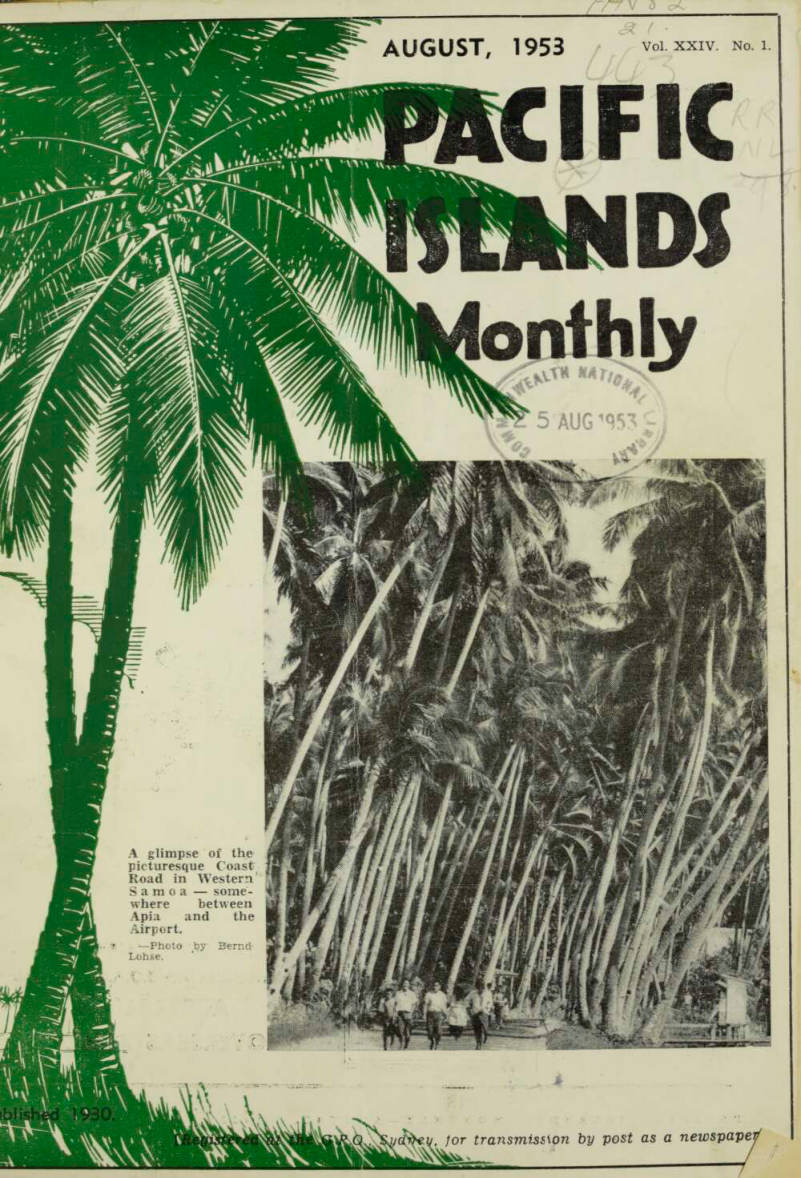 1
1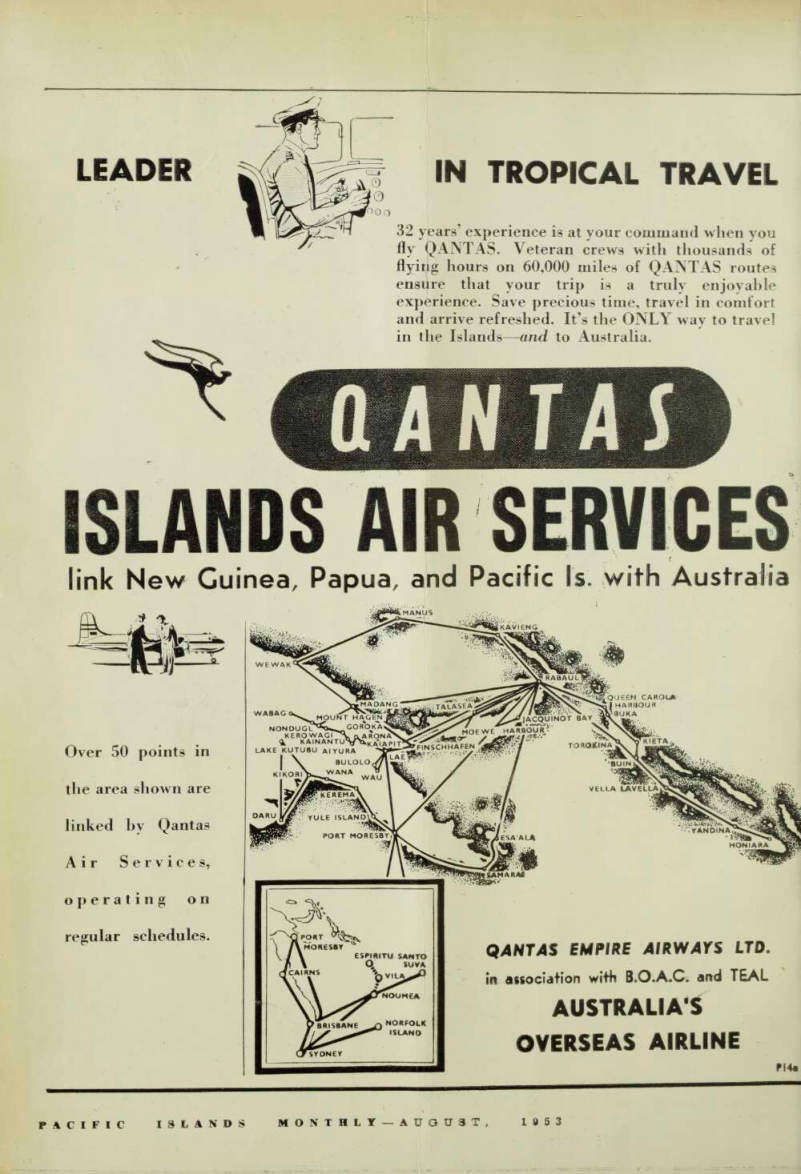 2
2 3
3 4
4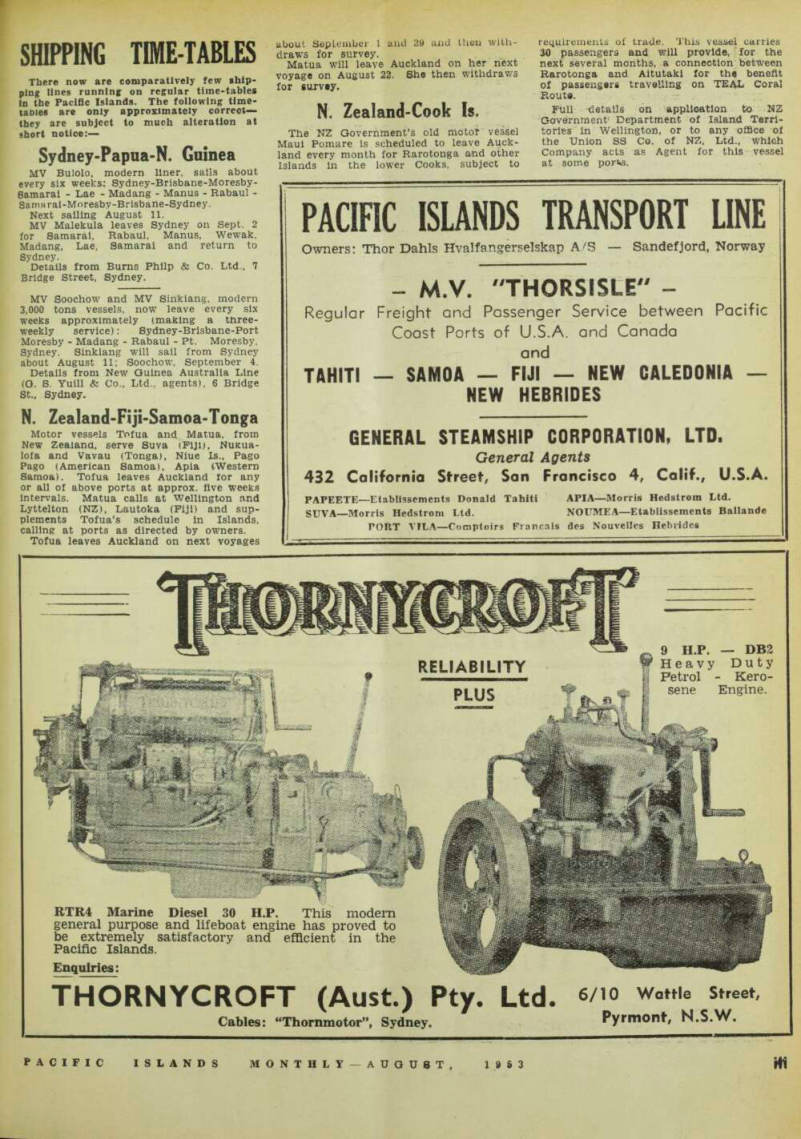 5
5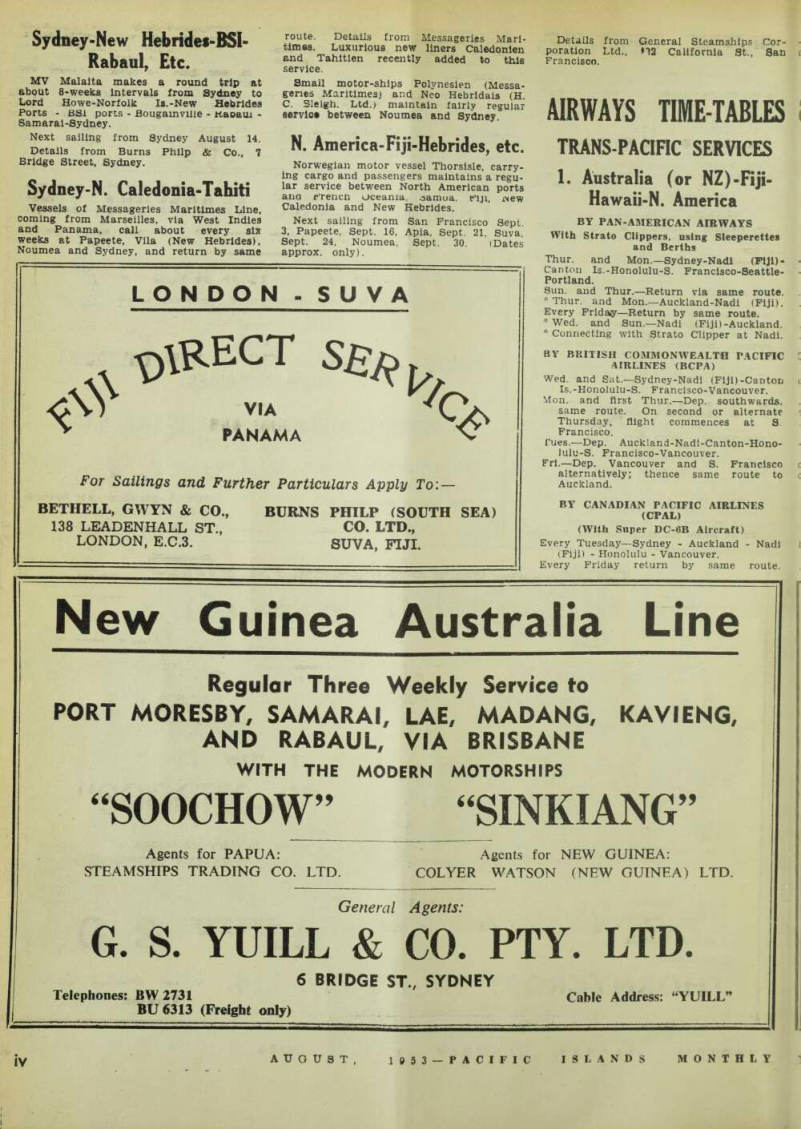 6
6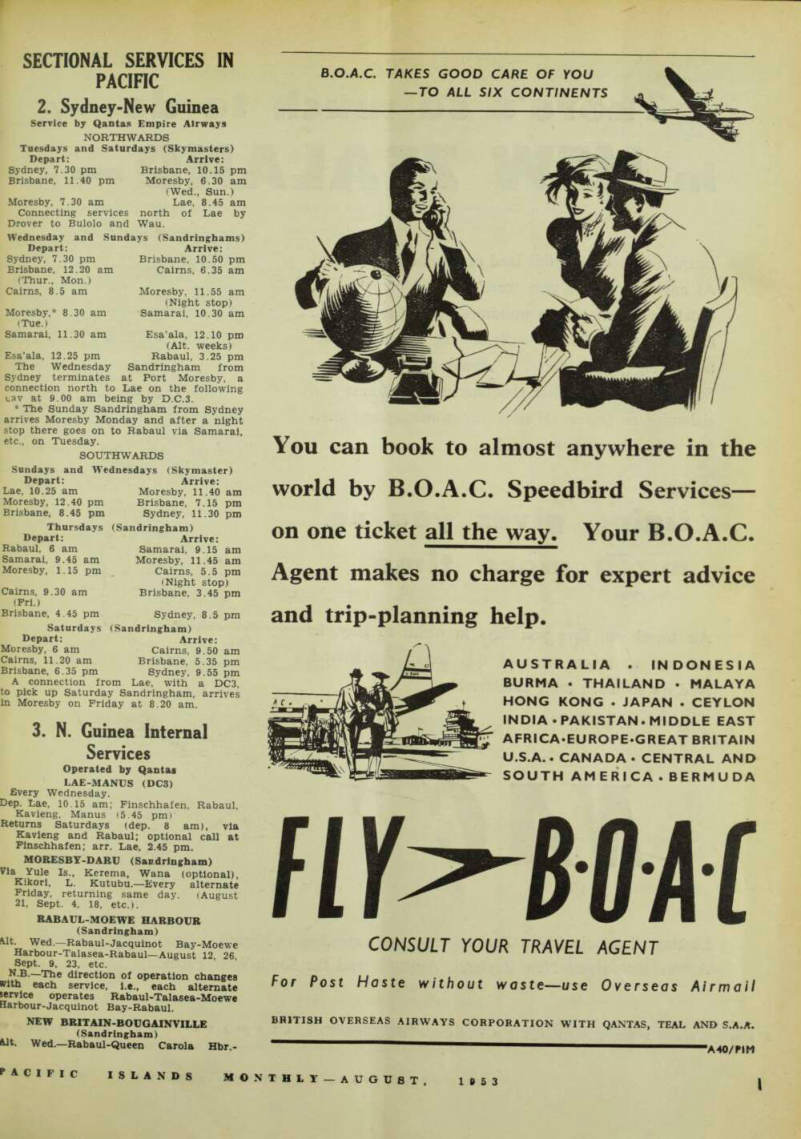 7
7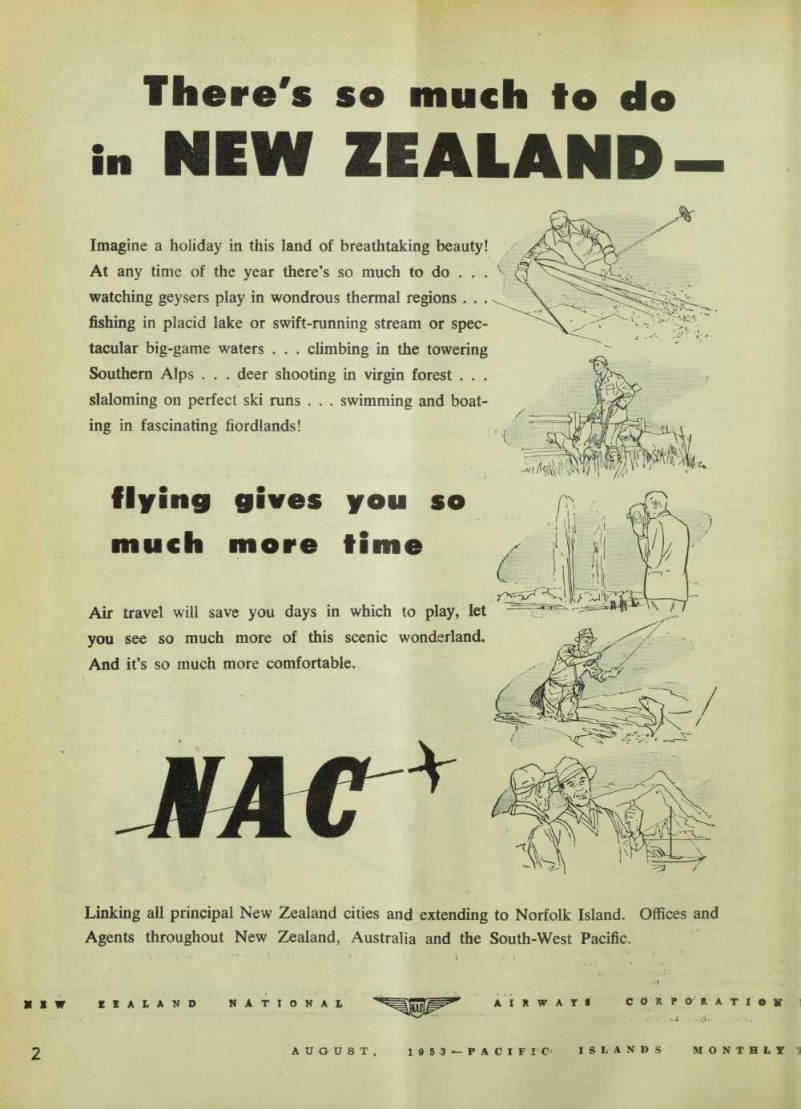 8
8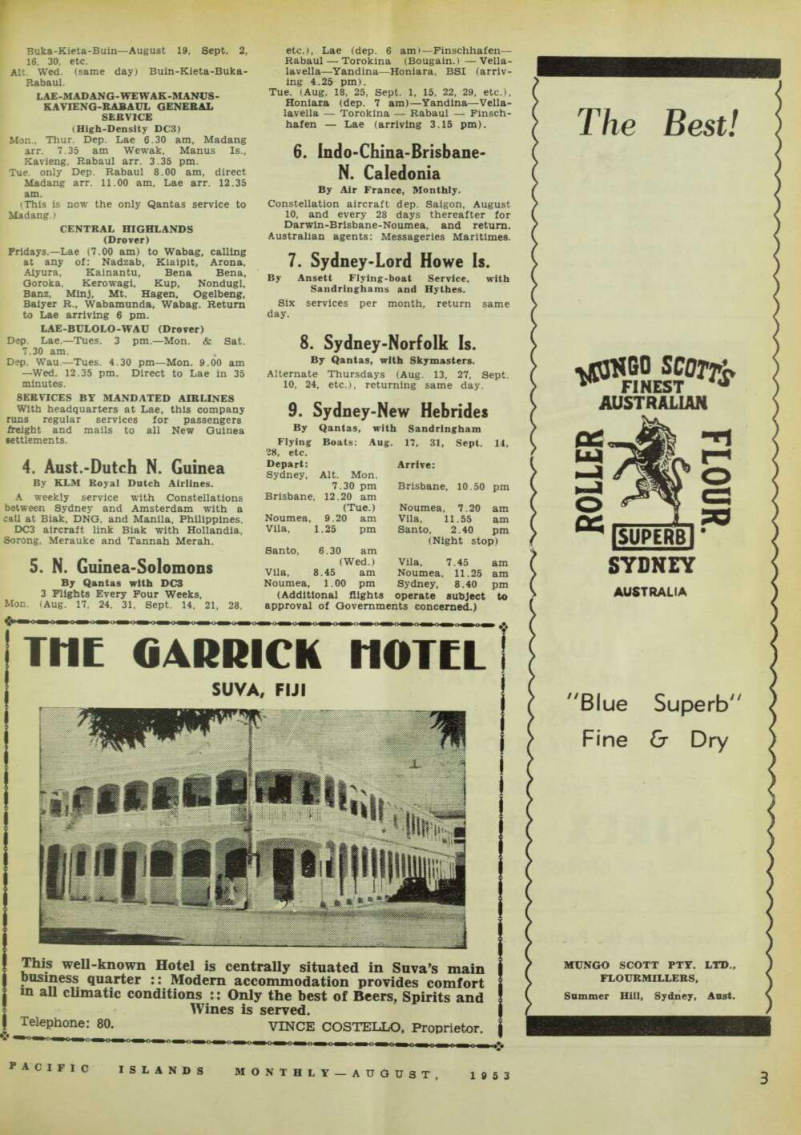 9
9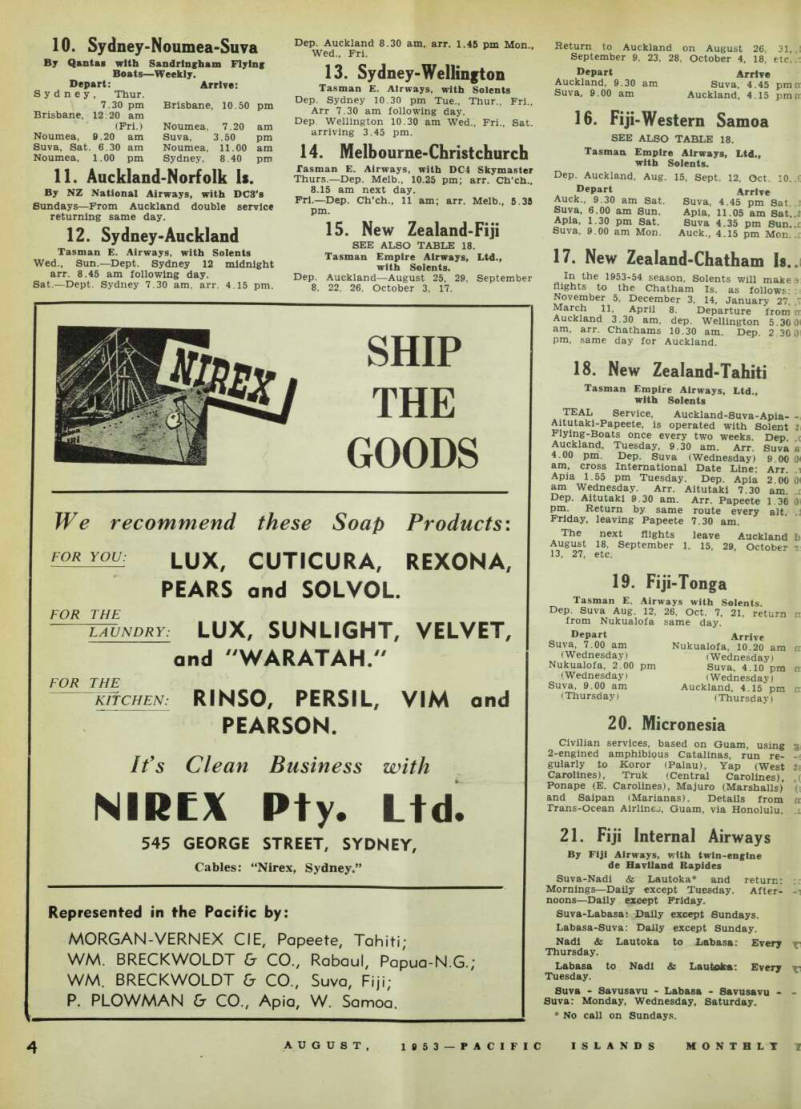 10
10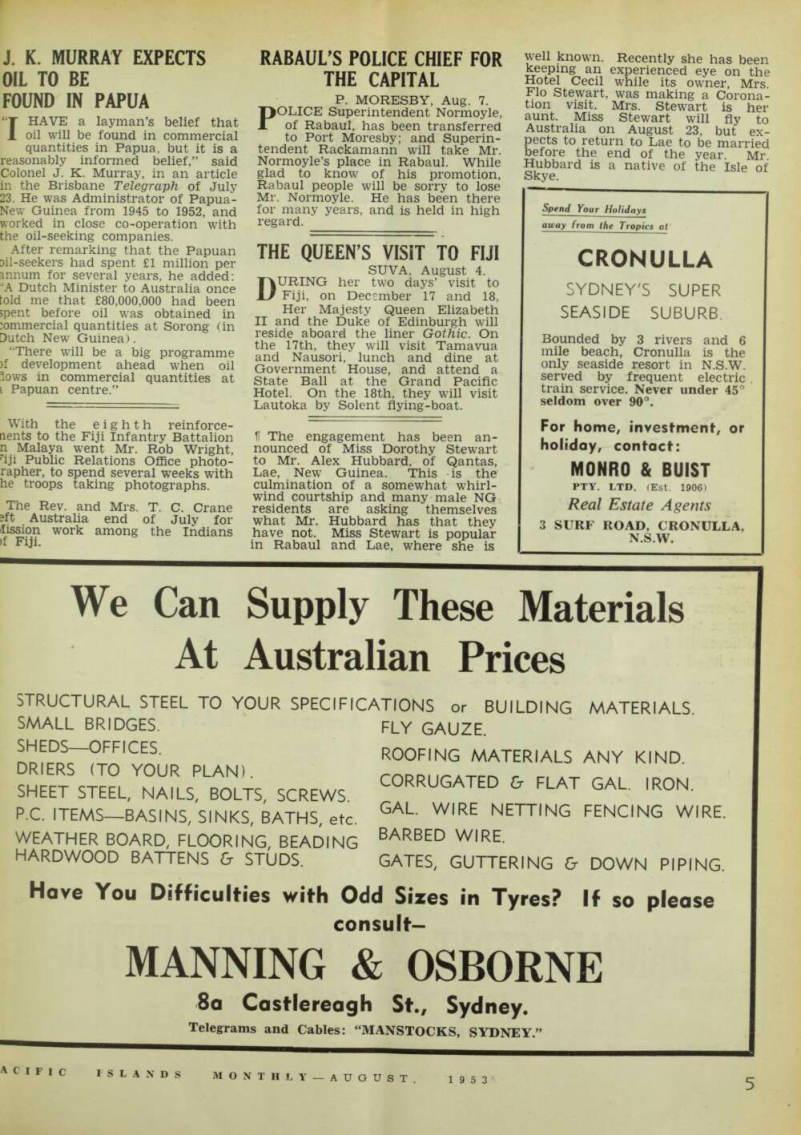 11
11 12
12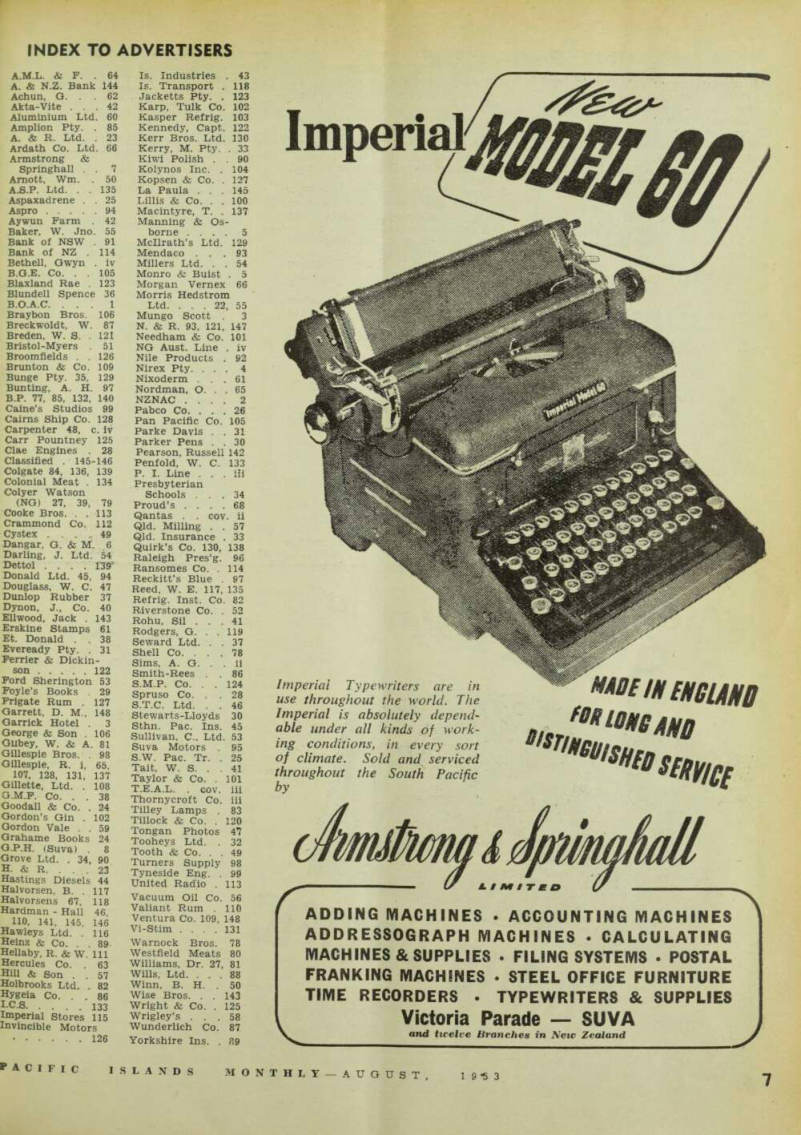 13
13 14
14 15
15 16
16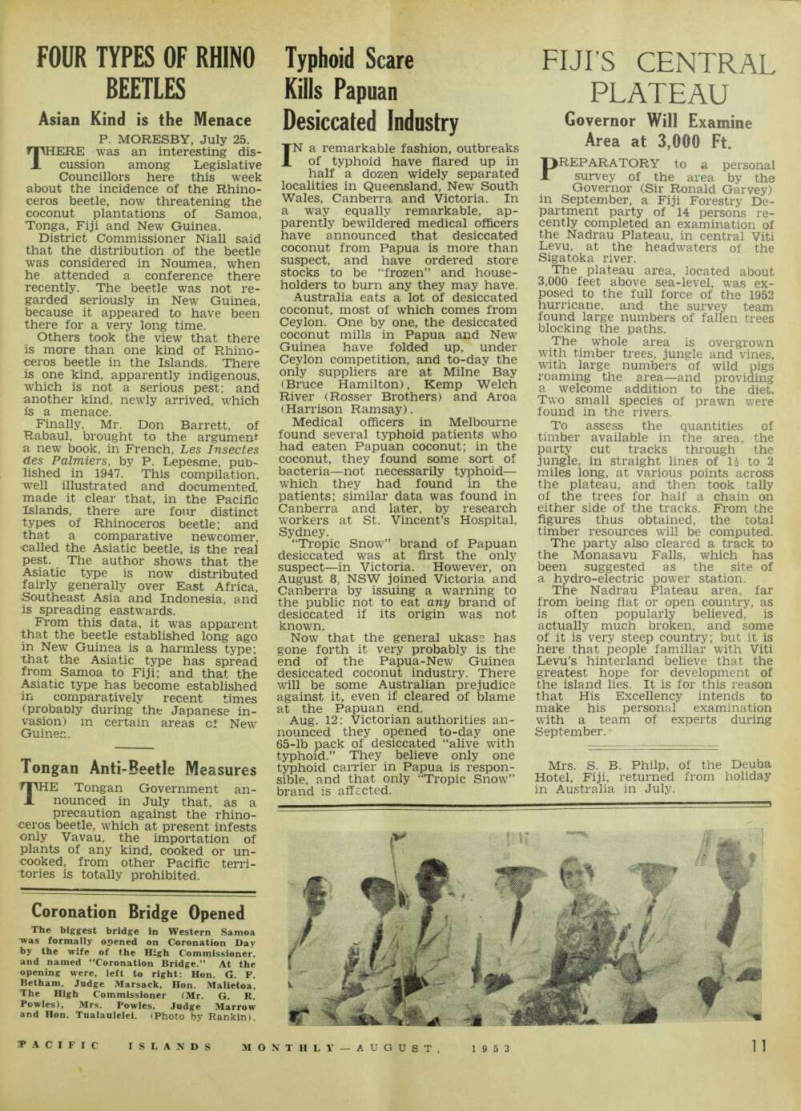 17
17 18
18 19
19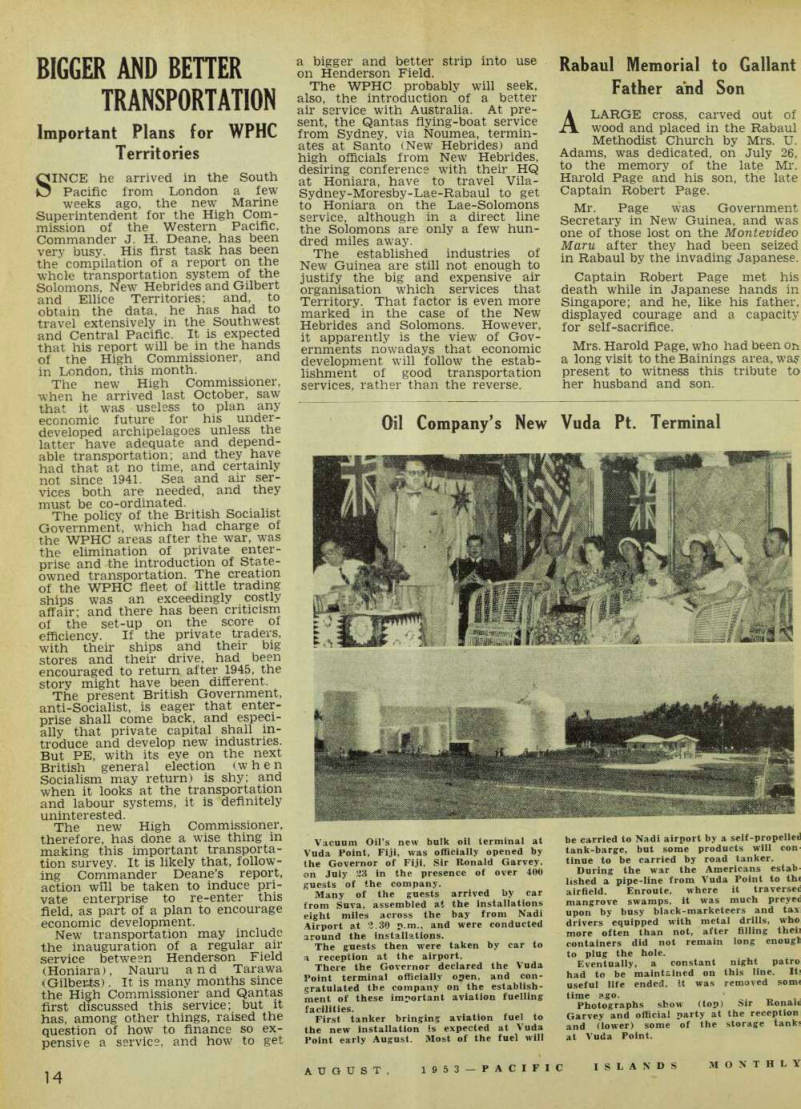 20
20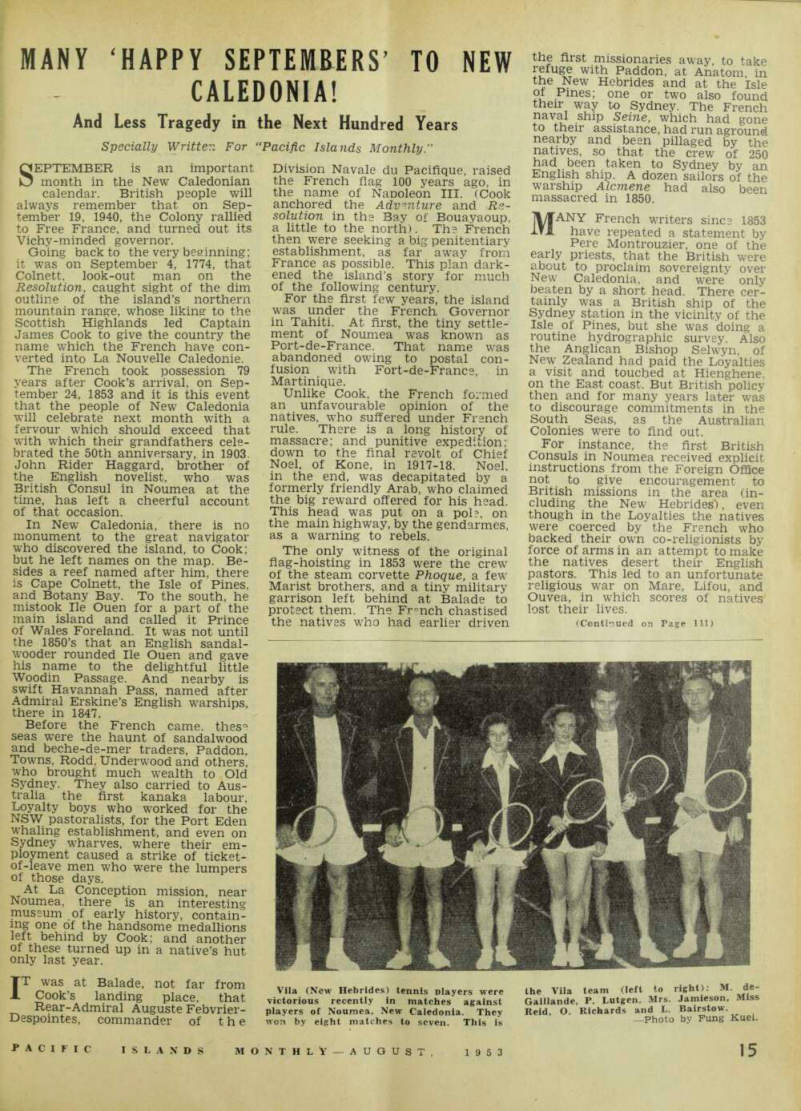 21
21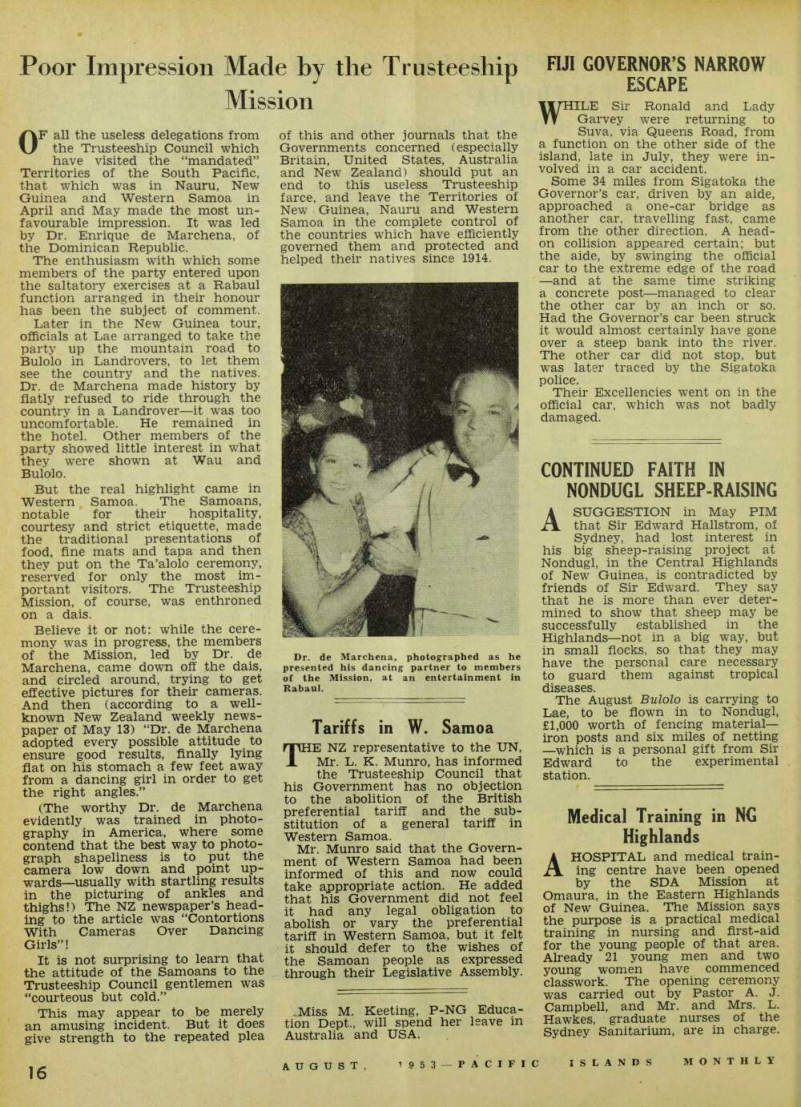 22
22 23
23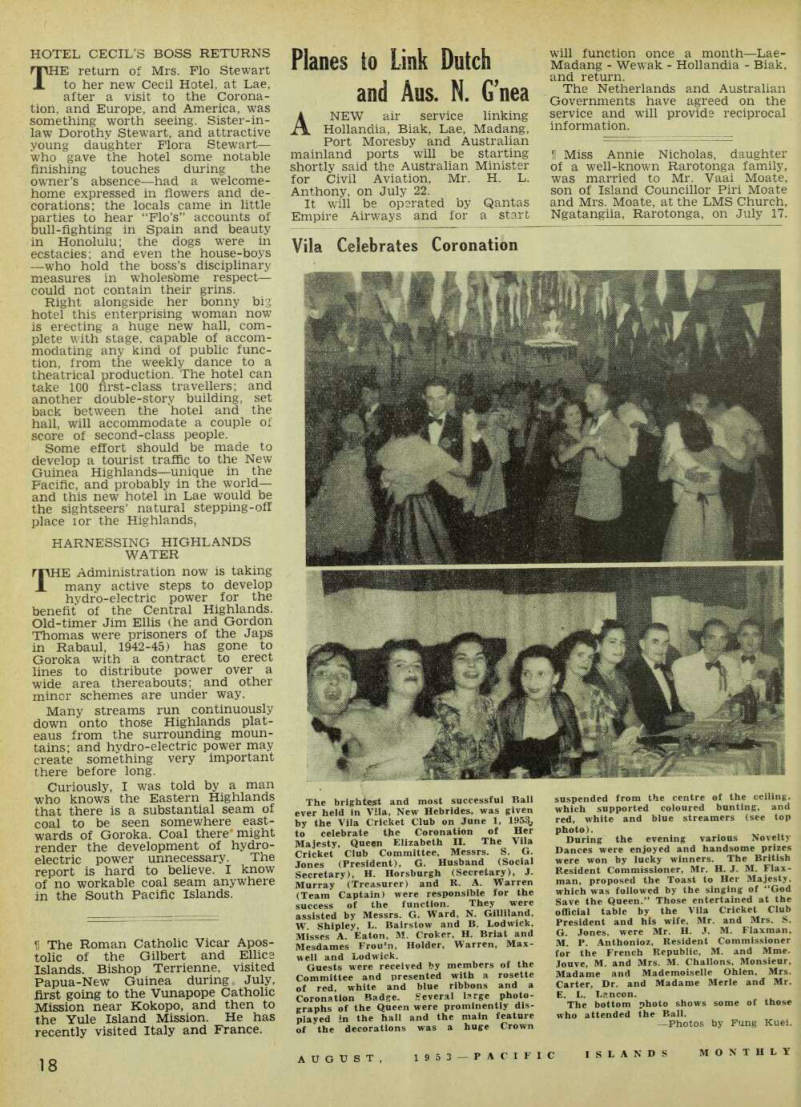 24
24 25
25 26
26 27
27 28
28 29
29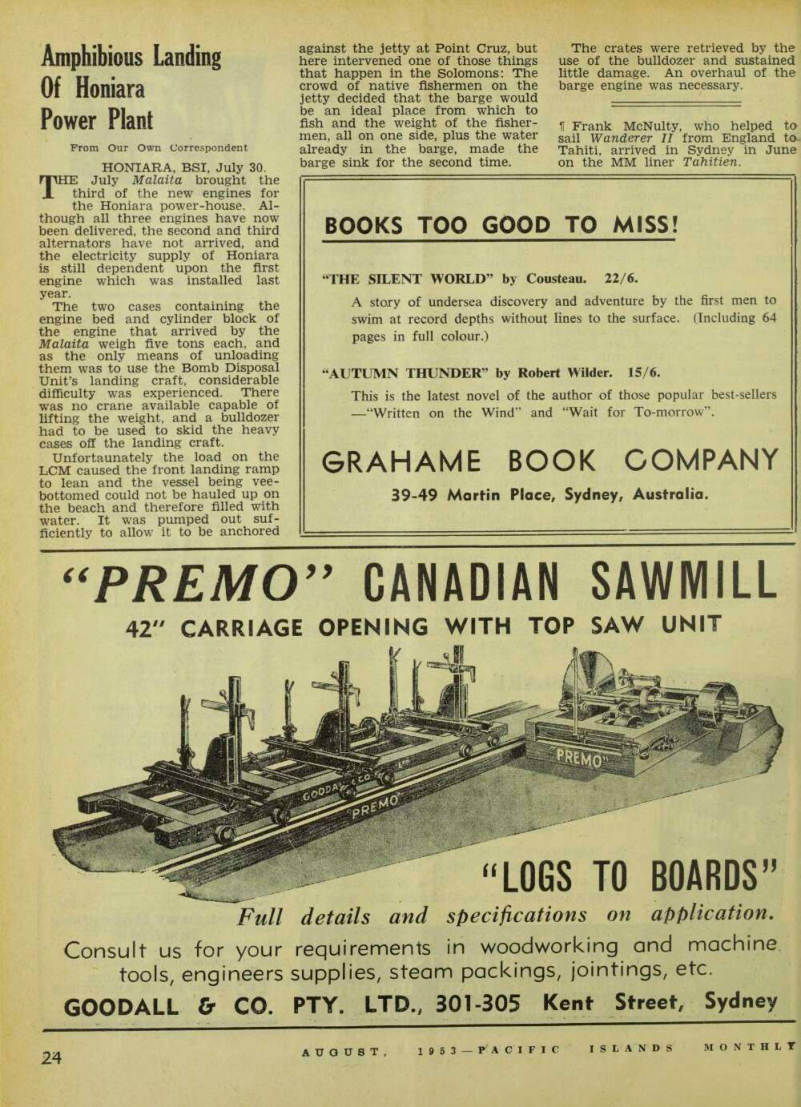 30
30 31
31 32
32 33
33 34
34 35
35 36
36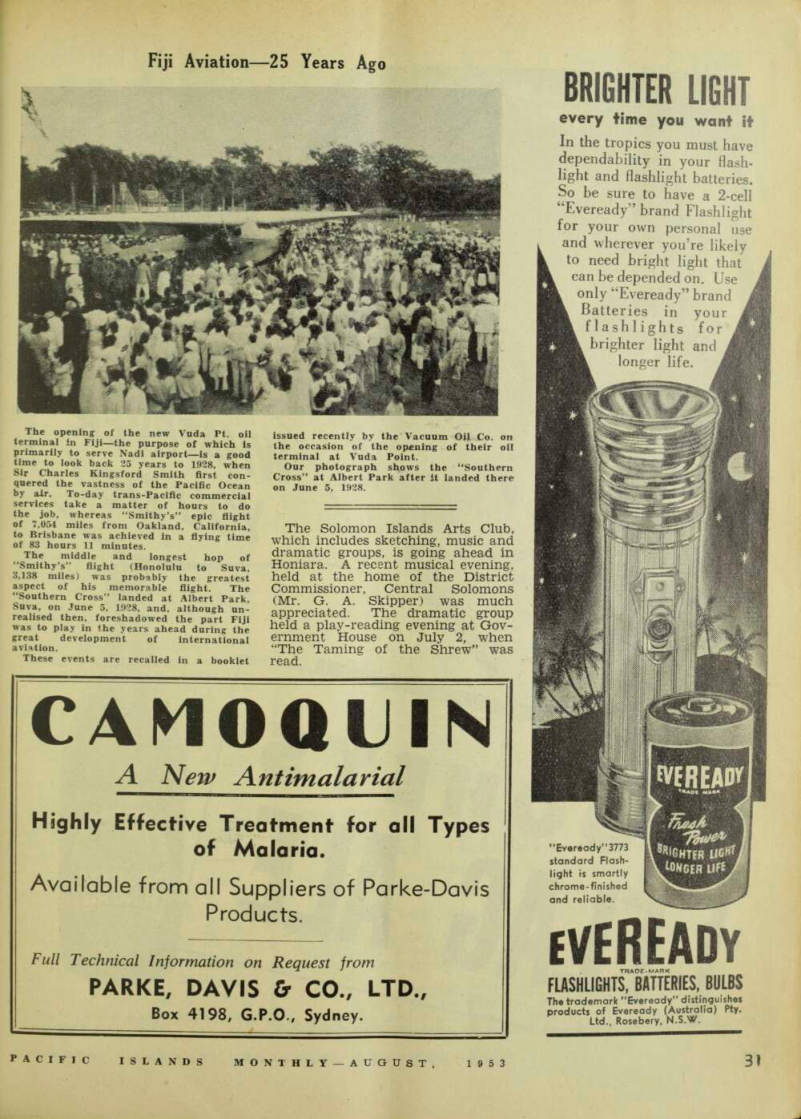 37
37 38
38 39
39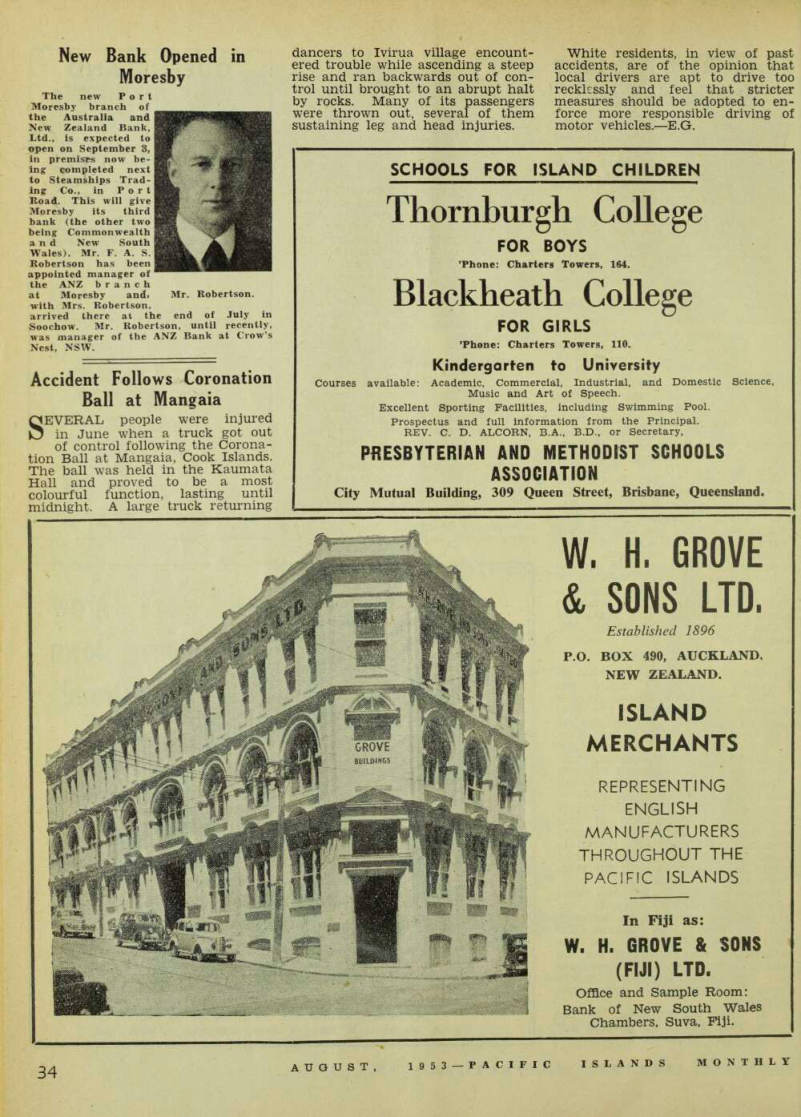 40
40 41
41 42
42 43
43 44
44 45
45 46
46 47
47 48
48 49
49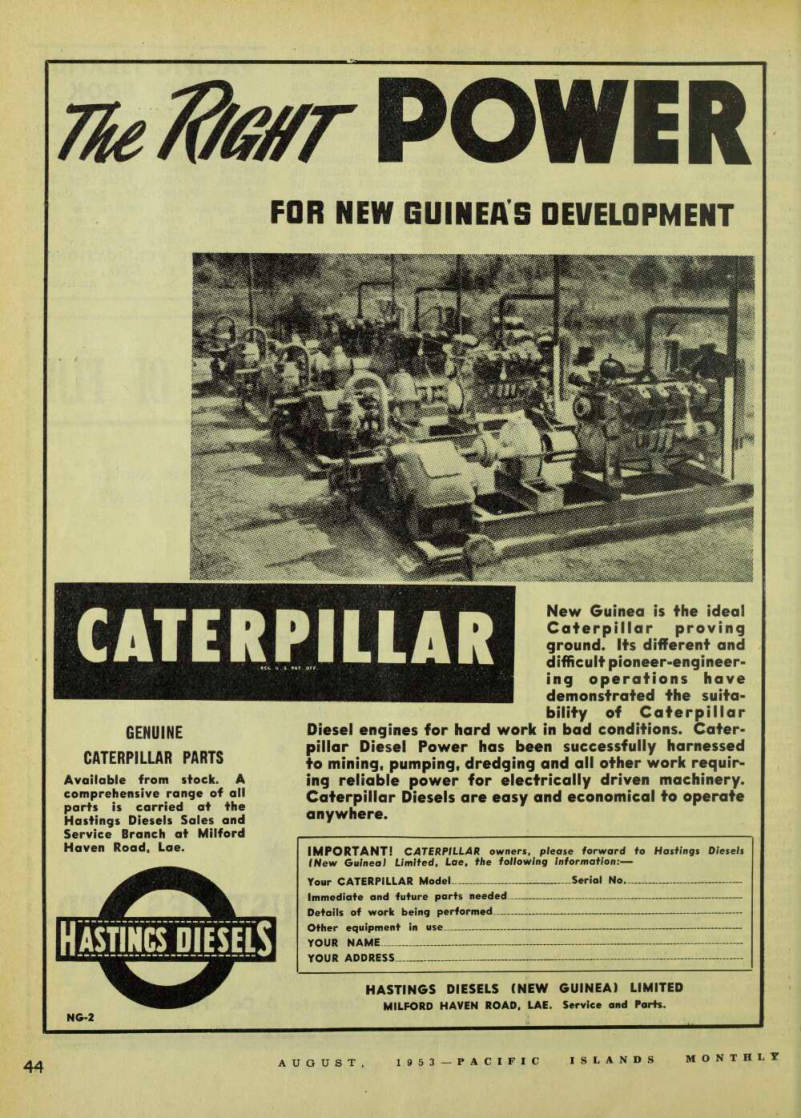 50
50 51
51 52
52 53
53 54
54 55
55 56
56 57
57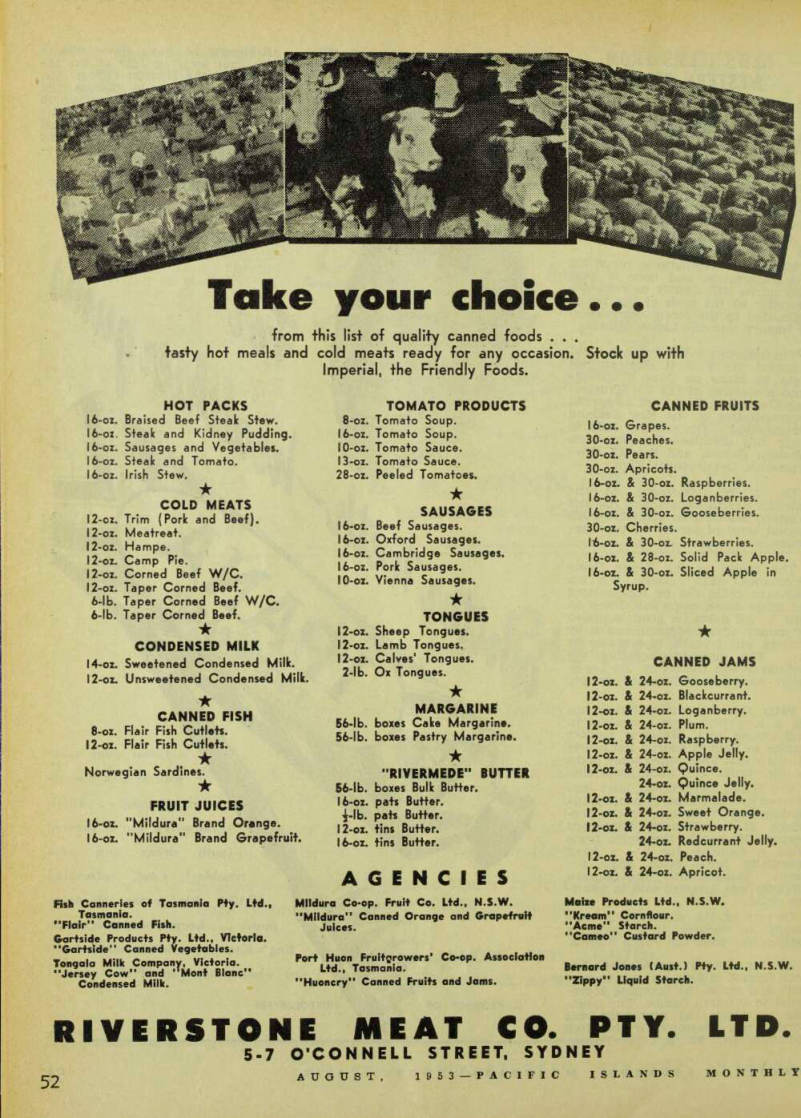 58
58 59
59 60
60 61
61 62
62 63
63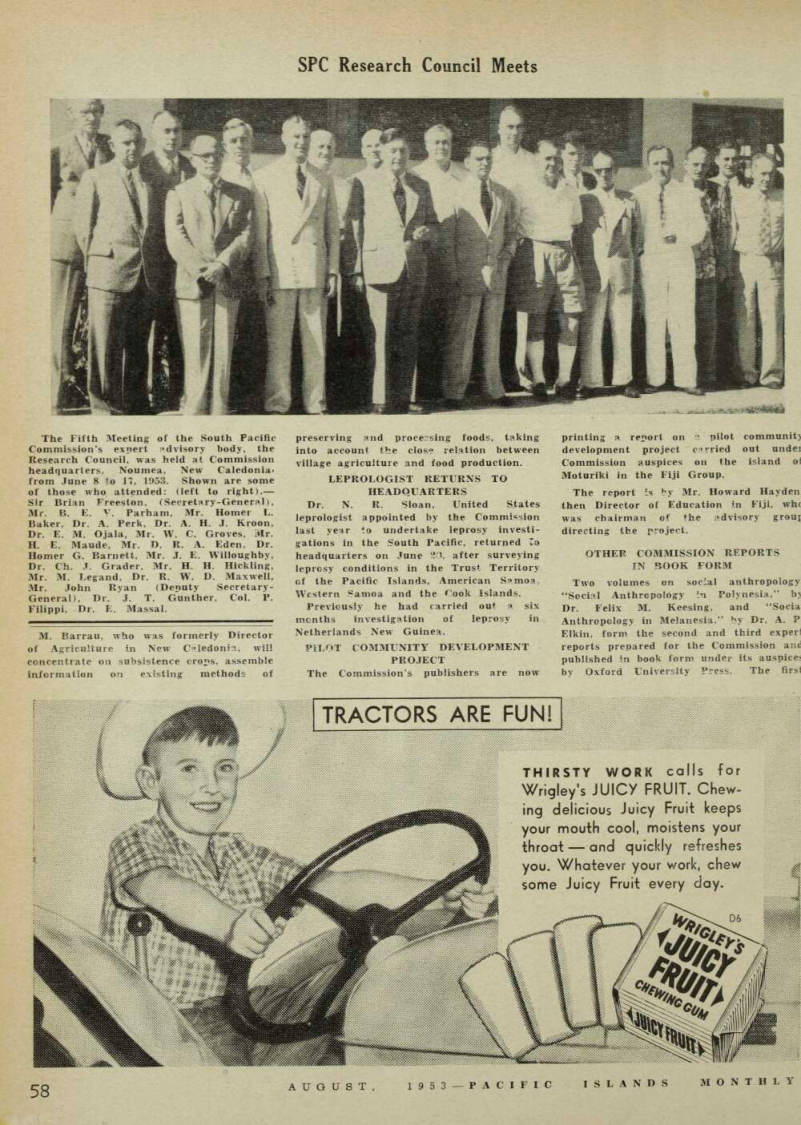 64
64 65
65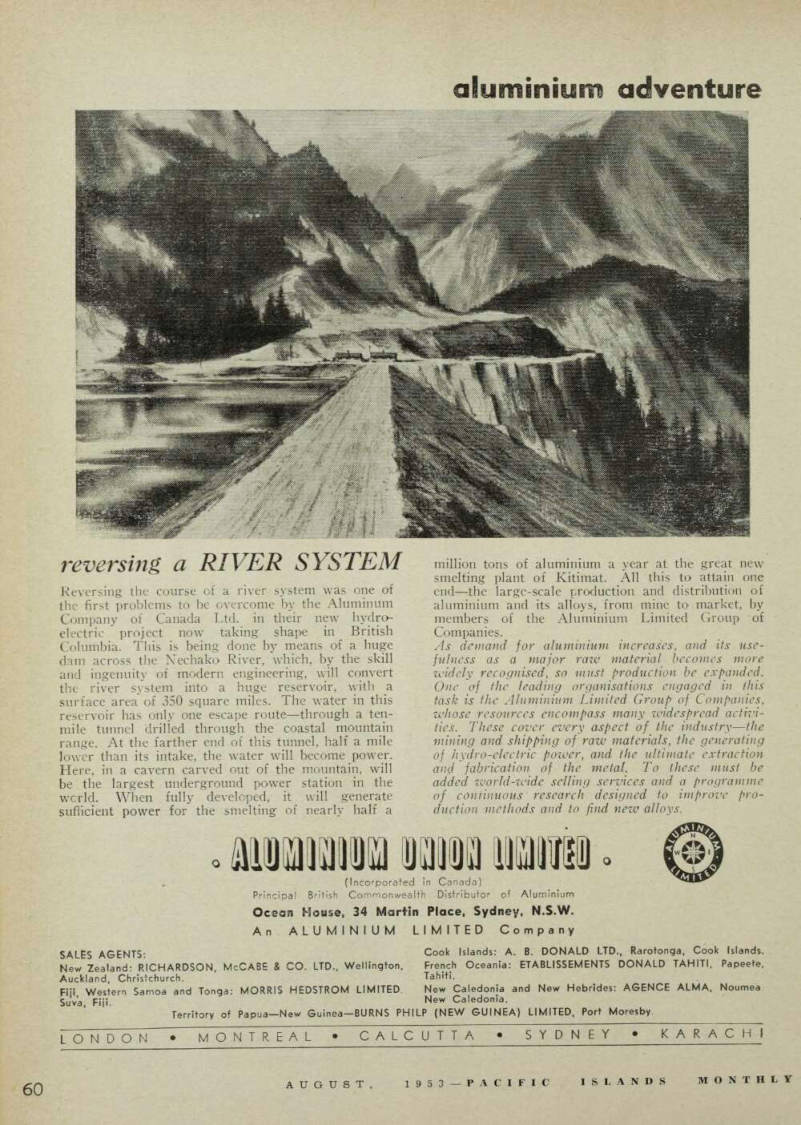 66
66 67
67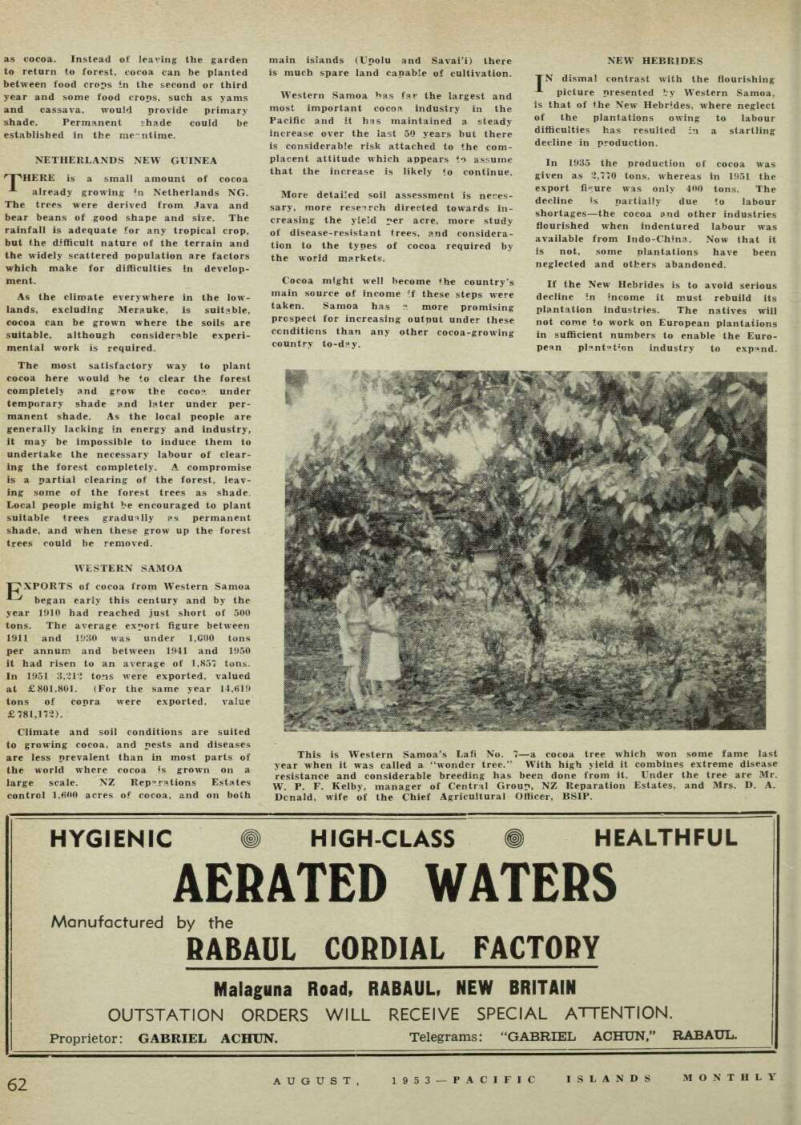 68
68 69
69 70
70 71
71 72
72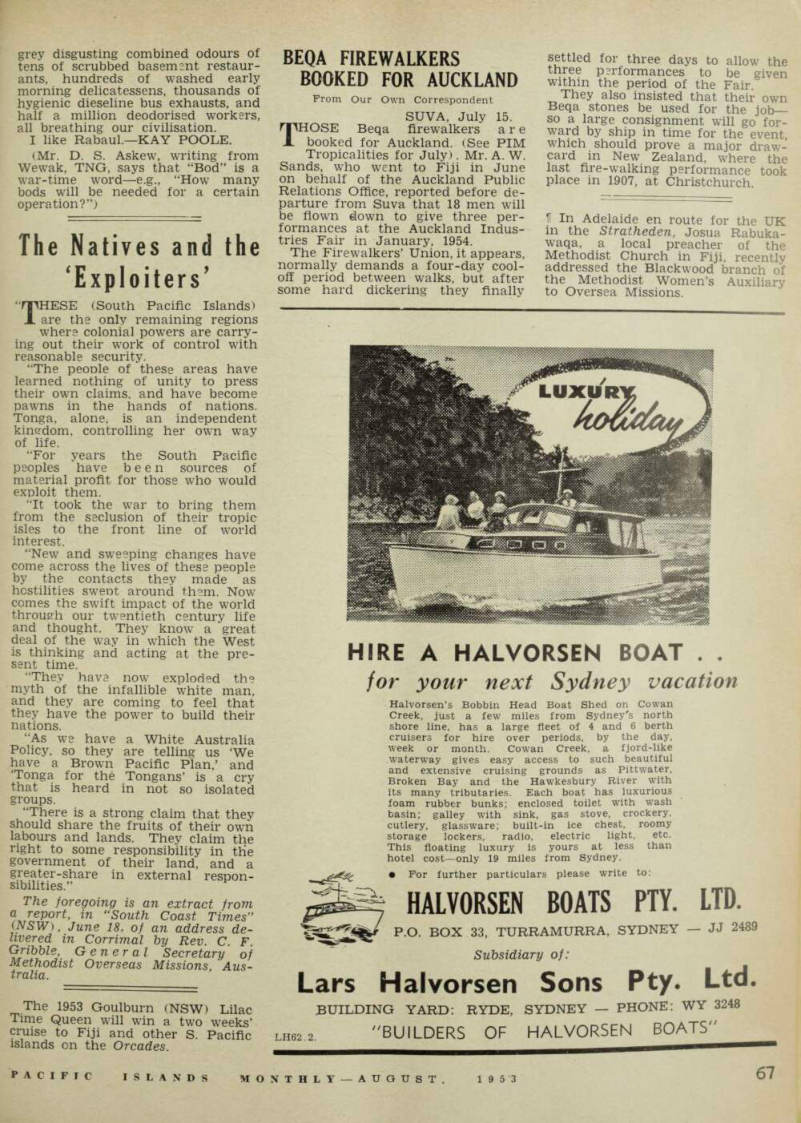 73
73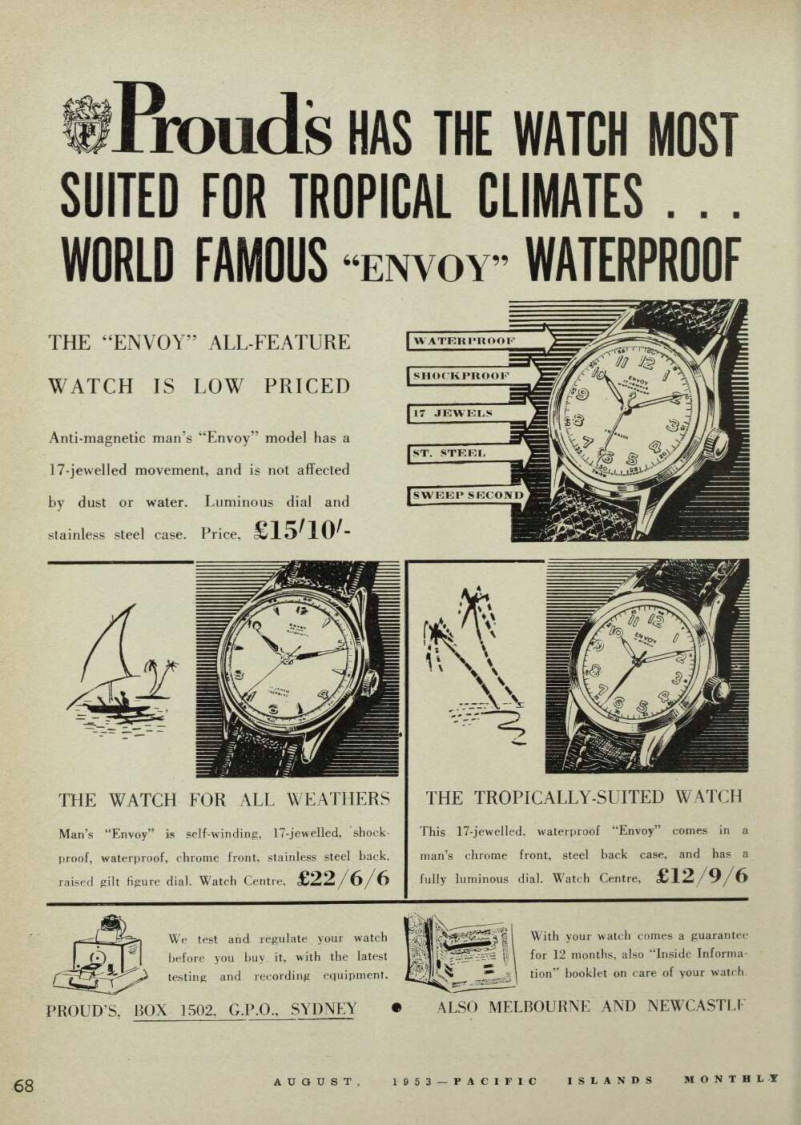 74
74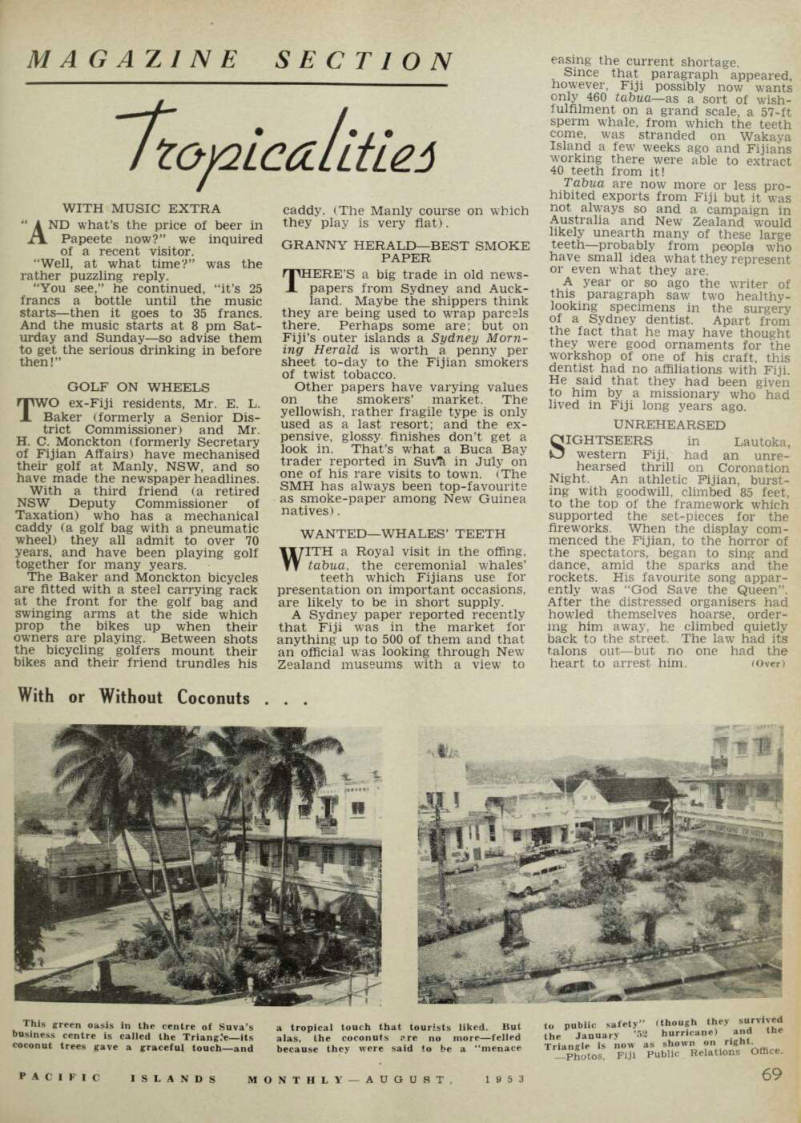 75
75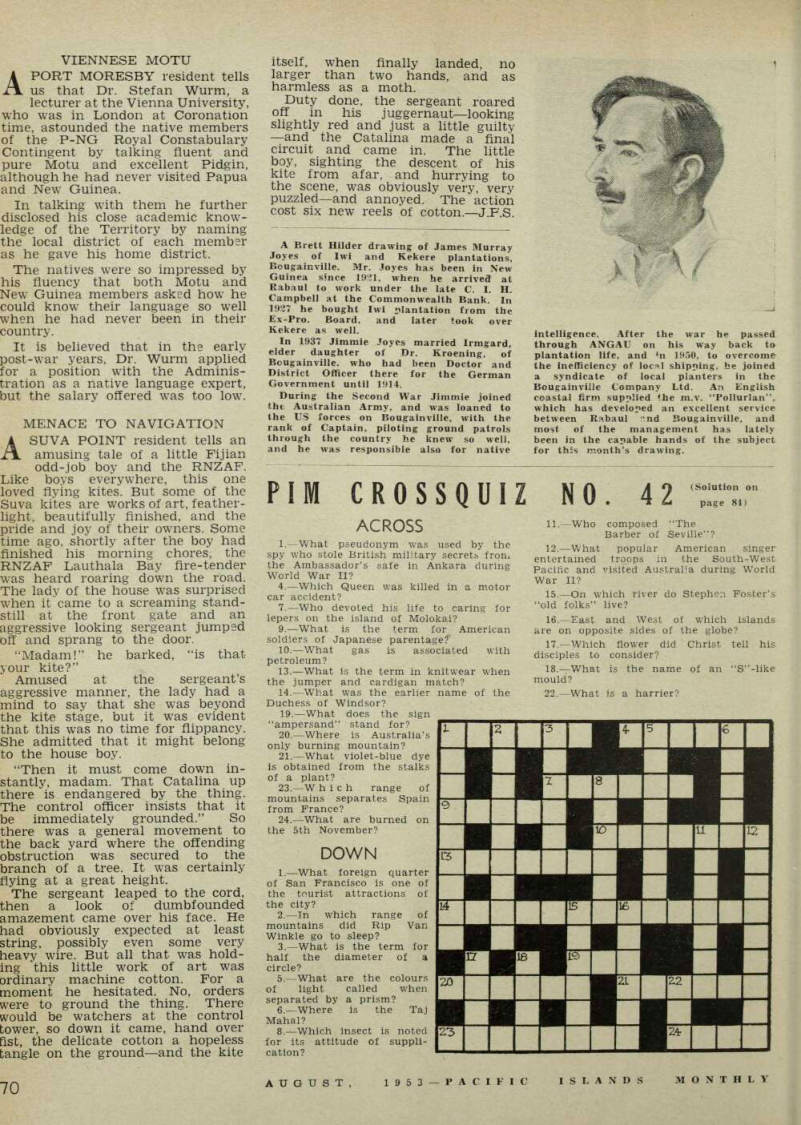 76
76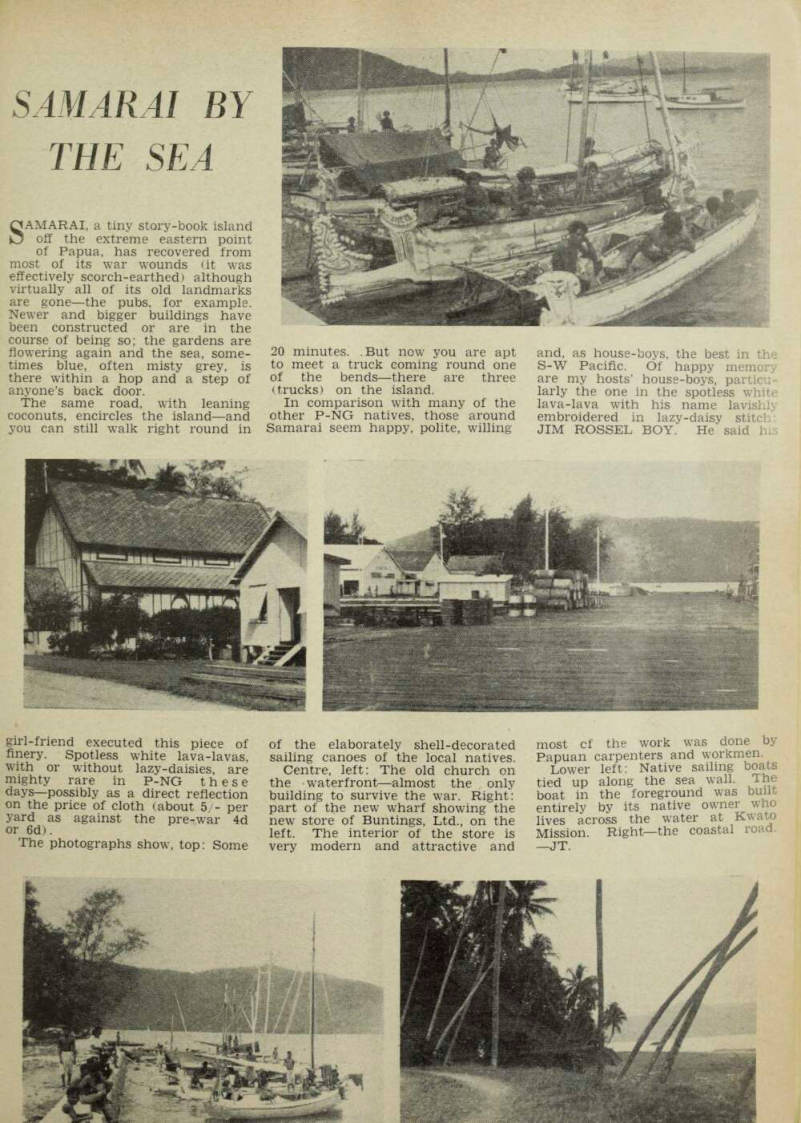 77
77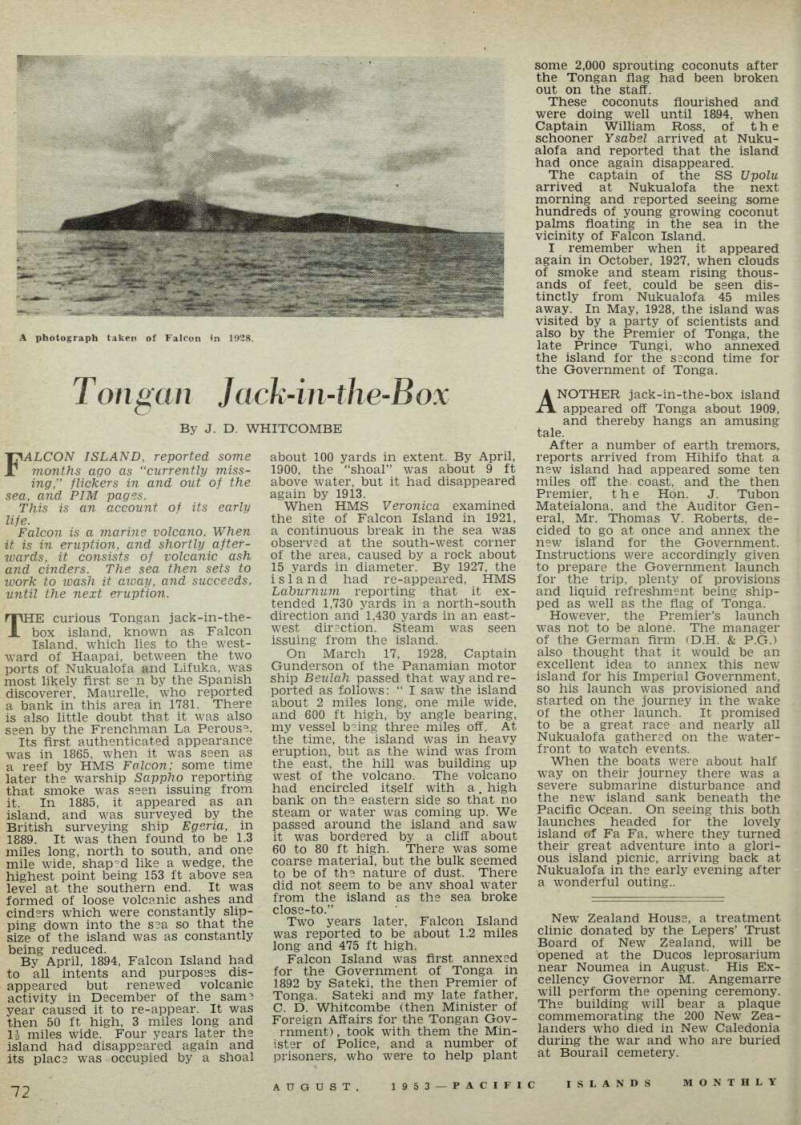 78
78 79
79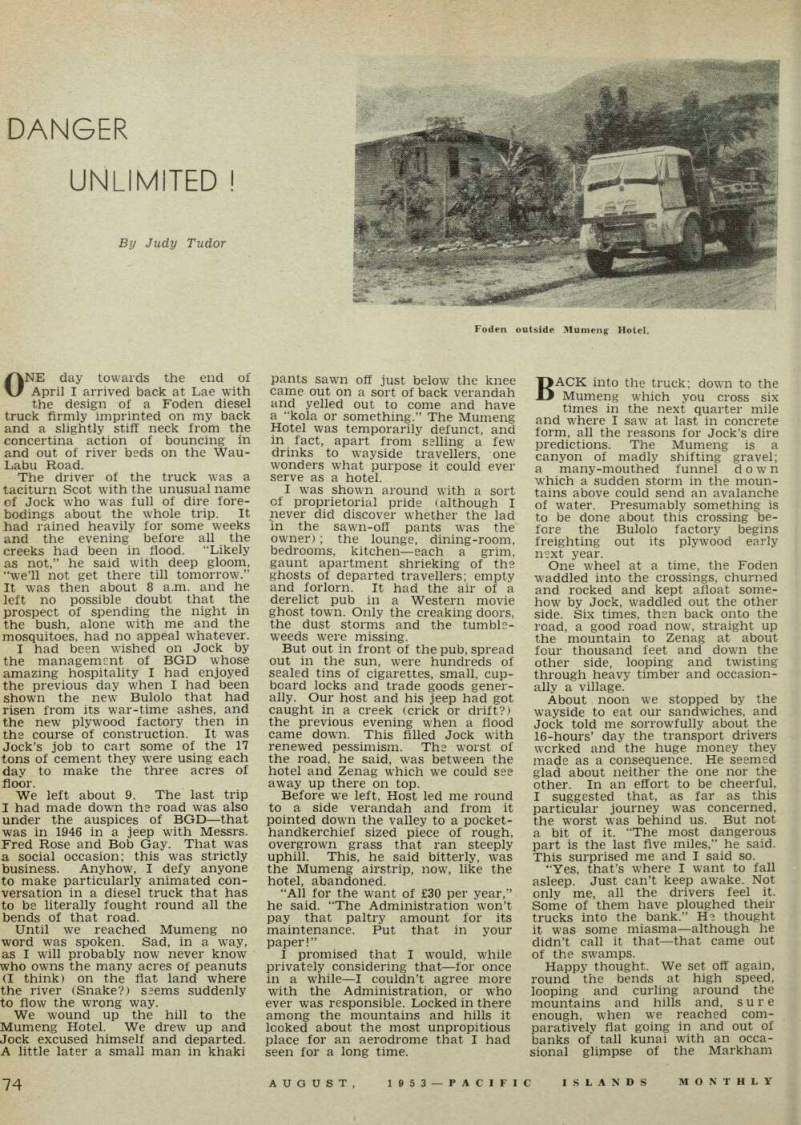 80
80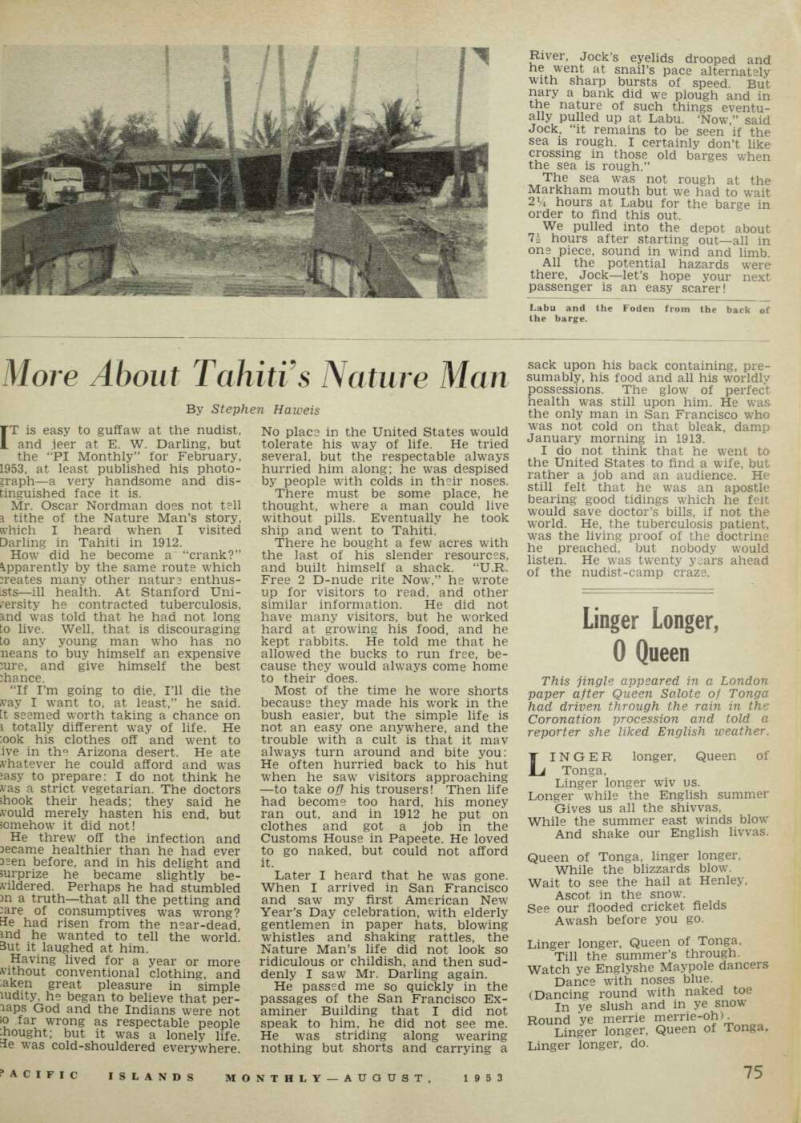 81
81 82
82 83
83 84
84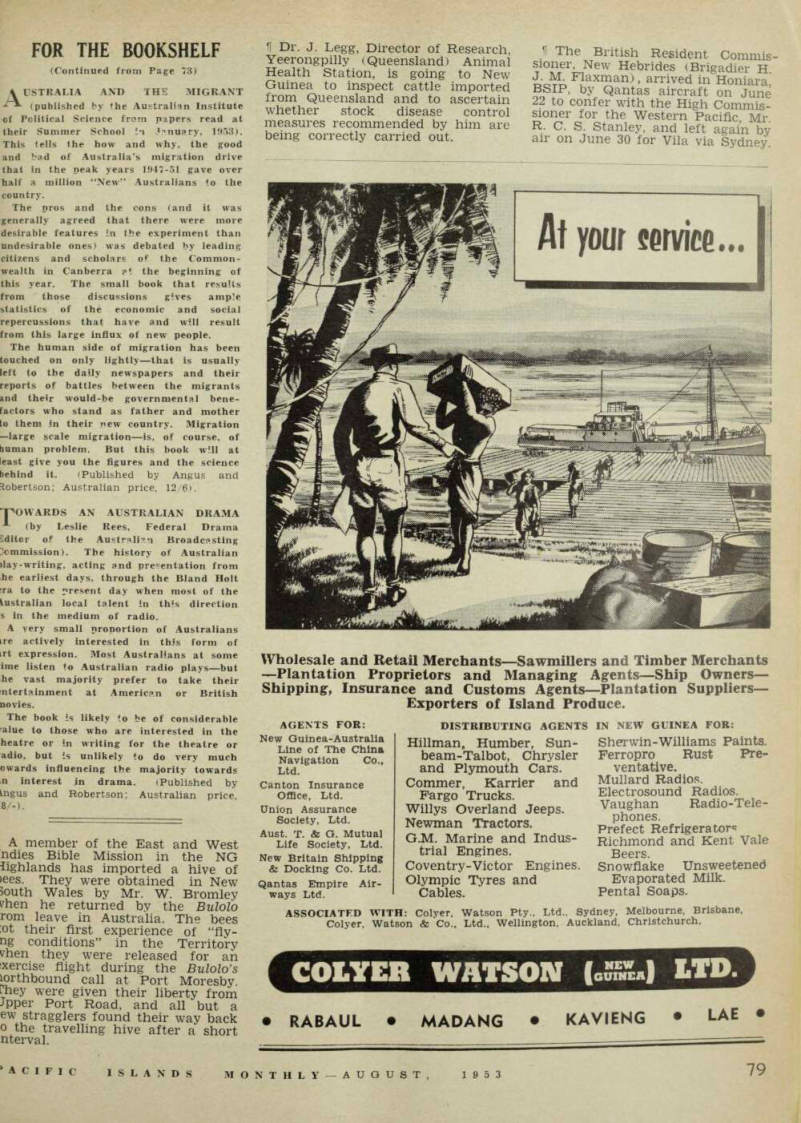 85
85 86
86 87
87 88
88 89
89 90
90 91
91 92
92 93
93 94
94 95
95 96
96 97
97 98
98 99
99 100
100 101
101 102
102 103
103 104
104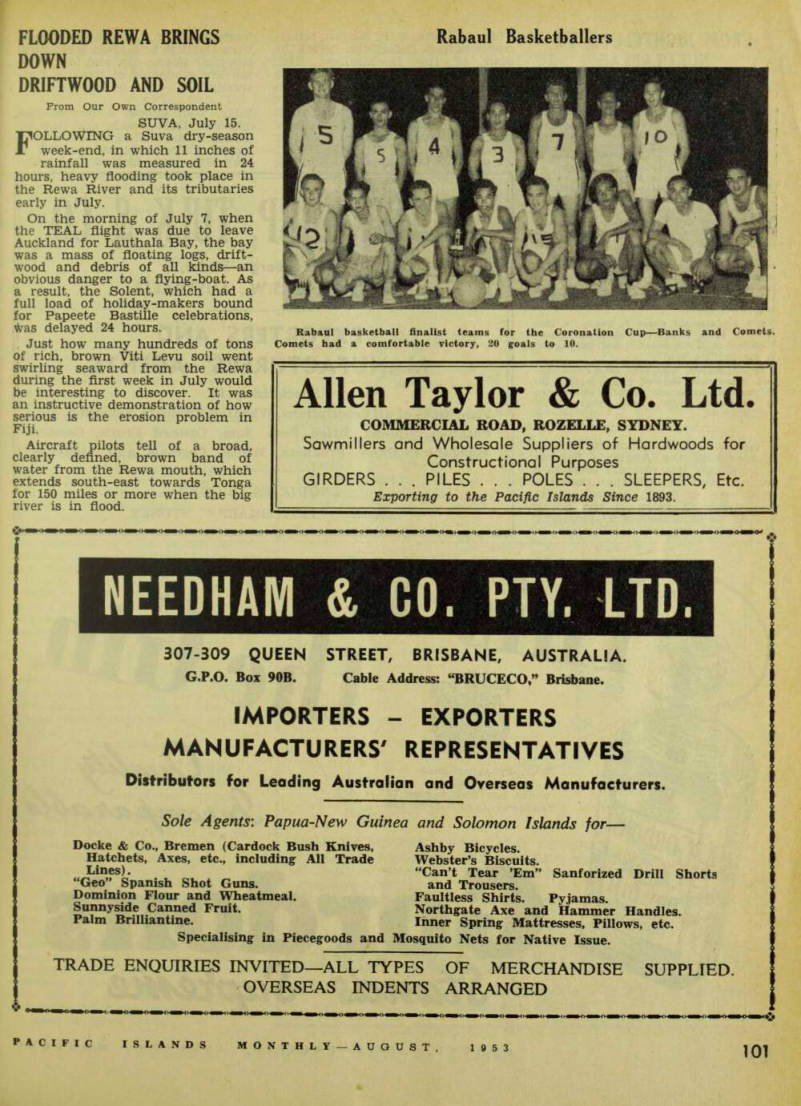 105
105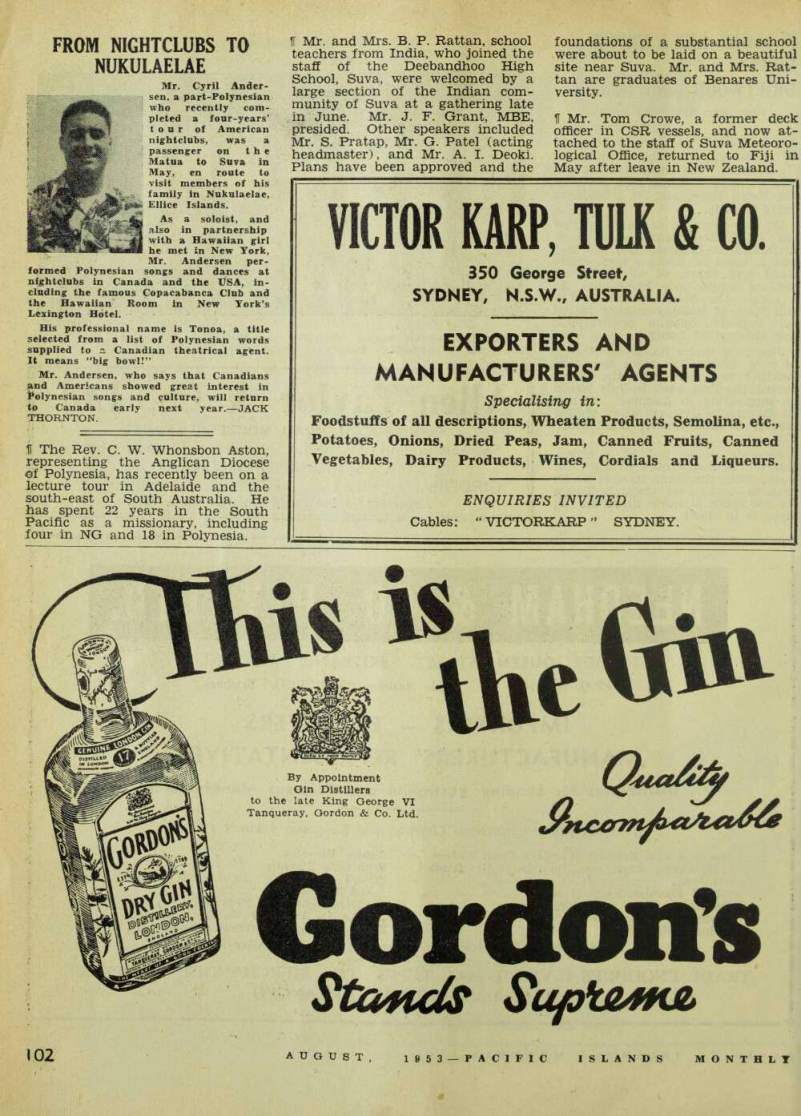 106
106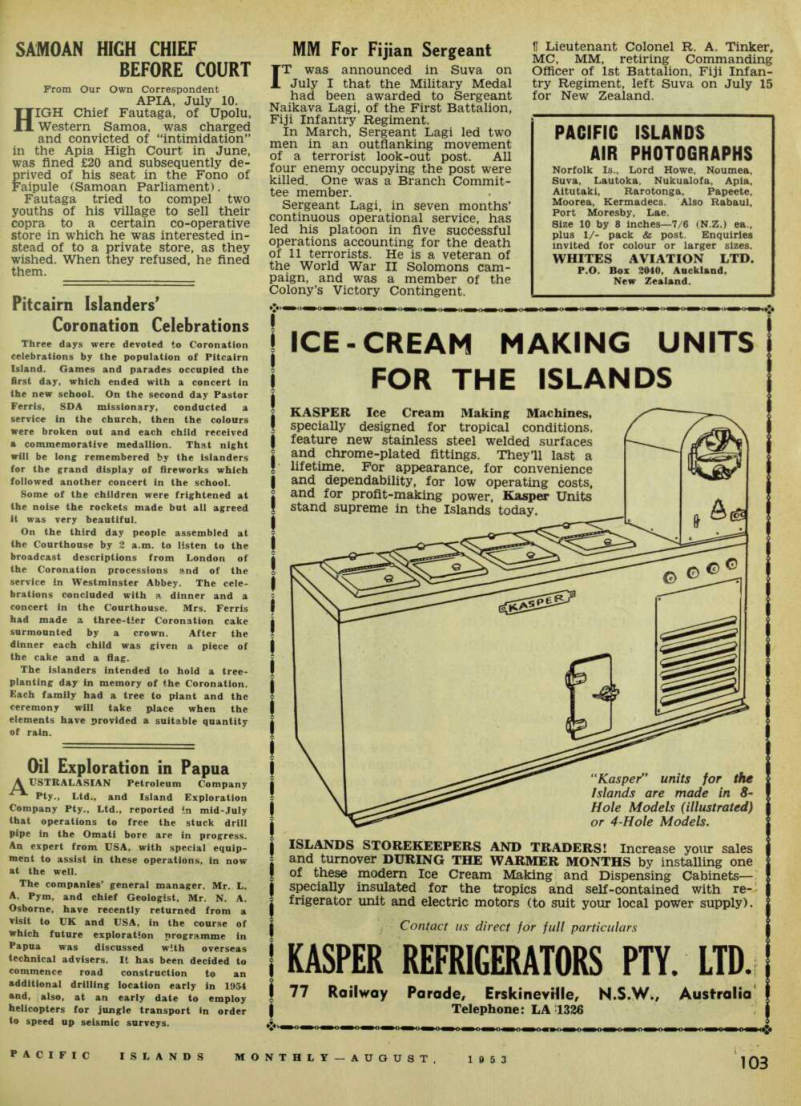 107
107 108
108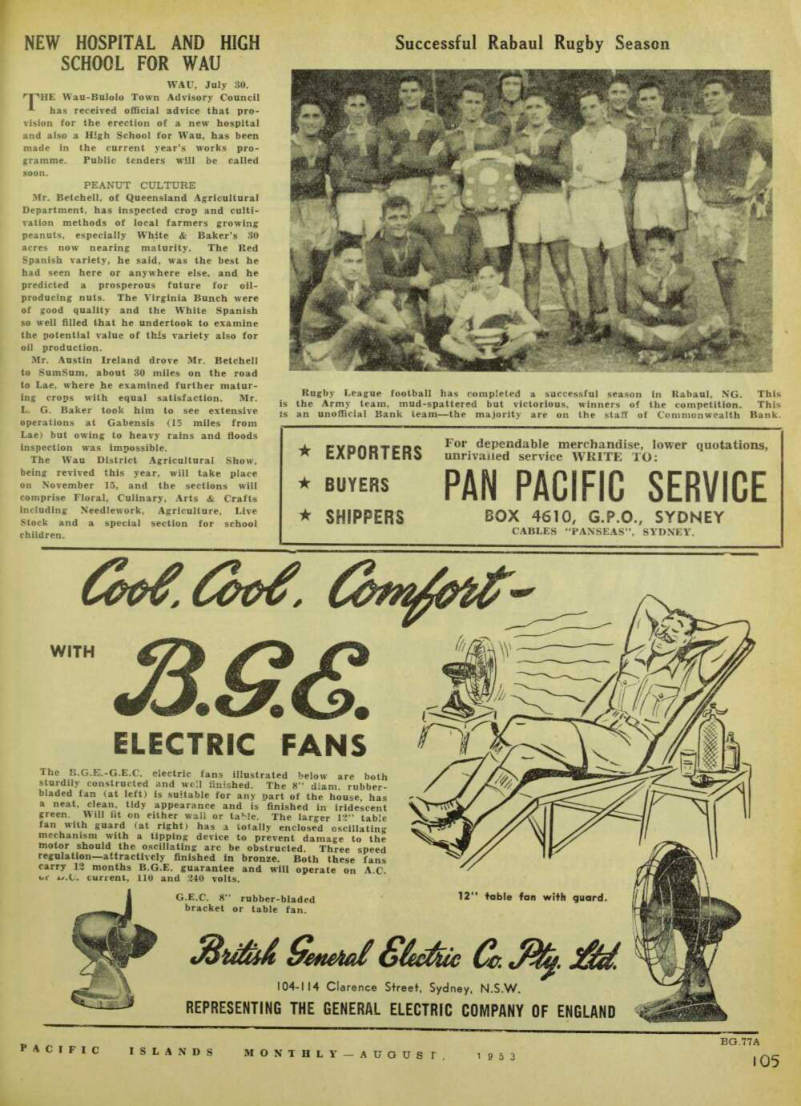 109
109 110
110 111
111 112
112 113
113 114
114 115
115 116
116 117
117 118
118 119
119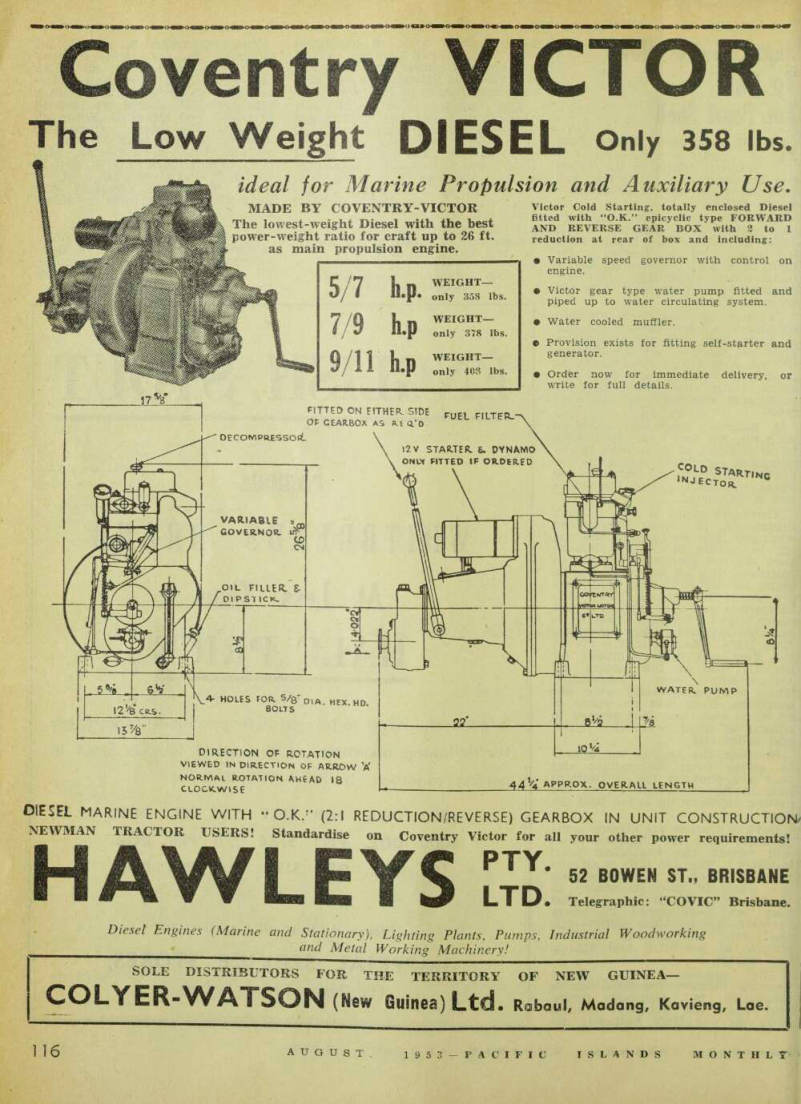 120
120 121
121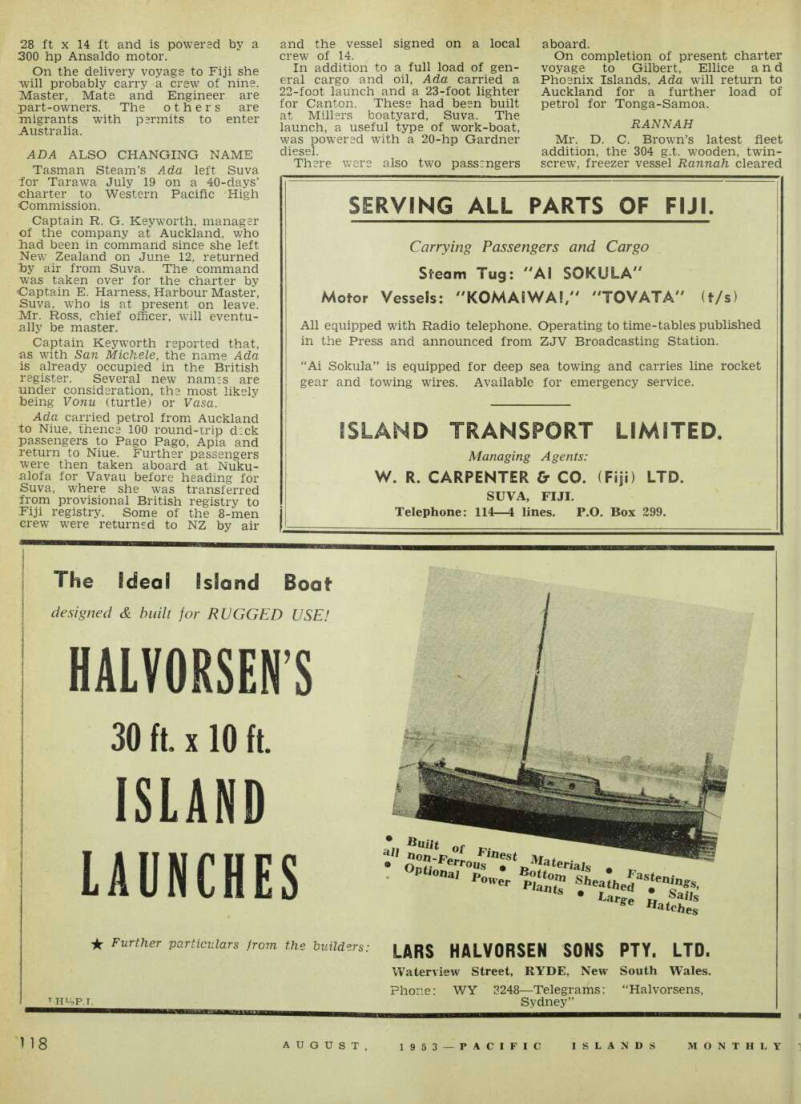 122
122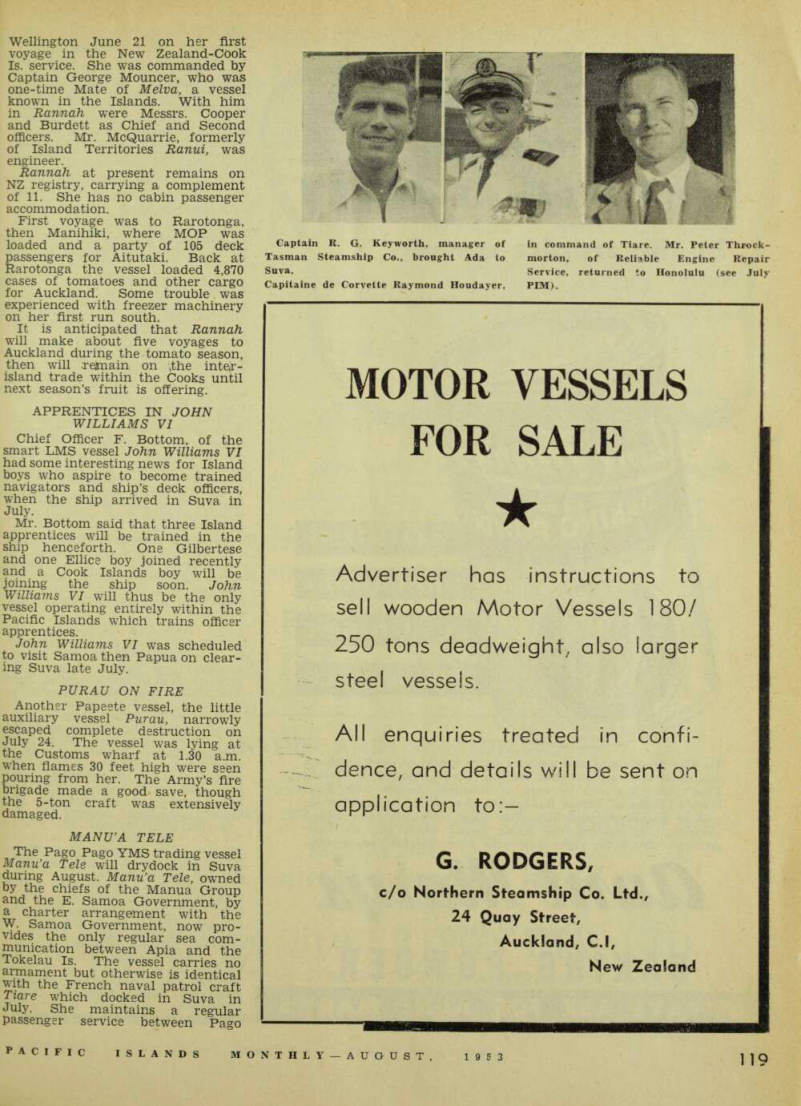 123
123 124
124 125
125 126
126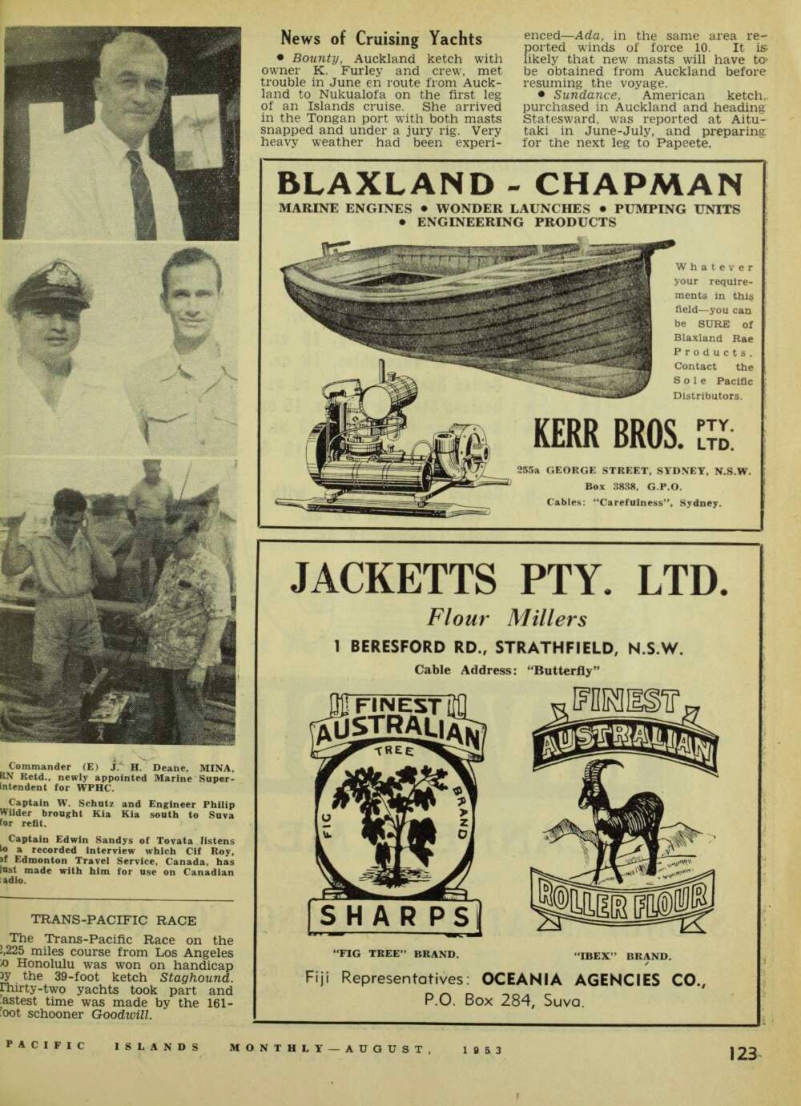 127
127 128
128 129
129 130
130 131
131 132
132 133
133 134
134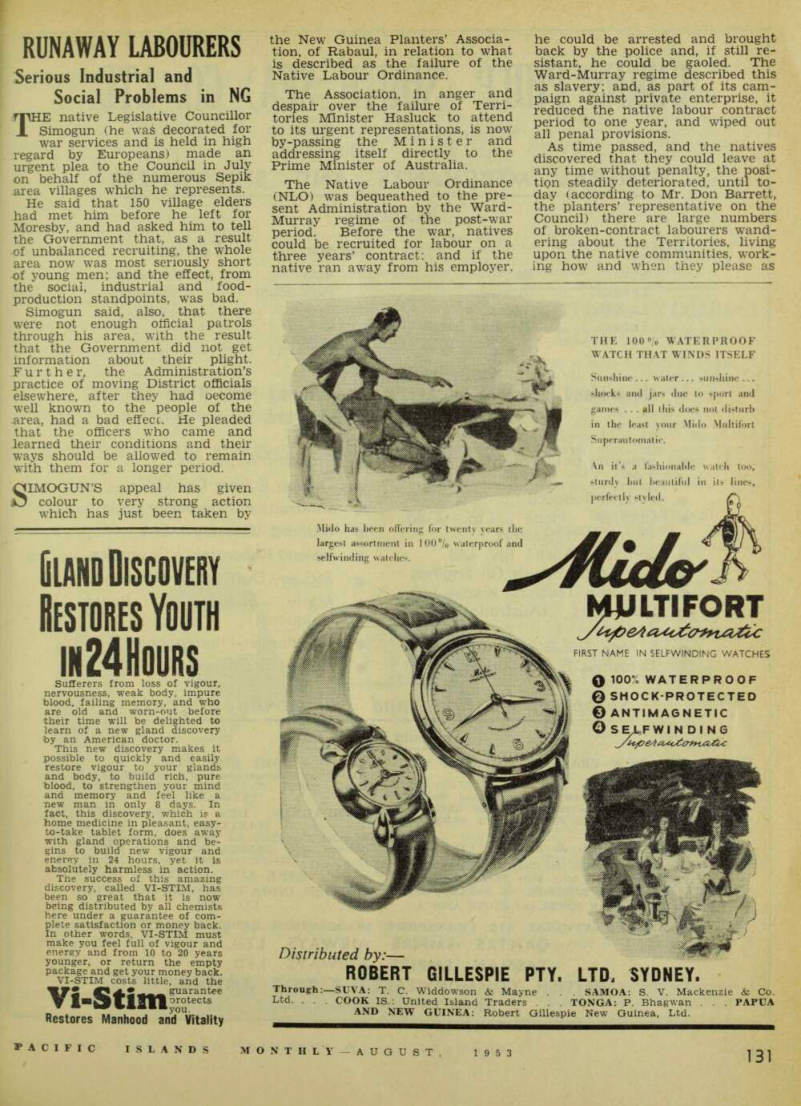 135
135 136
136 137
137 138
138 139
139 140
140 141
141 142
142 143
143 144
144 145
145 146
146 147
147 148
148 149
149 150
150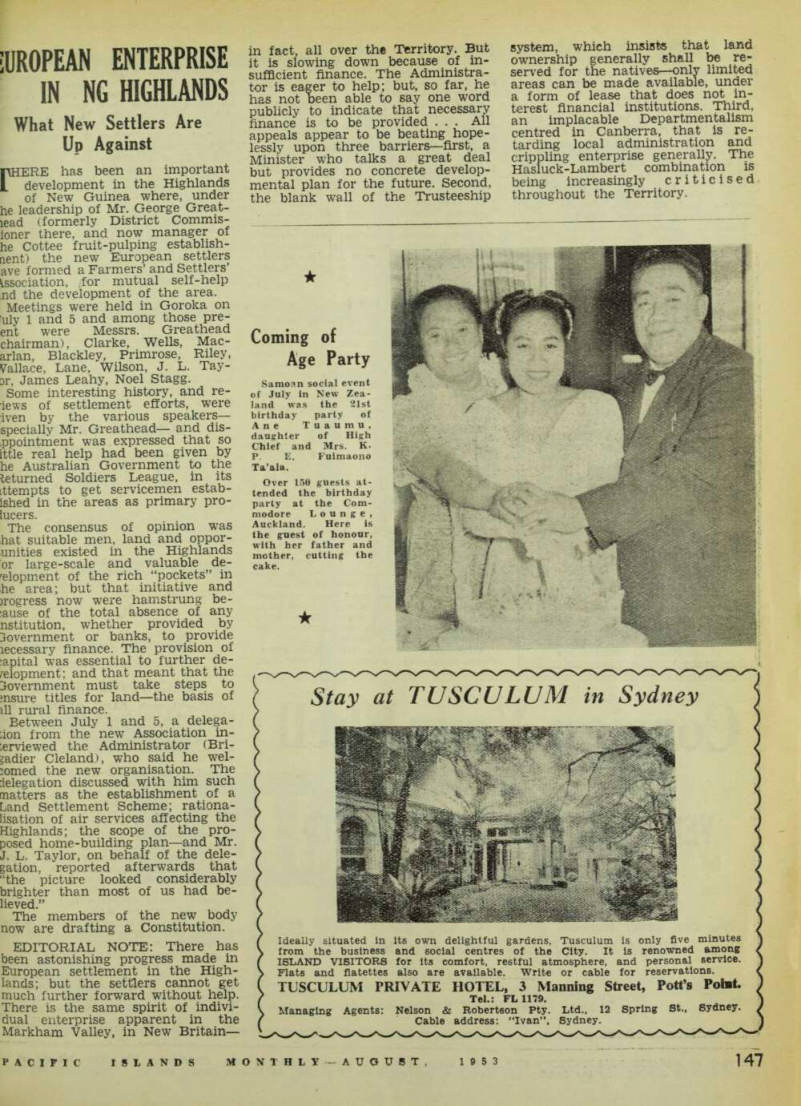 151
151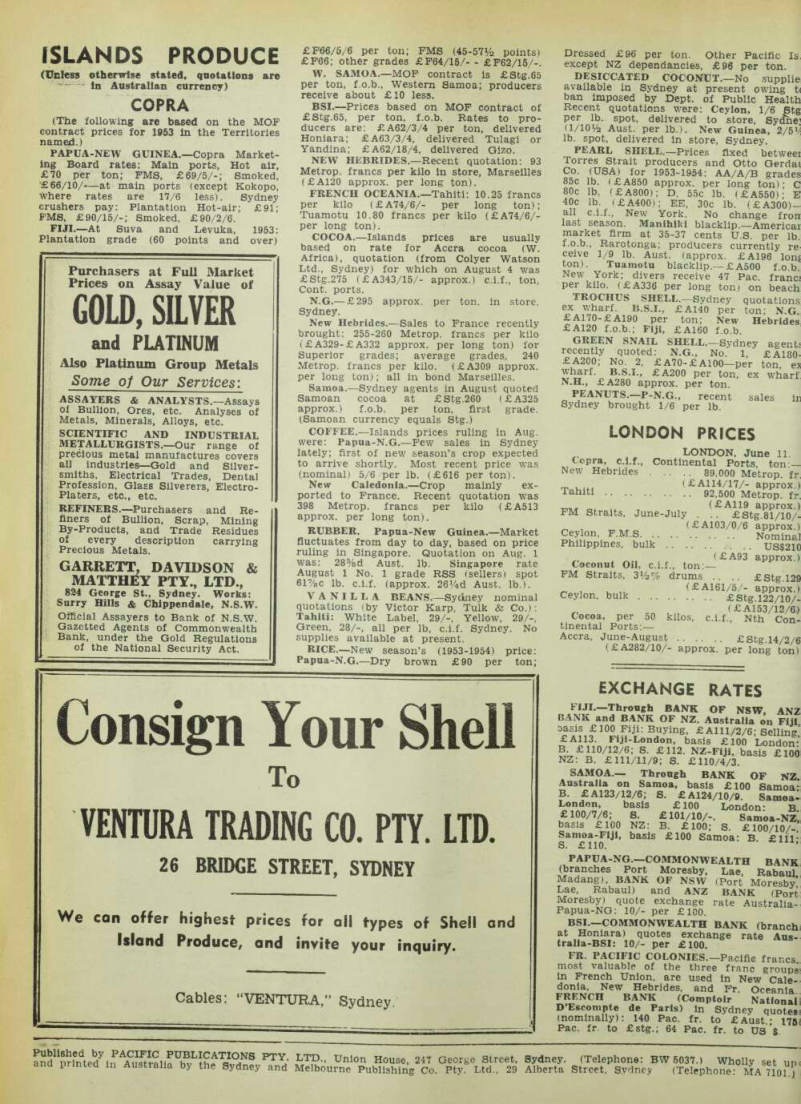 152
152 153
153 154
154