Eating Our Way Across the Gulf of Papua
pp. 74-78 · Read in the full issue
We Fly over the Rice Lands of Mekeo :: Refuel at Kikori :: Lunch over the Fly River :: And Uncover the Plot at Kerema
By Judy Tudor
'T'HIS is the story of a happy day. x Probably the happiest day of my recent wander in Papua-New Guinea—mainly because, on this occasion all I had to do was to sit and to dream and occasionally to think and to look.
This was the day on which I distinguished myself by having two afternoon teas and about seven other snacks and meals — and I am not overinterested in food at any time.
Moreover, Qantas supply on their Sandringhams, an inexhaustible supply of Penguin Who-dun-its, and Agatha Christie, Hercule Poirot and I (ivho had started in to solve the mystery of the murder on the Orient Express on a trip to Samarai some days before ) were able to complete the job somewhere over the Gulf of Papua. Eleven hours in a plane without getting off, ten take-offs and ten landings is not everyone’s dish. But I like planes and am seldom bored with flying.
You can watch the clouds and speculate about them or if there are no clouds, and that is rare in New Guinea, watch the sea or the bush. Above all, in this particular Qantas service, you can always EAT.
11 TE arose at 4.15 a.m., the crew V? and another passenger and myself, on the day that we were to fly from Port Moresby to Daru and back, with a side ex cursion in to Lake Kutubu, and were down at the airbase at 5.
J* o*' 0 *' ea an( * toast was waiting in the lounge.
Some of the passengers—a group of native policeboys—had been mis laid and we waited patiently while their bus broke down, and was re °n the Way in from the aepot- There were half a dozen of them an d their wives and an occasional infant and all their household goods done up in mats, bags, baskets. buckets and string-bags. The women had laid in a good supply of loaves of bread and bottles of lolly-water against the privations of the voyage but not a smile lightened any of the dusky faces. Travel was serious business.
Each family had its goods weighed separately. “Where’s the kitchen-sink?” asked a QEA official of one sad-looking corporal whose gear totted up to 156 pounds Clank, went another sack at the feet of the official, revealing the
unmistakable outline of a large enamel dish.
We got out to the aircraft in two launches and took off about six.
Fifteen minutes out, a group of very large coconut plantations roll out from under the flying-boat like a well-patterned carpet and two energetic stewards appear leaving cups of very good coffee and biscuits behind in their wake.
Scarcely had we time to dispose of this than we are landing on glass-like sea off Yule Island. The pursers or the super-cargoes (or whatever they are called on flying boats) come out of seclusion in the back premises where they have been conning over manifests and get busy with parcels and mailbags.
We are off again within half an hour, inland again over the partly cloud-obscured rice fields of Mekeo between coast and the foothills of the Owen Stanley Ranges.
Poirot and I return briefly to the Balkans and the dastardly business on the Orient Express and back come the stewards, flapping large tablecloths to dress the tables for breakfast. Fruit and scrambled eggs and bacon, with toast and coffee.
We are flying over vast swamps of sago palms, cut by a winding
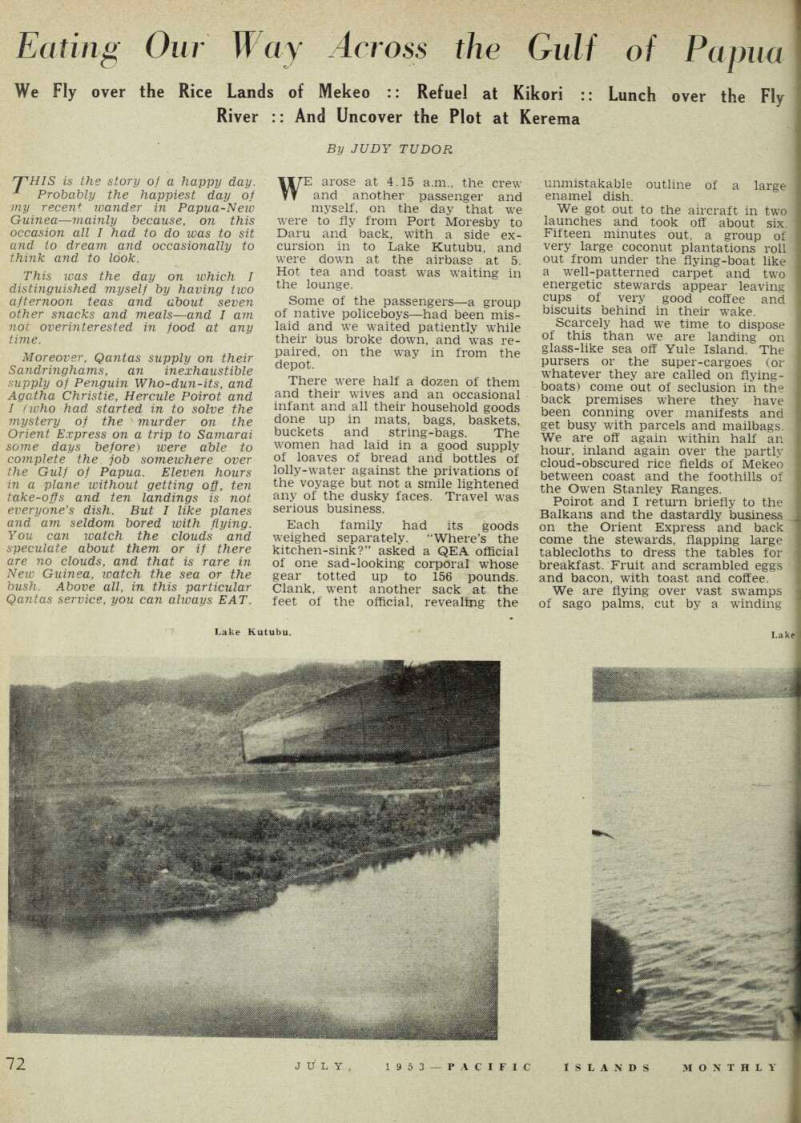
Lake Kutubu.
Lake
river, to Kerema, a pretty govern ment station at the top of Fresh water Bay.
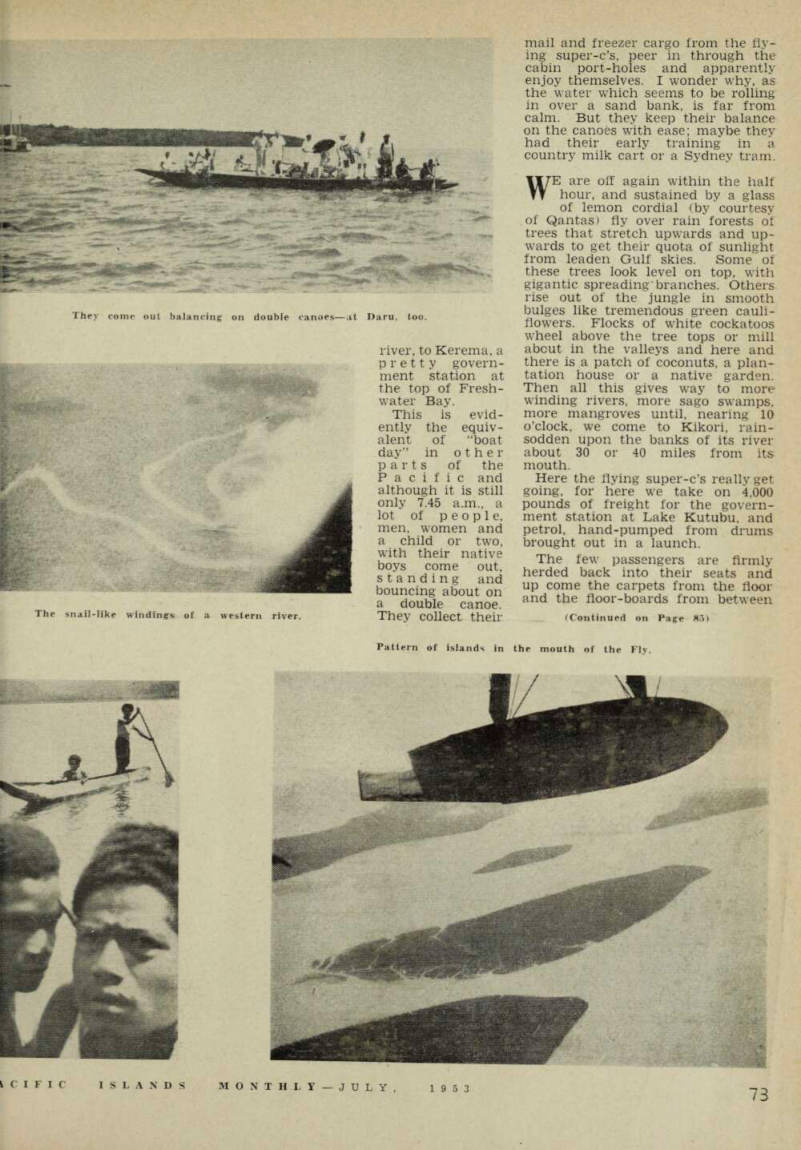
This is evid ently the equiv alent of “boat day” in other parts of the Pacific and although it is still only 7.45 a.m., a lot of people, men, women and a child or two, with their native boys come out, standing and bouncing about on a double canoe.
They collect their
mail and freezer cargo from the fly ing super-c’s, peer in through the cabin port-holes and apparently enjoy themselves. I wonder why. as the water which seems to be rolling in over a sand bank, is far from calm. But they keep their balance on the canoes with ease; maybe they had their early training in a country milk cart or a Sydney tram.
WE are off again within the half hour, and sustained by a glass of lemon cordial (by courtesy of Qantas) fly over rain forests of trees that stretch upwards and up wards to get their quota of sunlight from leaden Gulf skies. Some of these trees look level on top. with gigantic spreading'branches. Others rise out of the jungle in smooth bulges like tremendous green cauli flowers. Flocks of white cockatoos wheel above the tree tops or mill about in the valleys and here and there is a patch of coconuts, a plan tation house or a native garden.
Then all this gives way to more winding rivers, more sago swamps, more mangroves until, nearing 10 o’clock, we come to Kikori, rain sodden upon the banks of its river about 30 or 40 miles from its mouth.
Here the flying super-c’s really get going, for here we take on 4,000 pounds of freight for the govern ment station at Lake Kutubu, and petrol, hand-pumped from drums brought out in a launch.
The few passengers are firmly herded back into their seats and up come the carpets from the floor and the floor-boards from between
(Continued on Page #5)
They come out balancing on double canoes—at Daru, too.
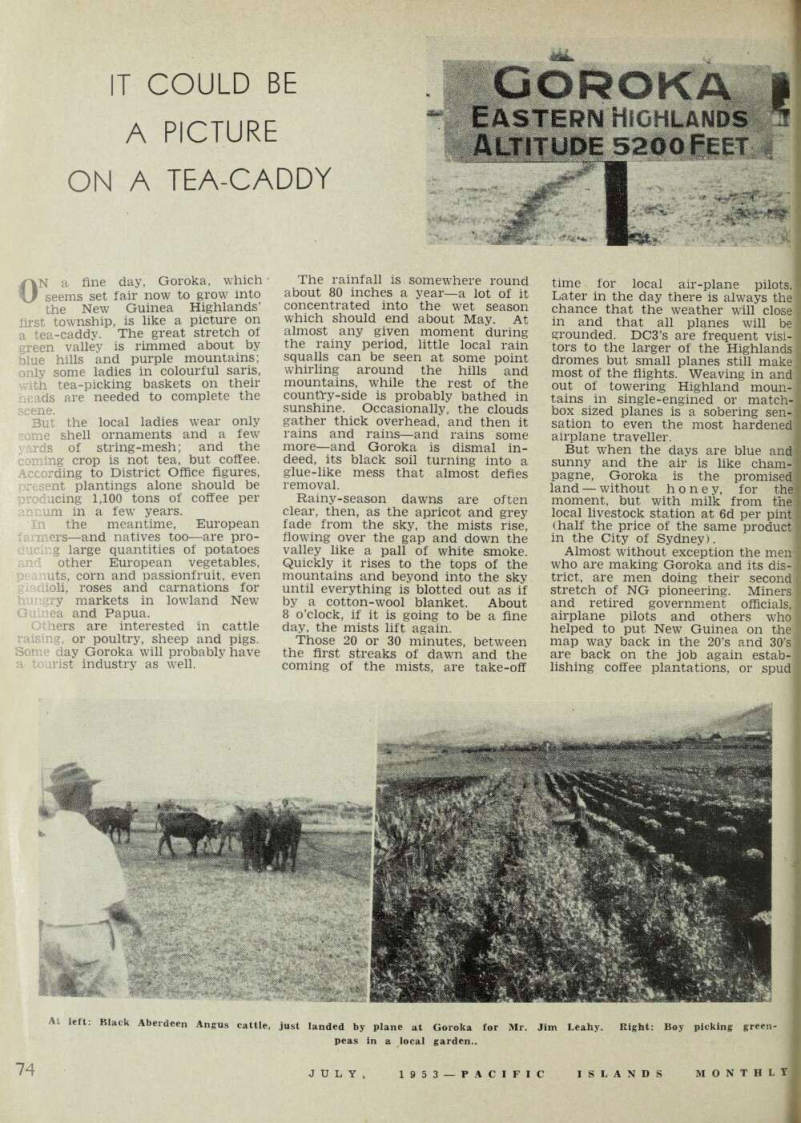
The snail-like winding's of a western river.
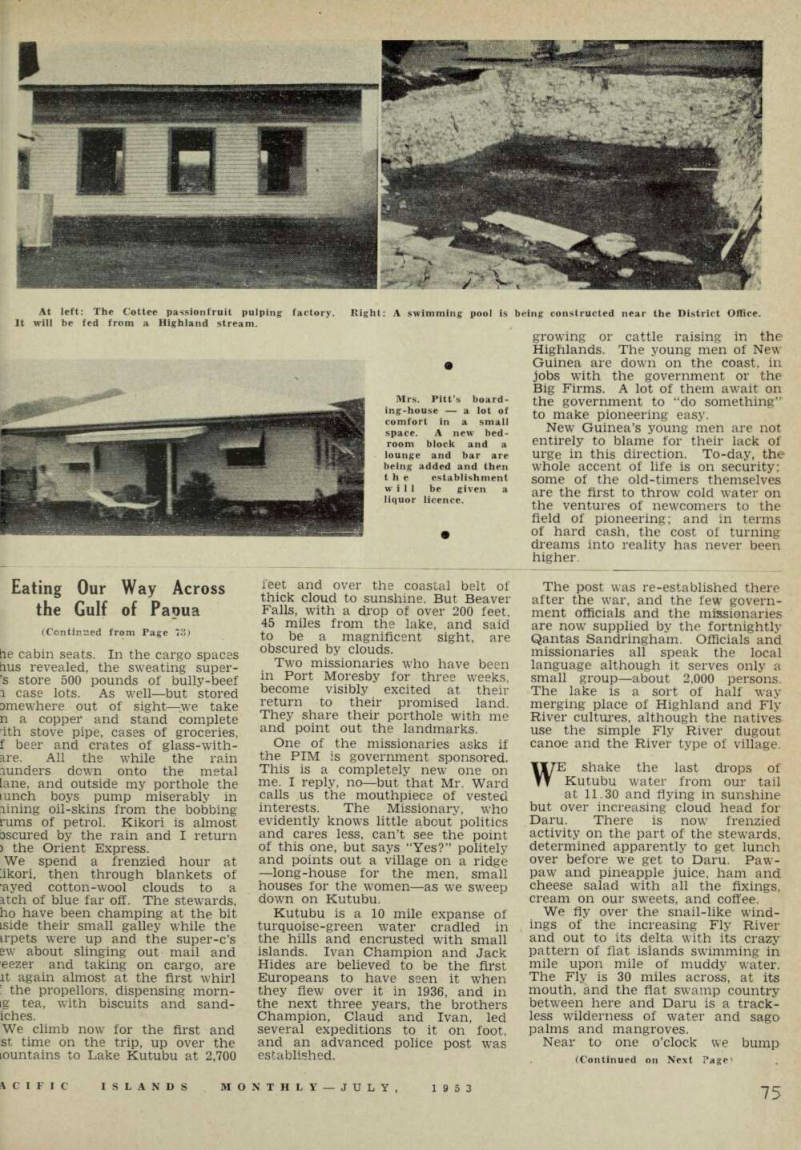
Pattern of islands In the mouth of the Fly.
tie cabin seats. In the cargo spaces tius revealed, the sweating super ’s store 500 pounds of bully-beef i case lots. As well—but stored imewhere out of sight—.we take n a copper and stand complete 'ith stove pipe, cases of groceries, f beer and crates of glass-with are. All the while the rain aunders down onto the metal lane, and outside my porthole the lunch boys pump miserably in lining oil-skins from the bobbing rums of petrol. Kikori is almost bscured by the rain and I return ) the Orient Express.
We spend a frenzied hour at ikori, then through blankets of •ayed cotton-wool clouds to a atch of blue far off. The stewards, ho have been champing at the bit iside their small galley while the irpets were up and the super-c’s ew about slinging out mail and eezer and taking on cargo, are it again almost at the first whirl : the propellers, dispensing morn ig tea, with biscuits and sand iches.
We climb now for the first and st time on the trip, up over the lountains to Lake Kutubu at 2,700
a F d over the coastal belt of thick cloud to sunshine. But Beaver Falls, with a drop of over 200 feet, 45 miles from the lake, and said to b e a magnificent sight, are obscured by clouds, . missionaries who have been F 1 Port Moresby for three weeks, become visibly excited at their £®^ urn to then* promised land, They share their porthole with me P°mt out the landmarks, One of the missionaries asks if the PIM is government sponsored, This is a completely new one on me. I reply, no—but that Mr. Ward palls us the mouthpiece of vested interests. The Missionary, who evidently knows little about politics and cares less, can’t see the point of this one, but says “Yes?” politely and points out a village on a ridge —long-house for the men, small houses for the women—as we sweep down on Kutubu.
Kutubu is a 10 mile expanse of turquoise-green water cradled in the hills and encrusted with small islands. Ivan Champion and Jack Hides are believed to be the first Europeans to have seen it when they flew over it in 1936, and in the next three years, the brothers Champion, Claud and Ivan, led several expeditions to it on foot, and an advanced police post was established.
The post was re-established there after the war, and the few govern ment officials and the missionaries are now supplied by the fortnightly Qantas Sandringham. Officials and missionaries all speak the local language although it serves only a small group—about 2,000 persons.
The lake is a sort of half way merging place of Highland and Fly River cultures, although the natives use the simple Fly River dugout canoe and the River type of village.
WE shake the last drops of Kutubu water from our tail at 11.30 and flying in sunshine but over increasing cloud head for Daru. There is now frenzied activity on the part of the stewards, determined apparently to get lunch over before we get to Daru. Paw paw and pineapple juice, ham and cheese salad with all the fixings, cream on our sweets, and coffee.
We fly over the snail-like wind ings of the increasing Fly River and out to its delta with its crazy pattern of flat islands swimming in mile upon mile of muddy water.
The rly is 30 miles across, at its mouth, and the flat swamp country between here and Daru is a track less wilderness of water and sago palms and mangroves.
Near to one o’clock we bump
(Continued on Next Page'
■down out of the clouds to a wind rippled anchorage off Daru Island and after the usual half-hour’s mad activity depart again, in alternate sunshine and cloud, to wards Kikori still swaddled in its oppressive blanket of grey cloud.
And herewith the first afternoon tea; Poirot reconstructs the crime and sums up.
Again to Kerema, where seem ingly the same people bob out in the same double-canoe, the sun shines fitfully, and, to the evident satisfaction of Agatha (who has probably wearied of the whole darned thing) and to me, Poirot makes his denouement.
After Kerema, the second after noon tea, and Yule Island. And after Yule, increasing sunshine until at 5 o’clock over Moresby, weeping, grey Gulf skies are for gotten and the sun shines brazenly down from the cloudless blue.
By Yule the stewards have washed up the last dish. They stand miserably in the galley door or mope about in the spare passenger seats with nothing to do.
What else can they produce in the fodder line? Nothing. Unless Qantas, to make them really happy, permitted them to whip up a few cocktails as the Sandringham slides over the wreck of the old Macdhui and settles down to her anchorage, 11 more hours of worthy flight behind her.