A Picture
pp. 76-77 · Read in the full issue
It Could Be
On A Tea-Caddy
ON a fine day, Goroka, which seems set fair now to grow into the New Guinea Highlands’ first township, is like a picture on a tea-caddy. The great stretch of green valley is rimmed about by blue hills and purple mountains; only some ladies in colourful saris, with tea-picking baskets on their heads are needed to complete the scene.
But the local ladies wear only some shell ornaments and a few ;,rds of string-mesh; and the coming crop is not tea, but coffee.
According to District Office figures, resent plantings alone should be producing 1,100 tons of coffee per ' . urn in a few years.
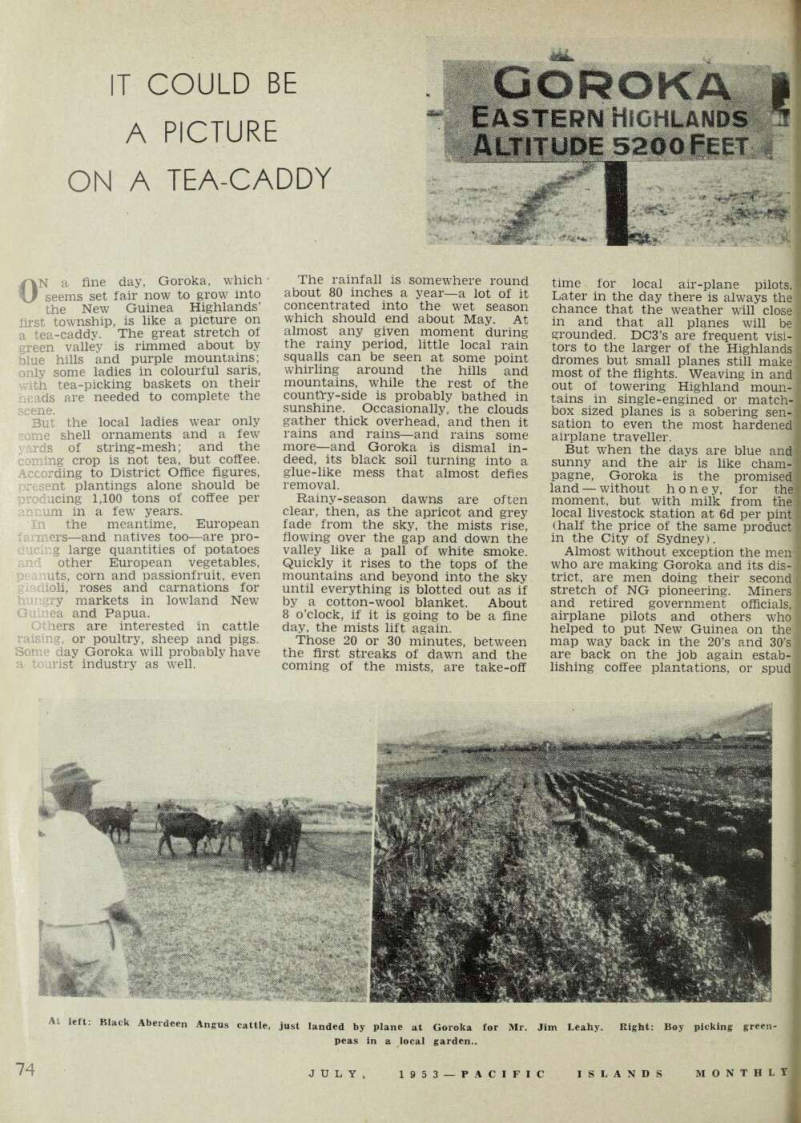
In the meantime, European farmers—and natives too—are pro . g large quantities of potatoes other European vegetables, uts, corn and passionfruit, even g rdioli, roses and carnations for hungry markets in lowland New Guinea and Papua.
Others are interested in cattle raising, or poultry, sheep and pigs.
Some day Goroka will probably have a tourist industry as well.
The rainfall is somewhere round about 80 inches a year—a lot of it concentrated into the wet season which should end about May. At almost any given moment during the rainy period, little local rain squalls can be seen at some point whirling around the hills and mountains, while the rest of the country-side is probably bathed in sunshine. Occasionally, the clouds gather thick overhead, and then it rains and rains—and rains some more—and Goroka is dismal in deed, its black soil turning into a glue-like mess that almost defies removal.
Rainy-season dawns are often clear, then, as the apricot and grey fade from the sky, the mists rise, flowing over the gap and down the valley like a pall of white smoke.
Quickly it rises to the tops of the mountains and beyond into the sky until everything is blotted out as if by a cotton-wool blanket. About 8 o’clock, if it is going to be a fine day, the mists lift again.
Those 20 or 30 minutes, between the first streaks of dawn and the coming of the mists, are take-off
time for local air-plane pilots.
Later in the day there is always the chance that the weather will close in and that all planes will be grounded. DC3’s are frequent visi tors to the larger of the Highlands dromes but small planes still make most of the flights. Weaving in and out of towering Highland moun tains in single-engined or match box sized planes is a sobering sen sation to even the most hardened airplane traveller.
But when the days are blue and sunny and the air is like cham pagne, Goroka is the promised land without honey, for the moment, but with milk from the local livestock station at 6d per pint (half the price of the same product in the City of Sydney).
Almost without exception the men* who are making Goroka and its dis trict, are men doing their second stretch of NG pioneering. Miners and retired government officials, airplane pilots and others who helped to put New Guinea on the map way back in the 20’s and 30’s are back on the job again estab lishing coffee plantations, or spud
Av left. Black Aberdeen Angus cattle, just landed by plane at Goroka for Mr. Jim Leahy. Right: Boy picking green peas in a local garden..
growing or cattle raising in the Highlands. The young men of New Guinea are down on the coast, in jobs with the government or the Big Firms. A lot of them await on the government to “do something” to make pioneering easy.
New Guinea’s young men are not entirely to blame for their lack of urge in this direction. To-day, the whole accent of life is on security; some of the old-timers themselves are the first to throw cold water on the ventures of newcomers to the field of pioneering; and in terms of hard cash, the cost of turning dreams into reality has never been higher.
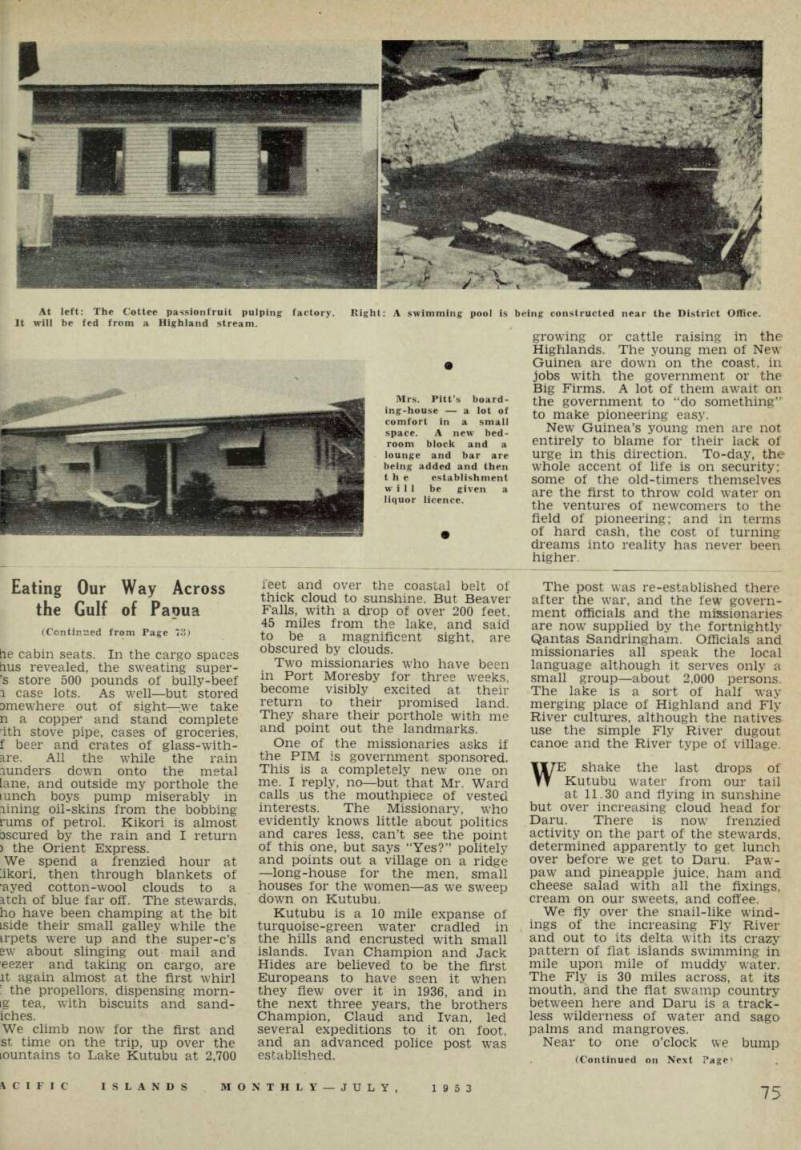
At left: The Cottee passionfruit pulping factory. Right: A swimming pool is being constructed near the District Office.
It will be fed from a Highland stream.
Mrs. Pitt’s board ing-house - a lot of comfort in a small space. A new bed room block and a lounge and bar are being added and then the establishment will be given a liquor licence.