Mapplng the Floor of the Pacific Ocean
pp. 73-85 · Read in the full issue
By Dr. Rhodes Fairbridge, of the University of Western Australia.
rWO little ships recently returned to San Diego, California, after completing one of the most de ailed scientific voltages ever at empted in the Pacific. Some emarkable discoveries have been lade.
“Expedition Capricorn” was or anised by the Scripps Institution f the University of California, in o-operation with the United States Javy (Office of Naval Research).
Its primary purpose was bathy letric geological and geophysical nvestigations in the Central and louth Pacific, and covered the •eriod October, 1952-February, 1953.
In previous years, Scripps has arried out expeditions to the Central Pacific, the Aleutian region, nd the Mexico-Central American egion, but this is by far the largest nd most ambitious programme yet ttempted. In addition to its primary •urpose, the directors also made irovision for routine meteorological bservations, biological trawling and lydrographic measurements.
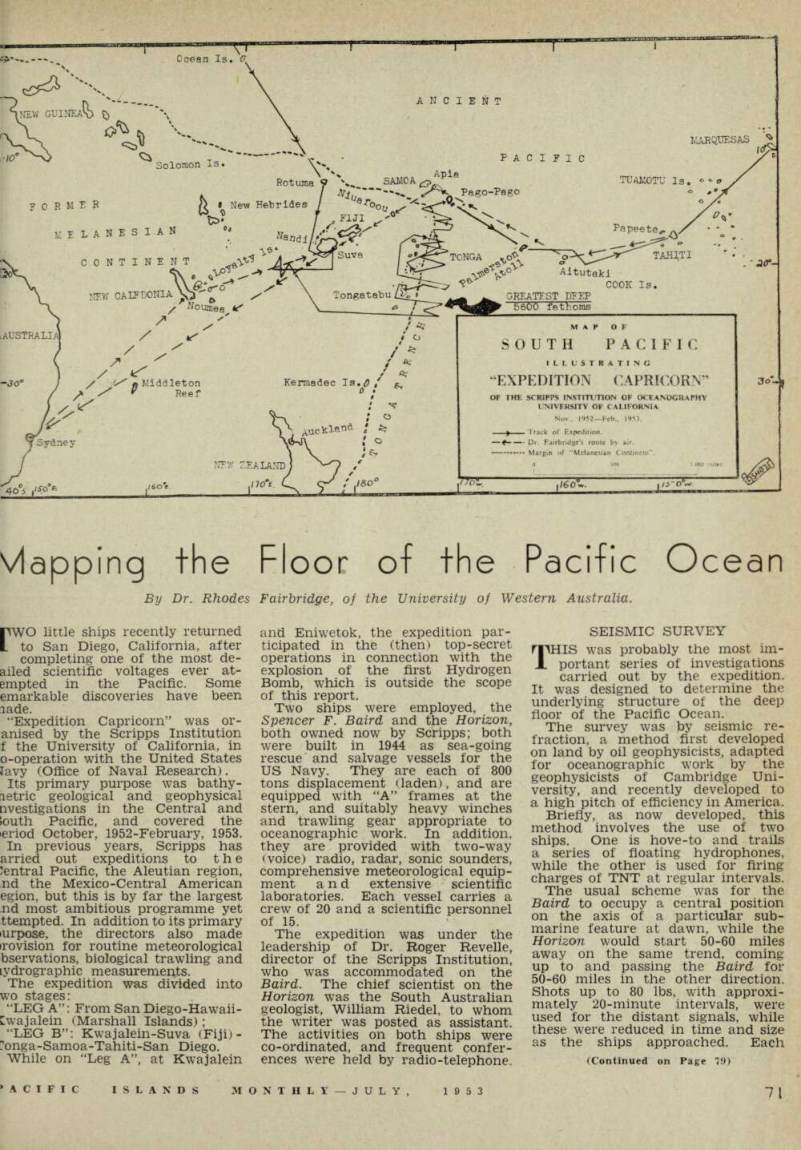
The expedition was divided into wo stages: “LEG A”: From San Diego-Hawaii- Cwajalein (Marshall Islands); “LEG B”: Kwajalein-Suva (Fiji)- :onga-Samoa-Tahiti-San Diego.
While on “Leg A”, at Kwajalein
and Eniwetok, the expedition par ticipated in the (then) top-secret operations in connection with the explosion of the first Hydrogen Bomb, which is outside the scope of this report.
Two ships were employed, the Spencer F. Baird and the Horizon, both owned now by Scripps; both were built in 1944 as sea-going rescue and salvage vessels for the US Navy. They are each of 800 tons displacement (laden), and are equipped with “A” frames at the stern, and suitably heavy winches and trawling gear appropriate to oceanographic work. In addition, they are provided with two-way (voice) radio, radar, sonic sounders, comprehensive meteorological equip ment and extensive scientific laboratories. Each vessel carries a crew of 20 and a scientific personnel of 15.
The expedition was under the leadership of Dr. Roger Revelle, director of the Scripps Institution, who was accommodated on the Baird. The chief scientist on the Horizon was the South Australian geologist, William Riedel, to whom the writer was posted as assistant.
The activities on both ships were co-ordinated, and frequent confer ences were held by radio-telephone.
Seismic Survey
THIS was probably the most im portant series of investigations carried out by the expedition.
It was designed to determine the underlying structure of the deep floor of the Pacific Ocean.
The survey was by seismic re fraction, a method first developed on land by oil geophysicists, adapted for oceanographic work by the geophysicists of Cambridge Uni versity, and recently developed to a high pitch of efficiency in America.
Briefly, as now developed, this method involves the use of two ships. One is hove-to and trails a series of floating hydrophones, while the other is used for firing charges of TNT at regular intervals.
The usual scheme was for the Baird to occupy a central position on the axis of a particular sub marine feature at dawn, while the Horizon would start 50-60 miles away on the same trend, coming up to and passing the Baird for 50-60 miles in the other direction.
Shots up to 80 lbs, with approxi mately 20-minute intervals, were used for the distant signals, while these were reduced in time and size as the ships approached. Each
(Continued on Page 79)
bismic station occupies about 10 ours, with the ship’s steaming need at about 11 knots.
Bathymetric Survey
► Continuous echo-sounding traces Eere maintained by the vessels :iroughout the expedition. As vast i*eas of the deep ocean have never sen purveyed at all, this bathy metric work was of the highest im ortance, and provides the basic attern into which all other deep oservations must be correlated. [Both vessels employed two sonic nnders of different types to main in a close check on deep readings [.he speed of sound in water varies lightly with pressure, temperature id salinity, and correction factors ust be applied). Both instruments mploy the system of sending out regular series of high frequency ♦unds (one “ping” per second), jerated electronically, which go iwn to the ocean floor and are ►fleeted back, to be received on a iilt-in hydrophone, and auto atically recorded in the laboratory.
The older machine, the NMC athometer, records with an audible ling,” either by loudspeaker or hones, simultaneously with a light lat flashes on a large dial (for the 3ep section divided into 2,000 ithom circles). A rotating arm ith an electronic stylus records the itgoing and incoming “ping” on a raduated role of prepared car inised paper. The brief electrical npulse through the stylus burns a lack streak in the paper.
The disadvantage of this machine that the stylus arm rotates, pro icing a curve on the paper, thus istorting the normal appearance : submarine features. Further, le paper width is only 6 inches id the scale is relatively small.
A more modern instrument, the DO Fathometer, is provided with broader paper, 10 inches wide, irther, there are two styli mounted i a rubber belt moving in a raight line down the sensitised iper. This method has the great ivantage of indicating submarine satures in their true shape.
The vertical scale covers only 600 ithoms, and at the normal cruis ig speed of the ship (11 knots), le paper moves along at about inch per mile; this provides a irtical exaggeration factor of >out 1:15, which is most helpful l emphasising the bottom pography.
Fathom scale changes are effected mply down to the greatest depths, it the sensitivity of the instru ent drops off seriously at 4,000 ithoms and, from 4-5 i thousand .thorns, constant reference to the idible trace (by ear-phones) is quired. In shallow water, a pidly rotating foot scale is pro ded; this is extremely accurate.
Particular features for bathy metric investigation included the physical relationships of the Tonga Trench, and individual sea-mounts located along the line of the sur vey.
The detailed survey of the Tonga Trench was carried out by both vessels in a series of zig-zag traverses, intersecting the single N-S line that was mapped two years before from the Galathea. In spite of the Galathea work the Tonga Trench was still one of the least known deeps in the world.
In the southern part of the trench the Horizon came upon an ex
tremely deep sector hitherto un suspected, where depths of the order of 5,600 fathoms were recorded.
In order to check these depths, a whole day was spent In the area at half-speed, using small ex plosive charges (a few lbs of TNT) and a trailed hydrophone for re cording the precise depths.
A narrow V-shaped bottom was indicated in many places. Only locally was a narrow flat bottom recorded. The sides were so steep that no unconsolidated sediment could be expected there, a fact that was borne out by the failure to secure sediment cores here (see be low) , only fragments of volcanic (basalt) rock being obtained.
One of the most astonishing features of this trench is the steep
slope on the east side, where a more gentle declivity might have been expected.
At one point—approximately east of Ha’apai—there is an extensive compound sea-mount on the east side and, falling away from this mount, there is an uninterrupted down-slope of 27,000 feet, at an average inclination of 1 in 2 (that is from 200 fm. to 4,800 fm. in 10 miles), which is undoubtedly the steepest and longest continuous slope yet recorded on the earth .
It would make the Himalayan “front” appear mild in comparison.
Several new sea-mounts were dis covered. These sea-mounts are old volcanic mountains, now submerged.
The method of surveying them generally employed w.as, after the initial crossing, to change course 120 degrees, until deep water was reached, then return towards the estimated peak, crossing it, and completing a Maltese cross pattern to enable generalised contouring to be carried out.
It was noted that several sea mounts rose from the saucer-shaped depression which would apparently correspond to the subsidence of an elastic crust after the loss of erupted mass beneath (and local accumulation of the sea-mount on the surface).
An interesting feature of several sea-mounts SE of Samoa, which had peaked tops (i.e., not flat-topped guyots), was the evidence of pos sible land-slip scars near the crest and a small jumble of material around the foot. The occurrence of such slides may be partly re sponsible for some of the serious tidal waves which occur in the Pacific. The future correlation of new eruptions with such waves would be indicated.
Bottom Temperature
Gradients
A SERIES of tests were carried out from the Baird to measure the rate of heat flow from the Earth’s interior to the surface at the bottom of the ocean. The in- , strument employed, the “Bottom Temperature Gradient Probe,” is of the nature of a spike (about 6 feet long), which is lowered by gravity \ into the soft bottom sediment in the manner of a sediment corer.
The probe contains sensitive thermometers and a recording system, so that the small tempera ture gradient in these sediments may be measured.
The bottom temperature recorder also makes a continuous trace of temperatures from the bottom of ; the greatest deeps to the surface, which has never before been pos sible.
Bottom Dredging
IN areas of rocky bottom, where the sediment corners may fail to collect material, a heavy j dredge may be used. The dredge consists of a steel rectangular frame ■
>o which is attached a bag of lhain (protecting a smaller mesh net bag within), together wdth two imall auxilliary bags of canvas, to satch fine sediment. The dredges iary in size for deep-water work, iizes from 3 to 6 ft across being nost used.
Considerable success attended iredging operations in the Fiji area, vhich showed the volcanic and ash >ottcm of an ancient submerged IMelanesian Continent.” A fine Lredge-haul on the edge of the "ongatabu Shelf produced numer jus corals, lithothamnia and a giant pecies of foraminipera (3-4 cm. icross). East of the Tonga Trench, sveral dredges were lost in endeav luring to sample interesting sea nounts that defied other means of nvestigation.
[Hydrologic Observations
rHE normal hydrologic procedure is to lower a series of Nansen bottles (for the collection of -ater samples) equipped with re lersing thermometers (also giving pressure) on a fine gauge (5 32) fire while the ship is hove-to. The isual scheme is to have the bottles paced at 0, 10, 25, 100 m, etc., in undreds, down to an average depth f 1,200 metres. Hydrologic casts .ave been made exceptionally well town to 7,500 m (3,500 fathoms).
Tie water samples are analysed for alinity, dissolved oxygen and phos hate. Correlation of a close net work of results leads to the deter
ruination of marine currents and mass water movements.
Core Sampling
Regular sampling of the bottom sediments by means of coring tubes was carried out wherever possible in each representative sector.
For shallow and intermediate depths the short “Pfleger” corer (with either U” or 2” barrelsi was used. It is operated simply by gravity, with a heavy lead-weight at the top.
It is lowered on a relatively fine gauge wire to depths up to 3,000 fathoms. When it hits bottom the jerk dislodges a pin which breaks
a glass ball: this produces a “ping” which should be heard on the echo sounder (if ship noises and other factors are not excessive). The core may then be withdrawn.
An appreciable number of cores apparently hit hard bottom and come up empty, but when dropped on a flat bottom (presumably sedi ment-full) a 95 per cent, success could be assured. The steel core barrels carry a plastic liner, which is removed and stored for the eventual laboratory examination of the sediment. The average cores with the Pfleger corer in mid-ocean was about 70-100 cm.
For longer cores the ’Kulenberg”
sampler and heavy winch would be required. The Kulenberg is de signed to bring up 20 m. core lengths, of about 21 inches diameter.
To carry this heavy sampler to great depths a special 21-tons winch had to be installed on the Baird. This winch carries 40,000 feet of steel cable, which is so heavy that it has to be tapered down from top to bottom. It is practic ally a whole day’s operation to lower the corer and retrieve it in great depths.
In suitable localities where there are soft sediments on a horizontal floor a number of excellent cores were secured. Attempts to use this corer in the Tonga Trench, how ever, were unsuccessful; but this seems to have been due to encount ering a hard bottom.
Magnetic Survey
AWATER-born magnetometer
(“M.A.D”) was towed from the Baird over certain sectors. It contains a continuous recording de vice for measuring magnetic in tensities.
The object is to measure varia tions in the Earth’s magnetic field.
Biological Work
Plankton hauls and general biological trawls were carried out at regular intervals by the Horizon under the direction of Dr. Martin Johnson, who also kept a general log of bird life and fish observa tions.
Bottom Photography
The problems of currents, and the nature of life on the ocean floor was studied by two cameras.
The larger of these cameras will go to any depth in the ocean. It is arranged to make a black and white photograph every minute as the camera descends, and to photo graph the bottom.
Owing to the complete darkness at depths, powerful floodlights were provided to go with each camera.
Aqua-Lung Diving
Diving, without suits, but witl compressed air bottles harnessed or the back and a simple mouth-piece is quite feasible in tropical waters: and several of the younger member!
5 Scripps scientific staff have been Lined for this work.
An outstanding result of this work 2S an examination of the surface [Falcon Island, near Tonga, which ■ some years has been beneath e surface.
The submerged volcanic cone was rated by echo-sounding and the test, a few hundred yards across, ?s found to be only 60 feet beneath s surface. Rounded, water-worn ilcanic boulders were found there, trusted by a healthy growth of ung coral.
If no new eruption occurs, a vigor s coral reef is to be expected here thin the next half-century.
Visits To Islands
A special, outstanding feature of 3 expedition, from the point of *w of its members, was the warm llcome we received on every island :ited. Leading members were tertained personally by the Gov aors of Fiji, American Samoa and ench Oceania, and by the British msul in Tonga. ?or a special Christmas party at mga, Prince Tungi put on a ignificent open-air feast, on the uth Coast, where we enjoyed the »1 breezes and magnificent scenery the famous blow-holes. The ;antic spread of roast sucking ;s, taros, sweet potatoes, bread lit, yams, plantains, fish in coco t juice, dumplings, and all rieties of tropical fruits and lons was indeed something to re imber.
In return, we had the local people board at each principal port and joyed showing visitors around our ;le ships and their impressive •ay of instruments and equip mt.
Outstanding amon g our im ;ssions of the Pacific was the re sation that the Polynesian peoples d such charm, graceful manners d a form of simple blit well lered civilisation that made our istern rush, hustle and competi n seem both rather brutal and lie in comparison. We envied sm their happy existence and tunate isolation from some of the mediate consequences of wars i political strife.
Taturally, in these days of global iflict and world marketing, no i can be quite aloof, and we found ! islanders’ interest in world lirs very real. Nevertheless, when r we observed the changing lights r the beauties of atolls or vol lic islands, and watched the ,ceful business of the fishermen work, or coming home from the fs, and the day-to-day activities every Polynesian village, it was d to realise that we had not n accidentally transported to le little Utopia.
He Object Of Our Work
.eaders may well ask what value d investigations have. It is dif
ficult to point straight away, and say we are going to distil gold from the sea. Certainly, we have many utilitarian projects in hand; but nevertheless the work is primarily one of pure science. That means that we go mostly for the pure joy of discovering new things. If, as often happens, some of our discoveries turn out to be useful, and beneficial to man—well, that’s fine.
H At an inquiry in Port Moresby recently into the death of Dr. Ces lovas Kocenas, the Coroner re turned a verdict of suicide while the balance of his mind was dis turbed. Dr. Kocenas, aged 42, married, was found dead from bullet wounds in a house at Boroka, Port Moresby, on May 24. He had been on the staff of the Public Health Department.