Tropicalities
pp. 69-77 · Read in the full issue
|Cashews For Pleasure
And Profit
ITHEN Fiji’s new Governor, Sir FT Ronald Garvey, toured the hot, rought-ridden western and northern istricts of Viti Levu in November, b looked for—and failed to find — Icashew nut tree.
I “That tree,” said Sir Ronald, produces both an edible nut and an dible fruit. It will grow in infertile oil and it is resistant to drought, imong its other virtues it readily fopagates itself. If we had the roduct available to-day I believe we ould sell some thousands of tons to lie confectionery trade,”
Horrified by the extent of forest jestruction and soil erosion in Viti ,evu, the Governor is forcefully dvocating an annual Arbor Day iroughout Fiji as the first tree lanting step to offset the loss of rees through forest fires, [(The cashew nut is also the source f a valuable industrial oil. Plans for lanting the trees and stepping up reduction of the oil recently con erned the Administrations of some f the British Colonies in Africa, ’he cashew apparently is a native of Lfrictv)
I Fijian As A Stabiliser
MONG the potent factors for stability in Fiji is the character I the Fijian, said the Governor (Sir Ronald Garvey) when addressing the legislative Council last month.
With his graceful calm, he has been ble to resist the impact of most of he less creditable elements of Vestern civilisation,” said Sir Ronald.
The fruit of his faith in the pax fritannica and the British way of ife can mean peace and tranquility or many generations to come. It oust be our first duty to see that (either he nor anyone else in the ommunity has cause to lose that aith”.
In 1947 another Governor, Sir lllexander Grantham (now Governor tf Hongkong) said that the Fijians (old the balance in Fiji and that it s Fijian tolerance, patience and live ind-let-live philosophy that has kept he balance between conflicting racial nterests in these islands. When he eft Suva, Sir Alexander warned
Europeans against the common mis take of believing that everything they did and thought was inevitably right, and urged the Indians to stop constantly looking for slights when slights were not administered or in tended. For the Fijians, said Sir Alexander, he had no message on these lines. They suffered from neither a superiority nor an in feriority complex and thus could exercise a unique stabilising influence.
Beer As You Want It
ONE of the economic achieve ments of Papua-New Guinea in 1952 was the establishment of a brewery with an initial output of something like 200,000 gallons of beer annually. The South Pacific Brewery located at Badili, Port Moresby, .is supplying beer both in bottles and in stainless steel kegs.
It is a light ale and its quality, of course, is the subject of much dis cussion among Territorians. But the master brewer says they can have whatever specific qualities they like— the only question is, what does the general public want? He’s confident that when that jackpot question is finally threshed out, Islanders will find “South Pacific” right up to their specific standards.
Anyway the brewery has certainly ended the local scramble for bottled beer. You can now buy a dozen any time, anywhere, and, strangely enough, even Aussie brands have suddenly re-appeared from their hiding places “under the counter.”— VJ.
Sport Of Kings—Rarotonga
Style
A MONTH before Christmas Raro tonga was preparing for the great day. And the following notices on the official board outside the post office told the story: On November 21: “A meeting of the Rarotonga Jockey Club will be held in the Court Room, at 4 p.m., Tuesday, to make the usual arrange ments for the annual race-meeting at Muri. It appears that the tides will be suitable for holding the meeting on Boxing Day. Sergeant Nia Rua with a working party (of prisoners) will commence re-roofing the Club’s building to-day.”
On November 22: “The Arorangi horses have commenced training ... one big horse, owned by Levi . . is showing promise.” (Though the board didn’t say it, the phrase, “commenced training,” merely meant that Rarotonga’s herd of scraggy little, long-haired, under nourished ponies, after completing their normal day in harness on the plantation, were being given an extra bare-backed gallop in the evenings— on the beach and “at the Sanatorium where there is a suitable stretch.”
The course is unusual, to say the least, involving a 180-degree turn).
November 27 (and here the mod ern touch): “ . . . A radio-telephone will be installed at the turn at the far
(Continued on Page 72)
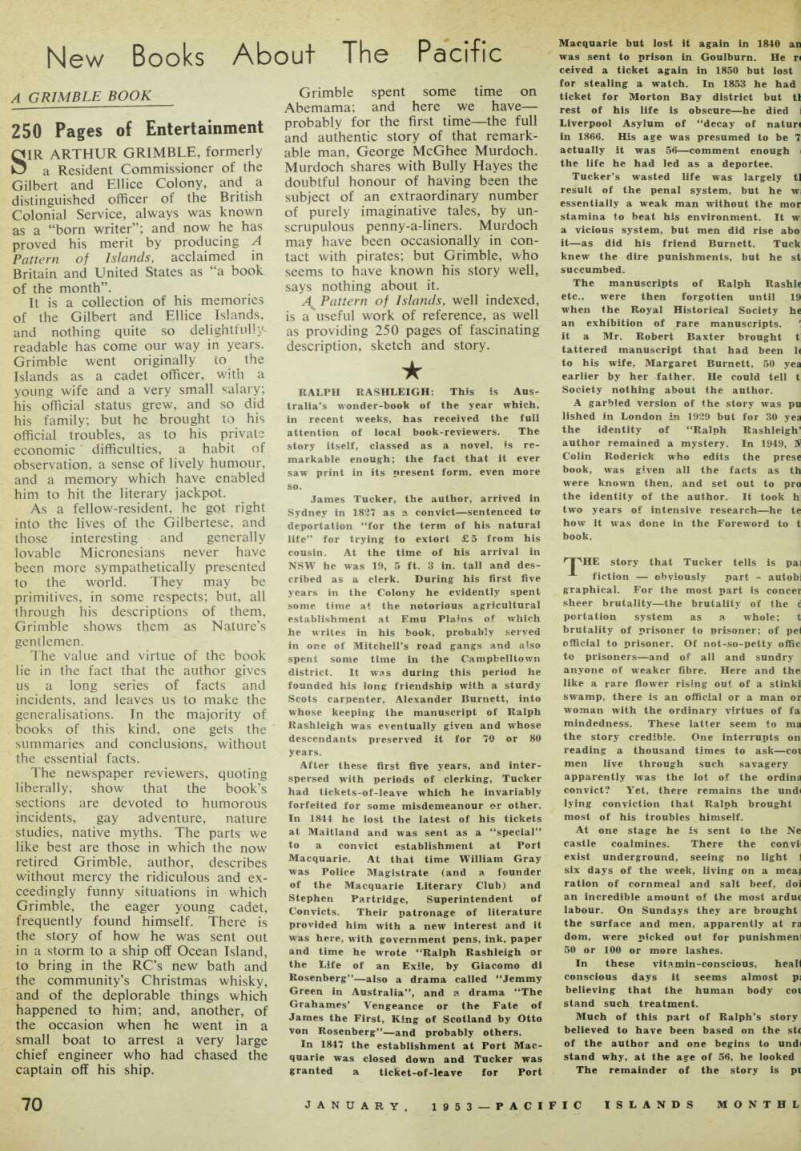
STEVE DUBOIS, of the New Hebrides, is in Sydney on leave, his first visit to Australia since 1924. He is a French- Canadian, born at Montmagny, in Quebec, 60 years ago. After attending the Merchant Venturers’ School at Bristol in England he went to sea as an apprentice in square-rigged sailing ships and got his Second Mate’s Certificate. Soon after that Steve settled in Australia for nine years before being attracted to the Islands. He first went to the Solomons to work for the well-known “Squeaker”
Hamilton, and was in Choiseul and at Inus in Bougainville. After two years in the Solomons, he went to the company at Port Patteson in the Banks Group of the Hebrides, and later settled at “Asauan” on Malo, where he traded for 14 years but still without making a fortune. While he was there he found real treasure —a wife, Caroline Stephens, most beautiful daughter of the half- Tongan Stephens family, of Uralapa Island, off South Santo. They have three sons, the eldest 15, all at school in Sydney.
During the last 11 years, Steve has been at the Condominium Joint Court in Vila as Registry Clerk, Interpreter and Bailiff, where the conflicting interests of French, British and natives have been giving much entertainment to observers since the inception of the Court in 1911.
Brett Hilder.
end of the course.” And other hazards: “The committee hopes to start the first race at 10 a.m. so that the last race will conclude before high tid » (Chief event, the Ayson Cup, called for 1/- entrance fee for the qualifying heats, all others free).
This Should Be Good
VIEW GUINEA is not altogether JM being left out of the current spate of Pacific movie-making. Now showing in Sydney (we have not seen it yet) is a Hollywood epic about a hunt for treasure in unexplored New Guinea. The action was “shot” in a remote section of Florida which is said to resemble tropical NG.
The action shots include scenes of undersea fights between men, crocodile attacks, ambushes by head-
hunters and battles with natives in canoes. Cast includes John Payne, Rhonda Fleming and Alan Mowbray, It’s all in techmcolour and is called Crosswinds.
Wait for it, you sceptical Terri tonans.
Housing Problems For
Suva’S Pigeons
, the . Januar y hurricane, ° pigeon population possibly as big as that in Trafalgar Square, London, but not so well mannered—has faced an acute hous in& shortage. With the demolition of old, gabled wooden buildings which provided ample roof-accom modation, the pigeons have moved to low verandahs with frequently disastrous results to pedestrians fcHow.
It is becoming alarmingly comm< to have to dodge apprehensively, ai sometimes the worst is not knov until one is tapped on the arm by fellow-pedestrian with the advic “Excuse me, but a bird has—er behaved very badly down the ba of your shirt” (or dress as the ca may be).
A curious sidelight on pigec nature is provided by the respor to the years-old custom of an eldei Indian peanut-seller. Every day noon the old man carefully empt his bags of peanut shells at the ed of the roadway near the corner wh( the Club Hotel used to be. Befc the hurricane the high-pitched re
(Continued on Page 74)
of the Club was haunted by doze of pigeons which have now mo\ far afield, but daily at noon 1 birds still collect from no-one-kno where to receive their ration. Tl will probably be doing it in IS when the new hotel should be stai ing on the site of the old pi (Work on the building started mid-November).
Surprise On Suwarrow
Dirk Tober, of the yacht Onn brought perplexing news from Suw row to Auckland. It seems that wl he dropped in on Tom Neal, island’s only inhabitant, the day al Tom took up residence there in < tober, he found him officiating ai maternity case. Tom’s famous t cat (PIM, September, p. 121, 1 vember, p. 50) had just produ kittens.
More Treasure Islands
Mr. Robert J. Cunningha
originally of NSW but who ' been living on Tupai, Frei Oceania, for the last 24 ye; arrived in Sydney in November the new French liner Caledonien i was hailed with joy by local porters. This was not because anything that Mr. Cunningham s —but in this overcrowded part the world it is always interesting have news of someone who lives a spot not so crowded. They s (as is usual in these cases) that 1 Cunningham was the uncrowned k of Tupai.
Mr. Cunningham said that there was idyllic but monotonous j that there were only three topics conversation—fish, the wind i coconuts because each in its o was very important to the 44 habitants.
He said that Tupai was repu to be a treasure island—that milli( of pounds worth of gems and g —Chilean pirates’ loot—was belie 1 to be buried on the island. He h self had never seen any sign of i be he had hunted off would seekers who had come along to lo (In December PIM, p. 19, we ported that Count von Luckner > to leave shortly for an undisclo Pacific Island where treasure —1 time Inca—was believed to buried. It was thought that > Luckner was referring to Mope Cocos Island (Pacific) is also famous treasure island—Chib pirates again.)
I Suva Has A Gifted Poet
LAURENCE DAKIN, who is con sidered by many competent aides to be one of the most gifted ©ntemporary poets—John Masefield las described him as a man of genius i-has been living in Suva for the >ast year, and is now building a imall house well out of town. [ He was born in Nova Scotia, nucated in medicine, and studied Iterature in Paris and Venice. He las spent most of his life in Europe, »ut has also lived in South America, Lsia and New Zealand. He speaks ix languages, reads nine, and has translations from the Italian of teopardi. Pascoli and Zanelli; from he Greek of Anaceon and Sappho; fam Spanish folk songs and the forks of Spanish poets; and from ie French of Verlaine and Ronsard. #r. Dakin’s own works have been anslated into Spanish, Italian, tench and Armenian, tLaurence Dakin is the author of ine major volumes, in addition to horter published poetry. Among his fajor works, Sorrows of the Hopeful ras described by Rabinbranath agore as “a beautiful work”; The I ream of Abaris has been recently |anslated into Italian for use in the pools of Italy; Ireneo—A Tragedy;
Marco Polo, of which Burns Martin wrote , . rich and varied, and the whole drama is shot through w |th exquisite lyrics”; The Tower of uf The Fire of which Prof . George P. Oikonoms, of the Academy of Athens, wrote; “A beautiful '>' ric drama b V a deep and inspired creator”
The poet is of retiring disposition and is working quietly in Suva—at present correcting the proofs of his next publication, The House of Orleoli. One of his earlier works,
since revised, sold 30,000 copies in the USA—an unusual achievement for any poet, and particularly for one who writes in the classic style, Prometheus, _j A CK THORNTON. === Miss Therese O’Brien, member of a well-known family of Madang, NO, left on the MV Sinkiang in December for Brisbane on the first stage of a tour of Canada, and probably the United States. Miss O’Brien is on the staff of the De partment of District Services.