Up-To-Date
pp. 70-71 · Read in the full issue
The O'Keefe Story Brought
Another Chapter in a Remarkable Family Story
IT all started back in April when, through PIM, Mr. John Riedel, of Washington, DC, asked us for details of Mapia and a “Miss Brown” who had lived there. Mr. Riedel had served there in the US forces during the war. Since then we have had almost enough material about O'Keefe, the people who were con nected with him and his Mapia and Yap families to write another “His Majesty O'Keefe.”
The following episode in the story comes from a correspondent in Hol landia, Dutch New Guinea, and answers the question asked originally by Mr. Riedel—the whereabouts of Miss Brown (in actual fact Mrs.
Brown) and whether she is still alive.
It was told our correspondent by Mr.
Fred Ellis, now of Hollandia, grand son of Radja Marwedi, of Mapia, and son of Louis Charles Ellis, a Welsh man, who was mate on one of O’Keefe’s schooners. “Mrs. Brown O’Keefe is still alive and in her early seventies, now,” he reports. “The story told by Mr. Davenport is true but this is how it went with the O’Keefes after 1942:”
They were all on Mapia when the Japs landed there—Mrs. Brown O’Keefe, her two sisters, Mrs. Eugenia Scott O’Keefe, and Miss Daisy O’Keefe and Lewis and Violet Ellis, elder brother and younger sister of Fred Ellis. All were taken aboard a Jap ship bound in convoy for the Netherlands Indies. The convoy first went to Manokwari and some days later departed again for Kendari and Makassar on South Celebes.
Fred Ellis was in Java at the time the Japs invaded the Indies.
In Makassar, Mrs. Brown, Eugene and Daisy O’Keefe were sent to a women’s camp together with Violet Ellis; Lewis was sent to a men’s camp. And there they stayed until
they were liberated in 1945 by Aus tralian Forces.
An Australian plane flew all ex cept Mrs. Brown and Daisy O’Keefe, who remained in Makassar, to Moro tai, in January, 1946.
Nineteen days later a US Airforce plane took them on to Biak, the pilot detouring over Mapia. In the plane Lewis Ellis wrote a letter in whic(i he informed the Mapia inhabitants that Mrs. Brown O’Keefe and all the others who left Mapia in 1942 were still alive. A “streamer” was attached to the letter and the whole thing dropped by the pilot.
Miss Daisy O’Keefe remained in Makassar where she opened a ballet dancing school. She still lives there; but intends to go back to Mapia when the O’Keefes and Ellises have the funds to open their coconut-planta tions up again.
Originally the concession of the three islets of Mapia—for a term of 30 years—was applied for in 1907 by the late Mrs. Lottie Terry, daughter of Captain Henry Terry, an English Master Mariner, and mother of Mrs. Brown O’Keefe. Mrs. Terry died in 1942, a few months before the Japs came.
In 1937 the concession-lease for the islets (which are in the Tidore area) was extended for 20 years.
Although the Administration in Netherlands New Guinea already has given permission for Mrs. Brown to re-open the plantation, she has not yet done so. Lack of finance keeps her on Biak for the time being, where she lives with her sister, Mrs, Eugenia Scott O’Keefe. Her four bungalows (one with 14 rooms) on Mapia and all other properties, esti mated to be worth £30,000, were com pletely destroyed by Allied naval and aerial bombardments in 1944 and 1945. Mapia was at that stage occupied by about 175 Japanese.
Mrs. Brown’s claims were honoured in spite of her request the US War Department in Washir ton.
From the estimated 250,000 coc nut trees on the plantations, abc 10,000 were also destroyed; 50 f cent of the remaining palms are be; ing and could be in production agj within a year of reopening the pla< MAFIA was discovered in 1537 Fernando de Guyabra. In 17( a certain James Dewar re-discover the atoll and the islets were nam St. Davids or “Freewill” islands.
It is believed that Polynesians liv there before Captain O’Keefe fi anchored his ship at Mapia. T large flat tomb-stones on the isl seem to prove this as they are simii to other stones found in Polynes Papuans or Micronesians have He's used such stones for their graves.
Radja Paul, who has already be mentioned in PIM (Sept. p. 70) v, the successor to the Radja Marwc of Mapia. Louis Charles Ellis marri a relative of Radja Paul and had U sons and a daughter—Lewis, Fr and Violet. Violet married a Frisi gentleman in Leeuwarden, and nc lives in Holland, Radja Paul told Fred Ellis that 1872 a “very rich trader,” known “Captain O’Keefe” arrived with 1 sailing ship at Mapia and there met a number of inhabitants of Pol nesian origin and a few Germ traders. The latter were local repi sentatives of the “Jaluit Gesellschaf a German trading concern on Jalu in the Marshalls.
Captain O’Keefe returned eve three or four months to Mapia whe he managed to get on such friend terms with the inhabitants that tl German traders soon packed up ai left the islands.
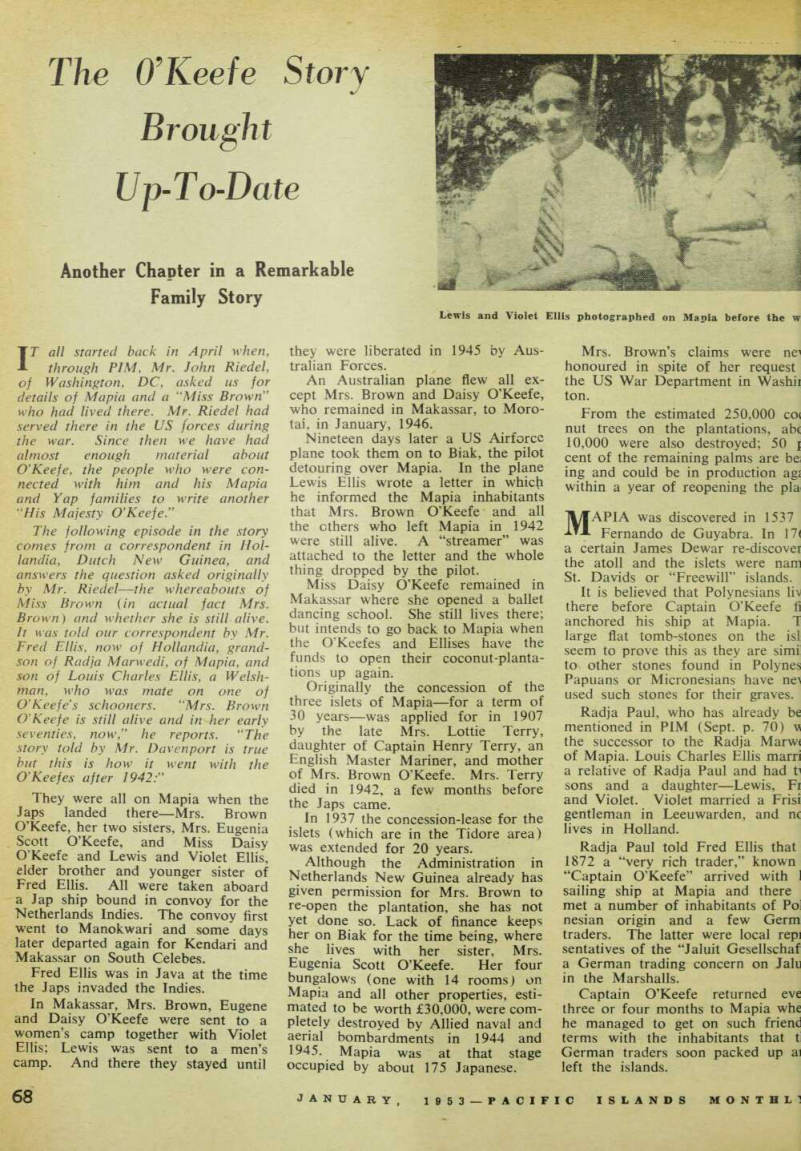
Lewis and Violet Ellis photographed on Mania before the w[?]
[ O’Keefe really was a “king” in his day. He asked the Radja Marwedi to hoist the American flag whenever he came to the islands and thereon bangs a tale: One day during O’Keefe’s absence Mapia was visited by the Resident of the Moluccas, Mr. Van der Horst. Seeing the Stars and Stripes flying above the palms the Resident asked the Radja Marwedi svhat was the meaning of hoisting
an American flag on Dutch territory.
Upon which the old Radja answered: “My boss, Captain O’Keefe, ordered me. This island his island, no?”
Another story of the Radja Marwedi concerns the occasion when Mr.
Henry Davenport left Mapia and went to Radja Marwedi to bid him goodbye. The old man really regretted Captain Davenport’s departure but his English was shaky. The Radja Mar-
wedi took both Davenport’s hands in his own, said: “Oh, you going away?
Well, me, an’ de you, an’ de all people on this island very, very glad.”
Mr, Davenport kept a straight face and answered; “Yes, I know you’re all glad to see me go.” And the Radja; “Yes, glad, all glad.”
Later, when told of his mistake, Radja Marwedi was loud in his re morse. He died in 1910.