Magazine Section
pp. 67-79 · Read in the full issue
Notes Made In
And
Around Tahiti
By R. W. Robson
(Photos by TEAL and Whites Aviation)
JJNAP impressions of a newcomer 9 in the streets of Papeete: [ The grace with which the merry fahitian girls on bicycles—an end
less procession—swing round the
corner of the Quai and the Rue ponnard . . . Every two out of three shops is in charge of a Chinese —übiquitous, Impassive, industrious. The Tahi tians insist that they do not like the Chinese, but they run practically the whole of the small trade of the town ...» Some of these signs have a mean ing in English that the French do not intend. For example, over one Section of a hospital, was the word ” At another section, only a few yards away, a little group of women awaited pre-natal care.
They took it as a matter of course — there was not one, even one thought ful glance at the big sign . . . Most trading signs in Tahiti are extremely modest and small. Reason: The municipality gets part of its Revenues from a tax on signs, at so much per square inch.
Not only does the keep-to-the right traffic indicate that one is out side the British Commonwealth: there also is the everlasting hooting of motor-horns—the one thing in t this happy French community which pminds one of Paris . . . ; One gets used to them after a [time; but, at first one’s eye is offended by the silly little plaited bats which so many Tahitian men wear. They are shaped like the old ptyle straw boater, but are very high
in the crown and narrow in the ■brim ...
The importance of bonito in the country’s diet is seen in the rows of fish which dangle from the buses which convey the morning’s shoppers back to the districts. Bonito has a thin tail and a big tail-fin—simply designed by Nature to hang from bicycles, lorries, buses, private cars, and pedestrians’ shopping baskets.
Indications axe that whole families live under and around those little, lamp-lit food-stalls along the lagoon side of the Quai, where one may buy mangoes, coconuts, alligator pears, confections—all sorts of lightly-cooked stuff. When it is fine, they sleep right there on the ground.
When it rains, they move across the street, and sleep on the concrete under the verandahs. alone knows how sanitary needs are pro vided for—but the thoroughfare is quite clean.
Teal’S New Era
Now that a British line, Tasman Empire Airways Limited, is running Polynesia’s most important air ser vice between New Zealand, Fiji and Tahiti, the British Consulate in Papeete has assumed a new import ance. It has been there for a long time—the never-to-be-forgotten Prit chard was the first Consul, 100 years ago—and, as Australian and New Zealand trade has displaced much of that formerly held by Britain, some people have wondered why the establishment is maintained. But the new era introduced by TEAL makes British official representation very necessary.
Mr. E. Devenish—an Englishman with no apparent “colonial” affilia tions—is the present Consul; and the Secretary is Mr. Walter Asmus, who was born in Australia. Both Mr.
Devenish and Mr. Asmus speak ex cellent French—Mr. Asmus grew up in New Caledonia, and has lived 30 years in Tahiti, and married a Tahitian girl.
Formal Claim
I claim no authority as a gour met; but I formally make the claim that Papaya Poi, as concocted by Mrs. Margot Nordman out of papaya, arrowroot, vanilla beans, and coconut milk, is the most delici ous sweet in the South Seas.
Painters
Painters come and go in Tahiti.
There were half a dozen French artists there in October, selling an occasional picture and living—very happily—close to nature. Charles McPhee, of Samoa and Rarotonga, had made a landfall there during the year, and produced some of his typical landscapes and seascapes; but the Government would not give him residential rights, so he revenged himself by taking away with him, to Rarotonga, as his second wife, one of Papeete’s fairest ladies.
The country’s outstanding artist to day is Edgar Leetag, an American, who has built himself a delightful retreat on one of loveliest bays in Moorea. He is a small, energetic man in his fifties, and his paintings on velvet have gained such a vogue that he now writes his own price tickets. He is a most generous,
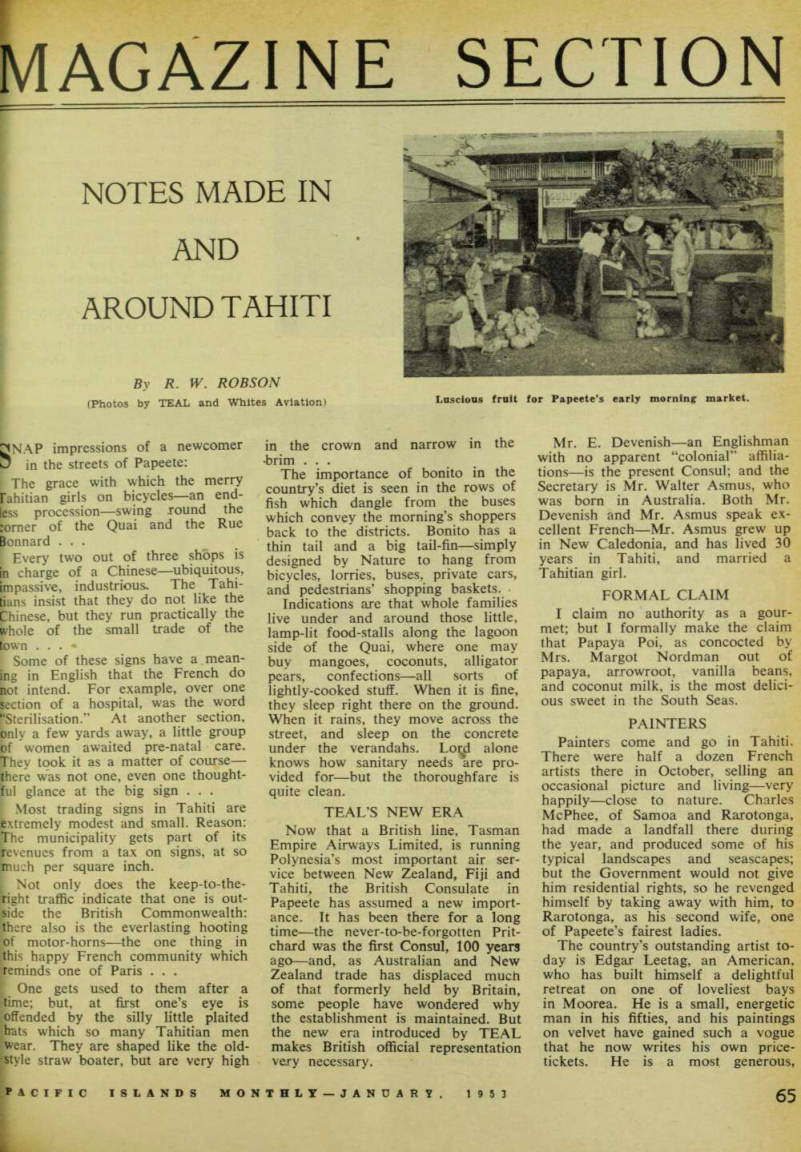
Luscious fruit for Papeete’s early morning market.
friendly man and his occasional visits to Papeete are made memor able by endless hospitality and wild waterfront wassail.
Floating Luxury
At Captain Barber’s invitation, I went aboard the Millionaire Reynolds yacht White Heron, which was tied up to Papeete’s main street in October. I never have seen so much luxury, artistry and amenities packed into so small a space. As I went ashore, I thought I saw the ghosts of Cook’s Endeavour and Bligh’s Bounty, lying in their old anchorage a few yards away. There was “wild amaze” in the faces of those tough Old mariners as they saw what could be put into a little hull, only 150 years after they pioneered Papeete.
Incidentally, Captain Barber wanted the address of Mr. H. A.
Markham, formerly of Marovo Lagoon, Solomons, and later of Christmas Island. I have lost track of the veteran. Does anybody know what has become of him?
Pacific Japanese?
In a delightful place of retirement at the back of Tahiti I found H. W.
Kinney, famous as a Far East news paperman and diplomat before World War 11. He has close Jap anese associations, reads and speaks Japanese, and keeps in touch with affairs in Japan.
“There is no chance of the Japanese again becoming belligerent,” he said to me. “The majority of Japanese are pacifists, and they will stubbornly remain so.”
One hopes fervently he is right.
But somehow we cannot forget that Japan’s population increases by over a million per annum, and there is no more room in Japan and that—
as demonstrated in 1941-42—the thoughts of many Japanese are focussea upon those great islands of the Southwest Pacific, comparatively unpopulated. Has anyone ever tried to compare the area and fertility and population of New Guinea, New Britain, New Ireland, Bougainville, the six big Solomons and the two big Hebrides with the islands of Japan?
Has anyone ever heard of Canute, who tried to hold back the tide?
Polynesian Brewery
New Guinea has not pioneered the Pacific Islands brewery idea, as some suppose—a brewery has been operat ing in Tahiti for several years. It was originally established by an American company, which did not nourish; and then it was taken over by Emil Martin, who has made of it a commercial success. The product is quaffed by most of Tahiti, and it
has a big market in the outer islan There is no restriction on the s; of liquor to the natives. The bt is palatable enough, and has ale rolic kick; but to my Sydney-train taste it seemed to lack strength a body. The brewery produces or bottled beer—no draught. It seei to have no difficulty in getting suffi ent supplies of imported bottles.
I found that there was some terest in Fiji in the successful est£ lishment of the brewery at P< Moresby. Fiji’s beer now con; from New Zealand and Australia, large quantities. Said a Fiji mi chant: “If New Guinea and Tahiti c do it profitably, why not Fiji?”
Chinese And French
Citizenship
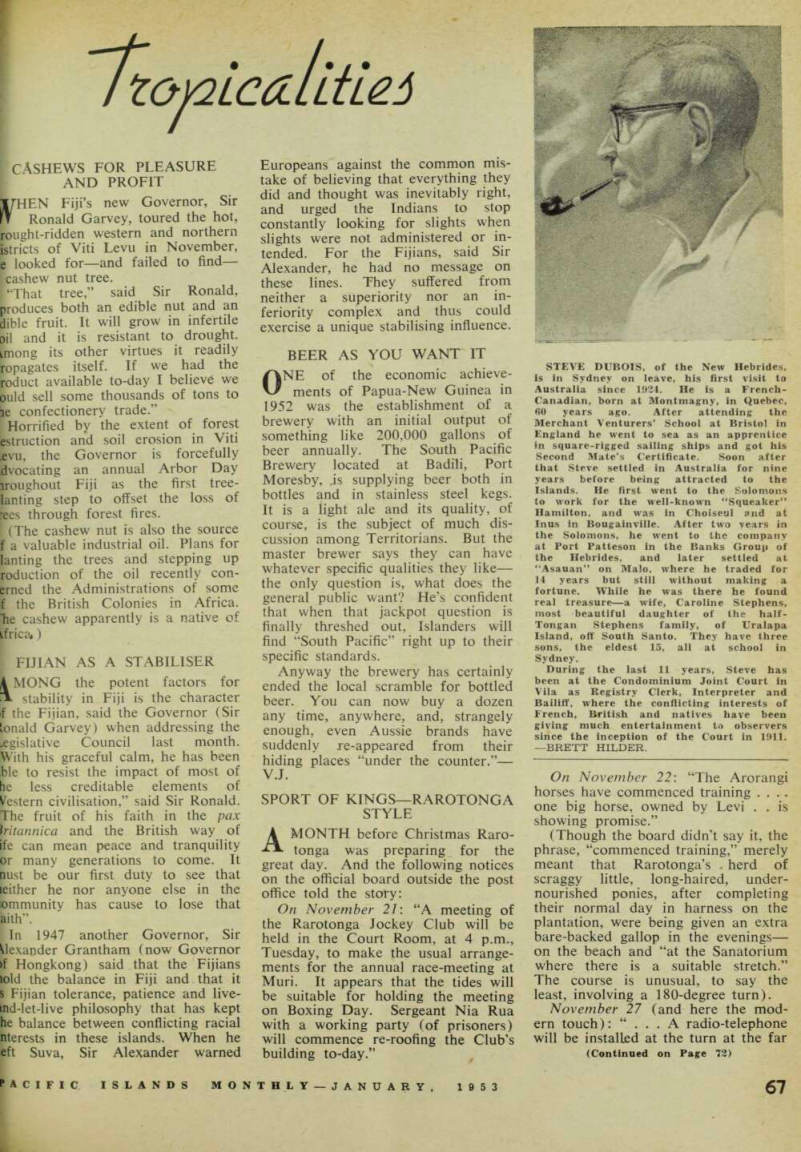
One of the minor anxieties of t Government of French Oceania Quinn’s —inside
that, under the laws of the Frem Union, any person of French natio ality can enter or leave Tahiti, whe ever he wishes. To protect t] kindly and hospitable Tahitians (wl are the natural prey of any kind beachcomber) the French exercise strict control over immigration. B practically any person born with the French Empire is free to con and go.
However, by some interpretatic of the law which I do not unde stand, Tahiti-born Chinese do n
automatically acquire French natio
ality; and the French thereby ke< the Tahiti Chinese under close chec The future of the growing Chine: community in Tahiti is as big headache, in its way, as is the futui of the Indians in Fiji.
There is a very considerable con
(Continued on Page 77)
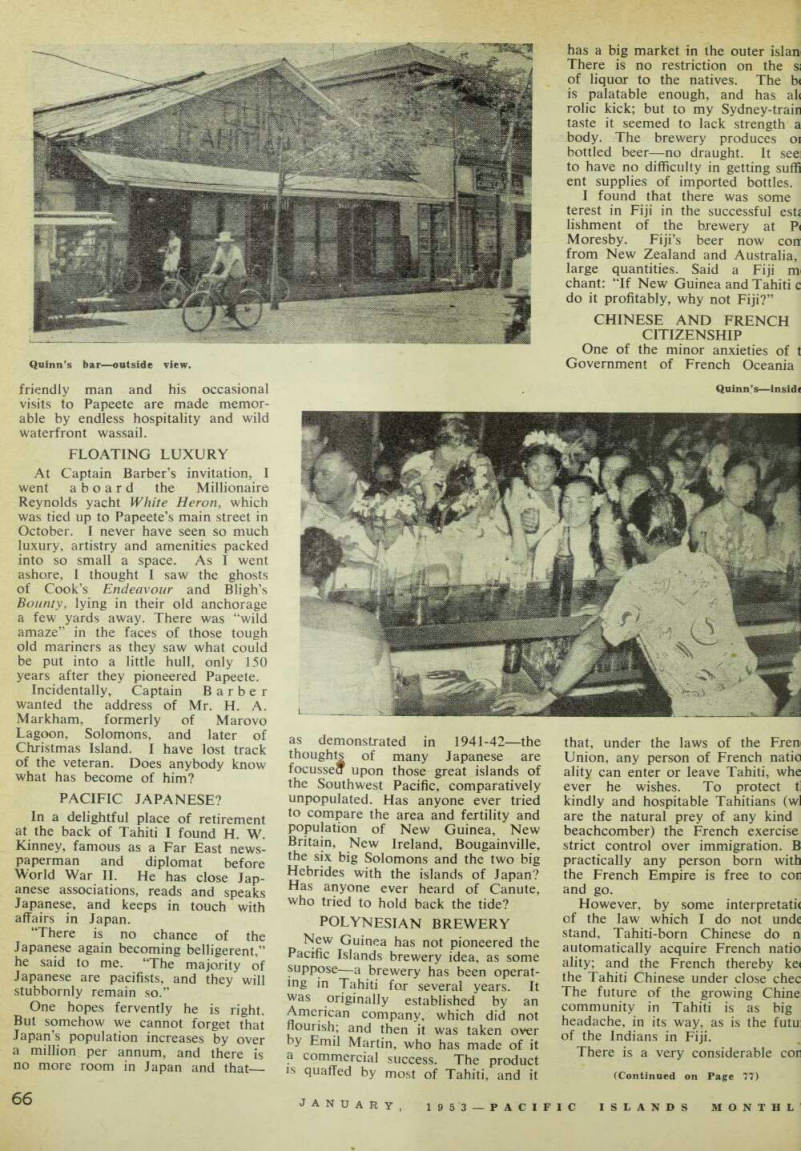
Quinn’s bar—outside view.
enmity of Chinese-Tahitians and these are good people—healthy, in telligent, industrious —it long has been known that the Chinese-Poly nesian cross is one of the world’s best. But the Chinese-Tahitian man in Tahiti objects to being called a Chinese—he insists he is a Tahitian. [ The old, full-blooded Chinese is going very carefully today, in a political sense. Since he cannot acquire French nationality, he of fcourse remains Chinese; but he does hot know whether to adhere to the Formosan Nationalists or the Peking Communists, because there is as yet 10 clear indication of which regime (vill survive. So he stays stolidly in the middle of the road, fThere are about 7,000 Chinese low among the 60,000 on Tahiti— ibout 12k per cent —and the propor tion is slowly growing. [ Some of the Chinese earn big in ternes. So do the leading Euro peans—an income of £lO,OOO Aus ralian per annum is not unusual. iVith allowances, the Governor gets ibout 72,000 frances (about £5OO per month.
‘ For Aviation Affairs
High French officialdom in Tahiti ippears to be giving real co-operation md practical assistance to TEAL, so hat the new air service will be of maximum value to the somewhat solated French Territory.
I TEAL’S happiest discovery in its lew dominion is the new officer in ‘harge of Civil Aviation in Tahiti, VI. Pierre Challet. M. Challet not >nly speaks perfect English—he Ipeaks it with an Oxford accent. He (pent some years with the RAF, and Fas a distinguished flier. Then, tfhen he was piloting a Boston in a logfight, someone cut his tail off.
Be crashed, of course; miraculously Scaped death, but got a badly smashed leg. After several opera tions, his leg was amputated below he knee. They describe him in Tahiti as “a fine bloke, with tons )f guts and a very charming wife”— >o he fits admirably into the new firways set-up in Oceania.
Apia And Suva Should
Note
Western Samoa and Fiji—especi ally Samoa—should try to organise something like the Syndicat dTnitia- Jve, or Tourist Bureau, which functions so energetically in Tahiti, h has the Government’s blessing,
and practical help: but it functions as an independent organisation of free citizens, under the active direction of a handsome blond Dutch giant, Charles van den Broek.
When big planes and ships arrive, bevies of distressingly pretty girls, directed by Madame Quinn, throw leis of lovely flowers around the necks of all incoming passengers; and, irrespective of whether they are perspiring dowagers, American millionaires or dehydrated commercial travellers, they love the ceremony,
and will not be separated from the fragrant mass until they have secured a photographic record.
All Papeete citizens with cars can be co-opted for transport of visitors.
It is the unwritten law: one bristling of the big van den Broek moustache, and the busiest merchant breaks off to do his share in making Tahiti’s beauties known to the world.
In due course, Tahiti will reap a rich harvest, in dollars from the east and pounds from the west. Apia and Suva should make a note of the French way of lining up the mer chants and traders. After all, who benefits most when the tourist party arrives?