Digoel River Journey
p. 69 · Read in the full issue
By "Sky Pilot”
READING the frequent references in PIM to Dutch New Guinea, the remnant of the once great Neth erlands East Indies still under Dutch control, I have been thinking of that I even smaller area that was left to the Dutch after the Jap invasion of 1942.
It was just a bit of southern DNG, the one tiny bit of the Indies that the Japanese did not overrun.
That the Japs did not occupy this area was due to its prompt garrison ing by Australian forces, Army men from Queensland and RAAF types from all over, with a small sprink ling of RAN. We were based on straggling, untidy Merauke, with small units scattered out deep into the jungle and away west along the coast.
What use is being made to-day, I wonder, of the little inland town of Tanahmerah, the administrative centre for the district of Upper Di goel? In late 1943 when I paid the place a brief visit on the old island tanker, once belonging to Shell, called Minyak Tanah, there were some Army men there and a RAAF Radar Unit. We sailed from Mer auke, along the coast and through the Princess Marianne Straits and to Digoel. There were a radar out fit and an Army OP in the Straits, and another Army post at Mappi halfway up the river.
To us, coming from Merauke, which we had regarded at the “capital” of DNG, Tanahmerah was a big surprise. A fairly decent wharf, a paved road leading uphill from it, even a street name—“Havenwig”— and then the concrete buildings with glass windows and septic tanks, and in the centre of the little town, a tiny park and a tennis court or two.
What was this place, we asked?
The answer, of course, is that it was the Dutch solution to the pol itical troubles of the 1920’s and later. It was an internment camp for political prisoners. True, it served also as an administrative centre for a big area, but that did not justify the money that had been spent on it.
It was built primarily to house political malcontents who made things troublesome in Java and else where. Amongst its notable resi dents at one time was Dr. Soekarno.
Probably some of his present col leagues too, knew Digoel well in those days. I found later in 1945,
that Indonesians regarded it with some dread as far away as Tarakan.
Immediately above the river was the township, with the Contrailleur’s house and other comfortable resi dences, the little park, the adminis trative buildings, and on the land ward side the big police barracks and gaol. Inland and uphill again from these was the Hospital and finally the fenced-in enclosure for the prisoners. Who the wit was we
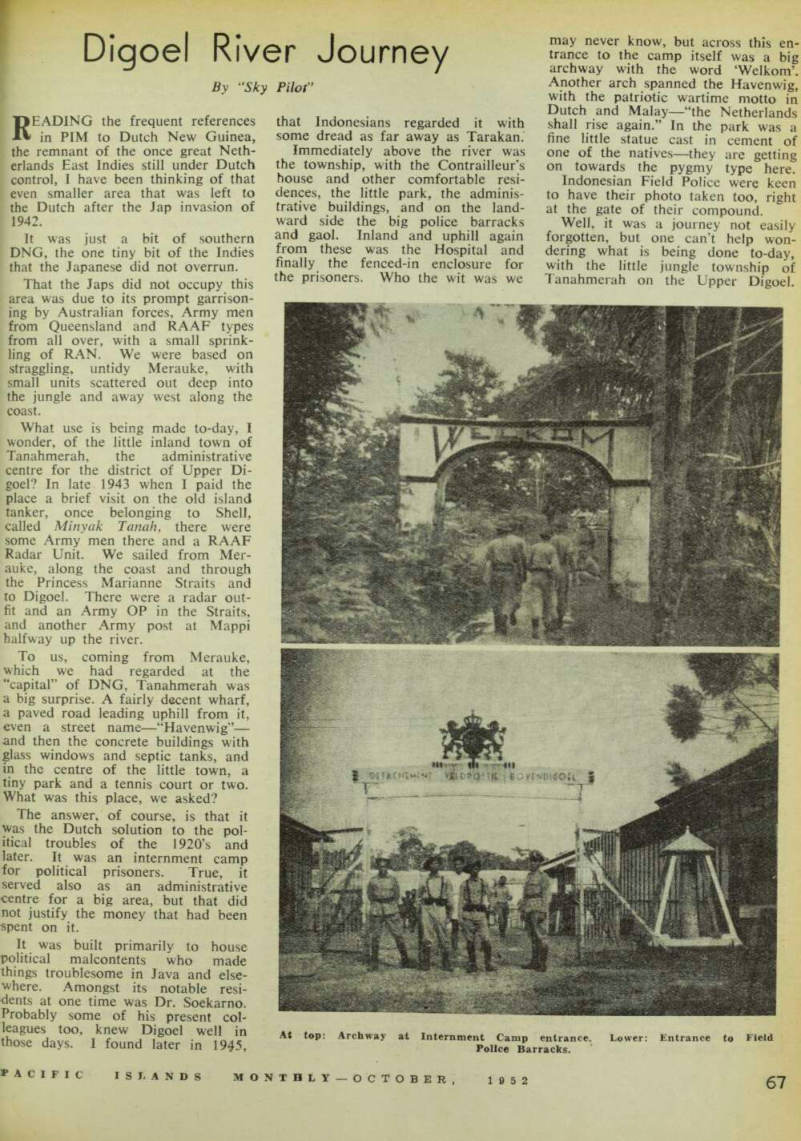
may never know, but across this en trance to the camp itself was a big archway with the word ‘Welkom’.
Another arch spanned the Havenwig, with the patriotic wartime motto in Dutch and Malay—“the Netherlands shall rise again.” In the park was a fine little statue cast in cement of one of the natives—they are getting on towards the pygmy type here.
Indonesian Field Police were keen to have their photo taken too, right at the gate of their compound.
Well, it was a journey not easily forgotten, but one can’t help won dering what is being done to-day, with the little jungle township of Tanahmerah on the Upper Digoel.
At top: Archway at Internment Camp entrance. Lower: Entrance to Field Police Barracks.