Nothing Ever Happens Here
pp. 70-71 · Read in the full issue
By Pereti
THE hurricane season was in the offing; the island schooner was making preparations for what would be its last trip around the group for several months.
I met Skipper Andy one afternoon, just as he was going aboard.
He said to me, in the course of conversation, “You’re pretty much a gentleman of leisure these days, what about coming for a trip?”
I could think of no real reason why I should not and a couple of days later we up-anchored and headed away north. We were a mixed but congenial crowd—an Assistant Commissioner, a couple of traders, a Dominican priest, a school teacher and myself. We dropped odd cargo and passengers at odd places, picking up other cargo and bodies to take their place. Uneventful day followed uneventful day.
Then one evening the skipper announced that he expected to make Mitiake early next morning. A pleasant and peaceful little island this, by all accounts. I looked forward to stretching my legs and having a look around.
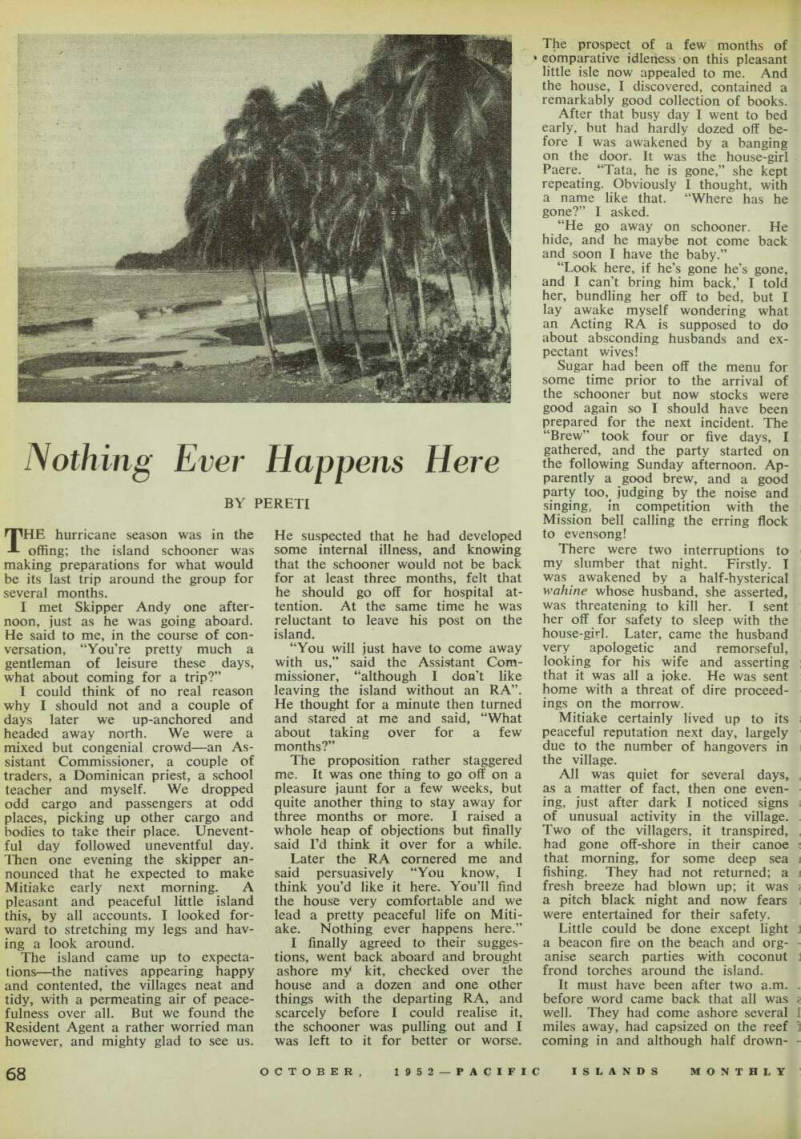
The island came up to expectations—the natives appearing happy and contented, the villages neat and tidy, with a permeating air of peacefulness over all. But we found the Resident Agent a rather worried man however, and mighty glad to see us.
He suspected that he had developed some internal illness, and knowing that the schooner would not be back for at least three months, felt that he should go off for hospital at tention. At the same time he was reluctant to leave his post on the island.
“You will just have to come away with us,” said the Assistant Com missioner, “although I don’t like leaving the island without an RA”.
He thought for a minute then turned and stared at me and said, “What about taking over for a few months?”
The proposition rather staggered me. It was one thing to go off on a pleasure jaunt for a few weeks, but quite another thing to stay away for three months or more. I raised a whole heap of objections but finally said I’d think it over for a while.
Later the RA cornered me and said persuasively “You know, I think you’d like it here. You’ll find the house very comfortable and we lead a pretty peaceful life on Miti ake. Nothing ever happens here.”
I finally agreed to their sugges tions, went back aboard and brought ashore mV kit, checked over the house and a dozen and one other things with the departing RA, and scarcely before I could realise it, the schooner was pulling out and I was left to it for better or worse.
The prospect of a few months of comparative idleness on this pleasant little isle now appealed to me. And the house, I discovered, contained a remarkably good collection of books.
After that busy day I went to bed early, but had hardly dozed off be fore I was awakened by a banging on the door. It was the house-girl Paere. “Tata, he is gone,” she kept repeating. Obviously I thought, with a name like that. “Where has he gone?” I asked.
“He go away on schooner. He hide, and he maybe not come back and soon I have the baby.”
“Look here, if he’s gone he’s gone, and I can’t bring him back,’ I told her, bundling her off to bed, but I lay awake myself wondering what an Acting RA is supposed to do about absconding husbands and ex pectant wives!
Sugar had been off the menu for some time prior to the arrival of the schooner but now stocks were good again so I should have been prepared for the next incident. The “Brew” took four or five days, I gathered, and the party started on the following Sunday afternoon. Ap parently a good brew, and a good party too, judging by the noise and singing, in competition with the Mission bell calling the erring flock to evensong!
There were two interruptions to my slumber that night. Firstly. I was awakened by a half-hysterical wahine whose husband, she asserted, was threatening to kill her. I sent her off for safety to sleep with the house-girl. Later, came the husband very apologetic and remorseful, looking for his wife and asserting that it was all a joke. He was sent home with a threat of dire proceed ings on the morrow.
Mitiake certainly lived up to its peaceful reputation next day, largely due to the number of hangovers in the village.
All was quiet for several days, as a matter of fact, then one even ing, just after dark I noticed signs of unusual activity in the village.
Two of the villagers, it transpired, had gone off-shore in their canoe that morning, for some deep sea fishing. They had not returned; a fresh breeze had blown up; it was a pitch black night and now fears were entertained for their safety.
Little could be done except light a beacon fire on the beach and org anise search parties with coconut frond torches around the island.
It must have been after two a.m. before word came back that all was well. They had come ashore several miles away, had capsized on the reef coming in and although half drown
ed. scratched and bruised, were at least safe. I sought my bed for what was left of that night.
It was only a short time after this that I was again wakened in the middle of the night, this time by a terrific how-do-you-do in the village.
As I hastily dressed I could easily guess the cause of this disturbance — it was fire this time. Starting in a cook-house, it had spread to an ad jacent house which was now merrily ablaze. A second house was threat ened but a hastily organised bucket brigade plus a great amount of shouting and yelling finally saved it from a similar fate. I remember dawn was just breaking as I turned in for the second time, and I also remember wondering why every thing on Mitiake must happen at night-time.
We were now well into the hurri cane season and although one always hoped to miss out, 1 had not liked the look of the weather for the past 24 hours; the barometer was falling too low for comfort. ~I arranged for the usual precau tions to be taken, and everyone spent a busy morning battening down and lashing everything possible. The wind had been increasing in force all the time with the glass still falling, then, about mid-afternoon, the full force struck us.
I’ll not try to describe the pande monium which raged over our little isle for the next few hours—only those who have been through a tropi cal hurricane can appreciate the des tructiveness and destroying power of that searing monster of the sky.
Fortunately, we were off the storm centre and by nightfall the rising barometer brought a decrease in the ferocity of the squalls, enabling a superficial survey to be made of the damage.
Several native huts had been de molished completely; many more had lost their kikau thatch roofs, but my own house had escaped fairly lightly—only a few sheets of iron were missing from one part of the roof. Half of them were never found again, having probably been blown out into the lagoon.
For quite a while after this the island was a scene of much activity.
Debris had to be cleared up, much replanting done, and houses had to be rebuilt and rethatched. I know I was kept pretty busy with one thing and another and I know too, that half way through this recon ditioning period, the rains came. It rained in the way it can rain in this part of the world when Hughie de cides to really send it down, and my poor house, sans a portion of roof, was a mighty uncomfortable abode,
half of it being flooded for several days at a stretch.
However, in due course the sun shone again and our little world be came restored to some semblance of tidiness and order. For this I was pleased, for the schooner was ex pected shortly and I wanted things shipshape against my departure.
It was four months to the day when she finally reappeared and I was able to receive some news of the outside world and greet my suc cessor. The previous RA was, it appeared, seriously ill, with little hope of returning to the island. The Administration had appointed a new Agent. Like myself, he had not been here before, so he was soon plying me with questions about the place.
I often think that living in the islands is like going to sea —in retro spect one seems to remember only the pleasant side of it all. So-be-it that I found myself forgetting all the domestic worries I had experi enced, forgetting the fires, floods and hurricane, and assuring the new Agent, in all sincerity, that Mitiake was a most peaceful isle and that “nothing ever happens here.”