Tropicalities
pp. 67-74 · Read in the full issue
Magazine Section
Edmund Opened The Door
IN one Auckland post office there is a small door that pops open when one rings a bell for his parcel mail.
When I pressed the bell the other day, the door opened to reveal a face last sighted on far off Puka Puka Island just six years ago—Ed mund Savage, son of Mr. R. C. Sav age, the then Resident Agent of that north-westernmost Cook Island.
The occasion was a visit by the schooner Tiare Taporo with Resi dent Commissioner Tailby, Chief Medical Officer Davis, and Radio Technician Mike Lee aboard, among others.
The schooner arrived on July 27.
Nothing had been heard from the island by radio or otherwise since the previous January.
The Puka Pukans are the Irish of the Cooks—in the habit occasionally
of tearing down the New Zealand flag and substituting one of their own—and it was known that there had been some unrest on the island.
Consequently, all on board were ex pecting bad news—and were greatly relieved to see a canoe coming off with Resident Agent Savage aboard, hale and hearty.
Nothing worse than a radio break down had occurred—and the Puka Pukans entertained their visitors in royal fashion, with feasting, dance and song, at the three native villages.
Excellent musical items were pro vided by Edmund and his brother Ray—now in Wellington—backed by some of the local boys—lPS.
Learn A Trade Jim
Edwards—In Gaol
4 state of affairs which has ex isted in the Cook Islands and is well known there, was given pub-
licity in New Zealand papers in Sep tember following publication of the Cook Islands Annual Report.
In noting that it is “hoped” that construction of a new gaol building will be commenced in Rarotonga this year, the report states: “There are powers in the Cook Islands Act, 1915, for any person sentenced by the High Court of the Cook Islands to a term of more than six months’ imprisonment to be sent to New Zealand to serve his term.
However, it has been found that prisoners serving sentence locally have broken custody in the hope that as a result of incurring a more serious charge they would be trans ferred to New Zealand. This desire is brought about by the knowledge that in New Zealand prisoners re ceive trade training which it is im practicable to give them in the Cook Islands. The situation has caused some concern and cannot be recti fied until the erection of a new gaol is undertaken.”
Cases could be cited of persons who have served terms in New Zea land prisons returning to the Cooks trained for jobs for which they could never otherwise have hoped to equip themselves.
Will Abandon Yachting
For Dog Breeding
VIfHEN the 48-foot ketch Mini " arrived at Callao, Peru, on August 26, after 71 days of tough sailing from Wellington, NZ, broken by a 17-day pause at Rapa Island, Mrs. Davis, wife of owner Dr. Tom Davis, expressed her feelings on yacht cruising down in the Roaring Forties in no uncertain terms.
Mrs. Davis said on arrival at the Peruvian port; “Dr. Davis can go to sea again if he wants to—but dry land for me. When this is all over, I’m going to buy a cottage in the mountains and breed Alsatian dogs”.
Dr. Davis, however, did not take such a dim view of sailing large oceans in small ships.
Admitting that it had been a rough voyage with plenty of dis comfort and some damage, he is reported as saying:— “The journey from now on, up the coast of South America and through Panama to Boston will be a joyride, except perhaps for the Caribbean.”
Some experienced seafarers are doubtful about the Caribbean passage at this time of the year—the
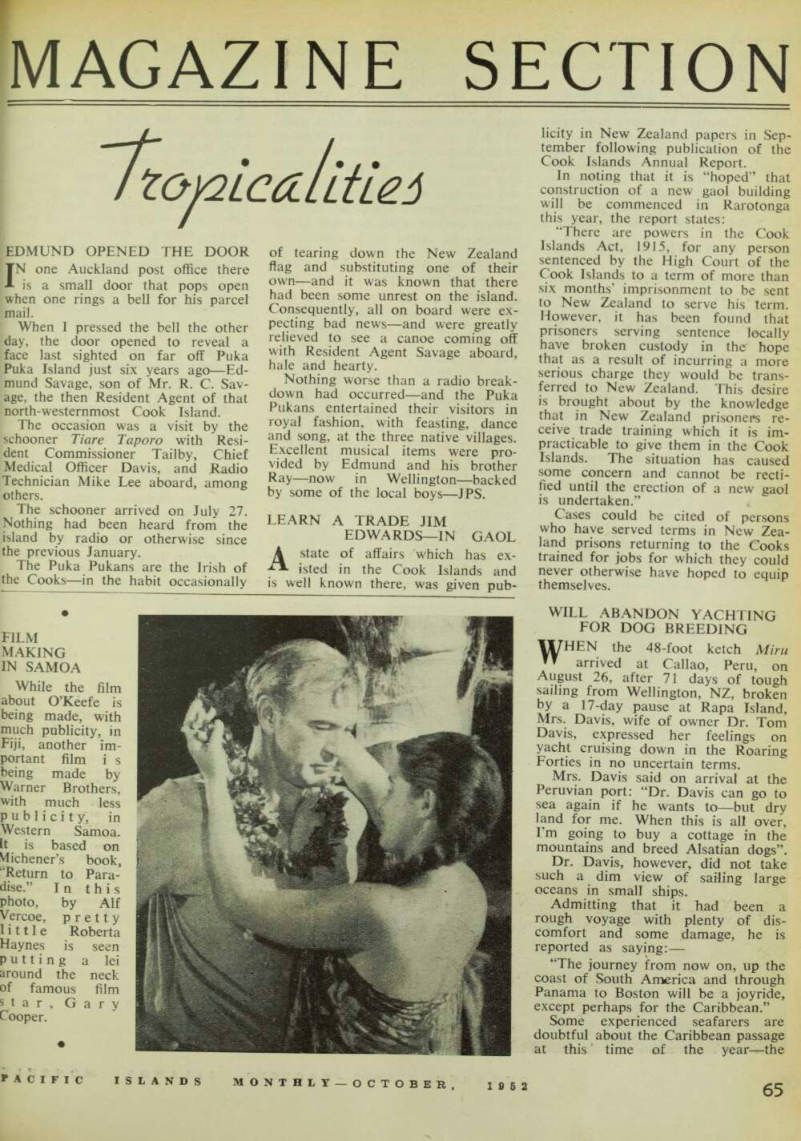
Film
Making
In Samoa
While the film about O’Keefe is being made, with much publicity, in Fiji, another im portant film i s being made by
Warner Brothers,
with much less publicity, in Western Samoa.
It is based on
Michener’s book,
“Return to Para dise.” In this photo, by Alf
Vercoe, pretty
little Roberta Haynes is seen putting a lei around the neck of famous film star, Gary Cooper.
hurricane season thereabouts. The first big blow of the season was rag ing along the South Carolina coast as the Miru arrived at Callao.
Dr. Davis had originally hoped to clear New Zealand early enough to arrive at Boston by about September and miss the hurricanes. (Dr. Davis, CMO of the Cook Islands, with his wife, two small sons and a Christchurch yachtsman, decided to go to America the hard way, when Dr. Davis was granted a US fellowship for Medical Research.)
Dr. Tom Davis Has New
Theory
About Polynesians
HAVING sucessfully crossed the Pacific Ocean, west to east, by the “southern route,” Dr. Davis, has been making the headlines in USA by developing a new Kon Tiki theory.
The Norwegian voyagers, drifting on their raft on the Humboldt cur rent from South America to French Oceania, claimed they had proved the South American origin of the Polynesians. Dr. Davis, himself half Polynesian, said the traces of South America in Polynesia (sun worship, certain artistic techniques, sweet potatoes, taro) might be explained in another way. He suggested that the Polynesians, after they had mi grated into the central Pacific from Madagascar and southeast Asia
might have voyaged to South America by the easy southern route, and drifted back to Polynesia by the Kon Tiki route.
The Miru, took the southerly route and encountered such stormy weather that the party had to spend 17 days in Rapa, French Oceania, undergoing repairs. Then they went southwards and eastwards again, and had more storms, hardships and short rations before reaching Callao.
Dr. Davis proved his point that the general drift of wind and sea, in the latitudes he sailed in, is easterly.
Another Big Game
Fisherwoman From Fiji
SOME time ago we reported that Mrs. Kathleen Hassal, formerly of Fiji, had in March hooked a record 542-lb Black Marlin at the Bay of Islands, NZ. This was a woman’s world record for a 24thread line.
Now from the rival Big Game club at Tauranga, NZ, we learn that another fisherwoman from Fiji, Mrs.
G. Wallace, landed the heaviest fish of the season just ended. This was a 672-lb thresher shark.
The type of line used in this case (the vital factor when records are considered) was not given, but 672lb is a lot of fish.
The Tauranga Club caught a total of 402 big fish during the season.
Mrs. Hassall’s club, further north,
landed 375 fish weighing altogether! over 42 tons.
The Harm An Unmuzzled (
Scribbler May Do
THERE is no doubt that when your enter the world of films you i enter the world of phantasy!
A magazine called Picture Show ,, printed in London on August 23,. published a blurb about someone t called Joan Rice, who was going to < Fiji to take a part in the O’Keefe i film. There is imaginative stuff about i Joan’s sarong, and native drum i signals; and then the writer really > lets himself go, thus: The studio has engaged a Fiji’s chieftain, Ratu Sir Lala Sukuna, as professor of the educated drum~~ sticks, to waft messages by tom~tom across the Pacific to nearby \ islands. There are no modern i means of communication between \ the islands. As they are needed \ for the Technicolor picture, spear i dancers will be summoned from t Cakau-drove, war dancers from i Nausori, and fire-walkers from t Mbengga.
For persons who do not know \ the South Pacific, it may be noted 1 that Lala Sukuna, while a Fijian t “chieftain,” also is a graduate of 1 Oxford University, a distinguished 1 and decorated soldier, a Knight of 1 the British Empire and an adminis- -
(Continued on Page 71)
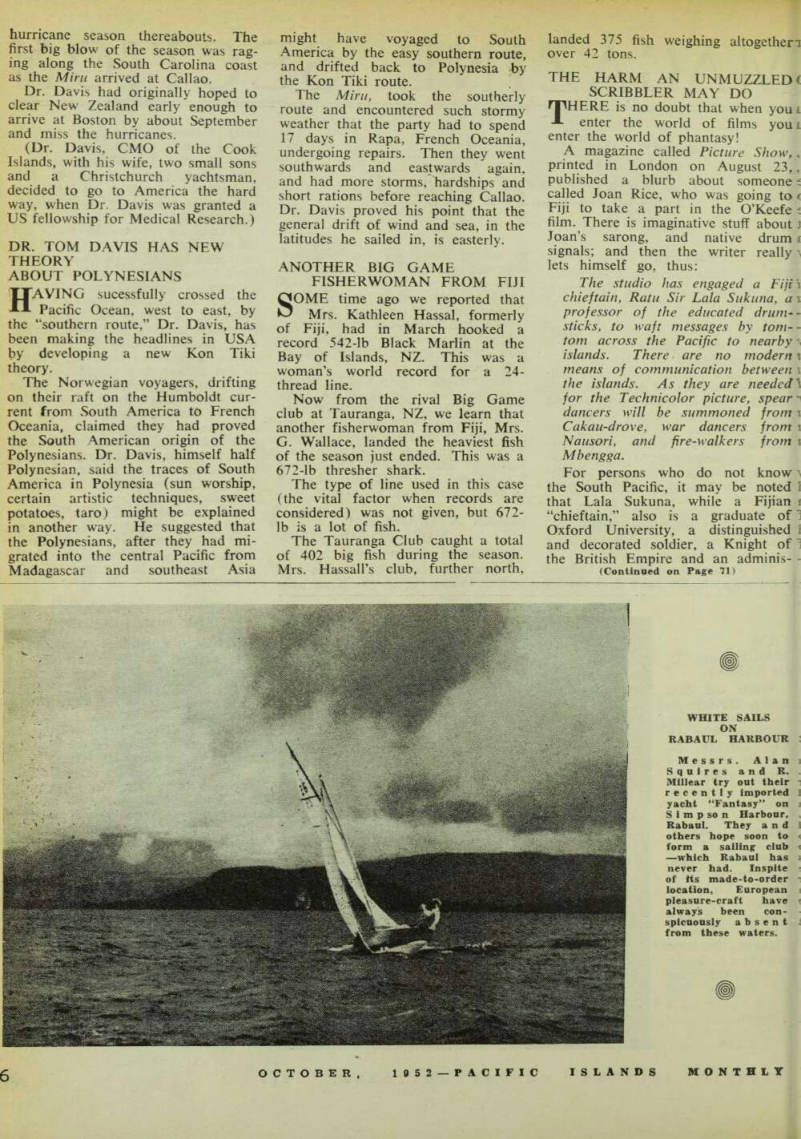
White Sails
ON
Rabaul Harbour
Messrs. Alan Squires and R.
Mlllear try out their recently imported yacht “Fantasy” on Simp so n Harbour.
Rabaul. They and others hope soon to form a sailing club —which Rabaul has never had. Inspite of its made-to-order location, European pleasure-craft have always been con spicuously absent from these waters.
trative official of a status second only to that of the Governor. A country which permits irresponsible unmuzzled scribblers to scatter in sults in this fashion does not deserve to have an Empire.
Do You Remember
This Book?
WHEN that indefatigable seeker after New Guinea fact and story, Alice Allen Innes, visited Ho bart, Tasmania early this year she took this snapshot of Miss Lillian Overell. Miss Overell may be re membered by some of the earliest post-World War I residents of New Guinea—or remembered for her book called A Woman’s Impressions of German New Guinea.
Miss Overell visited the Rabaul area somewhere around 1919-1920, while the Territory was still under military administration and when it was difficult, if not impossible, for a European woman to get permission to go there. However, she managed it somehow, as the guest of Mrs.
Phoebe Parkinson, and from Mrs, Parkinson’s plantation near Kokopo she was able to observe the New Guinea of that era and to comment on the German era that had not then passed away.
The book unfortunately is now out of print. If any reader has a copy of it, the editors of PIM would be happy to buy—or to borrow it, THE Overell family has been es tablished in Hobart for over 100 years. Miss Lillian Overell travelled
widely in the Pacific when she was younger and with two other sisters ran a well-known school in Hobart.
It was to the Misses Overell that Errol Flynn went at five years of age to begin his education.
Apparently even at five, Errol was a bad boy but had a way with the ladies. In spite of his pranks, the Misses Overell still think of him with affection.
The school had cows, fowls, ducks, cats, a dog and even a wal laby, A creek ran nearby and in it the small boys could fish with bent pins or sail their boats. But despite these delights—and the fact that he could spend much time pulling off the hair ribbons of the senior girls— Errol and his pal Jim decided they would run away and become bush rangers on Mt. Wellington. Their plan was given much thought but their courage failed them at the school gates.
Miss Overell recalls that Errol one day met the august Headmistress in town. He stopped in front of her with hands on hips and with true Flynn blarney said; “I never knew that you could look so pretty.”
Patriotism Overdone
fpHE NZ Island Territories Depart -*■ ment’s latest Annual Report gives an example of patriotism to wards the homeland which is caus ing officialdom a headache or two.
It seems that the Tokelau Islands postage stamps of three separate de nominations depict scenes from each of the three separate atolls of the Group—Fakaofu, Nukunono and Atafu. The postal authorities now find that the people of any particular atoll are very reluctant to buy any stamp other than the one depicting their particular island.
A Wonderful Bird Is The
Pelican . . .
PELICANS continue to be reported at various places in the British Solomon Islands. In addition to earlier sightings in the Western Solomons and Guadalcanal, they have now been seen on Malaita and at Star Harbour, Santa Anna and Wainoni on San Cristoval.
One pelican is now the station mascot at Malu’u District Station on Malaita. It appeared first in the Lau Lagoon, where the villagers took a dim view of the large unknown bird, partly because of its strangeness and partly because it ate too much fish.
They tied it up on a long string and reported it to the District Officer, who on his next visit reassured local misgivings and took the bird back with him to Malu’u. It now swims
about tethered by a long line to a piece of floating wood.
It is reported to have got quite used to people, and to submit quite cheerfully to being picked up and
handled.-
Ksp
Papuan Theory Of
Racial Superiority
11/IR. B-FOR writes that the Black Papuans consider themselves very much superior to the Black New Guinea natives.
“You would be amused to see the Papuans—black variety—in Rabaul.
There are just a score or two of odd bods from anywhere from Buna to Daru and when they arrive here they smartly learn that they are a class ahead of the local breeds and so immediately try to adopt the master-to-coon relationship that they learned from their previous Tau bada. This gets them into endless strife with the local Master Race and the dispensers of local justice who sense rivalry and competition, and react accordingly. If one is rash enough to make some mild remark such as one Papuan is worth half a dozen New Guinea coons then one is likely to find oneself tossed on one’s ear and an outcaste from de cent society.
“I remember once taking Billy Hughes to Moresby villages. Said Billy, ‘Mr. B-for, these natives seem to be much superior to the ones on the other side. They tell me that some of them can read and write.’ ‘Yes,’ I said, ‘they certainly can and some of them are so far advanced that they can forge and utter leave passes, cook their Taubada’s Please Supply chits to the stores and one bright spark recently pinched a cheque blank and forged his master’s signature.’ ”
Photographing Bop
A MILLIONAIRE whose hobby is photographing birds, set up his camp near Mt. Hagen, Central New Guinea Highlands, in early Septem ber. He plans to spend two months in the district “shooting” birds of paradise with his camera.
He is Mr. W. T. Loke, of Singa pore and of Chinese nationality. His special cameras are capable of taking photographs at 1/16,000 of a second.
With them he hopes to catch New Guinea BOP at play.
Most bird photography is done from a “hide”—a camouflaged struc ture of leaves, etc., where the photo grapher can conceal himself and his apparatus from the bird he wishes to photograph. Mr, Loke remarks that in Singapore because of the heat and the humidity eight hours
in a hide (as is sometimes necessary\ to get a good shot) can be exceed ingly uncomfortable. And away' from the city it can be downright; dangerous. A bird photographer ini a hide is himself a sitting shot for a terrorist.
Rarotongans, Save That
Old Paper!
Residents of Cook is. should look through the old family chests. David Strang, leading Auck land dealer in early Pacific literature, is currently offering a single copy of Te Torea, dated December 4, 1897, at 17/6.
Te Torea . a cyclostyled little local news-sheet that sold at 2d per copy, has long been out of existence, and now is of great historic interest.
What Gives?
T'HE following paragraph appeared in the Sydney Sun in early Sep tember: We would be very pleased to hear from pen-friends in Australia.
We are Fiji-born Europeans, and are secondary scholars. Our hobbies are stamp collecting, photography, swim ming and other sports.—Narendra, DAV College, Samabula, Suva, Fiji Island, Drona Charva, c/o. Hadhe Shyan Grahame and Co., GPO, Box 27, Suva, Fiji Island; Suruj Lai, c/o.
PO Box 237, Nausori, Fiji Island.
Fiji-Indians visiting Australia and NZ have often been described as “Fijians” but this is the first time we have seen Indians claim to be Europeans—Fiji-born or otherwise.
Mrs. Mildred Costello and her son, Mr. Ben Costello, of Rabaul are now in Sydney. Mrs. Costello intends to make her home there, while Mr.
Costello will train for a commercial pilot’s licence. For some time Mrs.
Costello’s plantation, Gire Gire, has been leased. She built herself a home at Revuvu, Rabaul, which enabled her to take a more active part in community work. Prior to her leaving Rabaul, the president of the New Britain Women’s Club (Mrs.
Arrowsmith) presented her with a travelling clock in recognition of her services as president, secretary and committee member of the club, and particularly for her efforts which resulted in the building and furnish ing of the Clubhouse.
Mr. W. Thomasetti, ADO Kavieng, New Ireland, has been transferred to Central District, Papua. He left recently in M. V.
Weston. Mrs. Thomasetti and two small daughters followed by ’plane.