The Editors' Mailbag
pp. 20-22 · Read in the full issue
Appeal for Distressed Fiji
That well-known Australian artist, Mary Edwards, never has lost her affection for Fiji. Within a few days of the hurricane, she was busily organising a fete—at “Coo inoo,” Turramurra, Sydney, on March I—to1 —to raise funds for Fiji Relief, She is getting support; but her plan is under the handicap that there are in Australia to-day far more distressed bush-fire sufferers than there are hurricane sufferers in Fiji. Normally, Australia would have contributed liberally to help Fiji. Just now, all the available re lief is urgently needed at home.
Nonetheless, sympathisers and friends of Fiji will wish to help Miss Edwards. Call her on JJ 2005.
Farewell to 'Leprosy’?
In ancient times, a leper was the complete human outcast. Fear of the disease he carried led to the perpetration of horrors indescrib able.
Even to-day, when it is known that leprosy to a large extent can be cured, and that there is almost no risk of casual infection, most people recoil in terror from any chance of contact with sufferers.
In this respect, splendid work has been and is being done by an organisation called “The Relatives and Friends Association,” whose Australian secretary is Mr. E. H.
Hinton, of Richer St., Toowong, Brisbane. By constant propaganda, this body tries to remove pessimism from the minds of the diseased, ond fear from among the unin fected. They forbid the use of the words leprosy and leper.
They call it by its scientific name of Hansen’s Disease: they refer to “patients suffering from HD”; and they constantly quote facts and figures to show how the disease now can be arrested, and the high and growing rsrcentage of cures.
One need only remember Molokai and Makogai to realise that there is much of this disease in Poly nesia; but how many know that it was brought into the Pacific Islands by Europeans?
It will not be easy to abolish the use of the word leprosy, used in our earliest records. But it is a fine idea; good luck to the Association.
More About Wahlenburg
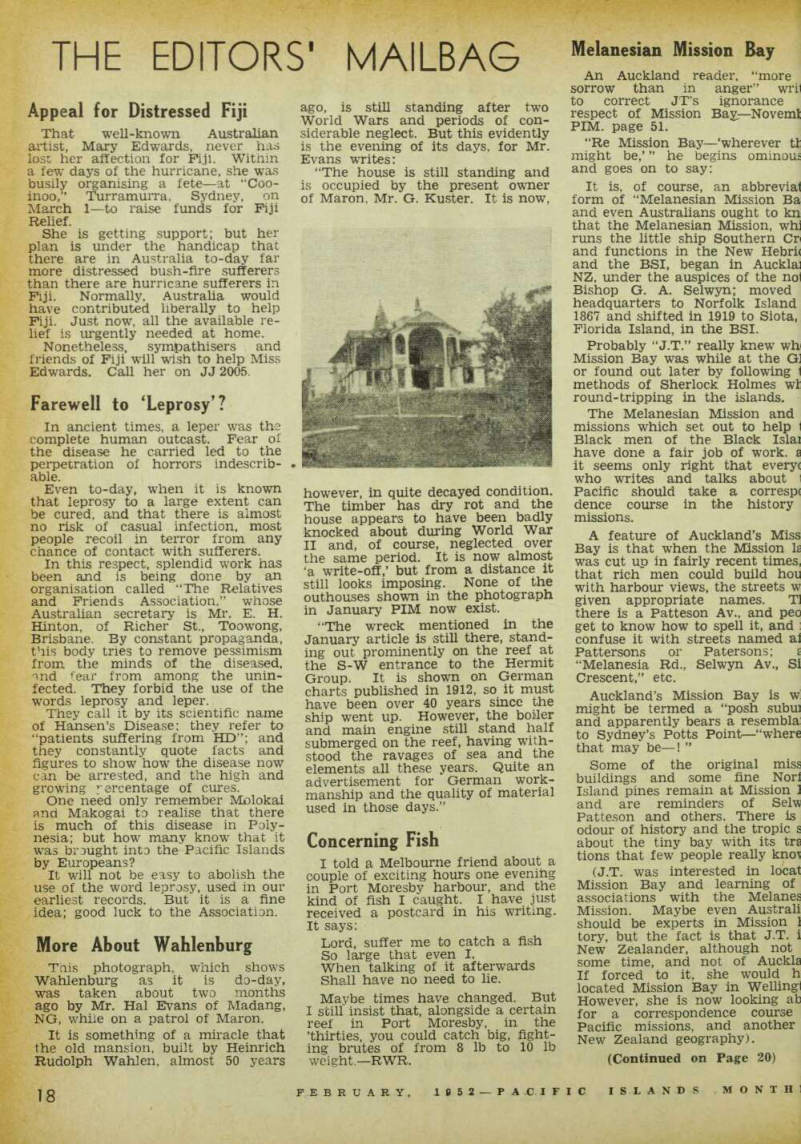
This photograph, which shows Wahlenburg as it is do-day, was taken about two months ago by Mr. Hal Evans of Madang, NG, while on a patrol of Maron.
It is something of a miracle that the old mansion, built by Heinrich Rudolph Wahlen, almost 50 years
ago, is still standing after two World Wars and periods of con siderable neglect. But this evidently is the evening of its days, for Mr.
Evans writes; “The house is still standing and is occupied by the present owner of Maron. Mr. G. Kuster. It is now,
however, in quite decayed condition.
The timber has dry rot and the house appears to have been badly knocked about during World War II and, of course, neglected over the same period. It is now almost ‘a write-off,’ but from a distance it still looks imposing. None of the outhouses shown in the photograph in January PIM now exist.
“The wreck mentioned in the January article is still there, stand ing out prominently on the reef at the S-W entrance to the Hermit Group. It is shown on German charts published in 1912, so it must have been over 40 years since the ship went up. However, the boiler and main engine still stand half submerged on the reef, having with stood the ravages of sea and the elements all these years. Quite an advertisement for German work manship and the quality of material used in those days.”
Concerning Fish
I told a Melbourne friend about a couple of exciting hours one evening in Port Moresby harbour, and the kind of fish I caught. I have just received a postcard in his writing.
It says; Lord, suffer me to catch a fish So large that even I, When talking of it afterwards Shall have no need to lie.
Maybe times have changed. But I still insist that, alongside a certain reef in Port Moresby, in the ’thirties, you could catch big, fight ing brutes of from 8 lb to 10 lb weight.—RWß.
Melanesian Mission Bay
An Auckland reader, “more sorrow than in anger” wril to correct JT’s ignorance respect of Mission Bay,—Novemt PIM. page 51.
“Re Mission Bay—'wherever tt might be,’ ” he begins ominous and goes on to say; It is, of course, an abbrevial form of “Melanesian Mission Ba and even Australians ought to kn that the Melanesian Mission, whi runs the little ship Southern Cn and functions in the New Hebri< and the BSI, began in Auckla] NZ, under the auspices of the nol Bishop G. A. Selwyn; moved headquarters to Norfolk Island 1867 and shifted in 1919 to Siota, Florida Island, in the BSI.
Probably “J.T.” really knew wh Mission Bay was while at the Gl or found out later by following 1 methods of Sherlock Holmes wt round-tripping in the islands.
The Melanesian Mission and missions which set out to help 1 Black men of the Black Islai have done a fair job of work, a it seems only right that everyc who writes and talks about i Pacific should take a corresp( dence course in the history missions.
A feature of Auckland’s Miss Bay is that when the Mission la was cut up in fairly recent times, that rich men could build hou with harbour views, the streets w given appropriate names. T 1 there is a Patteson Av., and peo get to know how to spell it, and : confuse it with streets named ai Pattersons or Patersons; a “Melanesia Rd., Selwyn Av., Si Crescent,” etc.
Auckland’s Mission Bay is w! might be termed a “posh subui and apparently bears a resembla: to Sydney’s Potts Point—“where that may be —! ”
Some of the original miss buildings and some fine Nori Island pines remain at Mission 1 and are reminders of Selw Patteson and others. There is odour of history and the tropic s about the tiny bay with its tra tions that few people really kno\ (J.T. was interested in local Mission Bay and learning of associations with the Melanes Mission. Maybe even Australi should be experts in Mission 1 tory, but the fact is that J.T. i New Zealander, although not some time, and not of Auckla If forced to it, she would h located Mission Bay in Welling) However, she is now looking ab for a correspondence course Pacific missions, and another New Zealand geography).
(Continued on Page 20)
A Man Lost at Tol
Walter Kennedy, a young member of Works and Housing staff in Papua, has been seeking information about the fate of his uncle, well known Bob Kennedy, formerly a Medical Assistant in Rabaul. Gordon Thomas says that Kennedy did a fine job helping the wounded in Rabaul on fateful January 23, 1942; and then, with other members of NGVR, he got away into the South Coast jungles.
Bob was last seen in the vicinity of Tol Plantation, and it is probable that he was one of the many men murdered by the Japs in tne in famous Tol Massacre.
Remembering Tol, and Tarawa, and Amboin, we find it difficult still to classify the Japanese as any thing other than sub-human. Yet to-day, only 10 years afterwards, we are asked, under the new Japanese Peace Treaty, to forgive them and accept them as allies against the Moscow-directed Asiatic Reds.
Time’s changes, indeed!
MacGregor of the Highlands
Broadcasters and journalists should get hold of Bill MacGregor when he arrives in Australia on leave—he tells us he will say Hulloa to Sydney in May. This man has a story to tell.
With commendable wisdom, the Papua-New Guinea Administration engaged this tough pioneer a couple of years ago to take charge of the new Livestock Experimental Station in the Baiyer River Valley, in the Highlands. northwards of Mt.
Hagen. (Baiyer River is a head water of the Sepik.) If temperate-country cattle can be acclimatised to the New Guinea Highlands—and some sound and practical people believe they can— the possibilities are enormous. Mr.
MacGregor, in this remote valley, has taken the keenest interest in his job, and in the possibilities of native co-operation. Ask him about language difficulties!
Maybe, his observations and con clusions are for the Administration, and therefore Hush-hush. But there are many thousands in Aus tralia who would like to know about the agricultural and pastoral pos sibilities of our “Second Kenya.”
Vanikoro: an Industrial
Headache
A couple of guarded letters indi cate that there has been something more than fun and games lately on the island of Vanikoro (Southern Solomons) where the good kauri pine comes from.
A core of European staff, and a large number of native labourers worKlng under contract for the Haling Brothers, of Cairns, Queens land, produce substantial shipments of this valuable timber for the Mel bourne market. The Earopeans are
supposed to go there for two years; but a number have broken away at shorter intervals, and seem full of fight.
It is a completely isolated com munity, working under conditions of everlasting rain, and a peaceful and contented atmosphere can be achieved only by supreme tact and vision in management. The belli gerent recent arrivals from Vani koro say their conditions were unendurable.
Bosses and staff doubtless will thresh it out to a conclusion. Mean while, Vanikoro production looks like falling somewhat in volume.
Even when European staff is happy there, Vanikoro is a headache for the management, owing to the diffi culty of getting native labourers.
The black men, emphatically, do not like Vanikoro.
Maoriland’s Famous Son
We learn from an overseas cor respondent that Peter Henry Buck, just dead in Honolulu, carried the following distinctions: Knight Commander of St. Michael and St. George—Conferred upon him by the King of England be cause of his great service to the Polynesian race and to science generally.
Distinguished Service Order —Won in World War I, when he was com mander of the first Maori Batta lion.
Master of Arts. Doctor of Litera ature, Doctor of Science—All achieved by scholastic achievement in the world’s most notable universities.
MD, Ch B—Medical degrees gained by study, by which he qualified as a medical practitioner.
He was also MP for six years. He won the Northern Maori seat in NZ Parliament without making a speech.
His mother was a Maori chief tainess, and his father an Irish soldier, William Henry Neal. Neal was known to his intimates as “Buck”; and the Maori people, who reared and trained the brilliant boy, adopted that as his surname.
Apart from all else. Sir Peter was a very lovable individual. It is un likely that New Zealand ever will produce another Peter Buck. But it is worth remembering that he was a man of mixed blood —a “half caste” —and that there have been other outstanding men of similar lineage.
M. Louis de Kerstrat, a bearded artist, aged 70, who is a professed Buddhist, and who has spent some time in Indian religious houses, passed through Sydney in February, on his return to his simple life in Tahiti. He had some forthright things to sav about “civilisation,” and the Australian newspapers gave him a lot of publicity.