Dutch New Guinea’
p. 21 · Read in the full issue
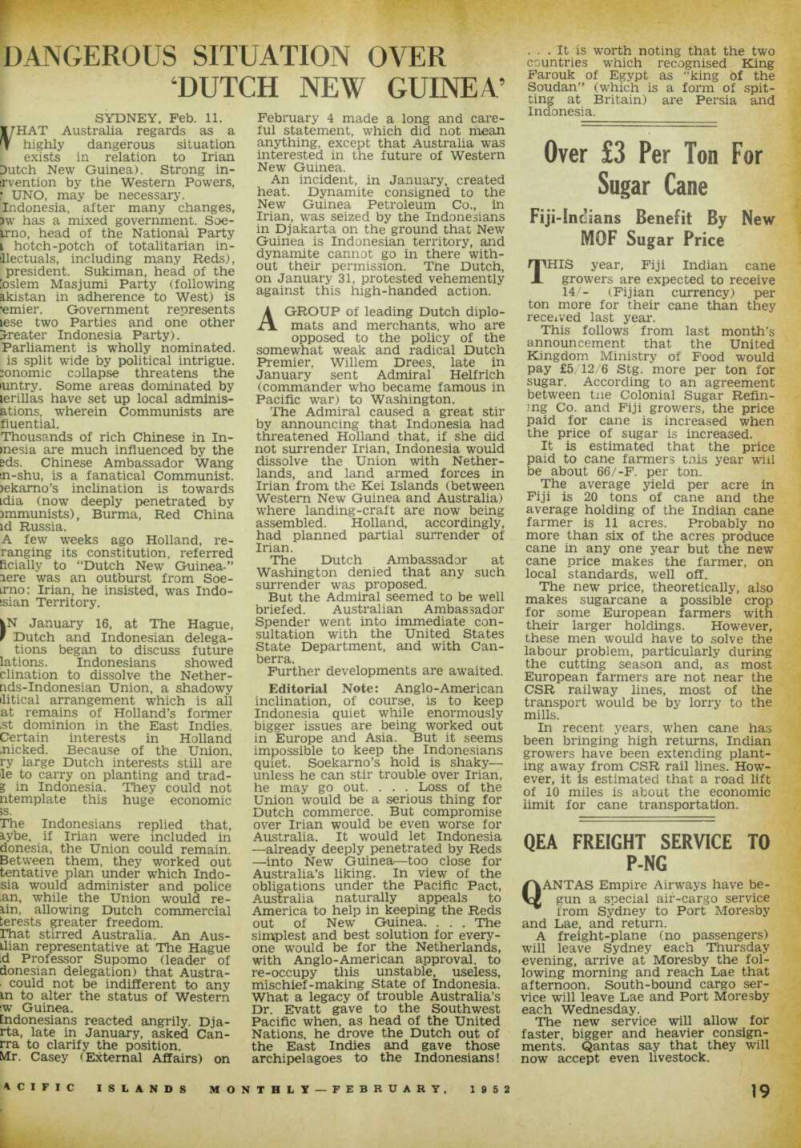
Dangerous Situation Over
Sydney. Feb. 11.
ITHAT Australia regards as a T highly dangerous situation exists in relation to Irian Dutch New Guinea). Strong in irvention by the Western Powers, r UNO, may be necessary.
Indonesia, after many changes, )w has a mixed government. Soe irno, head of the National Party i hotch-potch of totalitarian in ilectuals, including many Reds), president. Sukiman, head of the [oslem Masjumi Party (following akistan in adherence to West) is •emier. Government represents lese two Parties and one other Greater Indonesia Party).
Parliament is wholly nominated, is split wide by political intrigue. :onomic collapse threatens the •untry. Some areas dominated by lerillas have set up local admlnis ations, wherein Communists are fiuential.
Thousands of rich Chinese in In mesia are much influenced by the eds. Chinese Ambassador Wang >n-shu, is a fanatical Communist. )ekamo's inclination is towards idia (now deeply penetrated by mimunists), Burma, Red China id Russia.
A few weeks ago Holland, re ranging its constitution, referred ficially to “Dutch New Guinea-” lere was an outburst from Soe irno: Irian, he insisted, was Indo ssian Territory, |N January 16, at The Hague, f Dutch and Indonesian delega tions began to discuss future lations. Indonesians showed clination to dissolve the Nether nds-Indonesian Union, a shadowy ilitical arrangement which is all at remains of Holland’s former .st dominion in the East Indies.
Certain interests in Holland .nicked. Because of the Union, ry large Dutch interests still are le to carry on planting and trad ? in Indonesia. They could not ntemplate this huge economic SS.
The Indonesians replied that, a,ybe, if Irian were included in donesia, the Union could remain.
Between them, they worked out tentative plan under which Indo sia would administer and police an, while the Union would re lin, allowing Dutch commercial terests greater freedom.
That stirred Australia. An Aus ilian representative at The Hague .d Professor Supomo (leader of donesian delegation) that Austra could not be indifferent to any in to alter the status of Western iw Guinea. [ndonesians reacted angrily. Dja rta, late in January, asked Can rra to clarify the position.
Mr. Casey (External Affairs) on
February 4 made a long and care ful statement, which did not mean anything, except that Australia was interested in the future of Western New Guinea.
An incident, in January, created heat. Dynamite consigned to the New Guinea Petroleum Co., in Irian, was seized by the Indonesians in Djakarta on the ground that New Guinea is Indonesian territory, and dynamite cannot go in there with out their permission. The Dutch, on January 31, protested vehemently against this high-handed action.
A GROUP of leading Dutch diplo mats and merchants, who are opposed to the policy of the somewhat weak and radical Dutch Premier, Willem Drees, late in January sent Admiral Helfrich (commander who became famous in Pacific war) to Washington.
The Admiral caused a great stir by announcing that Indonesia had threatened Holland that, if she did not surrender Irian, Indonesia would dissolve the Union with Nether lands, and land armed forces in Irian from the Kei Islands (between Western New Guinea and Australia) where landing-craft are now being assembled. Holland, accordingly, had planned partial surrender of Irian.
The Dutch Ambassador at Washington denied that any such surrender was proposed.
But the Admiral seemed to be well briefed. Australian Ambassador Spender went into immediate con sultation with the United States State Department, and with Can berra.
Further developments are awaited.
Editorial Note: Anglo-American inclination, of course, is to keep Indonesia quiet while enormously bigger issues are being worked out in Europe and Asia. But it seems impossible to keep the Indonesians quiet. Soekarno’s hold is shaky— unless he can stir trouble over Irian, he may go out. . . . Loss of the Union would be a serious thing for Dutch commerce. But compromise over Irian would be even worse for Australia, It would let Indonesia —already deeply penetrated by Reds —into New Guinea —too close for Australia’s liking. In view of the obligations under the Pacific Pact, Australia naturally appeals to America to help in keeping the Reds out of New Guinea. . . . The simplest and best solution for every one would be for the Netherlands, with Anglo-American approval, to re-occupy this unstable, useless, mischief-making State of Indonesia.
What a legacy of trouble Australia’s Dr. Evatt gave to the Southwest Pacific when, as head of the United Nations, he drove the Dutch out of the East Indies and gave those archipelagoes to the Indonesians!
. . . It is worth noting that the two countries which recognised King Farouk of Egypt as “king of the Soudan” (which is a form of spit ting at Britain) are Persia and Indonesia.