Copra
p. 19 · Read in the full issue
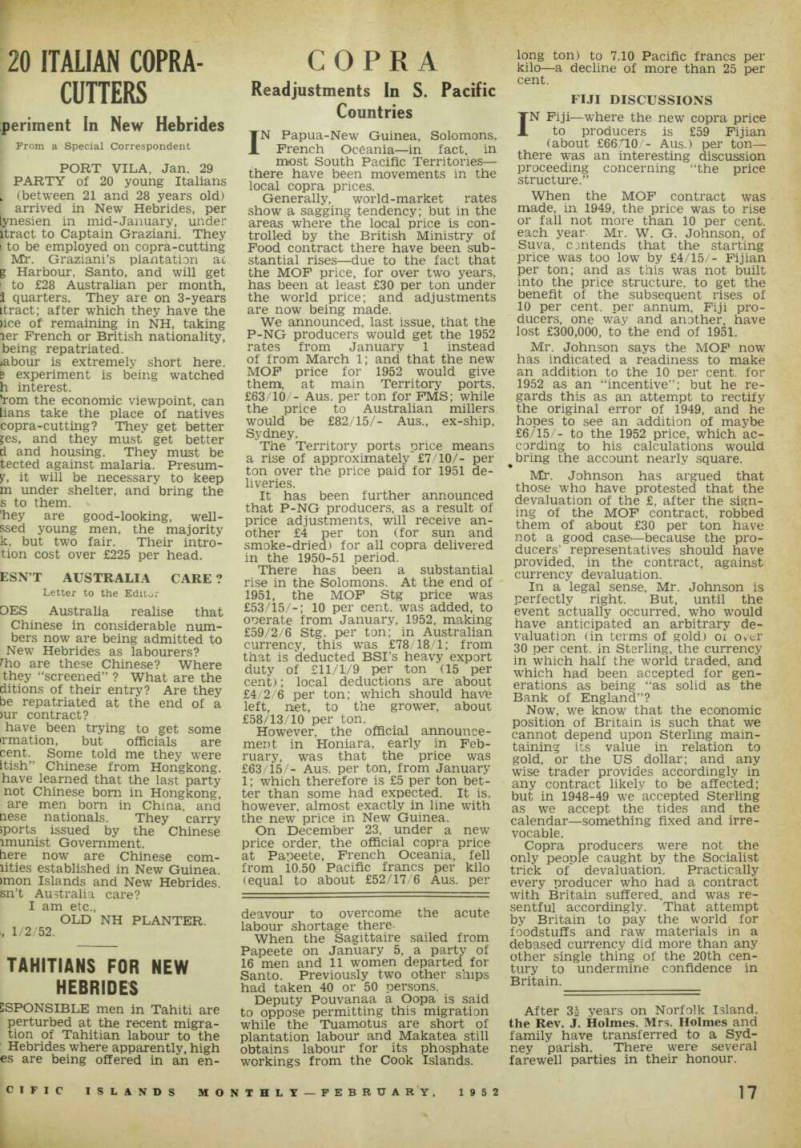
Readjustments In S. Pacific Countries
IN Papua-New Guinea, Solomons, French Oceania —in fact, in most South Pacific Territories — there have been movements in the local copra prices.
Generally, world-market rates show a sagging tendency; but in the areas where the local price is con trolled by the British Ministry of Food contract there have been sub stantial rises—due to the fact that the MOF price, for over two years, has been at least £3O per ton under the world price; and adjustments are now being made.
We announced, last issue, that the P-NG producers would get the 1952 rates from January 1 instead of from March 1; and that the new MOF price for 1952 would give them, at main Territory ports, £63/10/- Aus. per ton for FMS; while the price to Australian millers would be £B2/15/- Aus., ex-ship, Sydney.
The Territory ports price means a rise of approximately £7/10/- per ton over the price paid for 1951 de liveries.
It has been further announced that P-NG producers, as a result of price adjustments, will receive an other £4 per ton (for sun and smoke-dried) for all copra delivered in the 1950-51 period.
There has been a substantial rise in the Solomons. At the end of 1951, the MOF Stg price was £53/15/-; 10 per cent, was added, to operate from January, 1952, making £59/2/6 Stg. per ton; in Australian currency, this was £7B/18/1; from that is deducted BSl’s heavy export duty of £ll/1/9 per ton (15 per cent); local deductions are about £4/2/6 per ton; which should have left, net, to the grower, about £5B/13/10 per ton.
However, the official announce ment in Honiara, early in Feb ruary, was that the price was £63/15/- Aus. per ton, from January 1; which therefore is £5 per ton bet ter than some had expected. It is, however, almost exactly in line with the new price in New Guinea.
On December 23, under a new price order, the official copra price at Papeete, French Oceania, fell from 10.50 Pacific francs per kilo (equal to about £52/17/6 Aus. per
long ton) to 7.10 Pacific francs per kilo —a decline of more than 25 per cent.
Fiji Discussions
IN Fiji—where the new copra price to producers is £59 Fijian (about £66AO/- Aus.) per ton— there was an interesting discussion proceeding concerning “the price structure.”
When the MOF contract was made, in 1949, the price was to rise or fall not more than 10 per cent, each year- Mr. W. G. Johnson, of Suva, contends that the starting price was too low by £4/15/- Fijian per ton; and as this was not built into the price structure, to get the benefit of the subsequent rises of 10 per cent, per annum, Fiji pro ducers, one way and another, have lost £300,000, to the end of 1951.
Mr. Johnson says the MOF now has indicated a readiness to make an addition to the 10 per cent, for 1952 as an “incentive”; but he re gards this as an attempt to rectify the original error of 1949, and he hopes to see an addition of maybe £6/15/- to the 1952 price, which ac cording to his calculations would bring the account nearly square.
Mr. Johnson has argued that those who have protested that the devaluation of the £, after the sign ing of the MOF contract, robbed them of about £3O per ton have not a good case—because the pro ducers’ representatives should have provided, in the contract, against currency devaluation.
In a legal sense, Mr. Johnson is perfectly right. But, until the event actually occurred, who would have anticipated an arbitrary de valuation (in terms of gold) oi over 30 per cent, in Sterling, the currency in which half the world traded, and which had been accepted for gen erations as being “as solid as the Bank of England”?
Now, we know that the economic position of Britain is such that we cannot depend upon Sterling main taining its value in relation to gold, or the US dollar; and any wise trader provides accordingly in any contract likely to be affected; but in 1948-49 we accepted Sterling as we accept the tides and the calendar—something fixed and irre vocable.
Copra producers were not the only people caught by the Socialist trick of devaluation. Practically every producer who had a contract with Britain suffered, and was re sentful accordingly. That attempt by Britain to pay the world for foodstuffs and raw materials in a debased currency did more than any other single thing of the 20th cen tury to undermine confidence in Britain.
After 3h years on Norfolk Island, the Rev. J. Holmes. Mrs. Holmes and family have transferred to a Syd ney parish. There were several farewell parties in their honour.