The Story Of “Tavua”
pp. 64-65 · Read in the full issue
Johnson, Of Fiji
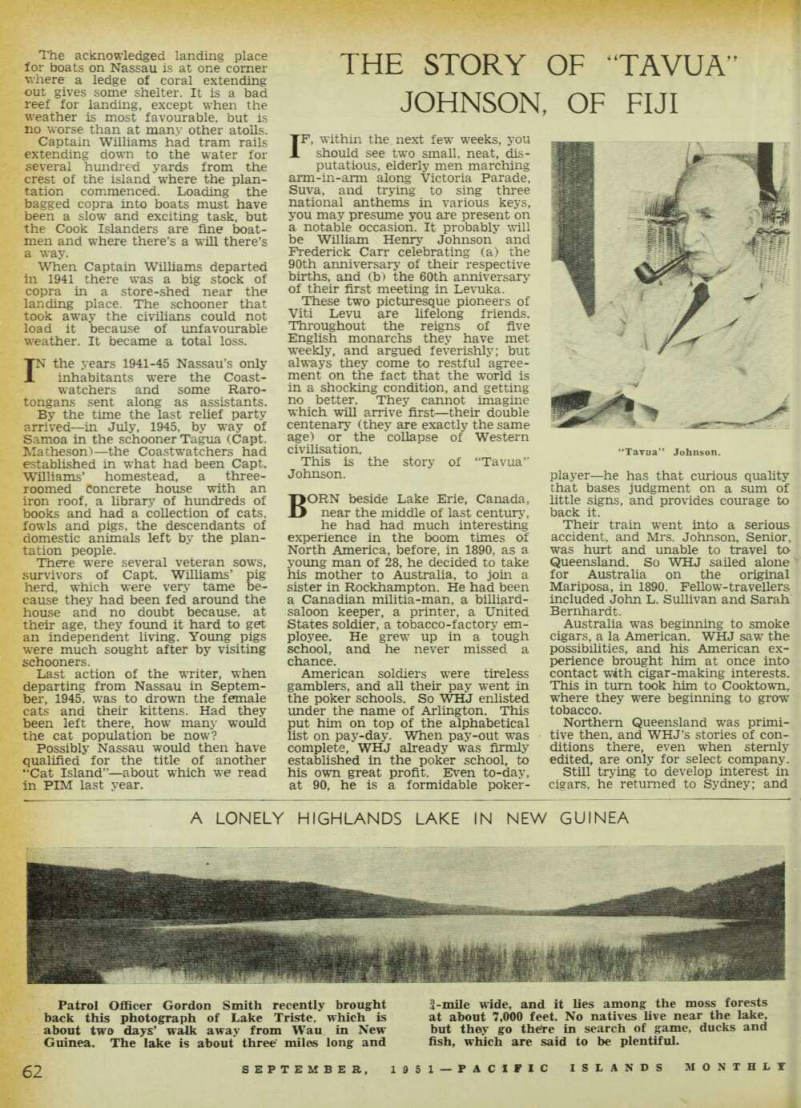
IF, within the, next few weeks, you should see two small, neat, dis putatious, elderly men marching arm-in-arm along Victoria Parade, Suva, and trying to sing three national anthems in various keys, you may presume you are present on a notable occasion. It probably will be William Henry Johnson and Frederick Carr celebrating (a) the 90th anniversary of their respective births, and (b) the 60th anniversary of their first meeting in Levuka.
These two picturesque pioneers of Viti Levu are lifelong friends.
Throughout the reigns of five English monarchs they have met weekly, and argued feverishly; but always they come to restful agree ment on the fact that the world is in a shocking condition, and getting no better. They cannot imagine which will arrive first—their double centenary (they are exactly the same age) or the collapse of Western civilisation.
This is the story of “Tavua’’
Johnson.
BORN beside Lake Erie, Canada, near the middle of last century, he had had much interesting experience in the boom times of North America, before, in 1890, as a young man of 28, he decided to take his mother to Australia, to join a sister in Rockhampton. He had been a Canadian militia-man, a billiard saloon keeper, a printer, a United States soldier, a tobacco-factory em ployee. He grew up in a tough school, and he never missed a chance.
American soldiers were tireless gamblers, and all their pay went in the poker schools. So WHJ enlisted under the name of Arlington. This put him on top of the alphabetical list on pay-day. When pay-out was complete, WHJ already was firmly established in the poker school, to his own great profit. Even to-day, at 90, he is a formidable poker-
player—he has that curious quality that bases judgment on a sum of little signs, and provides courage to back it.
Their train went into a serious accident, and Mrs. Johnson, Senior, was hurt and unable to travel to Queensland. So WHJ sailed alone for Australia on the original Mariposa, in 1890. Fellow-travellers included John L. Sullivan and Sarah Bernhardt.
Australia was beginning to smoke cigars, a la American. WHJ saw the possibilities, and his American ex perience brought him at once into contact with cigar-making interests.
This in turn took him to Cooktown, where they were beginning to grow tobacco.
Northern Queensland was primi tive then, and WHJ’s stories of con ditions there, even when sternly edited, are only for select company.
Still trying to develop interest in cigars, he returned to Sydney; and
“Tavua" Johnson.
in one phase of the enterprise he sat in a shop-window in Oxford Street and arrested the street crowds with his skill in rolling cigars by hand.
STILL restlessly following his hunch, WHJ went off to Fiji, in the belief that suitable tobacco could be grown there. He landed in Levuka in 1892, on almost the same day as Frederick Carr, also 30 years old and foot-loose, had arrived in search of fortune. When they found that they always held approximately equal cards and equal liquor, and neither could get an advantage over the other, they established a friendly truce, which has endured for 60 years.
Fiji grew fine tobacco—and even finer pests. The climate was against the planter, however, and the weevils shatttered the cigars and WHJ gave the enterprise away.
In Australia, WHJ had fallen in love with Blanche Wadeson, a ■charming girl who was induced to follow him to Fiji and marry him there. It was a modest but very happy wedding. WHJ refused to be disturbed by the knowledge that he had exactly £l3 in the world.
But life had now become a more serious matter. He held one or two jobs; and then they went out to Tailevu, and tried dairying, at Matavatutou, near where the Queen Victoria School now stands.
One day, a young whale stranded, on the nearby coast. WHJ attacked it with a duck gun, and got in a solid shot under the flipper, and the whale died. Delighted Fijians from Qoma carried off the makings of a feast. WHJ got some small teeth and with two of these, and some local pearls, there was made for him a beautiful brooch.
That was the beginning of pearl collecting, which became a life-long hobby. His collection of pearls now is notable, and perhaps unique.
BEFORE the old century was dead, he moved around to the Tavua district and prospered mightily.
It was then he became known as “Tavua” Johnson —and “Tavua” he remains to this day. He had a large area of land, and sugar-growing was developing, and Indians were settling in.
WHJ opened a large trading store, and maintained boat communi cations with Levuka—no roads over land in those days—and handled all the trade that was offering. By 1907 he had made a small fortune, so he sold part of his land to the CSR Co., his storekeeping business to Picker Brothers, young German traders, and went off to Canada for a long holiday with his wife and son.
When he returned to Fiji, “Tavua” settled in the new town of Suva and engaged in the develop ment of residential properties.
Victoria Parade then was a one sided street, running alongside the lagoon.
“Tavua” argued that Suva pre sently would need shop and office space, and he proceeded to build on the west side, on land reclaimed from the sea. His plans were criticised and condemned, especi ally when Central Building was erected under his direction. He has lived to see his judgment and enter prise justified and rewarded.
By the time World War I came, he had reached middle age and was taking life more quietly. As a property-owner, investor, bowler and a keen leader of discussions on all kinds of public affairs, he has been a well-known figure in Suva for 40 years, and present indications are that he will be there for a long time yet. His biggest misfortune came in 1938, when his Australian wife died. Their only son was named William Grainger Johnson— better kown as “Tui” Johnson, and fast becoming a Suva tycoon.
There seems to be something in the air of Fiji which tends to extend the life of the average European male by from one to two decades.
Is it kava, or freedom from worry?