They
pp. 63-64 · Read in the full issue
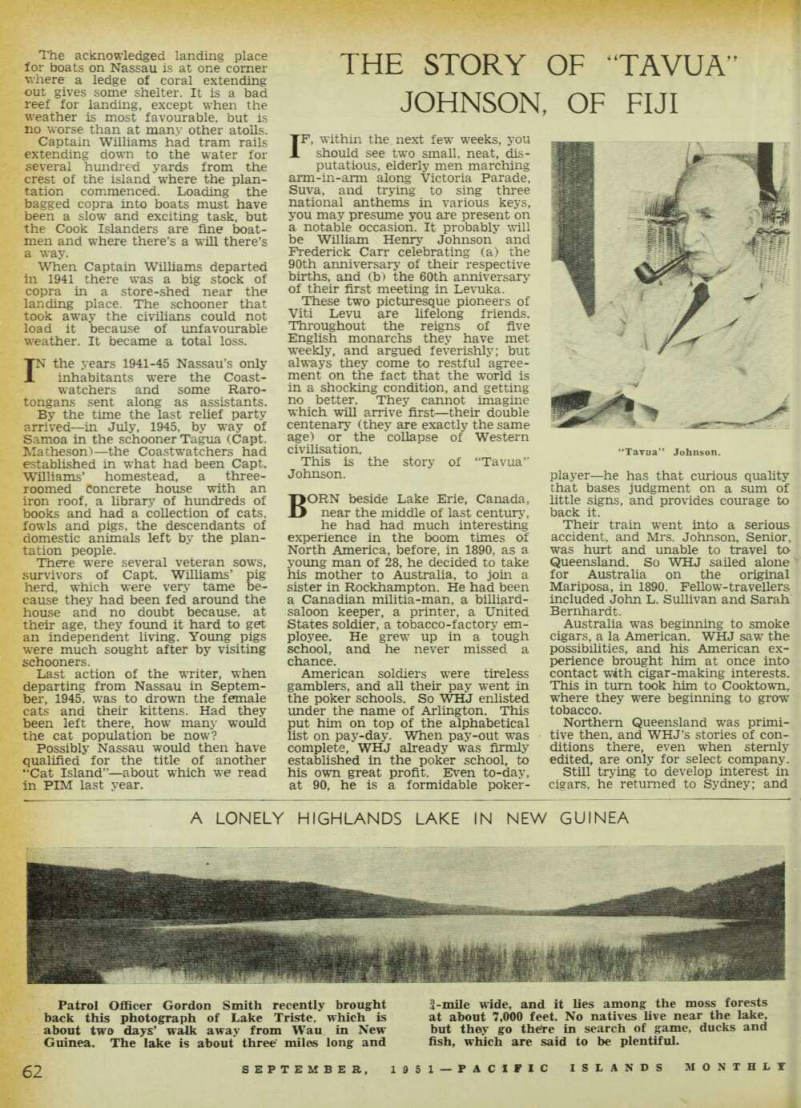
Magazine Section
And Still They Migrate!
The Story Of Nassau
Told by AJS
POLYNESIANS are still migrating, Recently the 600 Islanders of Pukapuka, Northern Cooks, purchased Nassau Island from the New Zealand Government and have moved 100 of their surplus population to their new possession. What the Pukapi£ans were acquiring was not so much an island—which is an
EfT*
fhj nrtS fi
bp nfrpnnf npiH 900 nfT Tiw t wUi debt of £2,000 and the rest will come from the copra Nassau will produce-about 150 tons a year.
A reader has given us the following story of little-known Nassau and its war-time role. rN years after lovely Nassau Island, 300-acre coral isle in the Northern Cook Group, was abandoned as a coconut plantation it is bemg re-occupied.
Its new inhabitants are 100 people from over-populated Pukapuka Atoll, (600 people to 1,000 acres of sand) which is 50 miles away over th e b 9. ri zp n - .. . „ , „ , Until the attack on Pearl Harbour m December, 1941, life went on quietly at Nassau. The plantation (which covered almost all of the
3 Wilfinm?
wifi and a g uSS family Folynesian Wlfe and a lar^e Nntivpc fmm Pnk-Qrmb-o and the finished SiVE’
ned to Ani? 7nS iSS,"
In t 1941 P t,he 70 Denartment sen?^n^?wntib*»? a + y
Sai nnd
»N R oX h r a Ks d S r Tob
was to keep Navy headquarters in Suva posted with weather information, which they did right up to V-J Day.
They might not seem to have contributed much to the war effort.
However, if the Allies had been forced back to their last sea-air route across the Pacific—through ?? hlt A Al J uta , ki . and Tonga—then the !t Coastwatchers may have been the xis h P e ’ as Wo re the 17 othe s N 5 Coastwatchers who were by the Ja Ps at Tarawa m 1942. with the advent of Coastwatchers and Allied prospects in the Southwest Pacific looking- really g-rim at the end of 1941 the civilians on tiny Nassau were evacuated
CaptainWmten*andh£familv
wenTto to anTwhen the write?
was to Witt family were happily established the captain being a busy man at the local establishment of Burns Philp (SS) Ltd a NZ teacher paid a tribute to Captain Williams for the wav he had attended to the education of his children—they were, it was said, lust as advanced for their age as other children attending the schools in Apia. They had lost nothing; through starting their education at their family sch ° ol on Nassau. (In 1951 °? + e °I children was attending University in New Zealand.) v, ° n ? A the P atheti c reminders of ? appier days on Nassau, when I was ere m 1945 ’ was the sch ° ol desk which the Williams children had l ea / ned T their lessons in the years before Jap-forced evacuation be- Islands 1 plantations' 1 many PaC “ C
VTASSAU was an efficiently-run ll plantation in the 1930’5. There was good coral roads through the 300 acres of coconuts. And Captain Williams had a Model T Ford, the remains of which were visible in 1945.
Captain Andy Thomson, then of the trading schooner Tiare Taporo, who had paid occasional visits was much impressed with the way the island was all ship-shape—as one might expect it would be with a man in charge who had served in nrid mndP bic bnmp tbprp Mth intentionof staying a long while Y , When the Pacific War ended there was some talk of movin S some of Pukapuka’s people to Nassau without more ado, but six yGarS ? aSS l d this very Y lO 18 ste P became an accomplished In the mean while the nuts must have been fallin g and taking root and the Plants must have made an impenetrable thicket amon S the ™ws of palms.
Nassau is roughly shaped like a square with the corners rounded °ff- evidently is a sandbank on the top of a submerged mountain over which the coral has formed.
The story is that it was named after a schooner called the Nassau, and was then merely a sandbank with no palms. The discoverer planted coconuts, as was done on several other Pacific Islands which had no native inhabitants. Another version is that it was named by an American whaler and that the Rev.
William Gill, a LMS missionary, the first 30 COCOnUts “
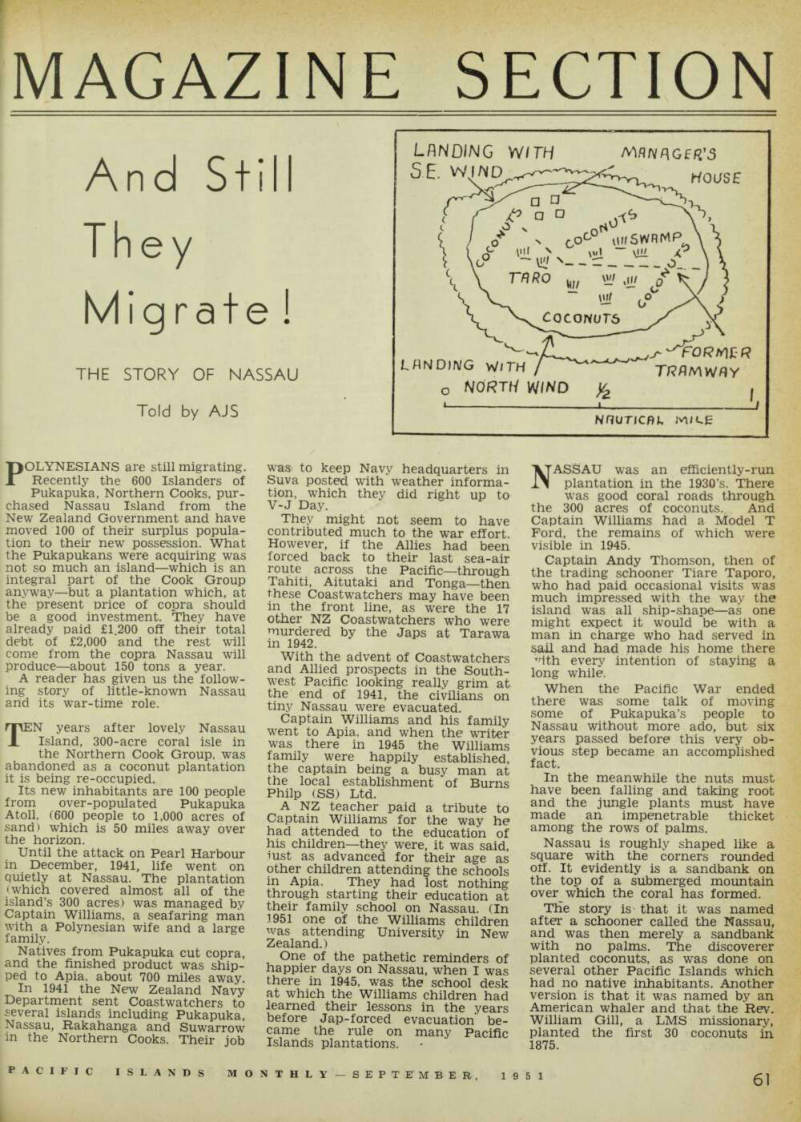
The acknowledged landing place for boats on Nassau is at one comer where a ledge of coral extending out gives some shelter. It is a bad reef for landing, except when the weather is most favourable, but is no worse than at many other atolls.
Captain Williams had tram rails extending down to the water for several hundred yards from the crest of the island where the plan tation commenced. Loading the bagged copra into boats must have been a slow and exciting task, but the Cook Islanders are fine boat men and where there’s a will there’s a way.
When Captain Williams departed in 1941 there was a big stock of copra in a store-shed near the landing place. The schooner that took away the civilians could not load it because of unfavourable weather. It became a total loss.
IN the years 1941-45 Nassau’s only inhabitants were the Coast watchers and some Raro tongans sent along as assistants.
By the time the last relief party arrived —in July, 1945, by way of Samoa in the schooner Tagua (Capt.
Matheson) —the Coastwatchers had established in what had been Capt.
Williams’ homestead, a three roomed Concrete house with an iron roof, a library of hundreds of books and had a collection of cats, fowls and pigs, the descendants of domestic animals left by the plan tation people.
There were several veteran sows, survivors of Capt. Williams’ pig herd, which were very tame be cause they had been fed around the house and no doubt because, at their age, they found it hard to get an independent living. Young pigs were much sought after by visiting schooners.
Last action of the writer, when departing from Nassau in Septem ber, 1945. was to drown the female cats and their kittens. Had they been left there, how many would the cat population be now?
Possibly Nassau would then have qualified for the title of another “Cat Island” —about which we read in PIM last year.