The Bank of Tonga
pp. 65-66 · Read in the full issue
How German Currency Tricksters Beat The Bank of Tonga
How many people know that there was once a Bank of Tonga?
How many, today, remember the trickery and lack of scruple with which the Germans met their com petitors in trade in the Pacific Islands prior to World War I?
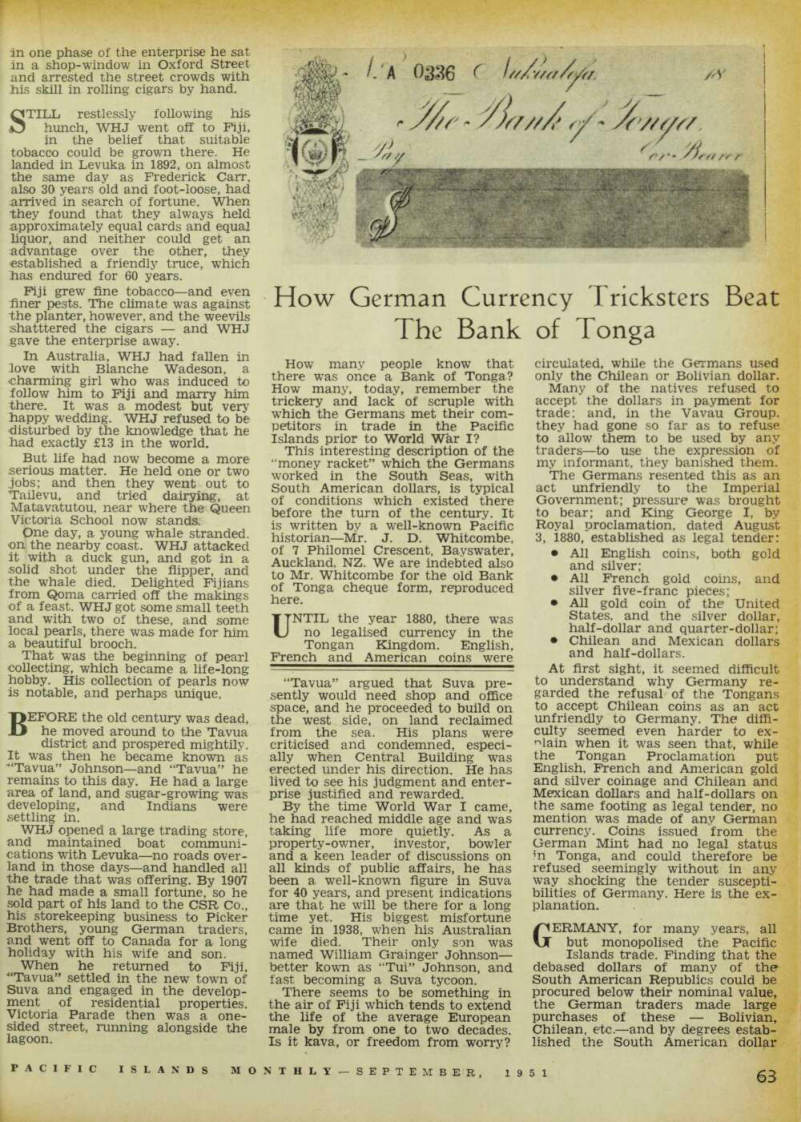
This interesting description of the “money racket” which the Germans worked in the South Seas, with South American dollars, is typical of conditions which existed there before the turn of the century. It is written by a well-known Pacific historian—Mr. J. D. Whitcombe, of 7 Philomel Crescent, Bayswater, Auckland, NZ. We are indebted also to Mr. Whitcombe for the old Bank of Tonga cheque form, reproduced here.
UNTIL the year 1880, there was no legalised currency in the Tongan Kingdom. English, French and American coins were
circulated, while the Germans used only the Chilean or Bolivian dollar.
Many of the natives refused to accept the dollars in payment for trade; and, in the Vavau Group, they had gone so far as to refuse to allow them to be used by any traders —to use the expression of my informant, they banished them.
The Germans resented this as an act unfriendly to the Imperial Government; pressure was brought to bear; and King George I, by Royal proclamation, dated August 3, 1880, established as legal tender: • All English coins, both gold and silver; • All French gold coins, and silver five-franc pieces; • All gold coin of the United States, and the silver dollar, half-dollar and quarter-dollar; • Chilean and Mexican dollars and half-dollars.
At first sight, it seemed difficult to understand why Germany re garded the refusal of the Tongans to accept Chilean coins as an act unfriendly to Germany. The diffi culty seemed even harder to ex plain when it was seen that, while the Tongan Proclamation put English, French and American gold and silver coinage and Chilean and Mexican dollars and half-dollars on the same footing as legal tender, no mention was made of any German currency. Coins issued from the German Mint had no legal status m Tonga, and could therefore be refused seemingly without in any way shocking the tender suscepti bilities of Germany, Here is the ex planation.
GERMANY, for many years, all but monopolised the Pacific Islands trade. Finding that the debased dollars of many of the South American Republics could be procured below their nominal value, the German traders made large purchases of these Bolivian, Chilean, etc. —and by degrees estab lished the South American dollar
currencies as their monetary trading medium In the South Seas.
By a well-known law of currency, a debased or inferior coinage will soon drive out the coins of superior fineness.
The Chilean dollar, though nominally worth 4/-, and made by the Germans to bear that value in trade throughout the Islands, was actually worth in international exchange only some 3/l£. The result was that any English money that was introduced was at once bought up by the Germans with the debased Chilean money (which they continued to import largely) and shipped away by them to pay their overseas obligations.
The principal German firm (the GH and PD) would only take its own Chilean introduced currency in retail dealings, across the counter, at a heavy discount. Any English or other firm, wishing to remit money to Europe or the Colonies, was (in the absence of a bank or any like institution) pretty well at the mercy of the German firm, and had to arrange with it for bills
(which, however, the Germans often refused to give) at from 5 to 15 and sometimes as high as 20 per cent, discount, and drawn at 90 days after sight, Bills could very seldom be ob tained as low as 5 per cent., and only when the German firm was pressed for ready cash, of whatever currency.
A bank, and a bank only, could remedy this anomalous state of affairs. The Rev. Shirley Baker, the then Premier of Tonga, started a Bank of Tonga under Govern ment auspices, and it was very successful. It was, however, found necessary to close it, for reasons not stated—probably German pressure —and it was never resuscitated.
All traders, except the Deutschen Handels and Plantagen-Gesellschaft dei Sudsee, were most anxious to see a stable and well-managed bank established at Tongatabu, with branches or agents at Haapai or Vavau; but the Germans killed the plan.
So ended a money headache in Holy Tonga in the year 1880.
But he didn’t get far. The mound of earth gave way, and with a yell Sol disappeared from view. Then — most unexpected sound—came a huge splash and some gurgled com ments from below that wrecked be yond repair any remaining mood of reverence in the spectators.
“Dash those goddashed dash tards! Waitel-I-gitm! I’ll kick their dashed dashes round their necks for collars, dashed if I don’t!
Hey! Hey! Git me out of here, dash it, before I git dashed well drowned.”
At least, that’s as near as dash it to the sounds that came from the depths of the grave.
After much struggling and grunt ing, and lurid encouragement that became more clear and less print able as the surface was approached, a fire-breathing ball of mud was de posited at the grave-top before the two open-mouthed savages who had dug the grave.
“A-a-a-ah!” roared Old Sol.
“U-u-u-uh!”
“Yessir!” said the gravediggers.
“What the hell d’you mean by it!” the mudball bellowed. “I told you to dig a grave, not a bloody gold mine. And it’s half full of water into the bargain!”
The boys said nothing.
Sol repeated his demand in Pid gin.
“Well, Master,” one of them re plied in Pidgin, “we kept digging till we struck water and couldn’t go any further ”
“But, dammit, why didn’t you stop before you got to the water?
Why didn’t you stop when you were about six feet down?”
“But, Master, you didn’t tell us to!”
Old Sol snorted like a charger.
The two boys began hurriedly shovelling some of the loose earth back into the grave, and soon all was in readiness to proceed with the service. Then Sol discovered that he’d lost the book down the grave. He let out a mighty roar and began stamping round like a demented Redskin. The boys fled.
Suddenly his eye fell on the pathetic little box on the other side of the grave. He stopped yelling, and his hands fell to his sides.
“Sorry Jimmy old man.” he mut tered.
But, without the book, Sol couldn’t go on. Nobody present had ever conducted a burial. Few had even read the burial service. There were no volunteers when Sol asked if anybody could remember even some of the words from the book.
So, instead, he gave a summary of Jimmy’s life in the Territory and the record of his popularity with its residents. The remains were laid finally to rest with those rough old voices singing most solemnly the strains of “For he’s a Jolly Good Fellow.”
And as the shovels slowly filled up the grave, New Guinea’s wheel of History, turning ever so slowly, silently disengaged another cog.