Tropicalities
pp. 68-73 · Read in the full issue
ALTHOUGH most Sydneysiders
who went along, in early July, to David Jones’ Galleries., to the exhibition of art from Sogen Government School in Papua, were interested or even impressed, it caused a couple of the fan" city s Art Critics real pain.
Striking their usual verbal atti tudes in columns of fine print, they bemoaned the passing of the noble savage and missed the point of the exhibition altogether.
Granny Herald’s pet critic wrings his hands thus: “This is not only a psychologi cal revolution, which strikes at the very depth of tradition, which tries to civilise abruptly that which has lived in the distant past, but it is a corrupting in fluence which effeminates so that a race may finally lose all charac ter, all identity for the sake of “absorption.”
“If a race has to die through the march of progress, let it die gracefully, or brutally, taut do not pervert it. Do not taring a tired and decadent art to a people far superior in their own expression.’
There is a great deal more in the same vein and even less lucid.
In conclusion, he says; “It appears that this is the result of only 18 months’ tuition, another few years and all but the most hidden regions are lost to us.”
Sad, isn’t it? But have you ever thought what a world composed entirely of art critics—or even artists —would be like? —MAC.
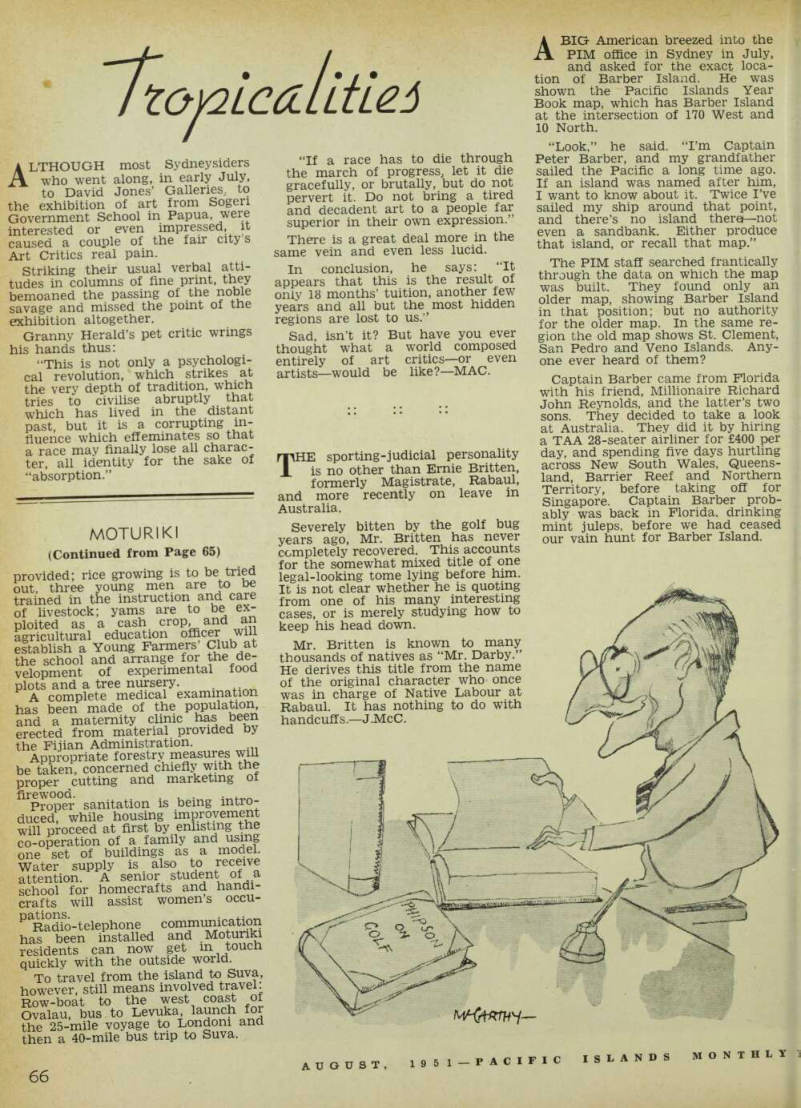
THE sporting-judicial personality
is no other than Ernie Britten, formerly Magistrate, Rabaul, and more recently on leave in Australia.
Severely bitten by the golf bug years ago, Mr. Britten has never completely recovered. This accounts for the somewhat mixed title of one legal-looking tome lying before him.
It is not clear whether he is quoting from one of his many interesting cases, or is merely studying how to keep his head down.
Mr. Britten is known to many thousands of natives as “Mr. Darby.”
He derives this title from the name of the original character who once was in charge of Native Labour at Rabaul. It has nothing to do with handcuffs. —J.McC.
A BIG American breezed into the PIM office in Sydney in July, and asked for the exact loca tion of Barber Island. He was shown the Pacific Islands Year Book map, which has Barber Island at the intersection of 170 West and 10 North.
“Look,” he said. “I’m Captain Peter Barber, and my grandfather sailed the Pacific a long time ago.
If an island was named after him, I want to know about it. Twice I’ve sailed my ship around that point, and there’s no island therei —not even a sandbank. Either produce that island, or recall that map.”
The PIM staff searched frantically through the data on which the map was built. They found only an older map, showing Barber Island in that position; but no authority for the older map. In the same re gion the old map shows St. Clement, San Pedro and Veno Islands. Any one ever heard of them?
Captain Barber came from Florida with his friend, Millionaire Richard John Reynolds, and the latter’s two sons. They decided to take a look at Australia. They did it by hiring a TAA 28-seater airliner for £4OO per day, and spending five days hurtling across New South Wales, Queens land, Barrier Reef and Northern Territory, before taking off for Singapore. Captain Barber prob ably was back in Florida, drinking mint juleps, before we had ceased our vain hunt for Barber Island.
Arlette Purea Reasin, De
scribed as “the wife of a Tahiti planter,” got herself promin ently into United States newspapers in July, when she claimed £60,000 from RKO Studios, in Hollywood.
When Thor Heyerdahl, the Nor wegian scientist who drifted on his raft Kon Tiki from South America into French Oceania, was in Tahiti on his way home, he took some movie pictures in Papeete. There was a “welcome party,” for the visi tors, and Mrs. Reasin and another attractive Tahitienne presented a native dance, which Heyerdahl filmed.
Later, Heyerdahl wrote a book, and RKO made a film of the great adventure; and the Norwegian’s pic tures of the dance in Tahiti were incorporated in the big picture, and shown all over the world.
Mrs. Reasin went to USA and complained that the picture of her in the native dance—which she never had authorised—damaged her social position.
The court, after lengthy argu ment, decided that Mrs. Reasin’s social position was still intact, and dismissed the claim.
Seraglio (Sultans, For The
USE OF) DEPT.: If you really want to see yourself quoted in Australian newspapers, don’t give reporters dreary stuff like copra statistics; whip out something on the exotic side, with a hint of naughty, naughty doings and you can be cer tain of a place on the front page.
A young man from Samarai, Papua (who, like another reader re cently, will probably claim that he was just chatting idly with a re porter) got all the Brisbane and Sydney editors breathing hard in late July, when he told them about King Cameron’s island paradise on Kitava (Trobriand Groun) where the planter “lives the life of a Baghdad sultan—complete with six young maidens who attend his every wish.”
This story of tropical lushness ends with the advice that “Any single young white man is welcome on Kitava Island.”
For heaven’s sake, since when have the Trobrianders been so fussy? Why draw the line just be cause a man happens to be married?—J.T.
TIMI wanted to give his pal, Tanga, who was a very devout churchgoer, a birthday present —said Tanga being one of the few Islanders who know the day and year of their birth.
After some trouble Timi secured a copy of the local translation of the celebrated Rarotongan Bible of 1895, which is still the current edi tion here.
But the problem of an inscription on the flyleaf was the trouble. His English was limited and a simple Maori inscription seemed inade quate. Finally he turned to a Euro
pean friend for assistance. Timi should have known better—the trader was by way of being a “bit of a wag.”
When the birthday came, the Bible was duly handed over and Tanga was exceedingly pleased— his old Bible had just about had it.
And when he saw the inscription
on the flyleaf he was even more pleased, although he knew not the meaning of it.
All Cl-ers write a good, round hand and on the fly-leaf Timi had inscribed: “To Tanga, with the compliments of the author.”—EG
(Continued on Page 70)
NOT long ago, when I was South (writes a New Guinea planter) I was asked whether I ever had seen any substantial evidence of Communist activities in New Guinea. I said I had not.
A few days since, I was in Wong You’s trade store in Kieta, Bou gainville. There, on a counter, was a large package of big folded pamphlets. I picked up one and examined it. It was red-hot Commo
stuff —Communist propaganda, if I ever saw it.
Naturally, I was interested. I wanted to know where it had come from, and what they were doing with it.
The store manager is Wong You’s brother, and he was away in Aus tralia on a health trip, and the store was in charge of a native. The native said that they bought scrap paper from South whenever they could get it, and the purpose of that package was to “round ’im something” (wrap up purchases).
The pamphlets were suitable for that.
One pamphlet was called “The Great £ Robbery,” and purported to show how the masses were ex ploited by the capitalists. The other was an attack on MacArthur, described as a bloodthirsty tool of the ruthless capitalists. One native in a thousand might be able to read the things; and not one in ten thousand could understand, even if he could read. So I suppose the wrapping-paper explanation is cor rect.
OUR Skippers may have a tough time in these waters wrestling with reef, wind and tide . . . but what of the old days?
The following extract from the New Yorker of September 30th, 1944, interested me; — “Chancellor James Kent, a nine teenth century American authority
on admiralty law, drew up what came to be regarded as the standard legal portrait of the Master of a vessel: ‘He should have,’ says the Chancellor, ‘the talent to command in the midst of danger, and courage, and the presence of mind to meet and surmount extraordinary perils.
He should be able to dissipate fear, and calm disturbed minds, and in spire confidence in the breasts of all who are under his charge, in tempest as well as in battle. The Commander of a ship must give desperate commands; he must re quire instantaneous obedience. He must watch for the health and com fort of the crew as well as for the safety of the ship and cargo. It is necessary that he should maintain perfect order, and preserve the most exact discipline under the guidance of justice, moderation, and good sense.’
“When a mate on the Joseph Crabtree, who had run across the Chancellor’s comments while thumb ing through a volume of sea-law, quoted the passage to Captain J . not long ago, the Master’s reaction was not one of pure pleasure.
“‘That hammer-headed old bas tard/ he remarked, ‘sure expects a lot from a merchant stiff!’.”
Feel that this might tie in with Captain Goya Henry’s comments on NG boat-crews, as published in July
Pim.—Rr.
ACCORDING to calculations made in Tokio, 670,000 Japanese ser vicemen are buried somewhere in the South Pacific islands—4oo,ooo soldiers and 260,000 sailors.
The Japanese Government pro poses, after the Peace Treaty is signed, to send into the south a fleet of “grave registration ships,” whose purpose will be to bring the Jap war dead from the mass graves New Guinea, Tarawa, Saipan, Guadalcanal, and wherever they can be located.
It will be a colossal task. There was a certain orderliness about the burial of American and Australian servicemen. The Allies were ad vancing, so they could collect their dead in small temporary cemeteries, for later removal to central bury ing places. The Aip,erica|i dead have been long since transferred to their homeland, while the Aus tralians remain in very beautiful, well-maintained cemeteries in New Guinea.
But the retreating Japanese could do nothing like that; and the ad vancing Allies simply buried them where they found them—mostly in small unmarked graves in the jungle. Countless thousands of them disappeared in places like Munda, Bougainville, the Bulolo slopes opposite Wau, the jungles around Sattelberg. Scores of thou
sands went down with the trans ports when the Allied airmen caught them in the Coral and Bis mark Seas, The Japanese along the northern New Guinea coast collected their dead in a vast burial-ground at Hollandia.
Ever since the war ended, the Japanese Government has post poned action; but now it is said to be under fire from relations of the missing men.
Another report says that an esti mated 2,000 Japanese servicemen are believed to be living still among the natives of the more secluded islands of the Pacific.
Native Girl Guides from Port Moresby will be present at the GG Jubilee International Camp, to be held near Sydney, in August.
All Australian newspapers are publishing—evidently with some re gret—that, although at home the girls wear only grass skirts, and badges in their hair, in Sydney they will be wearing an overall.
Wili Paia, 25 years an Adminis tration clerk in BSI, flew from Syd ney to London in July as BSI representative to the Festival of Britain.