Moturiki Tries Community Dew[?]opment
pp. 66-68 · Read in the full issue
ALTHOUGH experiments in what is called “commodity develop ment” are common enough in the British colonies in Africa, the experiment now being undertaken on Moturiki, a small island off the coast of Viti Levu, Fiji, is the first of its kind in the South Pacific.
Moturiki is a South Pacific Com mission project. The Commission made a grant of £1,500 to help things along but the rest of the responsibility rests with the Fijian Government and the Moturikians themselves. .
The idea behind community de velopment seems to be to send a team of cheer-leaders into a back
ward community to metaphoric ally shake them up and to show them how they can best improve their own lot.
Fortunately for the engineers of the scheme, Fijians always seem easily enthused by Government projects and the Moturikians, early in the experiment, quite gladly promised to give half the proceeds of their copra to financing develop ment.
Such unbridled generosity was not permitted however —it appears that the islanders were in arrears with the old tax collector already, and it was not considered a good thing to
let the experiment interfere withe their “normal obligations.”
The Moturikians therefore were given an interest-free loan from the Commission grant. It is hoped that, they will be able to repay it withim five years.
One of the greatest obstacles to progress is the interference of tribali custom; time out to explain why and how also is a time-waster.
But by and large, the experimenti is now in operation and progress* has already been made —as can be< seen from the photographs.
Of great interest to observers will be the long-term results—not thei
diate results. Most Islanders be kept up to scratch while is someone in authority to them along. When all super . is withdrawn, however,, it is a different story. rURIKI was chosen for the experiment because it is an island; it has a population of it is capable of some agri al development; markets are ble for cash crops; the com y is not progressive and has ; tradition of subjection to the ' of neighbouring islands; and was room for improvement in and sanitation, housing,
education, use of land and self-help g6nerally - An all-Fijian team of organisers was sent to the island—a leader, a instructor of homecrafts handicrafts, an assistant nurse . maternity and child welfare, an inspector of public health and hygiene, a field assistant from the Department of Agriculture and a carpenter and house-builder. Its work was planned in three stages— a sociological survey of the entire community, a training period, duri n £. which local leaders will be trained to replace members of the team, and the campaign itself.
plaStauLf
and drylng and s t° faculties
(Continued on Page 66)
Photographs
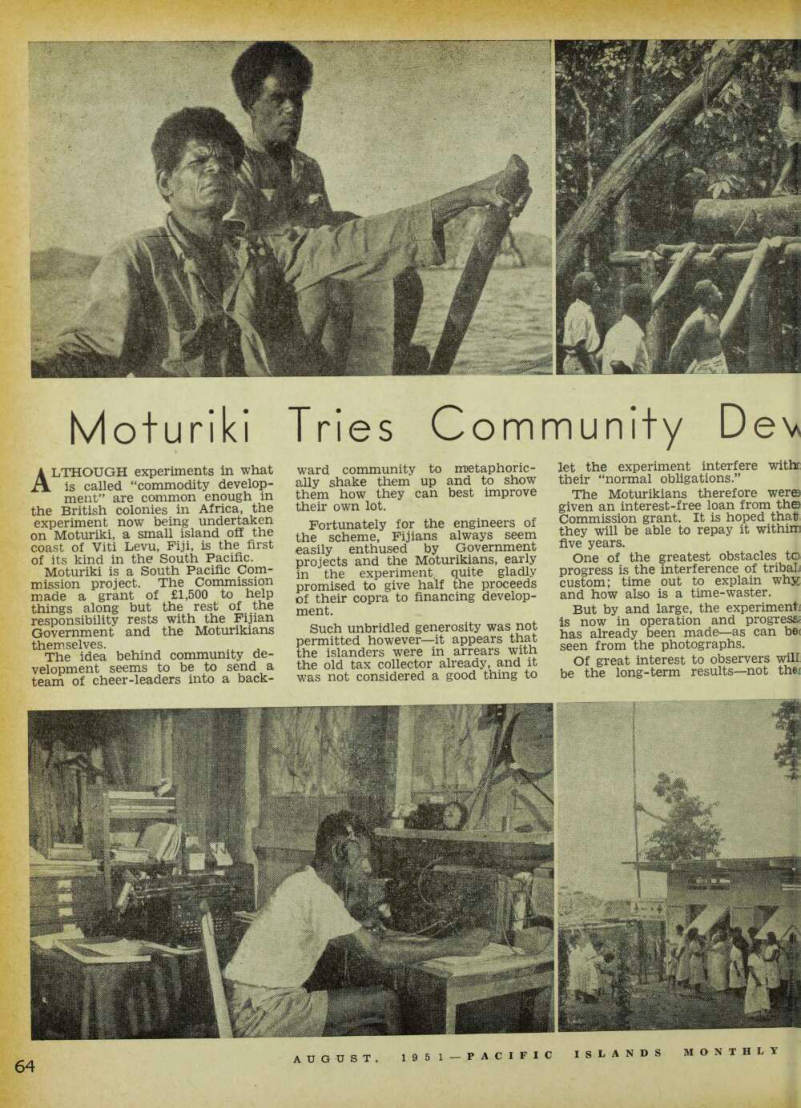
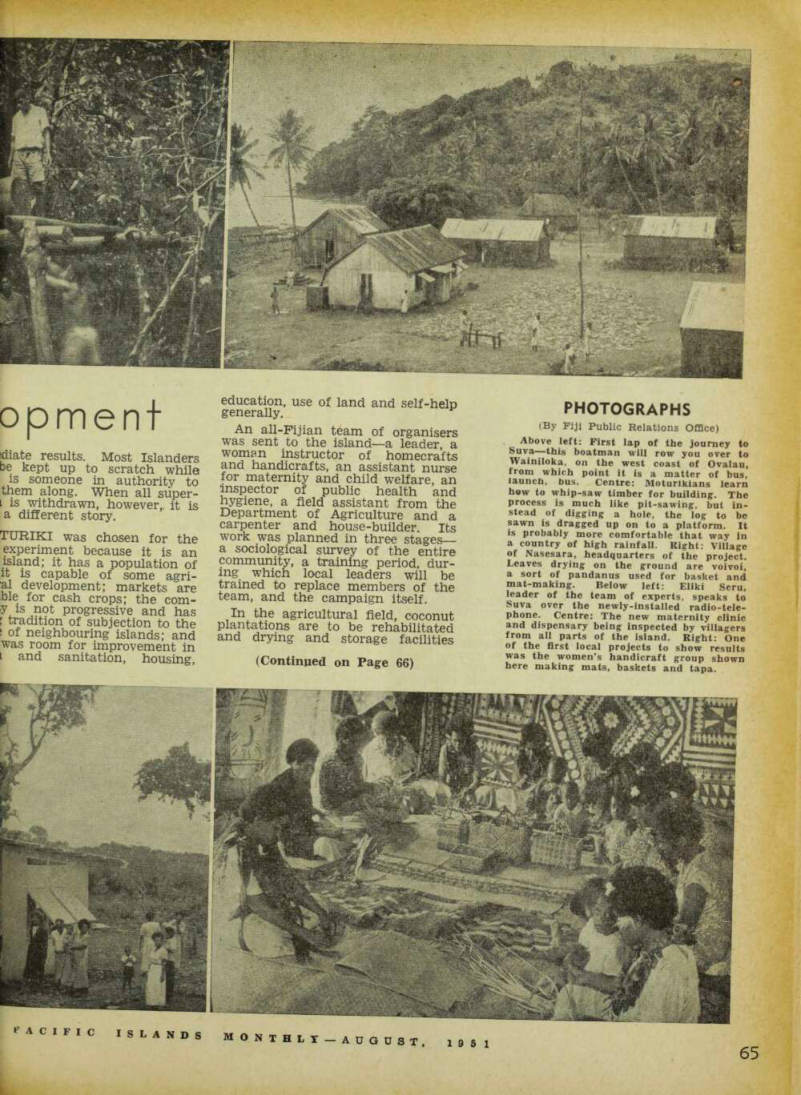
(By Fiji Public Relations Office) Above left: First lap of the journey to Suva—this boatman will row you over to Wainiloka, on the west coast of Ovalau, from which point it is a matter of bus, launch, bus. Centre: Moturlkians learn how to whip-saw timber for building. The process is much like pit-sawing, but in stead of digging a hole, the log to be sawn is dragged up on to a platform. It is probably more comfortable that way in a country of high rainfall. Right: Village of Nasesara, headquarters of the project.
Leaves drying on the ground are voivoi, a sort of pandanus used for basket and mat-making. Below left: Eliki Sent, leader of the team of experts, speaks to Suva over the newly-installed radio-tele phone. Centre: The new maternity clinic and dispensary being inspected by villagers from all parts of the island. Right: One of the first local projects to show results was the women’s handicraft group shown here making mats, baskets and tapa.
provided; rice growing is to be tried out, three young men are to be trained in the instruction and care of livestock; yams are to be ex ploited as a cash crop, and an agricultural education officer will establish a Young Farmers Club at the school and arrange for the de velopment of experimental food plots and a tree nursery. .
A complete medical examination has been made of the population, and a maternity clinic has been erected from material provided by the Fijian Administration.
Appropriate forestry measures will be taken, concerned chiefly with the proper cutting and marketing of sanitation is being intro duced, while housing improvement will proceed at first by enlisting the co-operation of a family and using one set of buildings as a model.
Water supply is also to receive attention. A senior student of a school for homecrafts and handi crafts will assist womens occu- Pa ßadfo-telephone communication has been installed and Moturiki residents can now get in touch quickly with the outside world.
To travel from the island to Suva, however, still means involved travel.
Row-boat to the west coast of Ovalau, bus to Levuka launch for the 25-mile voyage to Londoni and then a 40-mile bus trip to Suva.