Air-warfare
pp. 62-65 · Read in the full issue
Moresby Goes From Air-warfare To Air-fare War
R. W. Robson's Impressions of TOA's Solent Flight
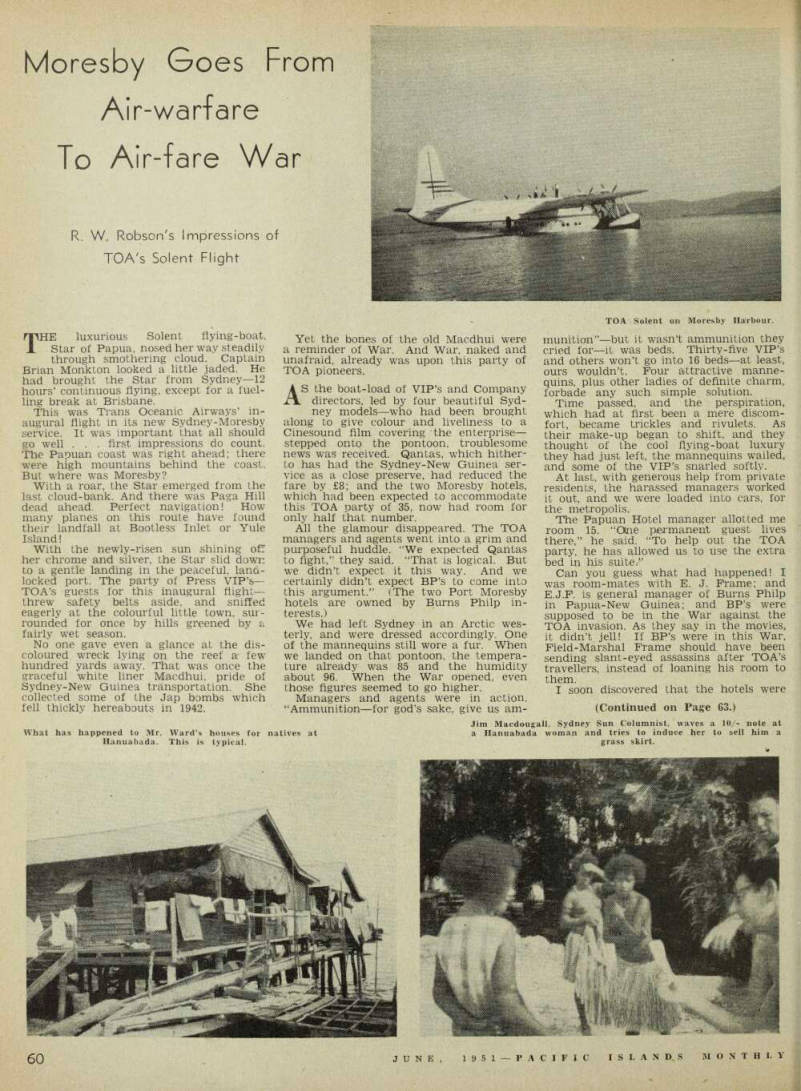
THE luxurious Solent flying-boat.
Star of Papua, nosed her way steadily through smothering cloud. Captain Brian Monkton looked a little jaded. He had brought the Star from Sydney—l 2 hours’ continuous flying, except for a fuelling break at Brisbane.
This was Trans Oceanic Airways’ inaugural flight in its new Sydney-Moresby service. It was important that all should go well . . . first impressions do count.
The Papuan coast was right ahead; there were high mountains behind the coast.
But where was Moresby?
With a roar, the Star emerged from the last cloud-bank. And there was Paga Hill dead ahead. Perfect navigation! How many planes on this route have found their landfall at Bootless Inlet or Yule Island!
With the newly-risen sun shining of: her chrome and silver, the Star slid down to a gentle landing in the peaceful, landlocked port. The party of Press VlP’s TOA’s guests for this inaugural flight— threw safety belts aside, and sniffed eagerly at the colourful little town, surrounded for once by hills greened by a fairly wet season.
No one gave even a glance at the discoloured wreck lying on the reef a- few hundred yards away. That was once the graceful white liner Macdhui. pride of Sydney-New Guinea transportation. She collected some of the Jap bombs which fell thickly hereabouts in 1942.
yet the bones of the old Macdhui were a reminder of War. And War, naked and unafraid, already was upon this party of TOA pioneers. , . TT „ A S the boat-load of VIP s and Company directors, led by four beautiful Sydney models—who had been brought along to give colour and liveliness to a Cinesound film covering the enterprise— stepped onto the pontoon, troublesome news was received. Qantas, which hitherto has had the Sydney-New Guinea service as a close preserve, had reduced the fare by £8; and the two Moresby hotels, which had been expected to accommodate this TOA party of 35, now had room for only half that number.
All the glamour disappeared. The TOA managers and agents went into a grim and purposeful huddle. “We expected Qantas to fight,” they said. “That is logical. But we didn’t expect it this way. And we certainly didn’t expect BP’s to come into this argument.” (The two Port Moresby hotels are owned by Burns Philp interests.) We had left Sydney in an Arctic westerly, and were dressed accordingly. One of the mannequins still wore a fur. When we landed on that pontoon, the temperature already was 85 and the humidity about 96. When the War opened, even those figures seemed to go higher.
Managers and agents were in action.
“Ammunition—for god’s sake, give us am-
munition”—but it wasn’t ammunition they cried for—it was beds. Thirty-five VlP’s and others won’t go into 16 beds—at least, ours wouldn’t. Four attractive manne quins, plus other ladies of definite charm, forbade any such simple solution, Time passed, and the perspiration, which had at first been a mere discom fort( became trickles and rivulets. As their make-up began to shift, and they thought of the cool flying-boat luxury they had just left, the mannequins wailed, an( j some 0 f the VlP’s snarled softly.
At last, with generous help from private residents, the harassed managers worked it out, and we were loaded into cars, for the metropolis.
The Papuan Hotel manager allotted me room 15. “One permanent guest lives there,” he said. “To help out the TOA party, he has allowed us to use the extra bed in his suite ; ” can you guess what had happened! I was room-mates with E. J. Frame; and e J.F is general manager of Burns Philp j n Papua-New Guinea- and BP’s were supposed to be in the’War against the TOA invasion As they say in the movies, it didn’t jell! If BP’s were in this War, Field-Marshal Frame should have been sending slant-eyed assassins after TOA’s travellers instead of loaning his room to them j SO on discovered that the hotels were
(Continued on Page 63.)
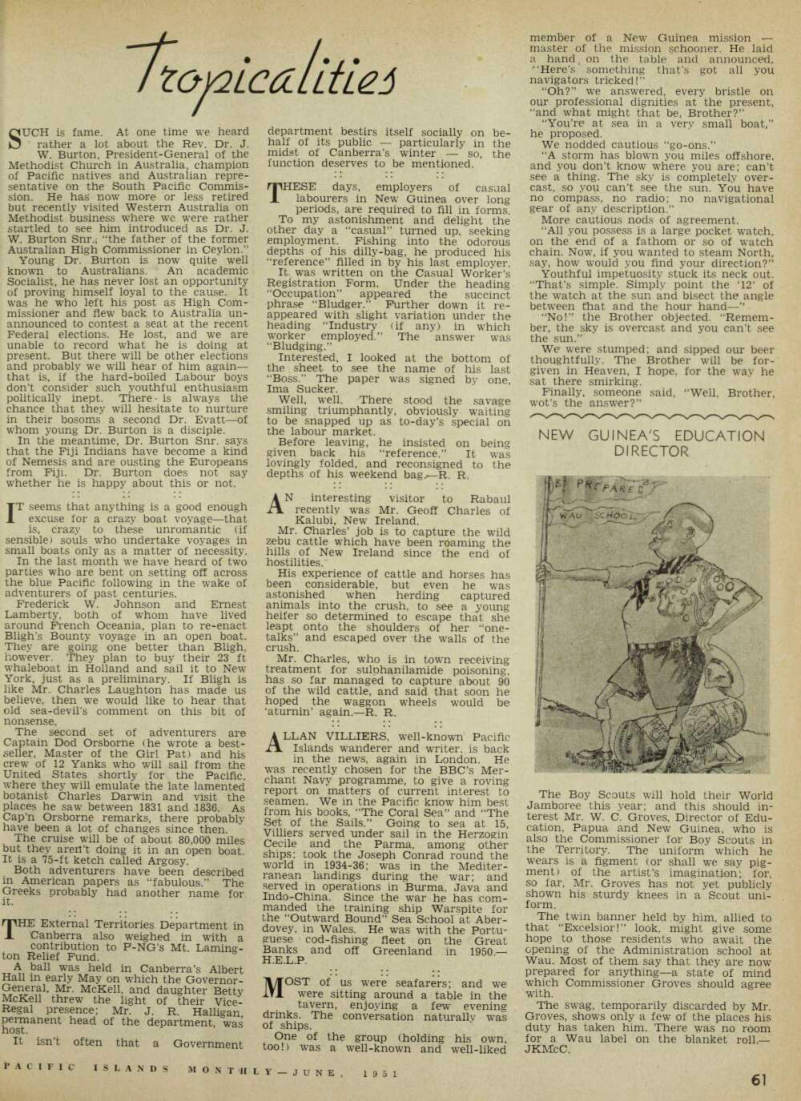
What has happened to Mr. Ward’s houses for natives at Hanuabada. This is typical.
TOA Solent on Moresby Harbour.
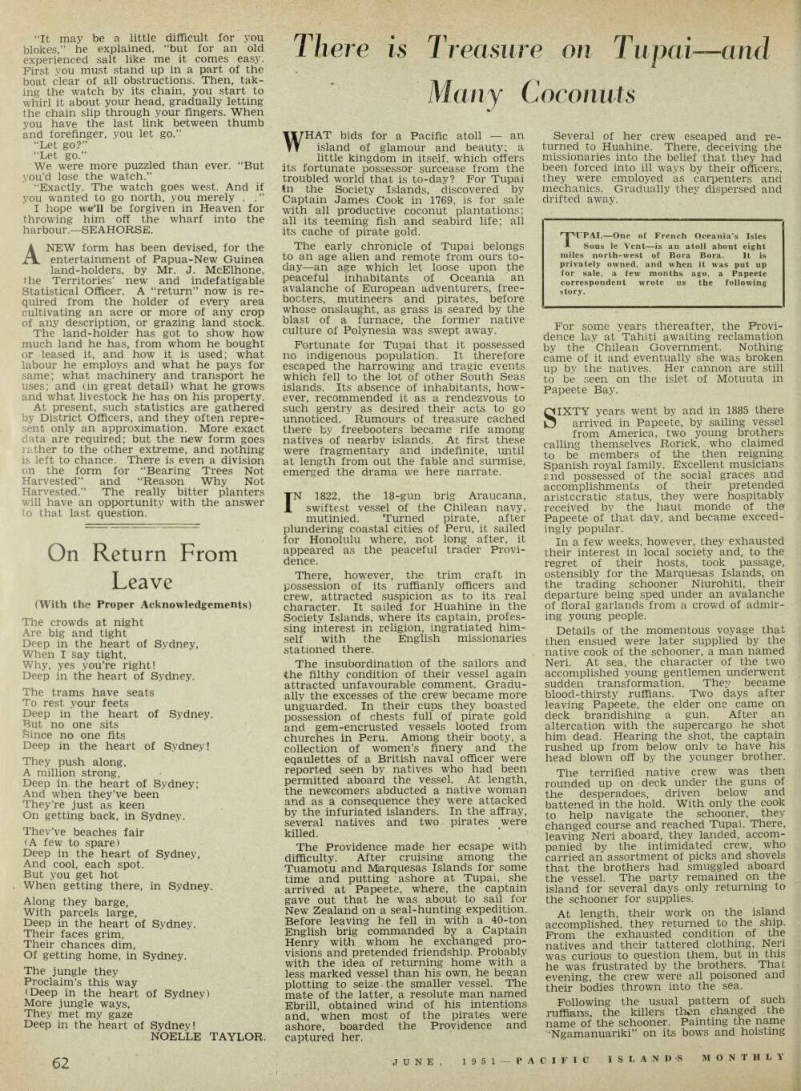
Jim Macdougall, Sydney Sun Columnist, waves a 10/- note at a Hanuabada woman and tries to induce her to sell him a grass skirt.
not in the War—they were merely the vic tims of an unhappy combination of cir cumstances, There had been dislocation of TOA’s hitherto smooth-flowing plans; but within an hour everyone was in quarters, and being fed with TOA lavish ness.
THE mannequins, four of the prettiest girls ever shipped out of Sydney, created a stir which was not wholly masculine. The women of Moresby, who generally are smart dressers, and socially adept, took all opportunities of looking the lovelies over; and, as the visitors were modest and amiable young women, they made a good impression everywhere.
What with glamour girls, expert opera tors and first-class instruments, the TOA party was all equipped, in a film sense, to go places and do things.
But Port Moresby is not naturally well endowed with novelty and beauty: the production there of a film worthy of the effort requires much cogitation and pre liminary staff work. Pictures were taken, with a lively mixture of tropical scenery, sophisticated natives and co-operative mannequins; but they will need a lot of trimming if their presentation is to achieve their ultimate purpose.
The Solent ran several short flights over town and coast, and scores of resi dents enjoyed brieflly the air-liner’s com forts and amenities. Even the Qantas men, who came out of their offices to watch the Solent “buzzing” the main street admitted sourly that TOA was making the most of its chance to advertise the new service. Then they went back to a close calculation of rival schedules and operating costs.
When the last guest-flight was over, the War was advanced another stage. Every VIP in Moresby and district was enter tained at TOA’s cocktail party in the Papuan Hotel. At the end of two hours of ardent hospitality, even the leading men from Qantas interests were telling each other cordially that, with all the money and movement now in Papua-New Guinea, there could be room for TOA’s new ser vice, without anyone being hurt much.
When TOA’s Solent left Sydney, 24 hours before, the TOA fares to Moresby were £39/5/- single, £7O/13/- return, com pared with Qantas £43/4 - and £77/16 0.
By the time the Solent arrived, Qantas fares were down to TOA level.
That, said TOA cheerily, is as it ought to be. Hold the fares steady, and let the Territories folk go to the service they like best. (Final decisions, of course, lie respec tively in Margaret Street and Macquarie Place, Sydney.) By the time the long evening’s fevers were waning, the TOA tigers were purring gently beside the Qantas lions, and every one was agreed that, if there had to be War, it really would be a gentlemen’s war, for the ultimate benefit of all concerned.
After a really successful 24 hours, the Solent departed next morning, with its over-fed and over-wined VlP’s, and its four delightful mannequins; and arrived without incident in Rose Bay.
And now the stern business of conduct ing rival air services—and making them pay!—really will commence.
Tjmom Sydney Truth:
That big bearded gentleman you’ve seen moving around Sydney in recent weeks isn’t really King Henry VIII.
He’s Ralph Ormsby, a District Officer from New Guinea, over here for a well earned six months’ holiday.