Namatjira
pp. 61-65 · Read in the full issue
Dinkum Aussi, Real Artist
Although Albert Namatjira and his paintings are somewhat outside our line of country, we feel that this article should be of interest to the Pacific reader.
Firstly, because Namatjira’s paintings are not just a fad, or a manifestation of Australia’s post-war brown-brother com plex, buX, are fine paintings, after a manner uniquely his own. Secondly, be cause it is one of the last articles written by young Clifford Kruse before he died in Papua last year. Kruse sandwiched a visit to Australia’s Dead Heart between his Polynesian rambles and his visit to Papua-New Guinea.
ALBERT NAMATJIRA, an Australian aborigine, is only one generation re moved from the Stone Age. A member of the Arunta tribe that lives in the great desert outback of central Aus tralia, Namatjira’s people are considered anthropologically as the most primitive people known. Yet at present he is the brightest star on the Australian cultural horizon.
A watercolour artist who took his first lesson in painting only 13 years ago, this 48-year old “blackfellow” is now gaining world prominence for his art productions.
No other contemporary Australian artist, white or black, is enjoying more popu larity at home or abroad. Or doing so well financially.
Namatjira, though he spends most of his waking hours with a brush and easel, never seems to catch up with demand.
With his watercolours bringing an average of 20 guineas each, his economic future is assured. But despite the increasing demand for his work, he, like the true artist, refuses to become “assembly-line” in his methods and frequently sits study ing and meditating upon a “location” long hours without putting brush to paper.
NAMATJIRA’S art is all concerned with the out-of-doors. The purple moun tains, the red sands and the cloud streaked skies that characterise the countless, unchanging square miles of Australia’s great heart are his subject.
And despite the eternal sameness of this near-barren land, no two of his pictures present exactly the same scene. As is the custom of his semi-nomadic peoples, he frequently goes on walkabout hundreds of
miles from his home at the Hermansburg Mission west of Alice Springs, Northern Territory. Until recently, he has gone on these long wanderings camelback, but now he has purchased an old truck to take him to location.
On these trips, which may last for months, he lives much as his people have lived for thousands of years. He sleeps on the bare ground close by a smoky fire and catches all his own food by stalking
By Clifford Kruse
and by spear. The meat of the kangaroo, the seed cakes and the witchetty grubs are more to his liking than the white man’s mission food. The aborigine, who ranks with the American Indian as the world’s most-gifted stalker, still prefers the native spear and the boomerang to modern firearms.
Because they have had to depend on it for survival, the aborigines have a keen kindredship for the land that is impos sible for the white man to understand.
They have been able to eke out a meager livelihood from the arid wasteland where a European, without outside food or water, would perish in a week. They are able to interpret and read tracks and signs, so faint that the white man cannot see them.
They are the perfect adaptation of man to his environment.
IT is this that gives Namatjira’s compo sitions an authenticity and appeal that few European artists, painting the same subjects, ever achieve. The faithfulness to colour seen in his purple at-dusk mountains, his coppery sands, his grey-white ghost gums, his barley-green spinifex grasses and his silver saltbush marks him as a colour-genius without peer.
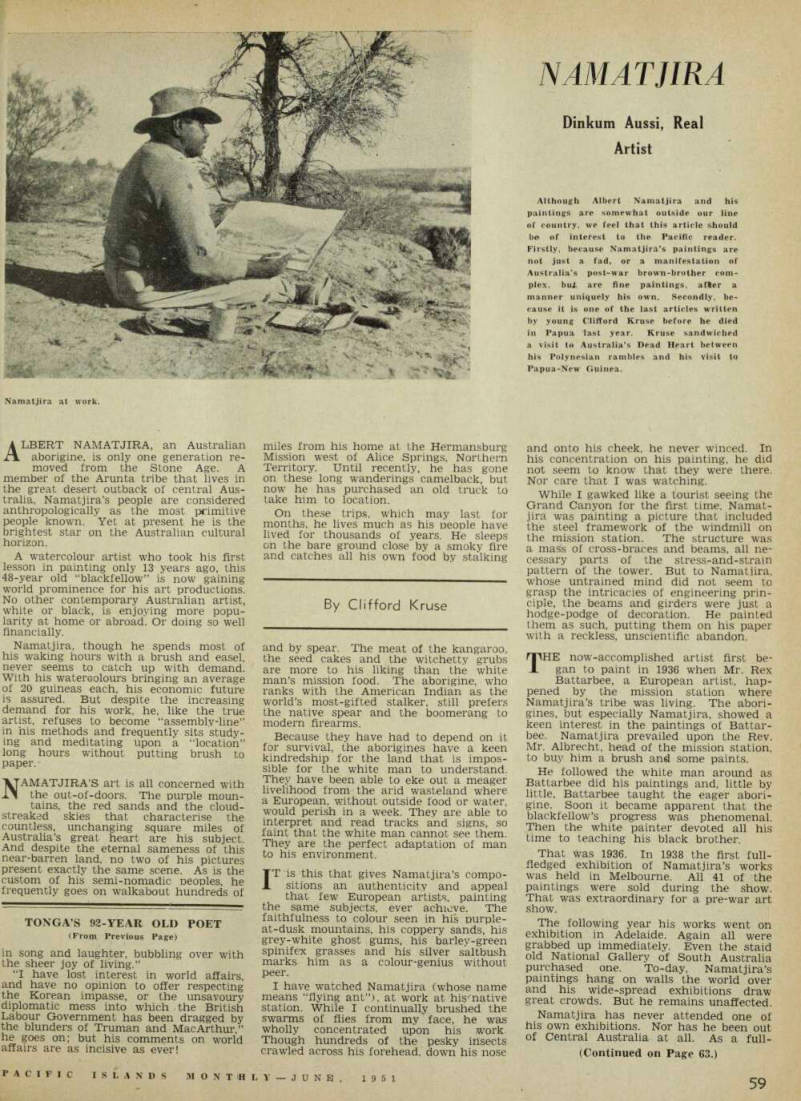
I have watched Namatjira (whose name means “flying ant”), at work at his’native station. While I continually brushed the swarms of flies from my face, he was wholly concentrated upon his work Though hundreds of the pesky insects crawled across his forehead, down his nose
and onto his cheek, he never winced. In his concentration on his painting, he did not seem to know that they were there.
Nor care that I was watching.
While I gawked like a tourist seeing the Grand Canyon for the first time. Namat jira was painting a picture that included the steel framework of the windmill on the mission station. The structure was a mass of cross-braces and beams, all ne cessary parts of the stress-and-strain pattern of the tower. But to Namatiira, whose untrained mind did not seem to grasp the intricacies of engineering prin ciple, the beams and girders were just a hodge-podge of decoration. He painted them as such, putting them on his paper with a reckless, unscientific abandon.
THE now-accomplished artist first be gan to paint in 1936 when Mr. Rex Battarbee, a European artist, hap pened by the mission station where Namatjira’s tribe was living. The abori gines, but especially Namatjira, showed a keen interest in the paintings of Battar bee. Namatjira prevailed upon the Rev.
Mr. Albrecht, head of the mission station, to buy him a brush and some paints.
He followed the white man around as Battarbee did his paintings and. little by little, Battarbee taught the eager abori gine. Soon it became apparent that the blackfellow’s progress was phenomenal.
Then the white painter devoted all his time to teaching his black brother.
That was 1936. In 1938 the first full fledged exhibition of Namatjira’s works was held in Melbourne. All 41 of the paintings were sold during the show.
That was extraordinary for a pre-war art show.
The following year his works went on exhibition in Adelaide. Again all were grabbed up immediately. Even the staid old National Gallery of South Australia purchased one. To-day, Namatjira’s paintings hang on walls the world over and his wide-spread exhibitions draw great crowds. But he remains unaffected.
Namatjira has never attended one of his own exhibitions. Nor has he been out of Central Australia at all. As a full
(Continued on Page 63.)
Namatjira at work.
blooded aborigine, he is a ward of the State and must get permission to travel, even though he can pay for it out of his own pocket. If he travelled by train, he could not buy himself a meal, although Clara, his half-caste half-sister could. The intricacies of Australian law in regard to the Stone Age blacks brings about this absurd situation. Namatjira has often expressed a desire to see something of the coast and the sea, but without special dispensation from the State he is unlikely ever to be able to do so.* Because he earns a good bit of money from his art, Namatjira also creates an other peculiar situation under Australian law. For the past five years, he has had to pay a sizable income tax. Since the abos have no political representation, there has always been a question as to whether or not he should pay this “taxa tion without representation.” But he always has. Although, in the communal fashion of the aborigines, he supports a tribe of some 60 persons, he is granted income tax exemption only for his wife and two youngest sons.
HIS measure of success has also brought additional woes to the Lutheran mis sion fathers, under whose watchful eyes Albert and his tribe live. A number of the natives, jealous of Namatjira’s in creasing good fortune, have abandoned their jobs in the mission’s saddlery and in its gardens and have turned to paint ing. Some of them, like the Pareroultja family, Henoch Raberaba. Walter Eba tarinja and Namatjira’s own sons, Ewald and Enos, have had some financial success, too. This has disrupted the plans and the orderly routine of the station built up over 73 years. Heads of the mission are concerned that their work shall not be come of secondary importance to the work of a few of their converts.
Namatjira, always a moody and difficult type, has lately had a run-in with the mis sionaries over the arrangement whereby they keep his bank and cheque books. Be fore he can write a cheque or spend a large sum of money he must get the per mission of a board of trustees especially set up to watch that some scheming white man (several have tried) does not victim ise Albert for his funds.
Among his own tribesmen he has many who commend him for his attainments, but many who also decry his achieve ments by saying “he tries to be like a white man.” To the tribal elders, he must still pay age-old tribute, although he has been known to say: “I guess I’m the big boss of this country ’round about here.”
Kruse wrote this. Namatjira has been to Darwin and has painted his first seascapes.