tropicalities
pp. 62-63 · Read in the full issue
THE phone rang, and the PIM editor wearily said “Hullo?”
A resonant bass voice, with a rich American accent, said: “John R. Cross an, of Cleveland, Ohio, speaking.
Thought I’d just like to express my ap preciation of this journal of yours. It sure gives me a lot of what I want about the South Pacific.”
“Nice of you to say so,” said the editor. “Staying long in Australia?”
“Goldarn it, I’m not in Australia,” he replied. “I’m speaking from my home in Cleveland. I was reading this Pacific Islands Monthly here tonight, and I thought I’d give you a call on the radio phone.”
And so it was. The transmission was so clear and steady that it might have been coming from next door, instead of across 9,000 miles. At four dollars a minute, it was the most expensive bouquet ever handed the PIM editor.
Mr. Crossan, a well-known lawyer in Ohio, commanded a battalion of Ameri can troops in the Solomons fighting in 1942-43, and saw many other Pacific islands. He discussed many interesting angles of his experiences, and he es pecially asked after the Rev. J. F. Goldie, veteran of the Methodist Missionary Society, whom he met at Roviana, BSi.
He warmly advocated American-Aus tralian friendship, and spoke feelingly of his admiration for Douglas MacArthur, whose dismissal had been announced that day.
THE three-cell electric torch, with its powerful beam, is a must in the Island territories, where, when moon goes on holiday, the tropical nights are dark indeed. As the advertisement says, if you can see, you’re safe.
Regrettably, the life of sells in continu ous use is not as long as one could wish the three-cell flashlight at length will produce only a reddish glow, and then the battery (though it will last quite a time after this stage is reached) is “junked” to the loss of three shillings.
This may be averted, by the following method. Although a 3-cell battery, almost exhausted, will give merely a dull glow with its own 3.8 volt bulb, the globe of a two-cell torch (2.5 v.) will give a bril liant light. The trick is to carry in your torch a 2.5 v. globe as a spare, and, when the battery weakens, insert it in place of the higher voltage one. In this way, a me of several months service may be had from the battery, which is only thrown away when completely dead.
The revival of dead batteries by heating them is so ineffective that it is not worth the waste of time involved.—E.G.
ONCE more the magnificent local Cook Island mixture of nescience and ob stinacy has flaunted defiance to con vention—this time, in the direction of the nz Post Office.
Certain young Villagers of Mangaia Island noticing in the NZ “School iRwl a - \ T 1 r| rtter from a schoolboy at Blenheim, NZ, decided to write to the young gentleman with a view to pen fnend acquaintance (a common pastime lsland y° uth > though some of the order? 8 hardly of the Chesterfield
There was the address, in print, as as any pikestaff. But Blenheim, both the famous battlefield and its NZ namesake, is an unfamiliar name to Mangaians. After due deliberation, the seekers of pen-friendships with white children decided that there was no such place, and they addressed their screeds to Bethlehem!
Needless to say, all the misdirected letters were returned by the NZ “dead letter” office as “insufficiently addressed” —the knowledgeable NZ authorities, per haps knowing the little ways of Cl-ers, didn’t even bother to send them on to the Palestine Post Office. Thousands are spent each year by the NZ taxpayer on Cook Is. education—the results of which are as shown above.—ETl.
PRESS FANTASY DEPT. According to Sydney Truth, a Melbourne artist, Russel Foreman, is shortly off to the Gilbert & Ellice Islands to paint. But, they say, there is no postal communication so “ . . . he’s taking two crates of empty Vitamin C bottles.
“There’s some sense in it—he’s studied the currents, found that if he tosses the bottles in the seas with messages for his friends, they’ll finish up somewhere in Australia or New Zealand.”
SOMEBODY in Papua-New Guinea will be the proud possessor of a Dobell painting before the end of May.
This has been donated by the well-known artist for the Mt. Lamington Fund and it is being raffled by the RSL.
The six other prizes, too, will be well worth having: two winning entries from the recent photographic print exhibition by members of the Papua Photographic Society, two examples of Native Art, and two drawings by art students at the Sogeri Education Centre.
The raffle is to be drawn on May 19. —PM.
WELL, with copra worth over £lOO per ton, it was bound to happen. The following is from a recent issue of North Borneo News:— According to police reports, on Friday, January 26, 1951, three boats bringing copra from Celebes were stopped and robbed of their cargo, amounting to 20 tons, between Pulau Tiga and Pulau Si Amil. Five kumpits, the crews of which were armed, are said to have been in volved in the crime; one had a black hull with red lines and “SOLU No. 500” painted on the bow. A patrol put out from Tawau, but returned without re sult.
On February 2, another case of robbery on the high seas was reported. Searches are being carried out in the vicinity of Pulau Bohayan and Pulau Mataking, where the robbers are believed to hide.
Crocodile-shooter g. m. Rio came down to Lae, New Guinea, from the back blocks of the Sepik Country, and decided to take a look at the Morobe district. He did not like the modern trends: and, least of all, he dis liked the practice of modern women of staining their hair, “The first time I saw one of them,” he writes, amusingly, “I got a shock. She was
blue. ‘Poor old thing,’ I said to myself, she must be off her nut.’ ”
Then another matron comes along— not so old. but she was green. ‘Hell!’ I said. “Must be a lunatic asylum around here, and the inmates are having a day ‘‘Now I know it’s the fashion for our ladies to tint their locks. Natural enough when you come to think of it. Our Marys (and men, too) have been staining their hair for ages. Sooner or later, I suppose, our ladies will take to pul-puls, or wear rings in their noses. Why not reduce the costume to a G-string and a few beads! f ‘T v l had civilisation. I can’t get back to Indo-Chma, so I’m going bush, all by myseU.lm going into Western Papua, where the rivers are full of lovely croco diles, and there are great mud-banks and masses of inviting mangroves, and the jungie is teeming with insects and long thick snakes . . . You can have the in flation, and the more or less vivacious ladies with blue hair.”
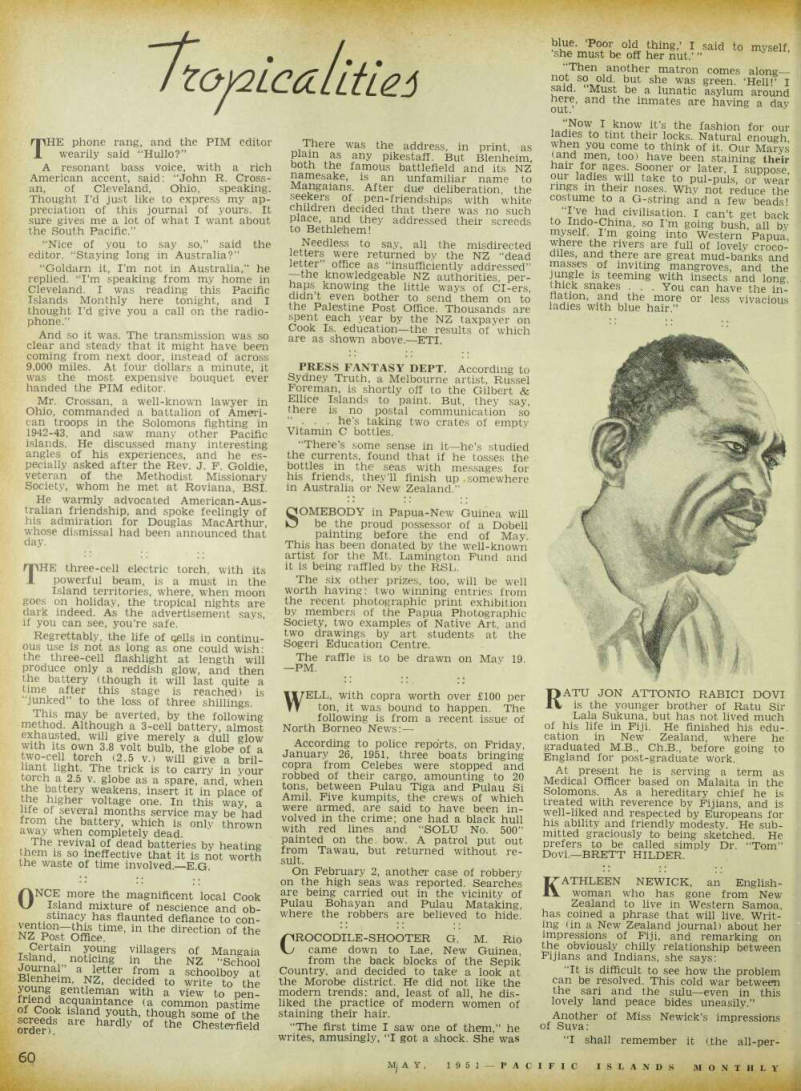
Ratu Jon Attonio Rabici Dovi
is the younger brother of Ratu Sir Lala Sukuna, but has not lived much of his life in Fiji. He finished his edu-. cation in New Zealand, where he graduated M. 8., Ch.B., before going to England for post-graduate work.
At present he is serving a term as Medical Officer based on Malaita in the Solomons. As a hereditary chief he is treated with reverence by Fijians, and is well-liked and respected by Europeans for his ability and friendlv modesty. He sub mitted graciously to being sketched. He prefers to be called simply Dr. “Tom”
Dovi.—Brett Hilder.
KATHLEEN NEWICK, an English woman who has gone from New Zealand to live in Western Samoa, has coined a phrase that will live. Writ ing (in a New Zealand journal) about her impressions of Fiji, and remarking on the obviously chilly relationship between Fijians and Indians, she says: “It is difficult to see how the problem can be resolved. This cold war between the sari and the sulu—even in this lovely land peace bides uneasily.”
Another of Miss Newick’s impressions of Suva: “I shall remember it (the all-per
vading odour of oil of copra, spices of India and rotting vegetation) as I re member the never-ceasing whirr of the sewing machines of Suva. Industrious little men in a legion of shops turn out unceasingly frocks and suits at in credible speed and low cost.”
THE speed at which the Australian Public Service works —or any other public service, for that matter — leaves one gasping.
On April 10 I called on the departing Minister for External Territories (going overseas to a new job) to say farewell.
I happened to remark that on April 18 I was to take part in a broadcast debate in Melbourne on the question of admit ting Red China to the United Nations.
Mr. Spender said he had dealt with this question before the United Nations Assembly on September 18, and offered to send me a copy of his statement: I gratefully accepted. He called in his secretary and gave him the necessary in structions.
On April 18 I took part in the debate, as arranged.
On May I—three weeks after I had seen Mr. Spender—l received a typed copy of his statement.
If Mr. Spender got that sort of service during his term as Territories Minister, it is little wonder his term was one long
record of frustration.-
Rwr.
A MOVIE of the Kon Tiki raft voyage will soon be released by RKO.
The Kon Tiki adventure was organ ised by Thor Heyerdahl three years ago to test his theory that the Polynesians came from South America, and not through Indonesia as is generally be lieved. On a balsa-wood raft. Heyerdahl and his five companions drifted from Cal lao, Peru, to the Raroia reef. Tuamotu Group, French Oceania, in 102 days. Their raft was a copy of primitive Peru rafts and they depended entirely on the Hum bolt Current to sweep them westward.
They proved that natives of Peru could and probably did make drift voyages in to the Pacific—but their adventure did not prove that the Pacific Islands were populated in this way.
Heyerdahl wrote a popular book about the 4,300 mile voyage of Kon Tiki, which was published last year. He also recorded the trip on film, and it is this that is the basis of the picture which will shortly be released by RKO.