Lovely are the Isles of Lau
p. 61 · Read in the full issue
Phctos by Public Relations Office, Fiji.
ALTHOUGH there is an increasing stream of tourists to the Colony of Fiii few ever get sufficiently off the beaten track around Viti Levu to cross the Knro Sea to the beautiful islands of Lau The majority of visitors, having motored around the coastal road of the main island of Fiii leave feeling that they have seen the J Colony, not knowing that there is a totally different Fiji over the sea to the eastward—a string of unspoiled small islands as unlike B suburb- Inised VfS LvuTs this cSitury is from l as t That the Lau islands remain largely undiscovered is not altogether the fault of the tourists. There are no hotels, few Europeans and no air company has yet
done for Fiji what the air companies have done for Papua-New Guinea—pro vided quick and frequent air transport to even the remotest places. All transport to Lau is by small inter-island motor vessel, or, even more frequently, by sail ing cutters. To make this trip you may not need much money but you do need oceans of time. And time is something which few people have got, these days Although today the group is a quiet backwater, it was the Lau Islands that attracted the first Europeans to settle in Fiji. A number of Americans estab lished themselves there about the middle of last century and began to grow Sea Island cotton when the American Civil War had hit the cotton industry in the Southern States. But after the war be
tween North and South ended, the cotton mdustry in Fiji Peered °ut^ The Lau islandsare generally smau with the coastal areas immensely fe , there are numerous quiet bays and sheltered waters and they can provide some of the most idyllic scenery m the South Seas. Here, too, is the traditional meeting and merging place between a £ s the Conffitoacv ’ and^on chief of the Lau Confederacy a con temporary of Cakobau who is generally attributed with ceding the islands to Britain, played an important role to those early years of Fijian history. Lau today has fewer oftheresults H cl ash between Europeans and Indians and the native Fijians than have the more acces sible parts of Fiji.
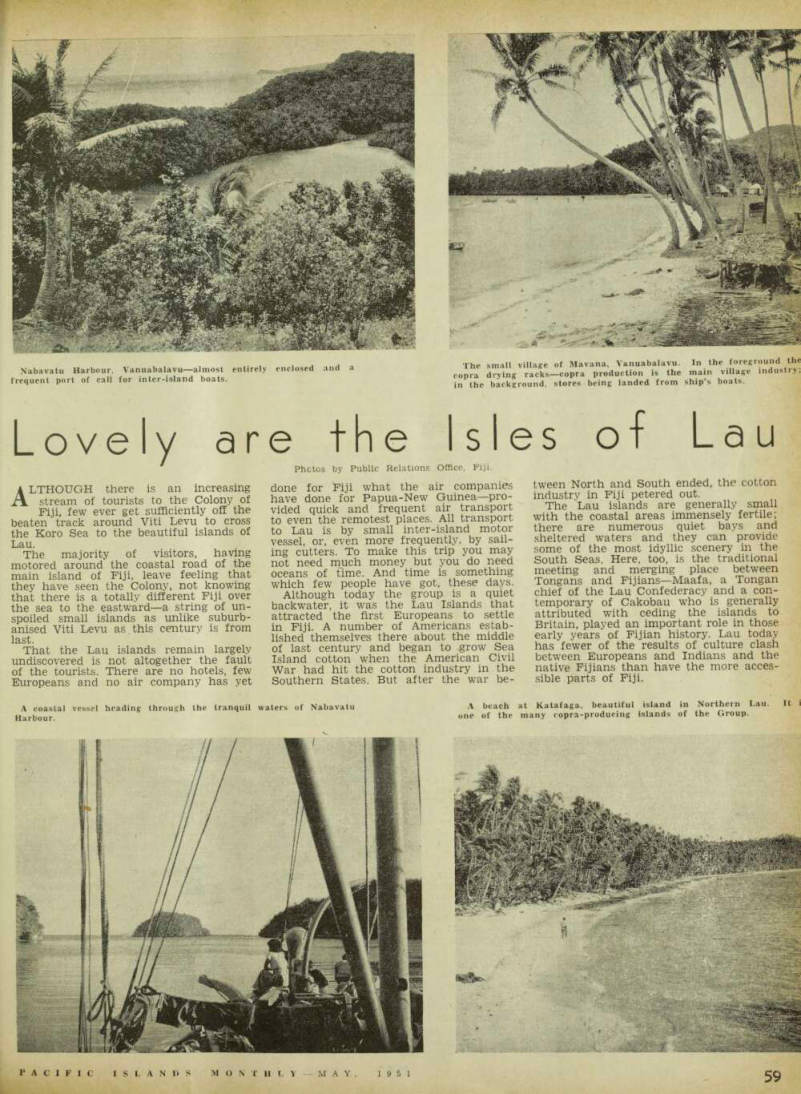
Nabavatu Harbour, Vanuabalavu —almost entirely enclosed and a frequent port of call for inter-island boats.
The small village of Mavana, Vanuabalavu. In the foreground the copra drying racks—copra production is the main village industry; in the background, stores being landed from ship’s boats.
A coastal vessel heading through the tranquil waters of Nabavatu Harbour.
A beach at Katafaga, beautiful island in Northern Lau. It i one of the many copra-producing islands of the Group.