Tropicalities
pp. 61-62 · Read in the full issue
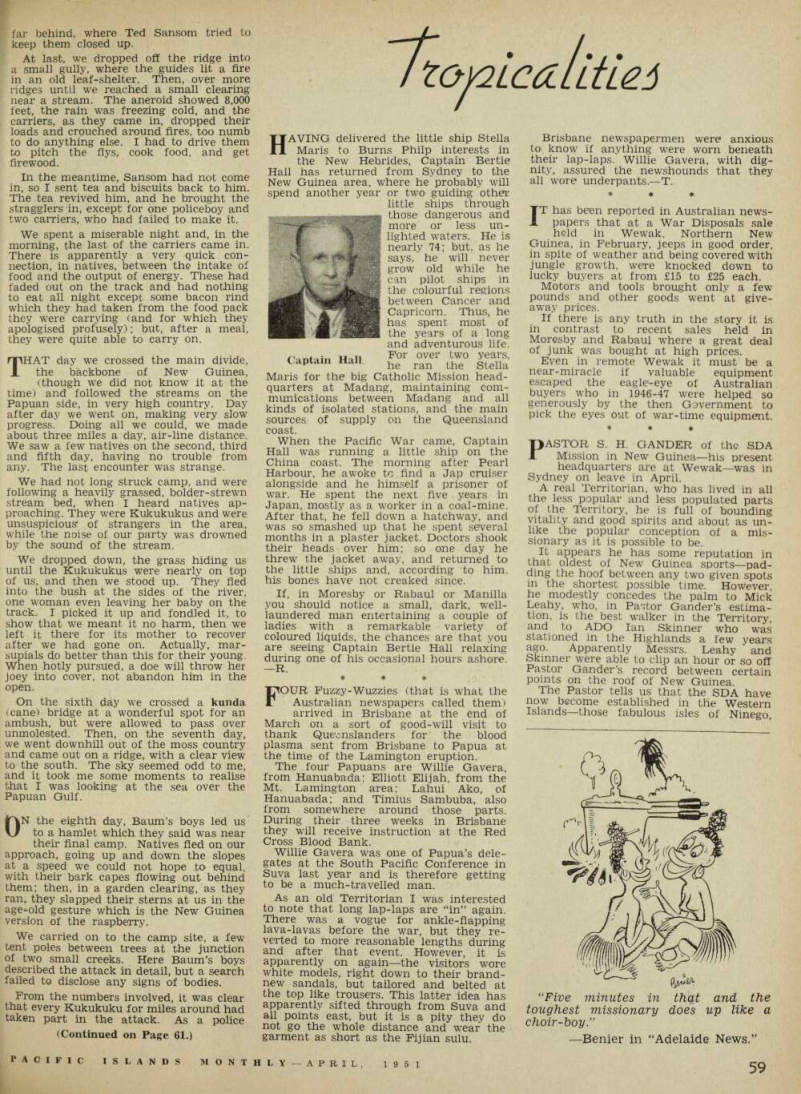
HAVING delivered the little ship Stella Maris to Burns Philp interests in the New Hebrides, Captain Bertie Hall has returned from Sydney to the New Guinea area, where he probably will spend another year or two guiding other
little ships through those dangerous and more or less un lighted waters. He is nearly 74; but, as he says, he will never grow old while he can pilot ships in the colourful regions between Cancer and Capricorn. Thus, he has spent most of the years of a long and adventurous life.
For over two years, he ran the Stella
Maris for the big Catholic Mission head quarters at Madang, maintaining com munications between Madang and all kinds of isolated stations, and the main sources of supply on the Queensland coast.
When the Pacific War came, Captain Hall was running a little ship on the China coast. The morning after Pearl Harbour, he awoke to find a Jap cruiser alongside and he himself a prisoner of war. He spent the next five years in Japan, mostly as a worker in a coal-mine.
After that, he fell down a hatchway, and was so smashed up that he spent several months in a plaster jacket. Doctors shook their heads over him; so one day he threw the jacket away, and returned to the little ships and, according to him, his bones have not creaked since.
If, in Moresby or Rabaul or Manilla you should notice a small, dark, well laundered man entertaining a couple of ladies with a remarkable variety of coloured liquids, the chances are that you are seeing Captain Bertie Hall relaxing during one of his occasional hours ashore. — R. * * ♦ FOUR Fuzzy-Wuzzies (that is what the Australian newspapers called them) arrived in Brisbane at the end of March on a sort of good-will visit to thank Queenslanders for the blood plasma sent from Brisbane to Papua at the time of the Lamington eruption.
The four Papuans are Willie Gavera, from Hanuabada; Elliott Elijah, from the Mt. Lamington area; Lahui Ako, of Hanuabada; and Timius Sambuba, also from somewhere around those parts.
During their three weeks in Brisbane they will receive instruction at the Red Cross Blood Bank.
Willie Gavera was one of Papua’s dele gates at the South Pacific Conference in Suva last year and is therefore getting to be a much-travelled man.
As an old Territorian I was interested to note that long lap-laps are “in” again.
There was a vogue for ankle-flapping lava-lavas before the war, but they re verted to more reasonable lengths during and after that event. However, it is apparently on again—the visitors wore white models, right down to their brand new sandals, but tailored and belted at the top like trousers. This latter idea has apparently sifted through from Suva and all points east, but it is a pity they do not go the whole distance and wear the garment as short as the Fijian sulu.
Brisbane newspapermen were anxious to know if anything were worn beneath their lap-laps. Willie Gavera, with dig nity, assured the newshounds that they
all wore underpants.-
T.
IT has been reported in Australian news papers that at a War Disposals sale held in Wewak. Northern New Guinea, in February, jeeps in good order, in spite of weather and being covered with jungle growth, were knocked down to lucky buyers at from £l5 to £25 each.
Motors and tools brought only a few pounds and other goods went at give away prices.
If there is any truth in the story it is in contrast to recent sales held in Moresby and Rabaul where a great deal of junk was bought at high prices.
Even in remote Wewak it must be a near-miracle if valuable equipment escaped the eagle-eye of Australian buyers who in 1946-47 were helped so generously by the then Government to pick the eyes out of war-time equipment. * • • PASTOR S. H. GANDER of the SDA Mission in New Guinea—his present headquarters are at Wewak—was in Sydney on leave in April.
A real Territorian, who has lived in all the less popular and less populated parts of the Territory, he is full of bounding vitality and good spirits and about as un like the popular conception of a mis sionary as it is possible to be.
It appears he has some reputation in that oldest of New Guinea sports—pad ding the hoof between any two given spots in the shortest possible time. However, he modestly concedes the palm to Mick Leahy, who, in Pastor Gander’s estima tion, is the best walker in the Territory, and to ADO lan Skinner who was stationed in the Highlands a few years ago. Apparently Messrs. Leahy and Skinner were able to clip an hour or so off Pastor Gander’s record between certain points on the roof of New Guinea.
The Pastor tells us that the SDA have now become established in the Western Islands—those fabulous isles of Ninego,
Captain Hall.
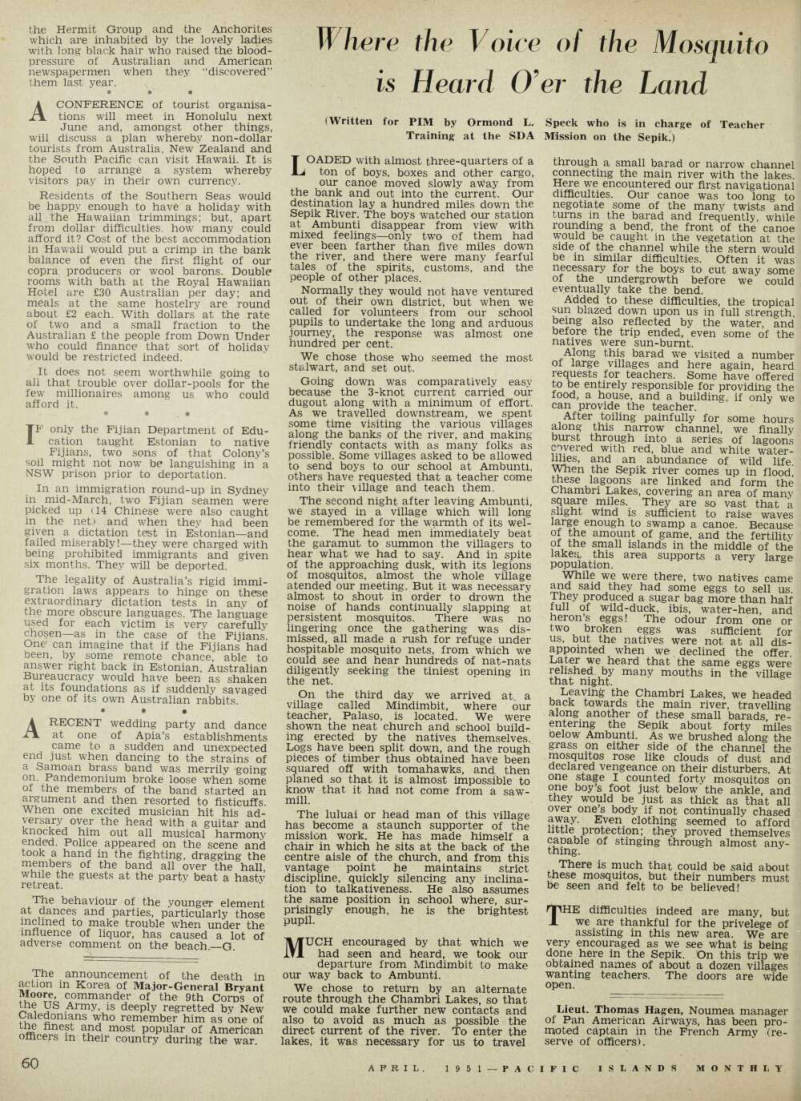
“Five minutes in that and the toughest missionary does up like a choir-hoy.” —Benier in “Adelaide News.”
the Hermit Group and the Anchorites which are inhabited by the lovely ladies with long black hair who raised the blood pressure of Australian and American newspapermen when they “discovered” them last year. * * * A CONFERENCE of tourist organisa tions will meet in Honolulu next June and, amongst other things, will discuss a plan whereby non-dollar tourists from Australia, New Zealand and the South Pacific can visit Hawaii. It is hoped to arrange a system whereby visitors pay in their own currency.
Residents of the Southern Seas would be happy enough to have a holiday with all the Hawaiian trimmings; but, apart from dollar difficulties, how many could afford it? Cost of the best accommodation in Hawaii would put a crimp in the bank balance of even the first flight of our copra producers or wool barons. Double rooms with bath at the Royal Hawaiian Hotel are £3O Australian per day; and meals at the same hostelry are round about £2 each. With dollars at the rate of two and a small fraction to the Australian £ the people from Down Under who could finance that sort of holiday would be restricted indeed.
It does not seem worthwhile going to all that trouble over dollar-pools for the few millionaires among us who could afford it. * * ♦ IF only the Fijian Department of Edu cation taught Estonian to native Fijians, two sons of that Colony’s soil might not now be languishing in' a NSW prison prior to deportation.
In an immigration round-up in Sydney in mid-March, two Fijian seamen were picked up (14 Chinese were also caught in the net) and when they had been given a dictation test in Estonian—and failed miserably!—they were charged with being prohibited immigrants and given six months. They will be deported.
The legality of Australia’s rigid immi gration laws appears to hinge on these extraordinary dictation tests in any of the more obscure languages. The language used for each victim is very carefully chosen—as in the case of the Fijians.
One can imagine that if the Fijians had been, by some remote chance, able to answer right back in Estonian, Australian Bureaucracy would have been as shaken at its foundations as if suddenly savaged by one of its own Australian rabbits. * • • A RECENT wedding party and dance at one of Apia’s establishments came to a sudden and unexpected end just when dancing to the strains of a Samoan brass band was merrily going on. Pandemonium broke loose when some of the members of the band started an argument and then resorted to fisticuffs.
When one excited musician hit his ad versary over the head with a guitar and knocked him out all musical harmony ended. Police appeared on the scene and took a hand in the fighting, dragging the members of the band all over the hall while the guests at the party beat a hasty retreat. 1 J The behaviour of the younger element at dances and parties, particularly those inclined to make trouble when under the influence of liquor, has caused a lot of adverse comment on the beach.—G.
The announcement of the death in action in Korea of Major-General Bryant Moore, commander of the 9th Corps of the US Army, is deeply regretted by New Caledonians who remember him as one of the finest and most popular of American officers in their country during the war.