Kukukuku Patrol
pp. 60-91 · Read in the full issue
By Eric Feldt
“A party of Lutheran Missionaries will explore the unknown Kukukuku country in New Guinea,” said the announcer’s imperscnal voice; and my memory jumped back 20 years, to the days when my beard was black.
IT was 1931, and I was District Officer at Salamaua. One normal morning I was in my office when a truck slithered to a stop in the sand outside and Ivan Paterson, a miner from the Upper Watut, strode in without any for mality.
He told me that Baum, a prospector, had been killed by Kukukukus. Some of his boys had escaped, and were at Sur prise Creek. Ivan had not seen them himself, but Schmidt Burgck, a miner there, had sent the message down.
Schmidt-Burgck, was of the opinion that it had happened about two days’ journey from the Upper-Watut-Surprise Creek area.
There were about a dozen miners, and Jack Ecclestone’s survey party, on the Upper Watut and Surprise Creek, which runs into it from the south. If the infor mation was correct, all these were in danger, and required immediate protection.
We knew little of the Kukukukus. They lived in the ranges between the Upper Watut and Lakekamu Rivers, the main divide of New Guinea. They had made no response to any civilising influences and were, in general, feared by all other natives. No other natives could speak
their language, nor would they have any thing to do with them.
When the Lakekamu goldfield was being worked, on the Papuan side, years before, the Kukukukus had been persistent thieves. They had occasionally visited the camp on the Upper Watut, where they traded sweet potatoes for iron, beads and salt, and stole whatever they could.
Attempts to civilise them by the Papuan administration had failed. Their numbers could only be guessed at.
After 24 hours of feverish activity, I had 12 police and six weeks’ supplies ready, and three Junkers aircraft from Guinea Airways were at Salamaua to fly us in. Three more police would take a party of 15 prisoners in by road through the Buangs, collecting 30 carriers on the way, and join us at the Upper Watut.
Patrol Officer Ted Sansom was at Wau, just in from patrol, and was instructed to dy in direct to the Upper Watut, where the drome could take only a light plane in those days.
The Junkers landed me and my party at Bulolo, and we set off immediately on the bush track to the Upper Watut, reaching it late that day. Sansom was already there.
We camped with Oscar Schwarz and decided, as an immediate measure, to patrol next day, myself towards Surprise Creek to the south, Sansom to the west, to see if any Kukukukus were about.
Having no carriers, we carried our own packs and travelled light. While we were away, Oscar Schwarz would store our supplies as they were ferried in from Bulolo by light plane.
Not long after Sansom and I had separated, I thought I saw symptoms of blackwater, which was not a comforting prospect. I camped at once, lay still in bed and drank as much bicarbonate of soda as I could and the signs passed away. Whether I had the beginnings of an attack and aborted it by early treatment, or just had a needless scare. I do not know to this day.
AT Surprise Creek, I saw the survivors of Baum’s party. They had now grown to a dozen, each one straggling in deeming himself to be the sole survivor.
Statements from them established that Baum had gone far into the ranges with 20 carriers, prospecting as he went. Baum was an advocate of peacful penetration, holding that raw natives would not harm a white man if the white man did not harm them. As part of his policy, he collected all knives and axes in his tent at night, so that his boys would not be able to take any aggressive action, and so provoke an attack.
On his way over the ranges, he had contacted natives, and bought vegetable foods from them in exchange for trade goods. At his last camp, he had estab lished friendly relations with the natives, and had traded with them.
After they had been there a few days, the natives, Kukukukus, had come to the camp at daybreak one morning and had
proffered sugar cane to Baum, who was in his bunk.
Finding him not on the alert, they had suddenly produced stone clubs from under their bark capes, had clubbed him to death, and then attacked the boys.
Eight boys were killed and the re mainder had escaped, making their way back over the ranges without food, or a blanket to cover them at night. The first had arrived at Surprise Creek three days after the massacre, the last three days after him.
With most natives, Baum’s methods were right, but Kukukukus are different.
SCHMIDT-BURGCK had assumed that the native carriers would be too cautions to make good time on their return journey and this, coupled with the fact that Jack Ecclestone’s camp had been robbed a few weeks before (in spite of the best watch-dog in the District), led him to the opinion that the scene of Baum’s murder was not far away.
However, my discussion with Baum’s boys established that the attack had taken place many days’ journey away, and that the miners at Surprise Creek were in no danger. To reach the place, a large patrol would be necessary and this could not be undertaken until the stores and carriers had arrived.
I returned to the Upper Watut drome and found Sansom there, he having drawn a blank in the west.
The police and prisoners arrived some days later and, with them, 30 carriers from the Buang villages. There had been no difficulty in engaging these, as Baum’s boys were Buangs, and the carriers were looking for revenge.
However, it was about a fortnight from the time I had left Salamaua before we were ready to start. Adding Baum’s boys to our own brought the party to about 60.
A PEW hours’ walk brought us to the foot of the range, where we ate an early lunch. Ahead of us was what Baum’s boys described as a “long mountain,” and so it proved to be.
It was a continuous climb. Up and up we went, backs and legs aching, chests gasping for breath, and sweat pouring off us, until a cold rain set in and we shivered.
Cold and clammy clouds blew about us, there was no let-up in the climbing, and rarefied air added difficulty to our breath ing, so that some of the carriers trailed
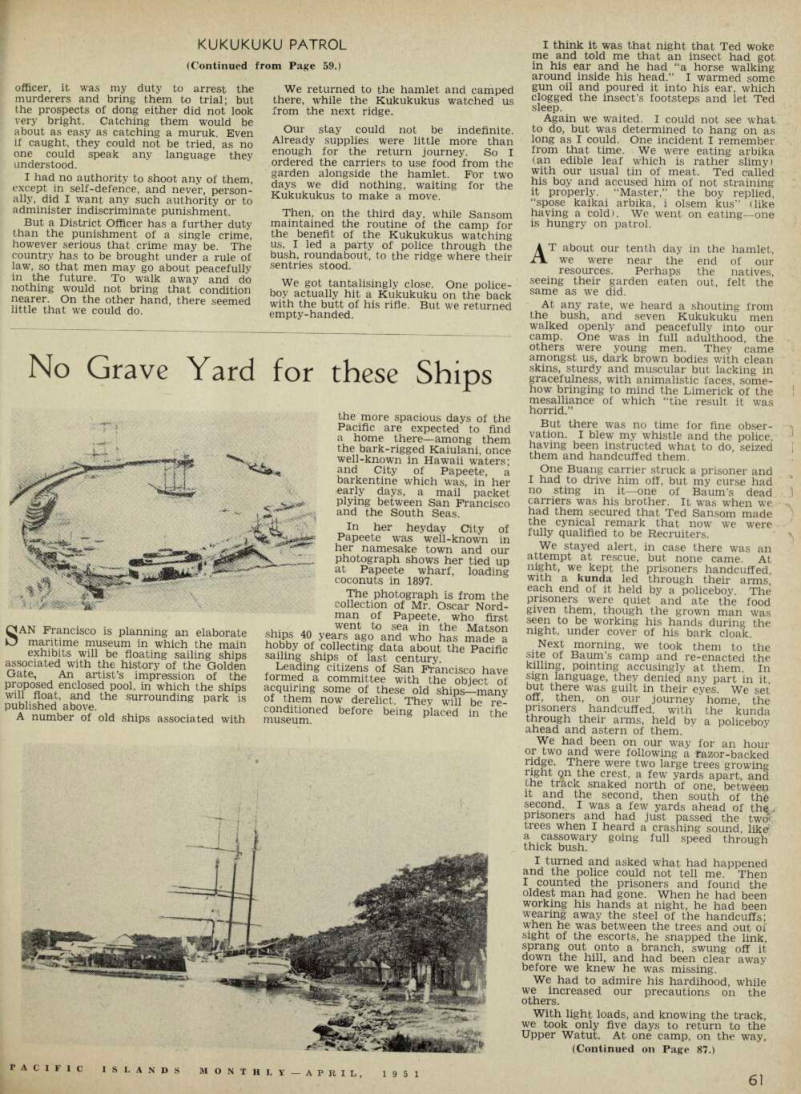
Three of the Kukukuku prisoners who were arrested by DO Feldt near Surprise Creek and brought into Wau.
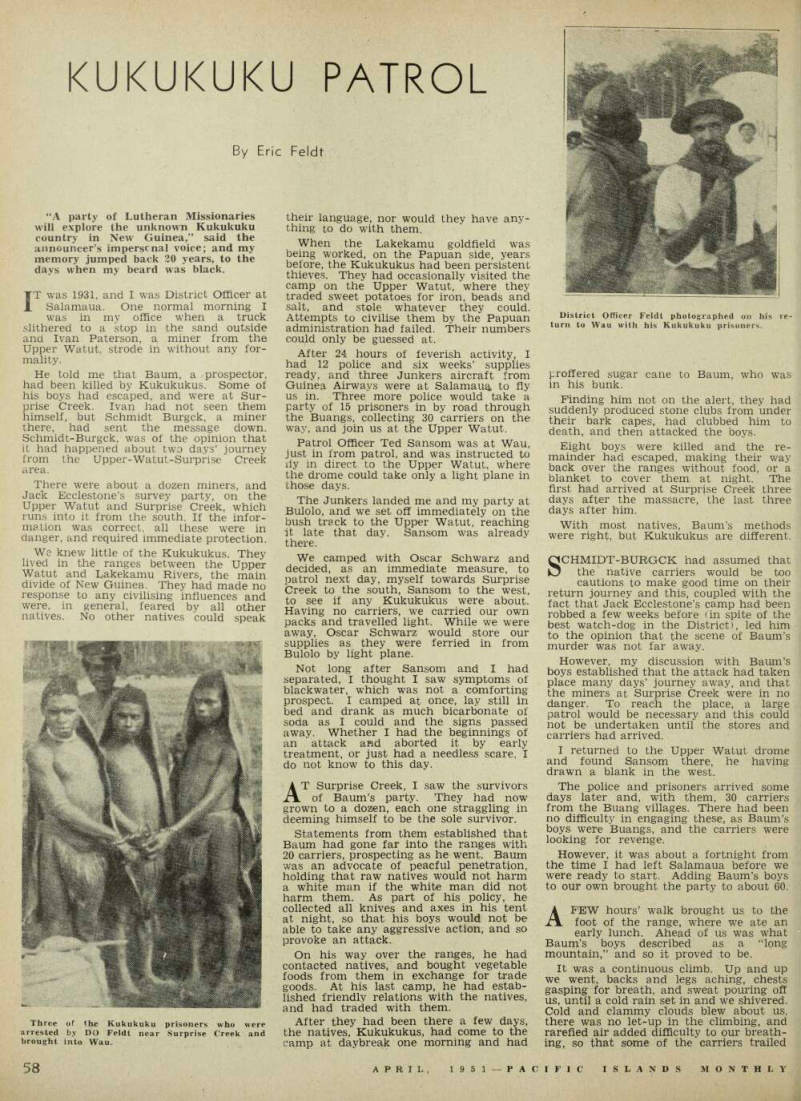
District Officer Feldt photographed on his re turn to Wau with his Kukukuku prisoners.
far behind, where Ted Sansom tried to keep them closed up.
At last, we dropped off the ridge into a small gully, where the guides lit a fire in an old leaf-shelter. Then, over more ridges until we reached a small clearing near a stream. The aneroid showed 8,000 feet, the rain was freezing cold, and the carriers, as they came in, dropped their loads and crouched around fires, too numb to do anything else. I had to drive them to pitch the flys, cook food, and get firewood.
In the meantime, Sansom had not come in, so I sent tea and biscuits back to him.
The tea revived him, and he brought the stragglers in, except for one policeboy and two carriers, who had failed to make it.
We spent a miserable night and, in the morning, the last of the carriers came in.
There is apparently a very quick con nection, in natives, between the intake of food and the output of energy. These had faded out on the track and had nothing to eat all night except some bacon rind which they had taken from the food pack they were carrying (and for which they apologised profusely); but, after a meal, they were quite able to carry on.
THAT day we crossed the main divide, the backbone of New Guinea, (though we did not know it at the time) and followed the streams on the Papuan side, in very high country. Day after day we went on, making very slow progress. Doing all we could, we made about three miles a day, air-line distance.
We saw a few natives on the second, third and fifth day, having no trouble from any. The last encounter was strange.
We had not long struck camp, and were following a heavily grassed, bolder-strewn stream bed, when I heard natives ap proaching. They were Kukukukus and were unsuspicious* of strangers in the area, while the noise of our party was drowned by the sound of the stream.
We dropped down, the grass hiding us until the Kukukukus were nearly on top of us, and then we stood up. They fled into the bush at the sides of the river, one woman even leaving her baby on the track. I picked it up and fondled it, to show that we meant it no harm, then we left it there for its mother to recover after we had gone on. Actually, mar supials do better than this for their young.
When hotly pursued, a doe will throw her joey into cover, not abandon him in the open.
On the sixth day we crossed a kunda (cane) bridge at a wonderful spot for an ambush, but were allowed to pass over unmolested. Then, on the seventh day, we went downhill out of the moss country and came out on a ridge, with a clear view to the south. The sky seemed odd to me, and it took me some moments to realise that I was looking at the sea over the Papuan Gulf.
ON the eighth day, Baum’s boys led us to a hamlet which they said was near their final camp. Natives fled on our approach, going up and down the slopes at a speed we could not hope to equal, with their bark capes flowing out behind them; then, in a garden clearing, as they ran, they slapped their sterns at us in the age-old gesture which is the New Guinea version of the raspberry.
We carried on to the camp site, a few tent poles between trees at the junction of two small creeks. Here Baum’s boys described the attack in detail, but a search failed to disclose any signs of bodies.
From the numbers involved, it was clear that every Kukukuku for miles around had taken part in the attack. As a police
(Continued on Page 61.)
officer, it was my duty to arrest the murderers and bring them to trial; but the prospects of dong either did not look very bright. Catching them would be about as easy as catching a muruk. Even if caught, they could not be tried, as no one could speak any language they understood.
I had no authority to shoot any of them, except in self-defence, and never, person ally, did I want any such authority or to administer indiscriminate punishment.
But a District Officer has a further duty than the punishment of a single crime, however serious that crime may be. The country has to be brought under a rule of law, so that men may go about peacefully In the future. To walk away and do nothing would not bring that condition nearer. On the other hand, there seemed little that we could do.
We returned to the hamlet and camped there, while the Kukukukus watched us from the next ridge.
Our stay could not be indefinite.
Already supplies were little more than enough for the return journey. So I ordered the carriers to use food from the garden alongside the hamlet. For two days we did nothing, waiting for the Kukukukus to make a move.
Then, on the third day, while Sansom maintained the routine of the camp for the benefit of the Kukukukus watching us, I led a party of police through the bush, roundabout, to the ridge where their sentries stood.
We got tantalisingly close. One police boy actually hit a Kukukuku on the back with the butt of his rifle. But we returned empty-handed.
I think it was that night that Ted woke me and told me that an insect had got in his ear and he had “a horse walking around inside his head.” I warmed some gun oil and poured it into his ear, which clogged the insect’s footsteps and let Ted sleep.
Again we waited. I could not see what to do, but was determined to hang on as long as I could. One incident I remember from that time. We were eating arbika (an edible leaf which is rather slimy) with our usual tin of meat. Ted called his boy and accused him of not straining it properly. “Master,” the boy replied, “spose kaikai arbika, i olsem kus” (like having a cold). We went on eating—one is hungry on patrol.
AT about our tenth day in the hamlet, we were near the end of our resources. Perhaps the natives, seeing their garden eaten out, felt the same as we did.
At any rate, we heard a shouting from the bush, and seven Kukukuku men walked openly and peacefully into our camp. One was in full adulthood, the others were young men. They came amongst us, dark brown bodies with clean skins, sturdy and muscular but lacking in gracefulness, with animalistic faces, some how bringing to mind the Limerick of the mesalliance of which “the result it was horrid.”
But there was no time for fine obser vation. I blew my whistle and the police, having been instructed what to do, seized them and handcuffed them.
One Buang carrier struck a prisoner and I had to drive him off, but my curse had no sting in it—one of Baum’s dead carriers was his brother. It was when we had them secured that Ted Sansom made the cynical remark that now we were fully qualified to be Recruiters.
We stayed alert, in case there was an attempt at rescue, but none came. At night, we kept the prisoners handcuffed, with a kunda led through their arms, each end of it held by a policeboy, The prisoners were quiet and ate the food given them, though the grown man was seen to be working his hands during the night, under cover of his bark cloak.
Next morning, we took them to the site of Baum’s camp and re-enacted the killing, pointing accusingly at them. In u lg L n i.l? nguage ’ they denied any part in it, but there was guilt in their eyes. We set off, then, on our journey home, the prisoners handcuffed, with the kunda through their arms, held bv a policeboy ahead and astern of them.
We had been on our way for an hour or two and were following a razor-backed ridge. There were two large trees growing right qn the crest, a few yards apart, and the track snaked north of one, between it and the second, then south of the second. I was a few yards ahead of the . prisoners and had just passed the tws trees when I heard a crashing sound, like a cassowary going full speed through thick bush.
I turned and asked what had happened and the police could not tell me. Then I counted the prisoners and found the oldest man had gone. When he had been working his hands at night, he had been wearing away the steel of the handcuffs; when he was between the trees and out of sight of the escorts, he snapped the link, sprang out onto a branch, swung off it down the hill, and had been clear away before we knew he was missing.
We had to admire his hardihood, while we increased our precautions on the others.
With light loads, and knowing the track, we took only five days to return to the Upper Watut. At one camp, on the way,
(Continued on Page 87.)
we bought a bunch of bananas from a Kukukuku for a small knife. Then we searched the prisoners after he had gone, and found the knife on one of them. It would have been very useful for cutting the kunda and so allowing an escape. In poetic justice, we left the knife sticking n a tree where the owner could come and ?et it.
But the long days of walking, the night patches and the stand-to at dawn, the Igours of the climate and the constant train, were beginning to tell on us. tores were developing on the feet of larriers and police, our own feet were ;iving out from constant wetting, we were .11 thin, and there was little cheerfulness n the camp at night.
A r the Upper Watut, we discharged the ra. carriers and borrowed rice from Oscar Schwarz to get them to their tomes, sending for more to be flown in rom Salamaua to replace it. Jim Smith, he Chief Clerk, sent the rice and with it small parcel of two bottles labelled “gun il.” But they were beer, all right.
Leaving Sansom at the Watut, I took he prisoners with a police escort to iulolo, to be flown out. Ted had had a card when we started and I had let mine row, so that I was not recognised at •ulolo, and posed for a while as a man >oking for a job, until Thos. Harris and ouis Joubert saw through it.
One prisoner signalled that his hand- Liff was too tight, so it was eased off for is comfort. He slipped it that night and 'ied to escape, but an alert policeboy cwled him over, and held him. I flew at with the six prisoners next morning.
I was now in a legal quandary. I had
six prisoners whom I supected of murder, but I could not try them. I did not even know their names. As Tom, Jack, Fred, Joe and Willie, I charged them and re manded them every fortnight. Willie developed a “New Guinea mouth” and, in spite of treatment, died.
The others seemed tractable prisoners but one day, when vigilance was relaxed a little, they escaped. Two got clear away and presumably home, two were captured by Normie Neale’s boys at Wau, and Joe by the Buang natives. They brought Joe in
trussed up like a pig, with small wounds on his back and chest as a payback for brothers who had been killed with Baum.
I did nothing about that—they had shown considerable forbearance, considering all things.
Joe went to hospital for a long stretch, but Penglase took the other two with him on the next patrol to the Baum country.
He released them when he got there, to make contact with their own people and establish friendly relations. They went off and he never saw them again. As the
policeboys said of the Kukukukus, they were “wild pig true.”
Joe remained and learned some Pidgin.
In the process, he learned far too much to implicate himself in the murder of Baum.
Some months later, he was taken back and released and disappeared from view.
Two more prospectors, who went into the area, in defiance of Government orders, were killed, and more patrols visited the area, having encounters with the natives and bringing in more prisoners to learn our ways and be released, so as finally to bring peace.
THEN, one day at Wau, a line of bark capes came out of the bush, there was the sound of the clucking speech, and a crowd of Kukukukus arrived at the District Office, having come in peacefully to trade sweet potatoes for knives and beads and salt. Their leader was Joe, come good at last.
I did not do another patrol to the Kukukuku country, myself. On arrival at Bulolo, the news was waiting that Les Trist was missing in a Junkers, and that Mick and Paddy Leahy had been attacked and wounded at Menyamnya. Did I say my beard was black, then? There were streaks of grey in it before those matters were finished.
There is a lot of Kukukuku country in New Guinea. Perhaps it is not the part of which I have written to which the Lutheran Missionaries are going. Wher ever it is, being missionaries, they will trust in God. And, as it is Kukukuku country, I hope they will keep their powder dry.
Dr. E. D. Pridie, CMG, DSO, OBE, Chief Medical Officer of the Colonial Office, arrived in Fiji this month, in the course of a visit of inspection to colonial territories.