Tropicalities
pp. 60-61 · Read in the full issue
OLD residents of the British Solomon Islands will be glad to know that Mrs. Clara Scott is battling along gamely with the rehabilitation of her Shortlands plantation.
No war damage compensation is pay able in the BSI and after having her house and personal possessions completely destroyed during the occupation, Mrs.
Scott has set to work to clean up her overgrown plantation, living considerably more austerely than in pre-war years, and faced by the acute labour shortage which is handicapping all Shortlands planters.
After more than 20 years in the Solomons, her enthusiasm and sense of humour are as keen as ever.
The amount of work involved in re habilitating the plantation can be judged from a story told by two pre-war residents who happened to land near Mrs. Scott’s plantation soon after the war. An odd shaped piece of concrete was visible through the grass and secondary growth; one vistor said, “Is that some Jap religious monument?” The other, better accus tomed to devastated areas,'said “Don’t be silly, those are Clara’s doorsteps.”
A fully trained nurse before her marriage, she acts as honorary emergency midwife and general dresser for Shortlands natives, many of whom go to her in preference to Government or Mission dressers because they have known her all their lives. It is nothing new for her to be called out at midnight for a canoe journey of several hours to attend a patient. Generous to a fault, and with an irrepressible twinkle in her eye, she takes it all in the day’s
work.
K.S.P.
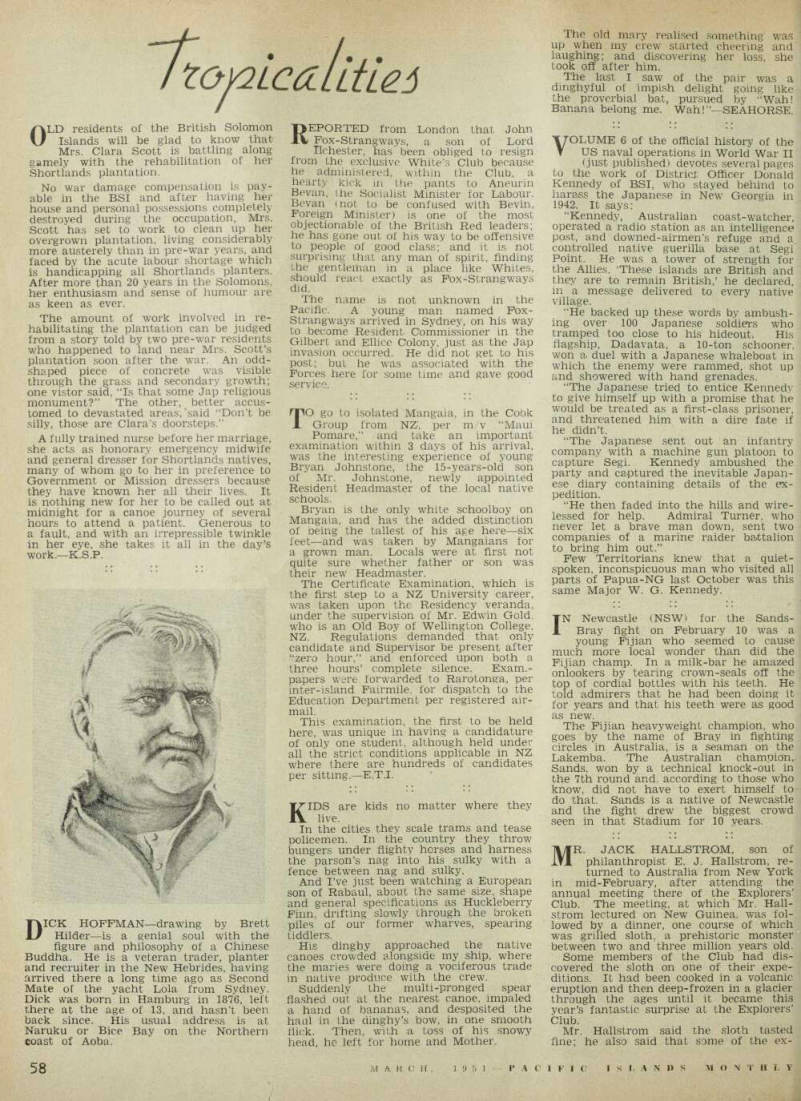
DICK HOFFMAN—drawing by Brett Hilder—is a genial soul with the figure and philosophy of a Chinese Buddha. He is a veteran trader, planter and recruiter in the New Hebrides, having arrived there a long time ago as Second Mate of the yacht Lola from Sydney.
Dick was born in Hamburg in 1876, left there at the age of 13, and hasn’t been back since. His usual address is at Naruku or Bice Bay on the Northern coast of Aoba.
REPORTED from London that John Pox-Strangways, a son of Lord Tlchester, has been obliged to resign from the exclusive White’s Club because he administered, within the Club, a hearty kick in the pants to Aneurin Sevan, the Socialist Minister for Labour.
Bevan (not to be confused with Bevin, Foreign Minister) is one of the most objectionable of the British Red leaders; he has gone out of his way to be offensive to people of good class; and it is not surprising that any man of spirit, finding the gentleman in a place like Whites, should react exactly as Pox-Strangways did.
The name is not unknown in the Pacific. A young man named Pox- Strangways arrived in Sydney, on his way to become Resident Commissioner in the Gilbert and Ellice Colony, just as the Jap invasion occurred. He did not get to his post; but he was associated with the Forces here for some time and gave good service.
TO go to isolated Mangaia, in the Cook Group from NZ‘, per m/v “Maui Pomare,” and take an important examination within 3 days of his arrival, was the interesting experience of young Bryan Johnstone, the 15-years-old son of Mr. Johnstone, newly appointed Resident Headmaster of the local native schools.
Bryan is the only white schoolboy on Mangaia, and has the added distinction of being the tallest of his age here—six feet —and was taken by Mangaians for a grown man. Locals were at first not quite sure whether father or son was their new Headmaster.
The Certificate Examination, which is the first step to a NZ University career, was taken upon the Residency veranda, under the supervision of Mr. Edwin Gold, who is an Old Boy of Wellington College.
NZ. Regulations demanded that only candidate and Supervisor be present after “zero hour,” and enforced upon both a three hours’ complete silence. Exam.papers were forwarded to Rarotonga, per inter-island Fairmile. for dispatch to the Education Department per registered air mail.
This examination, the first to be held here, was unique in having a candidature of only one student, although held under all the strict conditions applicable in NZ where there are hundreds of candidates
per sitting.
E.T.I.
KIDS are kids no matter where they live.
In the cities they scale trams and tease policemen. In the country they throw hungers under flighty horses and harness the parson’s nag into his sulky with a fence between nag and sulky.
And I’ve just been watching a European son of Rabaul, about the same size, shape and general specifications as Huckleberry Finn, drifting slowly through the broken piles of our former wharves, spearing tiddlers.
His dinghy approached the native canoes crowded alongside my ship, where the maries were doing a vociferous trade in native produce with the crew.
Suddenly the multi-pronged spear flashed out at the nearest canoe, impaled a hand of bananas, and desposited the haul in the dinghy’s bow, in one smooth flick. Then, with a toss of his snowy head, he left for home and Mother.
The old mary realised something was up when my crew started cheering and laughing; and discovering her loss, she took off after him.
The last I saw of the pair was a dinghyful of impish delight going like the proverbial bat, pursued by “Wah!
Banana belong me. Wah!”—SEAHORSE.
VOLUME 6 of the official history of the US naval operations in World War II (just published) devotes several pages to the work of District Officer Donald Kennedy of BSI, who stayed behind to harass the Japanese in New Georgia in 1942. It says: ‘‘Kennedy, Australian coast-watcher, operated a radio station as an intelligence post, and downed-airmen’s refuge and a controlled native guerilla base at Segi Point. He was a tower of strength for the Allies. ‘These islands are British and they are to remain British,’ he declared, in a message delivered to every native village. ‘‘He backed up these words by ambush ing over 100 Japanese soldiers who tramped too close to his hideout. His flagship, Dadavata, a 10-ton schooner, won a duel with a Japanese whaleboat in which the enemy were rammed, shot up and showered with hand grenades. ‘‘The Japanese tried to entice Kennedy to give himself up with a promise that he would be treated as a first-class prisoner, and threatened him with a dire fate if he didn’t.
“The Japanese sent out an infantry company with a machine gun platoon to capture Segi. Kennedy ambushed the party and captured the inevitable Japan ese diary containing details of the ex pedition.
“He then faded into the hills and wire lessed for help. Admiral Turner, who never let a brave man down, sent two companies of a marine raider battalion to bring him out.”
Few Territorians knew that a quiet spoken, inconspicuous man who visited all parts of Papua-NG last October was this same Major W. G. Kennedy.
IN Newcastle (NSW> for the Sands- Bray fight on February 10 was a young Fijian who seemed to cause much more local wonder than did the Fijian champ. In a milk-bar he amazed onlookers by tearing crown-seals off the top of cordial bottles with his teeth. He told admirers that he had been doing it for years and that his teeth were as good as new.
The Fijian heavyweight champion, who goes by the name of Bray in fighting circles in Australia, is a seaman on the Lakemba. The Australian champion, Sands, won by a technical knock-out in the 7th round and, according to those who know, did not have to exert himself to do that. Sands is a native of Newcastle and the fight drew the biggest crowd seen in that Stadium for 10 years.
Mr. Jack Hallstrom, Son Of
philanthropist E. J. Hallstrom, re turned to Australia from New York in mid-February, after attending the annual meeting there of the Explorers’
Club. The meeting, at which Mr. Hall strom lectured on New Guinea, was fol lowed by a dinner, one course of which was grilled sloth, a prehistoric monster between two and three million years old.
Some members of the Club had dis covered the sloth on one of their expe ditions. It had been cooked in a volcanic eruption and then deep-frozen in a glacier through the ages until it became this year’s fantastic surprise at the Explorers’
Club.
Mr. Hallstrom said the sloth tasted fine; he also said that some of the ex
plorers would probably visit New Guinea shortlv. They may find sloths there— but not of the prehistoric kind. (That last comment is ours—not Mr. Hall strom’s): WHEN Mr. Bertram Batt, a New Ire land coconut planter asked the Mayor of Flensburg, North Germany, to find him a wife, he seems to have started something'. Not only has it given newspapers all over the world a top grade “human interest story” but it has sent a flood of similar requests to Flens burg’s mayor from British Empire bache lors who evidently despair of getting themselves wives through more orthodox channels.
The Mayor chose Gisela Hansen for Mr.
Batt. She is a 19-years-old typist and, from her photograph—which has had as wide a distribution as that of a film star —she appears to be an attractive brunette.
Gisela is shown pointing to a map on a wall. On the top of the map are the words Papua-New Guinea and, under neath that, something that looks like “Colyer Watson.” Apparently Gisela knows where she is going. According to a Hamburg source sne says: “Mr. Batt is the kind of man I always longed for. I thought, until now, that such men existed only in dreams.”