Australia's New
pp. 58-85 · Read in the full issue
This
Dominion-
By R. W Robson
TF any Australian quiz-master asked, “What new dominion, ten thousand square miles in extent and containing a half million to one million people, was acquired by Australia be tween 1930 and 1933?” the chances are that he would get no answer.
Australians know nothing and care less about the New Guinea Highlands, that vast, cool, fertile region of green valleys and jungle-clad ranges, which lies at an average altitude of 5,000-6,000 feet, and which has been called “a second Kenya.” When Australia took over New Guinea in 1914, no one knew that the New Guinea Highlands existed—they were not dis covered and explored until prospectors from the Morobe goldfields began to penetrate the interior at the end of the ’twenties.
Pedants will point out that this is not Australian territory—that it is part of the New Guinea which is now held in trust by the United Nations. We need not worry about that—the UN still is very much an experiment. For all practical and material purposes, New Guinea, and the central plateaus of that region, are completely the responsibility of Australia. Periodical visits by parties of pettifoggers, called United Nations missions, are merely a nuisance to be suffered in silence.
Behind both the north and the south coasts of the 2,000-miles-long island there are high and almost impassable mountain ranges. Between these two chains of mountain systems lies, as on a great plateau, this vast network of valley systems, drained by several large rivers— the Sepik and the Ramu, which flow to the north coast; the smaller Markham, which flows east; and the Purari, the Fly, and several smaller streams, which flow to the south coast.
ATYPICAL valley system may be 20 miles wide and 50 miles long. A large river runs through it. It lies at about 5,000 feet, but the ranges which hem it in on all sides may go up another 3,000 to 5,000 feet. The valley is almost entirely without timber—it is simply a wide expanse of rolling grass-land which, trom a plane, looks like excellent pasture.
Little valleys run from the main valley into the mountains; and from these valleys and from points part-way up the foothills, the timber commences; and the
jungle continues practically to the mountain-tops.
Generally, the natives live, not in the main valleys, but in the smaller valleys among the foothills; and the houses of the natives who live farthest out are almost always perched on the razor-backs. So great has been the erosion, over the ages, of these volcanic formations that practic ally all the hills and mountains of New Guinea are razor-backs.
All the tracks in these regions follow the topmost ridge of the razor backs. Few tracks seem wider that a couple of dozen inches. The houses cling to the steep hillsides, just below the track. The oldest joke in New Guinea says that the natives, bred to this envoronment, have one leg five inches shorter that the other.
ALTHOUGH completely primitive—it is
barely 20 years since they first saw white men—the Highlands natives are goodlooking, intelligent, high-spirited, small of stature. Their forebears seem to have been the first inhabitants: there is little, if any evidence of a former culture.
Although they are clearly of the same race as the coastal dwellers, they more closely conform to one type. They, in their highland isolation, have not been subjected to the same invasions and race modifications as the coastal natives.
Among all Pacific Islands races, they are most notable for their agricultural technique. They cultivate their lands in neat and accurate squares and rectangles; they bring water, in races, long distances
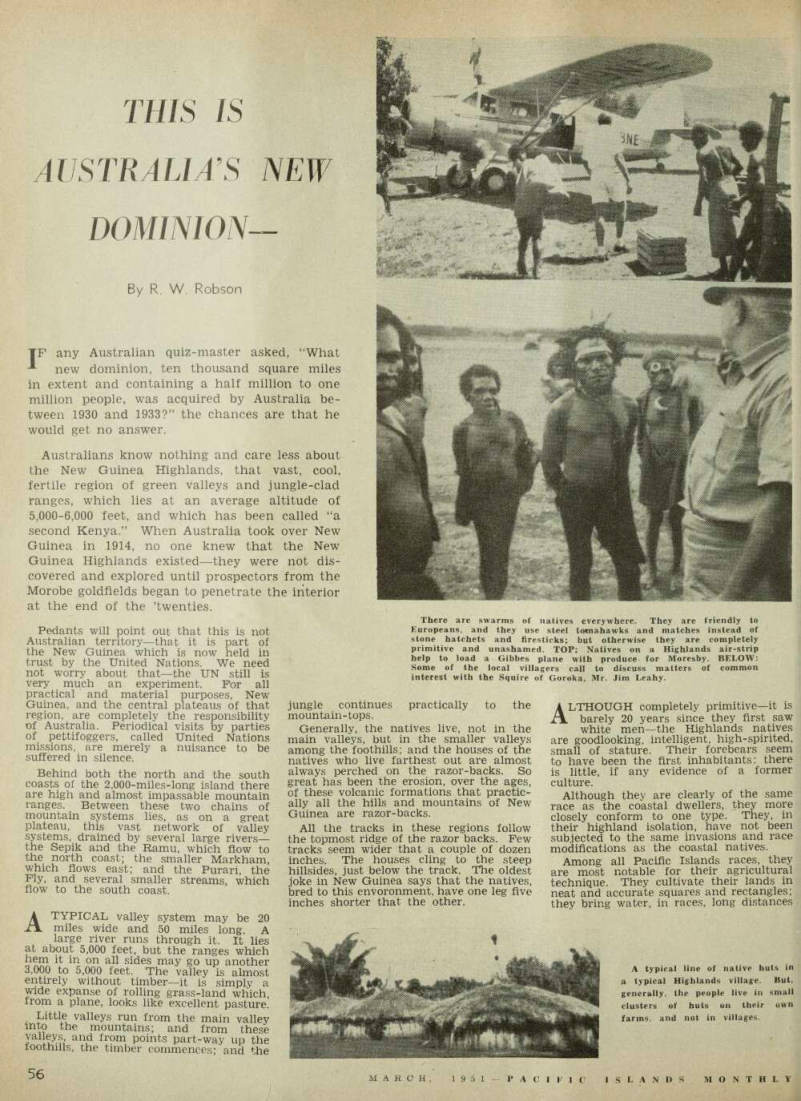
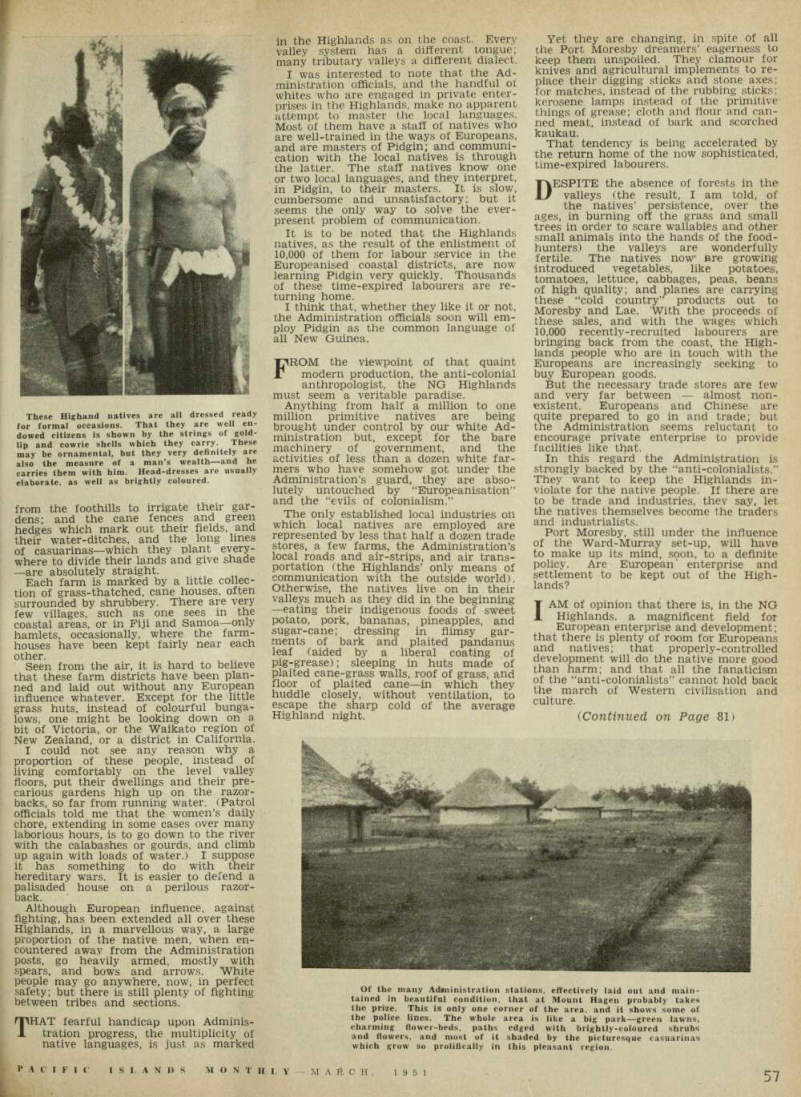
There are swarms of natives everywhere. They are friendly to Europeans, and they use steel tomahawks and matches instead of stone hatchets and firesticks; but otherwise they are completely primitive and unashamed. TOP: Natives on a Highlands air-strip help to load a Gibbes plane with produce for Moresby. BELOW: Some of the local villagers call to discuss matters of common interest with the Squire of Goroka, Mr. Jim Leahy.
A typical line of native huts in a typical Highlands village. But, generally, the people live in small clusters of huts on their own farms, and not in villages.
from the foothills to irrigate their gar dens; and the cane fences and green hedges which mark out their fields, and their water-ditches, and the long lines of casuarinas—which they plant every where to divide their lands and give shade —are absolutely straight.
Each farm is marked by a little collec tion of grass-thatched, cane houses, often surrounded by shrubbery. There are very few villages, such as one sees in the coastal areas, or in Fiji and Samoa —only hamlets, occasionally, where the farm houses have been kept fairly near each other.
Seen from the air, it is hard to believe that these farm districts have been plan ned and laid out without any European influence whatever. Except for the little grass huts, instead of colourful bunga lows, one might be looking down on a bit of Victoria, or the Waikato region of New Zealand, or a district in California.
I could not see any reason why a proportion of these people, instead of living comfortably on the level valley floors, put their dwellings and their pre carious gardens high up on the razor backs, so far from running water. (Patrol officials told me that the women’s daily chore, extending in some cases over many laborious hours, is to go down to the river with the calabashes or gourds, and climb up again with loads of water.) I suppose it has something to do with their hereditary wars. It is easier to defend a palisaded house on a perilous razor back.
Although European influence, against fighting, has been extended all over these Highlands, in a marvellous way, a large proportion of the native men, when en countered away from the Administration posts, go heavily armed, mostly with spears, and bows and arrows. White people may go anywhere, now, in perfect safety; but there is still plenty of fighting between tribes and sections.
THAT fearful handicap upon Adminis tration progress, the multiplicity of native languages, is just as marked
in the Highlands as on the coast. Every valley system has a different tongue; many tributary valleys a different dialect.
I was interested to note that the Ad ministration officials, and the handful of whites who are engaged in private enter prises in the Highlands, make no apparent attempt to master the local languages.
Most of them have a staff of natives who are well-trained in the ways of Europeans, and are masters of Pidgin; and communi cation with the local natives is through the latter. The staff natives know one or two local languages, and they interpret, in Pidgin, to their masters. It is slow, cumbersome and unsatisfactory: but it seems the only way to solve the ever present problem of communication.
It is to be noted that the Highlands natives, as the result of the enlistment of 10,000 of them for labour service in the Europeanised coastal districts, are now learning Pidgin very quickly. Thousands of these time-expired labourers are re turning home.
I think that, whether they like it or not, the Administration officials soon will em ploy Pidgin as the common language of all New Guinea.
FROM the viewpoint of that quaint modern production, the anti-colonial anthropologist, the NG Highlands must seem a veritable paradise.
Anything from half a million to one million primitive natives are being brought under control by our white Ad ministration but, except for the bare machinery of government, and the activities of less than a dozen white far mers who have somehow got under the Administration’s guard, they are abso lutely untouched by “Europeanisation” and the “evils of colonialism.”
The only established local industries on which local natives are employed are represented by less that half a dozen trade stores, a few farms, the Administration’s local roads and air-strips, and air trans portation (the Highlands’ only means of communication with the outside world).
Otherwise, the natives live on in their valleys much as they did in the beginning —eating their indigenous foods of sweet potato, pork, bananas, pineapples, and sugar-cane; dressing in flimsy gar ments of bark and plaited pandanus leaf (aided by a liberal coating of pig-grease); sleeping in huts made of plaited cane-grass walls, roof of grass, and floor of plaited cane—in which they huddle closely, without ventilation, to escape the sharp cold of the average Highland night.
Yet they are changing, in spite of all the Port Moresby dreamers’ eagerness to keep them unspoiled. They clamour for knives and agricultural implements to re place their digging sticks and stone axes; for matches, instead of the rubbing sticks: kerosene lamps instead of the primitive things of grease; cloth and flour and can ned meat, instead of bark and scorched kßiik^u That tendency is being accelerated by the return home of the now sophisticated, time-expired labourers.
DESPITE the absence of forests in the valleys (the result, I am told, of the natives’ persistence, over the ages, in burning off the grass and small trees in order to scare wallabies and other small animals into the hands of the food hunters) the valleys are wonderfully fertile. The natives now 1 are growing introduced vegetables, like potatoes, tomatoes, lettuce, cabbages, peas, beans of high quality; and planes are carrying these “cold country” products out to Moresby and Lae. With the proceeds of these sales, and with the wages which 10,000 recently-recruited labourers are bringing back from the coast, the High lands people who are in touch with the Europeans are increasingly seeking to buy European goods.
But the necessary trade stores are few and very far between almost non existent. Europeans and Chinese are quite prepared to go in and trade; but the Administration seems reluctant to encourage private enterprise to provide facilities like that.
In this regard the Administration is strongly backed by the “anti-colonialists.”
They want to keep the Highlands in violate for the native people. If there are to be trade and industries, they say, let the natives themselves become the traders and industrialists.
Port Moresby, still under the influence of the Ward-Murray set-up, will have to make up its mind, soon, to a definite policy. Are European' enterprise and settlement to be kept out of the High lands?
IAM of opinion that there is, in the NG Highlands, a magnificent field for European enterprise and development; that there is plenty of room for Europeans and natives; that properly-controlled development will do the native more good than harm; and that all the fanaticism of the “anti-colonialists” cannot hold back the march of Western civilisation and culture.
(Continued on Page 81)
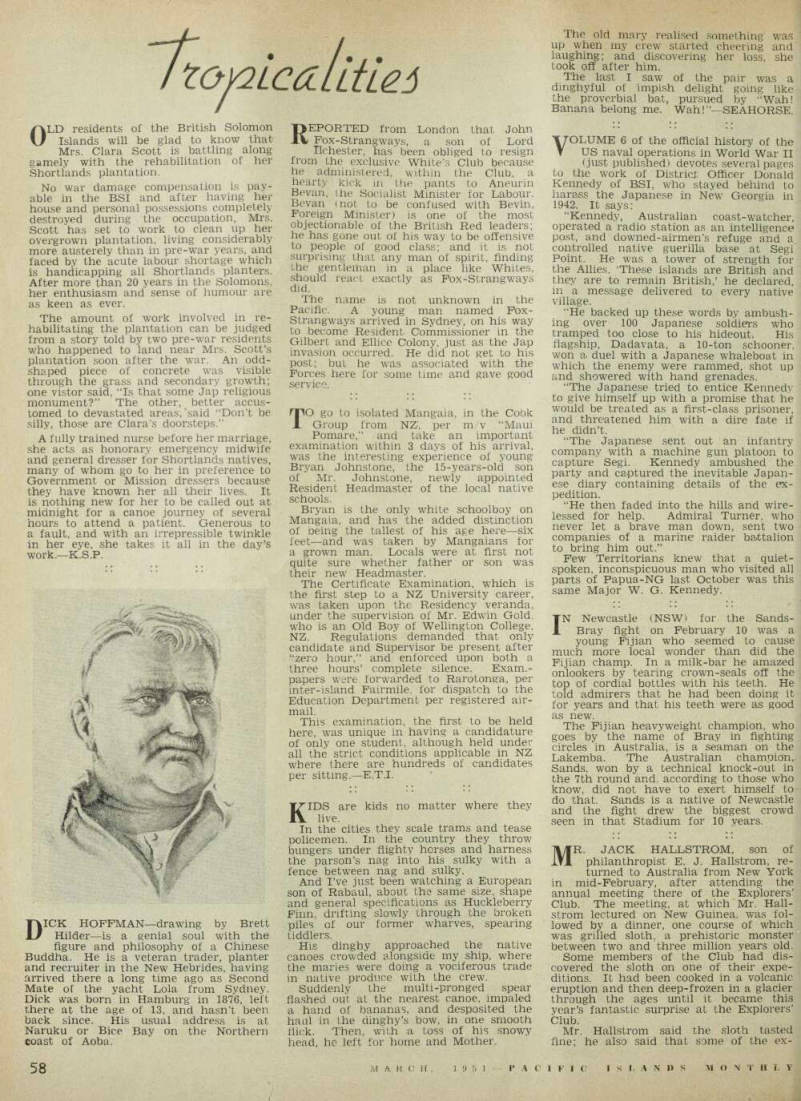
These Highand natives are all dressed ready for formal occasions. That they are well en dowed citizens is shown by the strings of gold lip and cowrie shells which they carry. These may be ornamental, but they very definitely are also the measure of a man’s wealth —and he carries them with him. Head-dresses are usually elaborate, as well as brightly coloured.
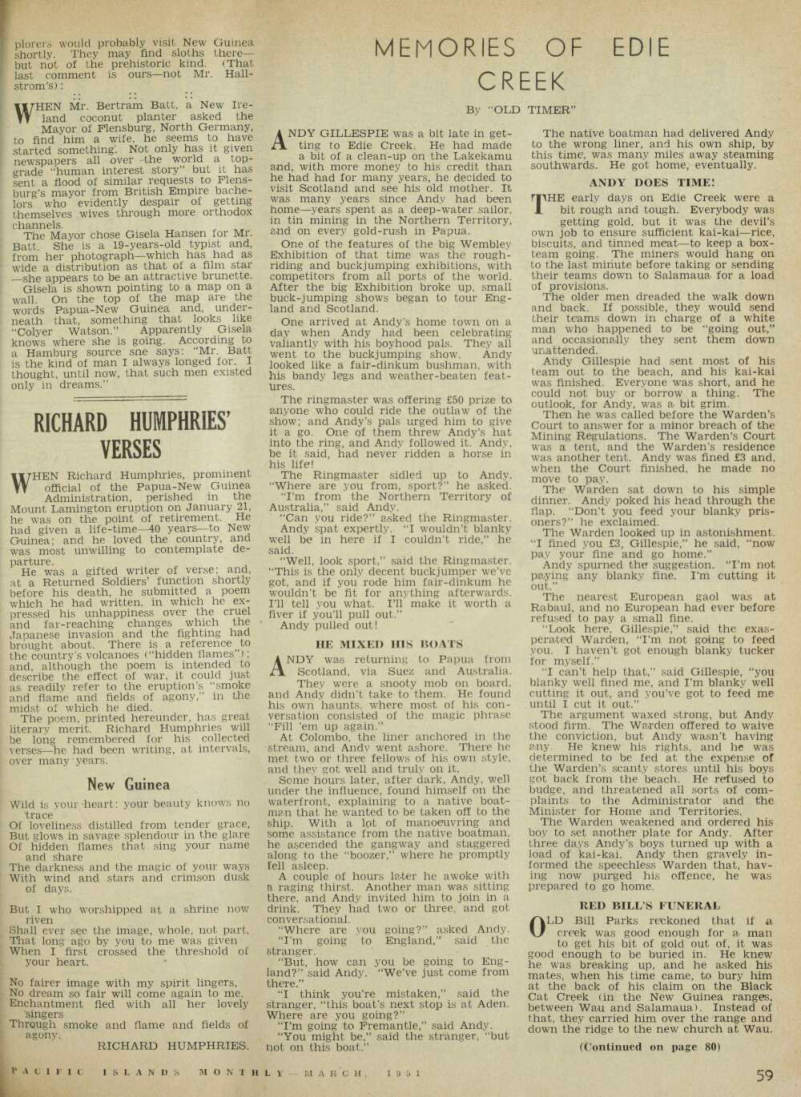
Of the many Administration stations, effectively laid out and main tained in beautiful condition, that at Mount Hagen probably takes the prize. This is only one corner of the area, and it shows some of the police lines. The whole area is like a big park—green lawns, charming flower-beds, paths edged with brightly-coloured shrubs and flowers, and most of it shaded by the picturesque casuarinas which grow so prolifically in this pleasant region
I think that the certainty of European settlement should be accepted, and planned for. A survey should be made to ascertain exactly what are the possibilities of agri cultural and pastoral development by private enterprise; what must be done to protect the interests of the natives and give them security; and to see how to deal with the problems of providing local transportation, adeo.uate communication with the coast, hydro-electric power, building materials, and so forth.
IN the past decade, the Administration has done an extraordinarily good job in bringing all this vast area under control.
It has been done by the progressive establishment of air-strips. The first air strips were in the vicinity of Kainantu, close to the mountain barrier between the Markham Valley (which leads up from Lae) and the first of the valley systems, around the headwaters of the Ramu and Purari Rivers. There, an Administration post was placed alongside the best air strip.
Then, step by step (or valley by valley) the Administration pushed its way west ward. Patrols went out, climbed across the mountain barriers into the next valley, established another air-strip; planes came in with personnel and supplies; another Administration post was built up; and so on.
Selected Administration officials, as they went on from valley to valley, exercised the greatest care in making contact with the inhabitants; with the result that, practically without exception, they have gained the trust, goodwill and co operation of the natives.
Wherever I went, I was impressed with the obvious good relations between the whites and the natives. Without ex ception, native headmen came smilingly but most respectfully to Mr. George Greathead, the experienced District Com missioner who is like an uncrowned king, ruling over this vast region; even the lines of native women, toiling along the tracks under incredible loads—they are the Highlands beasts of burden—recognised and greeted him.
Up on his lonely mountain-top farm, beyond Hagen, I saw Mr. Dan Leahy dealing out rough justice to natives who came to his door with their complaints, based mostly on local quarrels. Through his Pidgin-speaking kitchen-boys, who acted as interpreters, Mr. Leahy listened patiently to the stories, and either gave a decision, which was, accepted un questionably, or told them to go and see the Kiap (Assistant District Officer).
The Administration posts now extend far over into the west, beyond Wabag, be tween Hagen and the Dutch border; and into the south, beyond the Papuan border.
There, a new station has just been opened at Mendi, at the junction of the Mendi and Menken Rivers, 18 miles southwest of Mount Giluwe (13,660 feet—the highest mount in New Guinea). . The headquarters of District Commis sioner Greathead are at Goroka, in the broad Goroka Valley, 70 miles west of Lae—but separated from Lae by two or three mountain barriers which seem impassable. Westward of Goroka is the Kirigomin Range; and beyond that a series of mighty valley systems—the Chimbu-Wahgi region—leading on to the Hagen valley systems. Thence one goes northwards into the Baiyer-Sepik system, westward into the Wabag system, south wards into the Mendi-Menken system, which leads on to Lake Kutubu and the Papuan gulf.
THE administration is based on air transport, and the air strips. There are some quite good roads in the valleys; but most of the valleys are ringed in by the impassible mountain chains.
There are half a dozen sub-districts in charge of Assistant District Officers under DC Greathead’s care; and each, in its isolated valley, or series of valleys, operates almost as a self-contained unit.
Each ADO has a jeep or two; but there
is little inter-valley jeep communication, DC Greathead gets around his wide kingdom in a tiny hired plane. A day spent with him, skimming the mountam taps, nosing down into isolated green valleys, chasing around the shoulders of 13,000 ft. peaks looking' for stands of Hoop Pine, is an experience that this writer never will forget, Everything in the Highlands moves by plane. The rocky peaks literally yammer
at one. Fogs hang around at all hours of the day. Like all the works of human hands, plane engines are fallible. Yet one never hears of a plane accident in the Highlands. Touch wood!
The air transport companies—especially Qantas, Mandated Airlines and Bobby Gibbes’ Aitape-based carriers—have done a really wonderful job in assisting the Government to put administrative mach inery into this wide and dangerous territory. But a stage now has been reached when something more than passenger planes is needed.
The Highlands most urgently need trucks, road-making and earth-moving machinery, generators whereswith to har ness the big streams which rush everlast ingly out of the mountains, and heavy equipment generally. Such things cannot come in in little planes.
At Goroka I went for a walk. I found a road-making gang at work. Fifty natives, like a string of ants, were carry ing gravel on bits of tin, cut from the tops of kerosene cans, from a creekbed a quarter-mile to a place where an overseer used his hands to spread the gravel on the jeep -track.
Rather staggered, I asked an official why this primitive system was followed.
Being limited by the planes, they have difficulty in getting even the simplest road-making equipment. The rainy season was due; the jeep must run between the Government station and the air-strip; so, to avoid bogging, they got a trafficable road by using 50 natives and 50 bits of tin.
One day soon, Qantas are going to use Bristol freighters to fly heavy machinery into the Highlands, as well as pedigree bulls and prefabricated houses and motor spirit, and all the things which spell civilisation and progress. Then the life of an administrative official will contain fewer headaches.
But there can be no real settlement and development in the Highlands, on orthodox lines, until a motor-road con nects this beautiful country with the coast—either at Madang or Lae. The problem of the road is discussed in another article. It ties in with the prob lem of the Markham Bridge.
THE only European interests which the Administration, so far, has allowed to enter the Highlands are the missionaries. Otherwise, only a selected half-dozen individuals have been admitted.
Stations representative of most of the denominations are already established: and, to the extent that these organisations assist in the education and medical care of the natives, they deserve encourage ment and assistance.
But, in my tour of the Highlands, I several times encountered wrathful men who declare that certain classes of missionaries are using all their influence with the natives to prevent the natives from selling land rights to European enterprise. This is something that should have official attention.
It is not the function of missionaries to decide matters of policy. While the opinions of some missionaries should carry weight when mundane affairs are under consideration, there are others who are so simple in character, and so com pletely unworldly, that they certainly should not be allowed to interfere in things of such importance as the disposal of land.
In the case of New Guinea, there are two or three considerations which must rate higher than native welfare when the future use of land is being dealt with. Of course, certain highly-placed persons in and around Port Moresby and Lake Success will foam at the mouth over such a proposition; but it is quite seriously advanced.
The future of the New Guinea High
lands, in relation to New Guinea’s development and Australia’s defence, should be carefully considered and a policy decided upon, now, while the Highlands still are virgin territory. In connection with that, the representations of the missionaries should receive every consideration. But for the missionaries, at this stage, to take it upon themselves to try to keep European enterprise out of the Highlands, by opposing land trans actions, is something that will not be tolerated, and must create bad feeling.
It is in the interests of everyone in the Highlands that the Australian Government should decide upon a policy soon— and say whether private enterprise is, or is not, to be permitted in the Highlands.
But that is not to say that the Australian Government will do it.
The only positive policies we have had from Australia in relation to New Guinea came in 1945-6 from the Socialist set-up of the Ward-Murray regime, which produced mostly confusion and frustration; and in 1950 from the forthright Mr. Spender, which has been well and truly sabotaged by high officials who don’t like Mr.
Spender, ..
The NG Highlands, for years to come, probably will remain officially another Shangri-La—isolated, peaceful, cool and beautiful. Perhaps someone could get per mission to build a big accommodation house in one of the more lovely places, like Mount Hagen, so that travel-weary people could go in and have a look at a region that really is unique.