On Bougainville In
pp. 41-80 · Read in the full issue
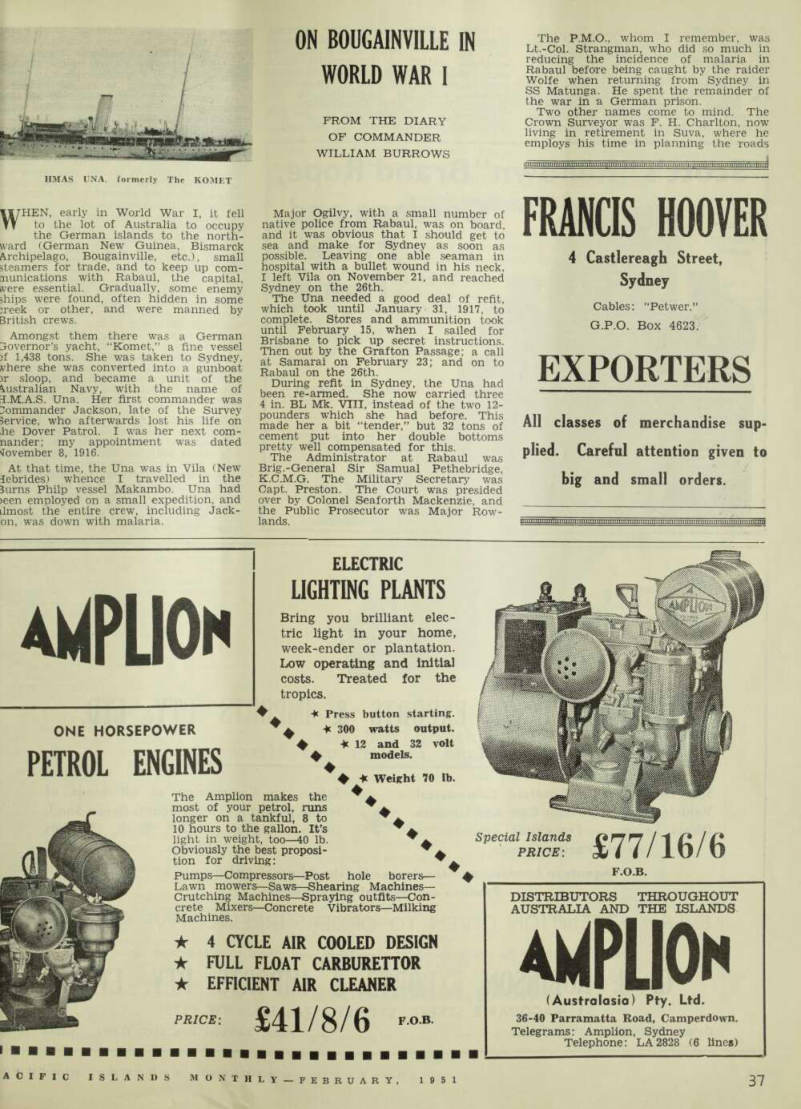

World War I
From The Diary
Of Commander
William Burrows
Major Ogilvy, with a small number of native police from Rabaul, was on board, and it was obvious that I should get to sea and make for Sydney as soon as possible. Leaving one able seaman in hospital with a bullet wound in his neck, I left Vila on November 21, and reached Sydney on the 26th.
The Una needed a good deal of refit, which took until January 31, 1917, to complete. Stores and ammunition took until February 15, when I sailed for Brisbane to pick up secret instructions.
Then out by the Grafton Passage: a call at Samarai on February 23; and on to Rabaul on the 26th.
During refit in Sydney, the Una had been re-armed. She now carried three 4 in. BL Mk, VIII, instead of the two 12pounders which she had before. This made her a bit “tender,” but 32 tons of cement put into her double bottoms pretty well compensated for this.
The Administrator at Rabaul was Brig.-General Sir Samual Pethebridge, K.C.M.G. The Military Secretary was Capt. Preston. The Court was presided over by Colonel Seaforth Mackenzie, and the Public Prosecutor was Major Row lands.
The P.M.0., whom I remember, was Lt.-Col. Strangman, who did so much in reducing the incidence of malaria in Rabaul before being caught by the raider Wolfe when returning from Sydney in SS Matunga. He spent the remainder of the war in a German prison.
Two other names come to mind. The Crown Surveyor was F. H. Charlton, now living in retirement in Suva, where he employs his time in planning the roads
of the rapidly growing town. Another— who will appear later as my Chief Engi neer on the Una, is settled in retirement at Levuka, Fiji.
AS Captain of the Una, it was in no way part of my duty to, become in volved in administration difficulties.
To show the flag—yes—and, in doing so, to report to the Administrator anything
of interest which might have occurred.
But something in a different category had come to light concerning the southern portion of Bougainville, which came under Rabaul, and the Shortland Islands, which form part of the Solomon Islands, and are controlled by the Western Pacific High Commission.
Independent investigation on the spot was most desirable and my instruction,
to see what facts could be elucidated, came from the highest authority.
The file on the subject was voluminous, and included reports that, in the Kieta- Buin area, native police boys had shot natives for refusing to act as carriers.
Food gardens had been destroyed for the same reason. One European officer had shot a native carrier.
All this disturbance had created among the natives a wish to escape to the Short lands and obtain work on the plantations there. They went by canoes, and some times in cutters. A native regulation of the Solomons was that no natives from Bougainville were allowed to be recruited for the British Solomons.
I visited the Native Affairs office and obtained much local information. The Chief of Police supplied me with one sergeant and 10 police, all German trained, and none of them from Bougain ville. They would be my body-guard, for I had no intention of landing any sea men. As a companion, I would take my Chief Engineer, Whittle. He was the officer who could best be spared. There was little likelihood of the Una’s engines wanting expert handling after her recent refit.
I informed the Administrator that I intended to sail for Kieta first; then Buin; and, thirdly, Faisi, in the Solomons.
How long I would be away it was then impossible to say—perhaps 10 or 12 days.
AT Kieta, I found a young District Officer who had only been in the country a few months. He was the only white man on the station, and his police were not under control. He com plained that he had not enough of them to do any patrolling and he was virtually a prisoner in his own compound.
Lacking information at Kieta, I de cided to make for the Mission Station at Buin. The DO gave me a letter of intro
duction to the two priests there—Fathers Grisward and Bucelet.
I timed my arrival off Buin for 4 p.m., on April 13, and handed over the com mand to Lt. Heriot, with the following instructions:— “On my landing at Buin you are to proceed to Tonolei Harbour and anchor Una as convenient. Steam is to be re tained at short notice during my absence.
The ship is to be off Buin again at 4 p.m., on Monday, 16th. If I am not on the beach, this procedure is to be repeated and inquiries made at the Mission Sta tion and steps taken to trace me.”
It was a lovely calm afternoon as Una approached anchorage, and the drums could be clearly heard, at first starting near the coast, and then taken up farther inland. What they said, one did not know, but it was pretty certain that it was a warning that a warship was in the bay.
Whittle, myself and the police landed near the Mission Station. As soon as the boats returned the Una put to sea.
Again the drums started up. Perhaps this was reporting that the warship had gone again. It was certainly what I wanted them to say!
We camped in the Mission compound where we were hospitably entertained by the Fathers. A sketch map of the district was produced, and guides were offered to put us on the road leading to at least one of the villages where there had been trouble. The man to look for was one named Kopena, the Luluai (chief) of Mamaromino village. It was true he had shot a policeman, but it was probably in self-defence, said the Father.
BEFORE dawn next morning we were on the track which led, for a while, through a muddy swamp—very hard going on slippery logs. The police, how ever, wanted no telling in the matter of assistance to their masters. For the whole time that we were in the bush they worked to pattern: One on each side of Whittle and myself; one out on each flank; the sergeant a few paces ahead; the guides from the Mission station lead ing the way with two police, and the re mainder following in the rear.
They were armed with a short carbine, which was slung, and carried a hatchet.
Their ammunition fitted into a leather belt, which also partly supported a skirt (or sulu) and a haversack, in which were rations and betel nut, and a woollen jersey, for use at night. In the daytime they wore no clothing above the waist.
Their coat was one of coconut oil.
The tough swamp road ended on a river, fortunately shallow, and the trail then rose steeply through a patch of bush. Here we came across a drum house, and called a much-needed halt.
The drum-house, in a small clearing with a palm-thatched roof, contained five drums of the hollowed log type. Two of these were six feet in length; others were smaller and of different shapes. The house gave a view over the bay.
Whitle and I carried water-bottles, but we used them sparingly. Fresh water might be scarce, and coconuts were the substitute. I had a double-barrelled shot gun with me, for pigeons are plentiful in that country.
From here, the single-file track rose steeply. How the police kept their posi tions in the thick bush on the two flanks was a mystery. Only the sergeant, a few naces ahead of me, could hear them, and he very occasionally stopped for a moment to allow them to get a little bit ahead.
By noon, we were in a second drum house and sergeant Peni assured me that there had been no sign of the party hav ing been detected as yet.
According to the sketch map, Mamaro mino, the village of Kopena, was only eight miles from the coast. We were,
and ecid ? d , to d surround the Vlll age before mgxiwa . in cirm-io „i ALICING in single file along a narrow path in the semi-darkness of a tropical forest is liable to get on one’s nerves, and I know that Whittle and I were more than glad when the path opened up on the outskirts of a native food-plantation.
Two sharp notes on Sergeant Peni’s
whistle, and the police came running to wards us. They were immediately de tailed, four to approach the village from the right-hand side and four from the left. If any villagers started to run away, shots were to be fired in the air not to kill. The rest of the party would walk straight into the village, on the main path.
The other side of the plantation hid a small cluster of native houses, close to
(Continued on page 76)
gether, with a certain amount of open space, and it was hard to believe that this was an important village. There was no sign of anyone outside, but one knew that a hundred or two pairs of eyes might be watching us through the loosely-built walls of the houses.
I told Sergeant Peni to blow a long blast on his whistle, and then translate into Pidgin-English what I called out: “Where are all the people of the village? Why are they hidden away?
Where is Kopena, the Luluai? Pernaps they are frightened? But why, etc.”
Presently, a middle-aged, upstanding man came out from one of the houses and walked straight towards us. I re member thinking that this was a courag eous thing to do. He could not have known whether we were friend or foe.
“I am Kopena, the Luluai of thisa village,” he said. “Why have you comes to visit me?”
I said that we had a lot to talk about,,d but not while standing out in the hotf sun. We would sit in the drumhouse„s which stood out clear of the houses..c After we had had some coconuts to drinks there would be a “talk-talk.”
KOPENA was an interesting man, but!
Whittle and I were too tired to talk)! with him then. I had selected thes drum-house in which to sleep that nightJ It would probably be cleaner than anyy of the houses, and I would feel more com fortable with the police camped along side.
Next morning, I decided to attache!
Kopena to my party, not because he hadb shot a policeman—which he frankly ad mitted—but because his knowledge of this; portion of Bougainville would be wel comed in the Native Affairs office inn Rabaul.
The sketch map showed several villages lying to the northward, which I decidedb to visit, taking Kopena with me.
At each I gleaned a little informational which I have long since forgotten. Thea map shows Birilo, and there I slept thes second night ashore.
Collecting a few “desirables,” the partyy returned to Mamaromino, where the third!: night was spent. On April 16, we mades Buin, where the Una was waiting.
Early the next morning I took Unas to Faisi, in the Shortlands, and there meti Dr. Crichlow, the D.M.O. and D.O. II remember my surprise that no Unions Jack was flying at his headquarters. Butt this was easily explained.
Not long before, his only Jack, ragged!: and patched, had succumbed to a gale off wind. On applying to Tulagi for a new* one, he was informed by the storekeeper! there that (a) he should not have flownn it in a gale of wind, and (b) that theres had not been a gale recorded at Faisii: during the previous year!
I was able to supply him with a spares one from “Una.”
Whittle and I felt fairly certain that! after those nights in the jungle, we wer© booked for a go of Malaria, and we had) a bet on who would be down to it firsts I won, but he was a close second.