“Oceania”
pp. 39-41 · Read in the full issue
THE September issue of the well-known anthropological quarterly, Oceania (published by the Australian National Research Council, Science House, Gloucester St., Sydney) contains the usual selection of useful articles. T.
Russell writes on the Fataleka bush people of Malaita; there is an article by Lommel on the influence of modern culture on the Australian aborigines; and John Nilles gives the result of several years of observation of the Kuman tribes of the Chimbu area of the New Guinea Highlands.
WHEN, early in World War I, it fell to the lot of Australia to occupy the German islands to the north ward (German New Guinea, Bismarck Archipelago, Bougainville, etc.), small steamers for trade, and to keep up com munications with Rabaul, the capital, were essential. Gradually, some enemy shins were found, often hidden in some ;reek or other, and were manned by British crews.
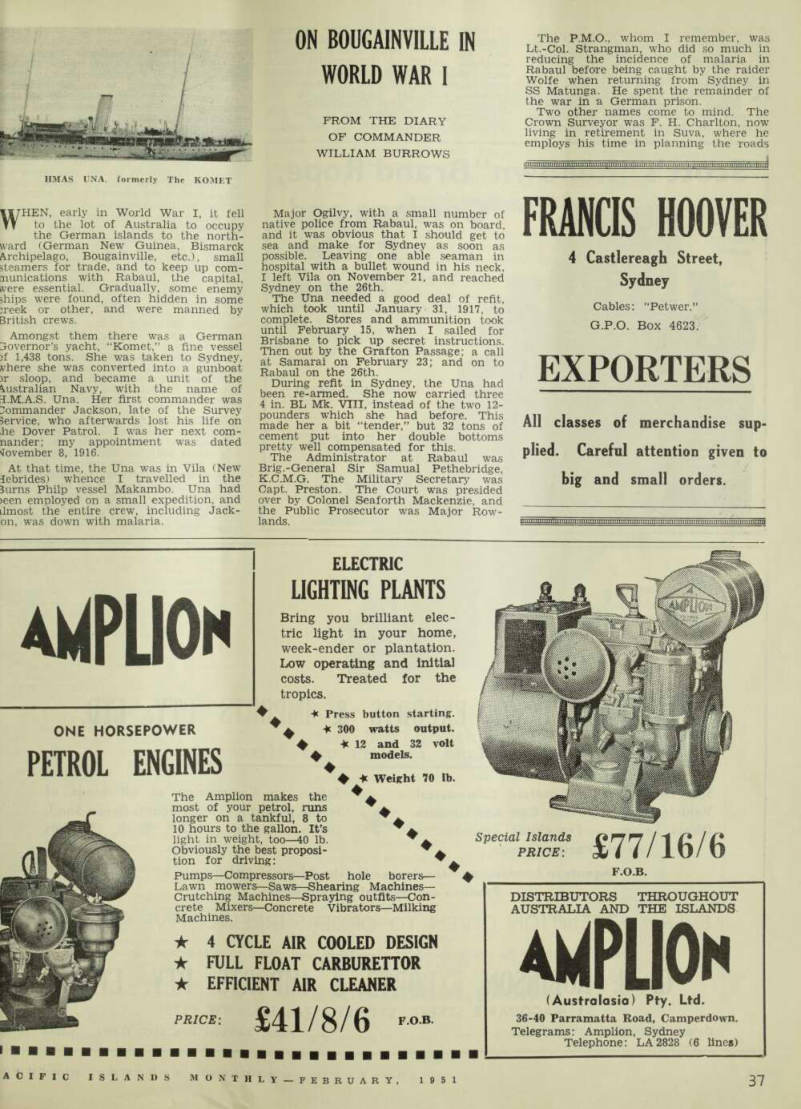
Amongst them there was a German governor’s yacht, “Komet,” a fine vessel )f 1,438 tons. She was taken to Sydney, where she was converted into a gunboat >r sloop, and became a unit of the \ustralian Navy, with the name of 3.M.A.5. Una. Her first commander was Commander Jackson, late of the Survey Service, who afterwards lost his life on he Dover Patrol. I was her next com nander; my appointment was dated November 8, 1916.
At that time, the Una was in Vila (New lebrides) whence I travelled in the Burns Philp vessel Makambo. Una had >een employed on a small expedition, and ilmost the entire crew, including Jack on, was down with malaria.
HMAS UNA, formerly The KOMET