Vale, “Dicky” Humphries
p. 17 · Read in the full issue
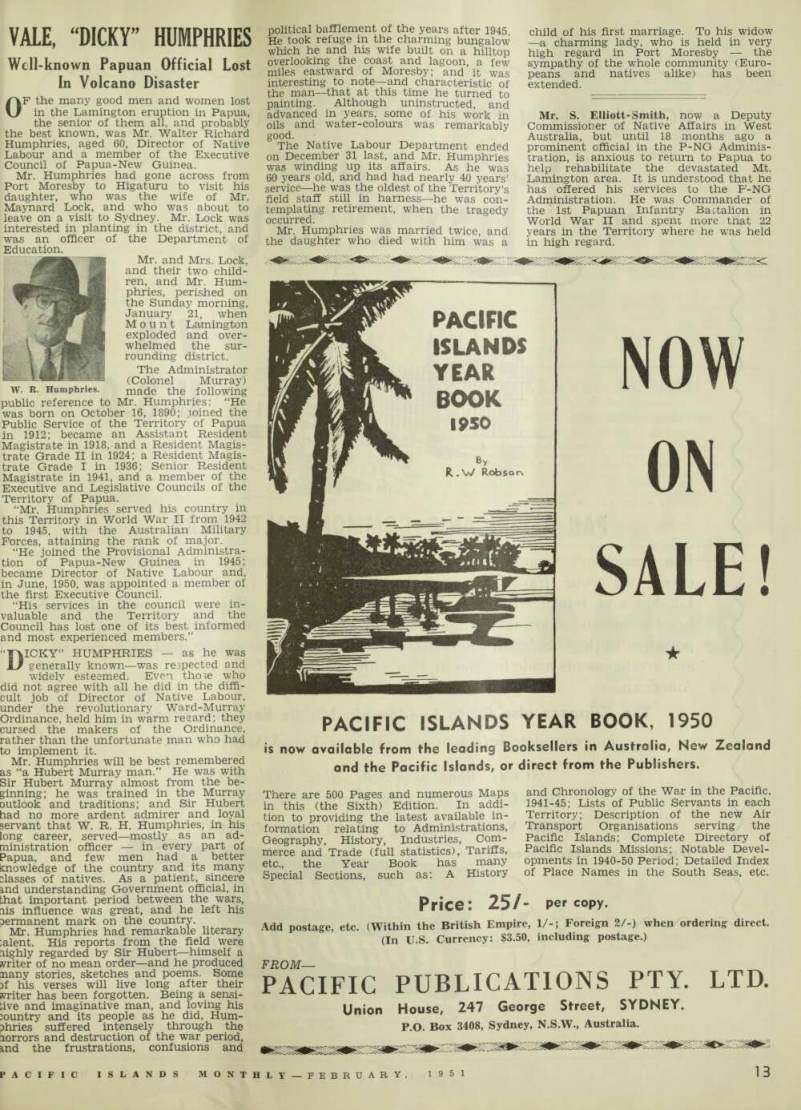
Well-known Papuan Official Lost In Volcano Disaster
OF the many good men and women lost in the Lamington eruption in Papua, the senior of them all, and probably the best known, was Mr. Walter Richard Humphries, aged 60, Director of Native Labour and a member of the Executive Council of Papua-New Guinea.
Mr. Humphries had gone across from Port Moresby to Higaturu to visit his daughter, who was the wife of Mr.
Maynard Lock, and who was about to leave on a visit to Sydney. Mr. Lock was interested in planting in the district, and was an officer of the Department of Education.
Mr. and Mrs. Lock, and their two child ren, and Mr. Hum phries, perished on the Sunday morning, January 21, when Mount Lamington exploded and over whelmed the sur rounding district.
The Administrator (Colonel Murray) made the following
public reference to Mr. Humphries: “He was born on October 16, 1890; ,ioined the Public Service of the Territory of Papua in 1912; became an Assistant Resident Magistrate in 1918, and a Resident Magis trate Grade II in 1924; a Resident Magis trate Grade I in 1936; Senior Resident Magistrate in 1941, and a member of the Executive and Legislative Councils of the Territory of Papua.
“Mr. Humphries served his country in this Territory in World War II from 1942 to 1945, with the Australian Military Forces, attaining the rank of major.
“He joined the Provisional Administra tion of Papua-New Guinea in 1945; became Director of Native Labour and, in June, 1950, was appointed a member of the first Executive Council.
“His services in the council were in valuable and the Territory and the Council has lost one of its best informed and most experienced members.”
“TRICKY” HUMPHRIES as he was U generally known—was respected and widely esteemed. Even those who did not agree with all he did in the diffi cult job of Director of Native Labour, under the revolutionary Ward-Murray Ordinance, held him in warm regard; they cursed the makers of the Ordinance, rather than the unfortunate man who had to implement it.
Mr. Humphries will be best remembered as “a Hubert Murray man.” He was with Sir Hubert Murray almost from the be ginning; he was trained in the Murray outlook and traditions; and Sir Hubert had no more ardent admirer and loyal servant that W. R. H. Humphries, in his long career, served—mostly as an ad ministration officer in every part of Papua, and few men had a better Imowledge of the country and its many classes of natives. As a patient, sincere md understanding Government official, in that important period between the wars, lis influence was great, and he left his oermanent mark on the country.
Mr. Humphries had remarkable literary :alent. His reports from the field were lighly regarded by Sir Hubert —himself a vriter of no mean order —and he produced many stories, sketches and poems. Some Df his verses will live long after their ivriter has been forgotten. Being a sensi tive and imaginative man, and loving his country and its people as he did, Hum phries suffered intensely through the lorrors and destruction of the war period, md the frustrations, confusions and
political bafflement of the years after 1945 He took refuge in the charming bungalow which he and his wife built on a hilltop overlooking the coast and lagoon, a few miles eastward of Moresby; and it was interesting to note —and characteristic of the man —that at this time he turned to
painting. Although uninstructed, and
advanced in years, some of his work in oils and water-colours was remarkably good.
The Native Labour Department ended on December 31 last, and Mr. Humphries was winding up its affairs. As he was 60 years old, and had had nearly 40 years’ service—he was the oldest of the Territory’s field staff still in harness—he was con templating retirement, when the tragedy occurred.
Mr. Humphries was married twice, and the daughter who died with him was a
child of his first marriage. To his widow —a charming lady, who is held in very high regard in Port Moresby the sympathy of the whole community (Euro peans and natives alike) has been extended.
Mr. S. Elliott-Smith, now a Deputy Commissioner of Native Affairs in West Australia, but until 18 months ago a prominent official in the P-NG Adminis tration, is anxious to return to Papua to help rehabilitate the devastated Mt.
Lamington area. It is understood that he has offered his services to the F-NG Administration, He was Commander of the ' Ist Papuan Infantry Bactalion in World War II and spent more that 22 years in the Territory where he was held in high regard.
W. R. Humphries.