Papua
pp. 15-21 · Read in the full issue

Volcanic Eruption In
Over 30 Europeans and 4,000 Natives Killed by One Blast
From a Special Correspondent
THE story of the Mount Lamington tragedy begins on the morning of Thursday, January 18, when the long dormant volcano began to send up columns of steam. These came from the vicinity of the old crater lake, cupped in the hollow between four peaks.
The eruption aroused much interest, but apparently no alarm, for there were no native villages in the immediate vicinity, and the Higaturu Government station was four miles away.
On Friday morning, the white steam cloud was 20,000 to 25,000 feet high, with a dull red glow in the centre, up to about half the height of the column.
At that time, the cloud showed no rapid movement; but by Friday mid-afternoon the situation had changed. Huge grey black masses were billowing from the volcano to around 30,000 to 35,000 feet,
violently agitated, with the base of the cloud extending over several miles, con stant rumblings were heard, and there were frequent ground tremors.
Then on Sunday morn ing, some time between 10 and 10.30, people at San gara heard a series of ex plosions and saw a huge black cloud sweeping to wards them, at an in credible speed.
They rushed for a truck as the explosions de veloped into a continuous gigantic roar; and, just as it seemed that they would be enveloped in the great black mass of cloud, it veered away. (This ap pears to have been due to a sudden change in the wind).
As they raced the truck along the road to Popan ietta, pumice mud rained down, blacking out the windshield and plastering the driver’s face. The Europeans and natives in the back of the vehicle huddled under grass mats, [t is now known that the earlier outbreaks went straight up; but the Sun day morning explosion Dlew straight out from the lorthern side of the nountain , and it was this ateral blast that did such fearful damage.
AT Popandetta, the women went to the two government louses at the agricultural station, and the men im mediately returned to wards Sangara, with other
European residents from the Popandetta area, to help the survivors of the disaster.
Others also —planters, Government men and mission staff—all made for the stricken area.
At Mongi Mission, they found the Rev.
D. Taylor, Father in charge of the Anglican Mission, who, although terribly burned, had got through to Mongi in search of help. Those who saw him said that only incredible courage and will power could have taken him that far. as he was suffering from shocking injuries.
The truck immediately took him to Popandetta, where he died a few hours later.
The rescue parties went on to Andemba, and other villages, getting injured natives into trucks and down to Popandetta and other emergency dressing stations out of the known danger area. Some died on
the journey out and others after they reached the dressing stations; but many survived and were later flown to hospital at Lae.
No praise is too high for those Euro peans, men and women, who worked un ceasingly in those crowded hours after the Sunday eruptions, before the full knowledge of the catastrophe got through to the outside world.
The men who went into the danger area did so at imminent risk of death; and the womenfolk, after treating the shockingly burned casualties, even helped to bury the dead.
At the Isivita Anglican Mission, the European staff quieted the terrified natives and then worked without pause, treating the injured. Afterwards, they carried through the difficult task of getting most of the injured out of the area.
Later, when the big evacuee camp was established at Wairopi, a member of the Isivita mission continued working among the evacuees.
Rescue Operations
EARLY Monday morning, after brief news of the Lamington disaster had reached Port Moresby, rescue teams flew in to Popandetta, and the Govern ment took over relief and evacuation of the danger area. By early Monday after
(Continued on page 17)
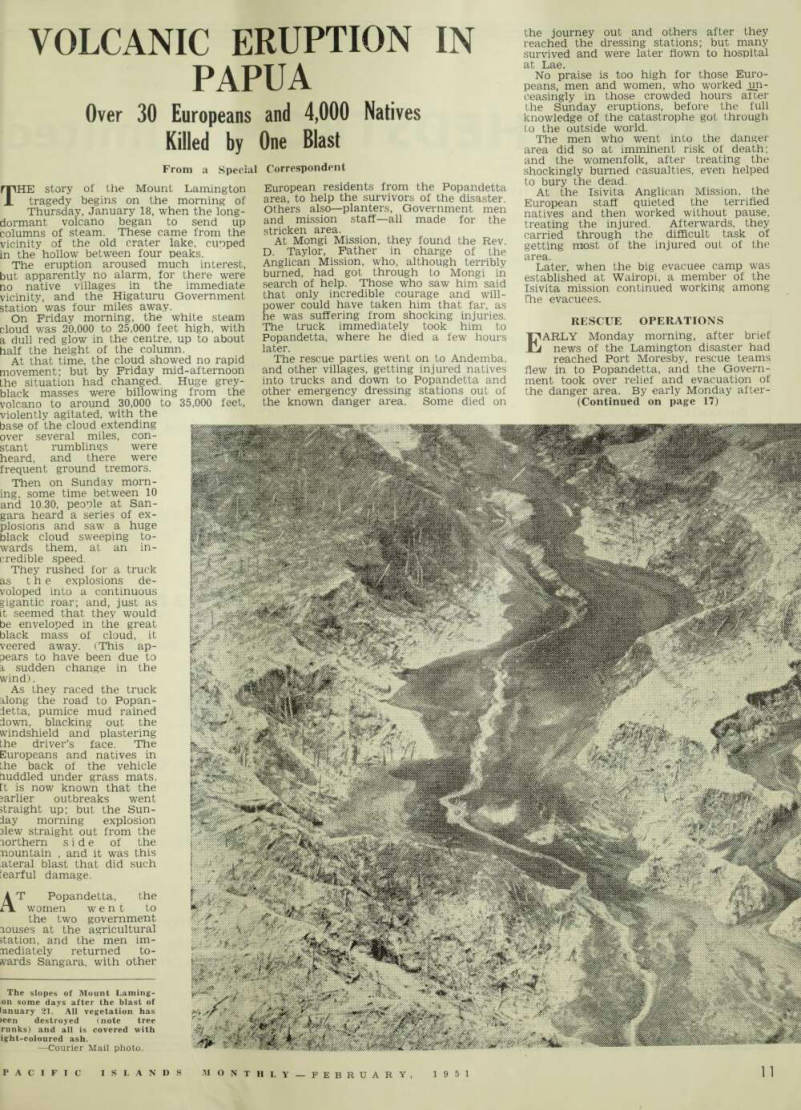
The slopes of Mount Laming on some days after the blast of [?]anuary 21. All vegetation has [?]een destroyed (note tree [?]runks) and all is covered with [?]ight-coloured ash.
Courier Mail photo.
noon more than six planes had arrived at Popendetta airstrip), and the Adminis trator (Colonel Murray), and key Govern ment personnel, had flown over the terribly devastated area.
That night, at emergency headquarters in Popendetta, while casualties were still being treated in the building, a conference was held in another comer of the room, to plan the immediate survey, and the evacuation of the stricken zone.
Early on Tuesday morning patrols moved out to locate any further injured, evacuate the survivors, and try to ascertain the casualties in each area.
It was known from the aerial survey that the blast area extended eight miles deep around the crater, and it was about twenty miles wide. From the air it appeared that nothing had survived the holocaust.
Higaturu itself, previously a garden settlement, and one of the most beautiful in the Territory, had been absolutely flattened to the ground, as though a giant steam roller, spreading a following layer of thick, grey pumice, had passed over the station. The dense tropical foliage around the station grounds had dis appeared entirely—only the stripped grey trunks lay like matchwood under the covering of pumice.
Utter desolation reigned over the vast area of the blast. Rain forests, and the thick tropical growth, villages, bush tracks and the whole once-smiling countryside had completely disappeared, leaving only a wasteland of debris strewn with the bodies of the dead, who lay where the blast had struck them on that smiling Sunday morning.
What The Patrols Found
THE patrol which went into Higaturu first passed through Andemba village, where there were only 12 known survivors out of a population of 400. The victims lay in, under, and around their homes, along the roadsides, in the bush tracks from the adjoining gullies, some huddled into the earth and others sprawling where the blast had struck them.
Moving on along the road to Higaturu, the toll of the dead was equally tragic; and the native co-operative coffee planta tion lay in utter ruin.
But there was even more terrible desolation at Higaturu itself, which was directly in the path of that overwhelming lateral volcanic blast.
Only the District Commissioner’s house remained intact; and this had been lifted off its piles and set down square about twenty yards away. Other homes had collapsed into a pile of wreckage or had been blown right off the ridge into the adjoining gullies.
All that remained of the District Office was the floor of the building, with the two safes toppled over, but still intact.
Steel poles were bent almost level with the ground, and heavy Marsden steel matting was wrapped around the broken stumps of trees like wet brown paper.
The wreckage of the hospital buildings contained the bodies of a number of native patients.
Most of the European victims who were found lay scattered in the pumice at the eastern end of the Station, away from Mt. Lamington. Identification was difficult in most cases, nor was it possible to locate all the European casualties.
Most of the dead throughout the whole area appeared to have died from the effect of blast; and, probably, death was almost instantaneous.
Others, in the gullies and on lower levels, who may have escaped the worst of the initial blast, were caught in the thick, smothering mass of hot, pumice laden air.
(Continued Page 19)