The Royal and Ancient
p. 60 · Read in the full issue
Game of Pua
By John Rolley
EVERY Monday in Aitutaki, Cook Islands, there is a holiday. The Post Office and the few stores close down, copra-making is abandoned, and work on the island ceases so that all may devote their time to playing in, or watching the Pua competitions.
The game of Pua is Aitutaki’s national sport. It originated in Aitutaki, I was told, and is played in only one other Pacific island. It is mentioned in stories of the old days, as told by the Koreros or speakers for the island. The word pua means roll, or trundle.
A disc of very hard and heavy wood is used, thick in the middle and tapering towards a rim three quarters of an inch thick. The diameter of this eliptical disc is four to six inches.
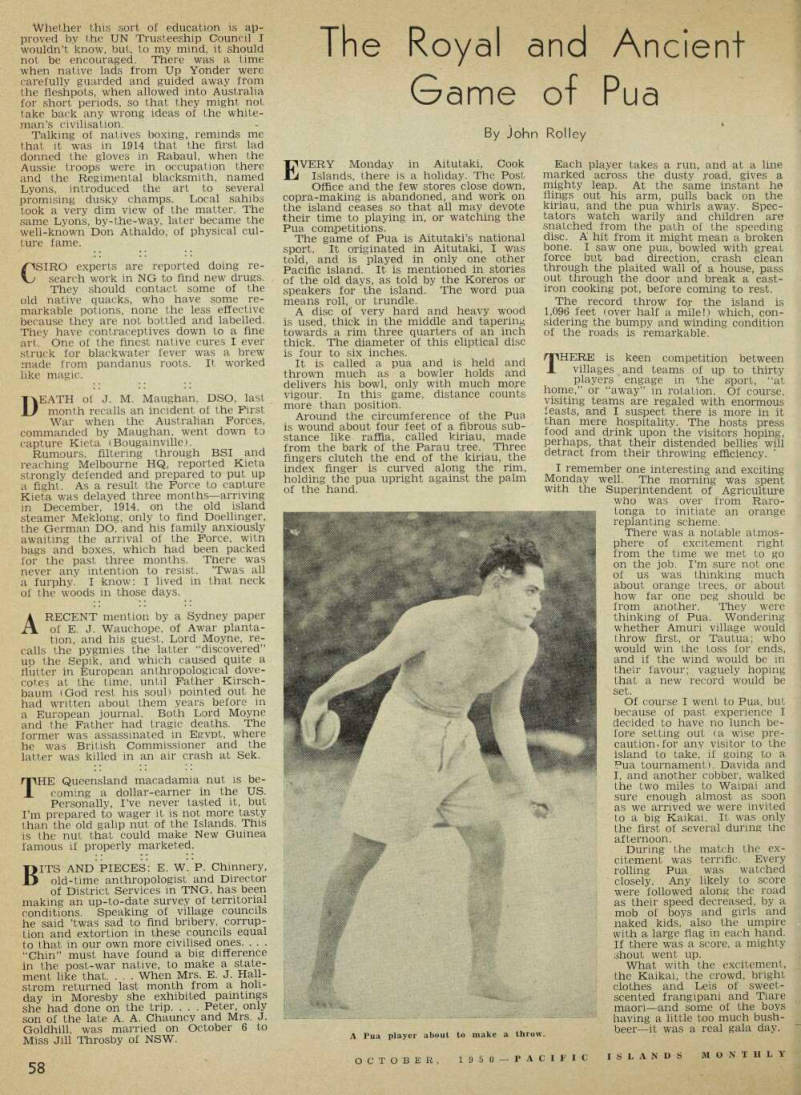
It is called a pua and is held and thrown much as a bowler holds and delivers his bowl, only with much more vigour. In this game, distance counts more than position.
Around the circumference of the Pua is wound about four feet of a fibrous sub stance like raffia, called kiriau, made from the bark of the Parau tree. Three fingers clutch the end of the kiriau, the index finger is curved along the rim, holding the pua upright against the palm of the hand.
Each player takes a run, and at a line marked across the dusty road, gives a mighty leap. At the same instant he flings out his arm, pulls back on the ki.riau, and the pua whirls away. Spec tators watch warily and children are snatched from the path of the speeding disc. A hit from it might mean a broken bone. I saw one pua, bowled with great force but bad direction, crash clean through the plaited wall of a house, pass out through the door and break a cast iron cooking pot, before coming to rest.
The record throw for the island is 1,096 feet (over half a mile!) which, con sidering the bumpy and winding condition of the roads is remarkable.
INHERE is keen competition between villages and teams of up to thirty players engage in the sport, “at home,’’ or “away” in rotation. Of course, visiting teams are regaled with enormous feasts, and I suspect there is more in it than mere hospitality. The hosts press food and drink upon the visitors hoping, perhaps, that their distended bellies will detract from their throwing efficiency. ' I remember one interesting and exciting Monday well. The morning was spent with the Superintendent of Agriculture
who was over from Raro tonga to initiate an orange replanting scheme.
There was a notable atmos phere of excitement right from the time we met to go on the job. I’m sure not one of us was thinking much about orange trees, or about how far one peg should be from another. They were thinking of Pua. Wondering whether Amuri village would throw first, or Tautua; who would win the toss for ends, and if the wind would be in their favour; vaguely hoping that a new record would be set.
Of course I went to Pua, but because of past experience I decided to have no lunch be fore setting out (a wise pre caution, for any visitor to the island to take, if going to a Pua tournament). Davida and I, and another cobber, walked the two miles to Waipai and sure enough almost as soon as we arrived we were invited to a big Kaikai. It was only the first of several during the afternoon.
During the match the ex citement was terrific. Every rolling Pua was watched closely. Any likely to score were followed along the road as their speed decreased, by a mob of boys and girls and naked kids, also the umpire with a large flag in each hand.
If there was a score, a mighty shout went up.
What with the excitement, the Kaikai, the crowd, bright clothes and Leis of sweet scented frangipani and Tiare maori—and some of the boys having a little too much bush beer —it was a real gala day.
A Pua player about to make a throw.